AFTER our profitable meeting with the Siberian Union Committee, Brethren Guy Dail, J. Sprohge, and I left on the Volga steamer "Samolett," June 4, reaching Tzaritzin next morning. Several of our believers met us here, and in the evening we had a meeting with our church at this place, which was attended by about fifty.
Proceeding on our journey that same night, we came to Alexandrodar next evening, and here we stopped three days. The village officials had kindly given their schoolhouse for our services, and it was well filled at every meeting. As Elder K. A. Reifschneider has been invited to take charge of the South Russian, or Azof, Conference, and Elder Sprohge is to take the presidency of the North Caucasian Conference, which office was thus made vacant, we met in council with the committee to arrange the details of the transfer. We were pleased to meet with the brethren in this field once more, and to see evidences of the progress of the work.
Immediately after the evening meeting of June 9, we took the train, reaching Tiflis June 11. Elder A. Osol and Brother T. Heyde met us at the station, whence we were conducted to Brother Heyde's home. That night we spoke to the brethren in Tiflis, some forty being in attendance. After the meeting we again took the train, accompanied by Brother and Sister Osol, who were going to visit our Molokan brethren at Basartschai, during a tour among the churches of the Transcaucasian field. There is a great interest in these mountain districts to hear the message, and the work is onward. The train was so crowded that some of us were absolutely unable to get a seat until morning, when we were passing through an interesting mountain pass, in the midst of beautiful scenery. To our left was the great Mt. Allakaja, or the "Eye of God." Later we saw the two highest peaks of the Mountains of Ararat on the right. Late in the afternoon we followed the Aras River, and near midnight we reached Julfa, the Russian border town, commanding the northern entrance to Persia. Here we remained until morning. We had letters of introduction to the leading banker of the place, and he kindly met us at the train and saw that we were brought to the hotel, where we stayed overnight. Next morning we called upon the banker at his office. As we had never been in Persia, we had to get some experience with the money in use there. There are no railways whatever in Persia; so our inland trip of about one hundred fifty miles had to be made entirely by team. We therefore not only purchased the outfit necessary for traveling, but also had to supply ourselves with the money. On exchanging about one hundred fifteen dollars, we were given a large bagful of silver coins to carry. As there was no gold money at the bank, and there is no paper currency in circulation that is good for the country in general, we finally got about two thirds of this money converted into a draft on the Russian bank in Urumiah, and even then our supply of silver was rather heavy.
After arranging our passport, we crossed the Persian boundary in company with a Persian merchant who spoke a bit of Russian, whom the banker had kindly secured to assist us in making proper arrangements for securing a team to Urumiah. We drove about half a mile to the iron bridge crossing the Aras, which was as far as the Russian team went. Then the Russian sentinel, finding our passports in order, called for the Persian porters to come over and carry our luggage across the bridge. The baggage was placed on a Persian carriage, after we had paid a small fee, and we went another half-mile to the Persian custom-house. Here our passports were beautifully ornamented with four different kinds of stamps, for which we were charged $1.25. The customs proved more a matter of fees than anything else. We were then driven to a Persian khan, or caravansary.
The khans of Persia, so far as our observation goes, consist of large courts where many teams may be accommodated, while the guests go into separate chambers that contain no furniture whatever. The servants brought us a few carpets upon which our luggage was placed. The merchant, finding no teams in town that might be hired for the trip, left us in despair, not even notifying us of the results of his search. Nor did he turn up next morning, so we finally began the search ourselves. I went to purchase some stamps at the Persian post-office, and there I found an official who knew French. Later on in the forenoon a Persian driver accosted us, asking if we did not want to have him take us to Urumiah. We looked over his hack, and his three horses, and finally went to the post-office, where the young man translated for us, and we secured the team for thirty-eight tomans (a toman is about ninety cents). After having closed this bargain, we desired to send a telegram, and were referred to the Indian telegraph office, where, to our surprise, we found a German woman who had been employed in Persia for about sixteen or seventeen years. She helped us in completing suitable arrangements for the trip, our driver giving us, at her suggestion, nearly three dollars as security that he would stick to his part of the bargain.
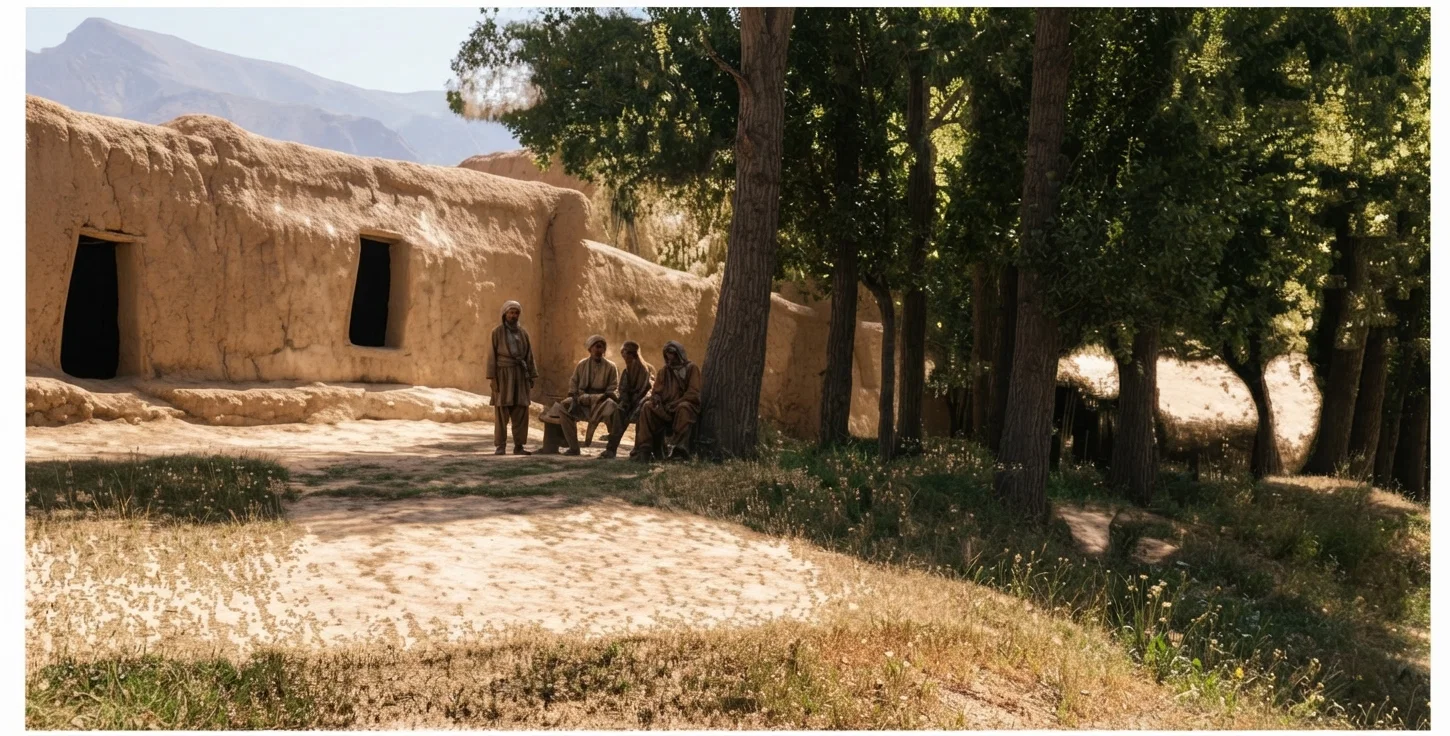
A PERSIAN VILLAGE SCENE
At four o'clock the next morning, the driver appeared, and tied our baggage securely on his rig, and we began to ascend toward Urumiah, via Khoi. Our road was largely the bed of a stream. We passed through that part of the country that was infested with robbers during the revolution three years ago, when traveling was very dangerous here. But now we found large numbers of Russian Cossacks patrolling the roads, ever on the lookout for those who might offer violence to travelers or to commerce.
We found the border country anything but inviting. There were high mountains all about, some of which were even snow-capped. The people of the valley are troubled with severe dust and sandstorms half of the year. The shops of Dschulfa are stocked with imported wares of poor quality, for which the merchants demand high prices.
About noon we were near a khan, and there we met a number of persons coming from Urumiah. One of these was a physician, who spoke English. We asked him if he knew Brethren F. Oster and H. Dirksen. He replied in the negative. But when we mentioned them as Sabbatarians, he at once knew whom we meant, and told our driver how to find the house without trouble. The first day we made about fifty miles, as the horses were fresh, and then we turned in for the night at Khoi, a town of some 25,000 inhabitants. The city was surrounded by a double wall, through which only a few gates had been made. In front of the entrance were Russian barracks, and the gates themselves were guarded by Russian soldiers. The bazaars were rather13interesting to us, and we soon learned to bargain in the Persian currency, purchasing such provisions as we needed. Our first night in this interior town was so interesting that we did not sleep very much. The khan was small, only large enough to accommodate four teams. Above the stalls for the horses there were small mud huts where travelers pretended to sleep. After some mats had been placed on the mud floor for us, we lay down, surrounded by our luggage; and the many marks upon our bodies next morning witnessed to the weary hours we had passed during the night.
Quite early in the morning we left Khoi. The country was now well watered. We were in the midst of many gardens, and there was a large number of trees to be seen. At Salmas we ate our dinner beside one of the clearest of brooks, running along under the trees. About three o'clock in the afternoon we reached Dilman, also a town surrounded by mud walls, lying in the heart of the plain. We experienced one great inconvenience here in this part of the country. What was once a good road had been very largely ruined because the peasants had converted the way into irrigation ditches, so that the road was full of mud-holes, and had been largely destroyed. At Dilman we had a somewhat better place to sleep than we enjoyed at Khoi, but still our rest was rather limited. Shortly after departing from Dilman, we came in sight of Lake Urumiah, but were surprised that there was not so much as even a sail to be seen. For several years a German had been operating a small steamboat on Lake Urumiah, by which the trip from Julfa to Urumiah had been shortened considerably, but the boat had recently sunk. However, there is hope that soon several boats will be plying on this lake, for the accommodation of travelers.
Having crossed the plain, we had to climb the steepest and worst divide on the journey. Our three horses were not equal to the task; but we had happily met the mail-wagon going from Tabriz to Urumiah, and the driver kindly lent us the use of one of his horses till the summit was reached, we ourselves naturally walking all the way up. Upon the top we found a Russian guard-house, from the level roof of which a watchman could be seen carefully surveying the landscape through a field-glass. The descent was also very steep, and by dinner-time we had reached the lake, and stopped in the town called Ghusty. At each town we saw the Russian flag displayed, and found quite a number of Cossacks stationed along the way. Proceeding on the journey, we discerned a heavy storm gathering in the mountains, but were glad to see that it did not reach the plain. We stopped about three hours' journey from Urumiah. Here we had to climb up a rude ladder to the "upper room," whither our luggage had been transferred, and there we spent the last night before reaching our brethren in Urumiah.