A Tour in the Country of the Indus

9%

Review and Herald Publishing Association · Takoma Park Station, Washington, D. C. · Jul 18, 1912

FromReview and Herald, Vol. 89, No. 29.

Read the full edition

A Tour in the Country of the Indus

P. C. POLEY
INDIA has shared in the impulse given in recent years to the circulation of our literature. The influence of the printed page, like a stream of widening light, is destined to extend, and to become one of the strongest factors in the work of giving to these unwarned millions a knowledge of this message.
On my last tour, I visited several cities lying along the course of the river Indus. Karachi, situated at its mouth, is a large seaport, having a wheat export trade second to no other in the Old World. Here the canvasser finds himself in the daily heart-beat of a large city, its strong pulsation of humanity being the more interesting to the observer because various races are represented, distinguishable by features and dress. In such a city our books are surely needed to reveal the Creator's claims on those in danger of making a god of the ruling passion of gain.
There are a large number of Goans at this place, a people of Portuguese descent, who as a class are well educated; but they are of the Roman Catholic persuasion. Many of them hold clerkships in the mercantile offices of Karachi. Some are willing to buy our literature, although this is disapproved by the priests. Their unassuming kindness and instinctive courtesy do much to smooth the path of the canvasser. Recently they have built a number of picturesque little bungalows, to form a colony, in one of the suburbs of Karachi, where they are afforded purer air than in their former congested city quarters. The move is favorable for an evangelistic effort among them.
Once, in passing through their location in the cool of evening, I became interested in a juvenile party in progress on an open piece of ground. Here were well-dressed children, happy and pleasant-faced, much like those one would see now in western Europe, whence their ancestors came long ago. A jovial-looking priest and a number of adult members of the community were present, who found pleasure in watching the happiness of the bright-eyed younger folk; but one who could view the scene with the eyes of the Master, would be moved by the thought that they were sheep without a true shepherd. There are many things in India which act as incentives to the missionary canvasser to be faithful in ministering the bread of life.
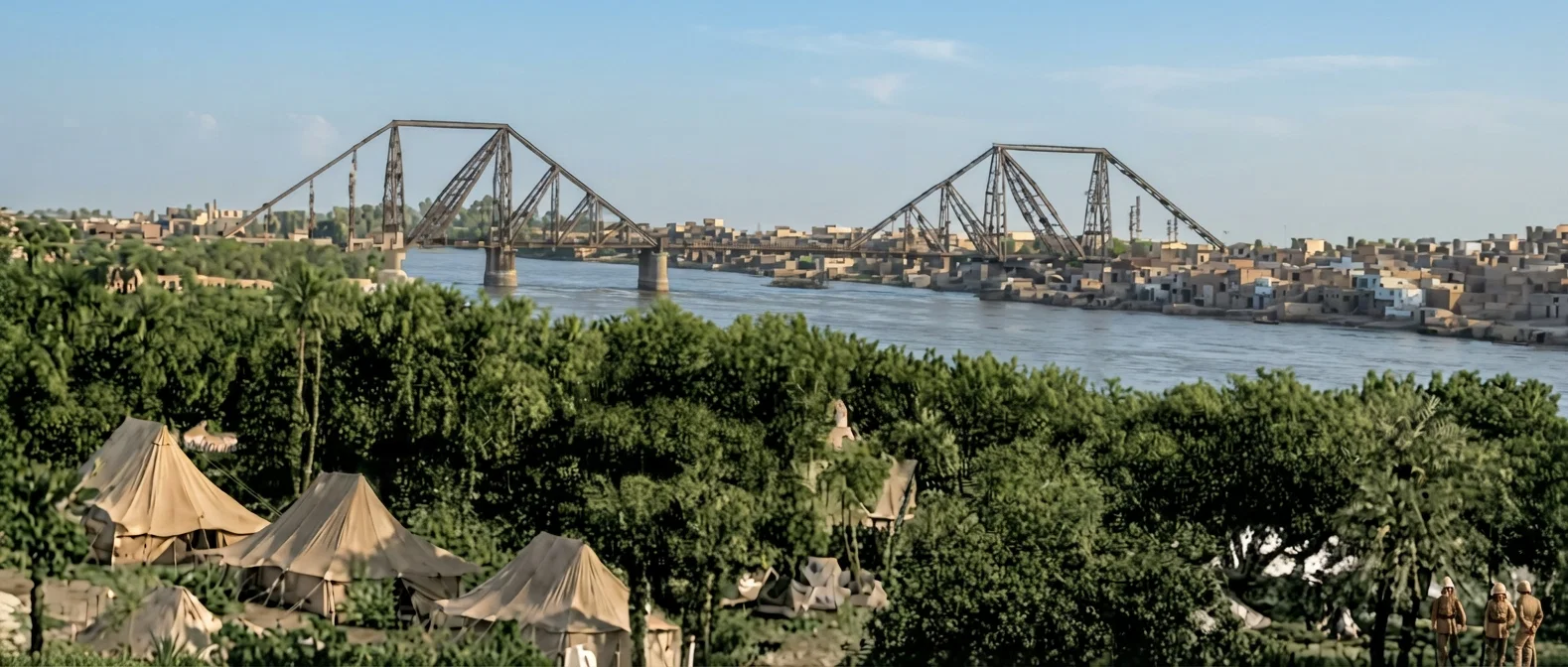
ROHRI CITY, CANTILEVER BRIDGE, AND THE RIVER INDUS
I labored for a few weeks at Karachi in the latter part of the summer of 1911. The climate is mild all the year, and there is not that migration of Europeans to the hill stations which residents in the hotter plains of the interior are so used to.
Another city visited was Sakkar. The European portion is built on an eminence, having a commanding view of the river at one of its most beautiful points. A lively aspect is imparted to the scene by the interesting type of native craft which plys the waters. Opposite Sakkar is the city of Rohri, on the left bank. The island of Bakkur, almost in midstream, served the engineers in the construction of two bridges. The larger of the two is a steel cantilever bridge, spanning the waters between Bakkur and Rohri. These facilitated my crossing over on several occasions to canvass on the Rohri side.
I shall not soon forget my impressions when I viewed the mighty Indus. I thought of Alexander the Great, who led his army to its banks hundreds of years ago. I felt it a privilege to be a soldier in the army of Christ, carrying its victories to this point and beyond.
Some of these Indian people bear more than the Christian name, and adorn their profession with simplicity of demeanor in imitation of Christ. One is led to pray that these shall not be found wanting when the great test comes which is to reveal the true worshipers of God.