In Heb. ix, Paul tells us what the first covenant is. In verse 1, he says: "Then verily the first covenant had also ordinances of divine service and a worldly sanctuary." He then gives a description of the vessels of the sanctuary, the ark, the ministration of the priests, &c., and finally says of that covenant, "Which stood only in meats and drinks, and divers washings and carnal ordinances, imposed on them until the time of reformation." This being true, there was not one of the ten commandments in the first covenant unless they came under the head of meats, drinks, divers washings and carnal ordinances.
Is it objected that, in verse 4, he speaks of the tables of the covenant? I answer these are not the tables of the first covenant. But of God's covenant, which was commanded to a thousand generations.
Paul proceeds, talking about the blood of the old and new covenants (not the ten commandments,) until we come to verses 16-24, when he says, "For where a testament [diatheke, covenant] is, there must also of necessity be the death of the testator. For a testament is of force after men are dead; otherwise it is of no strength while the testator liveth. Whereupon, neither the first testament was dedicated without blood; for when Moses had spoken every precept to all the people according to the law, he took the blood of calves and of goats with water, and scarlet wool, and hyssop, and sprinkled both the book and all the people, saying: This is the blood of the testament which God hath enjoined unto you. Moreover, he sprinkled with blood both the tabernacle, and all the vessels of the ministry. And almost all things are by the law purged with blood, and without shedding of blood is no remission. It was therefore necessary that the patterns of things in the heavens should be purified with these; but the heavenly things themselves with better sacrifices than these.
From the above quotation we learn,
1st. That a testament (or covenant) is of force after the death of the testator. This being true, if the ten commandments was the first covenant, they were not in force until after the death of the testator, be that whom or what it may. This also clearly refutes the position that the new covenant is not made in this dispensation; for if Christ is the testator, the covenant comes in force immediately after his death.
2d. The first covenant was dedicated with blood. But the ten commandments were not thus dedicated; hence they are no part of this covenant. The history of the dedication of the first covenant reads as follows: "And Moses wrote all the words of the Lord, and rose up early in the morning, and builded an altar under the hill, and twelve pillars, according to the twelve tribes of Israel. And he sent young men of the children of Israel, which offered burnt offerings, and sacrificed peace offerings of oxen unto the Lord. And Moses took half of the blood, and put it in basons; and half of the blood he sprinkled on the altar. And he took the book of the covenant and read in the audience of the people; and they said, all that the Lord hath said will we do, and be obedient. And Moses took the blood and sprinkled it on the people, and said Behold the blood of the covenant which the Lord hath made with you concerning all these words. Ex. xxiv, 4-8. In this history of the dedication of the first covenant, it is said that Moses "sprinkled both the book and all the people," but the tables are not so much as referred to.
4th. The first covenant provided blood which could not take away sin. But the ten commandments knew no blood. They offered no sacrifices.
5th. It was only typical of the new covenant which takes away, in fact, the sins which were only taken away in figure under the old. Heb. ix, 23, 24.
From the above facts we draw the conclusion that the first covenant was not something by which sin was made known, but was introduced as a remedy for sin, or, rather, as pointing to a remedy under the new, and antitypical covenant.
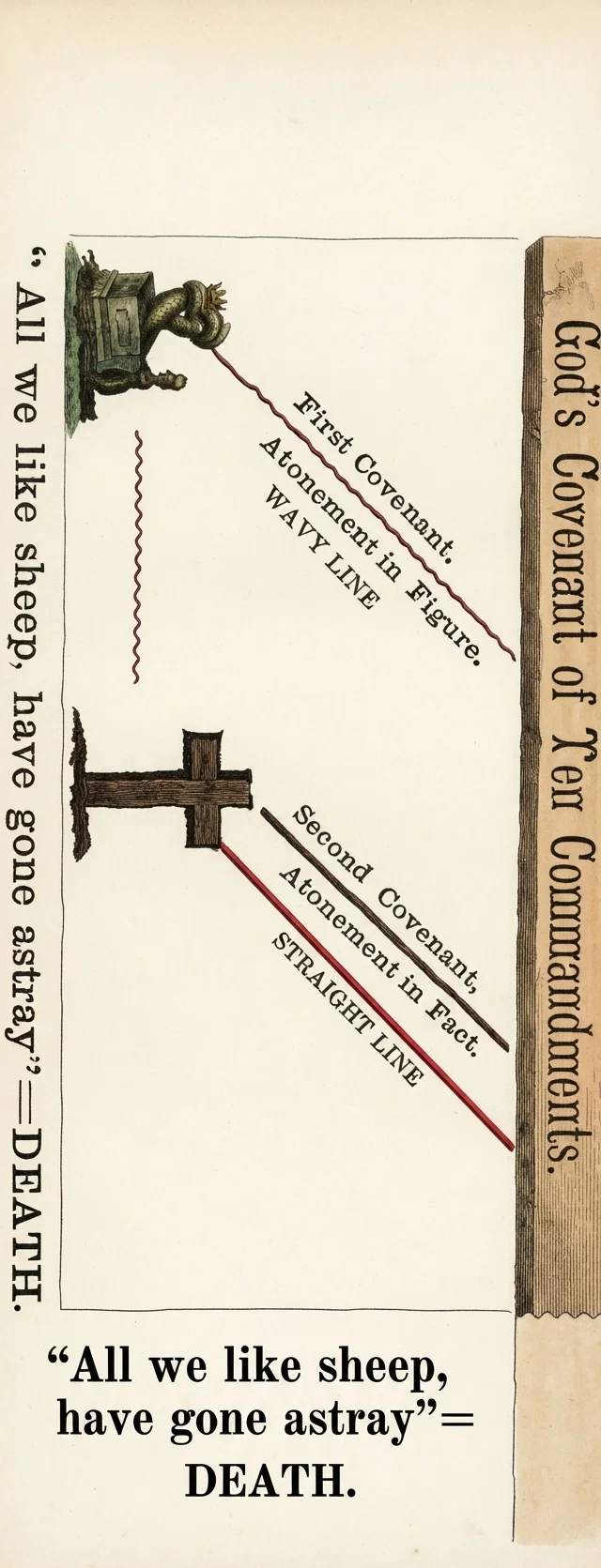
To present my views of this subject more fully before the reader, I introduce the following diagram.
PARADISE. { God's Covenant of Ten Commandments. PARADISE RESTORED. EXPLANATION.—The word, Paradise, at the left, represents the state of man before the fall. The words, Paradise Restored, at the right, represent the future redeemed state. The words, God's Covenant of Ten Commandments, ...
I regard God's covenant of ten commandments as embracing every moral principle, and as reaching from paradise, where the morning stars sang together, and the sons of God shouted for joy. Job. xxxviii, 7, to paradise restored, where every creature in heaven and earth and under the earth and such as are in the sea, will be heard praising God. Rev. v, 13.
But that happy state of things which existed when man was placed in Paradise did not continue. Man sinned and thus fell from that "high way of holiness." The prophet declares that "all we like sheep have gone astray." Isa. liii, 6. Now man needs a covenant to bring him back to allegiance, to place him again in "the old paths," as though he had never transgressed God's covenant of commandments. To this end a plan was provided embracing the new covenant; and until this could be brought about, a system of types and shadows, a faulty covenant, which could not take away sin, was introduced, to point the poor otherwise hopeless sinner to a covenant where God's law should be engraved upon his heart, and his sins be remembered no more.
We think the idea is now clearly before the reader that the first covenant is identical with the ceremonial law, and its priesthood. Now if the reader will turn to Heb. x, 1-9, he will find Paul speaking of the law and covenant in the same terms. In verse 9, he says, "he taketh away the first that he may establish the second." This first which is taken away is the first covenant. Now is it the ten commandments or any one of them that is taken away? Answer. See verses 5-10. Wherefore when he cometh into the world, he saith, sacrifice and offering thou wouldst not, but a body hast thou prepared me: In burnt offerings and sacrifices for sin thou hast had no pleasure. Then said I, Lo, I come (in the volume of the book it is written of me) to do thy will, O God. Above when he said sacrifice and offering and burnt offerings and offering for sin thou wouldst not, neither hadst pleasure therein; which are offered by the law. Then said he, Lo, I come to do thy will, O God. He taketh away the first, that he may establish the second."
This connection shows very clearly that it is the first order of sacrifice that is taken away in order to give place to the second.
That the Levitical priesthood was emphatically called a covenant, we prove by the following quotations from scripture. Num. xxv, 12, 13. "Wherefore say, behold, I give unto him my covenant of peace: and he shall have it, and his seed after him, even the covenant of an everlasting priesthood; because he was zealous for his God, and made an atonement for the children of Israel." Neh. xiii, 29, "Remember them, O my God, because they have defiled the priesthood, and the covenant of the priesthood, and of the Levites." See also Mal. ii, 4-10.
Now, kind reader, I shall relieve your patience. May you and I ever live in obedience to that law which is "holy, just and good." And through the blood of Jesus Christ the Mediator of the new covenant, which is applied on the mercy seat over the ark of God's covenant in the sanctuary in heaven, obtain remission for our past transgressions, and finally with the redeemed stand upon Mount Zion.