A. G. DANIELLS

3%

Review and Herald Publishing Association · Takoma Park Station, Washington, D. C. · Mar 19, 1914

FromReview and Herald, Vol. 91, No. 12.

Read the full edition

A. G. DANIELLS

Does the History of Turkey and Egypt Since 1798 Fulfill the Prophecy of Dan. 11: 40-44?—No. 21

A. G. DANIELLS
"BUT tidings out of the east and out of the north shall trouble him: therefore he shall go forth with great fury to destroy, and utterly to make away many." Dan. II:44.
The part of the prophecy we are now considering states that "tidings out of the east and out of the north shall trouble him." From this we understand that the prophet foresaw developments of a serious character taking place in the eastern and northern parts of the territory of the king of the north, which, we believe, is the Turkish Empire.
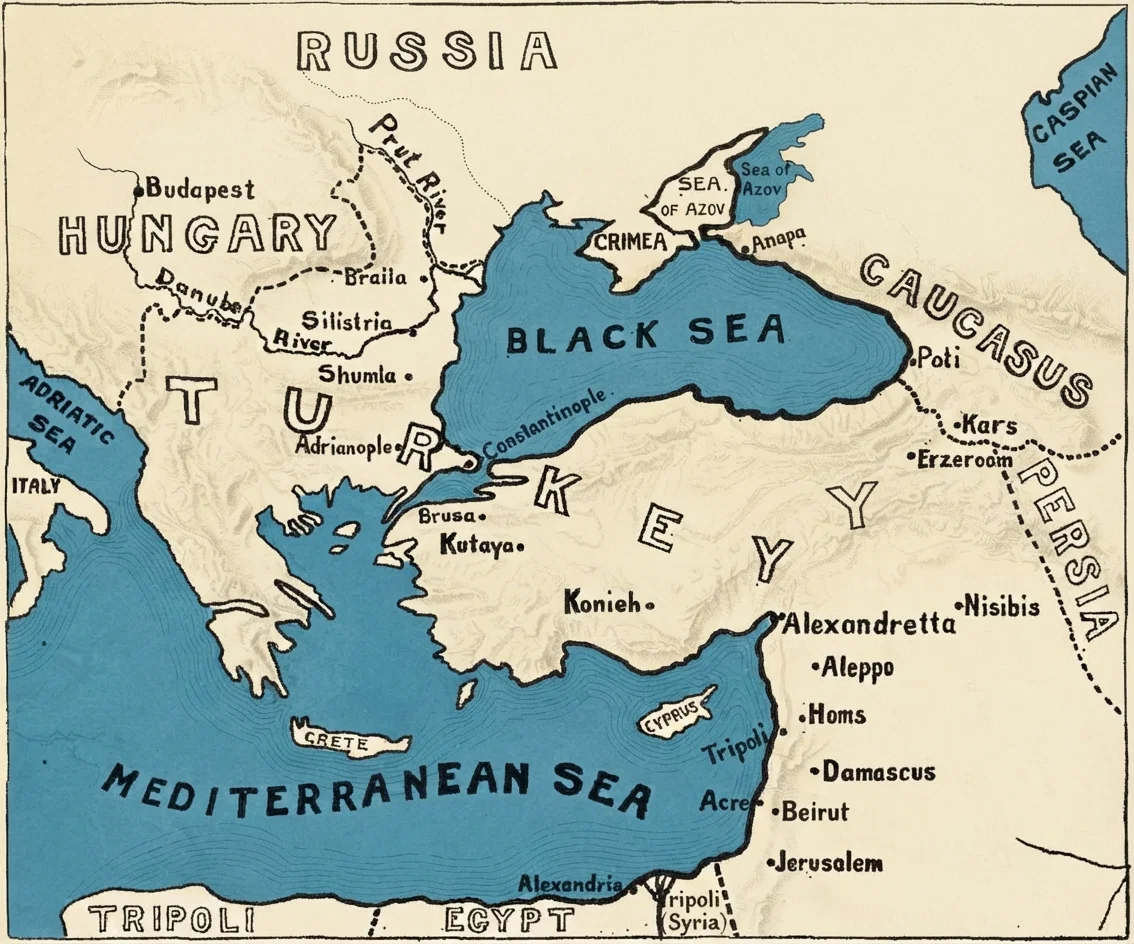
The history being given in these studies shows that ever since the beginning of the year 1828 events have been taking place in the eastern and northern parts of Turkey that have imperiled the very existence of that empire. Note the ominous statements given in the preceding article; the Egyptian army had crossed the Taurus Mountains and completely routed the Turkish army at the ancient city of Konieh. This was in Asia Minor, and only three hundred miles southeast of Constantinople. With this victory the Egyptian general became, says Paton, "master, not only of Syria, but of AsiaMinor, which was the center of Turkish power and resources."
A glance at the accompanying map will show the territory that had now fallen into the hands of the Egyptians. Asia Minor is all that territory east of Constantinople between the Mediterranean and Black Seas as far east as the Taurus range.
From Konieh, the Egyptian army advanced to Kutaia, from which it menaced the capital only one hundred and fifty miles distant. The tidings of this advance filled Constantinople with consternation, and the sultan implored Russia for help. Russia responded by placing 12,000 soldiers in Scutari, just across the Bosporus from Constantinople.
The result was two treaties, one with Egypt and the other with Russia. Egypt got all of Syria and a part of Asia Minor. Russia secured a preponderant position at Constantinople above all the other European powers. "Thus a great part of the empire," says one of the writers already quoted, "was virtually severed from its trunk, and a power [Russia] aggrandized that might at any time be turned against the remainder." Creasy, already quoted, says, "It was the general opinion in Europe at this time [1833] that Turkey was irretrievably ruined, and that the attempts of her reforming sovereign to resuscitate her power had been the mere galvanizing of a corpse."
All these perilous developments, it should be remembered, were in the eastern and northern sections of the empire, from whence tidings of trouble were to come.
After the signing of the treaty of peace at Kutaia, 150 miles southeast of Constantinople, the Egyptian army was withdrawn from Asia Minor into Syria. But there was no peace. "The quarrel between Egypt and Turkey was not settled, it was only slumbering; both sides, foreseeing a rupture, were actively pushing their armaments and preparing in silence."—"Historian's History of the World," Vol. X, page 452.
"The convention of Kutaia had never been considered by either of the contracting parties as establishing a permanent settlement. The very form of the concessions made by Sultan Mahmud was significant of his intention to reverse them at the earliest opportunity. . . .
"The Russian squadron had scarcely left the Bosporus, after the signing of the treaty of Unkiar-Skelessi, before rumors were rife as to the sultan's intention of taking advantage of the promise of eventual Russian aid to renew the war with Mehemet Ali. . . .
"Mehemet Ali, for his part, was credited with stirring up the formidable insurrection that broke out in Albania, and intriguing at Constantinople for the deposition of Mahmud and the proclamation of his son."—"Cambridge Modern History," page 558, 559.
"Mehemet declined to continue the payment of tribute to the Porte; and his removal of the Turkish guards from the Prophet's Tomb, and substitution of his own Arab soldiers, constituted a still more open denial of the sovereignty of the sultan, as chief of Islam.
"Attempts at negotiation only led to mutual complaints and recriminations; and the sultan at last sent a final summons to the pasha, requiring him to reestablish the Turkish guards at the Tomb of the Prophet, to pay regularly his tribute, and to renounce all sovereignty over Egypt, save so far as the sultan might concede it to him. On obedience to this being refused, Mahmud directed his generals and admirals to attack his refractory vassal." See "History of the Ottoman Turks," Creasy, pages 521-526.
"It was not, however, till the spring of 1834, when the discontent of the Syrians had issued in widespread revolt, that the crisis became acute. . . . The first to revolt were the Turks, [who were] resentful of the loss of their ancient privileged position. . . .
"On the first news of the insurgent successes, Mahmud struggled, like a hound straining at the leash, to break the diplomatic bonds that prevented him from hurrying to their assistance. He protested that it was his duty as sultan to go to the help of his subjects when oppressed by one of his servants. Even when, in his great wrath, Russia refused to support him, in the event of his being the aggressor, he pressed on the preparations for war. . . .
"The sultan's accumulated passion had, however, placed him beyond the control of any argument but that of hate; the hand of death was upon him, and he was determined at all hazards at least to attempt to revenge himself upon his enemy before he died. 'I would rather die,' he exclaimed, 'or become the slave of Russia, than spare my rebellious vassal.'"—"Cambridge Modern History," Vol. X, pages 559-561.
"A great council was held at the Porte on the twenty-second of January, 1839, in order to discuss the question of peace or war with the Egyptians; and thereafter measures were taken on a large scale for arraying an imposing force to be employed against Mehemet Ali. Eighty thousand men were ordered to be levied, in addition to the force already under arms. . . .
"Mahmud at length resolved on war, and a message was sent to the Great Council to the following purport: 'Hafiz Pasha informs me that my army is able to defeat the Egyptian army in Syria. The Capudan Pasha tells me that my fleet is strong enough to defeat and destroy the Egyptian fleet. It remains for you to be courageous and do your duty.' To this Hati-Sherif, the Great Council, returned for answer, 'that His Highness's ministers would do everything in their power to act in conformity with the pleasure of their master.' . . .
DISTANCES FROM CONSTANTINOPLE
"In Syria, Ibrahim Pasha displayed his well-known activity in preparing for the storm. . . . In the end of April, rumors having reached him that the sultan's troops had crossed the Euphrates, Ibrahim immediately held a council of war in Aleppo, which was his headquarters at this period in consequence of its large resources and its vicinity to the northern frontier."—Paton's "History of the Egyptian Revolution," pages 127-130.
"A numerous and well-appointed Turkish army had been collected at Bir, on the Euphrates; and by the strenuous exertions of many years, a well-disciplined and well-manned fleet of thirty-sixvessels of different rates, twelve being ships of the line, had been formed and collected in the harbor of Constantinople.
"But venality and treachery baffled all the preparations of the Ottoman sovereign. When his army under Hafiz Pasha met the Egyptian under Ibrahim, at Nezib, on the twenty-fifth June, 1839, whole battalions and squadrons, whose officers had taken the gold of Egypt, deserted the sultan's standard, and ranged themselves with the enemy. The remainder was hopelessly routed, with the total loss of artillery, camp, baggage, and military stores of every description." See "History of the Ottoman Turks," by Creasy, pages 521-526.
"Such was the disastrous battle of Nezib. The Turkish army left on the field more than a hundred pieces of artillery, besides its camp, baggage, and ammunition, only the military chest being saved. The number of killed and wounded Turks was estimated at four thousand and the number of Egyptians at three thousand, in round numbers; but the actual loss of the Turkish commander was incalculable, and the army of the sultan may be said to have ceased to exist—a demoralized and disorganized rabble, destitute of artillery, commissariat, and baggage, having preceded and accompanied Hafiz Pasha in his retreat to Marash." See "History of the Egyptian Revolution," by A. A. Paton, pages 127-135.
The city of Nezib, where this great disaster befell Turkey, was the old "Nisibis, an ancient city and fortress in the north of Mesopotamia, near a point where the Mygdonius leaves the mountains by a narrow defile. . . .
"Nisibis (Nezib) appeared for the last time in history in 1839, when the Egyptians under Ibrahim Pasha defeated the Turkish army under Hafiz Pasha, on the twenty-fourth of June, in a battle at which von Moltke was present."—Encyclopedia Britannica, article "Nisibis."
The battle of Nezib, in the far eastern part of the Turkish Empire, practically wiped out the Asiatic division of the sultan's army, leaving him without any means to prevent the Egyptian forces from marching to his capital. Thus, a second time the whole of the eastern part of the empire fell into the hands of Mehemet Ali, of Egypt.
"The road to Constantinople once more lay open to Ibrahim, who pressed on the defiles of the Taurus, and there halted, pending the development of the diplomatic situation. For Sultan Mahmud had not lived to hear of this crowning disaster, the news of which reached Constantinople as he lay unconscious on his deathbed. He died on July 1, leaving his empire to Abdul-Medjid, a lad of sixteen."—"Cambridge Modern History," Vol. X, page 562.