A Plea for Peru's Indians

6%

Review and Herald Publishing Association · Takoma Park Station, Washington, D. C. · Apr 2, 1914

FromReview and Herald, Vol. 91, No. 14.

Read the full edition

A Plea for Peru's Indians

EDGAR BROOKS
AFTER reading some time ago of the attack made by the bishop of Puno on our mission station at Plataria, Lake Titicaca, the readers of the REVIEW will no doubt be interested to hear of further developments.
The Lord overruled that attack to greatly spread the work and influence of the mission. As soon as possible afterward, however, Camacho, the Indian who was used of God to begin the work, was sent to Lima, the capital, to presentbefore the parliament and the president a testimonial pleading for protection from the constant persecution to which the Indians were subject. Some liberal-minded men of influence interested themselves in the matter, and gave such publicity to it that a bill was introduced in the senate granting religious toleration. In spite of opposition on the part of the Roman Catholic press, so bitter that the archbishop of Lima himself condemned its extreme views, this bill quickly passed both houses by almost unanimous votes; and if it passes again next year, as we have every hope it will, religious toleration will be established by law in Peru.
This bill proposed an amendment of the fourth article of the constitution, which formerly read, "The nation professes the Catholic religion, apostolic and Roman, and the state protects it, and does not permit the public exercise of any other." The amendment called for the omission of the last clause, so that the article would read, "The nation professes the Catholic religion, apostolic and Roman, and the state protects it."
The president, who had received Camacho very kindly, gave him a free pass back to his home, and sent a commissioner to investigate the complaints that were continually reaching him from the Indians of various parts of the sierra.
Among those who study the Indian from a humanitarian standpoint, there is a deep conviction of the abundant justice of these complaints. A society has been formed called La Asociación Pro-Indígena (The Pro-Indian Association), with the purpose of ameliorating the lot of the poor Indian. One of the leaders of this society, Dr. J. Capelo, writes thus of the present condition of the Indian:—
"In Europe it is considered that the workingman has a right to receive for his work remuneration sufficient to provide him food, home, and clothing, and something in addition for his education and the wherewithal to bring up his family and to enjoy some of the benefits of life. And there in Europe the different branches of human activity, far from having decayed under the control of such ideas, have progressed, and progress more and more; and the worker is in those countries a social factor of great importance.
"In Peru we do not think like this. Here we believe that the workingman, especially if an Indian, and much more if he is of the sierra (high mountainous plateau), has no other raison d'être than that of spending all his energies in the service and to the profit of whoever can get control of them. If there is near, within a radius of fifty leagues (150 miles), a farming or mining company, the Indian is obliged to work for that company and spend there all his energies, as a slave, receiving merely enough in recompense to keep him alive one, two, or three years—sufficient time for the exhaustion of his entire being and his consequent death from tuberculosis, if some accident has not before this precipitated matters and cut short his life in some more violent manner.
"By the laws of Peru it is established that there are within her borders no slaves, and no prison for debt; but these laws are dead for the Indian. He is certainly a slave; for him there is certainly prison for debt; and he is pursued like a wild beast, tortured, and killed if he presumes to attempt to escape from his condition of slavery. Woe to the fool who tries to come forth in his defense—better had it been for him if he had never been born!"—El Deber Pro-Indígena, August, 1913.
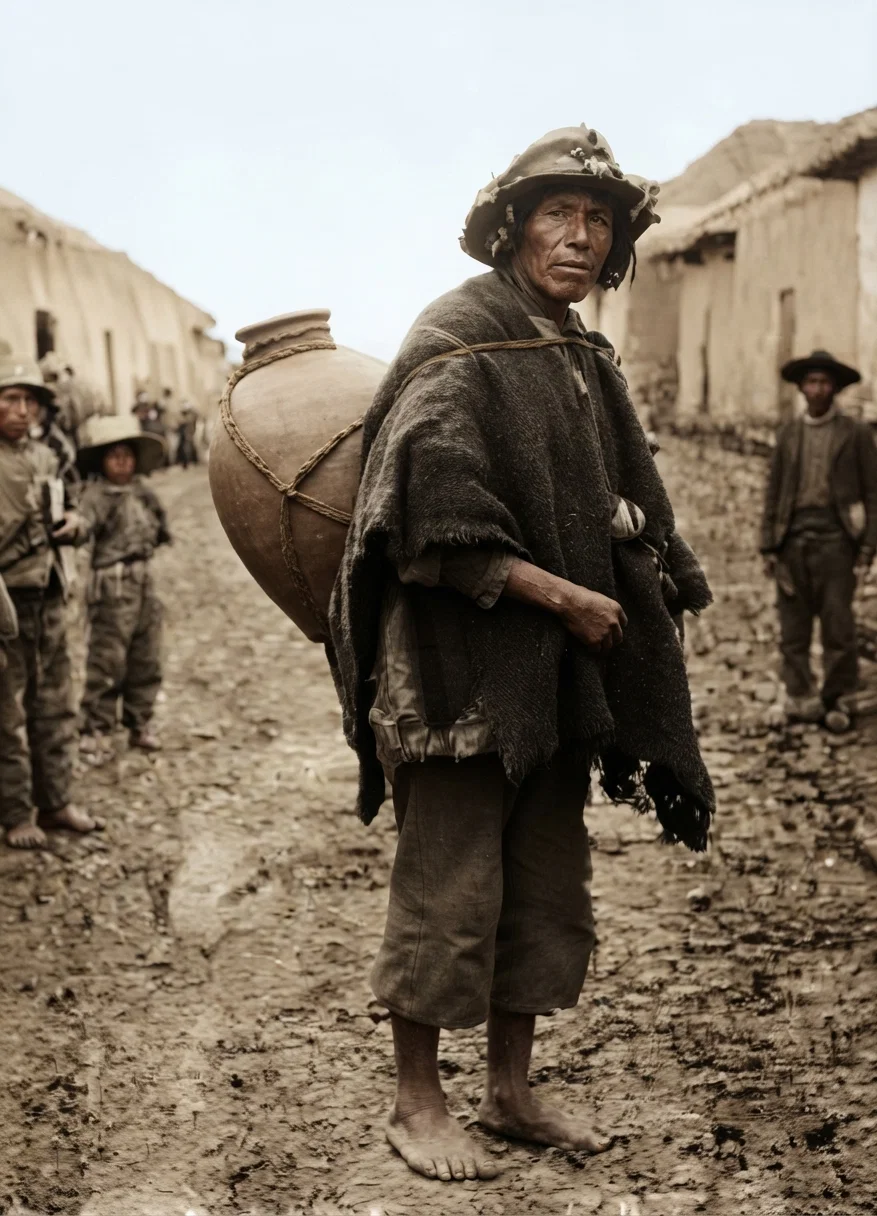
A WATER CARRIER IN CUZCO
The wording of this description is by no means overdrawn, as will be seen. Dr. F. Chuquihuanca Ayulo, a prominent lawyer of Indian descent, and a man devoted to the cause of his oppressed brethren, accompanied the official sent to investigate, and from a private letter written by him describing what they found, to a lawyer friend here in Arequipa, local correspondent of the Pro-Indian Association, I have been permitted to copy the following:—
"From the beginning the Indians had confidence in the commissioner, so that from the night of our arrival the number of Indians amounted to some four hundred. The poor people hoped for much, but what could the commissioner do if the authority of a criminal justice of peace and a criminal governor were superior to his own? . . . He did what he could, but he was only a human being. He was a moral menace to the murderers and robbers of the Indians—and you know what they have managed to do. [They sent such telegrams to Lima charging the commissioner with stirring up the Indians to insurrection, as caused his recall.] The insurrection of the Indians is all a lie. What have taken place were expeditions against the Indians, worse and more inexcusable than those of the Putumayo.
"Here is an example: On May 6, certain Indians who, after dozens of complaints to the prefecture, had managed at length to arrange that about this date the subprefect of Azangaro should go to Saman [a center of oppression], were greeted, as they approached the village, by shots, and pursued like wild beasts. They took refuge in a hut, which was burned over their heads. As a result, five were killed outright and five were wounded.
"Three days later, the subprefect and a judge of the supreme court arrived. They encountered five of the wounded men under arrest, two of them already dying. Do you suppose that either of these authorities initiated an investigation?—Absolutely none! They did not even take a declaration from them, or even order some examination of the wounded. They were both lodged in the house of Mariano Abarca Duenas, sleeping perhaps over pools of blood, for into this same house had fled three of the wounded Indians, whose murder was completed there, so that their corpses might not come to light.
“This seems a story from the ‘Thousand and One Nights,’ but it is the naked truth. Later, in August and September, men belonging to this Duenas and to Gonzalez, with some soldiers, held shooting practice with human targets. O, it is horrible!”
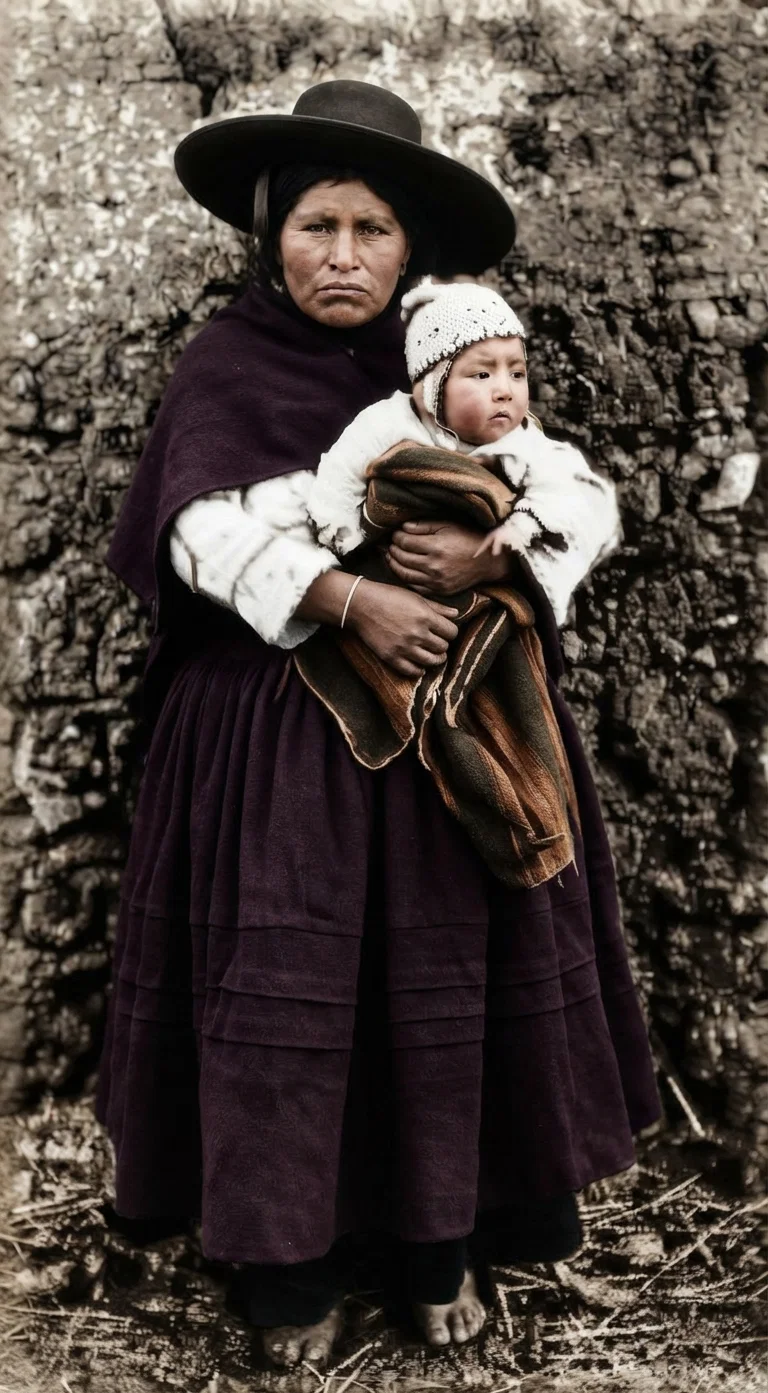
AN INDIAN MOTHER
AN INDIAN MOTHER
From other cases cited by the doctor (all related in sworn declarations recorded by the commissioner), and from the statements of Indians who have presented themselves before my friend the lawyer here in Arequipa, it appears that poor, defenseless women and girls have suffered equally with men and boys. But the Lord’shand has been over our workers and believers at the mission. One old brother, it is true, was so cruelly beaten with cudgels that he is crippled for the rest of his days; but he remains true to the Saviour, and rejoices in his precious gospel. Surely there is need for missionary work here; and the rapidly growing membership of our church at Plataria, by the shore of Lake Titicaca, bears witness to the ready response of these poor people to the gospel, and the blessed hope it brings to the toiler and the oppressed.