A. G. DANIELLS

6%

Review and Herald Publishing Association · Takoma Park Station, Washington, D. C. · Mar 5, 1914

FromReview and Herald, Vol. 91, No. 10.

Read the full edition

A. G. DANIELLS

Does the History of Turkey and Egypt Since 1798 Fulfill the Prophecy of Dan. 11: 40-44?—No. 20

A. G. DANIELLS
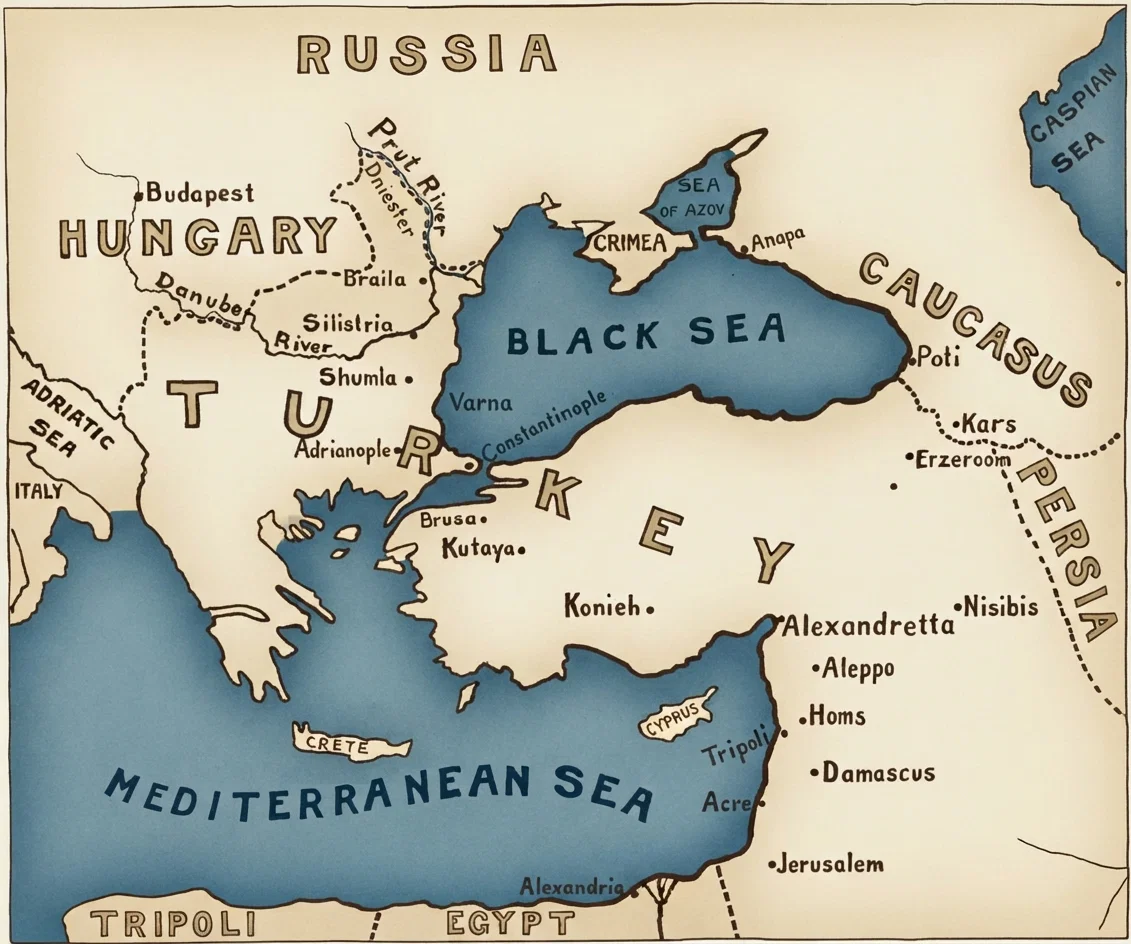
AFTER the defeat of the Turkish army at Beilan, on the eastern side of the Taurus, the war was transferred across the mountain range into Asia Minor. The forces met at Konieh for a decisive battle. Konieh is the Iconium of Galatia, where the apostle Paul preached the gospel on his first missionary tour.
"In the eyes of the Ottomans this place is invested with a semisacred character, from its having been—before Brusa, Adrianople, and Constantinople—the capital of Turkish power, and still containing the remains of the revered Mollah Hunkiar, with a university and mosques, associated with a religion considered orthodox, and such learning as the Ottomans possess and delight to honor. . . .
"Konieh was the easiest of all the conquests of Ibrahim—a victory without a battle, in which thirty thousand Egyptians drove nearly double that number of Turks before them, and menaced the sultan in his capital. It was on a thick, foggy morning, in the month of December, 1832, that the two armies met. Reeschid bravely led his men into the thick of the fight, while the Egyptians were enabled by the Turkish cannonade to find out the position of their adversaries, their own guns remaining silent; but he soon perceived that, in the fog, his Arnauats had failed to follow him. Bedouins near at hand, hearing a language they did not understand, took him prisoner. This event carried consternation into the Turkish ranks. The whole army of sixty thousand men took to flight, after a trifling loss on both sides. Ibrahim Pasha was thus master not only of Syria, but of Asia Minor, which was the center of the Turkish power and resources. . . .
"It is impossible to describe the consternation which was produced in Constantinople by the battle of Konieh, and the subsequent advance of the Egyptians. The Greek and Servian revolts, and the wars with Russia, were all on the borders and outlying provinces of Turkey; but, if any part of the empire could be considered a citadel of the loyalty and nationality of the Ottomans, it was AsiaMinor. Yet the sacred Konieh had seen the military disasters of the sultan; and Kiutahieh, a great stage nearer to the Bosporus [one hundred miles], was immediately after the headquarters of Ibrahim, from which he menaced the capital."—"History of the Egyptian Revolution," by Paton, Vol. II, pages 98-100.
"The disaffected armies of raw recruits, badly officered and worse generated, which the sultan sent against the rebel Egyptian chief were beaten by Ibrahim in three great battles, at Ems [Homs] in Upper Syria, on July 6, 1832; at Beilan (in Cilicia, near the ancient battle field of Issus), on the twenty-ninth of the same month; and at Konieh, in Asia Minor, on the twenty-ninth of October.
DISTANCES FROM CONSTANTINOPLE
"The positions of these places indicate the rapid progress and bold designs of the Egyptian commander, who seemed to annex Asia Minor to Mehemet's dominions with the same ease as Syria; and whose advance upon Constantinople in the coming spring appeared to be inevitable and irresistible. In this agony of his house and empire, he sought aid first from England, but none, unhappily, was accorded. . . .
"Russia was watching eagerly for the opportunity which English folly thus threw in her way. Her troops, and her transports, and her ships of war were ready at Sevastopol and Odessa; and when Mahmud humbled himself to express to his ancient enemy a wish for a protecting force, prompt messengers were dispatched to the Crimean depot of the Muscovite power, and a Russian squadron of four ships of the line set out from Sevastopol, and landed six thousand of the emperor's troops near the mouth of the Bosporus, on Feb. 20, 1833.
"Meanwhile the forward march of Ibrahim had been temporarily stayed by a messenger from Admiral Raussin, whom the French government had sent with a fleet to help the sultan. A negotiation was entered into, but broken off after a few days; and in the beginning of March, Ibrahim again pointed his columns toward the Bosporus. But a second Russian armament from Odessa now had reached those straits, and on the fifth of April twelve thousand soldiers of Czar Nicholas were encamped on the Giant's mountain near Scutari.
"Ibrahim felt that any further advance on his part would be madness, and occupied himself in procuring the largest possible increase to his father's power in the negotiations that followed, in which England and France (now thoroughly alarmed at the advantages gained by Russia) took part with anxious zeal.
"The terms of compulsory reconciliation between the sultan and his overpowerful vassal were embodied in a firman of May the sixth, 1833, by which the Porte confirmed Mehemet Ali in his governments of Crete and Egypt, and added to them those of Jerusalem, Aleppo, Damascus, and Adana. This was virtually a cession to the Egyptians of nearly all the countries which the victories of Selim I had incorporated with Turkey, besides the important island of Candia, which it had cost the Porte a twenty years' war to wrest from Venice.
"At such a bitter cost was Mahmud compelled to purchase the removal from Asia Minor of his insurgent pasha; and before he could obtain the withdrawal of his equally formidable Russian friends, he was obliged to sign the treaty of Unkiar-Ikelessi on the eighth of July, 1833, which by its public articles bound him to an offensive and defensive alliance with Russia, and by a still more secret article, provided that the Ottoman Porte should, when required by the Russian emperor, close the straits of the Dardanelles against the armed vessels of all other foreign powers.
"It was the general opinion in Europe at this time that Turkey was irretrievably ruined, and that the attempts of her reforming sovereign to resuscitate her power had been the mere galvanizing of a corpse. . . . First the foreign invader, and, next, the home rebel, had rent from him his dominions, and had bowed him beneath the humiliation of treaties, worse even than those of Karlowitz and Kainardji."—"History of the Ottoman Turks," by Creasy, pages 521-526.
"Thus a great part of the empire was virtually severed from its trunk, and a power aggrandized that might at any time be turned against the remainder."—"History of the Egyptian Revolution," by Paton, Vol. II, page 101.
Such were the developments in the east and the north that brought serious "trouble" and great losses to the "king of the north."