In the creation of man was manifest the agency of a personal God. When God had made man in His image, the human form was perfect in all its arrangements, but it was without life. Then a personal, self-existing God breathed into that form the breath of life, and man became a living, intelligent being. All parts of the human organism were set in action. The heart, the arteries, the veins, the tongue, the hands, the feet, the senses, the faculties of the mind, all began their work, and all were placed under law. Man became a living soul. Through Christ the Word, a personal God created man, and endowed him with intelligence and power.
Our substance was not hid from Him when we were made in secret; His eyes saw our substance, yet being imperfect, and in His book all our members were written, when as yet there were none of them.
Above all lower orders of being, God designed that man, the crowning work of His creation, should express His thought and reveal His glory. But man is not to exalt himself as God.
“Make a joyful noise unto the Lord, . . .
Serve the Lord with gladness,
Come before His presence with singing.
“Know ye that the Lord He is God:
It is He that hath made us, and His we are;
We are His people, and the sheep of His pasture.
Enter into His gates with thanksgiving,
And into His courts with praise:
Be thankful unto Him, and bless His name.”
“Exalt the Lord our God,
And worship at His holy hill;
For the Lord our God is holy.”
The Laws of Nature, God’s Servants
God is constantly employed in upholding and using as His servants the things that He has made. He works through the laws of nature, using them as His instruments. They are not self-acting. Nature in her work testifies of the intelligent presence and active agency of a Being who moves in all things according to His will.
“Forever, O Lord, Thy word is settled in heaven. Thy faithfulness is unto all generations; Thou hast established the earth, and it abideth. They continue this day according to Thine ordinances; For all are Thy servants.”
“Whatsoever the Lord pleased, that did He
In heaven, and in earth, in the seas, and all deep places.”
“He commanded, and they were created.
He hath also established them forever and ever:
He hath made a decree which shall not pass.”
It is not by inherent power that year by year the earth yields its bounties, and continues its march around the sun. The hand of the Infinite One is perpetually at work guiding this planet. It is God’s power continually exercised that keeps the earth in position in its rotation. It is God who causes the sun to rise in the heavens. He opens the windows of heaven and gives rain.
“He giveth snow like wool:
He scattereth the hoar-frost like ashes.”
“When He uttereth His voice, there is a multitude of waters in the heavens, And He causeth the vapors to ascend from the ends of the earth; He maketh lightnings with rain, And bringeth forth the wind out of His treasures.”
It is by His power that vegetation is caused to flourish, that every leaf appears, every flower blooms, every fruit develops.
The mechanism of the human body can not be fully understood; it presents mysteries that baffle the most intelligent. It is not as the result of a mechanism, which, once set in motion, continues its work, that the pulse beats, and breath follows breath. In God we live and move and have our being. The beating heart, the throbbing pulse, every nerve and muscle in the living organism, is kept in order and activity by the power of an ever-present God.
His Providential Care
The Bible shows us God in His high and holy place, not in a state of inactivity, not in silence and solitude, but surrounded by ten thousand times ten thousand and thousands of thousands of holy beings, all waiting to do His will. Through these messengers He is in active communication with every part of His dominion. By His Spirit He is everywhere present. Through the agency of His Spirit and His angels, He ministers to the children of men.
Above the distractions of the earth He sits enthroned; all things are open to His divine survey; and from His great and calm eternity He orders that which His providence sees best.
“The way of man is not in himself:
It is not in man that walketh to direct his steps.”
“Trust in the Lord with all thine heart; . . . In all thy ways acknowledge Him, And He shall direct thy paths.”
“The eye of the Lord is upon them that fear Him;
Upon them that hope in His mercy;
To deliver their soul from death,
And to keep them alive in famine.”
“How precious is Thy loving-kindness, O God! . . . The children of men take refuge under the shadow of Thy wings.”
“Happy is he that hath the God of Jacob for his help, Whose hope is in the Lord his God.”
“ Thou makest the outgoings of the morning and evening to rejoice.”
“The earth, O Jehovah, is full of Thy loving-kindness.”
Thou lovest “righteousness and justice.”
Thou “art the confidence of all the ends of the earth,
And of them that are afar off upon the sea;
Who by His strength setteth fast the mountains,
Being girded about with might:
Who stilleth the roaring of the seas, . . .
And the tumult of the peoples.”
“Thou makest the outgoings of the morning and evening to rejoice.”
“Thou crownest the year with Thy goodness,
And Thy paths drop fatness.”
“The Lord upholdeth all that fall,
And raiseth up all those that be bowed down.
The eyes of all wait upon Thee;
And thou givest them their meat in due season.
Thou openest Thine hand,
And satisfiest the desire of every living thing.”
Personality of God Revealed in Christ
As a personal being, God has revealed Himself in His Son. The outshining of the Father’s glory, “and the express image of His person,” Jesus, as a personal Saviour, came419to the world. As a personal Saviour, He ascended on high. As a personal Saviour, He intercedes in the heavenly courts. Before the throne of God in our behalf ministers “One like unto the Son of man.”
Christ, the light of the world, veiled the dazzling splendor of His divinity, and came to live as a man among men, that they might, without being consumed, become acquainted with their Creator. Since sin brought separation between man and his Maker, no man has seen God at any time, except as He is manifested through Christ.
“I and My Father are one,” Christ declared. “No man knoweth the Son but the Father, neither knoweth any man the Father save the Son, and he to whomsoever the Son will reveal Him.”
Christ came to teach human beings what God desires them to know. In the heavens above, in the earth, in the broad waters of the ocean, we see the handiwork of God. All created things testify to His power, His wisdom, His love. Yet not from the stars or the ocean or the cataract can we learn of the personality of God as it was revealed in Christ.
God saw that a clearer revelation than nature was needed to portray both His personality and His character. He sent His Son into the world to manifest, so far as could be endured by human sight, the nature and the attributes of the invisible God.
Revealed to the Disciples
Let us study the words that Christ spoke in the upper chamber, on the night before His crucifixion. He was nearing His hour of trial, and He sought to comfort His disciples, who were to be so severely tempted and tried.
“Let not your heart be troubled,” He said. “Ye believe in God, believe also in Me. In My Father’s house are many mansions; if it were not so, I would have told you. I go to prepare a place for you. . . .
“Thomas saith unto Him, Lord, we know not whither Thou goest; and how can we know the way? Jesus saith unto him, I am the Way, the Truth, and the Life; no man cometh unto the Father, but by Me. If ye had known Me, ye should have known My Father also; and from henceforth ye know Him, and have seen Him. . . .
“Lord, show us the Father,” said Philip, “and it sufficeth us. Jesus saith unto him, Have I been so long time with you, and yet hast thou not known Me, Philip? He that hath seen Me hath seen the Father, and how sayest thou then, Show us the Father? Believest thou not that I am in the Father, and the Father in Me? The words that I speak unto you I speak not of Myself; but the Father that dwelleth in Me, He doeth the works.”
The disciples did not yet understand Christ’s words concerning His relation to God. Much of His teaching was still dark to them. Christ desired them to have a clearer, more distinct knowledge of God.
“These things have I spoken unto you in parables,” He said; “but the time cometh when I shall no more speak unto you in parables, but I shall show you plainly of the Father.”
When, on the day of Pentecost, the Holy Spirit was poured out on the disciples, they understood more fully the truths that Christ had spoken in parables. Much of the teaching that had been a mystery to them was made clear. But not even then did the disciples receive the complete fulfilment of Christ’s promise. They received all the knowledge of God that they could bear, but the complete fulfilment of the promise that Christ would show them plainly of the Father was yet to come. Thus it is to-day. Our knowledge of God is partial and imperfect. When the conflict is ended, and the Man Christ Jesus acknowledges before the Father His faithful workers, who in a world of sin have borne true witness for Him, they will understand clearly what now are mysteries to them.
Christ took with Him to the heavenly courts His glorified humanity. To those who receive Him He gives power to become the sons of God, that at last God may receive them as His, to dwell with Him throughout eternity. If during this life they are loyal to God, they will at last “see His face; and His name shall be in their foreheads.” And what is the happiness of heaven but to see God? What greater joy could come to the sinner saved by the grace of Christ than to look upon the face of God, and know Him as Father?
Testimony of Scripture
The Scriptures clearly indicate the relation between God and Christ, and they bring to view as clearly the personality and individuality of each.
“God who at sundry times and in divers manners spake in time past unto the fathers by the prophets, hath in these last days spoken unto us by His Son; . . . who being the brightness of His glory, and the express image of His person, and upholding all things by the word of His power, when He had by Himself purged our sins, sat down on the right hand of the Majesty on high; being made so much better than the angels as He hath by inheritance obtained a more excellent name than they. For unto which of the angels said He at any time,—
“Thou art My son,
This day have I begotten thee?
And again,
I will be to him a father,
And he shall be to Me a son?”
The personality of the Father and the Son, also the unity that exists between them, are presented in the seventeenth chapter of John, in the prayer of Christ for His disciples:
“Neither pray I for these alone, but for them also which shall believe on Me through their word; that they all may422be one; as Thou, Father, art in Me, and I in Thee, that they also may be one in Us: that the world may believe that Thou hast sent Me.”
The unity that exists between Christ and His disciples does not destroy the personality of either. They are one in purpose, in mind, in character, but not in person. It is thus that God and Christ are one.
Character of God Revealed in Christ
Taking humanity upon Him, Christ came to be one with humanity, and at the same time to reveal our heavenly Father to sinful human beings. He who had been in the presence of the Father from the beginning. He who was the express image of the invisible God, was alone able to reveal the character of the Deity to mankind. He was in all things made like unto His brethren. He became flesh, even as we are. He was hungry and thirsty and weary. He was sustained by food and refreshed by sleep. He shared the lot of men; yet He was the blameless Son of God. He was a stranger and sojourner on the earth,—in the world, but not of the world; tempted and tried as men and women to-day are tempted and tried, yet living a life free from sin. Tender, compassionate,423symphathetic, ever considerate of others, He represented the character of God, and was constantly engaged in service for God and man.
He maketh His sun to rise on the evil and on the good, and sendeth rain on the just and on the unjust.
“Jehovah hath anointed Me,” He said, “To preach good tidings unto the poor; He hath sent Me to bind up the broken-hearted, To proclaim liberty to the captives,” “And recovering of sight to the blind;” “To proclaim the year of Jehovah’s favor; . . . To comfort all that mourn.”
“Love your enemies,” He bids us; “bless them that curse you, do good to them that hate you, and pray for them which despitefully use you, and persecute you; that ye may be the children of your Father which is in heaven;” “for He is kind unto the unthankful and to the evil.” “He maketh His sun to rise on the evil and on the good, and sendeth rain on the just and on the unjust.” “Be ye therefore merciful, as your Father also is merciful.”
Be ye therefore merciful, as your Father also is merciful.
“Through the tender mercy of our God,
The Day-spring from on high hath visited us,
To give light to them that sit in darkness and in the shadow of death,
To guide our feet into the way of peace.”
The Glory of the Cross
The revelation of God’s love to man centers in the cross. Its full significance tongue can not utter, pen can not portray, the mind of man can not comprehend. Looking upon424the cross of Calvary we can only say, “God so loved the world, that He gave His only-begotten Son, that whosoever believeth in Him should not perish, but have everlasting life.”
Christ crucified for our sins, Christ risen from the dead, Christ ascended on high, is the science of salvation that we are to learn and to teach.
It Was Christ
“Who existing in the form of God, counted not the being on an equality with God a thing to be grasped, but emptied Himself, taking the form of a servant, being made in the likeness of men; and being found in fashion as a man, He humbled Himself, becoming obedient even unto death, yea, the death of the cross.”
“It is Christ that died, yea rather, that is risen again, who is even at the right hand of God.” “Wherefore He is able also to save them to the uttermost that come unto God by Him, seeing He ever liveth to make intercession for them.”
“We have not a high priest that can not be touched with the feeling of our infirmities; but One that hath been in all points tempted like as we are, yet without sin.”
Here are infinite wisdom, infinite love, infinite justice, infinite mercy,—“the depth of the riches both of the wisdom and knowledge of God.”
The Unspeakable Gift
It is through the gift of Christ that we receive every blessing. Through that gift there comes to us day by day the unfailing flow of Jehovah’s goodness. Every flower, with its delicate tints and its fragrance, is given for our enjoyment through that one Gift. The sun and the moon were made by Him. There is not a star which beautifies the heavens that He did not make. Every drop of rain that falls, every ray of light shed upon our unthankful world,425testifies to the love of God in Christ. Everything is supplied to us through the one unspeakable Gift, God’s only-begotten Son. He was nailed to the cross that all these bounties might flow to God’s workmanship.
“Behold what manner of love the Father hath bestowed upon us, that we should be called the sons of God!”
“Men have not heard, nor perceived by the ear, Neither hath the eye seen a God besides Thee, Who worketh for him that waiteth for Him.”
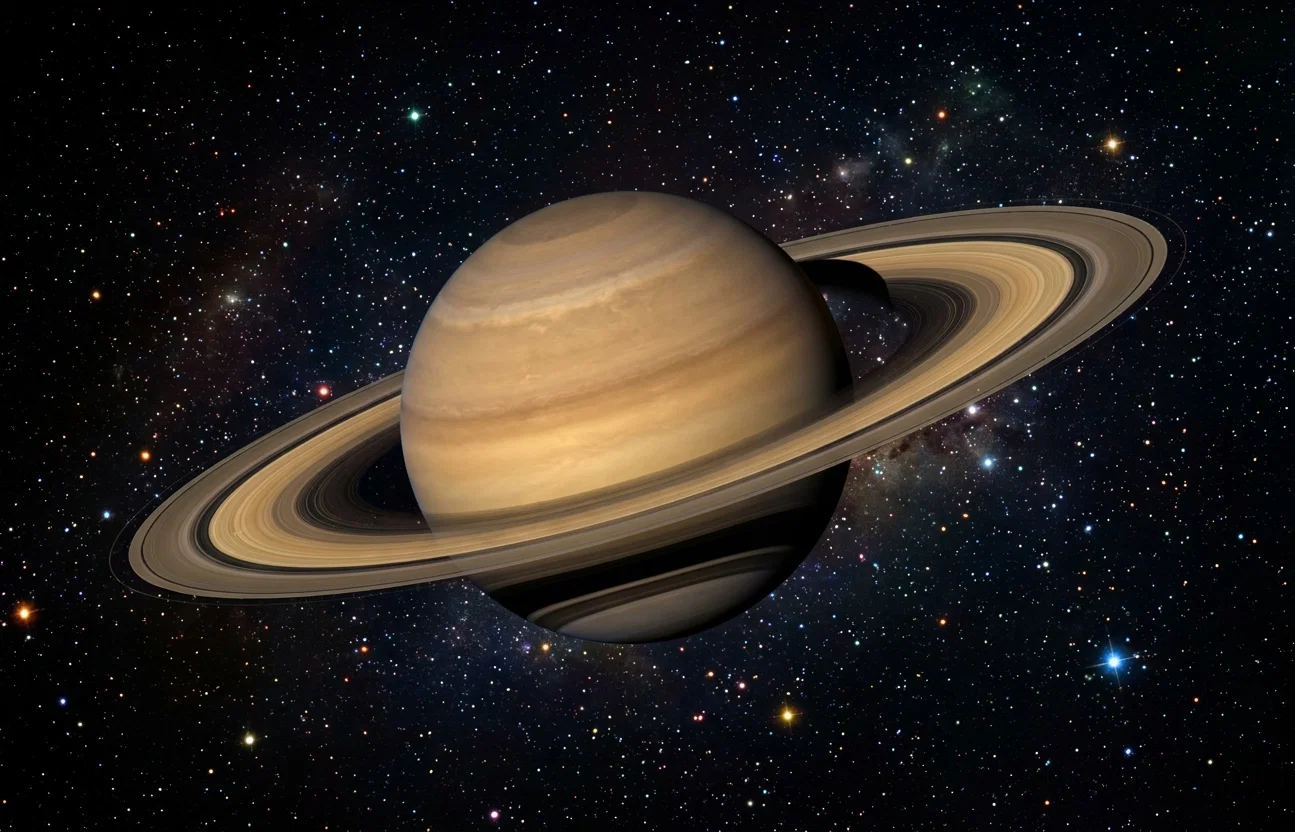
Saturn and His Rings
The Knowledge That Works Transformation
The knowledge of God as revealed in Christ is the knowledge that all who are saved must have. It is the knowledge that works transformation of character. This knowledge, received, will re-create the soul in the image of God. It will impart to the whole being a spiritual power that is divine.
“We all, with open face beholding as in a glass the glory of the Lord, are changed into the same image from glory to glory.”
Of His own life the Saviour said, “I have kept My Father’s commandments.” “The Father hath not left Me alone; for I do always those things that please Him.” As Jesus was in human nature, so God means His followers to be. In His strength we are to live the life of purity and nobility which the Saviour lived.
“For this cause,” Paul says, “I bow my knees unto the Father of our Lord Jesus Christ, of whom the whole family in heaven and earth is named, that He would grant you, according to the riches of His glory, to be strengthened with might by His Spirit in the inner man; that Christ may dwell in your hearts by faith; that ye, being rooted and grounded in love, may be able to comprehend with all saints what is the breadth, and length, and depth, and height; and to know the love of Christ, which passeth knowledge, that ye might be filled with all the fulness of God.”
We “do not cease to pray for you, and to desire that ye might be filled with the knowledge of His will in all wisdom and spiritual understanding; that ye might walk worthy of the Lord unto all pleasing, being fruitful in every good work, and increasing in the knowledge of God; strengthened with all might according to His glorious power, unto all patience and long-suffering with joyfulness.”
This is the knowledge which God is inviting us to receive, and beside which all else is vanity and nothingness.
Danger in Speculative Knowledge
“Professing themselves to be wise, they became vain in their reasonings, and their senseless heart was darkened.”
ONE of the greatest evils that attends the quest for knowledge, the investigations of science, is the disposition to exalt human reasoning above its true value and its proper sphere. Many attempt to judge of the Creator and His works by their own imperfect knowledge of science. They endeavor to determine the nature and attributes and prerogatives of God, and indulge in speculative theories concerning the Infinite One. Those who engage in this line of study are treading upon forbidden ground. Their research will yield no valuable results, and can be pursued only at the peril of the soul.
Our first parents were led into sin through indulging a desire for knowledge that God had withheld from them. In seeking to gain this knowledge, they lost all that was worth possessing. If Adam and Eve had never touched the forbidden tree, God would have imparted to them knowledge,—knowledge upon which rested no curse of sin, knowledge that would have brought them everlasting joy. All that they gained by listening to the tempter was an acquaintance with428sin and its results. By their disobedience, humanity was estranged from God, and the earth was separated from heaven.
The lesson is for us. The field into which Satan led our first parents is the same to which he is alluring men to-day. He is flooding the world with pleasing fables. By every device at his command he tempts men to speculate in regard to God. Thus he seeks to prevent them from obtaining that knowledge of God which is salvation.
Pantheistic Theories
To-day there are coming into educational institutions and into the churches everywhere spiritualistic teachings that undermine faith in God and in His word. The theory that God is an essence pervading all nature is received by many who profess to believe the Scriptures; but, however beautifully clothed, this theory is a most dangerous deception. It misrepresents God, and is a dishonor to His greatness and majesty. And it surely tends not only to mislead, but to debase men. Darkness is its element, sensuality its sphere. The result of accepting it is separation from God. And to fallen human nature this means ruin.
Our condition through sin is unnatural, and the power that restores us must be supernatural, else it has no value. There is but one power that can break the hold of evil from the hearts of men, and that is the power of God in Jesus Christ. Only through the blood of the crucified One is there cleansing from sin. His grace alone can enable us to resist and subdue the tendencies of our fallen nature. The spiritualistic theories concerning God make His grace of no effect. If God is an essence pervading all nature, then He dwells in all men; and in order to attain holiness, man has only to develop the power within him.
These theories, followed to their logical conclusion, sweep away the whole Christian economy. They do away with the necessity for the atonement, and make man his own saviour.429These theories regarding God make His word of no effect, and those who accept them are in great danger of being led finally to look upon the whole Bible as a fiction. They may regard virtue as better than vice; but, having shut out God from His rightful position of sovereignty, they place their dependence upon human power, which, without God, is worthless. The unaided human will has no real power to resist and overcome evil. The defenses of the soul are broken down. Man has no barrier against sin. When once the restraints of God’s word and His Spirit are rejected, we know not to what depths one may sink.
“Every word of God is pure:
He is a shield unto them that put their trust in Him.
Add thou not unto His words,
Lest He reprove thee, and thou be found a liar.”
“His own iniquities shall take the wicked himself, And he shall be holden with the cords of his sins.”
Searching into Divine Mysteries
“The secret things belong unto the Lord our God, but those things which are revealed belong unto us and to our children forever.” The revelation of Himself that God has given in His word is for our study. This we may seek to understand. But beyond this we are not to penetrate. The highest intellect may tax itself until it is wearied out in conjectures regarding the nature of God, but the effort will be fruitless. This problem has not been given us to solve. No human mind can comprehend God. None are to indulge in speculation regarding His nature. Here silence is eloquence. The Omniscient One is above discussion.
Even the angels were not permitted to share the counsels between the Father and the Son when the plan of salvation was laid. And human beings are not to intrude into the secrets of the Most High. We are as ignorant of God as little children; but, as little children, we may love and obey430Him. Instead of speculating in regard to His nature or His prerogatives, let us give heed to the words He has spoken:
“Canst thou by searching find out God?
Canst thou find out the Almighty unto perfection?
It is as high as heaven; what canst thou do?
Deeper than hell; what canst thou know?
The measure thereof is longer than the earth,
And broader than the sea.”
“Where shall wisdom be found?
And where is the place of understanding?
Man knoweth not the price thereof;
Neither is it found in the land of the living.
The depth saith, It is not in me;
And the sea saith, It is not with me.
It can not be gotten for gold,
Neither shall silver be weighed for the price thereof.
It can not be valued with the gold of Ophir,
With the precious onyx or the sapphire.
The gold and the crystal can not equal it;
And the exchange of it shall not be for jewels of fine gold.
No mention shall be made of coral or of pearls;
For the price of wisdom is above rubies.
The topaz of Ethiopia shall not equal it,
Neither shall it be valued with pure gold.
Whence then cometh wisdom?
And where is the place of understanding? . . .
Destruction and death say,
We have heard the fame thereof with our ears.
God understandeth the way thereof,
And He knoweth the place thereof.
“For He looketh to the ends of the earth,
And seeth under the whole heaven. . . .
When He made a decree for the rain,
And a way for the lightning of the thunder;
Then did He see it and declare it;
He prepared it, yea, and searched it out.
And unto man He said,
Behold, the fear of the Lord, that is wisdom;
And to depart from evil is understanding.”
Neither by searching the recesses of the earth nor in vain endeavors to penetrate the mysteries of God’s being, is wisdom found. It is found, rather, in humbly receiving the revelation that He has been pleased to give, and in conforming the life to His will.
The Mysteries of Nature
“Men of the greatest intellect can not understand the mysteries of Jehovah as revealed in nature. Divine inspiration asks many questions which the most profound scholar can not answer. These questions were not asked that we might answer them, but to call our attention to the deep mysteries of God, and to teach us that our wisdom is limited; that in the surroundings of our daily life there are many things beyond the comprehension of finite beings.
Skeptics refuse to believe in God, because they can not comprehend the infinite power by which He reveals Himself. But God is to be acknowledged as much from what He does not reveal of Himself, as from that which is open to our limited comprehension. Both in divine revelation and in nature, God has given mysteries to command our faith. This must be so. We may be ever searching, ever inquiring, ever learning, and yet there is an infinity beyond.
“Who hath measured the waters in the hollow of His hand,
And meted out heaven with the span,
And comprehended the dust of the earth in a measure,
And weighed the mountains in scales,
And the hills in a balance?
Who hath directed the Spirit of Jehovah,
Or being His counselor hath taught Him? . . .
Behold, the nations are as a drop of a bucket,
And are accounted as the small dust of the balance:
Behold, He taketh up the isles as a very little thing.
And Lebanon is not sufficient to burn,
Nor the beasts thereof sufficient for a burnt-offering.
All the nations are as nothing before Him;
They are accounted by Him as less than nothing, and vanity.
“To whom then will ye liken God? Or what likeness will ye compare unto Him? . . . Have ye not known? Have ye not heard? Hath it not been told you from the beginning? Have ye not understood from the foundations of the earth? It is He that sitteth above the circle of the earth, And the inhabitants thereof are as grasshoppers; That stretcheth out the heavens as a curtain, And spreadeth them out as a tent to dwell in. . . . To whom then will ye liken Me? . . . Saith the Holy One. Lift up your eyes on high, And see who hath created these, That bringeth out their host by number; He calleth them all by name; By the greatness of His might, and for that He is strong in power, Not one is lacking.
“Why sayest thou, O Jacob, and speakest, O Israel,
My way is hid from Jehovah,
And the justice due to me is passed away from my God?
Hast thou not known?
Hast thou not heard?
The everlasting God, Jehovah,
The Creator of the ends of the earth,
Fainteth not, neither is weary;
There is no searching of His understanding.”