Library
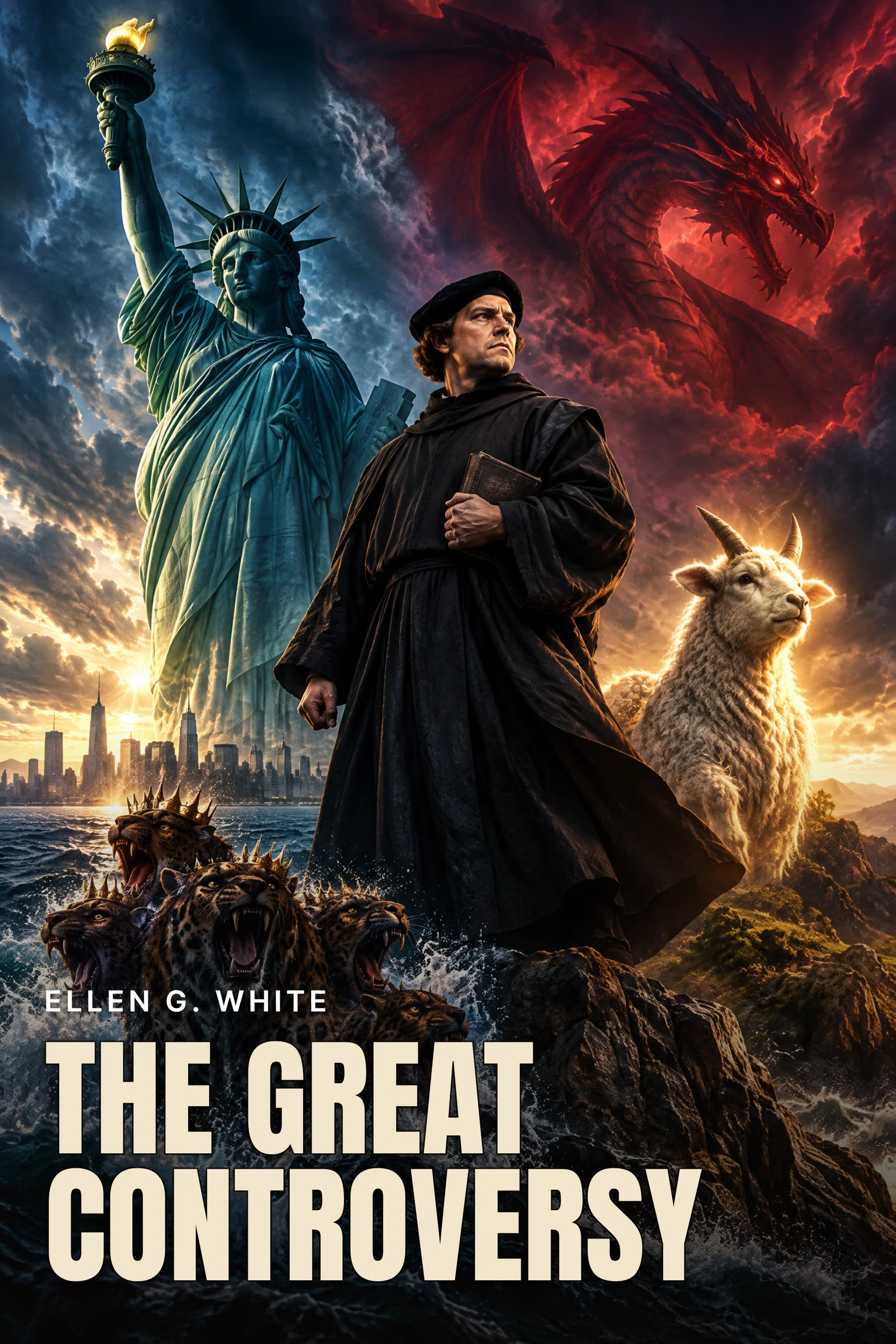
The Great Controversy
Pacific Press Publishing Association · Mountain View, California; Portland, Oregon; Cristobal, Canal Zone; Omaha, Nebraska · 1911
- Pages
- 682
- Illustrations
- 47
Contents
- THE DESTRUCTION OF JERUSALEM—117
- PERSECUTION IN THE FIRST CENTURIES—239
- THE APOSTASY—349
- THE WALDENSES—461
- JOHN WYCLIFFE — 579
- HUSS AND JEROME—697
- LUTHER’S SEPARATION FROM ROME—7120
- LUTHER BEFORE THE DIET—8145
- THE SWISS REFORMER—9171
- PROGRESS OF REFORM IN GERMANY—10185
- PROTEST OF THE PRINCES—11197
- THE FRENCH REFORMATION—12211
- THE NETHERLANDS AND SCANDINAVIA—13237
- LATER ENGLISH REFORMERS—14245
- THE BIBLE AND THE FRENCH REVOLUTION—15265
- THE PILGRIM FATHERS—16289
- HERALDS OF THE MORNING—17299
- AN AMERICAN REFORMER — 18317
- LIGHT THROUGH DARKNESS — 19343
- A GREAT RELIGIOUS AWAKENING — 20355
- A WARNING REJECTED—21375
- PROPHECIES FULFILLED — 22391
- WHAT IS THE SANCTUARY? — 23409
- IN THE HOLY OF HOLIES—24423
- GOD’S LAW IMMUTABLE—25433
- A WORK OF REFORM — 26451
- MODERN REVIVALS — 27461
- THE INVESTIGATIVE JUDGMENT — 28479
- THE ORIGIN OF EVIL—29492
- ENMITY BETWEEN MAN AND SATAN—30505
- AGENCY OF EVIL SPIRITS—31511
- SNARES OF SATAN—32518
- THE FIRST GREAT DECEPTION—33531
- SPIRITUALISM — 34551
- AIMS OF THE PAPACY—35563
- THE IMPENDING CONFLICT—36582
- THE SCRIPTURES A SAFEGUARD—37593
- THE FINAL WARNING — 38603
- “THE TIME OF TROUBLE”—39613
- GOD’S PEOPLE DELIVERED—40635
- DESOLATION OF THE EARTH — 41653
- THE CONTROVERSY ENDED — 42662
- APPENDIX679
- GENERAL NOTES679
Illustrations
 PREFACE
 INTRODUCTION
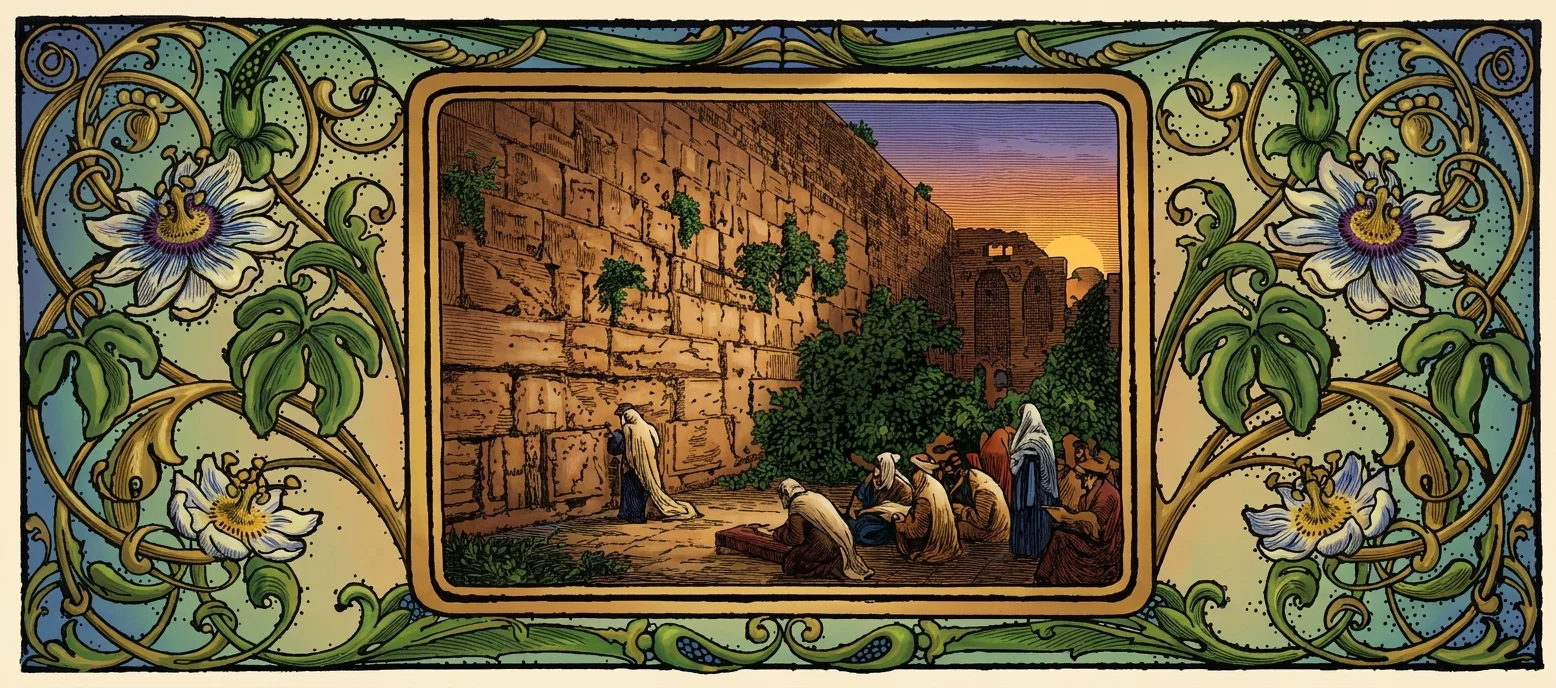 A framed biblical scene shows a group of robed figures gathered beside a massive, weathered stone wall at sunset. Several people sit or kneel in the foreground, apparently listening or praying, while one cloaked figure stands near the wall with head bowed. Dense green shrubs partially obscure an ancient masonry building and tower behind them. The central scene is surrounded by an elaborate ornamental border of curling vines, large green leaves, and pale blue-white passion flowers, rendered in symmetrical Art Nouveau-like decoration. No text or lettering appears within the depicted artwork.
 A woman in a flowing white classical gown, cinched with a dark sash, stands on rugged stone ruins beneath a deep, star-filled night sky. She extends one arm upward and points toward a slender crescent moon, while her other hand hangs at her side. The central scene is surrounded by an elaborate symmetrical black-lined ornamental border featuring sweeping arches, stylized leaves, curling floral forms, dotted patterns, and geometric interlacing details. No lettering or other text is visible within the artwork.
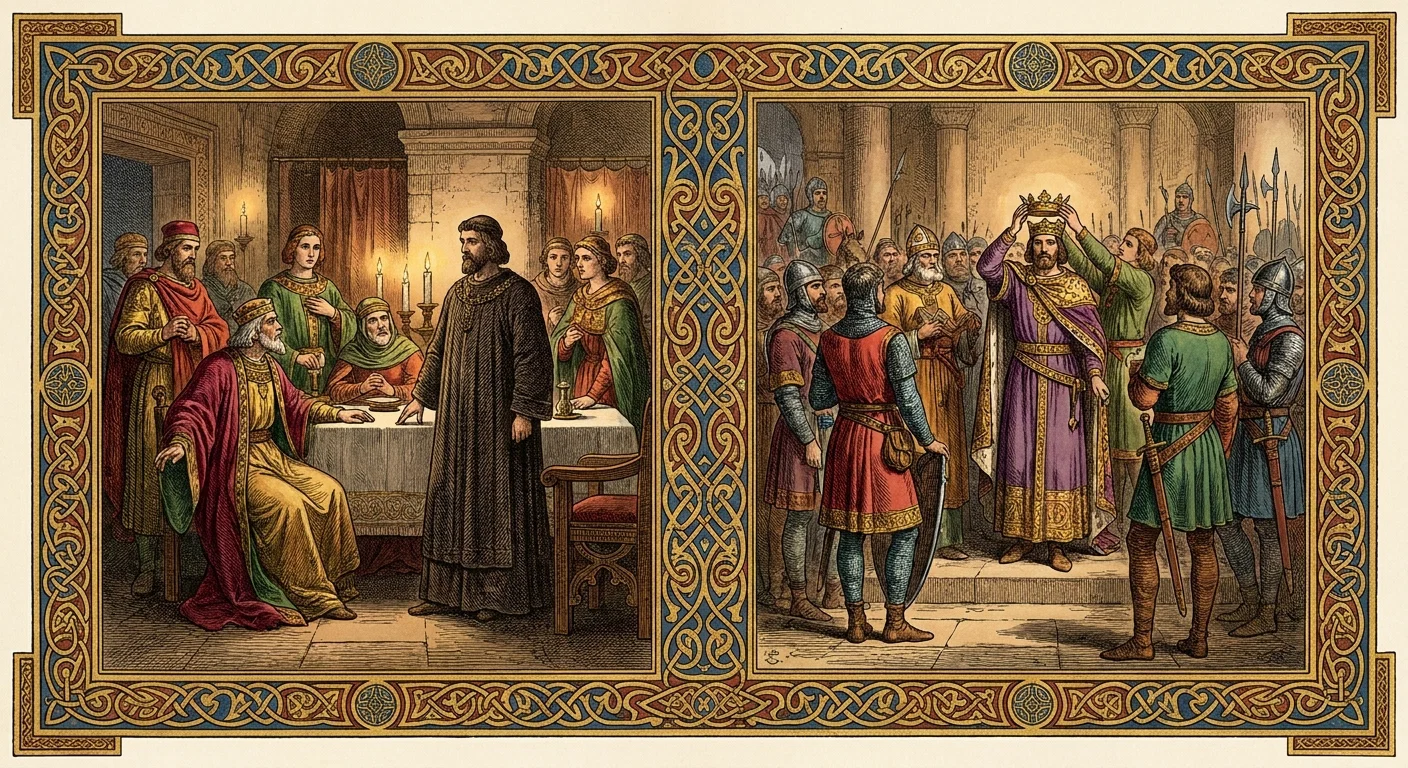 A richly ornamented two-panel historical scene portrays the rise of imperial Christianity and religious authority. In the left panel, a bearded ruler or ecclesiastical leader in a gold robe and crimson cloak sits at a table in a stone chamber, surrounded by robed advisers and attendants, while a dark-clad man stands before him. Candles, draperies, and architectural arches fill the room. In the right panel, a crowned king in purple and gold raises a crown above his head as clergy and armored soldiers gather around him, with spears, shields, helmets, and banners suggesting a public proclamation or coronation.
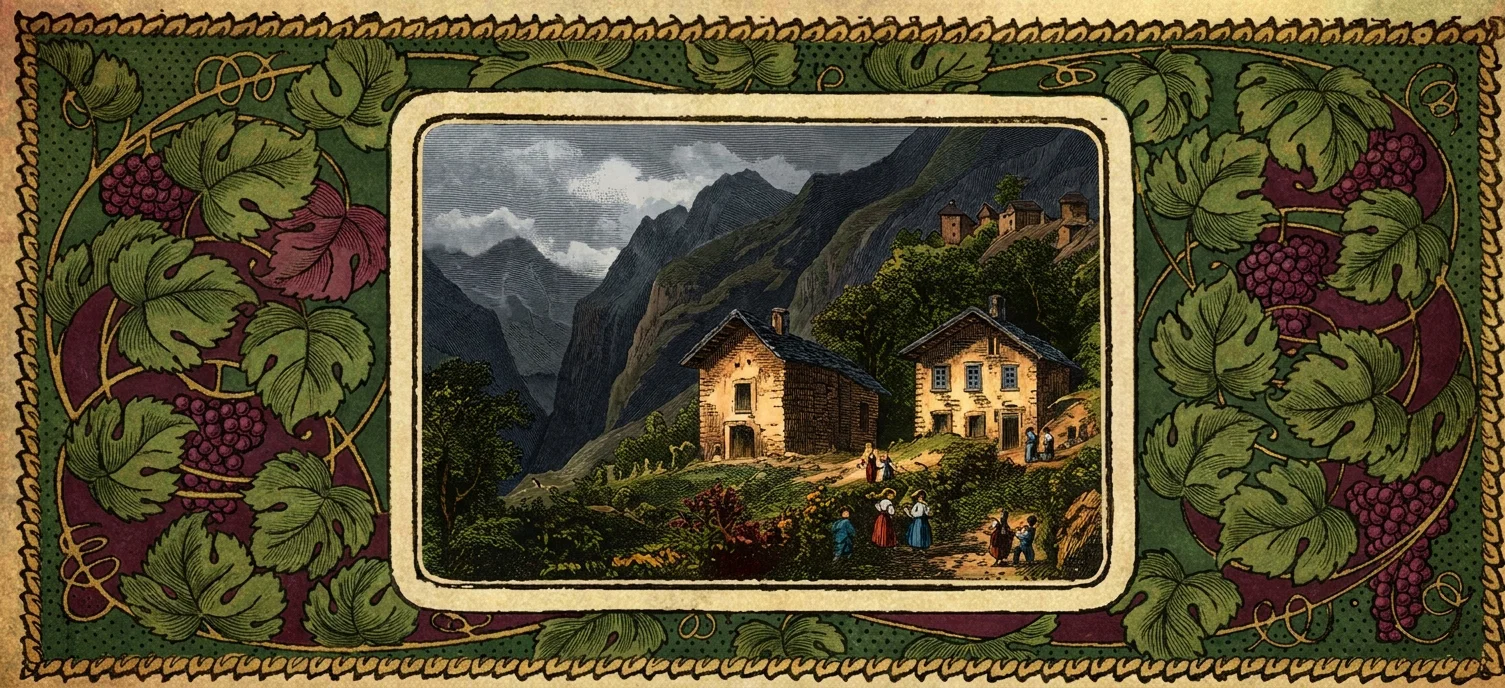 A mountain village is nestled in a dramatic, shadowed alpine valley, with steep craggy peaks rising behind it beneath a cloudy sky. Two rustic stone-and-timber houses stand on a sunlit hillside, joined by a winding path where several villagers, including women in long dresses and men in dark clothing, gather or walk. Dense trees, shrubs, and flowering plants fill the foreground. The central scene is surrounded by an ornate decorative border of curling grapevines, broad green leaves, and clusters of purple grapes on a dark green ground; no text is visible.
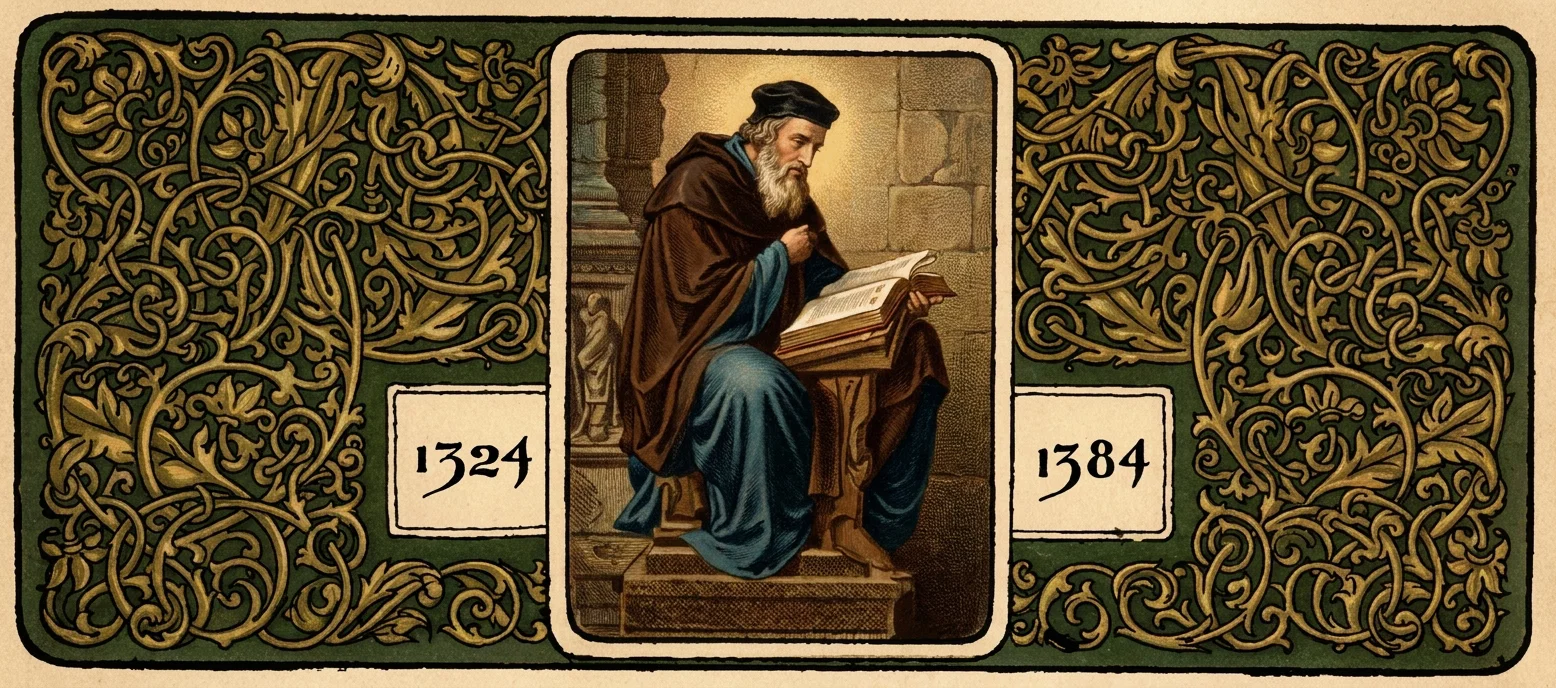 1324 1384
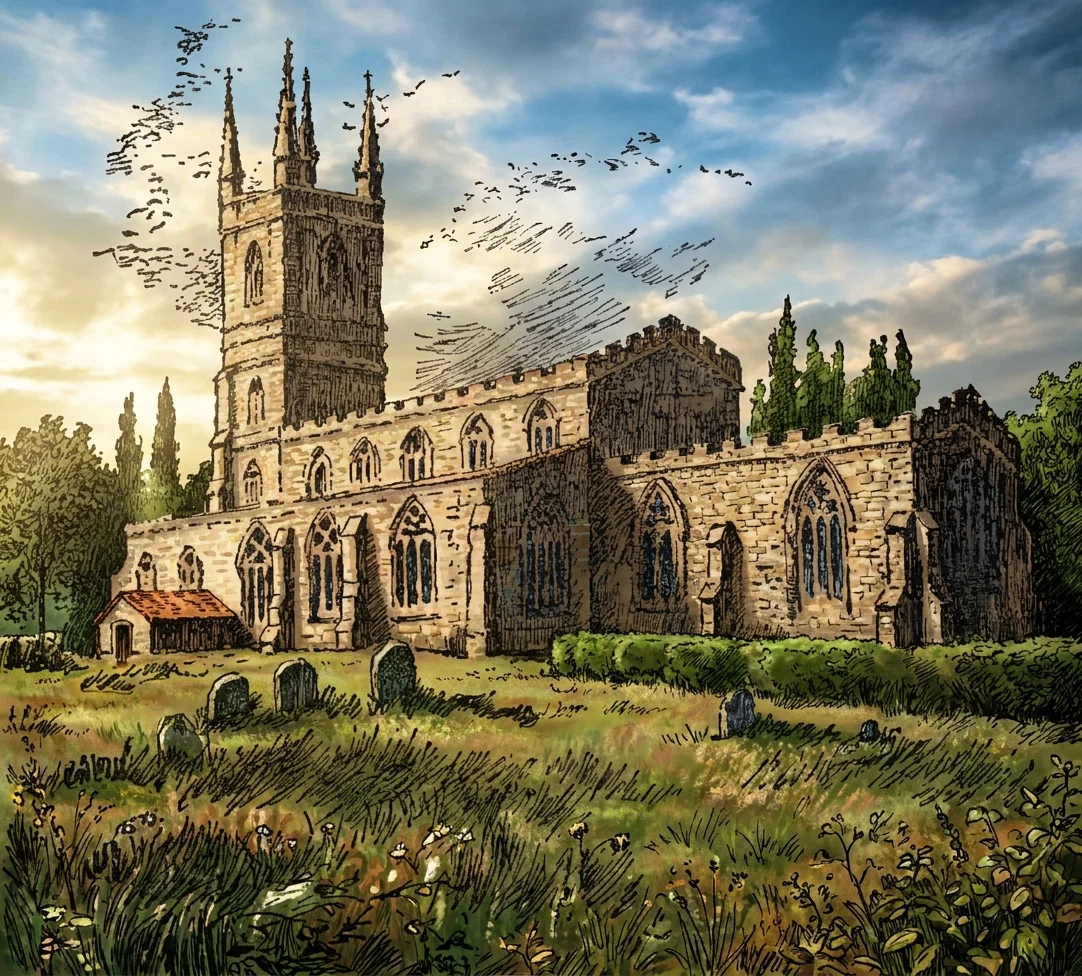 A historic stone Gothic church stands in a rural churchyard, viewed from the front and slightly to the side. Its tall square tower rises at the left, crowned with several narrow pinnacles, while the long nave and adjoining sections display crenellated rooflines, buttresses, and numerous pointed-arch windows with dark tracery. Weathered gravestones are scattered across the grassy foreground, with a small red-roofed outbuilding near the church’s left end. Dense trees frame the scene beneath a dramatic blue, cloud-filled sky, and small handwritten marks appear near the lower edge.
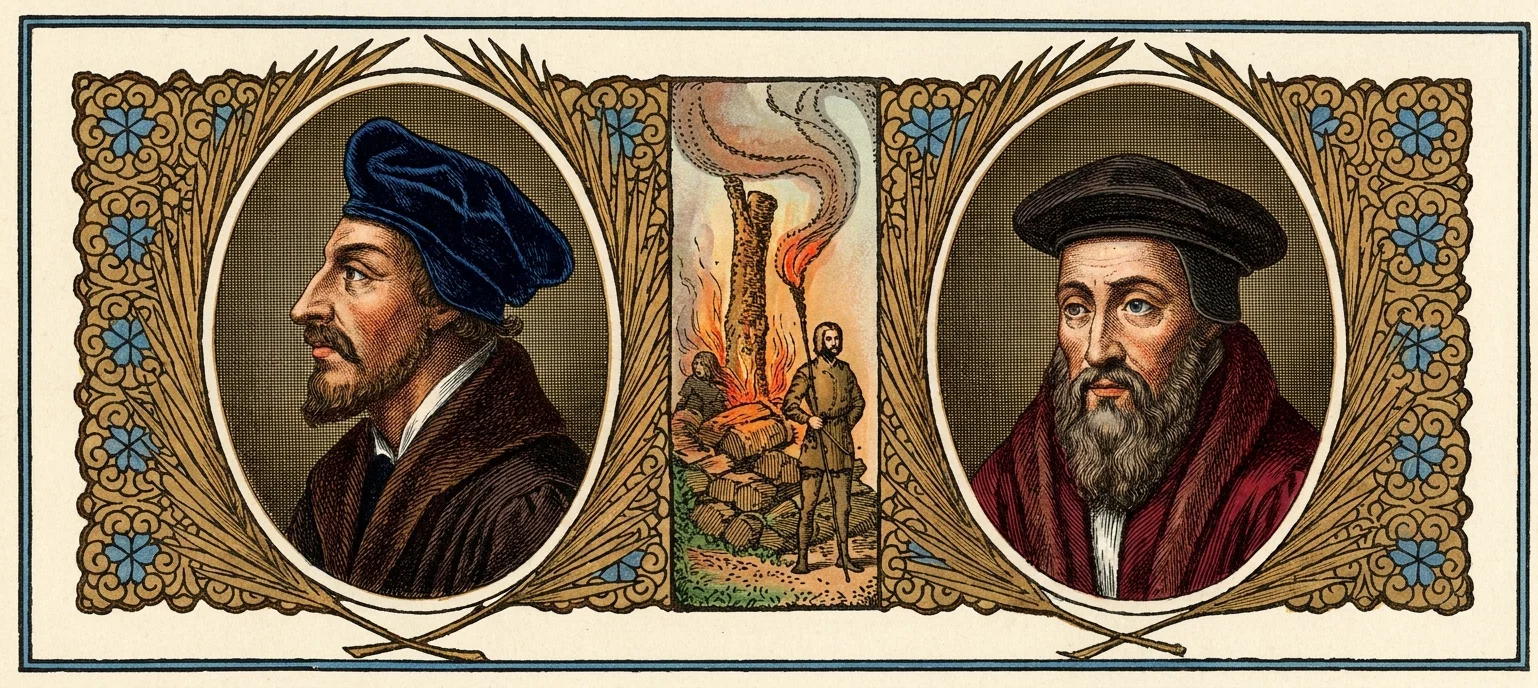 An ornate triptych portrays two prominent Reformation-era men in oval portraits: at left, a bearded profile wearing a dark blue cap and brown robe, and at right, a bearded man facing forward in a black cap and deep red robe. Between them, a narrow central scene shows persecuted Christians gathered around a blazing woodpile, with one figure apparently bound or lying amid the flames and another standing nearby holding a staff or weapon. Smoke rises dramatically above the fire. Stylized golden foliage, blue floral motifs, and crossed branches frame the portraits and central martyrdom scene.
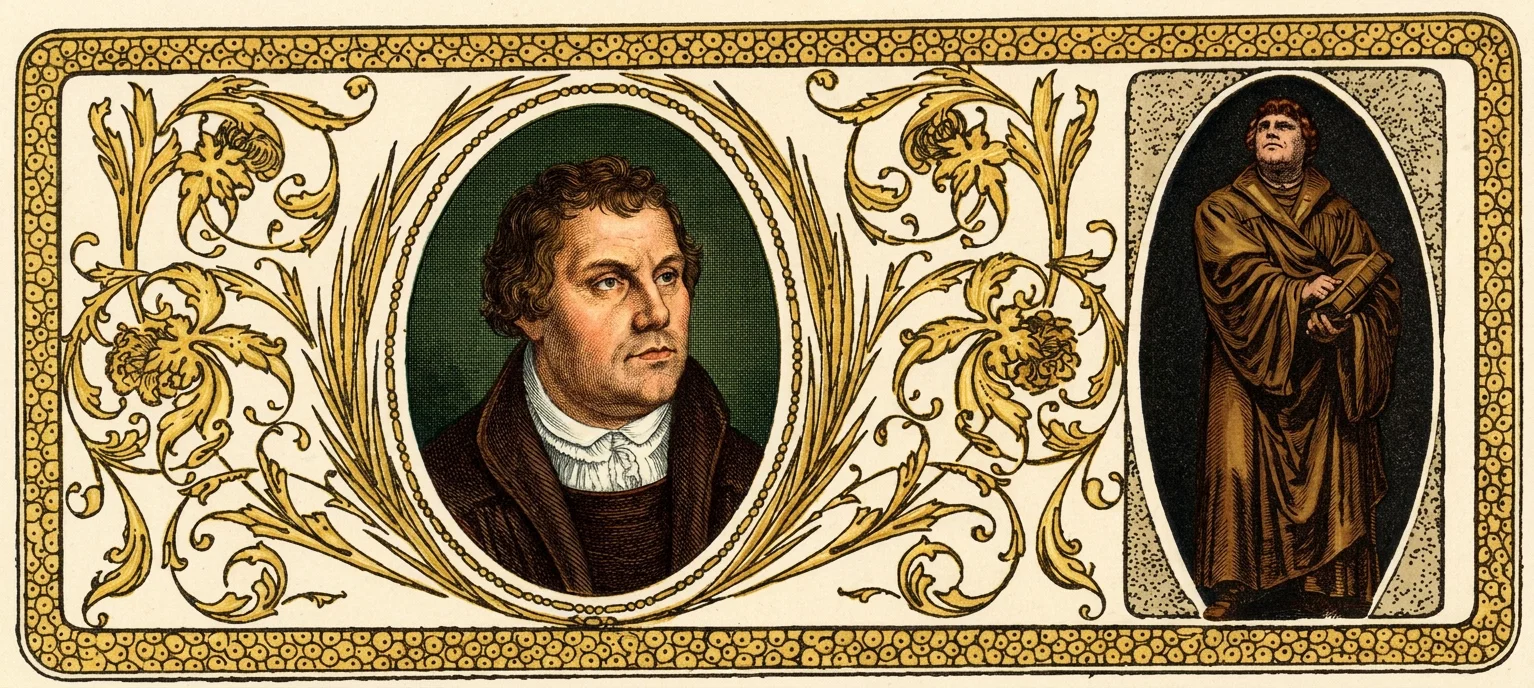 An ornate decorative panel presents two depictions of Martin Luther. At center, a detailed bust portrait shows Luther with curly dark hair, a serious expression, a white gathered clerical collar, and a dark robe, enclosed in an oval medallion with a deep green background. To the right, a full-length image shows him standing in a brown monastic robe, holding a closed book or bound volume across his body. Golden scrolling acanthus leaves and floral motifs surround the central portrait, all enclosed by a patterned gold border; no text is visible.
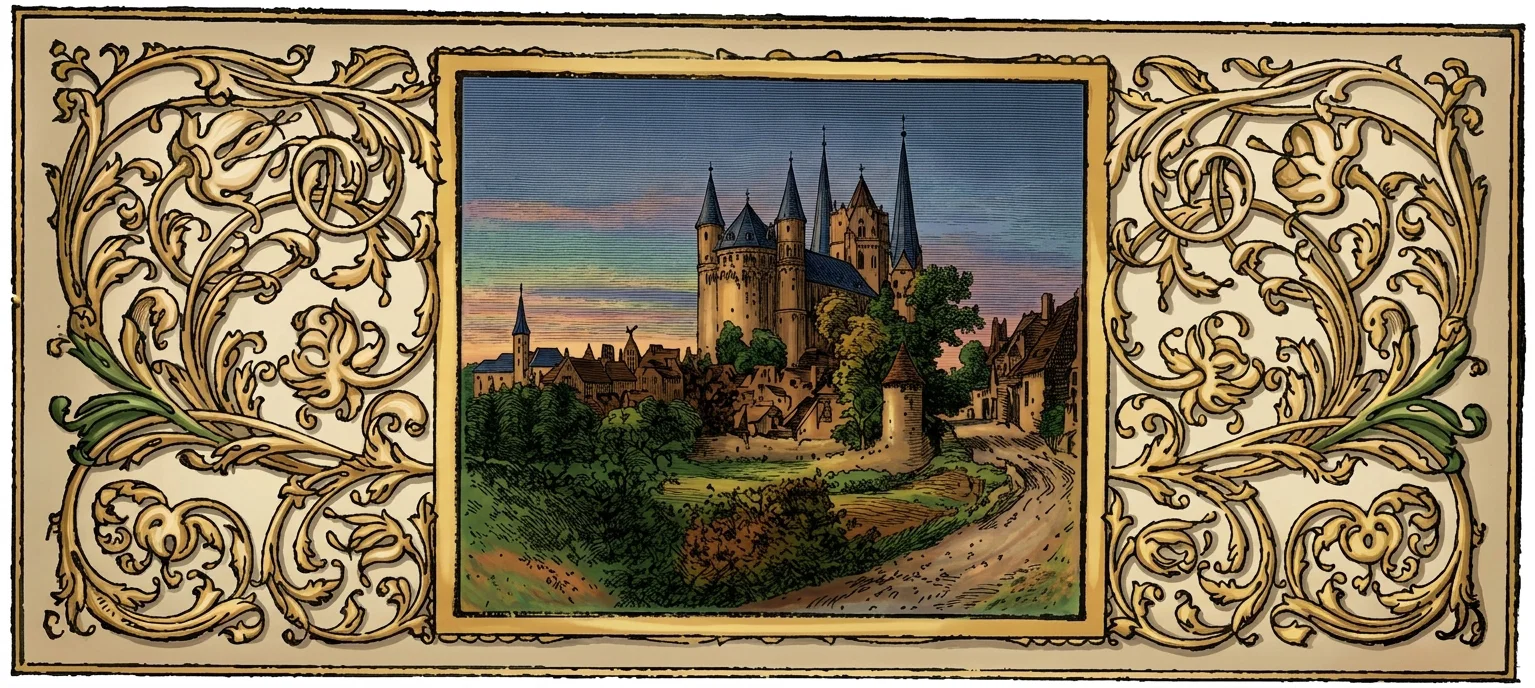 A panoramic view of a medieval German town at sunset, centered on a large fortified church or castle complex with several tall, pointed towers and a prominent central spire. Smaller timbered and masonry houses, additional church towers, and a round turret line the settlement below, surrounded by dense green trees and rolling countryside. A winding road leads from the foreground toward the town. The central scene is enclosed by an elaborate symmetrical ornamental border of curling gold and cream acanthus leaves, with green accents and scrollwork on both sides; no lettering or people are visible.
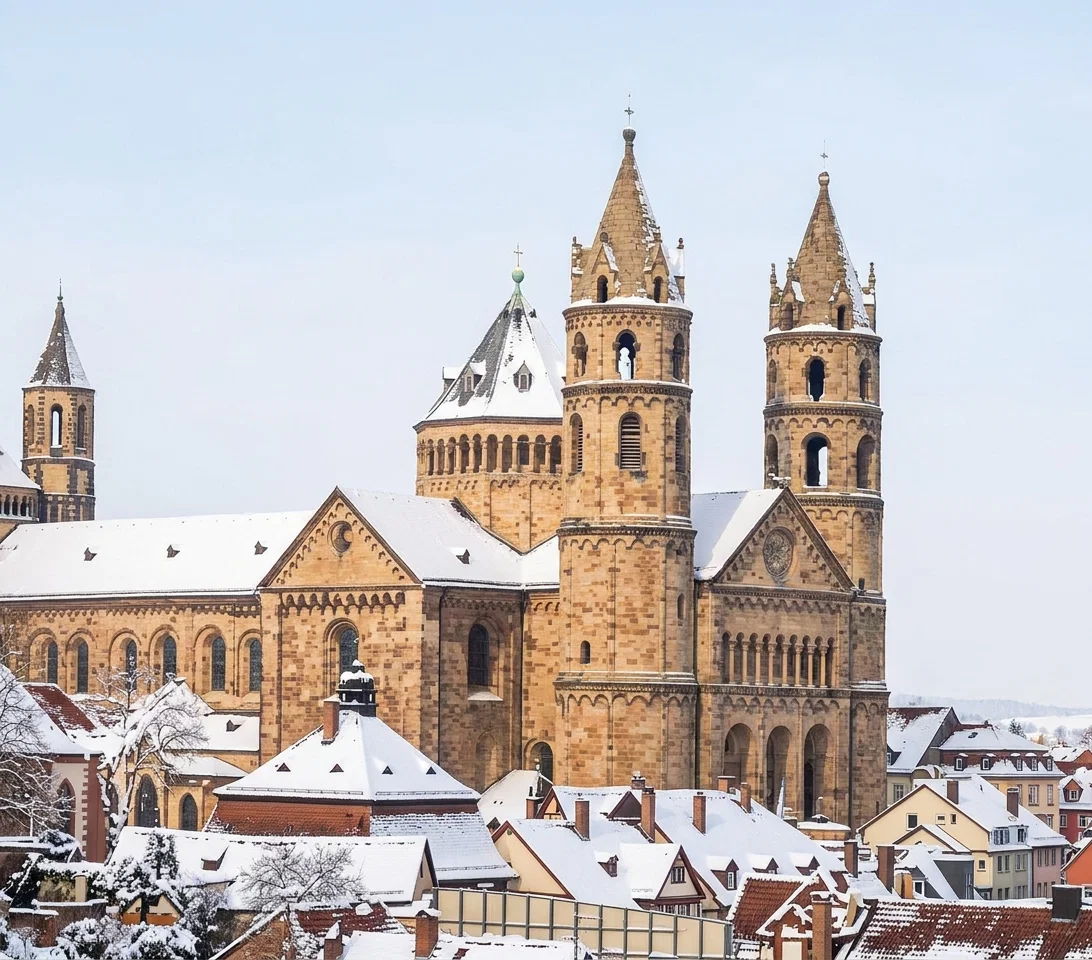 A large Romanesque cathedral dominates a snow-covered town, its warm ochre stone walls contrasting with the white roofs and pale winter sky. The church has multiple massive towers, including two prominent square towers with arched openings, tiered decorative arcades, and steep pointed roofs, as well as additional smaller towers and a central roofed structure. In the foreground, clustered houses with red tile roofs, chimneys, dormers, and snow-laden trees surround the cathedral, while softly rolling, snowy countryside is visible in the distance.
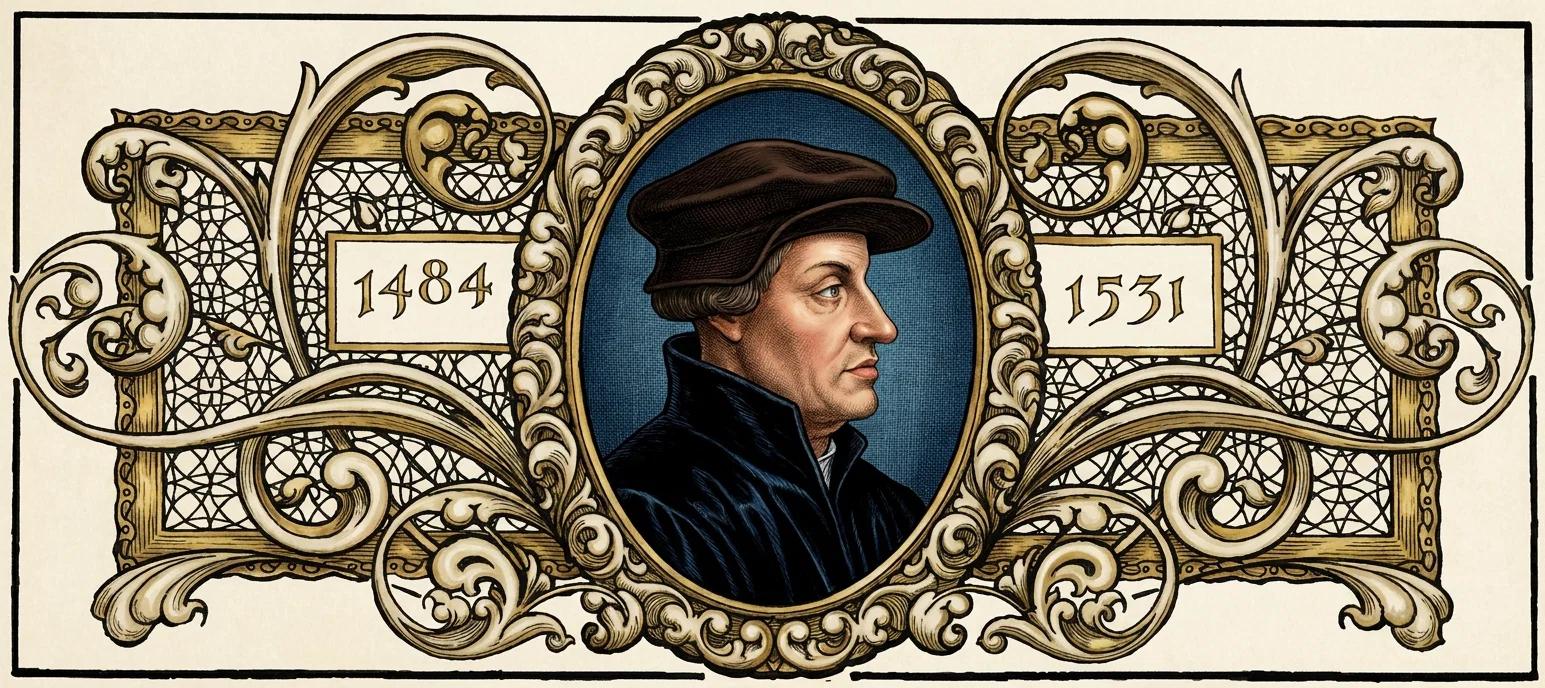 1484 1531
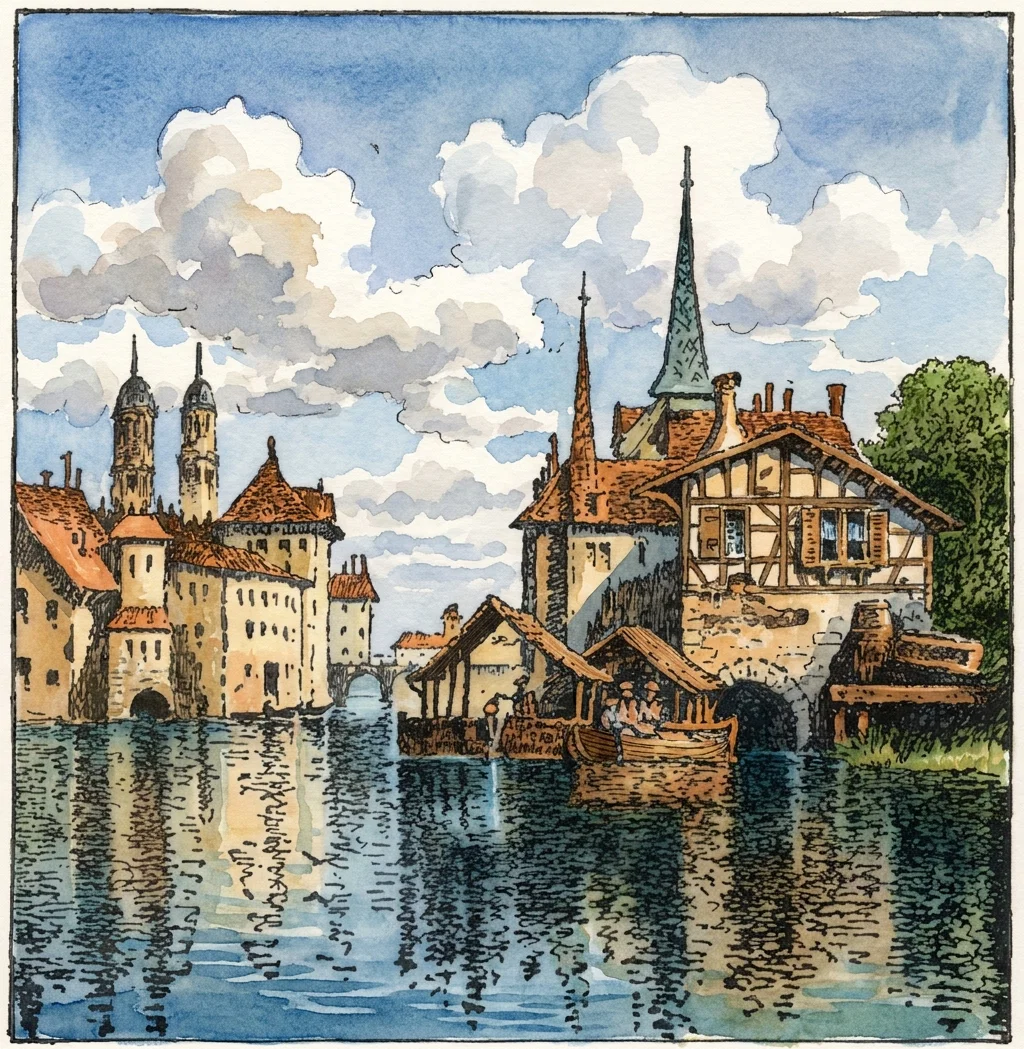 A picturesque historic European waterfront is shown beneath a bright blue sky filled with large billowing clouds. Rippling water occupies the foreground, reflecting the clustered ochre, cream, and brown buildings along the shore. At left, a church or cathedral rises with twin domed towers, while at right a tall, ornate green spire stands behind steep red-tiled roofs and a half-timbered house. Wooden docks, sheds, moored boats, barrels, and small indistinct figures fill the center and right shoreline, with a leafy tree framing the scene.
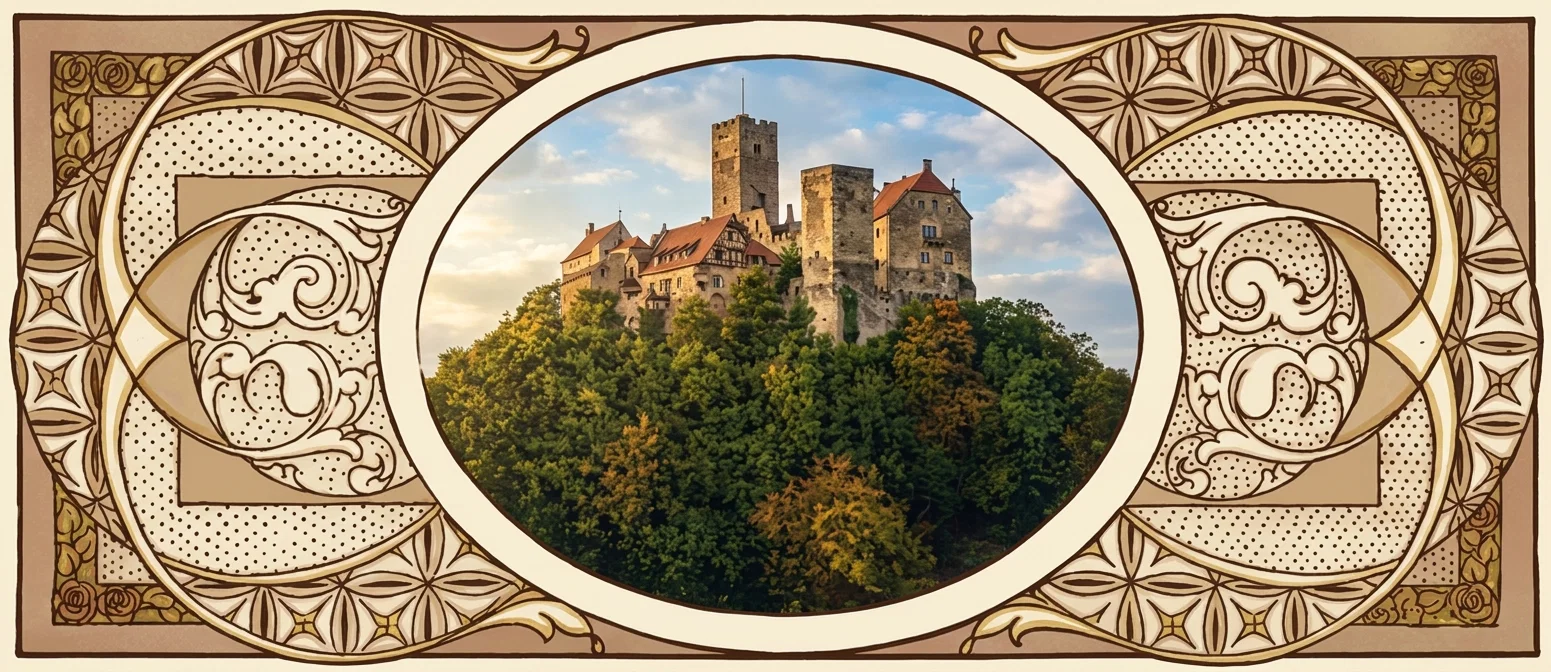 A grand medieval stone castle rises above a dense, wooded hill under a blue sky with scattered clouds. The fortress includes several connected buildings with steep red-tiled roofs, tall square towers, battlements, small windows, and weathered masonry, suggesting a historic German stronghold. The central landscape scene is enclosed within a large oval frame, surrounded by an ornate symmetrical Art Nouveau-style border of cream, brown, and gold tones, featuring stylized leaves, floral rosettes, curling foliage, geometric patterns, and dotted decorative panels. No people, animals, or lettering are visible.
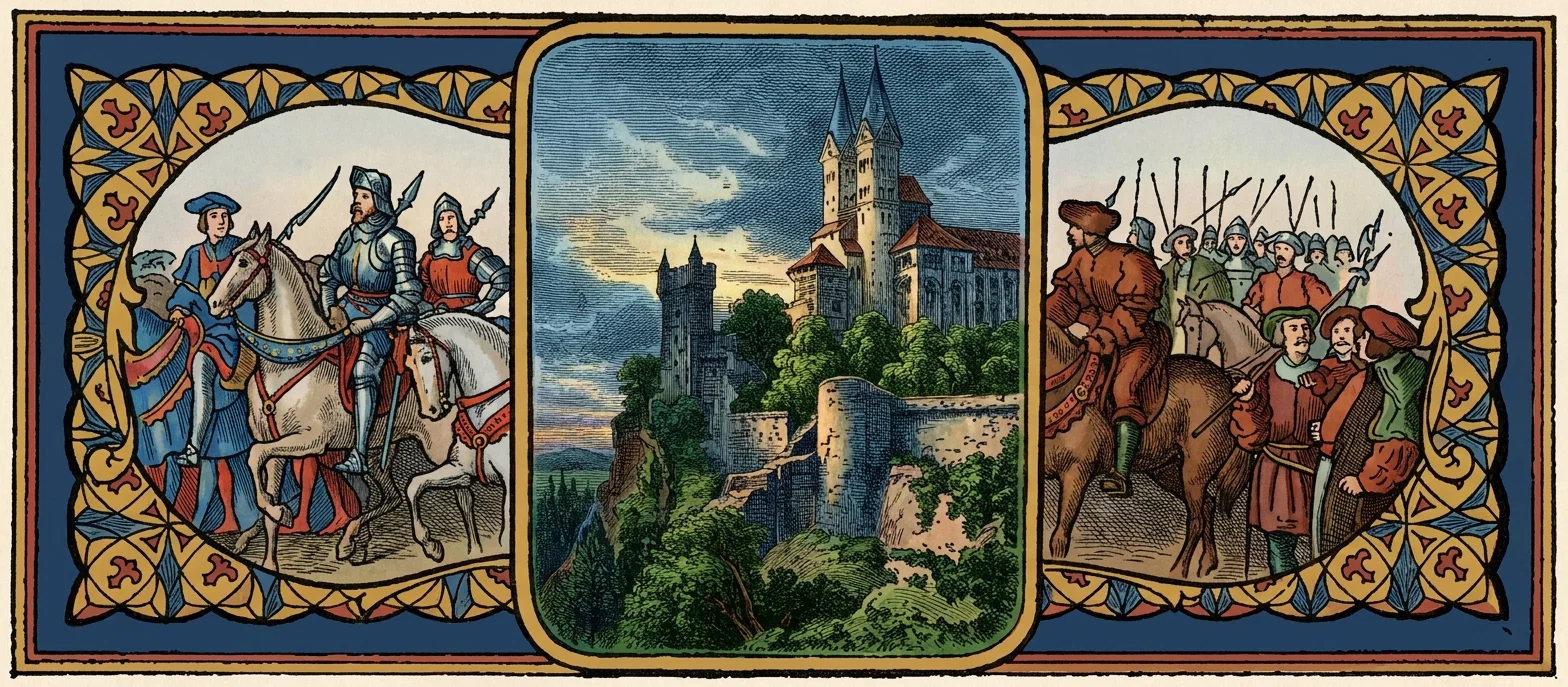 A decorative triptych portrays the Protestant princes and their military support during the Reformation. In the central panel, a fortified medieval town or castle rises above wooded hills beneath a cloudy blue sky, with towers, walls, and a large church-like building. The left panel shows armored mounted knights and attendants, including a rider on a white horse carrying a lance. The right panel depicts a procession of armed soldiers and nobles on horseback and on foot, wearing colorful medieval garments and helmets, with spears and staffs raised. Ornate blue, gold, red, and cream geometric and floral borders frame the scenes.
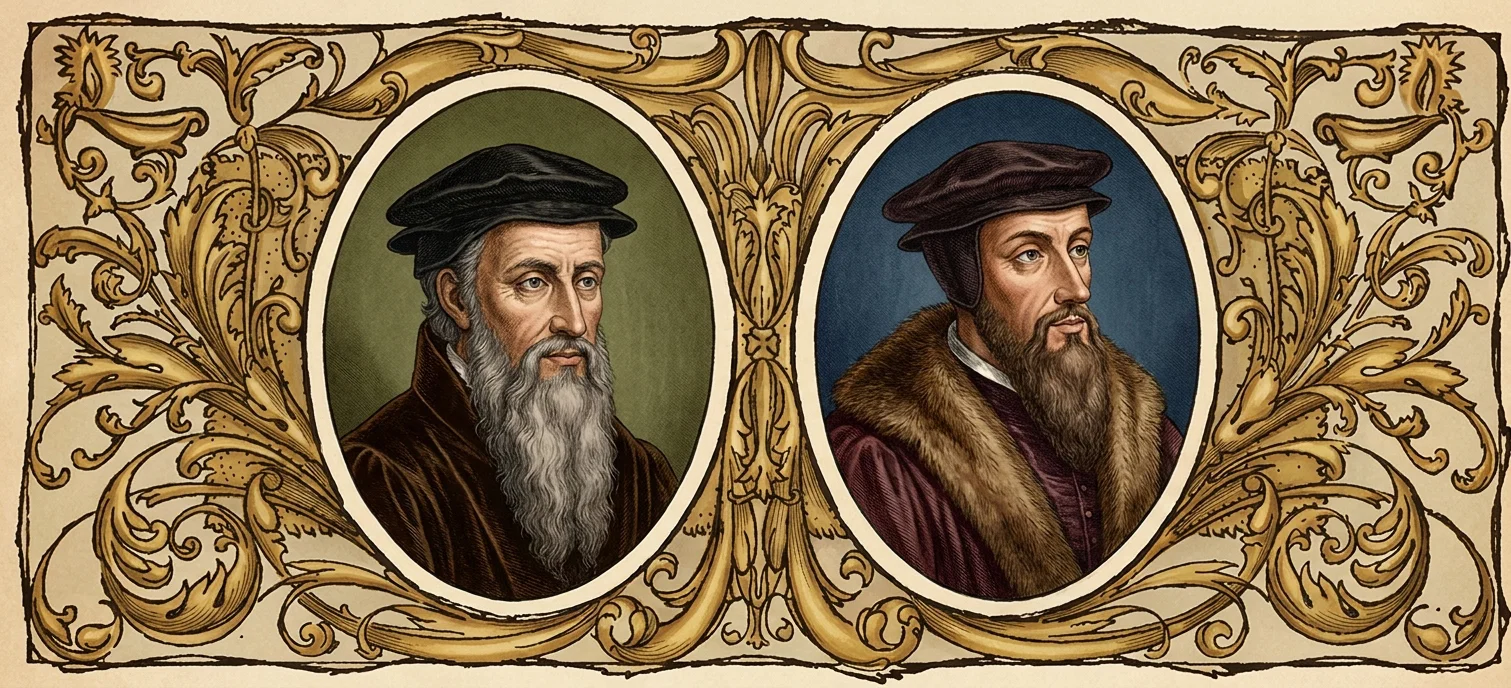 The image presents two formal bust portraits within separate oval medallions, surrounded by an elaborate symmetrical border of curling golden foliage, leaves, flowers, and scrollwork. On the left, a stern gray-bearded man wears a black soft cap and dark robe against a muted olive-green background. On the right, a younger-looking bearded man wears a dark reddish cap, fur-trimmed cloak, and burgundy garment against a deep blue background. Both figures face slightly inward toward the center, creating a balanced paired composition.
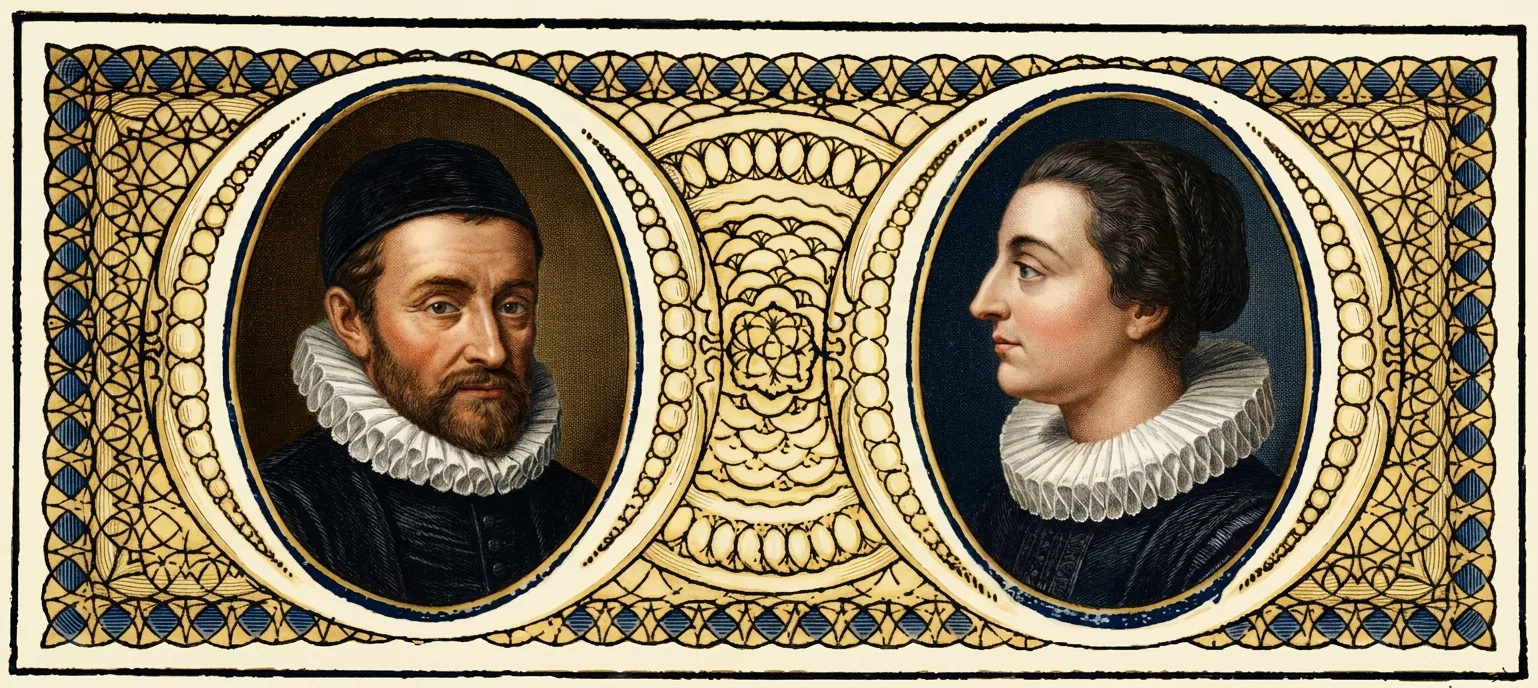 The image presents two formal, oval portrait busts set side by side within an elaborate cream, gold, black, and blue geometric border. On the left, a bearded man in dark clothing wears a broad white pleated ruff and faces slightly toward the viewer. On the right, a woman in profile faces him, dressed in dark garments with a similarly large white ruff, her hair swept back into a bun. Intricate repeating diamond, floral, and scalloped patterns fill the surrounding frame, with no visible lettering or other objects.
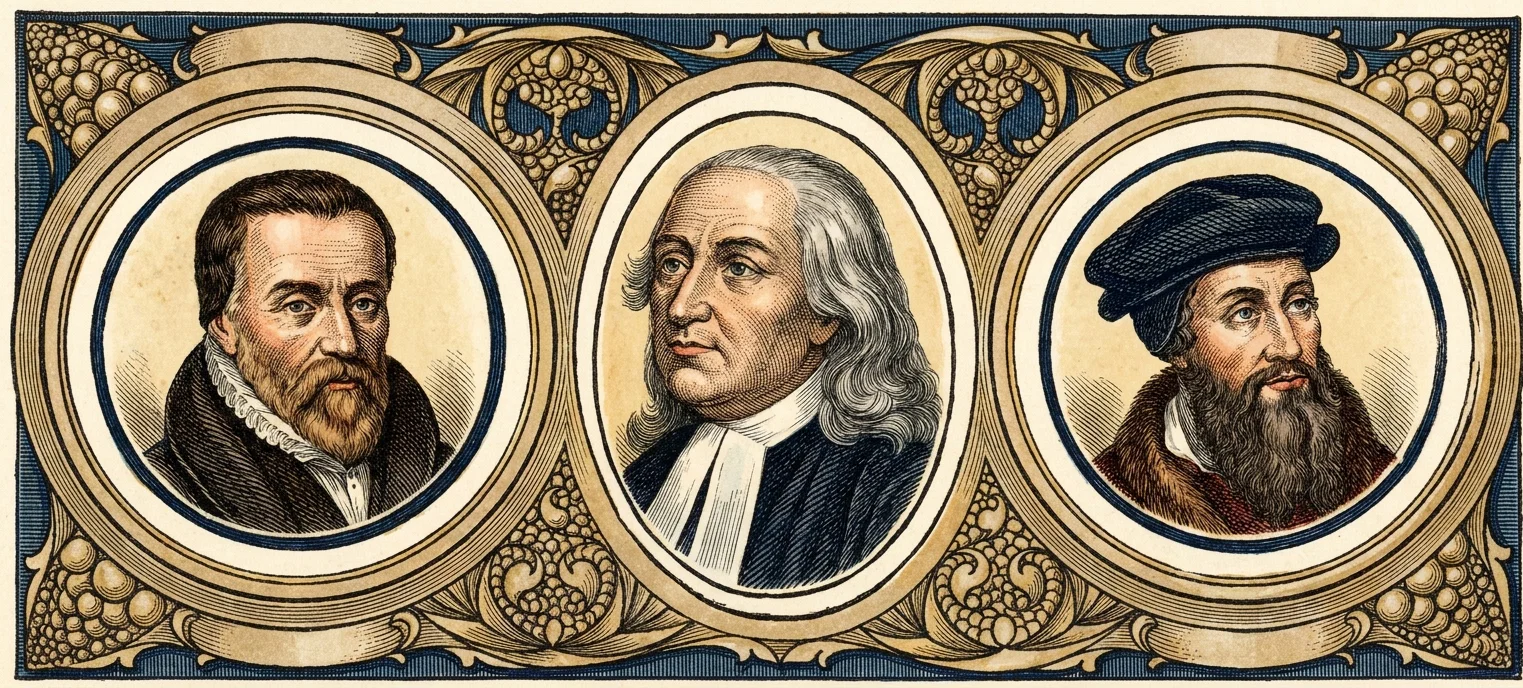 A decorative triptych presents three solemn male reformer portraits in oval medallions. At left, a dark-haired man with a pointed beard wears a black robe and prominent white ruff; in the center, an older, clean-shaven, long-haired man faces slightly left in a dark clerical robe with a broad white collar; at right, a bearded man wears a dark cap, fur-trimmed garment, and reddish clothing. The medallions are framed by elaborate gold-toned scrollwork, floral and fruit-like motifs, and a dark blue ornamental border.
 THE OLD TESTAMENT
THE NEW TESTAMENT
THE OLD TESTAMENT
THE NEW TESTAMENT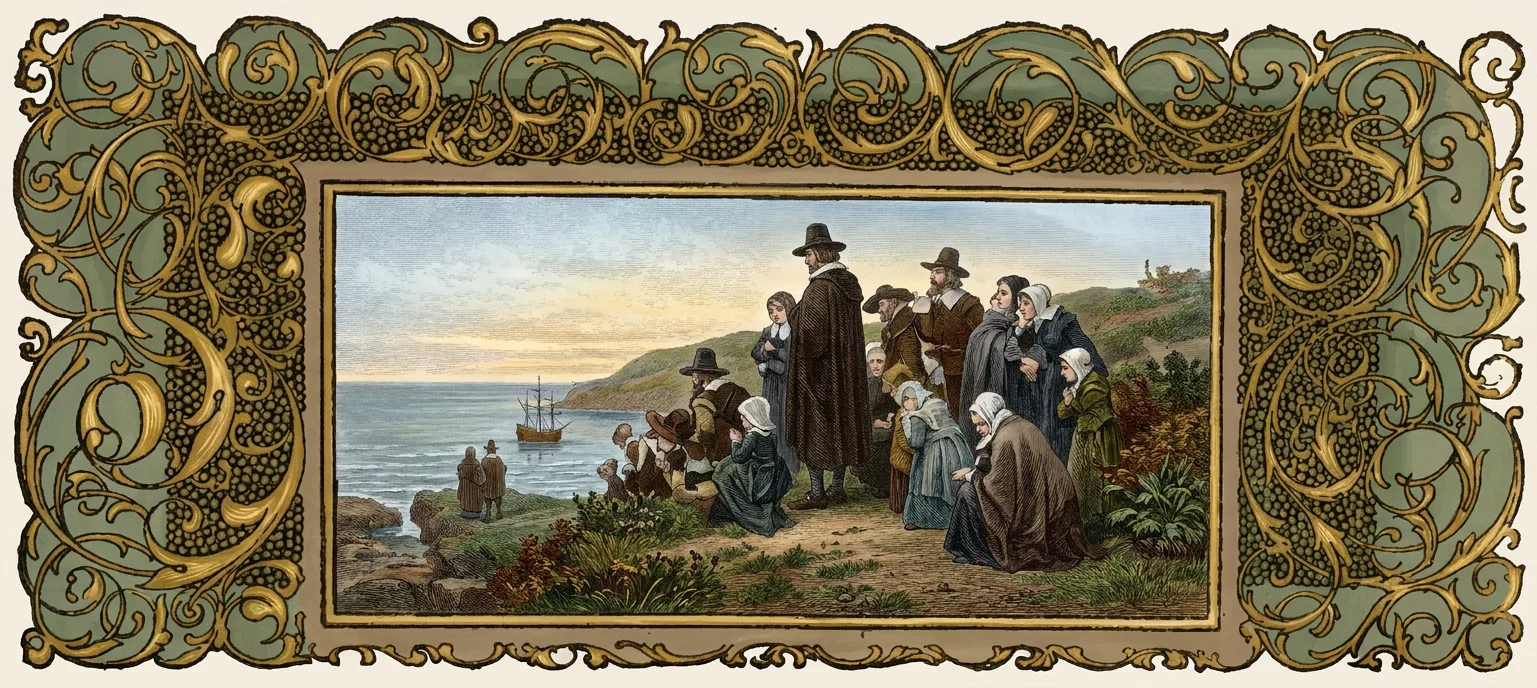 A group of English Puritan settlers gathers on a rocky shoreline beside a calm sea, with a small sailing ship anchored offshore and another figure standing near the water. Men in broad-brimmed hats and dark cloaks stand among women and children wearing bonnets, shawls, and long dresses; several kneel or sit facing the vessel and distant coast. Low green hills and flowering grasses frame the scene beneath a pale sunset sky. The central image is surrounded by an elaborate gold, green, and black border of curling foliage, scrollwork, and stippled ornament.
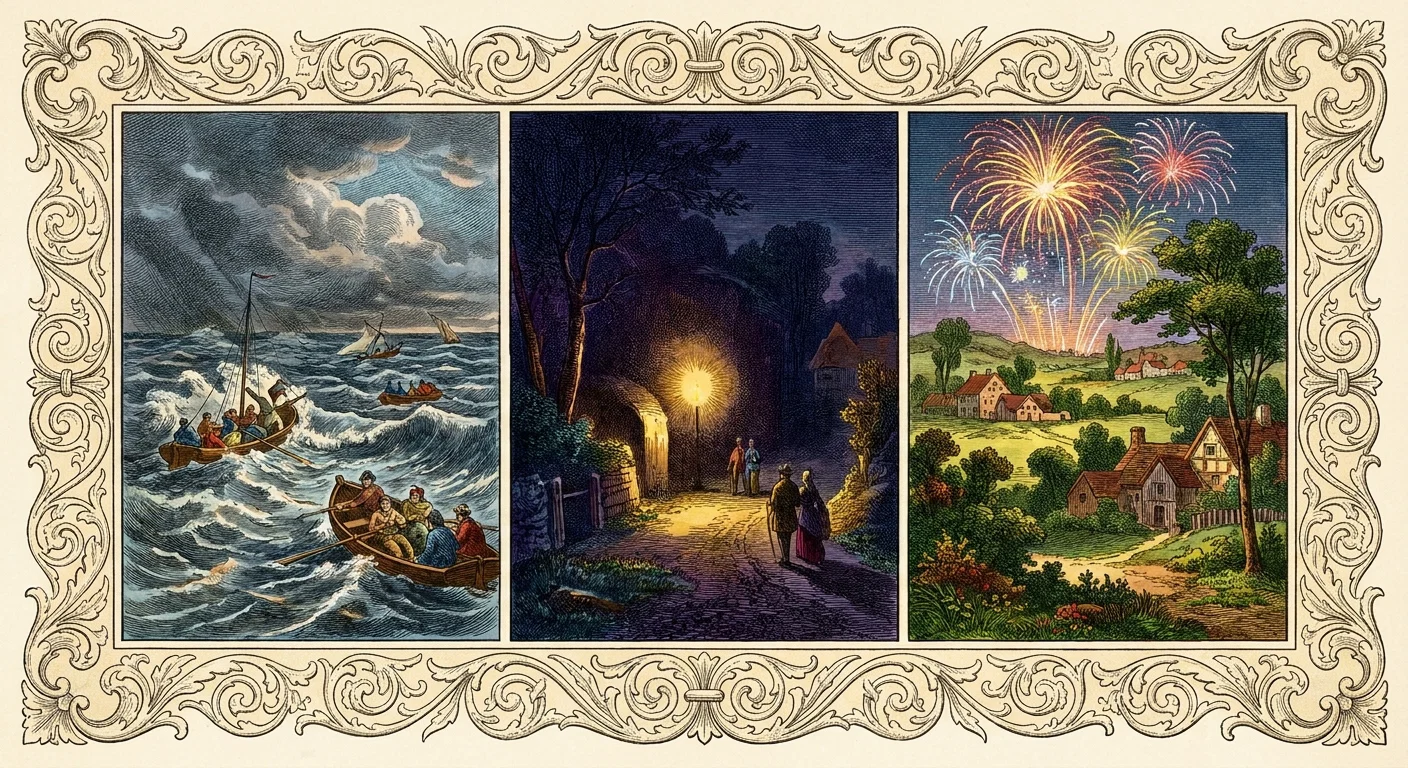 A triptych of dramatic scenes framed by an ornate curling floral border. At left, several small boats crowded with people battle towering, foaming waves beneath a stormy sky, while other vessels appear farther offshore. In the central panel, travelers move along a dark wooded village road at night toward a brilliant golden light shining from a doorway or passage, with cottages and trees around them. At right, a peaceful rural landscape of green fields, trees, clustered houses, and distant hills is illuminated by numerous colorful fireworks bursting overhead.
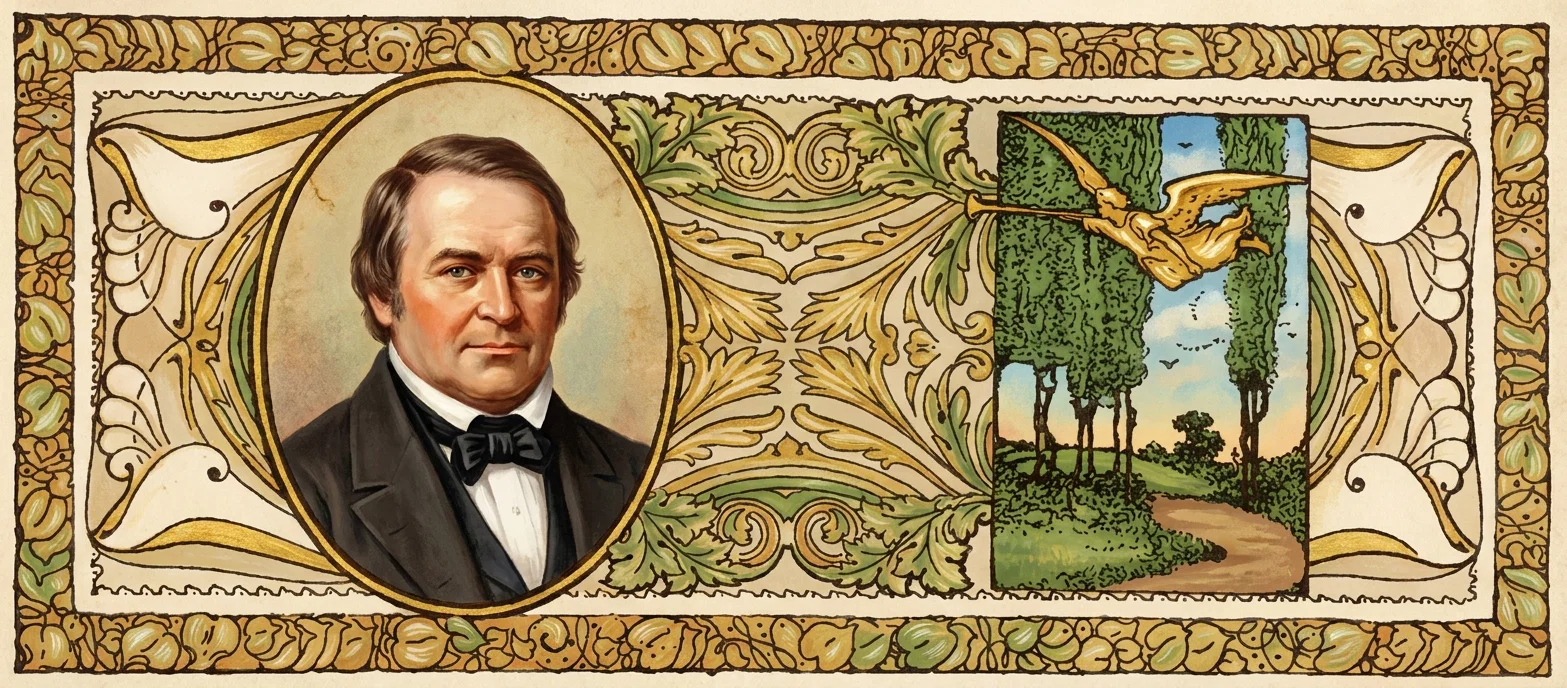 An ornate decorative panel presents a formal portrait of William Miller, shown from the chest up in a dark suit, white shirt, and black bow tie, within a large oval frame on the left. Opposite him is a pastoral landscape framed as a secondary inset: a winding path passes through tall, narrow trees and green vegetation beneath a bright blue sky, while a large golden-brown bird flies across the upper portion. Elaborate Art Nouveau-style borders of curling foliage, leaves, scrollwork, and stylized birds surround both scenes in muted gold, green, cream, and brown.
 At the center, a tall glowing beacon or obelisk rises before a massive golden-brown pyramid, casting warm light into the dark blue evening sky. Small groups of robed figures stand and walk across the sandy foreground, emphasizing the monument’s scale. The scene is enclosed in an elaborate symmetrical Art Nouveau frame of curling vines, leaves, tendrils, and shell-like scrolls, rendered in cream, gold, green, and deep blue. No lettering or other text appears within the depicted scene.
 A richly colored scene shows four winged angels flying across a glowing sunset sky, each blowing a long trumpet. They wear flowing robes in red, gold, blue, and purple, with their wings outspread as they move over a tranquil landscape of wooded hills, a lake or broad river, and distant mountains. One large golden-robed angel dominates the foreground, while three smaller angels fly above and to the right. The central image is surrounded by an elaborate symmetrical border of dark ornamental vines, scrollwork, and geometric framing, with no visible lettering.
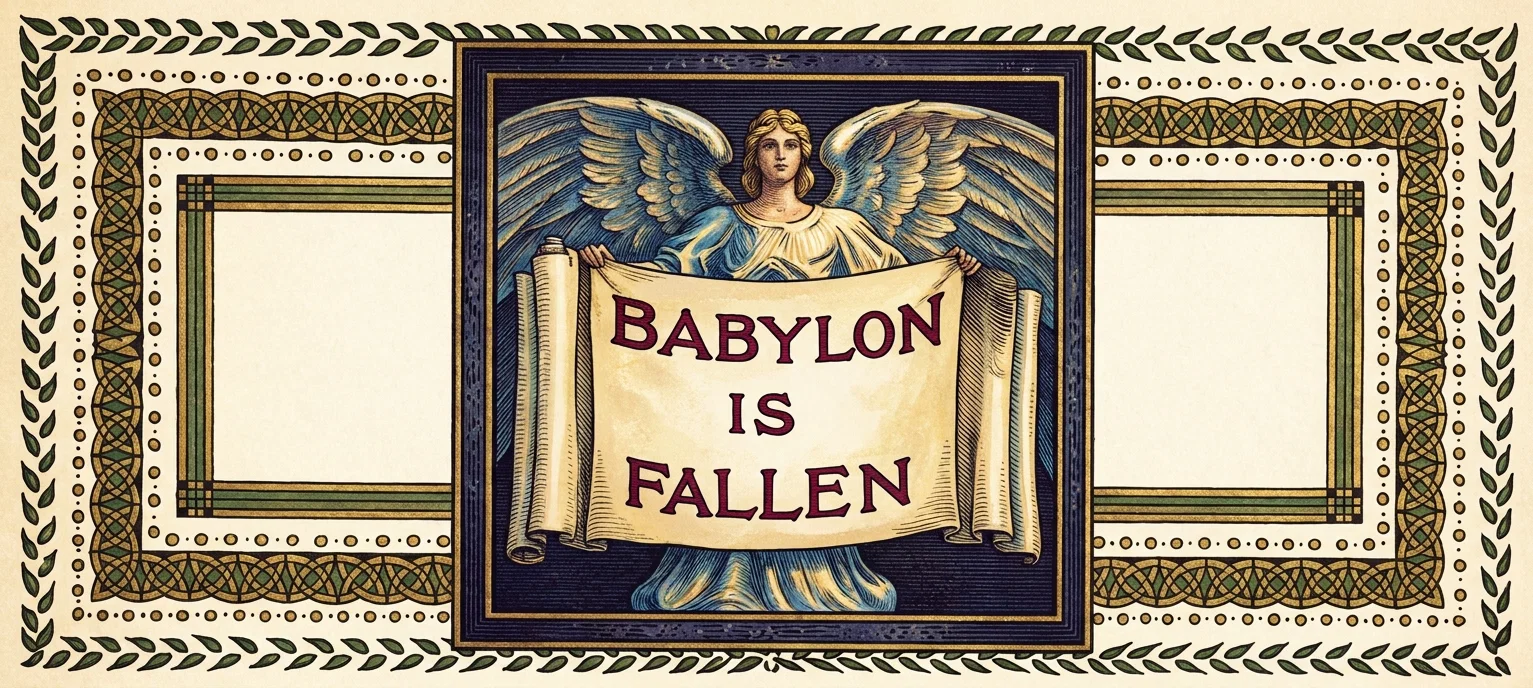 BABYLON IS FALLEN
 A centrally framed, historic-style scene shows a lone warrior or traveler standing in profile on a high stone platform, facing right and holding a tall spear. The figure wears a richly patterned dark cloak, tunic, leggings, and sandals, with long hair gathered behind the head. Below and beyond him stretches a rugged range of green mountains beneath a glowing sunset sky streaked with purple, pink, orange, and yellow. The central panel is surrounded by an elaborate symmetrical ornamental border in deep blue, cream, gold, and black, featuring curling foliage, stylized flowers, leaves, dotted decorative fields, and geometric framing; no text or lettering is visible.
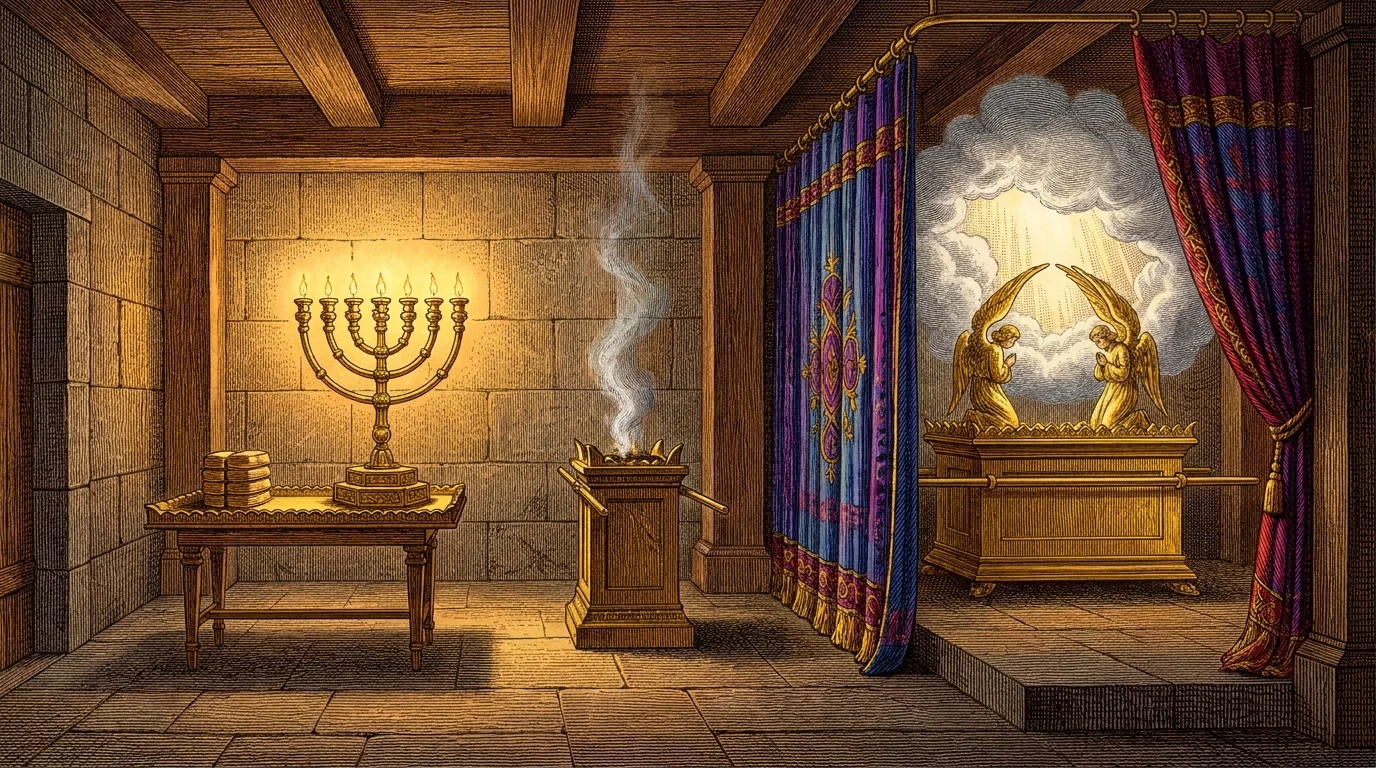 An ornate interior of the ancient Hebrew sanctuary is shown in warm, wood-toned engraving. At left, a seven-branched golden lampstand with lit flames stands on a table beside stacked loaves of bread. Near the center, a small altar emits a curling column of incense smoke, with implements resting against it. At right, richly patterned blue and crimson curtains open into the inner chamber, where a golden ark or chest is crowned by two winged cherubim facing each other beneath radiant light and clouds. Stone walls, beams, tiled flooring, and a raised threshold frame the solemn space.
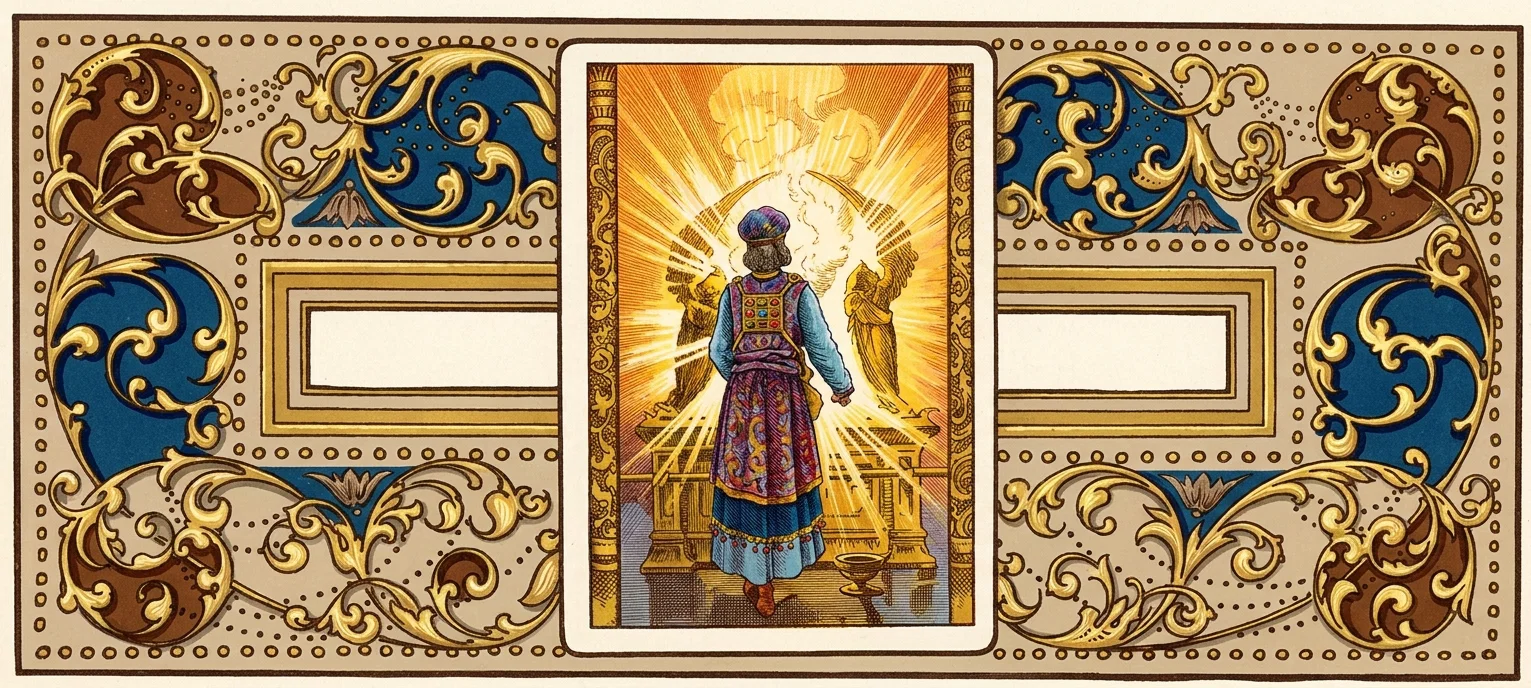 An ornate, symmetrical decorative panel surrounds a central framed religious scene. In the central image, a richly robed figure viewed from behind stands inside a radiant sanctuary, facing a brilliant opening or heavenly apparition. A winged angelic figure appears at the right amid clouds and intense golden rays, while architectural elements, columns, steps, and vessels suggest the Holy of Holies. The surrounding design features elaborate blue, brown, cream, and gold scrolling foliage, dotted borders, and empty rectangular cartouches on both sides; no lettering is visible.
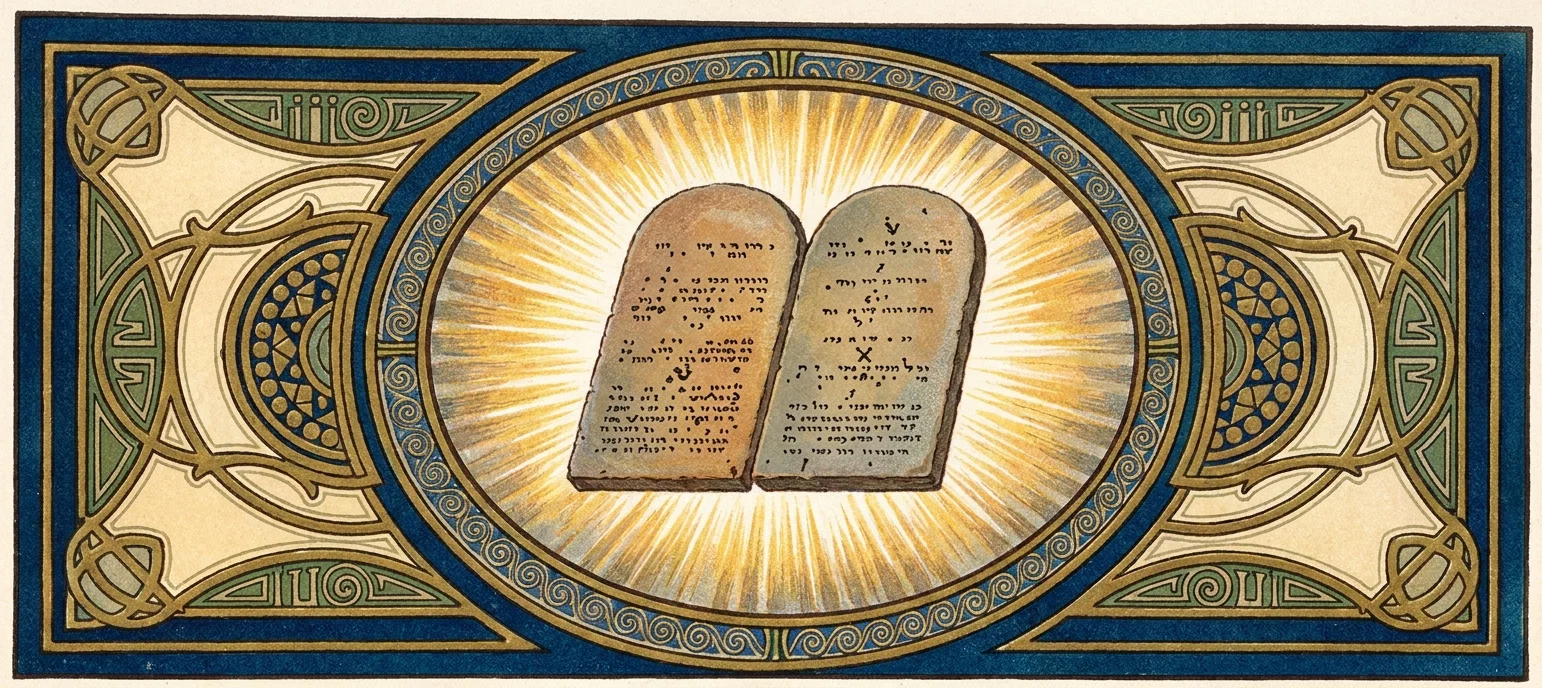 A symmetrical ornamental panel centers on two stone tablets bearing rows of Hebrew lettering, representing the divine law. The tablets stand upright within a large circular medallion and are surrounded by radiant golden-white beams, emphasizing their sacred significance. The medallion is edged with intricate blue and gold spiral ornament, while elaborate Art Nouveau-style green, cream, gold, and blue scrollwork fills the surrounding rectangular border. Geometric knot-like motifs decorate the corners and side panels, creating a richly illuminated, ceremonial composition.
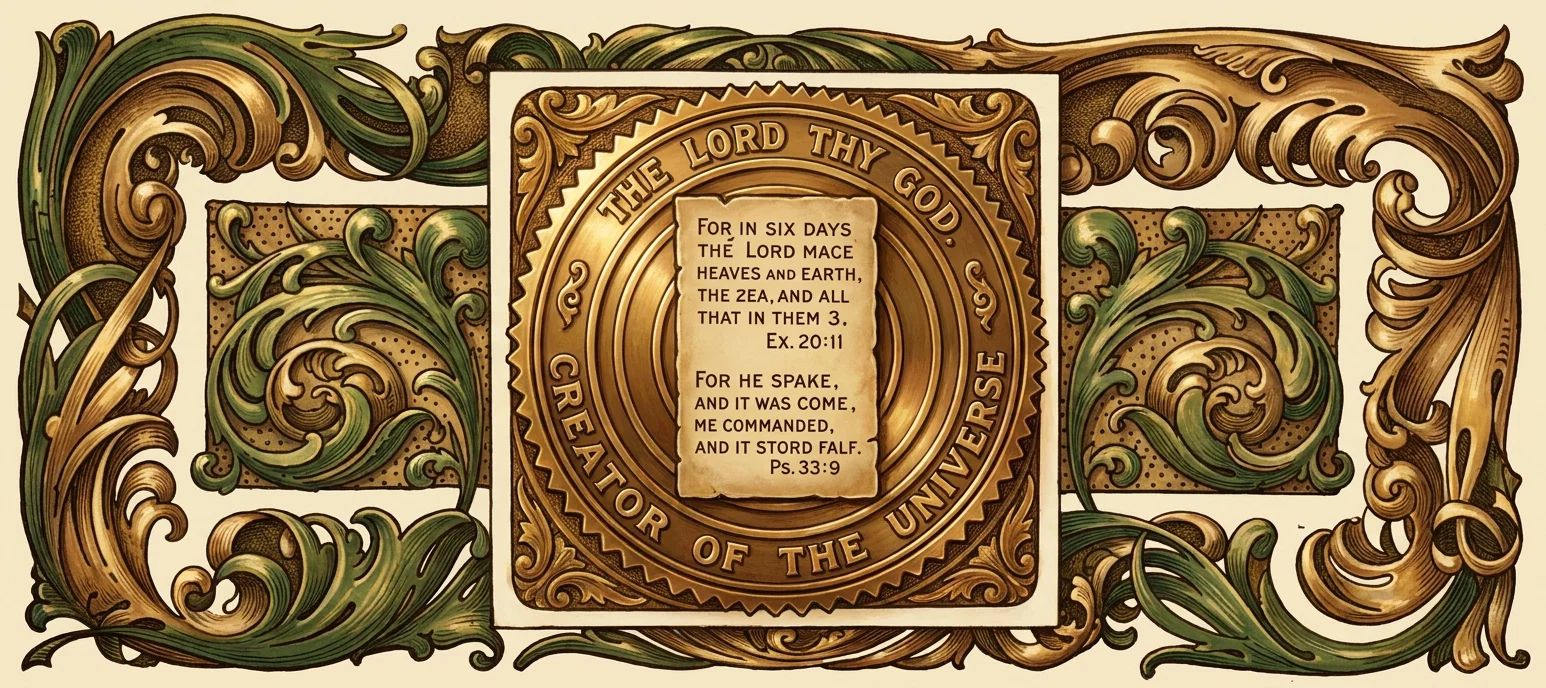 THE SEVENTH DAY IS THE SABBATH OF THE LORD THY GOD:
FOR IN SIX DAYS THE LORD MADE HEAVEN AND EARTH, THE SEA, AND ALL THAT IN THEM IS. EXOD. 20:11
FOR THE SEVENTH DAY GOD BLESSED, AND SANCTIFIED IT: BECAUSE THAT IN IT HE HAD RESTED FROM ALL HIS WORK WHICH GOD CREATED AND MADE. GEN. 2:3
THE SEVENTH DAY IS THE SABBATH OF THE LORD THY GOD:
FOR IN SIX DAYS THE LORD MADE HEAVEN AND EARTH, THE SEA, AND ALL THAT IN THEM IS. EXOD. 20:11
FOR THE SEVENTH DAY GOD BLESSED, AND SANCTIFIED IT: BECAUSE THAT IN IT HE HAD RESTED FROM ALL HIS WORK WHICH GOD CREATED AND MADE. GEN. 2:3 A colorful architectural scene is framed by elaborate symmetrical Art Nouveau–style floral ornament. In the central panel, a densely built historic town rises around a large Gothic cathedral complex, with multiple steep blue-gray roofs, pinnacles, towers, and a prominent tall pointed spire. Smaller houses, trees, and narrow streets fill the foreground and middle distance, while a sunlit landscape with greenery and low hills extends behind the buildings. The side panels feature curling red, blue, green, and gold leaves and vines enclosed by repeating arched border patterns. No lettering is visible.
 An ornate symmetrical panel frames two scenes of winged angels surrounded by stacks of books. On the left, a golden-winged angel in a flowing cream robe sits on piled volumes, writing with a pen in an open book. On the right, a pale-winged angel in a white robe stands atop more books, one hand raised while the other rests on an open volume; loose pages spill over the stack. Decorative blue, gold, and cream geometric and scrolling patterns fill the surrounding border. No prominent readable text appears beyond tiny indistinct marks in the open books.
 A symmetrical decorative panel frames a central classical marble sculpture of a seated, partially draped winged figure, likely an angel, resting on a rocky pedestal and gazing outward. On either side are matching hourglasses with sand gathered in the lower bulbs, enclosed within elaborate looping, interlaced floral or geometric ornament. Broad curling bands, dark patterned borders, and muted tan, brown, and cream tones give the composition an ornate antique appearance. No lettering or other text is visible within the artwork.
 A large, dark, mottled snake lies tightly coiled on the ground in a wooded, grassy setting, its body looping across the foreground and rising into a broad coil at the rear. The snake’s head is lowered near the center-front, with its mouth open and pale fangs visible, giving the scene a threatening appearance. Leaves, rocks, tufts of grass, and textured earth surround the animal. The central colored scene is enclosed by an ornate black-and-white border of curling acanthus-like foliage and decorative scrollwork; no lettering appears within the artwork.
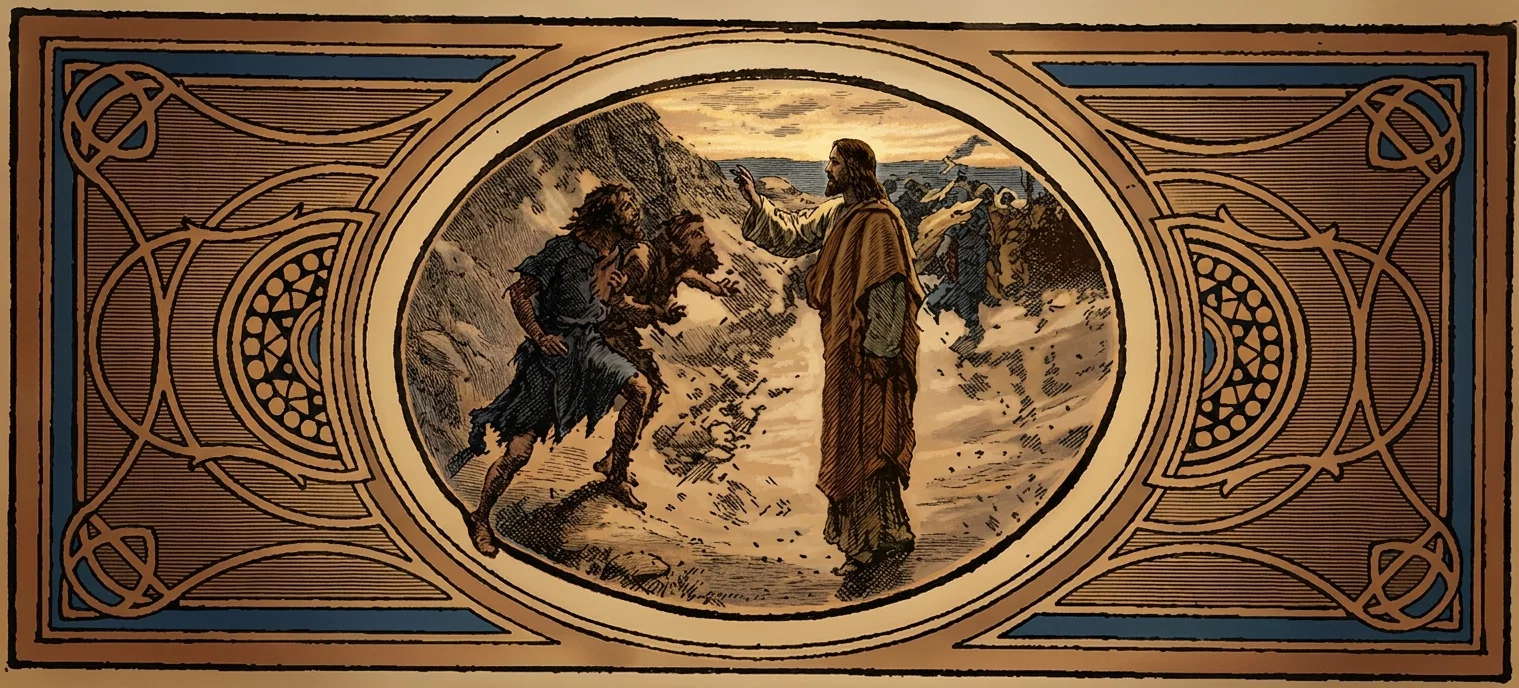 A central oval scene shows Jesus, dressed in a long brown robe and extending one hand, standing on a rugged mountain path. A disheveled, dark-clad man or spirit recoils and bends away before him, while a cluster of shadowy, contorted figures gathers among the rocks behind Jesus, suggesting evil spirits confronting him. Steep mountains and a pale, clouded sky form the background. The scene is surrounded by an elaborate geometric Art Nouveau-style border with interlacing curves, circular motifs, and dark blue, brown, and tan decorative panels; no lettering appears within the artwork.
 A large brown spider hangs at the center of an intricate, radiating web, its long legs spread against the fine white strands. The web spans a shadowy, dense forest scene, with tall tree trunks, moss-covered branches, ferns, tangled undergrowth, and a dim greenish pathway receding into the background. The composition places the spider prominently in the foreground, symbolically dominating the woodland setting. No people, signs, labels, or other visible text appear within the artwork.
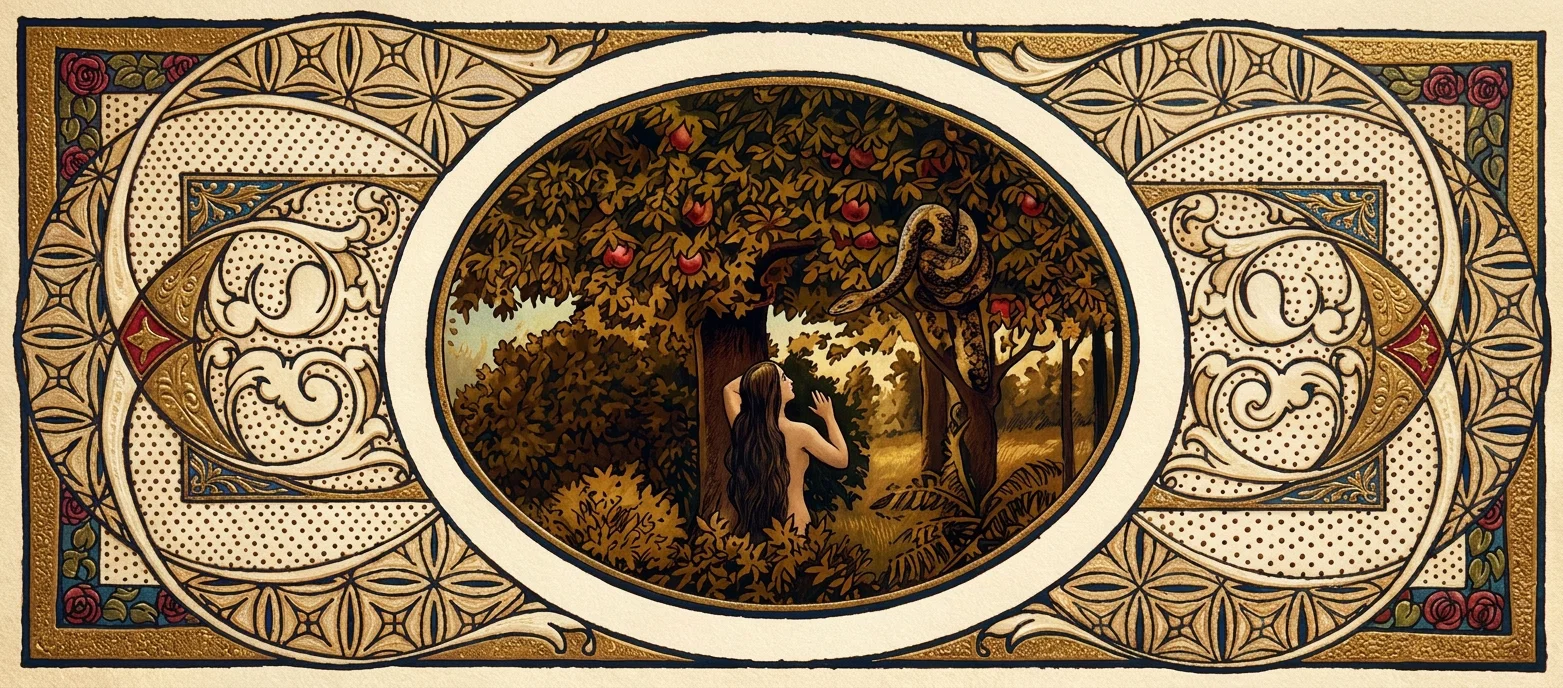 An ornate symmetrical Art Nouveau-style scene depicts Eve in the Garden of Eden, standing among dense foliage and reaching toward a serpent coiled in the branches of a fruit-laden tree. Eve, shown from behind with long dark hair and a bare upper body, faces the serpent as sunlight filters through the wooded garden. The central oval scene is surrounded by elaborate cream, gold, blue, and brown floral scrollwork, geometric leaf patterns, dotted panels, and red roses, with no visible lettering or text within the artwork.
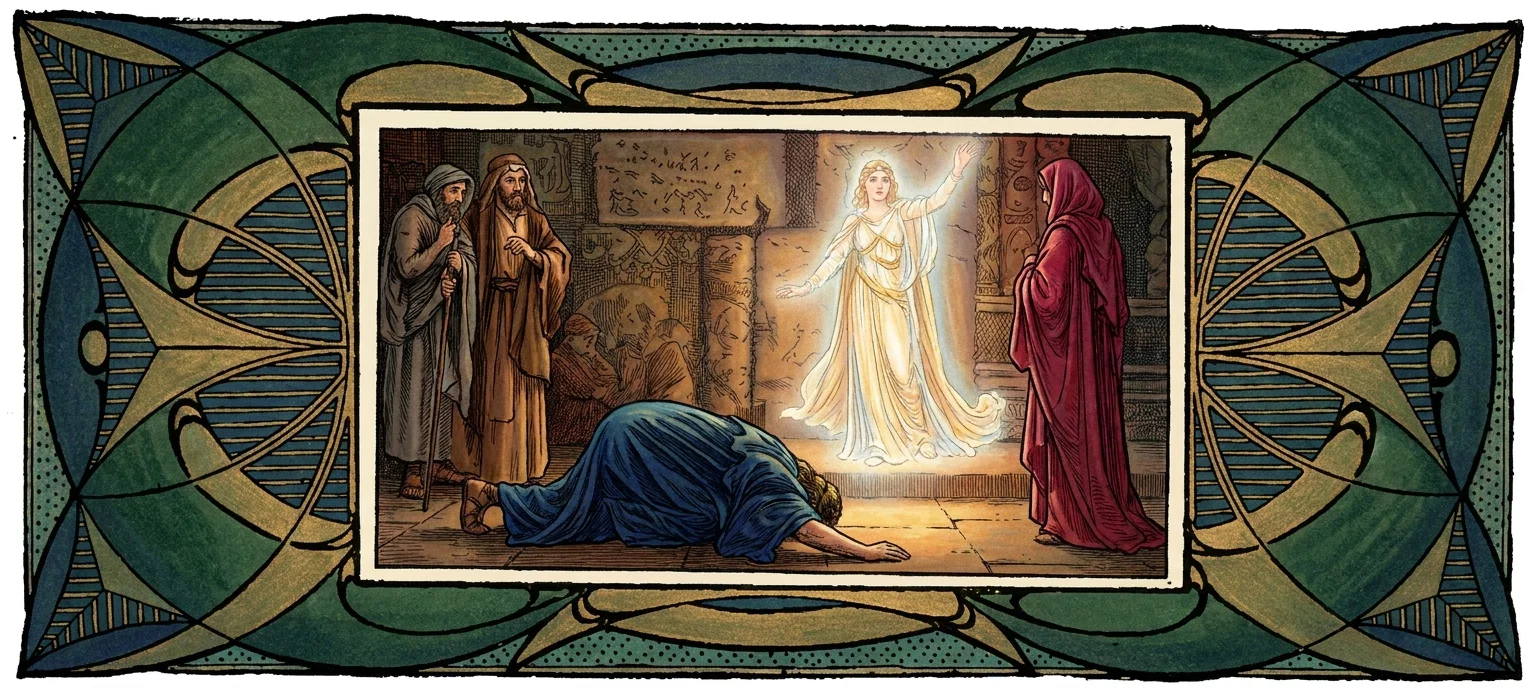 A dramatic ancient interior scene shows a luminous, angelic woman in flowing white robes extending one hand upward and the other outward, radiating light before a stone wall covered with hieroglyphic-like markings. In the foreground, a figure in blue lies prostrate on the tiled floor, reaching toward her. Two bearded, robed men stand at the left watching, while a woman in a deep crimson hooded robe faces the apparition from the right. The central scene is surrounded by an ornate symmetrical Art Nouveau border of interlacing green, blue, and gold geometric forms.
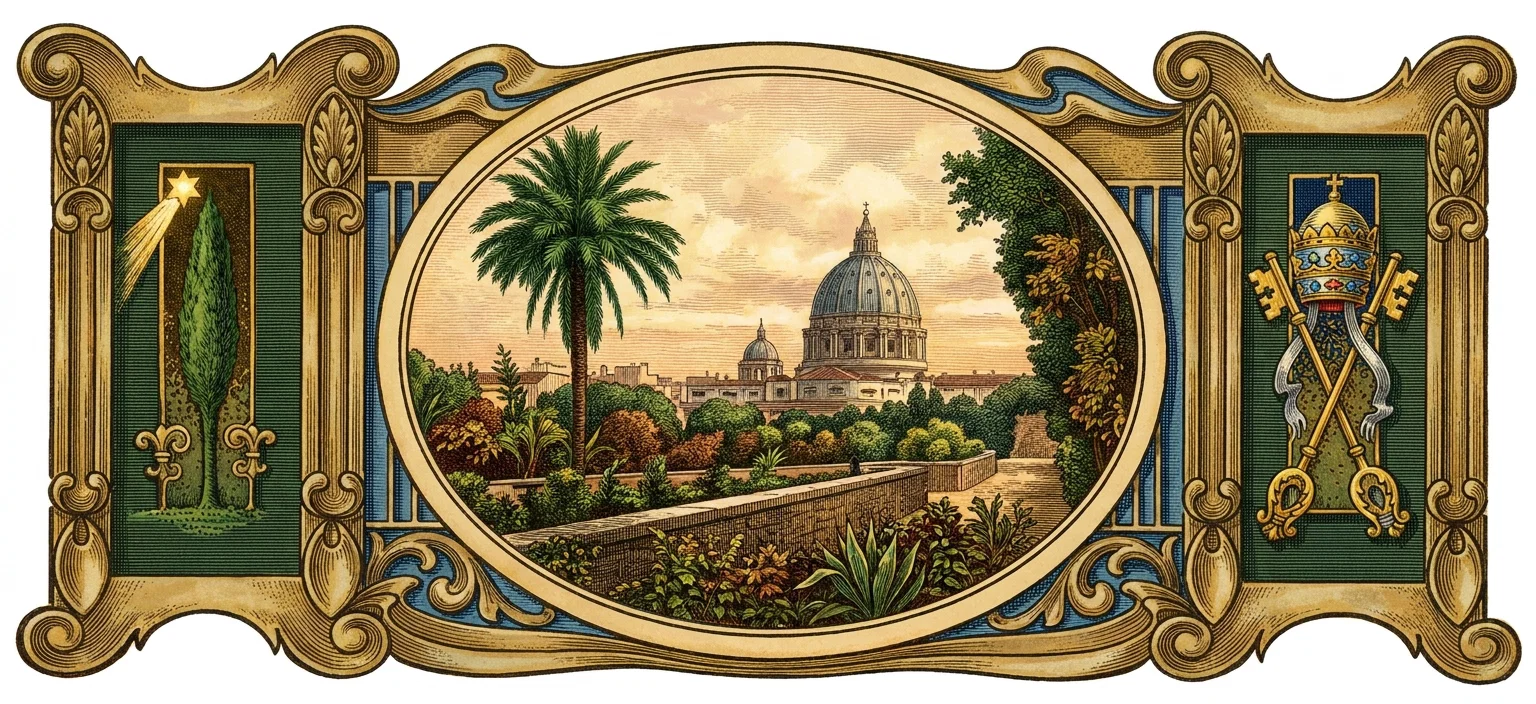 An ornate, symmetrical allegorical scene centers on a panoramic view of St. Peter’s Basilica, with its monumental domed church rising beyond a formal garden of palms, flowering shrubs, trees, terraces, and a low stone balustrade. The central landscape is enclosed in a large oval gilt frame with blue-and-gold scrollwork. At left, a dark green panel shows a tall cypress beneath a radiant star, flanked by decorative floral motifs. At right, a matching panel displays a papal tiara above crossed keys and a richly ornamented shield.
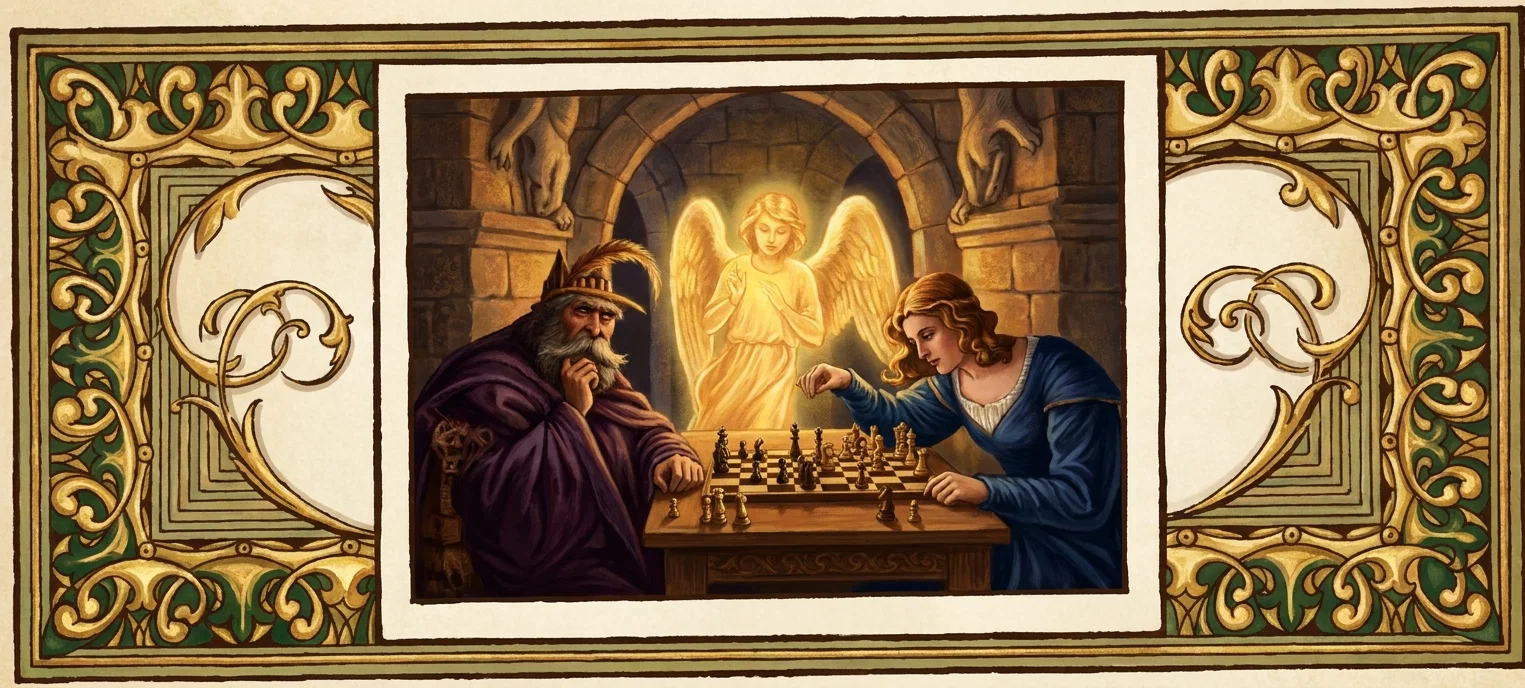 A richly colored scene shows an elderly, bearded man in a dark purple robe and feathered cap facing a young woman in a blue dress as they play chess at a wooden table. The woman reaches toward the arranged chess pieces while the man rests his hand thoughtfully near his face. Behind them, a luminous golden-winged angel stands within a stone archway, flanked by carved architectural figures. Ornate gold, green, and cream scrollwork frames the central scene on both sides, with no visible lettering or text.
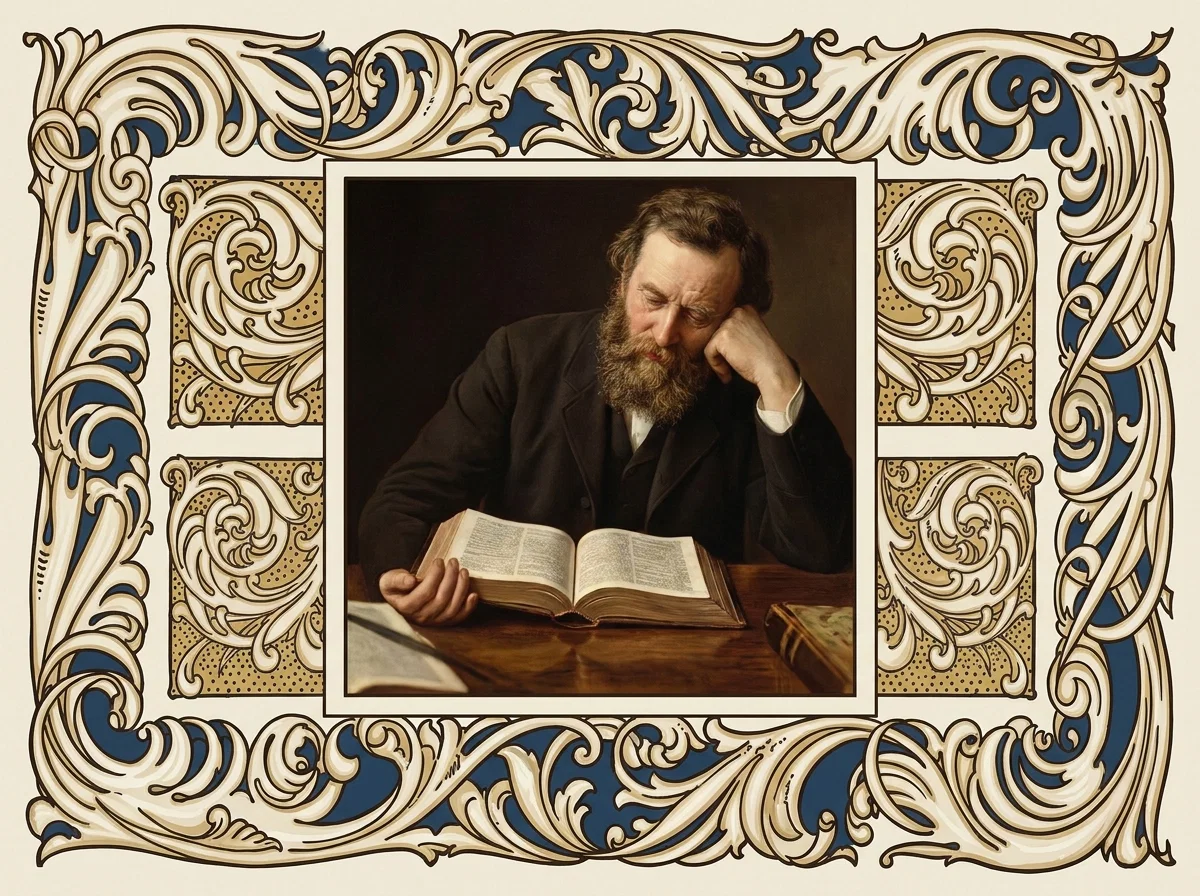 A bearded man in dark clothing sits at a wooden table, leaning his head into one hand while thoughtfully reading an open Bible. The central portrait is surrounded by an elaborate decorative frame of cream, tan, dark blue, and black scrolling foliage, with symmetrical acanthus-like curls and ornamental panels along the sides. Additional books or papers lie on the table in the foreground and at the right. The open pages contain dense printed text, but no legible lettering or other distinct words are visible.
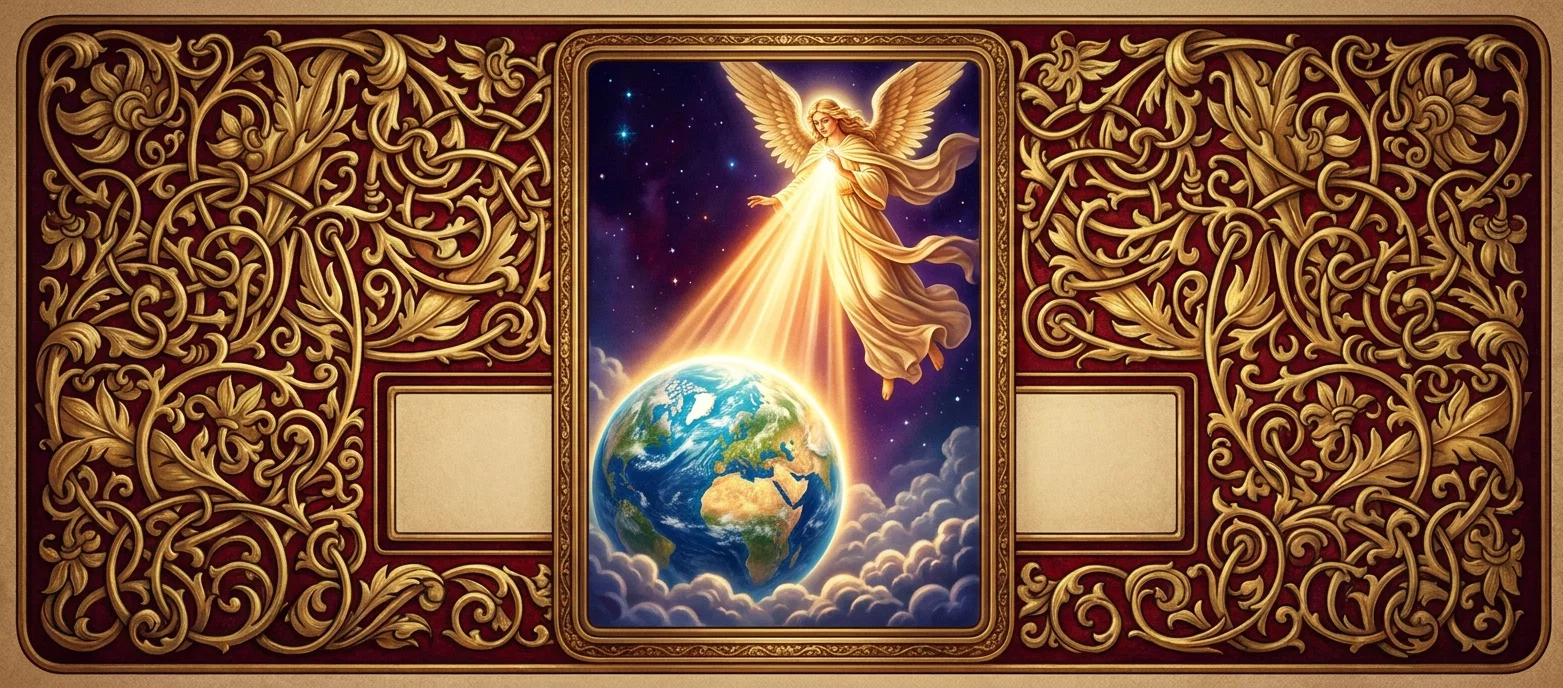 A luminous winged angel in flowing white and golden robes hovers above the Earth, extending one hand while radiant beams stream downward from the figure toward the globe. The Earth is shown prominently with recognizable continents, including Europe, Africa, and Asia, suspended amid billowing clouds. A deep purple and blue star-filled sky forms the background. The central scene is surrounded by an elaborate symmetrical frame of richly ornamented gold foliage and scrollwork on a dark red ground, with two blank rectangular panels flanking the image. No lettering is visible.
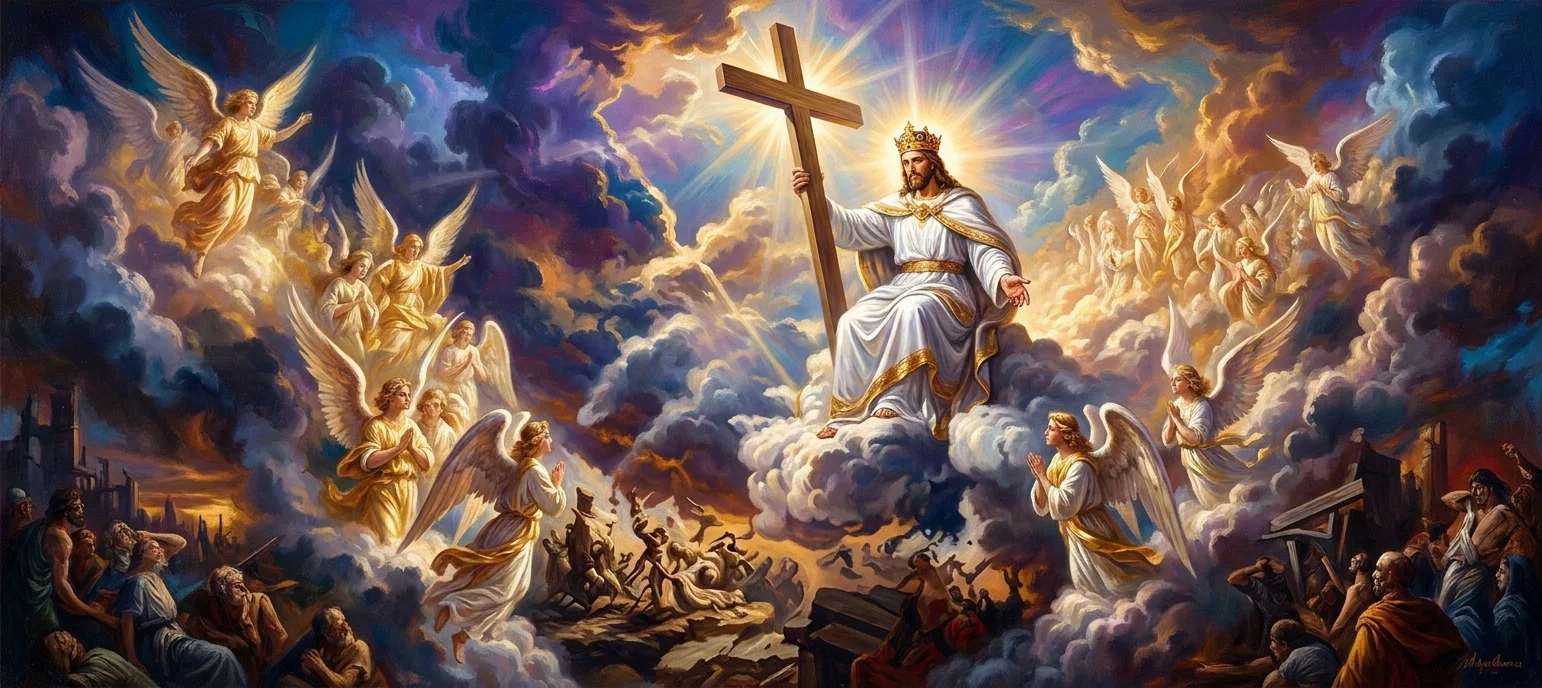 A dramatic heavenly scene shows Christ enthroned on luminous clouds at center, crowned and robed in white with gold trim, holding a large wooden cross while extending his other hand. Radiant light breaks through dark, richly colored storm clouds behind him. Numerous winged angels in flowing pale garments surround him in ascending groups, some kneeling or praying. Below, a turbulent earthly crowd gathers amid rugged ground, smoke, broken structures, and what appear to be weapons or debris, while shadowed observers occupy both lower corners. No legible text appears within the artwork.
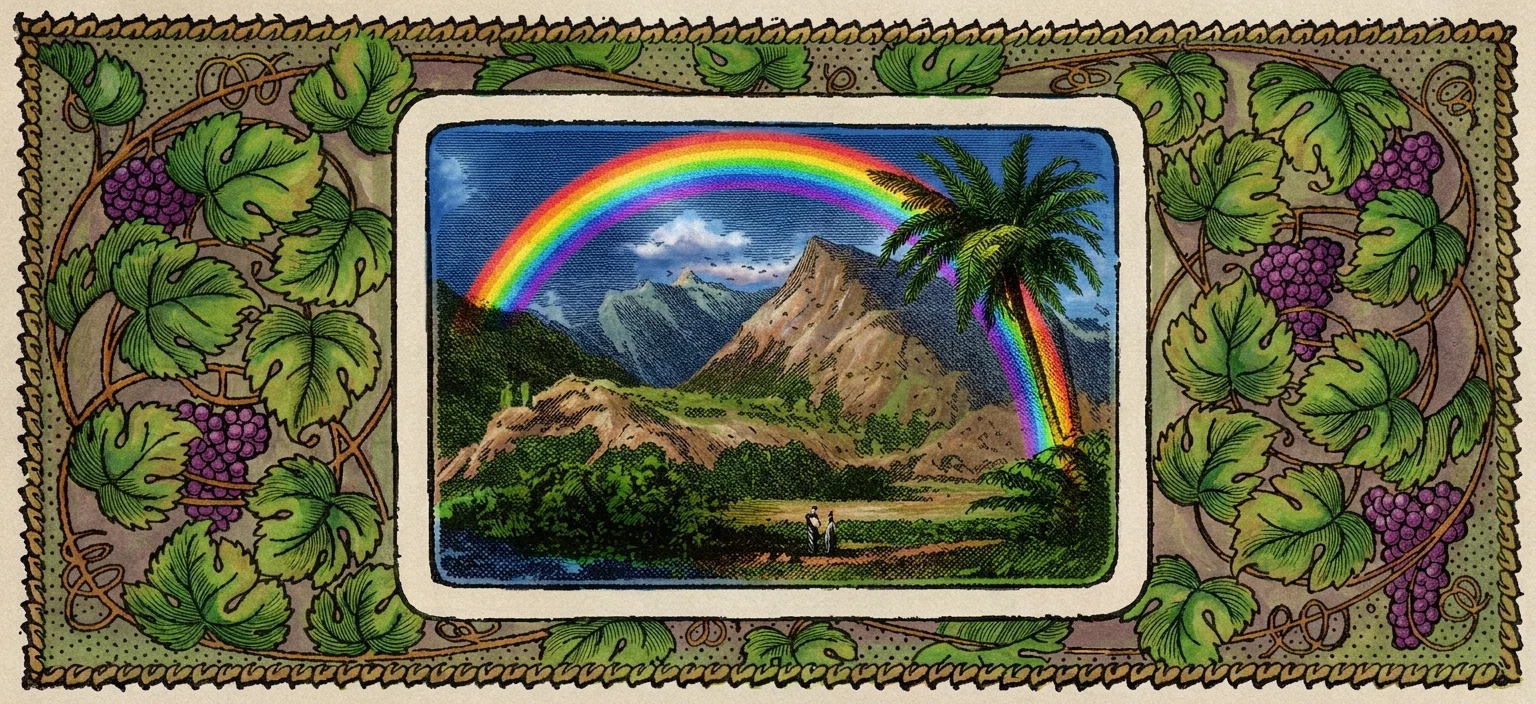 A vivid landscape shows a rainbow arching across a blue, cloud-filled sky above rugged, towering mountains. A second brilliant rainbow appears beside a tall palm tree on the right, descending toward the green valley. Dense forests and shrubs surround a calm dark-blue body of water in the foreground, while two small figures stand together on a path or open bank near the center. The scene is framed by an ornate border of curling vines, large green grape leaves, and clusters of purple grapes.
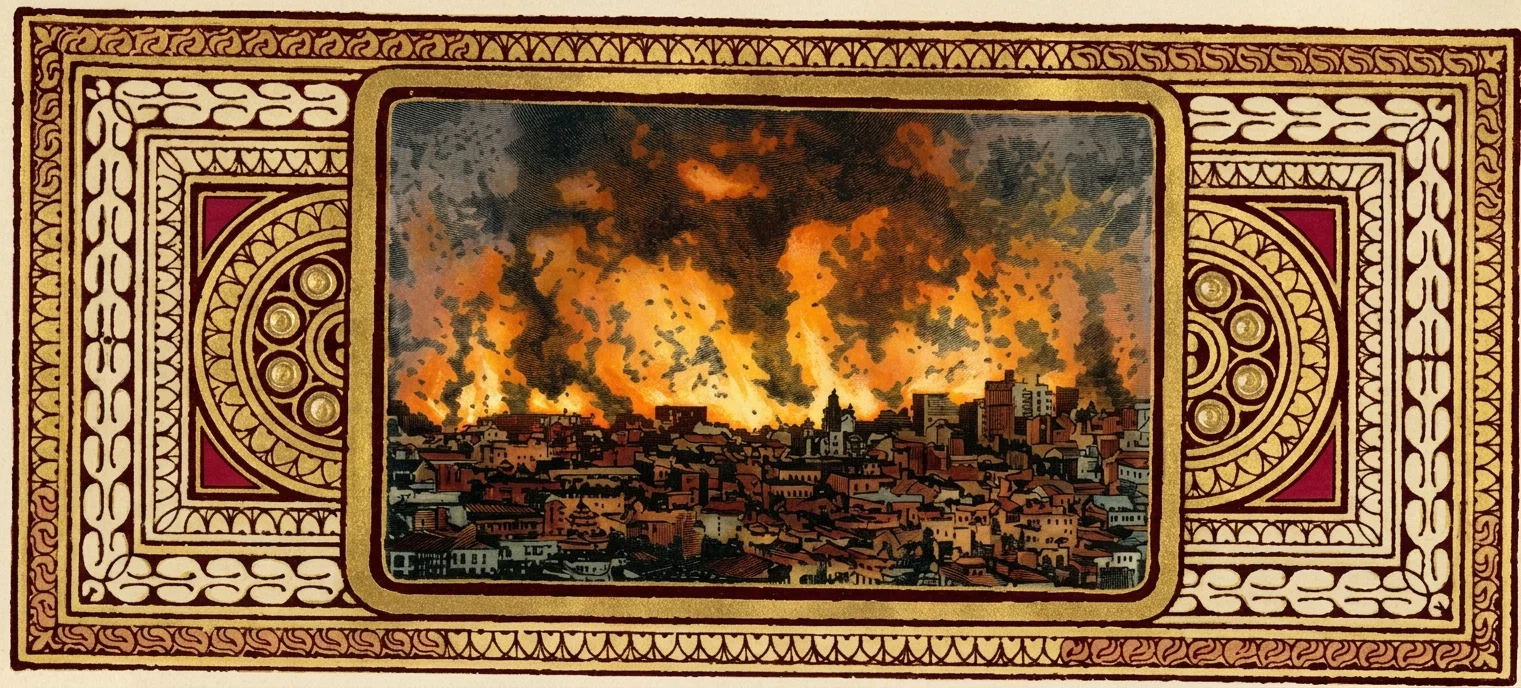 A densely built city stretches across the foreground beneath a vast, turbulent sky engulfed in orange flames, black smoke, and dark, billowing clouds. The skyline includes tightly packed low rooftops, varied masonry buildings, a prominent church or tower near the center, and several taller modern structures toward the right. The fiery glow silhouettes the city and suggests widespread destruction, while no individual people or animals are visible. An elaborate symmetrical decorative border surrounds the scene, featuring geometric bands, scrolling motifs, circular medallions, and muted red, gold, cream, and brown tones.
 A richly ornamented emblem fills the image. At the center, a jeweled golden crown rests within the frame of a classical harp, whose strings rise to a curved crossbar topped with small decorative knobs. Long green palm or laurel leaves fan outward behind the harp against a stippled gray-blue panel. The central scene is enclosed by a rectangular gold-lined border, while elaborate surrounding decoration consists of curling green foliage, clusters of dark blue berries, and sweeping gold scrollwork, with a narrow blue ornamental flourish along the bottom.