Āb'a-cŭs, n.
n. [Lat. abacus, and abax: Gr. ἄβαξ, from the names of the first letters of the Greek alphabet. By some it is derived less probably from Gr. βαστάζειν, to bear, to carry; by others it is supposed to be a prefix, and βακ is compared with the Ger. bank, bench, Pr. abac, It. abbaco.]
- A drawing-board; a tray strewn with dust or sand, anciently used for drawing, calculating, &c.
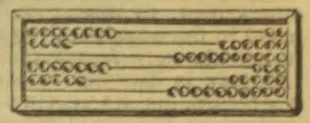
- A calculating-table; an instrument for performing arithmetical calculations by balls sliding on wires, or counters in grooves, the lowest line representing units, the second tens, &c.;—also called abacus Pythagoricus.
- A board, tray, or table, divided into perforated compartments, for holding cups, bottles, or the like; a cupboard; a buffet; a sideboard.
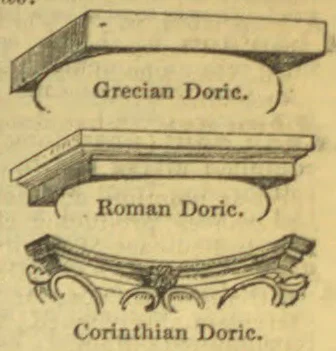
- (Arch.) (a.) A tablet, panel, or compartment in ornamented or mosaic work. (b.) The upper plate upon the capital of a column, supporting the architrave.
- An ancient game played on a board.
Abacus harmonicus (Mus.), an ancient instrument for dividing the intervals of the scale.