Bärk1, n.
n. [Dan. & Sw. bark, Icel. börkr, L. & H. Ger. borke.]
- The exterior covering of the trunk and branches of a tree; the rind.
- Specifically, Peruvian bark.
5 entries under this word
n. [Dan. & Sw. bark, Icel. börkr, L. & H. Ger. borke.]
[imp. & p. p. BARKED; p. pr. & vb. n. BARKING.]
n. The noise made by a dog.
v. i. [A-S. beorcan. Cf. Icel. barki, throat.]
Sense 1. To make the explosive noise of dogs and other canines. “The dog loud barking.” Wordsworth.
Sense 2. To pursue or annoy with continued vociferation or importunity; to clamor.
Therefore they bark, and say the Scripture maketh heretics. Tyndale.
Where there is the barking of the belly, there no other commands will be heard, much less obeyed. Fuller.
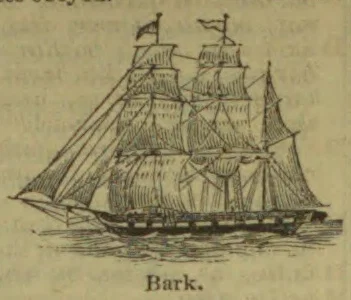
n. [Fr. barque, Wallachian barcë, Pr., Sp., Pg., & It. barca, D. & Sw. bark, Ger. & Dan. barke, L. Lat. barca, barcha, barga, Icel. barkr, skiff, barki, prow, Lat. baris, Gr. βᾶρις, a small and flat Egyptian row-boat, Coptic bari, a small boat, barahe, cart, boat.]
Sense 1. (Naut.) A three-masted vessel, having her fore and main masts rigged as a ship, and her mizzen as a schooner. Totten.
Sense 2. Any small vessel. “That fatal and perfidious bark.” Milton. “An armed barque.” Goldsmith.