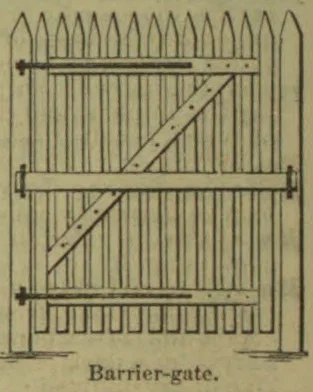
Bär'ri-er or Barrier-gate, n.
n. [Fr. barrière, Pr. & It. barriera, Sp. barrera, from barra, bar, q. v.]
Sense 1. (Fort.) A kind of fence made in a passage or retrenchment, to stop an enemy. It is usually a palisade or a stockade.
Sense 2. A fortress or fortified town on the frontier of a country. Swift.
Sense 3. Any obstruction; any thing which confines or which hinders approach or attack. “Constitutional barriers.” Hopkinson.
Sense 4. A bar to mark the limits of a place; any limit or boundary; a line of separation.
'Twixt that [instinct] and reason what a nice barrier? Pope.
To fight at barriers, to fight within lists. [Obs.]
Barrier-gate, a heavy gate to close the opening through a barrier.