Ear1, n.
n. [A-S. eare, O. Fries. are, ar, O. Sax. ora, ore, D. oor, Icel. eyru, Sw. öra, Dan. öre, O. H. Ger. ora, N. H. Ger. ohr, Goth. auso, Lat. auris, O. Lat. & Lith. ausis, Gr. οὖς.]
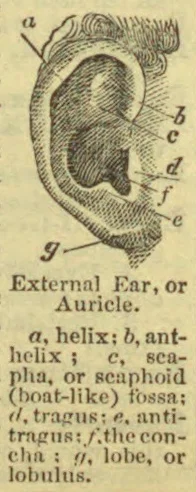
- The organ of hearing. In man and the higher animals it is composed of three portions; the external ear, which is a cartilaginous funnel, covered by the integument serving to collect sonorous vibrations and determine their direction; the middle ear, or drum of the ear, which is a bony cavity lined by mucous membrane, separated from the external ear by a delicate membrane, the membrana tympani, and containing a chain of small bones which transmit the vibrations of the latter to the third portion, the internal ear, in which are the terminal expansions of the auditory nerve. The internal ear consists of a bony cavity, the vestibule, which communicates with three semicircular canals, and with a bony structure in the form of a snail shell, called the cochlea, all occupied by the auditory nerve.
- The sense of hearing; the perception of sounds; the power of discriminating between different tones; as, a nice ear for music; — in the singular only.
Songs . . . not all ungrateful to thine ear. Tennyson. 3. Willingness to listen; attention; regard; heed. Lend me your ears; I come to bury Caesar, not to praise him. Shak.
- A part of any inanimate thing resembling in shape or position the ear of an animal; as, the ears of a tub, a skillet, or dish.
- [A-S. ear, D. aar, O. H. Ger. ahir, N. H. Ger. ähre, Icel., Sw., & Dan. ax, Goth. ahs.] The spike or head of a plant of Indian corn or other grain, containing the kernels.
First the blade, then the ear, after that, the full corn in the ear. Mark iv. 28. About the ears, in close proximity to; near at hand. — By the ears, in close personal contest; as, to set by the ears, to fall together by the ears, to be by the ears. — Up to the ears, deeply absorbed; almost overwhelmed.