Jăck1, n.
n. [Cf. Fr. Jacques, James.]
- A nickname or diminutive of John: as, (a.) A saucy or paltry fellow;—said in contempt or ridicule. (b.) A seafaring man.
- An instrument that supplies the place of a boy; as, (a.) An instrument to pull off boots; a boot-jack. (b.) A portable machine, variously constructed, for raising great weights through a small space, as by means of a pedestal or support, in which works a screw, lever, rack, and pinion, or some combination of simple mechanical powers. See also HYDROSTATIC JACK. (c.) An engine to turn a spit; as, a kitchen jack; a smoke jack. (d.) In general any appendage to a machine, rendering convenient service, as the vibrating levers of a stocking-frame.
- A young pike.
Mortimer. 4. [Fr. jaque, jacque, Sp. jaco, It. giaco.] A coat of defensive armor, quilted and covered with leather, worn particularly by horsemen; a buff jerkin; rarely, a coat of mail. Their horsemen are with jacks for the most part clad. Harrington. 5. A pitcher of waxed leather;—called also a black-jack. Dryden. 6. The mark at which the bowler aims his ball in wicket, &c. Shak. Like an uninstructed bowler who thinks to attain the jack by delivering his bowl straight forward upon it. W. Scott.
- The male of certain animals, as of the ass.
- A horse or wooden frame on which wood or timber is sawed.
- (a.) Half a pint. (b.) Quarter of a pint. [Prov. Eng.]
Grose. Pegge.
- A wooden wedge used by miners to separate rocks after blasting.
- (Mus.) The quill or the hammer which strikes the strings in a harpsichord, piano, &c.
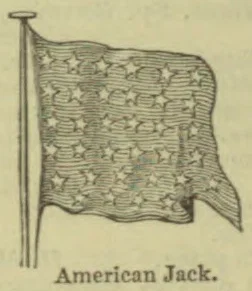
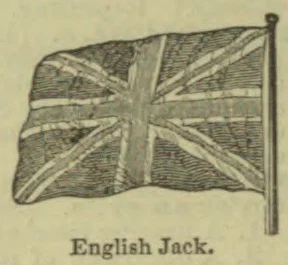
Moore. 12. (Naut.) (a.) A small flag, containing only the union, without the fly, usually hoisted at the bowsprit cap;—called also union-jack. (b.) The jack-cross-tree. R. H. Dana. Lifting Jack. Jack-screw. American Jack. English Jack. Jack is sometimes used adjectively to designate something cut short or diminished in size; as, a jack timber, a jack rafter, and the like. Jack-at-all-trades, a person who can turn his hand to any kind of business.—Jack-at-a-pinch. (a.) A person who receives unexpected calls to do any thing. (b.) A poor, hackney parson. Halliwell.—Jack-by-the-hedge, a plant of the genus Erysimum (E. alliaria, or Alliaria officinalis), which grows under hedges, bearing a white flower, and having a taste not unlike garlic;—called also in England sauce alone. Eng. Cyc.—Jack-in-a-box. (a.) (Bot.) A plant of the genus Hernandia, which bears a large nut that rattles in its pericarp when shaken. Loudon. (b.) A large wooden male screw turning in a female one. (c.) A child's toy, consisting of a box, out of which, when the lid is raised, a figure springs.—Jack-in-office, an insolent fellow in authority.—Jack-of-the-clock-house, a little man that strikes the quarters in a clock.—Jack-on-both-sides, one who is or tries to be neutral.—Jack-out-of-doors, a houseless person.—Jack-out-of-office, one who has been in office and is turned out.—Jack-with-a-lantern, an ignis fatuus, a meteor that appears in low, moist lands.