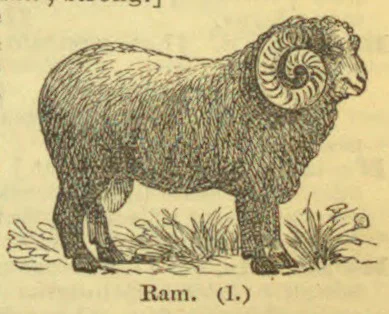
Răm1, n.
n. [A-S. ramm, ram, O. H. Ger. & D. ram, Prov. Ger. ramm, rammer, rammel, rammbock, perhaps allied to Icel. ramer, strong.]
Sense 1. The male of the sheep and allied animals;—in some parts of England called a tup.
Sense 2. (Astron.) (a.) Aries, the sign of the zodiac which the sun enters about the 21st of March. (b.) The constellation Aries, which does not now, as formerly, occupy the sign of the same name.
Sense 3. An engine of war, used for butting or battering; as, (a.) An instrument suspended by slings in a framework, and used for battering the walls of cities, &c.; a battering-ram. (b.) A steam ship or vessel, armed with a heavy steel or iron beak for piercing and destroying other vessels.
Sense 4. A machine for raising water by means of the momentum or moving force of the water of which a part is to be raised:—called also hydraulic ram or water-ram. [See Illust. under Hydraulic.]
Sense 5. The hammer of a pile-driver.
Sense 6. The piston of a hydraulic press.