Sāil1, n.
n. [A-S. segel, segl, O. H. Ger. sekal, segal, N. H. Ger. & Sw. segel, L. Ger. segel, seil, D. zeil, Icel. segl, Dan. segl, seil, Pol. z’agiel, O. Fr. sigle, Ir. & Gael. seol, W. hewl.] 1. A texture spread to the wind, to assist the progress of a vessel in the water; a sheet of canvas or of some substitute, as matting, extended by means of masts, yards, ropes, &c., as a means of locomotion by the action of the wind upon it. “Behooves him now both sail and oar.” Milton.
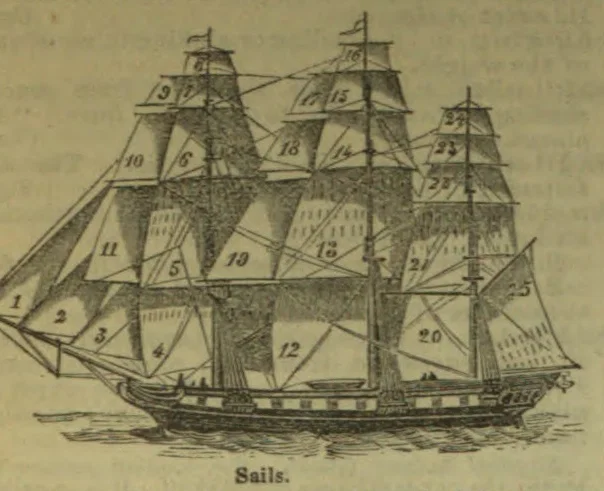
Sails. 1, flying jib; 2, jib; 3, foretop-mast-stay sail; 4, fore-course; 5, foretop sail; 6, foretop-gallant sail; 7, fore-royal; 8, fore sky sail; 9, fore-royal studding sail; 10, foretop-gallant studding sail; 11, foretop-mast studding sail; 12, main-course; 13, maintop sail; 14, maintop-gallant sail; 15, main-royal; 16, main sky sail; 17, main-royal studding sail; 18, maintop-gallant studding sail; 19, maintop-mast studding sail; 20, mizzen-course; 21, mizzen-top sail; 22, mizzen-top-gallant sail; 23, mizzen-royal; 24, mizzen sky sail; 25, mizzen-spanker.
Sense 2. Hence, a wing; a van. [Poet.]
Like an eagle soaring To weather his broad sails. Spenser.
Sense 3. A sailing vessel; a ship of any kind; a craft. ☞ In this use, the plural has usually the same form as the singular.
Sense 4. A journey or excursion upon the water; a passage by a sailing vessel.
Shoulder-of-mutton sail (Naut.), a triangular sail, so called from the peculiarity of its form. It is chiefly used to set on a boat’s mast. Totten. — To loose sails, to unfurl them. — To make sail, to extend an additional quantity of sail. — To set sail, to expand or spread the sails; and hence, to begin a voyage. — To shorten sail, to reduce the extent of sail, or take in a part. — To strike sail, to lower the sails suddenly, as in saluting, or in sudden gusts of wind; hence, to acknowledge inferiority; to abate pretension. — Under sail, having the sails spread.