Your ShelfYour Projects

Signs of the Times, Vol. 42, No. 5.

THE SOCIAL VOLCANO

Signs of the Times

Feb 2, 1915

Pacific Press Publishing Association · Mountain View, California · Feb 2, 1915

THE SOCIAL VOLCANO

The “Explosion” of War—The Social Conditions of the Old World That Preceded It—The Unrest in This Country, and What It Portends
It has been recognized that the conditions in society have been intensifying, particularly during the last twenty or twenty-five years. This is shown by the remarkable unrest, and, in many instances, manifestations of violence. But while men have recognized these conditions of social turbulence, they have nevertheless been surprised that our European war should have broken out as it did. As suggested by the Scientific American, “It came with the suddenness of an explosion of dynamite.”

THE TRUSTED FORCES FAILED

Dr. Thomas Edward Green, a vice president of the American Peace Society, says: “We had hoped that financial necessity would prove an unsurmountable obstacle to war. Not a nation of Europe that was not already face to face with economic tragedy. . . . We had hoped that the menacing figure of famine would have prevented war. With crops ungathered, fields untilled, ports blockaded, supplies exhausted, not alone the fighting millions in the field, but the helpless millions at home, helpless in the clutch of hunger, would have cried halt to the mad war plans of jealous kings. But regardless of famine, careless of the sure and awful specter of starvation, the terrible conflict marches on. “It is pitiful satire to say that we had hoped that Christian faith and obedience, the religion whose practice and profession have been our proudest and most sacred boast, would fend the Christian nations from war. Pius X was the only consistent ruler in the world, and he died of a broken heart as he prayed for peace. “The forces we trusted, have failed us. “And for the future they give no promise. . . . Out yonder is the horrid wreck and rack of battle. Yonder are hospitals stinking of putrid blood. Yonder are sodden fields soaked with carnage, laid out with windrows of grinning, ghastly dead. “The awfulness is indescribable. We have not yet invented adjectives with which to tell of the horror of ‘civilized warfare.’”
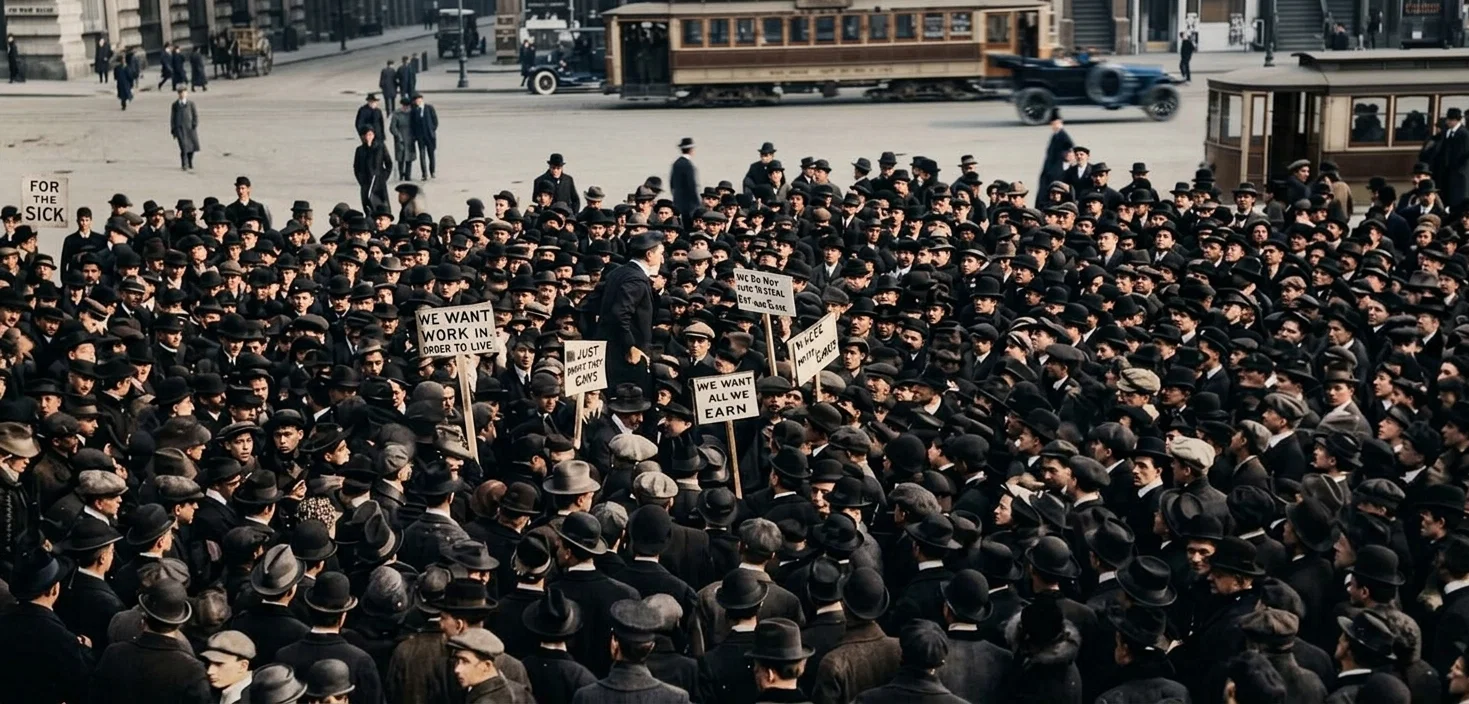
MEETING OF THE “UNEMPLOYED,” NEW YORK CITY
The doctor furthermore suggests that since these forces that had been trusted, have all failed, the one hope left is for the women of the world to band themselves together in a league to refuse absolutely to bear any more children unless they can be assured that they will not be sacrificed to the god of war.

THE WAR SHOULD NOT HAVE SURPRISED US.

While this great war of Europe came as an awful surprise to the great mass of mankind, yet those who are following the prophecies of the Bible would have been just as greatly surprised if something of the kind had not occurred in these days in which we live, for the prophecies plainly tell us that the nations will be angry in the closinghours of time. The furies among the nations will finally lead them as a maddened mob of nations to the great war of Armageddon so vividly set forth in the book of Revelation.
This European tornado of war was preceded by a series of years of great social unrest and upheaval. It was not such a very long time before the great war broke out that England had labor troubles that practically amounted to a civil war. Spain, France, Germany, Austria, Italy, Russia, and even Japan had internal conditions that were on a par with those in England, although in these latter nations they had not ripened into so much violence and war-like demonstration. These conditions were so intense in most of the nations, that some of the rulers really welcomed this horrible war as a sort of relief to the social troubles they were endeavoring to cope with and seeking to overcome.

THE SOCIAL VOLCANO IN THIS COUNTRY

In this country we are trying to comfort ourselves with the idea that we are at peace, and that there is no danger of our being involved in war; but the illustration on page one, which is so representative of conditions in general, ought to disabuse our minds. Current news dispatches inform us that there are a half million men in New York alone who are out of employment, and destitute of the necessities of life, and who are consequently becoming more and more turbulent.
Their banners displayed in this picture are truly significant. They say that they want work, and an opportunity to acquire in an honest manner, by their own exertions, an honorable livelihood. One of their banners is most suggestive in saying, “We want all we earn.” This banner expresses the belief held by so many millions of our population—that the working man is not getting his share of what is earned. The theory is that the working man gets but a mere pittance, while the great lords of finance seize the lion’s share.

THE RICH TO WEEP AND WAIL

One of the most startling prophecies in the Bible forecasts these conditions, and that prophecy would seem to be on the side of the contention of these laborers; for after warning the wealthy men of the conditions that are coming, and bidding them to “weep and wail” for the miseries that are coming upon them, the prophecy lays the charge of fraud at the doors of the wealthy men. A portion of that prophecy as given in the graphic language of the Twentieth Century Version is the following: “Listen to me, you rich men, weep and wail for the miseries that are coming upon you. Your riches have wasted away, and your clothes have become moth-eaten. Your gold and silver are rusted; and the rust on them shall be evidence against you, and shall eat into your very flesh. It was fire, so to speak, that you stored up for yourselves in these last days. I tell you, the wages of the laborers who mowed your fields, which you have been fraudulently keeping back, are crying out against you, and the cries of your reapers have reached the ears of the Lord of hosts. You have lived on earth a life of extravagance and luxury; you have indulged your fancies in a time of bloodshed. You have condemned, you have murdered, the Righteous One. Must not God be opposed to you?” James 5:1-6.
Of course it would be wrong to say that all men of wealth are fraudulent and dishonest, but the facts show that the majority of them are. And these facts are most strikingly in harmony with this prophecy. There is scarcely a city of any size or consequence in this country that is not battling with the problem this winter of the “army of the unemployed.” Chambers of commerce, city councils, and church federations are holding meetings to discuss ways and means by which the difficulties may be met. And in the midst of all of this social turmoil, men are trying to teach us that regardless of these conditions, we may depend upon continued peace and prosperity.

BUT ONE PROSPECT OF PEACE

We are assured by many men who try to pose as optimists that everything is coming out all right. But a true optimist is an individual who recognizes existing facts and conditions, and who draws his conclusions accordingly. There is absolutely no prospect for peace in this world until that great and glorious day of the coming of the Prince of peace Himself in the clouds of heaven. That is the one bright event before the world, and the only one. The individual is blind who cannot see that the conditions all over this world forebode increasing turbulence, violence, strife, and war. And he is doubly blind who turns away from the clear light of prophecy, and refuses its teaching; for it not only foretells the prevalence of these conditions, but also tells us what they mean.
If you have allowed the dust to accumulate on your Bible, you should brush it off, and begin to study the Book as never before. We leave it to the candid consideration of the reader if anything that may be found in current literature is so thoroughly up to date on the capital and labor problems as the prophetic utterances quoted in this article, and that were written by the apostle James nearly two thousand years ago. There is much more prophecy in the great book of God, and it is all timely and clear, and should be devoutly studied in these perilous days into which the world has come.

The Development and Exercise of Faith

The Medium of Contact with the Infinite—Ingredients of Faith—Made a Friend of God—The Experience Producing It
By Roderick S. Owen
THIS is the second of several articles that Elder Owen has prepared on the experiences of Abraham in developing the mighty faith that made him the friend of God. Each article is independent and complete in itself, and hence may be read with profit whether you have the opportunity or not to read all. The subject of faith is of paramount importance, and we bespeak for these articles a wide reading and careful study.
“SEEST thou how faith wrought with his works, and by works was faith made perfect?” James 2:22. “Now faith is the substance of things hoped for, the evidence of things not seen.” Heb. 11:1. Many people look upon the exercise of faith as some great or marvelous feat to be performed by the mind, whereas it is in reality a very simple operation. I do not mean by this that there is nothing marvelous connected with faith; for the results and achievements of faith are not only marvelous, but incomprehensible, as is shown by the examples given in the eleventh chapter of Hebrews.

THE CONTACT WITH THE INFINITE

Faith connects finite man with an infinite God. Faith introduces into our experiences an infinite power, even that power which shapes worlds out of nothingness. The marvelous part of faith lies in the results, which belong to God’s part. Our part, as I have said, is very simple. The text quoted shows that in the working of the mind, faith and hope are closely associated. Yet no one looks upon hope as a strange or mysterious thing.
Let us analyze a little more closely. The mind will not hope for a thing until that thing is sincerely desired. Hence we say that hope is born of desire. But hope is made up of desire and expectation. We cannot expect a thing until we have some evidence that leads us to think that it may be attained. Desire may come without such evidence, but hope must have evidence on which to rest.
Expectation, which, we see, is a prominent element in hope, is also a principal element in faith. With a sincere hope, we have already entered the domain of faith. Thus in the exercise of faith, we must first have a sincere desire; then we must have hope based upon evidence that leads us to expect; and then faith will come in and confirm our hope, “for faith is the substance of things hoped for, the evidence of things not seen.”
In all spiritual matters, the evidence upon which both faith and hope must rest is the promise or word of God. Standing on any other foundation, our supposed faith is nothing but fanaticism, and our hope must end in complete disappointment. The apostle James, in reasoning upon the subject of faith and its development, says: “Even so faith, if it hath not works, is dead, being alone. Yea, a man may say, Thou hast faith, and I have works: show me thy faith without thy works, and I will show thee my faith by my works. Thou believest that there is one God; thou doest well: the devils also believe, and tremble. But wilt thou know, O vain man, that faith without works is dead?” James 2:17–20.

FAITH AND WORKS INSEPARABLE

Here we are taught that faith and works are inseparable. Faith, a living faith, must find expression in works. Here we are also taught that saving faith is something more than belief; for devils believe, but they have no saving faith.
Paul tells us that Enoch, before his translation, pleased God; but “without faith it is impossible to please Him: for he that cometh to God must believe that He is, and that He is a rewarder of them that diligently seek Him.” Thus we see that saving faith is made up of three things, works, belief,and confidence; and these three, combined in Enoch’s experience, led him to translation. So with the remnant. Belief in God, confidence in God, and works in God, will bring them to the same experience.
But what were the works by which Enoch came to God?—They were works which pleased God. Then they were works of obedience, for with works of disobedience God could not be pleased. They were works in which he walked with God. Then they were works that agreed with God; for how can two walk together, except they are agreed? Again, they are works of obedience; for no works of disobedience would agree with God. Then “coming to God” and “walking with God” mean to come into harmony with His will and to walk in harmony with that will; but as without faith it is impossible to please God, then all these works are works of faith, and works of faith and works of obedience are identical.

THEIR EXPERIENCES MADE THEM FRIENDS

The apostle James, in chapter two, after stating that faith without works is dead, cites the case of Abraham, saying: “Was not Abraham our father justified by works, when he had offered Isaac his son upon the altar? Seest thou how faith wrought with his works, and by works was faith made perfect? And the scripture was fulfilled which saith, Abraham believed God, and it was imputed unto him for righteousness: and he was called the friend of God.” Verses 21–23. “A friend of God”! Similarity of experiences, specially in suffering, always draws hearts together, and makes friends of the participants. So Abraham, in the three days during which he saw his son as dead, was led to appreciate the sacrifice of God, whose dear Son was slain for our transgressions, and bruised for our iniquity.
Could we all appreciate this fact, we would all be friends of God. Abraham is also called “the father of all them that believe.” A father is one who stands at the head. Abraham is placed at the head of all who have faith, because his faith was submitted to the severest possible trial, which is, to be placed where the command of God seems to cut off the fulfillment of His promise. God had said that in Isaac should all nations be blessed. Then God said to take Isaac and offer him as a burnt offering. This of course would destroy the one in whom the promise centered, and would seem to cut off the possibility of its fulfillment. But Abraham had acquired such confidence in God—such an assurance that God’s promise could not fail—that he by faith grasped something that never had occurred in the history of the world before; to wit, a resurrection from the dead, “accounting that God was able to raise him up, even from the dead; from whence also he received him in a figure.”
The Jewish nation, the professed children of Abraham, were brought to a place where, if the people had walked in the steps of their father Abraham, and had accepted Jesus of Nazareth as the promised seed, they could have exercised the faith of Abraham. For even though the entire nation had accepted Jesus as the Messiah, still the Romans would have put Him to death; and the Hebrews, exercising the faith of Abraham, would have seen Him, the One in whom the promise centered, slain as a sacrifice, while they by faith would have grasped the thought that God was able to raise Him even from the dead, and they would have received Him not in a figure, but in the blessed reality of a risen Saviour.
What a glorious triumph of faith that would have been! O, if they had known the day of their visitation! O, if they had known the things that belonged to their peace! But worldly ambition, blinding their eyes, hid the things of faith from their view, and they went down in the destruction that followed.
There is great danger that the professed children of God to-day may fall after the same example of unbelief and worldly ambition.
Thus we have found that God accounted Abraham righteous in response to an imperfect faith. Then during a period of about forty years, Abraham, by seeking to do just what God asked of him, although he often failed, at last developed a perfect faith, which enabled him to endure the severest possible test; and the righteousness which had been accounted or imputed to him, became a reality in his experience. Thus the scripture was fulfilled that said, “Abraham believed God.”
So to-day God is seeking for children of Abraham—children of faith—who will do just what He asks of them, without stopping to know more than simply that God says so, and who will do just what He says, even though it may seem unreasonable—yea, even though it may seem to conflict with the promises of God. Such a people will agree with God, will walk with God, and like Enoch, will be translated. Such a people will have the faith of their father Abraham, and with him will share the inheritance.

DESTROYING THE INFLUENCES OF THE WORD

Deceitful Forces That Work to Overthrow Us—But We Hold Secure the Power of Choice—May Determine Our Own Future—The Sinful and the Imperfect Called to the Rich Treasure House of Truth
By MRS. E. G. WHITE
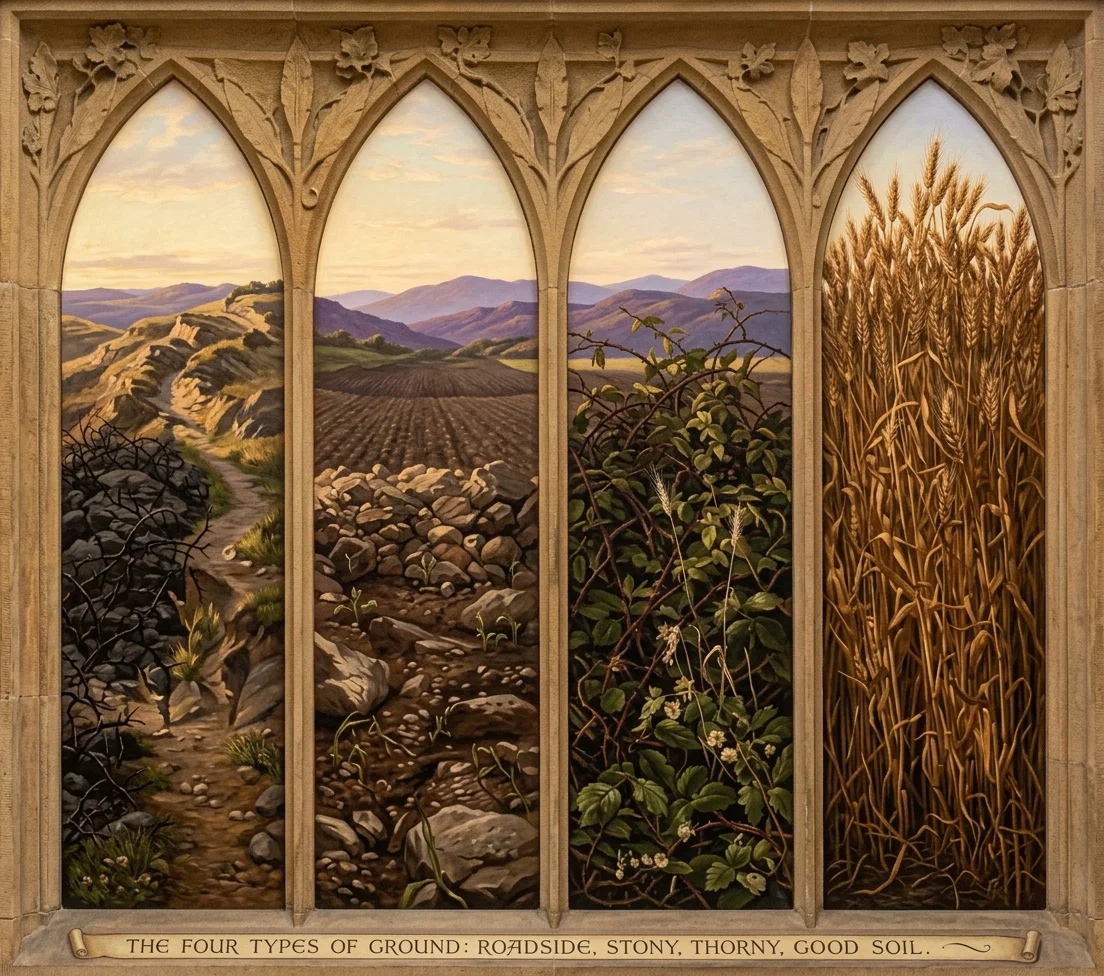
“He also that received seed among the thorns is he that heareth the Word; and the care of this world, and the deceitfulness of riches, choke the Word, and he becometh unfruitful.” Matt. 13:22.
The gospel seed often falls among thorns and noxious weeds; and if there is not a moral transformation in the human heart, if old habits and practices and the former life of sin are not left behind, if the attributes of Satan are not expelled from the soul, the wheat crop will be choked. The thorns will come to be the crop, and will kill out the wheat.

Must Be Constantly Prepared

Grace can thrive only in the heart that is being constantly prepared for the precious seeds of truth. The thorns of sin will grow in any soil. They need no cultivation; but grace must be carefully cultivated. The briars and thorns are always ready to spring up, and the work of purification must advance continually. If the heart is not kept under the control of God, if the Holy Spirit does not work unceasingly to refine and ennoble the character, the old habits will reveal themselves in the life. Men may profess to believe the gospel; but unless they are sanctified by the gospel, their profession is of no avail. If they do not gain the victory over sin, then sin is gaining the victory over them. The thorns that have been cut off but not uprooted grow apace, until the soul is overspread with them.
Christ specified the things that are dangerous to the soul. As recorded by Mark, He mentions the cares of this world, the deceitfulness of riches, and the lusts of other things. Luke specifies the cares, riches, and pleasures of this life. These are what choke the Word, the growing spiritual seed.

He Will Carry Our Burden

“The cares of this world.” No class is free from the temptation to worldly care. To the poor, toil and deprivation and the fear of want bring perplexities and burdens. To the rich come fear of loss and a multitude of anxious cares. Many of Christ’s followers forget the lesson He has bidden us learn from the flowers of the field. They do not trust to His constant care. Christ cannot carry their burden, because they do not cast it upon Him. Therefore the cares of life, which should drive them to the Saviour for help and comfort, separate them from Him.

A Chief Secret of Failure

Many who might be fruitful in God’s service become bent on acquiring wealth. Their whole energy is absorbed in business enterprises, and they feel obliged to neglect things of a spiritual nature. Thus they separate themselves from God.
And many who are working with a very different purpose, fall into a like error. They are working for others’ good. Their duties are pressing, their responsibilities are many, and they allow their labor to crowd out devotion. Communion with God through prayer and a study of His word, is neglected. They forget that Christ has said, “Without Me ye can do nothing.” John 15:5. They walk apart from Christ, their life is not pervaded by His grace, and the characteristics of self are revealed. Their service is marred by desire for supremacy, and the harsh, unlovely traits of the unsubdued heart. Here is one of the chief secrets of failure in Christian work. This is why its results are often so meager.
“The deceitfulness of riches.” The love of riches has an infatuating, deceptive power. Too often those who possess worldly treasure forget that it is God who gives them power to get wealth. They say, “My power and the might of mine hand hath gotten me this wealth.” Deut. 8:17. Their riches, instead of awakening gratitude to God, lead to the exaltation of self. They lose the sense of their dependence upon God and their obligation to their fellow men. Instead of regarding wealth as a talent to be employed for the glory of God and the uplifting of humanity, they look upon it as a means of serving themselves. Instead of developing in man the attributes of God, riches thus used are developing in him the attributes of Satan. The seed of the Word is choked with thorns.

Which War Against the Soul

“And pleasures of this life.” There is danger in amusement that is sought merely for self-gratification. All habits of indulgence that weaken the physical powers, that becloud the mind, or that benumb the spiritual perceptions, are “fleshly lusts, which war against the soul.” 1 Peter 2:11.
“And the lusts of other things.” These are not necessarily things sinful in themselves, but something that is made first instead of the kingdom of God. Whatever attracts the mind from God, whatever draws the affections away from Christ, is an enemy to the soul.

We May Determine Our Future

Throughout the parable of the sower, Christ represents the different results of the sowing as depending upon the soil. In every case, the sower and the seed are the same. Thus He teaches that if the word of God fails of accomplishing its work in our hearts and lives, the reason is to be found in ourselves. But the result is not beyond our control. True, we cannot change ourselves; but the power of choice is ours, and it rests with us to determine what we will become. The wayside, the stony-ground, the thorny-ground hearers need not remain such. The Spirit of God is ever seeking to break the spell of infatuation that holds men absorbed in worldly things, and to awaken a desire for the imperishable treasure. It is by resisting the Spirit that men become inattentive to or neglectful of God’s word. They are themselves responsible for the hardness of heart that prevents the good seed from taking root, and for the evil growths that check its development.
But the sower is not always to meet with disappointment. Of the seed that fell into good ground the Saviour said, This “is he that heareth the Word, and understandeth it; which also beareth fruit, and bringeth forth, some an hundredfold, some sixty, some thirty.” Matt. 13:23. “That on the good ground are they, which in an honest and good heart, having heard the Word, keep it, and bring forth fruit with patience.” Luke 8:15.

“Not a Heart Without Sin”

The “honest and good heart” of which the parable speaks, is not a heart without sin; for the gospel is to be preached to the lost. Christ said, “I came not to call the righteous, but sinners to repentance.” Mark 2:17. He has an honest heart who yields to the conviction of the Holy Spirit. He confesses his guilt, and feels his need of the mercy and love of God. He has a sincere desire to know the truth, that he may obey it. The good heart is a believing heart, one that has faith in the word of God. Without faith it is impossible to receive the Word. “He that cometh to God must believe that He is, and that He is a rewarder of them that diligently seek Him.” Heb. 11:6.
The good-ground hearer receives the Word, “not as the word of men, but as it isin truth, the word of God.” 1 Thess. 2:13. Only he who receives the Scriptures as the voice of God speaking to himself is a true learner. He trembles at the Word; for him it is a living reality. He opens his understanding and his heart to receive it. Such hearers were Cornelius and his friends, who said to the apostle Peter, “Now therefore are we all here present before God, to hear all things that are commanded thee of God.” Acts 10:33.

Opening the Rich Treasures of Truth

A knowledge of the truth depends not so much upon strength of intellect as upon purity of purpose, the simplicity of an earnest, dependent faith. To those who in humility of heart seek for divine guidance, angels of God draw near. The Holy Spirit is given to open to them the rich treasures of the truth.
The good-ground hearers, having heard the Word, keep it. Satan with all his agencies of evil is not able to catch it away.
Merely to hear or to read the Word is not enough. He who desires to be profited by the Scriptures must meditate upon the truth that has been presented to him. By earnest attention and prayerful thought, he must learn the meaning of the words of truth, and drink deep of the spirit of the holy oracles.
“And bring forth fruit.” Those who, having heard the Word, keep it, will bring forth fruit in obedience. The word of God, received into the soul, will be manifest in good works. Its results will be seen in a Christ-like character and life. Christ said of Himself, “I delight to do Thy will, O My God: yea, Thy law is within My heart.” Ps. 40:8. “I seek not Mine own will, but the will of the Father which hath sent Me.” John 5:30. And the Scripture says, “He that saith he abideth in Him ought himself also so to walk, even as He walked.” 1 John 2:6.
And he brings forth fruit “with patience.” None who receive God’s word are exempt from difficulty and trial; but when affliction comes, the true Christian does not become restless, distrustful, or despondent. Though we cannot see the definite outcome of affairs, or discern the purpose of God’s providences, we are not to cast away our confidence. Remembering the tender mercies of the Lord, we should cast our care upon Him, and with patience wait for His salvation.

Strengthened Through Conflict

Through conflict the spiritual life is strengthened. Trials well borne will develop steadfastness of character, and precious spiritual graces. The perfect fruit of faith, meekness, and love often matures best amid storm clouds and darkness.
“The husbandman waiteth for the precious fruit of the earth, and hath long patience for it, until he receive the early and latter rain.” James 5:7. So the Christian is to wait with patience for the fruition, in his life, of the word of God. Often when we pray for the graces of the Spirit, God works to answer our prayers by placing us in circumstances to develop these fruits; but we do not understand His purpose, and wonder, and are dismayed. Yet none can develop these graces except through the process of growth and fruit bearing. Our part is to receive God’s word and to hold it fast, yielding ourselves fully to its control, and its purpose in us will be accomplished.
“If a man love Me,” Christ said, “he will keep My words: and My Father will love him, and We will come unto him, and make Our abode with him.” John 14:23. The spell of a stronger, a perfect mind will be over us; for we have a living connection with the source of all-enduring strength. In our divine life we shall be brought into captivity to Christ Jesus. We shall no longer live the common life of selfishness, but Christ will live in us. His character will be reproduced in our nature. Thus shall we bring forth the fruits of the Holy Spirit—“some thirty, and some sixty, and some an hundred.”

The Sabbath a Memorial

A Sign of Royalty and a Test of Loyalty
By ELIZA H. MORTON
A MEMORIAL always points backward to something to be remembered. For example, baptism is a memorial of the resurrection of Christ (Col. 2:12), and as such, resembles the thing commemorated; for as Christ rose from the grave to the glory of the Father, so we rise from the water in baptism to walk in newness of life. Rom. 6:4.
A memorial differs from a type in that the latter always points forward to something to come, which is faintly shadowed by the type, and the type ceases when it meets its antitype. Thus the new moons, the annual sabbaths, and other ceremonial days of the old dispensation, were but shadows of the body of Christ. Col. 2:16, 17. The weekly Sabbath, called the Sabbath of the Lord, was not included in those holy days. Lev. 23:37, 38. Its observance was obligatory throughout all ages. It was a pledge of the rest which remains for the people of God (Heb. 4:4, 9), and a memorial of creation, enduring forever. Ex. 20:8-11; Ps. 111:4; Isa. 66:23.
The Sabbath has in it the thought of creative power—the same power which creates a soul anew in Christ Jesus—and is thus a reminder of redemption, which is re-creation. Eph. 2:10.
The observance of the Sabbath is the sign of royalty to God, and a mark of allegiance to the government of heaven. Eze. 20:12.
The Sabbath is not dependent upon genealogy, but upon the facts of creation. The true Israel of God in every age are those who have clean hearts. Ps. 73:1. To such the Sabbath is a perpetual covenant, even to the end of time.
A certain king ordered a curtain with a purple groundwork. The weaver found it customary and more convenient to weave the curtain with a red groundwork; but his work did not please the king, for purple was the royal color, and a substitute would not do.
A substitute sabbath may be in accordance with custom, and be more convenient, but it lacks the sign of royalty—the rest of Jehovah—which marks God as the Creator.
The Sabbath has ever been the great test of loyalty, the test of the ages. Ex. 16:4; Neh. 9:14. In this age of the world, when men have made void God's law by their traditions, even as they did in the days of Christ (Matt. 15:3), God is speaking to hearts, and calling out a people who will be true to Him. Isa. 58:13, 14.
Light is shining upon God's true Sabbath. The question is agitated, Which day of the week is the Sabbath? A loyal few are obeying the Bible command; but the majority—the world and professed Christians—are saying:
“The cross is hard. We will refrain And hope the Lord may not complain. At least, He'll not bar me from heaven, If I but keep one day in seven.”
God's answer to this, and to the excuse that “the ministers teach us that the first day of the week is now the Sabbath,” is found in Eze. 22:26: “Her priests have violated My law, and have profaned Mine holy things; they have put no difference between the holy and profane, neither have they showed difference between the unclean and the clean, and have hid their eyes from My Sabbaths, and I am profaned among them.”

The Old and the New

BY WORTHE HARRIS HOLDEN
The curfew tolls the passing of the year. Hushed are its voices, vanished is its cheer, Gone is the sorrow of its fervored day; We softly tread, then silent turn away.
The chiming bells ring out, The New, the New! Their tones reach all the wide world through. Come calm or tempest, God is ever near; With courage ring thy chimes throughout the year.
A year to do and dare for truth and right, A year to shine amid earth's darkest night; Ring for each day a welcome glad and free, For nearer dawns a blest eternity!

A Good Warfare

WAR has been a common occurrence ever since Cain killed Abel. While it has been and is such an inhuman and terrible evil, yet Inspiration has used it as an illustration of Christian experience.
Paul's admonition to Timothy was that he might “war a good warfare,” “fight the good fight of faith,” and “endure hardness, as a good soldier of Jesus Christ.” He also says concerning himself, that he had “fought a good fight.” 1 Tim. 1:18; 6:12; 2 Tim. 2:3; 4:7.
There is indeed a real battle in which every Christian must engage. The foes with whom we are to contend are principalities, powers, the rulers of the darkness of this world, and spiritual wickedness in high places. Eph. 6:12. Our chief contention is to keep the body under and bring it into subjection; to bring into captivity every thought to the obedience of Christ. 1 Cor. 9:27; 2 Cor. 10:5. The victory is won by faith. 1 John 5:4.
F. D. Starr.

Using Time Wisely

OBSERVE a method in the distribution of your time. Every hour will then know its proper employment, and no time will be lost.— Bishop Horne.

M. A. H

CHRIST took our nature, and overcame in every temptation common to man, that we, by taking His nature, might overcome in these same things.

M. A. H

Gladly Spend and Be Spent

“I WILL very gladly spend and be spent for you; though the more abundantly I love you, the less I be loved.”
Continue reading: Congress on Nation-Wide Prohibition