Your ShelfYour Projects

Signs of the Times, Vol. 28, No. 23.

SAINT PETER'S AND THE VATICAN

Signs of the Times

Jun 4, 1902

Pacific Press Publishing Company · Oakland, California · Jun 4, 1902

SAINT PETER'S AND THE VATICAN.
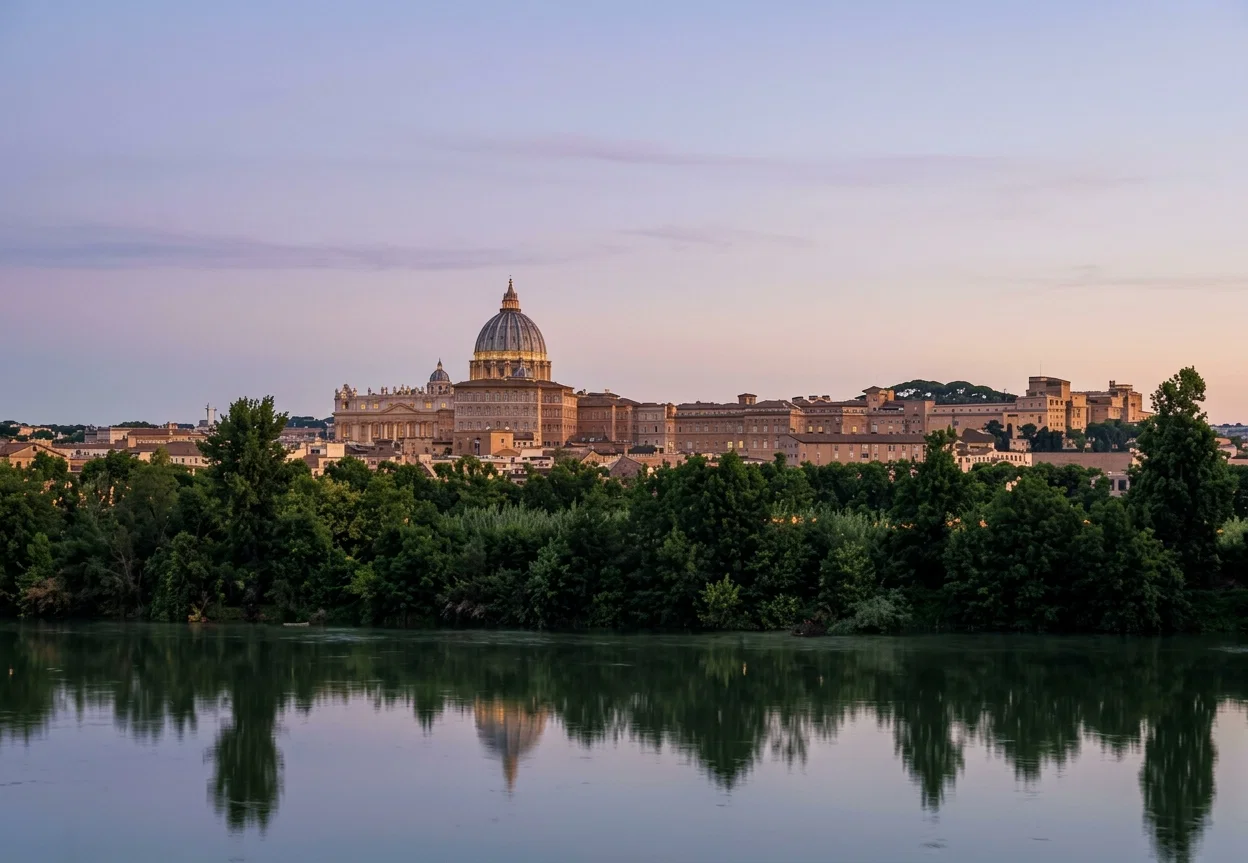
IN the accompanying illustration we have in the immediate foreground a glimpse of the historic Tiber. In the distance, on the left, is a view of the Basilica of St. Peter, and on the right, of the Vatican. Since the return of the papacy to Rome in 1376, after the seventy years' exile in France, the Vatican has been the official residence of the Roman pontiffs.
THE BASILICA OF ST. PETER AND THE VATICAN, FROM THE TIBER.
POPE NICHOLAS V. about the middle of the fifteenth century began the rebuilding of the old palace on a large scale. The work thus begun was carried forward by about a dozen other popes, and the building in its present form was not completed till the reign of Pius IX., in the third quarter of the nineteenth century. The entire mass of buildings, enclosing and fronting on twenty different courts, is computed to contain about eleven thousand rooms. It is especially noted for the splendor of its frescoes, many of which are by Michael Angelo, Raphael, and other great masters. Its museum contains the largest collection of classical statuary in Europe, and its library is famous for its magnificent collection of old manuscripts and rare and early printed books. There is also an immense collection of gems and small objects of value, presented to the different popes by sovereigns, princes, and others.
IN this splendid palace the pope styles himself a prisoner. Why? Not because he is not free to travel over the whole world, if he so wills. But he, the professed vicegerent and representative of the Christ who when on earth had not where to lay his head, asserts it his right, by virtue of his office, to be lord over all lands. Tho Jesus said, “My kingdom is not of this world; if My kingdom were of this world, then would My servants fight,” the pope claims that of right he is king over the kings and suzerain of the world; and so long as it was possible to maintain this high assumption by war and bloodshed, he did so. Now his authority, tho recognized by millions over the whole world, can be exercised up to his high ideal of absolutism only in the Vatican. So here he claims he is a prisoner, for beyond the boundaries of his absolute rule, he will not go.
THE Basilica of St. Peter is the largest church in Christendom. It is in the form of a Latin cross, 613 feet long and 450 feet across the transept. It is surmounted by a dome which rises 434 feet and 9 inches above the pavement, with a diameter of 195 feet and 6 inches. The present building was begun in 1450 A.D. by Pope Nicholas V., the same who began the rebuilding of the Vatican. The church was consecrated by Urban VIII., Nov. 18, 1626, the 1,300th anniversary of the day on which St. Sylvester consecrated the original basilica builded by Constantine the Great, and occupying the same site. Michael Angelo designed the dome of the present building, and nearly completed its erection. Architecture has seldom if ever produced a more magnificent object. The façade also, which is by Carlo Madrino, is grand and imposing. The dome and the façade, the most prominent features of the building, give the impression to visitors of the grandeur of St. Peter's. The Britannica says: “Few people ever seem to trouble themselves to look at any part of St. Peter's except the entrance front and the dome. If they would examine the rest of the exterior, they would find it to be a building without one other redeeming feature, or a single grace of outline or detail, and so absolutely unscientific in its construction and arrangements as to bebeneath contempt as a complete work of architecture.”
“INTERNALLY, the structure is open to similar praise and dispraise. Gorgeousness in matter, and meanness in manner, characterize the interior of St. Peter's.” “It is not too much to say that throughout the interior there is scarcely an ornament that is not offensive, while not one of them has the slightest natural connection with, or use in, a sacred building. Perhaps sculpture never reached so profound a bathos as in the hideous cherubs which are stuck, like petrified acrobats, against all the piers of St. Peter's.”—Encyclo. Britannica, art. Architecture. After reading from the Britannica this description of the architecture of St. Peter's, we can but feel that the basilica stands as a fitting symbol of the religion of Romanism.
VIEWED externally and casually, that is, considered as a human organization, the institution of Romanism rises like a magnificent dome overshadowing all lands. The entrance front to this structure is made enticingly beautiful by art and music. It appeals to the eye and the ear. Its sacred (?) mysteries, locked in, to them, an unknown tongue, appeal to the imagination of the multitude. It appeals also to the innate spiritual indolence of the human heart, by professing to take the full charge of the soul, and to insure its eternal felicity after the purgatorial fires are past. Then, too, it is hard to find any man or any organization that has always been wholly bad. In the age of anarchy and wickedness which succeeded the breaking up of the Roman empire, the church, bad as it was, was the source of many blessings to the people.
DRAFER, who has pictured the utter corruption of early Christianity in the Roman system, as perhaps no other man has, until it became, to use his words, an “adulterated, festering mass,” says: “But there is another very different aspect under which we must regard this church. Never in the world before was there such a system. From her central seat at Rome her all-seeing eye, like that of Providence itself, could equally take in a hemisphere at a glance, or examine the private life of an individual. Her boundless influence enveloped kings in their palaces, and relieved the beggar at the monastery gate. In all Europe there was not a man too obscure, too insignificant, or too desolate for her. Surrounded by her solemnities, every one received his name at her altar; her bells chimed at his marriage, her knell tolled at his funeral, when even to his friends his lifeless body had become an offense, in the name of God she received it into her consecrated ground, and under her shadow he rested till the great reckoning-day. From little better than a slave she raised his wife to be his equal. In ages of lawlessness and rapine, among people but a step above savages, she vindicated the inviolability of her precincts against the hand of power, and made her temple a refuge and a sanctuary for the despairing and the oppressed.”
SO MUCH for a glance at the externals of Rome, at the dome and façade of the building, so to speak; and in an age when the meanness of all other buildings makes this towering structure look splendid by contrast. But this same historian says: “If there is something grand and imposing about the history of the papacy, its biography is infamous.” He says, too: “No one can study the development of the Italian ecclesiastical power without discovering how completely it depended on human passion and intrigues; how completely it was wanting of any mark of divine construction and care.”
STILL more true is this when we come to examine the religious teachings and practises of the Roman Church. Almost every doctrine and every ceremony came either wholly or in part from paganism. The gods of ancient heathenism grin down upon you from every niche and every pillar of the vast edifice. We can apply the language of the Britannica concerning the ornamentation of the interior of St. Peter's almost word for word against the spiritual edifice of Romanism, and truly say that throughout the interior of the church there is scarcely a doctrine or a ceremony that is not offensive, and out of place in a truly Christian institution. Even the statue of St. Peter under the dome of the basilica, the stone toe of which has been nearly worn off by the kissing of the faithful, is only a statue of Jupiter taken from one of the pagan temples. The keys of St. Peter, the sacred symbols of the pope's office as divine interpreter, are the ancient symbols of Janus and Cybele.
SAYS Bower: “The Romans had, as they thought, till the year 1662, a pregnant proof, not only of Peter's erecting their chair, but of his sitting in it himself; for, till that year, the very chair on which they believed, or would make others believe, he had sat, was shown and exposed to public adoration on the 18th of January, the festival of the chair. But while it was cleansing in order to set it up in some conspicuous place in the Vatican, the twelve labors of Hercules unluckily appeared on it.” So they had to change this chair for another; but unfortunately they made small improvement. “If the former chair was borrowed from the pagans, the next was purloined from the Mussulmans; for when the French soldiers under General Bonaparte took possession of Rome in 1795, they found on the back of it in Arabic, this well-known sentence from the Koran: ‘There is no God but God, and Mahomet is his prophet.’”
THE Church of Rome has resisted all efforts to emancipate her from the Pagan corruptions of the Dark Ages. To-day she is the dark shadow which prevents millions of poor souls from seeing the Gospel light. She stands for spiritual tyranny and oppression instead of the liberty of the sons of God. She thrusts her mighty organic whole between each individual soul and God, ordering and prescribing its every belief and practise, and professing, in return for its support and its attendance on her confessional, to insure it against eternal fire. Thus the soul is defiled by the woman instead of following the Lamb whithersoever He goeth. See Rev. 14:4.
SADDEST of all! O, infinitely sad! she makes multitudes believe that they are saved and all right, thus silencing the voice of God in their souls, while they bear on their very faces, in the deepening, hardening lines of vice and sin, the evidence that they are lost and are being lost more and more. It is for this reason that we protest against Romanism, because the Romanist we love and long to see saved. We protest against it because it is the mighty last-day beast-power that shall so overshadow the earth that “all shall worship” it, “whose names are not written in the Book of Life of the Lamb slain from the foundation of the world.” We protest and warn all men against it, because the Scripture says: “If any man worship the beast and his image . . . the same shall drink of the wine of the wrath of God.” Dear reader, we beseech you, be warned.
G. E. FIFIELD.

THE NEVER-FAILING FOUNTAIN.

GOD'S inexhaustible supply of grace is awaiting the demand of every soul. It will heal every spiritual disease. By it hearts may be cleansed from all defilement. It unites human beings with Christ, enabling them to walk in the path of willing obedience. Through the influence of the Spirit of God, man is transformed; his taste is refined, his judgment sanctified, his heart cleansed; he becomes complete in Christ. The love that was manifested in the death of Christ awakens in his heart a thankful response. The understanding takes hold of Christ. The beauty and fragrance of His character is revealed in the life, testifying that God has indeed sent His Son into the world. No other power could bring about so wonderful a change.
The words of Christ will fall with living power upon obedient hearts; the perfect image of God will be reproduced, and in heaven it will be said, “Ye are complete in Him.”
Realizing that he lacks wisdom and experience, the Christian places himself under the training of the great Teacher, knowing that only thus can he attain perfection. And the indwelling of the Spirit enables him to reveal Christlikeness. Daily he becomes better able to comprehend spiritual things. Each day of diligent labor finds him at its close better fitted to help others. Abiding in Christ, he bears much fruit.
“This is the will of God concerning you, even your sanctification.” Is this your will also? Do you long after God, yea, pant after Him, as the hart pants after the water brooks? The world's pleasure and power will pass away; but the life spent in doing the will of God will abide forever. The results of the efforts put forth to uplift humanity will endure through all eternity.
As the sinner, drawn by the love of Christ, approaches the cross, and prostrates himself before it, there is a new creation. A new heart is given him. He becomes a new creature in Christ Jesus. Holiness finds that it has nothing more to require. God Himself is “the justifier of him which believeth in Jesus.” And “whom He justified, them He also glorified.” Great as is the shame and degradation through sin, even greater will be the honor and exaltation through redeeming love. To human beings striving for conformity to the divine image, there is imparted an outlay of heavenly treasures, an excellency of power, that will place them higher than even the angels who have never sinned.
Those who consecrate their lives to the service of God will live with Him through the ceaseless ages of eternity. “God Himself shall be with them, and be their God.” “They shall see His face, and His name shall be in their foreheads.” In this world their minds were given to God; they served Him with the heart and intellect, and now He can put Hisname in their foreheads. They do not go into the holy city as those who have no place there; for Christ says to them, “Come, ye blessed of My Father, inherit the kingdom prepared for you from the foundation of the world.” “And God shall wipe away all tears from their eyes; and there shall be no more death, neither sorrow, nor crying; neither shall there be any more pain; for the former things are passed away.” MRS. E. G. WHITE.

RESTORATION from BABYLON

BY ALONZO TREVIER JONES

THE WALL OF JERUSALEM DEDICATED; THE RIVAL WORSHIP OF SAMARIA ESTABLISHED

The Dedication of the Wall.

Some time after the events related in the preceding article, Nehemiah made a journey to the court of the king of Persia, where he stayed several months, and then returned to Jerusalem.
As soon as he returned, he began to arrange for a great celebration in the dedication of the wall that had at last, through such “troublous times,” been triumphantly finished. He gathered from the cities, the villages, and the plain country of Judah, priests, Levites, and singers, in great numbers to bear a leading part in “the dedication with gladness, both with thanksgivings, and with singing, with cymbals, psalteries, and with harps. And the sons of the singers gathered themselves together, both out of the plain country round about Jerusalem, and from the villages of Netophathi; also from the house of Gilgal, and out of the fields of Geba and Azmaveth; for the singers had builded them villages round about Jerusalem. And the priests and the Levites purified themselves, and purified the people, and the gates, and the wall.”
When all had thus been “purified,” and so prepared, the day of the dedication came. There were formed two great processions of princes, priests, singers, and people who ascended the wall at opposite points, and marched round upon the top of the wall till the two processions were joined at both ends of each—forming now one continuous procession round the whole city upon the top of the wall. Then the whole united procession stood still and “gave thanks,” and “the singers sang loud, with Jezrahiah their overseer. Also that day they offered great sacrifices, and rejoiced; for God had made them rejoice with great joy; the wives also and the children rejoiced; so that the joy of Jerusalem was heard even afar off.”

Enemies Cast Out.

During Nehemiah’s absence, the Samaritans, the enemies of the work of God, through their friends among the princes and priests in Judah and Jerusalem, had secured a foothold in Jerusalem. Eliashib the priest had allowed one of his daughters to marry that chief and persistent enemy, Tobiah the Ammonite! Not only this, but Eliashib had actually emptied of its proper belongings one of the great chambers of the temple, had fitted it up as a residence, and had installed there his new son-in-law, Tobiah the Ammonite.
Now amid the services of the festival days of the dedication, in reading the Scriptures in the book of the law “they read in the book of Moses in the audience of the people; and therein was found written, that the Ammonite and the Moabite should not come into the congregation of God forever. . . . Now it came to pass, when they had heard the law, that they separated from Israel all the mixed multitude.”
Thus there came to the attention of Nehemiah the crooked and brazen course of Eliashib the priest in his alliance with Tobiah the Ammonite, and “in preparing him a chamber in the courts of the house of God.” “And,” he says, “it grieved me sore; therefore I cast forth all the household stuff of Tobiah out of the chamber. Then I commanded, and they cleansed the chambers; and thither brought I again the vessels of the house of God, with the meat offering and the frankincense.”

The Lord Robbed of Means and Time.

Also during Nehemiah’s absence there had been a falling away from faithfulness in bringing the tithes into the storehouse. “And I perceived that the portions of the Levites had not been given them; for the Levites and the singers, that did the work, were fled every one to his field. Then contended I with the rulers, and said, Why is the house of God forsaken? And I gathered them together, and set them in their place. Then brought all Judah the tithe of the corn and the new wine and the oil unto the treasuries.”
There had been also a falling away from the proper observance of the Sabbath; indeed, with many, from any observance of the Sabbath at all; for—
“In those days saw I in Judah some treading wine-presses on the Sabbath, and bringing in sheaves, and lading asses; as also wine, grapes, and figs, and all manner of burdens, which they brought into Jerusalem on the Sabbath day; and I testified against them in the day wherein they sold victuals. There dwelt men of Tyre also therein, which brought fish, and all manner of ware, and sold on the Sabbath unto the children of Judah and in Jerusalem. Then I contended with the nobles of Judah, and said unto them, What evil thing is this that ye do, and profane the Sabbath day? Did not your fathers thus, and did not our God bring all this evil upon us, and upon this city? yet ye bring more wrath upon Israel by profaning the Sabbath.
“And it came to pass, that when the gates of Jerusalem began to be dark before the Sabbath, I commanded that the gates should be shut, and charged that they should not be opened till after the Sabbath; and some of my servants set I at the gates, that there should no burden be brought in on the Sabbath day. So the merchants and sellers of all kind of ware lodged without Jerusalem once or twice. Then I testified against them, and said unto them, Why lodge ye about the wall? if ye do so again, I will lay hands on you. From that time forth came they no more on the Sabbath.”

Mixed Marriages.

Encouraged by the example of the priests and others, many of the people had again fallen away to mixed marriages:—
“In those days also saw I Jews that had married wives of Ashdod, of Ammon, and of Moab; and their children spake half in the speech of Ashdod, and could not speak in the Jew’s language, but according to the language of each people. And I contended with them, and cursed them, and smote certain of them, and plucked off their hair, and made them swear by God, saying, Ye shall not give your daughters unto their sons, nor take their daughters unto your sons, or for yourselves. Did not Solomon king of Israel sin by these things? yet among many nations was there no king like him, who was beloved of his God, and God made him king over all Israel; nevertheless even him did outlandish women cause to sin. Shall we then hearken unto you to do all this great evil, to transgress against our God in marrying strange wives?”
We have seen that a daughter of Eliashib had been given in marriage to one of the chief enemies of the cause of God—Tobiah the Ammonite. In addition to that, one of his grandsons had married the daughter of the very chief enemy himself—Sanballat the Horonite. When it was demanded that he separate from this heathenish connection, he was so far gone in apostasy that he refused. And as the consequence, says Nehemiah, “One of the sons of Joiada, the son of Eliashib the high priest, was son-in-law to Sanballat the Horonite; therefore I chased him from me.”

Samaritan Worship Established.

The chasing away of this young man—his name was Manasseh—brought curious historical results. The mixture of Samaritans and Jews was now as follows: Sanballat’s daughter was married to this young Jew, Manasseh. Tobiah was married to at least one, if not two of the Jewesses. Tobiah’s son, Johanan, was also married to a Jewess. And now this company, including young Manasseh, finding themselves permanently excluded from Jerusalem and the temple and worship there, conceived a design to have a temple and worship of their own. However, so long as Artaxerxes Longimanus lived, they could do nothing, because of his fixed favor toward the temple and worship in Jerusalem. But in 425 B.C. Artaxerxes died. He was succeeded by Xerxes II., who, after forty-five days, was murdered and succeeded by his half-brother, Sogdianus; and he in turn, after six months and fifteen days, was murdered and succeeded by his half-brother, Ochus, who reigned as Darius Nothus. To Darius Nothus Sanballat made personal application, and was successful in obtaining from him a grant to build on Mount Gerizim, near Samaria, a temple like that at Jerusalem, and to make Manasseh, his son-in-law, high priest of it.
Sanballat having built this temple, and made Manasseh high priest of it, Samaria thenceforth became the common refuge and asylum of the refractory Jews; so that, if any among them were found guilty of violating the law, as in eating forbidden meats, the breach of the Sabbath, or the like, and were called to an account for it, they fled to the Samaritans, and there found reception; by which means it came to pass that, after some time, the greatest part of that people were made up of apostate Jews and their descendants. . . . The mixing of so many Jews among them soon made a change in their religion. For whereas they had hitherto worshiped the God of Israel only in conjunction with their other gods,—that is, the gods of those nations of the East from whence they came,—after a temple was built among them, in which the daily service was constantly performed in the same manner as at Jerusalem, and the book of the law of Moses was brought to Samaria, and there publicly read to them, they soon left off worshiping their false gods, and conformed themselves wholly to the worship of the true God, according to the rule which was in that book prescribed to them.
However, the Jews, looking on them as apostates, hated them above all the nations of the earth, so as to avoid all manner of converse and communication with them. This hatred first began from the opposition which the Samaritans made against them on their return from the Babylonish captivity, both in their rebuilding of the temple, and their repairing of the walls of Jerusalem, of which an account hath been above given; and it was afterward much increased by this apostasy of Manasseh and those whojoined with him in it, and by their erecting thereon an altar and a temple in opposition to theirs at Jerusalem. And all others who, at any time after, fled from Jerusalem for the violating of the law, always finding reception among them, this continually further added to the rancor which the Jews had entertained against them, till at length it grew to that length that the Jews published a curse and an anathema against them, the bitterest that ever was denounced against any people. For thereby they forbade all manner of communication with them, declared all the fruits and products of their land, and everything else of theirs which was either eaten or drunk among them, to be as swine’s flesh; and prohibited all of their nation ever to taste thereof; and also excluded all of that people from ever being received as proselytes to their religion.—Prideaux.
This is why the woman of Samaria was so surprised when Jesus asked her to give him a drink of water: and she replied, “How is it that Thou, being a Jew, askest drink of me, which am a woman of Samaria? for the Jews have no dealings with the Samaritans.” It also illustrates the force of that expression of the Jews to the Saviour, “Thou art a Samaritan, and hast a devil;” as in their estimation to be a Samaritan and to have a devil—be possessed—were the same thing.
[“Backsliding to Confirmed Apostasy” is the title of the instructive article to appear next week.]

Two Questions Answered.

  1. What did Christ not abolish?
  2. What did Christ abolish?

First Question Answered.

Man is the incarnation of a perpetual and awful tragedy—a tragedy as much greater than Shakespeare ever wrote, as eternal things transcend the baubles of time; a being with capabilities and powers designed by the Creator to possess and appreciate the most exalted eternal blessedness, the means placed within his reach, yet finds himself slipping helplessly down to eternal death.
God, who knows the deeps of the human spirit, who sees the inmost springs of the heart, has made plain in His Word the plot and movement of this mighty drama.
Man, God’s son and freeman, sold himself into bondage to evil. From the bread of heaven he turned to feast on the carrion of sin, and to riot with the enemies of his Maker. Had the Father left him entirely to himself when the ingrate disobeyed, man would never have had so much as a desire or wish to return to purity or righteousness. He would have reveled in the offal of unholiness. As the buzzard loves the putrefying carcass, so his soul would have delighted in naught but spiritual uncleanness. This would have been a natural, inevitable result of the carnal, sinful mind which he had after his lapse from uprightness; for the inspired Word declares, “The carnal mind is enmity against God; for it is not subject to the law of God, neither indeed can be,” and “to be carnally minded is death.” Rom. 8:6, 7.
But God pitied His erring creature. The Father still longed to restore him to sonship and happiness. He determined not to leave him alone in his corruption, to wander in the dark labyrinths of transgression until he perished. Infinite love prompted the Father to plant in the polluted heart of His rebellious child a longing for the things of God, a desire for restoration to the divine favor, a wish for purity. “I will put enmity between thee,” decreed the Sovereign of the hearts of men in the presence of their adversary, the devil, “and the woman [the church, 2 Cor. 11:2, compare with ch. 11:2, also Rev. 12:1–6], and between thy seed and her seed; it shall bruise thy head; and thou shalt bruise his heel.” Gen. 3:15.
When this promise of the Gospel was given, there was not a righteous person in the earth; for Adam and Eve were “dead in trespasses and sins.” A soul dead in sin can not possibly have any desire to get out of that condition. They were, so to speak, totally depraved; and no man will ever repent who cares for nothing but unrighteousness. It is evident, therefore, that in this promise is implied not only the gift of Christ, who was “slain from the foundation of the world;” but also a longing in the hearts of men to obtain what He has to bestow—purity here and salvation in the world to come. Thus within weakened, unprofitable, sinning flesh, was put a loathing for that condition. To God be all the glory! “By grace are ye saved!”
Thus within man was placed the antagonism between the “enmity” (Rom. 8:7) and the love of better things. Paul experienced the meaning of this. “What I hate,” he said, “that do I.” Rom. 7:15. Read the whole fearful tragedy from the fifteenth verse to the twenty-fifth. This, then, is the enmity; and its result is the opposition of flesh and spirit, the war between the “law of the mind” and “the law of sin” in the flesh, the gravitation of the earth against the attractions of the heavens, with earth millions of times the nearest and therefore relatively the most powerful.
Man therefore remains in sin. Of himself he can do nothing. Inspiration has well stated it in Gal. 5:17, “The flesh lusteth against the spirit, and the spirit against the flesh: and these are contrary the one to the other; so that ye can not do the things that ye would.” He would do right. He can not. But this is not to say that he does not do the things he would not. Indeed, these are exactly what he does do, as Paul says over and over in his experience mentioned above, in Romans 7. Individually, also, every person can testify to the truth of this fact, for we have all realized it. These works are all sin; and sin is the transgression of God’s law. 1 John 3:4.
Let us now sum up: The “enmity” hinders us from doing what we would. We would do the law of God. Therefore the enmity keeps us from doing the law of God; for “it is not subject to the law of God, neither indeed can be.” Rom. 8:7. But Christ “abolished in His flesh the enmity” (Eph. 2:15); by the cross slew in Himself the enmity. Verse 16, margin. That is, the Master slew, or abolished in Himself, that which would have prevented Him doing what He would. What He would do is plainly stated: “I delight to do Thy will, O My God; yea, Thy law is within My heart.” Ps. 40:8. Thus He was left free to perform God’s sacred law. Let Inspiration speak: “And ye know that He was manifested to take away our sins; and in Him is no sin.” 1 John 3:5. “Sin is the transgression of the law.” Verse 4. He takes away our sin, not by abolishing the law, but by abolishing in us, when we are in Him, that which makes the performing of the law impossible, namely, the enmity; for this was what He abolished in Himself. Therefore, Christ DID NOT ABOLISH THE LAW OF GOD.

Second Question Answered.

What did Christ abolish?
The Scripture says He “abolished . . . the law of commandments contained in ordinances.” Eph. 2:15. The best commentary in the world on the meaning of this text is found in Paul’s letter to the Colossians. This and his letter to the Ephesians are supposed to have been written about the same time, which may account for the great similarity between them. At any rate their likeness will be strikingly seen by the following partial comparison:—

Ephesians.

Ch. 1:22, 23: God “gave Him [Christ] to be head over all things to the church, which is His body, the fulness of Him that filleth all in all.”
Verse 5: “The good pleasure of His will.”
Verses 9, 10: “According to His good pleasure which He hath purposed in Himself: that . . . He might gather together in one all things in Christ, both which are in heaven, and which are on earth.”

Colossians.

Ch. 1:18: “And He [Christ] is the head of the body, the church; . . . that in all things He might have the pre-eminence.”
Verses 19, 20: “For it pleased the Father . . . through the blood of His cross, by Him [Christ] to reconcile all things, whether they be things in earth, or things in heaven.”
Compare further Eph. 1:15–22 with Col. 1:9–14. Any one can see by even a casual reading of these passages that the general thought of both epistles is largely the same. This parallelism continues in the texts that we shall now discuss.
In Eph. 2:12 the apostle speaks of the past spiritual condition of the Ephesians, reminding them that they “were without Christ,” “aliens,” “strangers.” In Col. 1:21 he reminds the Colossians of the same thing in their own experience, saying that they likewise “were sometime alienated and enemies.”
In Eph. 2:13 he speaks of their conversion, that they “who sometimes were far off are made nigh by the blood of Christ.” In Col. 1:21, 22, he recalls their conversion, saying, “You . . . now hath He reconciled in the body of His flesh through death.” Notice also that this verse tells how they were reconciled, or, as expressed in the verse from Ephesians above, “made nigh;” namely, “in the body of His flesh through death.” The words explaining to the Ephesians how this work was done are, “having abolished in His flesh the enmity.” Verse 15. Thus his thought becomes very clear and definite. Colossians, Ephesians, or any others that are in Christ, have the enmity abolished in them as it was and is abolished in Christ, and so they are reconciled. They now can do the law of God, even as Christ did it, and as Paul did it after he got out of the experience of Rom. 7:15–24.
Continuing His statement to the Ephesians, the apostle indicates the result of the abolition of the enmity—this opposition of the carnal mind to God’s law (Rom. 8:7)—which is, in their practise, and in the practise of every other man that knows the Gospel, the abolition of the natural and universal effect and outgrowth of a carnal heart; viz., “the law of commandments contained in ordinances.” Eph. 2:15. The “enmity” is said to be “the law of commandments” of a certain kind. The law of a thing is the rule by which it works. Therefore this law of commandments is a statement of how the enmity works in a certain direction; and the way it works is said to be by producing certain “ordinances.”
Before we show what these ordinances are, let me ask the reader, Can you stand before God and say that you believe that ordinances or commandments produced by the carnal mind—the enmity to God’s law—are the law of God? If not, then Christ did not abolishthe law of God, or God’s commandments. For your answer to this question you must one day justify yourself before the tribunal of the Judge of all the earth. Let each reader test by this question the honesty and sincerity with which he comes to this investigation.
But what are these ordinances, then? Paul in his letter to the Colossians has defined them with the utmost precision.
In discussing, “What did Christ not abolish?” we found that the enmity results in wicked works; and this is exactly what he tells the Colossians, “You that were sometime alienated and enemies in your mind by wicked works.” Ch. 1:21. Let us sum up. To the Colossians: The enmity produces wicked works. To the Ephesians: The enmity produces ordinances. Therefore it is certain that these ordinances are wicked works in principle, whatever they may be objectively. This is their character; what are they in substance?
Again the apostle is very explicit: “If ye be dead with Christ from the rudiments of the world, why, as tho living in the world, are ye subject to ordinances?” Col. 2:20, 22. “Are subject to ordinances” is a translation from the Greek of a single word whose root is the same as that of the word “ordinances” in Eph. 2:15 and Col. 2:14, which is never used in the Bible in reference to a command of God, if it is not so used here; and whether it is or not is placed beyond controversy by the context of this very scripture; for these ordinances (Greek, dogmas) to which we are not to subject ourselves, the inspired apostle declares unequivocally and without ambiguity to be “after the commandments and doctrines of men” (verse 22); and in verse 20 he affirms that they have as their base and authority “the rudiments of the world,” and these latter are, in verse 8 of this chapter, identified with “the tradition of men.”
Here, then, we may sum up the parts of this system of human ordinances: First, its root and origin is in the carnal mind—the enmity; second, its visible trunk has nothing more substantial than the traditions of men; there is no “Thus saith the Lord” for any of them; third, its fruit is every Jewish, every heathen, every Catholic, every Protestant, festival, fast, holy day, holiday, sacrifice, rite, ceremony, prayer, rigmarole, incantation, ordinance, and commandment. And finally, when Christ abolished in His flesh the enmity—the foundation of this whole superstructure of human works as a means of grace—He abolished for every individual in Him this whole system of self-righteousness. Therefore every commandment and ordinance of men supported only by tradition, resting only on human authority, and yet taught as essential to salvation, WAS AND IS FOREVER ABOLISHED. J. A. L. DERBY.
Continue reading: PAUL CROSSES TO EUROPE