Your ShelfYour Projects

Signs of the Times, Vol. 31, No. 22.

OUR GREAT DEFENDER

Signs of the Times

May 31, 1905

Pacific Press Publishing Company · Mountain View, California · May 31, 1905

OUR GREAT DEFENDER

I will lift up mine eyes unto the mountains; From whence shall my help come? My help cometh from Jehovah, Who made heaven and earth. He will not suffer thy foot to be moved; He that keepeth thee will not slumber. Behold, He that keepeth Israel will neither slumber nor sleep. Jehovah is thy keeper; Jehovah is thy shade upon thy right hand. The sun shall not smite thee by day, Nor the moon by night. Jehovah will keep thee from all evil; He will keep thy soul. Jehovah will keep thy going out and thy coming in From this time forth and forever more.
If it had not been Jehovah who was on our side, Let Israel now say, If it had not been Jehovah who was on our side, When men rose up against us; Then they had swallowed us up alive, When their wrath was kindled against us; Then the waters had overwhelmed us, The stream had gone over our soul; Then the proud waters had gone over our soul. Blessed be Jehovah, Who hath not given us as a prey to their teeth. Our soul is escaped as a bird out of the snare of the fowlers; The snare is broken, and we are escaped. Our help is in the name of Jehovah, Who made heaven and earth.
Pacific Press Publishing Company, Mountain View, Cal.

A STUDY OF THE HUMAN BODY.

A 350-page book by F. M. Rossiter, M.D. in which the following is a portion of the author's Preface:
"This book was suggested by experience, both in teaching and professional work. Its plain object, bare figures of speech, is to arouse in the young a deeper interest in the study of the human body. As a physician called to see both young and old, I have long been convinced that 'people are destroyed for lack of knowledge.' They lack a practical knowledge of the physical basis of health and happiness and morality. As a teacher, I have found that when presented as here outlined, the study of the human body becomes, not only interesting, but fascinating. The young mind can easily be led to regard the human building as a masterpiece of creation, a beautiful structure, worthy of the most profound admiration. In addition to this, every young person who once comes to a clear perception of the true relation of body to mind and mind to body, must ever after hold his health as sacred as his character."
Price, in cloth, $1.00, post-paid. Address, Pacific Press, Mountain View, Cal.

The Sabbath and the Law

The Sabbath and the Law.—A treatise on the Sabbath, giving its Biblical and secular history for six thousand years. 190 pages. Price, 15 cents.

Sunday in History

Sunday in History.—A vast array of historical facts regarding its development, and startling admissions of eminent clergymen relative to its sacredness. A mine of information in a nutshell. 232 pages. Price, 30 cents.

Address the Publishers

Address publishers of this paper.

American Standard Revised Bibles

EDITED BY THE AMERICAN REVISION COMMITTEE
NOTE THE FOLLOWING ENDORSEMENTS:
"The most perfect translation of the Bible into English there is in the world."—Elder M. C. Wilcox, editor of "The Signs of the Times."
"It is by far, and in every respect, the best English translation of the Bible in existence, both for scholars and for people."—Biblical World.
"There can be no doubt that in this version we are nearer the thought, and therefore the spirit of the Master than in any other version now existing in English."—Northwestern Christian Advocate.
SOME SELECTED NUMBERS
Style R. Minion Type, text Bible, no references or concordance, size 4x6 inches, 12 maps, cloth, limp, round corners, red burnished edges . . . . . . . . . . . . . . . . . . . . . . . . . . . . . . . . . . . . . . . . . . . . . . . . . . . . . . . . . . . . . . . . . . . . . . . . . . . . . . . . . . . . . . . . . . . . . . . . . . . . $0 50
LARGE TYPE BIBLES, 5¼ x 8 inches; references and maps, but no concordance
Style R 1. Cloth Boards, red edges . . . . . . . . . . . . . . . . . . . . . . . . . . . . . . . . . . . . . . . . . . . . . . . . . . . . . . . . . . . . . . . . . . . . . . . . . . . . . . . . . . . . . . . . . . . . . . . . . . . . $1 00 " R 2. Egyptian Seal, limp, round corners, red under gold edges . . . . . . . . . . . . . . . . . . . . . . . . . . . . . . . . . . . . . . . . . . . . . . . . . . . . . . . . . . . . . . . . . . . . . . . . . . . . . . . . . . . . . . . . . . . . . . . . . . . . 1 75 " R 3. Limp Leather, lined, round corners, red under gold edges . . . . . . . . . . . . . . . . . . . . . . . . . . . . . . . . . . . . . . . . . . . . . . . . . . . . . . . . . . . . . . . . . . . . . . . . . . . . . . . . . . . . . . . . . . . . . . . . . . . . 3 00 " R 4. Egyptian Seal, divinity circuit, round corners, red under gold edges . . . . . . . . . . . . . . . . . . . . . . . . . . . . . . . . . . . . . . . . . . . . . . . . . . . . . . . . . . . . . . . . . . . . . . . . . . . . . . . . . . . . . . . . . . . . . . . . . . . . 2 00 " R 5. Egyptian Seal, divinity circuit, leather lined to edge, round corners, red under gold edges . . . . . . . . . . . . . . . . . . . . . . . . . . . . . . . . . . . . . . . . . . . . . . . . . . . . . . . . . . . . . . . . . . . . . . . . . . . . . . . . . . . . . . . . . . . . . . . . . . . . 2 75
INDIA PAPER EDITION. Same as above, but only ¾ of an inch in thickness
Style R 6. Egyptian Seal, divinity circuit, leather lined to edge, silk sewed, round corners, red under gold edges . . . . . . . . . . . . . . . . . . . . . . . . . . . . . . . . . . . . . . . . . . . . . . . . . . . . . . . . . . . . . . . . . . . . . . . . . . . . . . . . . . . . . . . . . . . . . . . . . . . . $4 00 " R 7. Persian Levant, divinity circuit, leather lined to edge, silk sewed, round corners, red under gold edges . . . . . . . . . . . . . . . . . . . . . . . . . . . . . . . . . . . . . . . . . . . . . . . . . . . . . . . . . . . . . . . . . . . . . . . . . . . . . . . . . . . . . . . . . . . . . . . . . . . . 5 00 " R 8. Levant, divinity circuit, calf lined to edge, silk sewed, round corners, red under gold edges . . . . . . . . . . . . . . . . . . . . . . . . . . . . . . . . . . . . . . . . . . . . . . . . . . . . . . . . . . . . . . . . . . . . . . . . . . . . . . . . . . . . . . . . . . . . . . . . . . . . 7 00 " R 9. Sealskin, divinity circuit, calf lined to edge, silk sewed, round corners, red under gold edges . . . . . . . . . . . . . . . . . . . . . . . . . . . . . . . . . . . . . . . . . . . . . . . . . . . . . . . . . . . . . . . . . . . . . . . . . . . . . . . . . . . . . . . . . . . . . . . . . . . . 9 00
VERY LARGE TYPE BIBLES, 6¾ x 8¾ inches. References and maps, but no concordance
Style R 10. Cloth Boards, red edges . . . . . . . . . . . . . . . . . . . . . . . . . . . . . . . . . . . . . . . . . . . . . . . . . . . . . . . . . . . . . . . . . . . . . . . . . . . . . . . . . . . . . . . . . . . . . . . . . . . . $1 50 " R 11. Egyptian Seal, limp, round corners, red under gold edges . . . . . . . . . . . . . . . . . . . . . . . . . . . . . . . . . . . . . . . . . . . . . . . . . . . . . . . . . . . . . . . . . . . . . . . . . . . . . . . . . . . . . . . . . . . . . . . . . . . . 2 50
INDIA PAPER EDITION. Same as above, but only 13-16ths of an inch in thickness
Style R 12. Egyptian Seal, divinity circuit, leather lined to edge, silk sewed, round corners, red under gold edges . . . . . . . . . . . . . . . . . . . . . . . . . . . . . . . . . . . . . . . . . . . . . . . . . . . . . . . . . . . . . . . . . . . . . . . . . . . . . . . . . . . . . . . . . . . . . . . . . . . . $6 00
TEACHERS' EDITION. Containing the concise Bible Dictionary and a new Concordance to the Revised Bible with Indexed Bible Atlas Large Type, size 5½ x 8 inches
Style R 13. Egyptian Seal, limp, round corners, red under gold edges . . . . . . . . . . . . . . . . . . . . . . . . . . . . . . . . . . . . . . . . . . . . . . . . . . . . . . . . . . . . . . . . . . . . . . . . . . . . . . . . . . . . . . . . . . . . . . . . . . . . $2 25 " R 14. Egyptian Seal, divinity circuit, round corners, red under gold edges . . . . . . . . . . . . . . . . . . . . . . . . . . . . . . . . . . . . . . . . . . . . . . . . . . . . . . . . . . . . . . . . . . . . . . . . . . . . . . . . . . . . . . . . . . . . . . . . . . . . 2 50
INDIA PAPER EDITION. The thinnest printing paper in the world
Style R 15. Egyptian Seal, divinity circuit, leather lined to edge, silk sewed, round corners, red under gold edges . . . . . . . . . . . . . . . . . . . . . . . . . . . . . . . . . . . . . . . . . . . . . . . . . . . . . . . . . . . . . . . . . . . . . . . . . . . . . . . . . . . . . . . . . . . . . . . . . . . . $5 25 " R 16. Levant, divinity circuit, calf lined to edge, silk sewed, round corners, red under gold edges . . . . . . . . . . . . . . . . . . . . . . . . . . . . . . . . . . . . . . . . . . . . . . . . . . . . . . . . . . . . . . . . . . . . . . . . . . . . . . . . . . . . . . . . . . . . . . . . . . . . 8 50
Pacific Press Publishing Company MOUNTAIN VIEW, CAL.

VIII. "HE SENT HIS WORD."

The Centurion's Servant.
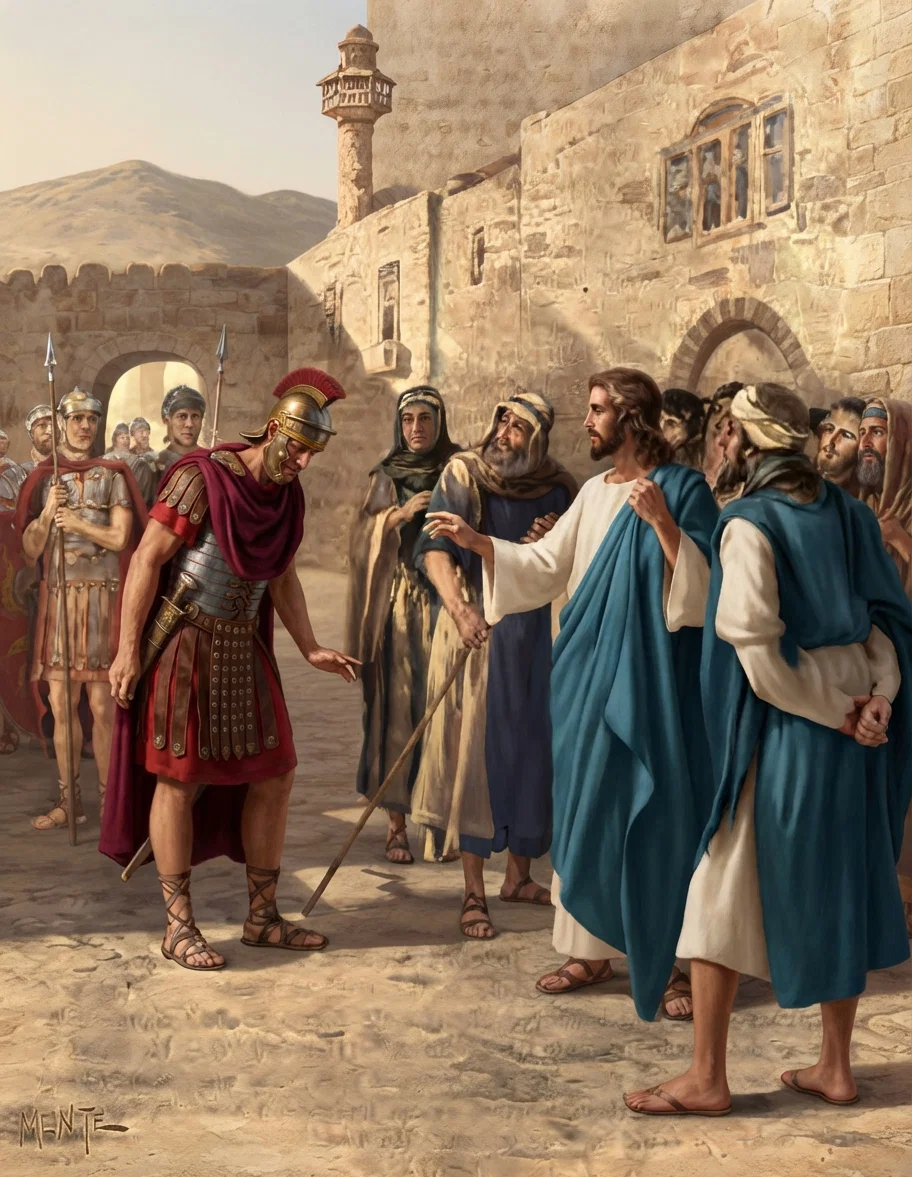
THE place is Capernaum, noted for many miracles. The time is shortly after the Sermon on the Mount. The record is found in Matt. 8:5-13; Luke 7:1-10.
THERE was no question of faith on the part of the centurion. It takes both of the records to give us all the facts. From Luke we gather that already the Roman captain had opened his heart to receive the truth. He had come to believe in the one true God. He had come to love the Jewish people on account of their true worship and superior morality. He had shown his love by building them a synagog.
HE was a humble man. He did not think that his good works entitled him in any way to special recognition. He recognized in Jesus One sent of the Most High, in whose sight he was most unworthy. He therefore gathers the elders of the synagog, lays the case before them, and asks them to entreat Jesus to come and heal his servant. And they hasted and performed their mission faithfully, declaring to our Lord he was worthy, and Jesus went with them.
“Go thy way; and as thou hast believed, so be it done unto thee.”
It seems that the centurion almost feared that the Jews would flatter him. He therefore sent other friends, who bore this message for the Roman officer: "Lord, trouble not Thyself; for I am not worthy that Thou shouldest enter under my roof; wherefore neither thought I myself worthy to come unto Thee; but say in a word, and my servant shall be healed." But this is not all. Seemingly fearful that the elders and his friends would not fulfil their mission, as Jesus nears his house he himself, moved by the suffering of his servant, goes to meet Jesus, and pleads: "Lord, my servant lieth at home sick of the palsy, grievously tormented." Jesus replied, "I will come and heal him." And in humility the proud Roman officer again repeated the message he had sent: "Lord, I am not worthy that Thou shouldest come under my roof; but speak the word only, and my servant shall be healed. For I am a man under authority, having soldiers under me; and I say unto this man, Go, and he goeth; and to another, Come, and he cometh; and to my servant, Do this, and he doeth it."
JESUS recognized the grasp of the truth and the faith of the Roman. He ought to have seen many such evidences among His own people, but they were wanting. But here was a Roman proselyte who had grasped it. And as the joyful words fell upon the ears of the Master, His human heart marveled; and He said to those who followed: "Verily I say unto you, I have not found so great faith, no, not in Israel. And I say unto you, That many shall come from the east and west, and shall sit down with Abraham, and Isaac, and Jacob, in the kingdom of heaven. But the children of the kingdom shall be cast out into the outer darkness; there shall be weeping and gnashing of teeth. And Jesus said unto the centurion, Go thy way; and as thou hast believed, so be it done unto thee. And his servant was healed in the selfsame hour." "And they that were sent, returning to the house, found the servant whole." Thus reads the simple record. What are the lessons? We note four.
FIRST of all, Christ's power to heal at all times, under all circumstances, in response to faith. "I am Jehovah that healeth thee," is God's message to His people, and all His fulness is found in Christ Jesus our Lord. O, that men would look away from men to the Maker of men, the Redeemer of the world, the Lifegiver! In Him is balm for every bruise, healing for every hurt. The God that gave life giveth life still, and "abundance" of life to those in harmony with His law.
SECONDLY, we must come with our sense of need and utter unworthiness. Our benefactions to God's cause or to charity entitle us to nothing. If we give largely, of His own we have given. If we have been righteous, we have only done simple duty. Our mighty twofold plea with God is His exceeding goodness and our need.
THIRDLY. In what did the superior faith of the Roman consist?—Not merely that Jesus could heal; for many in Israel believed that. But the people of Israel, instructed tho they had been of God's superhuman agencies, could not believe that Jesus could heal unless He were personally present. Even at the home of Lazarus, the sisters could only moan, "Lord, if Thou hadst been here, my brother had notdied." The centurion believed that He could heal whether present or not. He himself had been commissioned by higher power. He had soldiers under him. This in the civil world. Was not the spiritual world better organized? Jesus was the Sent of God. Surely, He had spiritual powers or servants at His disposal whom He could send with power sufficient to do His bidding. The simple faith grasped the plan; and Jesus honored the faith. Of old it was said, "He sent His word and healed them." He is the same to-day. Angels of light may bear the word to suffering soul or body, but its potency is not thereby diminished. The power of the Roman was not in himself, but in the imperial power at Rome. God's agencies must be clean, that the word be not corrupted, but the power is in the word and its life; and, if the agency have power, it is because of the indwelling Word by faith. Christ ministers in heaven; we may not be worthy that He should come under our roof; but, praise God, as ever, He will send His word, and heal, full with the potency of God.
LASTLY, our fathers, our birth, our name, our present position, will not commend us to God or give us a place in His kingdom. We may trace a succession in the priesthood; we may be a blood-descendant of Luther or Calvin or Wesley; we may have had hands laid upon us by priest or bishop never so holy; but all these or any of these will not avail unless by faith in Jesus Christ He is formed within, and His Word is all potent in us. And it may be; He wants to heal both soul and body.

WHY THEY WERE HONORED.

It was Mary Magdalene, out of whom the devil was cast seven times before the Spirit of Christ could take permanent possession, who was the first human being to whom Christ appeared after His resurrection, and who was the first to be honored with a mission to announce the resurrection to others.
It was Peter, who had so strenuously denied his Lord in the hour of His greatest need of a friend, who was honored with a special invitation to meet the risen Saviour at a time when others were invited in a group. It was this same Peter who was selected by the Spirit to preach the principal sermon when the Gospel work was inaugurated under the new order on the day of Pentecost.
It was Saul of Tarsus, the persecuting Pharisee, who verily thought that he ought to do everything possible against the name of Jesus, and who persecuted unto the death the disciples of Christ, whom the Lord chose to be the foremost missionary of the cross in all the world.
Why were these so chosen? Was it because their conspicuous sins had qualified them for conspicuous service?—No, it was because of their deep conviction of sin and contrition of heart; because of their sincere repentance and their intense love of Him who had forgiven so much. It was through their high appreciation of His great mercy that they became such instruments as He could use to His honor and glory in the salvation of other sinners.
“When men are cast down, then thou shalt say, There is lifting up; and He shall save the humble person.” Job 22:29. The Lord’s commendation of Saul to Ananias of Damascus was, “Behold he prayeth.” The general principle announced in the Gospel is, “He that humbleth himself shall be exalted.” And the sinner truly humbles himself only when he confesses and forsakes his sins. G.

AN ALL-SUFFICIENT SAVIOUR.

An intelligent but troubled Ohio correspondent writes us as follows:
If Christ possessed no advantage over a converted human being, how could He live an absolutely sinless life? Surely no Christian, however thoroughly converted, maintains a perfectly sinless record.
If He was born just like ourselves, with no greater knowledge, power, or purity, He must have been guarded and guided in some peculiar manner, or, as a child, He would have done something wrong, as every other child does. But, as He was kept from sin, He never had a sinful habit to fight or correct as we have. It seems to me there must be some difference, somehow, between Christ and even the best Christian.
In your paper some time ago an article says, "Knowing this, that our old man is crucified with Him." Do not contradict God, and say, "No; it is not; it is alive and active in me, producing evil every minute," but agree with God, etc.
How can such an one claim that the old nature is crucified—that he is "dead to sin?" I can see how Paul could claim this, for sin was not active in him. He was loving and serving God right along. But how any one can claim this who is constantly falling, and producing evil every minute is more than I can see.
There are many things we can apprehend, lay hold of, by faith which we can not comprehend by reason or knowledge; and yet we can demonstrate their verity by walking out in faith upon their demands, whether in the promise or precept. A person's reason or knowledge might reject God, but faith might demonstrate His existence by proving the assurance "that He is a rewarder of them that seek after Him."
We may not be able to understand how the Son of God gave up Himself and took our nature; but He did. "He was born of the seed of David according to the flesh" (Rom. 1:3), "was born of a woman, born under the law" (Gal. 4:4), and so gathered within Himself all the hereditary tendencies of sin the race had known, the awful fruits of which were seen in the Judean tribe from which He came, and especially in the seed of David. For "it behooved Him in all things to be made like unto His brethren" (Heb. 2:17).
Now these are plainly stated facts; why not believe them, whether we can understand how it could be true or not. He lived a sinless life; and we believe that.
He suffered temptation in the wilderness; He suffered being tempted; He offered up prayers and supplications "with strong crying and tears unto Him that was able to save Him from death." He was "heard for His godly fear," and learned, tho a Son, "obedience by the things which He suffered." Heb. 5:7, 8. And the same scripture also implies that He resisted even "unto blood, striving against sin." Heb. 12:4. All this we may fully accept by faith and know that it was so, tho we but dimly comprehend it.
When the wicked man comes to Christ and confesses his sin, he is forgiven and counted in the Beloved as tho he had never sinned. None of his iniquities of the past are held against him. "There is therefore now no condemnation to them that are in Christ Jesus." In His sight they are no longer sinners.
"But the evil habits remain?"—No; not as in the past. Before conversion they were the dominating power; now they are subject to the Spirit of Christ, and will so continue, if the soul continues to walk in Christ as he accepted Christ. Then he confessed his sin, his nothingness, his weakness, his lack of strength, his absolute need of a guide, a saviour, a keeper; and he finds in Christ all of these. All this implies daily feeding upon God's Word; constant humility before God, earnest, importunate prayer, the improvement of every available means of grace, walking with God, while reaching out strong, helpful hands to the sinful, the needy, the helpless of this world.
Do you not believe, dear soul, that you could thus live for God one minute? Could you not do it by His grace for sixty minutes or one hour? Could you not walk to please Him for twenty-four hours? Jesus did, and overcome for us, that He might, through our faith, overcome in us.
The "old man" represents sin dominant, ruling, in our being. His crucifixion is not the death of the tendency of the flesh to sin, but the death of sin as a dominating, ruling power. The "new man" is not a being with no tendency to sin, but it is a life in which Christ rules over sin. The person may make mistakes; his speech and walk may be halting and weak, like that of a little child; but he is dominated by the new man, not by the old. He does not count himself, as himself, different, but he counts on Christ Jesus, the Coverer of his imperfection, the Healer of his infirmities, the Companion by the way, and in Christ he is free. Rom. 8:1. And the same power which set him free can keep him free.
The work must be of faith. Of course, if the soul loves sin, and desires to continue in it, he can not count it dead as a dominating power within. But, if he has given up sin, he can count the old man crucified on the cross of Christ. His death is our death; His life our life. For He was crucified for you. He died for your sins. Why not believe it, and rejoice?
Paul could claim no more than you may claim. Sin was as active in him as in others. He found it necessary to "die daily," to constantly keep his "body under," to brow-beat it, literally, lest, having preached to others, he himself should be a castaway. See 1 Cor. 9:26, 27; Phil. 3:7-14. He did not conquer self by self; he conquered by counting Christ all by faith. You are a failure in yourself; good, count it so. But Christ is a glorious success; count Him so in you, and rejoice.
If you would believe that Christ forgives, that Christ furnishes all, that it is all yours by believing, you would find joy instead of discouragement, and strength instead of weakness. Say ever, Nothing in myself; praise God, everything in Christ Jesus; and "I am His and He is mine, forever, O forever," and you will find that the joy of the Lord is your strength, and Christ is "the One altogether lovely," the "Chiefest among ten thousand." Do not look to self, look to Him, and let Him reign.

WHERE OUR HOPE IS.

SOME of the states have recently passed laws which are in themselves good, and have repealed others which are in themselves bad; and for every passage of a good law and for every repealing of a bad law, we rejoice. The anti-cigaret laws, the anti-gambling laws, and all laws that prevent fraud and deeds of violence, are good. The laws which make divorce on light pretexts easy, the laws which permit gambling, pool-selling, and liquor-selling, are bad. We could wish that every bad law on the statute books of our land were repealed, and that every good law that should be enacted, might be enacted at once.
Nevertheless, we are not pinning our hope of a renovated humanity upon the passing or repealing of human laws. They may make the way we travel more convenient or more fearsome, as the case may be; but they can not change the hearts of men, planting good there and uprooting the bad. Only the power of Jesus Christ in the life can do that. All hopes based on anything else are doomed to disappointment.
We have had numerous illustrations recently to the effect that the passing of good laws is not generally due to an awakening of conscience on the part of the legislators themselves. They have yielded to the pressure of an insistent demand on the part of bodies of their constituents, or to the effect of long rolls of petitions. They have passed the laws demanded, fearing lest they might fail for re-election, or their party might fail of maintaining its dominance. The states in which these “good laws” have been enacted will have an opportunity to learn, as Kansas, for instance, has learned already, that the passage of a law does not mean its enforcement.
We are living in an age of disregard for law, and the lawyer who can most skilfully manipulate law to the advantage of his client, is the one whose services are most eagerly sought after, and command the highest remuneration. Christians rejoiced when the Kansas Legislature enacted the prohibitory law; but to compel the officers of the state to enforce it, has been a long and apparently losing struggle, either through the opposition of the officers themselves, or through the powerful financial influence of the liquor men. Good men may compel time-serving legislators to place good laws upon the statute books; but the power of money is so great to-day as to be able to nullify almost any law that can be made.
He who looks to-day for any striking reformation in the land by the enactment of law, is cherishing a vain hope. The greed for gold is blinding the finer instincts of the race, till the conditions which Inspiration has said would characterize the last days are literally fulfilled before our eyes to-day:
“They all lie in wait for blood; they hunt every man his brother with a net. That they may do evil with both hands earnestly, the prince asketh, and the judge asketh for a reward; and the great man, he uttereth his mischievous desire; so they wrap it up. . . . The day of thy watchmen and thy visitation cometh; now shall be their perplexity.” Micah 7:2-4.
That “visitation” is the second coming of Christ; and that “perplexity” is the consternation of the wicked when they see Him whom they have rejected; and the conditions there brought to view are the conditions of this present day. Good laws may be passed; but lawlessness is ever increasing, and will continue to increase; for it is declared that “evil men and seducers shall wax worse and worse, deceiving and being deceived.”
This being true, the only hope of any worth is the Christian’s hope in Christ. Everything else is vanity, and, in the end, disappointment and death. We must not pin our hope to man, or to laws that man may make; but in perfect submission to the will of God and faith in Him, we have an anchor whose hold no stress or strain of storm can break. In that is hope; in that is life and joy and peace. S.

Prophetic Weeping.

“O that my head were waters, and mine eyes a fountain of tears, that I might weep day and night for the slain of the daughter of my people!” Jer. 9:1. It was not for those who had been slain in the past that Jeremiah felt so much inclined to weep. Neither weeping nor any other human exercise or service can avail anything for the welfare of those who have passed into the silence of the tomb. It was consequences that the prophet saw by the Spirit of prophecy, the future results of the then present lives of his people, that were giving him such a burden of sorrow and anxiety. It was because they were walking “after the imagination of their own heart,” that the Lord said by the prophet, “I will scatter them also among the heathen, whom neither they nor their fathers have known; and I will send a sword after them, till I have consumed them.” And Jeremiah lived to see in reality what he then saw in vision, and so bitterly lamented. It was not many years after this prophecy when Jerusalem was destroyed, and the people were carried away to Babylon. And it was all because the Lord’s people forsook His law, and refused to listen to His voice uttered through His prophet. Let none forget that “whatsoever things were written aforetime were written for our learning.” God has not changed, neither has His law. “If thou seek Him, He will be found of thee; but if thou forsake Him, He will cast thee off forever.”

Question Corner

1674.—Japan and Russia in Prophecy.
One of your writers refers to the great struggle in which Russia and Japan are engaged as a subject of prophecy. Where can this be found? A. F. H.
It is believed that Russia is especially mentioned in Ezekiel 38 and 39 as the chief prince of Meshech and Tubal, in the Revised Version called "Rosh," and that Japan is one of the means which the Lord is using to turn Russia back. Eze. 38:1-4.
1675.—A Question of Conscience.
We could only say that for ourself we would begin now personally to obey God. We should tell Him all about our business and partnership with the outside, confessing our sins and consecrating to Him our all. We should ask Him to help us close out our business to the best advantage, and soon. Putting it off will lead to compromise, and compromise in duty is death. Therefore in response to your question, "I could sell out, but what should be my course in the meantime?" we would say, Sell, and in the meantime obey God. You could refuse to take any profits from your Sabbath-transgression business. The question is one of personal duty. "Do thy duty, that is best, Leave unto the Lord the rest."
1676.—God the Healer.
God said to His people, "I am the Lord that healeth thee." But King Asa, when he was diseased, sought not unto the Lord, but unto the physicians, and he died. Would not that imply that God’s people should seek Him for healing instead of the physicians? M. I.
We think that it implies just that. Of course one ought to seek to conform unto the laws of his physical being; and good physicians ought to teach that. If they do not, it is certainly better to trust the Lord than to put confidence in men. He is ever the same.
1677.—“Come to His Temple.” Mal. 3:1.
What is the meaning of "the Lord whom ye seek, shall suddenly come to His temple"? Mal. 3:1. O.
The "messenger" of Mal. 3:1 is John the Baptist, who came to prepare the way before Christ. Mark 1:2. "The Lord whom ye seek" is Christ, who came to His temple in Jerusalem as God’s messenger of His covenant, and also to the temple in heaven where He still ministers. Eph. 1:20; Heb. 8:1. The last expression, "Behold, He shall come," refers to the second coming, described in the first part of the second verse. The whole work of Christ is set forth in verses 1 to 5.
Continue reading: TWO SAULS


