Your ShelfYour Projects

Signs of the Times, Vol. 25, No. 39.

THE GLORY OF BUILDINGS

Signs of the Times

Sep 27, 1899

Pacific Press Publishing Company · Oakland, California · Sep 27, 1899

THE GLORY OF BUILDINGS.
FROM the years 1627 to 1658 there reigned in India Shah Jehan. He was the oldest son and successor of Selim, who assumed the lofty title of Jahangir, the "conqueror of the world." On taking the throne he put all possible heirs to death save himself and sons. Near the close of his reign his debauched life brought on a sudden severe illness, and he was reported dead. His four sons went to war for the throne. Three were killed. The third was successful. He kept his father imprisoned at Agra till the day of his death, in 1666.
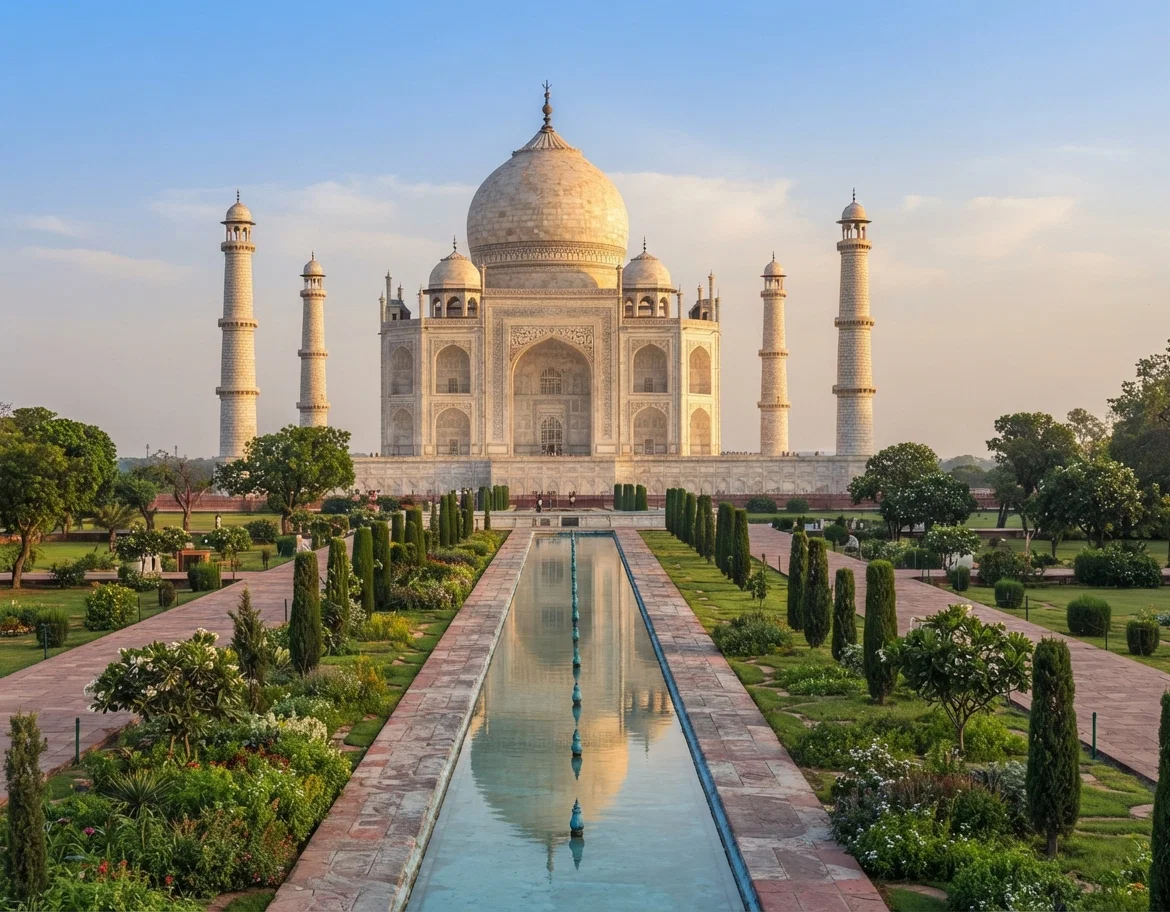
IT was at Agra that Shah Jehan erected the famous mausoleum, Taj Mahal ("Gem of buildings"), for his favorite wife, Empress Arjamund, known as Mumtaz-i-Mahal, corrupted into Taj Mahal, the "exalted one of the harem." The Taj Mahal palace is said to be "the most beautiful the world has ever possessed."
HERE is a brief description of it as given in the "Century Cyclopedia:" "It stands on a platform of white marble 18 feet high and 313 feet square, with tapering cylindrical minarets 133 feet high at the angles. The mausoleum itself is in plan 186 feet square, with the corners cut off; it consists without of two tiers of keel-shaped arches with a great single-arched porch in the middle of each side. The structure is crowned by a pointed and slightly bulbous dome, 58 feet in diameter, and about 210 in exterior height, flanked by four octagonal kiosks. The interior is occupied by four domed chambers in the corners, and a large arcaded octagon in the middle, all connected by corridors. In the central chamber stand two cenotaphs, inclosed by a remarkable open-work rail in marble. No light is admitted to the interior, except through the delicately-pierced marble screens, which fill all the windows. The decoration is enriched by admirable Mosaic inlaying in stone of flower motives and arabesques, much of it in agate, blood-stone, and jasper."
THE TAJ MAHAL.
THE TAJ MAHAL.
So MUCH man builds for pure sensual affection, lust, and pride, and death. But its glory is only outward. It will sometime crumble and decay, even as did the fair form of the favorite empress enshrined therein. It is of the earth, earthy. It has no more value than millions of meaner buildings, save as a work of beauty, beauty that crumbles to dust.
THERE are many lessons to us all, one of which is that it is possible for every sentient soul to erect a grander, more beautiful temple, which will endure forever. The glory of the Taj Mahal was wholly in form and surface; but the glory of our possible temple is inward, growing, developing, enlarging, glorifying, to all eternity. This is the temple of holy character, which God would build in each of us, which He will build in every soul yielded to Him.
THE foundation of that structure is the Rock Christ Jesus, the same foundation on which the prophets and apostles were builded. Luke 6:47, 48; 1 Cor. 3:11; Eph. 2:20. Its superstructure is the living Word of God, inwrought by faith into every motive, principle, action, and fiber of life. Acts 20:32. And, thus building on the Rock Christ Jesus, feeding, growing upon His Word, we become "rooted and built up in Him, established in the faith, abounding therein with thanksgiving."
He who is established in God will endure forever.
TO BRING the lesson closer still: our bodies are temples "of the Holy Ghost." 1 Cor. 6:19. "Know ye not that ye are the temple of God?" Many do not know it; for the rightful Temple-dweller has been refused admittance. Yet God in the beginning designed to make man His eternal dwelling-place. How beautiful and glorious was that temple, which Infinite Wisdom pronounced, "Very good"! But God was shut out by the temple-keeper, and the enemy was given welcome. Man sold the beautiful dwelling to the despoiler; and his evil work is everywhere manifest. And yet, even now, how many beautiful human forms there are, despite sin's work! Man created and embellished the Taj Mahal. But its beauty is cold and dead. God made living man in His own glorious image. Satan and man marred God's handiwork, yet, even now, "fearfully and wonderfully made." Man is more than cold marble. God has, by an eternal sacrifice, bought back the marred and distorted image, such a disgrace to His universe. And the great Architect proposes to every soul which will yield to Him to take the ruins of this wonderful templeand rebuild it into His own divine image, and make it "to the praise of the glory of His grace," to all eternity.
THE Taj Mahal stands to the praise of its builder; but the builder is dead, and people say concerning his work, Ne plus ultra. Should it be destroyed by an earthquake, it would not be rebuilt; and when shattered by the voice of God, with all earth's dead monuments, it will perish forever. The temple of Solomon exceeded in magnificence and richness that built by Zerubbabel, but God said that the glory of the latter should exceed that of the former, because of Christ's literal presence within its walls. So Christ takes the poor, ruined, dying, yet willing temple from the slums or the brothel, where Satan has cast it, puts within it His own presence, and bids it "live." The form stands erect. The bloated face disappears; the rheum departs from the eyes; the foul spirits from the breath; the tongue sings praises to God; the rags give place to cleanness and wholeness, emblem of the life within; and out from the clear, true, steady eyes another spirit looks. The Shepherd is restoring the soul. The Architect is rebuilding the temple. In our own limited observation we see done what man can not do. Even here it is to the praise of the glory of His grace.
BUT, O, what will it be when the incorruptible character shall be given the immortal flesh; when the Divine shall have fashioned the outward as well as the inward, when every form and motion, every look and tone, shall speak of Infinite Power, Wisdom, and Love!—then will we see God's handiwork unmarred. And then all the dead temples of earth will be seen in their insignificance. But now, brother, God's possible immortal temples are all around you; do you appreciate their worth? Are you helping to build? X.

“SOME BETTER THING.”

PRESENT accepted theology teaches that as soon as the saint is done with life, immediately he enters upon his heavenly reward. God says that He has provided for us who remain in the strife “some better thing” than that. If any should be enjoying their heavenly home, surely all will agree that such faithful ones as David, Gideon, Samuel, Daniel, Isaiah, Daniel’s three companions, Stephen, and those faithful ones who were sawn asunder for their faith in Christ, who were tempted, tormented, made destitute—surely such will have a glorious entrance into Christ’s everlasting kingdom, if any one is admitted. But of these God positively says they have not received their heavenly homes. “And these all, having obtained a good report [not on earth, but in heaven] through faith, received not the promise.” Heb. 11:39.
What was the “promise”?—It was a place of “inheritance,” for which Abraham went out, but, with the above class, he received it not here. It was the “city which hath foundations, whose builder and maker is God,” to which their eyes of faith were directed. But why did they not enter their beautiful homes?—O, God wanted all His dear children to enter upon their heavenly inheritance at the same time and all together! This He calls “some better thing” than each to go alone when they die—and surely He should know.
Ponder carefully what God says in closing the record of what faith hath wrought for these chosen ones of the past: “And these all, having had witness born to them through their faith, received not the promise, God having provided some better thing concerning us, that apart from us [who are alive and remain] they should not be made perfect.” Heb. 11:39, 40, R.V.
Why fix up some other way and call that the best, “more pleasant to think upon,” etc., when God says His way of all entering the heavenly home together is the “better thing” for us? Shall we believe God, or the one who told Eve she would never die if she ate the forbidden fruit?
T. E. BOWEN.
Rome, N. Y.

THE OUTPOURING OF THE SPIRIT.

In Two Numbers.

No. 2.

THE promise of the Holy Spirit was the brightest hope and the strongest consolation that Christ could leave His disciples when He ascended to heaven. The truths of God's Word had been buried beneath the rubbish of misinterpretation; the maxims of men, the sayings of finite beings, had been exalted above the Word of the living God. Under the enlightening power of the Holy Spirit, the apostles separated truth from false theories, and gave to the people the Word of life.
The Holy Spirit is often rejected because it comes in unexpected ways. Evidence upon evidence that the apostles were speaking and acting under divine inspiration had been given to the Jewish priests and rulers, but still they firmly resisted the message of truth. Christ had not come in the way they expected, and tho at times they were convinced that He was the Son of God, yet they stifled conviction, and thus became blinder and more hardened than before. They crucified Christ, yet Christ in His mercy gave them additional evidence in the works wrought by the disciples. He sent His servants to tell them what they had done, and even in the terrible charge that they had killed the Prince of Life, He gave them another call to repentance. But, feeling secure in their own righteousness, the Jewish teachers were not prepared to admit that the men who had reproved them for crucifying Christ were speaking by the direction of the Holy Spirit.
Every act of resistance makes it harder to yield. Being the leaders of the people, the priests and rulers felt it incumbent on them to defend their course of resistance. Having committed themselves to a course of opposition to Christ, every act of resistance became an additional incentive to pursue the same course. They regarded the events of their past career as treasures to be jealously guarded, and the hatred and malignity which inspired those acts they concentrated against the disciples.
The Spirit of God inspired His servants, who, irrespective of the fear or the favor of men, declared the truths which had been committed to them. And under the demonstration of the Spirit's power the Jews could not but see their guilt in refusing the evidences God had sent. But they would not yield their wicked resistance. Their obstinacy became more and more determined, and resulted in the ruin of their souls. It was not that they could not yield; they could, but would not. It was not alone because they were guilty and deserving of wrath, not alone because they had put to death the Son of God, that they were cut off from salvation; it was because they armed themselves with the attributes of Satan, and determined continually to be opposed to God, persistently rejected light, and stifled the convictions of the Holy Spirit. The spirit that works in the children of disobedience worked in them, leading them to abuse the men through whom God was speaking. The malignity of their rebellion was intensified by each successive act of resistance against God and the message He had given His servants to declare. Every day, in their refusal to repent, the Jewish rulers took up their rebellion afresh, preparing themselves to reap that which they had sown.
The wrath of God is not declared against men merely because of the sin they have committed; but because they choose to continue in a state of resistance, because they repeat the sins of the past in spite of the light and evidence given them. If the Jewish leaders had submitted, they would have been pardoned; but they were determined not to yield. In the same way, the sinner, by continued resistance, places himself where he knows nothing but resistance.
How was it with the rebellious inhabitants of the antediluvian world?—After rejecting the message brought them by Noah, they abandoned themselves to sin as never before, doubling the enormity of their corrupting practises. The judgments which God brought upon the antediluvian world declared it incurable. The destruction of Sodom showed that the inhabitants of the most beautiful city in the world were incorrigible in sin. Those who refuse to reform by accepting Christ, find nothing reformative in sin. Their minds are set to carry out their purpose of revolt, and they are not, and never will be, forced into submission. Today there is danger that, as of old, the Holy Spirit will be rejected because it comes in a way not in accordance with the minds of men. Because it comes, not to praise men, or to build up their erroneous theories, but to reprove the world of sin, of righteousness, and of judgment to come, many turn away from it. They are not willing to exchange their own righteousness (which is unrighteousness) for the righteousness of Christ, which is pure, unadulterated truth. The Holy Spirit flatters no man, neither does it work according to human devising, and if it comes as a reprover, it is man's place to hear and to obey its voice.
We need to pray for the impartation of the divine Spirit as the remedy for sin-sick souls. The surface truths of revelation, made plain and easy to be understood, are accepted by many as supplying all that is essential; but the Holy Spirit, working upon the mind, awakens an earnest desire for truth uncorrupted by error. He who is really desirous to know what is truth can not remain in ignorance; for precious truth rewards the diligent seeker. We need to feel the converting power of God's grace, and I urge all who have closed their heart against God's Spirit to unlock the door,and plead earnestly, Abide with me. Why should we not prostrate ourselves at the throne of divine grace, praying that God's Spirit may be poured out upon us as it was upon the disciples? Its presence will soften our hard hearts, and fill us with joy and rejoicing, transforming us into channels of blessing.
The Lord would have every one of His children rich in faith, and this faith is the fruit of the working of the Holy Spirit upon the mind. It dwells with each soul who will receive it, speaking to the impenitent in words of warning, and pointing them to Jesus, the Lamb of God, that taketh away the sin of the world. It causes light to shine into the minds of those who are seeking to co-operate with God, giving them efficiency and wisdom to do His work.
The Holy Spirit never leaves unassisted a soul who is looking to Jesus. It takes of the things of Christ, and shows them to the seeker. And if the eye is kept fixed upon Jesus, the work of the Spirit ceases not until the soul is conformed to His image. Through the gracious influence of the Spirit the sinner is changed in spirit and purpose, till he becomes one with Christ. His affection for God increases; he hungers and thirsts for righteousness, and by beholding Christ he is changed from glory to glory, from character to character, and becomes more and more like his Master. Christ is formed within, and by His Spirit He fulfils the promise, "I will never leave thee nor forsake thee." "The Comforter, which is the Holy Ghost, whom the Father will send in My name, He shall teach you all things, and bring all things to your remembrance, whatsoever I have said unto you."
MRS. E. G. WHITE.

THE HIGHER LIFE.

WE speak of the soul that has freedom within; Of hopes untarnished by pain; We speak of a land where there's nevermore sin, A home which the humblest may gain.
We speak of a faith that is leading the way From earth to mansions above; And we joy in the hope of that endless day, That comes with the blessings of love.
We speak of a life that is hidden in Him; Of peace as a river that flows. We speak of the light that will never grow dim, Of the grace which masters our foes.
Our Lord's life the pattern is, life without sin, Triumphant o'er death and the grave; From every temptation without and within His strong arm is able to save.
Dear Lord, we will trust Thee forever, amen, And wait Thy sweet presence to come. We will sing to Thy praise, for Thy promise to men Of a sinless, a heavenly home. L. D. W.

SIGNS OF CHRIST'S COMING.

In the Sun.

THAT the Lord has warned the world of the near approach of the end of all things, is only in harmony with His character of love and mercy. In all judgments which He has visited upon guilty man, those judgments have been preceded by messages of love, offering time for repentance and opportunity for escape from the visitation of divine wrath. As He says through His prophet Amos, "Surely the Lord God will do nothing, but He revealeth His secret unto His servants the prophets." When the ancient world was visited by a flood of waters, for one hundred and twenty years Noah, a preacher of righteousness, warned men to flee from the wrath to come. And not alone has the Lord exercised His clemency toward the world in a general way, but His loving mercy has extended to particular localities, and even to single cities,—as in the case of the cities of the plain in the days of Lot, and of Nineveh in the days of Jonah, the people of which He warned through His servants of impending judgments.
Hence, if God would give warning of such comparatively small visitations, how much more reasonable is it to suppose that all the great events connected with the second coming of Christ, such as the destruction of this earth by fire, the judgment of the world, the annihilation of the wicked, the inauguration of everlasting peace and righteousness—all of which will take place within the day of the Lord—would be preceded by portending signs and warning messages of mercy. This the Scriptures reveal that He will do, and in no inconspicuous way does He reveal these indications.

Signs in the Heavens.

In the heavens, than which there could be no more conspicuous place for the revelation of His will to the natural sight of man, God hangs out the signs of the last great day. Indeed, this purpose must have entered into His mind way back in the days of creation. In making the lights of the firmament of heaven, He said, "Let them be for signs, and for seasons, and for days, and for years." Says our Lord, as recorded by Luke, "And there shall be signs in the sun, in the moon, and in the stars." Matthew and Mark, in their record of these predictions of the Lord, are more specific. By Matthew our Saviour is represented as speaking of the great period of tribulation which will come upon the church of God, evidently that found in the papal persecution beginning in 538 A.D., and ending in 1798. Dan. 7:25, et al. These were the years of tribulation, when by the kings of the earth the word of the pope was recognized as law, and they stood ready to follow his behests and do his bidding. It may be stated here, however, that, altho this papal persecution extended until 1798, when the pope was robbed of his authority as corrector of heretics by the armies of the French Republic, owing to the influences of the Protestant Reformation, one after another of the States of Europe had withdrawn from him their power and patronage, until he was recognized as head over all the church in form only, with little of the civil power to back up his decrees.
In the year 1776 there was proclaimed the Declaration of American Independence. In the same year Maria Theresa, empress of Austria, at that time one of the most powerful States in the Eastern world, issued a decree of religious toleration to all her subjects. The influence of this decree in Europe, and the asylum opened up in the Western world for the oppressed and persecuted, proved the last straws in the destruction of papal supremacy. Hence, it may be said that while the papal supremacy continued until its formal overthrow by France in 1798, its force as a persecuting power was effectually broken in 1776.

In the Sun.

With this statement of facts before us, we are now prepared to intelligently enter upon a consideration of the signs in the heavens. Said our Lord, as recorded by Matthew, "Immediately after the tribulation of those days shall the sun be darkened." This is the first sign in the series. Note that our Saviour does not say, "after those days," but, "after the tribulation of those days," these signs shall begin to take place. As quoted by Mark, His words are even more to the point: "But in those days, after that tribulation, the sun shall be darkened, and the moon shall not give her light." If our statement is correct, that the persecuting power of the Papacy was broken in 1776, and the papal supremacy was taken away in 1798, then somewhere between these two dates, namely, 1776 and 1798, must occur the fulfilment of this prediction.
What do the records of the past show? —In 1780, on May 19, only four years after the ending of the period of tribulation, and eighteen years before the end of papal supremacy, occurred a most remarkable darkening of the sun. The same event is foretold in the sixth chapter of the Revelation, when, upon the opening of the sixth seal, "there was a great earthquake; and the sun became black as sackcloth of hair, and the moon became as blood." Reference here is undoubtedly made to what is known as the earthquake of Lisbon, occurring in 1755. The dark day of 1780 would come in as a fulfilment of this prophecy, likewise.
This darkening was not an eclipse. Regarding its causes, "Webster's Unabridged Dictionary," edition of 1869, says:—
The dark day of May 19, 1780, so called on account of the remarkable darkness on that day, extending over all New England; in some places persons could not see to read good print in the open air for hours together. The true cause of this phenomenon is unknown.
Robert Sears' "Guide to Knowledge," published in New York in 1844, contains the following reference:—
On the 19th of May, 1780, an uncommon darkness took place all over New England, and extending to Canada. It continued about fourteen hours, or from 10 o'clock in the morning until midnight. The darkness was so great that people were unable to read good print, or to tell the time of day from their watches, or to dine, or to transact their ordinary business without the light of candles. They became dull and gloomy, and were excessively frightened. The fowls went to roost; objects could not be distinguished but a very little distance, and everything bore the appearance and gloom of night. The causes of these phenomena are unknown; they certainly were not the result of eclipses.
Milo Bostwick, writing from Camden, N. J., March 3, 1848, says:—
The 19th of May, in the year 1780, I well remember. The sun shone with a pale and yellowish hue, but kept growing darker and darker, until it was hid from sight. At noon we lit a candle, but it did not give light as in the night, and my father could not see to read with two candles. My father and mother, who were pious, thought the day of judgment was near. They sat up that night, during the latter part of which they said the darkness disappeared, and then the sky seemed as usual, but the moon, which was at its full, had the appearance of blood.
The following graphic description by the Quaker poet, J. G. Whittier, is to the point:—
"Twas on a May day of the fair old year Seventeen hundred eighty, that there fell Over the bloom and sweet life of the spring, Over the fresh earth and heaven of noon, A horror of great darkness, like the night In day, of which the Norland sages tell— The twilight of the gods. "Birds ceased to sing, and all the barn-yard fowls Roosted; the cattle at the pasture bars Lowed; and looked homeward; bats on leathern wings Flitted abroad; the sounds of labor died; Men prayed, and women wept: all ears grew sharp To hear the doom-blast of the trumpet shatter The black sky."
In this record we have the remarkable fulfilment of the prophetic Word. The greatest scientific men of the day were unable to give any reason in nature for the cause of the phenomenon. It was as tho the Creator Himself reached forth His hand and covered up the great orb of day, to give a fulfilment to His own prophetic sayings. Prophecy said it would be; history says it has been. The Word of God is proven true, and thus the future fulfilment of the prophecy demonstrated.

Christ’s Unchanging Love

As THE Father loves the Son, in the same manner Jesus loves His people. He loved Him without beginning, and thus Jesus loves us. "I have loved thee with an everlasting love." You can trace the beginning of human affection; you can easily find the beginning of your love to Christ, but His love to us is a stream whose source is hidden in eternity. God the Father loves Jesus without any change. Christian, take this for your comfort, that there is no change in Jesus Christ's love to those who rest in Him. Yesterday you were on the mount and you said, "He loves me;" to-day you are in the valley of humiliation, but He loves you still the same.—Spurgeon.

THE VOLCANO, AN OBJECT LESSON.

"THESE are the generations of the heavens and of the earth when they were created, in the day that the Lord God made the earth and the heavens, and every plant of the field before it was in the earth, and every herb of the field before it grew; for the Lord God had not caused it to rain upon the earth, . . . but there went up a mist from the earth, and watered the whole face of the ground." God's plan is always perfect. Left in His order, nature always works in quiet ways. The contrast is very marked when we think of the earth, clean and pure from the hand of the Creator, sending forth from its hidden fountains a noiseless spray to water the whole face of the ground, and then compare it with the present thorny, barren, broken condition, deluged by torrents of rain, accompanied by the death-dealing cyclone, the flashing lightning, and the roaring thunder.
The devil goes about "as a roaring lion;" and every battle of the warrior is with "confused noise and garments rolled in blood."
It seems to be the mind of sin that a big noise is an evidence of great power, but not so with the mind of Him who controls all power.
When the prophet Elijah was alone in Horeb, the Lord appeared to him, not in the great and strong wind that passed by before him and rent the mountains and brake the rocks in pieces, nor in the earthquake that followed the wind, nor yet in the fire that came after the earthquake. In none of these did the Lord speak to the prophet; but after the tumult there came a still small voice, and God was in the voice.
In the midst of the raging of the heathen and the din of war, the Lord says to us, "Be still and know that I am God." When the demons of storm were shrieking around the disciples' little bark, and the roar of the maddened waves filled their hearts with fear, they awoke the Master of sea and sky, who said, "Peace, be still." "And the wind ceased, and there was a great calm." The Lord exhorts us to study, to be quiet, and to attend to our own business. And He says: "The work of righteousness shall be peace; and the effect of righteousness quietness and assurance forever. And My people shall dwell in a peaceable habitation, and in sure dwellings, and in quiet resting-places."
There came a time when the American Colonies could no longer endure the oppression of England, and so declared their independence. This decision was reached on July 4, 1776. A bloody and cruel war settled the question of the right of sovereignty, and from that time until now the people of the United States have set apart the Fourth of July as a day especially devoted to noise-making. The greater the noise, the more intense and far-reaching the patriotism displayed.
July 4, 1899, found Honolulu all agog to show her loyalty to "Old Glory." We could hardly say, "To her country," for about all we have had of the United States thus far is the flag and the soldiers.
Nevertheless, the Fourth was celebrated in a way that did great credit to the aspiring capital of the Sandwich group. A "grand display" of fireworks and a "magnificent" ball completed the program.
The enterprising little town of Hilo, on Hawaii, could not make so much of a display as her older sister, but late in the evening the volcano came to her assistance. When Mauna Loa threw her rockets of fire skyward, all of man's efforts paled into insignificance. Mother Earth was again reminding the pleasure-loving world that that day is surely coming when the elements shall melt with fervent heat and the earth also.
Far away at sea the flaming heavens heralded the news, and erelong the newsboys were crying the burnings of Hawaii on the streets of Honolulu. All sorts of rumors were afloat, and if report could have done the work, Hilo would have been blotted from the map, and the island of Hawaii turned to ashes. Yet it remains a fact that there was a large lava flow, which continued for several days.
As the vapor settled down in the valleys, casting a vail, as it were, over the face of the sun, and from night to night the jets of fire were seen shooting far up into the air, a kind of fear that can not be expressed took hold upon the hearts of the people. There is something about such manifestations that brings over the mind more of a prayer-meeting spirit than the ordinary fireworks do.
The view was grand beyond any power of words to describe, and we daily meet people who say, "I wish I could have seen it." Many who read this will express the same desire. Do you think you would enjoy the sight? You may see, not only one small volcano belching forth fire, smoke, and melted rock, but you may see the old earth open her sides in hundreds, yea, thousands of places; you may see, not one small spot of lava, but you may look upon the whole earth's surface turned into one great lava bed. Methinks I hear you ask, "How can I get there?" "When will it be?" In the courts in heaven the roll is being called for the last time. If, when your name is called, the Judge finds you an overcomer, you may be within the jasper walls of the holy city, New Jerusalem, which comes down out of heaven from God.
It will rest in a place prepared for it by Him whose feet rest in that day upon Mount Olivet, on the east of Jerusalem. God will reserve a place for you upon the walls of the city. "With thine eyes shalt thou behold and see the reward of the wicked."
The Word tells us that in the flood the fountains of the great deep were broken up. The waters that had been stored up in the earth mingled with the rain from the windows of heaven. To-day we have the evidence before us that the earth is stored, not with water, but with fire. So the apostle says: "The world that then was, being overflowedwith water, perished." "But the heavens and the earth, which are now, by the same Word are kept in store, reserved unto fire against the day of judgment and perdition of ungodly men."
The volcano is God's great object lesson, given to the world as a warning that the day will surely come when every man's work will be tried by fire. When fire shall come down from God out of heaven and devour sin and sinners, all will be without excuse, for the Lord has not left Himself without witness.
While Israel of old were yet in the wilderness, they refused to execute the judgments of God, despised His statutes, polluted His Sabbaths, and their eyes were after their father's idols. For these things the Lord said that He lifted up His hand unto them, that He would scatter them amongst the heathen, and disperse them through the countries. Eze. 20:23, 24. They went over into the promised land, but there they forgot God, and would not walk in His ways. The Syrians came in and took some of the people away captive. The Midianites overran a portion of the country and laid it waste. The Moabites brought in their army, innumerable as the sands. Israel when in distress, would turn to the Lord, and He would raise up a deliverer. The Lord was trying to teach them that the word of the Lord was sure. But they soon forgot God and turned away to Baal. When the Assyrians and Chaldeans came in and carried Israel and Judah away captive, the scattering among all nations began. To-day in nearly every little hamlet, town, and city in the world, we find the Jew a living witness of the sure fulfilment of that word that the Lord spoke when He lifted up His hand in the wilderness over three thousand years ago.
Less than two thousand years ago the Lord said that the earth and all the works of sin in it would be dissolved by fire. In the active volcano, God has given to the world a warning that testifies that this melting will surely come. Now, reader, will we heed the warning, or, like Israel, spurn His love until it is forever too late? God is calling yet, "Turn ye; turn ye from your evil ways, for why will ye die?" Just as surely as Israel was scattered, so surely will this word of God be literally carried out.
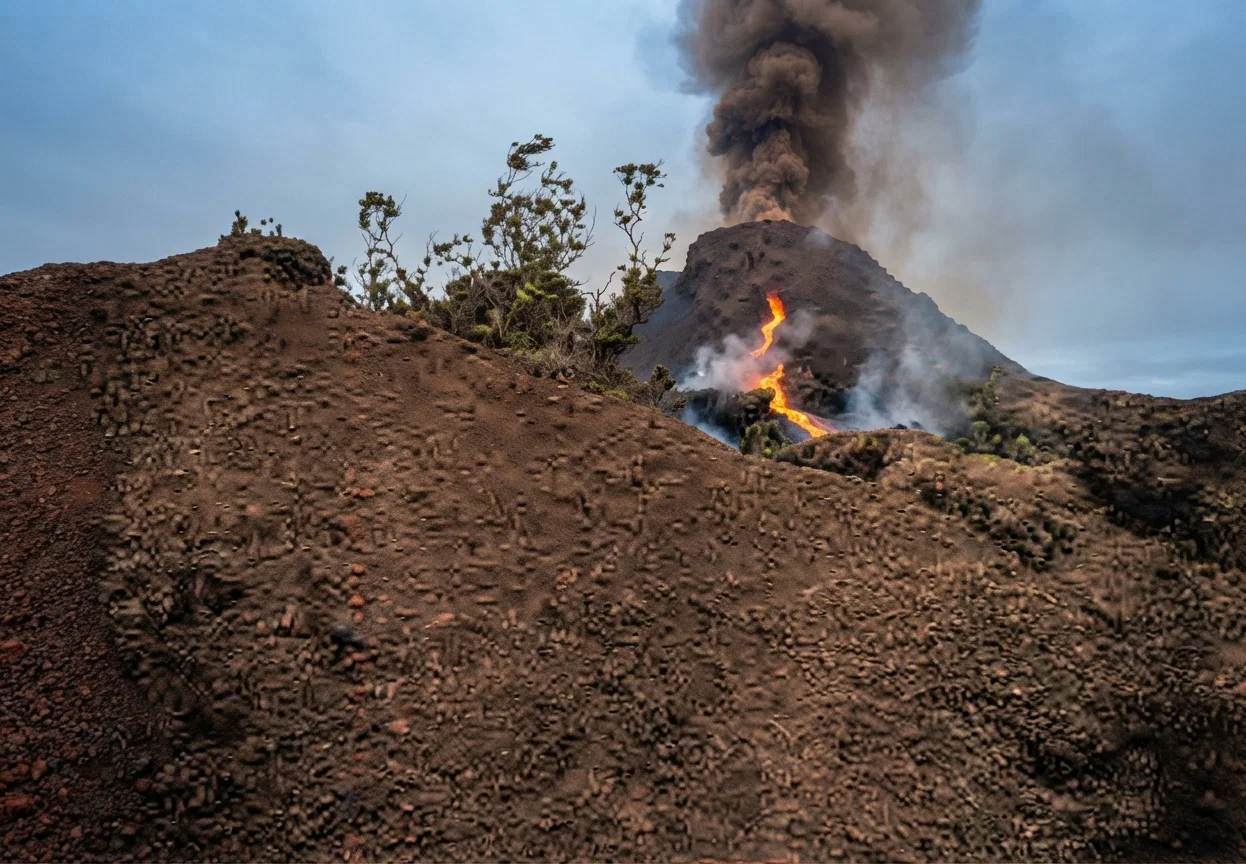
Mauna Loa, on the island of Hawaii, in action. The cloud-like substances in the air, above the mountain, are melted rock and lava as thrown out from the crater. From the top of the mountain down to the front of the picture is the stream of flowing lava.
The thing for us to know is that, like the three Hebrew children, we can pass through the fire unharmed. At that time the Lord says: "The sinners in Zion are afraid; fearfulness hath surprised the hypocrites. Who among us shall dwell with the devouring fire? who among us shall dwell with everlasting burnings? He that walketh righteously, and speaketh uprightly; he that despiseth the gain of oppression, that shaketh his hands from holding of bribes, that stoppeth his ears from hearing of blood, and shutteth his eyes from seeing evil; he shall dwell on high." Isa. 33:14-16.
The harvest-time is near. The gathering call is sounding. Soon the sign of the Son of man will appear in the clouds of heaven, and He will send forth His angels to gather His elect from the four winds, from one end of heaven to the other; but all things that offend, and them that do iniquity, will be gathered out and cast into a furnace of fire.
Honolulu, H. I. BAXTER HOWE.
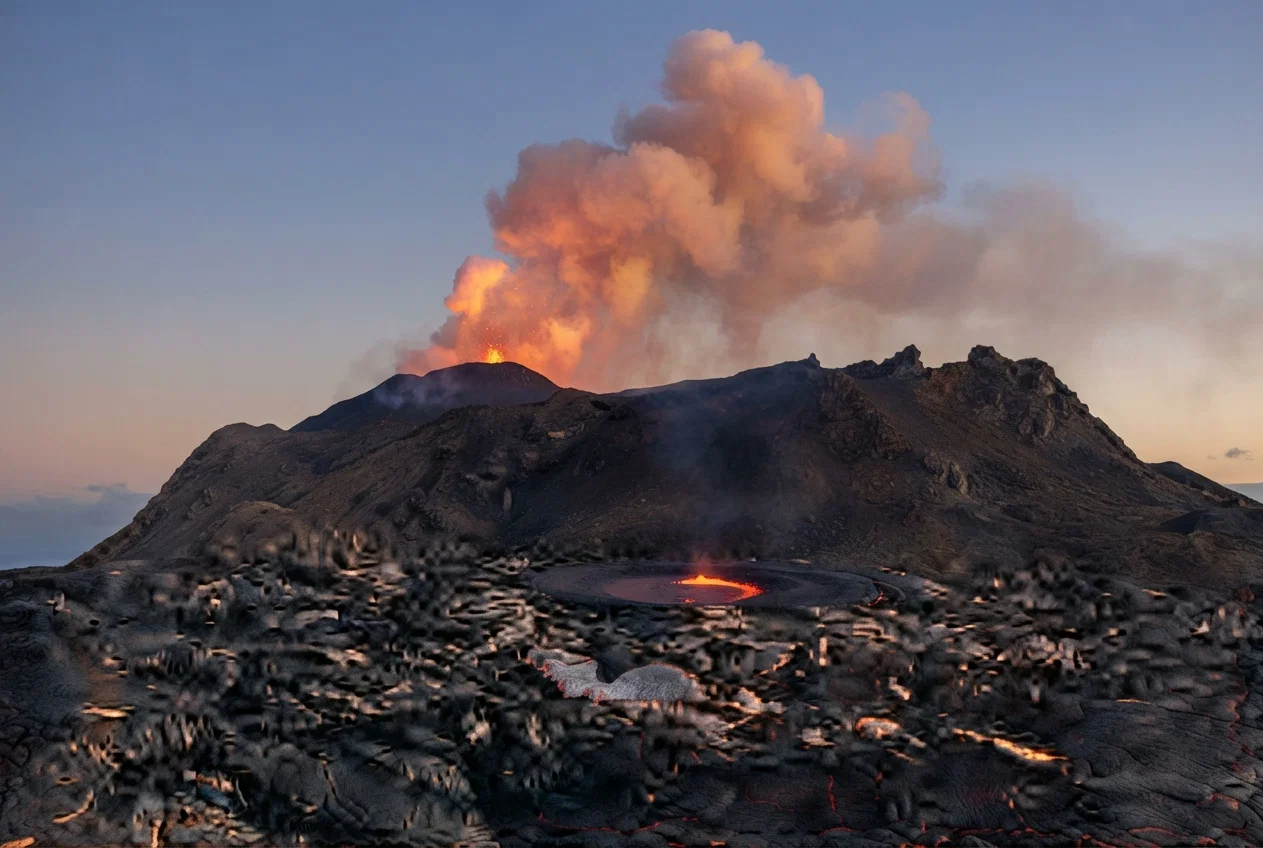
Mauna Loa about 5 A.M. The cloud above the summit is the flame and vapor rising. One-half inch from the bottom of the picture and about the middle is a rather smooth dark spot. Here the lava was boiling. Just below is a whitish, ragged appearance, while the broad, smooth, dark part at the bottom is the living lava flow, in natural color a dark red, growing paler as it cools.
Continue reading: MAN'S PRIMITIVE AND BEST DIET