Your ShelfYour Projects

Review and Herald, Vol. 92, No. 58.

Reigning With Christ

Review and Herald

Nov 25, 1915

Review and Herald Publishing Association · Takoma Park Station, Washington, D. C. · Nov 25, 1915

Reigning With Christ

William Brickey
O Lamb of Calvary! Fain would I dwell with Thee, And be at rest. When Thou shalt claim Thine own, And reign upon Thy throne, We'll know as we are known, Forever blest.
O blessed Saviour, come, And take Thy people home To reign with Thee. Away with sighs and tears, Away with doubts and fears, When Jesus Christ appears, To set me free.
There we shall be at peace, Where war and strife shall cease, While ages roll. With voices tuned to sing The glories of our King, We'll make the new earth ring From pole to pole.
Kamiah, Idaho.

Zionist Movement

The chairman of the provisional executive committee for Zionistic affairs, Mr. Louis D. Brandeis, delivered November 9, in the Memorial Continental Hall, at Washington, D. C., a lecture on Zionism, in which he first explained what Zionism is and what it is not:—
First, it is not a movement to transport all the Jews in the world to Palestine. That, indeed, would be impossible, for Palestine is only about the size of Massachusetts. There are 14,000,000 Jews in the world, and Palestine could not accommodate more than one fifth of the number.
Second, it is not a movement to compulsorily transport a single Jew to Palestine. For Zionism is preeminently a movement of freedom, to give the Jews more liberty, not less, the liberty which practically every other people in the world enjoys—the liberty to live in the land of their birth or adoption or to go to the land of their fathers.
Third, neither is it a movement to wrest the sovereignty of Palestine from the Turkish government.
Zionism is a movement to give the Jews a home in the land of their fathers, where the Jewish life may be lived normally and naturally, and where the Jews may in time hope to constitute a majority of the population, and look forward to what we have come to call home rule. — Washington Post, November 10.
We do not think, however, that the Scriptures justify the expectation of even this much of a return of the Israel after the flesh to their native land of Palestine. It is the spiritual Israel to whom the promises of restoration are now to be fulfilled.

A Leader of the Negro Race Dies

THE morning press of November 15 brought the news of the death of Booker T. Washington, foremost teacher and leader of the Negro race. Hardening of the arteries, following a nervous breakdown, caused his death, at 4:40 A. M., at his home, in Tuskegee. Though he was born into slavery when Negro mothers made no record of nor long remembered the date of a child's birth, “Who's Who in America” states that he was born “about 1859.” We take from the Washington Post of November 15 the following brief summary of his life up to the time he took charge of the Tuskegee Institute:—
Soon after the close of the Civil War the little Negro boy went with his stepmother to Malden, W. Va., where he worked in salt furnaces for nine months in the year and attended school for three months. After several years of such life the boy obtained work in the kitchen of Mrs. Viola Ruffner, a New England woman who had married a Southerner. Mrs. Ruffner soon recognized the boy's eagerness and ability to advance himself, so she taught him the elementary subjects. Booker Washington felt grateful to her to the end of his life because she really gave him his start.
In 1871, when he was about thirteen years old, he heard of the Hampton Institute, and he decided at once to attend it. So, with the little money he had been able to save from his wages of six dollars a week, he set out for Richmond, Va., hoping to earn enough there to enable him to go on to Hampton, which is near Norfolk. This was in 1871. (Dr. Washington founded the Tuskegee Institute just ten years later.) He was admitted to the institute, and was graduated at the head of his class in 1875, after working his way through the school.
After graduation, Dr. Washington returned to Malden, and taught school until he had earned enough to enable him to go to the Wayland Seminary, in Washington, D. C., where he studied until 1879, when he was called to Hampton as a teacher in the institute. After he had taught for two years, in 1881 the State of Alabama voted to found an industrial institute for Negroes, similar to that at Hampton, and, after searching for a Negro qualified to head the proposed institution, Dr. Washington was selected. This was his entrance into the “black belt” of the South, a chance which he had long desired; and when he assumed charge of the institute at Tuskegee, Ala., his real life work began.
How well he did his work is shown by the following statistics:—
The institute opened on July 4, 1881, with one teacher and thirty pupils. At that time it had neither land nor buildings, nothing but the $2,000 a year granted by the Alabama Legislature.
When the institute celebrated its twenty-fifth anniversary, it owned 2,000 acres of land and eighty-three large and small buildings, which, with its equipment of live stock, stock in trade, and other personal property, were valued at $831,895. This did not include 22,000 acres of public land remaining unsold from the 25,000 acres granted by Congress, valued at $135,000, nor the endowment fund, which was $1,275,644. During the year there were more than 1,500 students enrolled in the school, more than 1,000 young men, and more than 500 young women. The students were trained in thirty-seven industries.
In his death the whole Negro race has sustained a great loss.

Note and Comment

Petition Against Religious Toleration

THE Roman Catholic Church still has a strong hold on the women of Peru. That the women are to be used to hinder religious toleration in Peru is indicated by the following dispatch from Lima, Peru, printed in the Washington Post of November 1:—
A petition has been presented to the president, signed by more than a thousand prominent women, including the mother, the mother-in-law, and sisters of the president, and wives of cabinet members, requesting his veto of the constitutional amendment authorized by congress establishing religious tolerance in Peru and permitting public worship of other religions than the Roman Catholic.
Constitutional amendments require the authorization of two congresses. The measure was first passed two years ago. Whether or not the president will exercise his veto is not known. The petition was a remarkable demonstration of the strong religious [Roman Catholic] attitude of the women of Latin America.

Christ to Come After This War

It is rather striking that a prediction of Christ's soon coming should have been made recently at a meeting of the Theosophical Society, in Washington, D. C. We quote from the Washington Herald of October 25:—
“Christ will probably appear among men at the close of this horrible war in Europe, and give additional teachings fitted to the new era into which we are just entering,” said Dr. W. W. Baker, presiding at the meeting of the Theosophical Society, at 1216 H Street Northwest, last night.
Dr. Baker stated that Mrs. Besant, president of the society, has been predicting for several years that Christ would soon return among men, and that only last December she announced publicly, “He cometh quickly.”
The Scriptures teach that Christ will come soon, yet not in the manner in which the Theosophists expect him. It is not necessary that he come to “give additional teachings,” but that he may end the reign of sin and establish God's eternal kingdom on earth.

An African Missionary Garden

Going down on the boat from England, I met a lady from Kimberley. Speaking of our work, I mentioned the fact that our Brother and Sister J. V. Willson were operating treatment rooms in that city of the diamond fields.
“O, yes,” said the lady; “there is where we go to get flowers. I have often bought flowers there.”
We had heard by reports of the missionary garden Brother and Sister Willson have been operating; but we thus found on the boat that by some in Kimberley the flower side of the enterprise was better known than the treatment rooms.
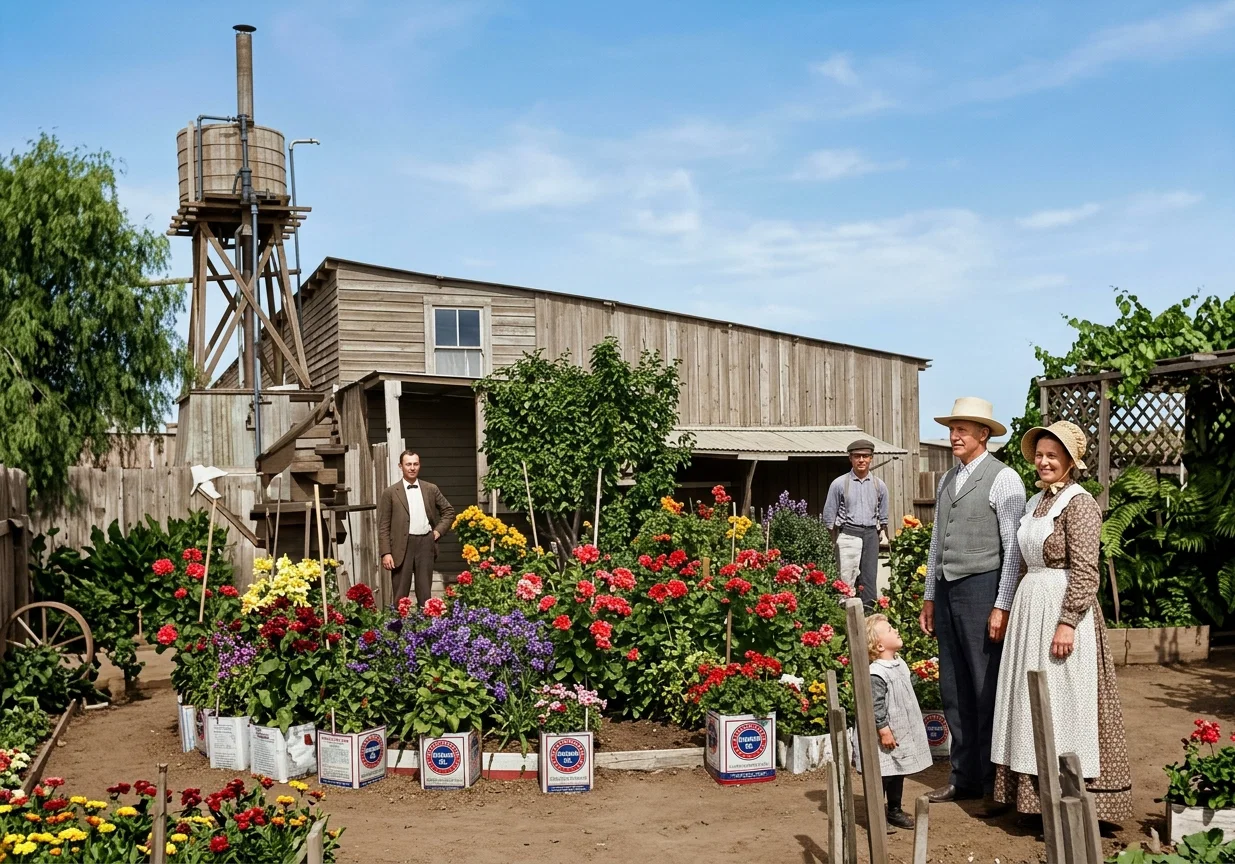
IN THE FLOWER GARDEN (BROTHER AND SISTER J. V. WILLSON AT THE RIGHT)
On my visit to Kimberley and to Beaconsfield, where our first South African church building was erected, I found Brother and Sister Willson busy with both sides of the enterprise.
“How did you come to start the flower business?” I asked.
“Well,” they said, “really the suggestion came through reading what the spirit of prophecy has said about the possibility of developing small plots of ground to bring good returns.”
I found in Kimberley that the treatment rooms face Main Street, while the living house, with rooms for transients above, is in the rear, facing the next street. In between are practically three small garden plots, each one just about such a little garden as may be found in the rear of most suburban homes. It is really a tiny piece of ground, but it is full of well-fertilized beds, and of Standard oil tins filled with earth. The waste water from the treatment rooms is run into a cistern, and from there by force pumps sent into a tank on the roof, from which it is piped out over the garden. Everywhere flowers are blooming, or springing up to yield blooms for coming months. Against the wall in one corner is a fernery, kept shaded by trellis work, with creeping vines, which are worked into bouquets and flower baskets. The moss for the foundations of wreaths and baskets is imported from down in the Cape Province. Brother Willson manages the garden end, while I found Sister Willson out early in the morning or late at night making up baskets or bouquets to meet orders.
“Without the flower garden we should not have been able to keep on financially with the treatment rooms,” Brother Willson told me.
“How much have you taken in for flowers out of this little garden plot?” I asked, as I saw bouquets and baskets made up to meet calls, at prices all the way from a shilling to a pound.
“Well, I will see. I will figure it out and tell you.”
So Brother Willson sat down, and from his books gave me the record for the ten years since 1905, though that first year was evidently but the beginning of the enterprise and had returns of only $500. The highest amount for one year was about $2,000, in 1911. The total, from 1905 to 1914, was $13,981.
That is a good record, is it not, for a missionary garden? It has meant hard toil for Brother and Sister Willson, but it has been a joy to them, not only because they love the flowers and know how to work among them, but because the income was for the mission cause.
W. A. S.

Notes From the Field — No. 3

We speak in a last-page note of the opening of the autumn council of the General Conference and North American Division Committees. It can truly be said that this is the most important gathering of these committees which has ever been held. Questions of far-reaching and world-wide interest will be considered. The last few years have witnessed wonderful advances in every department of the message in all parts of the world. Our work is assuming large proportions, and every gathering of this character has to deal with questions of growing magnitude.
At this council the needs of the great mission fields will be considered, and preparations made for their support. Urgent demands which exist in the fields for additional workers will be met. The large interests centered at Loma Linda will be considered.
Already it has been voted to effect the organization of an Asiatic Division Conference, and many important questions will arise in fully effecting this organization.
The brethren assembled fully realize, we believe, the heavy responsibility which rests upon them, and are earnestly seeking for divine enlightenment, that they may know what God would have them do in laying wise plans for the promotion and furtherance of his work.
The services of the first Sabbath were of deep interest. The keynote sounded by Elder I. H. Evans in his sermon Friday evening—the evangelization of the world in this generation—met with a hearty response on the part of all present. This spirit was deepened by the earnest sermon by Elder A. G. Daniells Sabbath morning, in which he spoke of the opening providences of God in all the world, and the call of God to us to arise and finish his work.
At an early meeting Sabbath morning, conducted by Elder G. B. Thompson, many spoke of their faith in the speedy triumph of this message. Sabbath afternoon another and more general meeting was held, in which a large number took part, in praise and testimony. We are indebted to Brother C. C. Crisler for the report of this excellent afternoon service, from which we selected the following:—
Elder W. A. Spicer led out with a few words of exhortation and good cheer, based on a passage recorded in the last chapter of the Bible. To John on Patmos were revealed the glories of the New Jerusalem; and in his testimony of what he saw, he writes:—
“And he showed me a pure river of water of life, clear as crystal, proceeding out of the throne of God and of the Lamb.” Rev. 22: 1.
Elder Spicer referred to the eagerness with which a traveler in a dry and thirsty land pushes onward to get to water. Far up in the interior of Africa, the soldiers measure a day's march, not by miles, but by water holes. Once a camp is struck, the soldiers must press on and on until they reach the next water hole, whether it be ten, twenty, or fifty miles, before they camp again.
We as Christians are journeying in a dry and thirsty land. The way has been long; but, just a little beyond, the river of water of life is flowing from the throne. We have assurance upon assurance from fulfilled and fulfilling prophecy, that our pathway leads to the city of God. Only a little while, if faithful, and we shall be kneeling down at the banks of that river; we shall put our mouths to the stream, and we shall drink from the fountainhead.
Elder Spicer read from “Early Writings” the familiar passage outlining the experience of the advent band as they pressed onward along the narrow way, lighted from behind by the glory of the midnight cry.
The way of advance is made plain by the Lord of glory himself, who is going before his people and throwing light upon their pathway. In this time of pressing on and on toward the city of our God, it is our privilege to sound the note of hallelujah. The Lord is making bare his holy arm in the sight of all the nations of earth; his glorious right arm is beckoning us on.
O, let us keep our eyes on the end of the way! When fording a river, with the swift water swirling beneath, it is a good thing for us to fasten our eyes on the end of the way. By the grace of God, I say, I will push on with the advent people to the end of the way, and drink of the water of life that is flowing from the throne.
In Volume VIII of “Testimonies for the Church,” we read:—
The Lord is soon to come, and we must be prepared to meet him in peace. Let us be determined to do all in our power to impart light to those around us. We are not to be sad, but cheerful. We are to keep the Lord Jesus ever before us. He is soon coming, and we must be ready and waiting for his appearing. O, how glorious it will be to see him, and be welcomed as his redeemed ones! Long have we waited; but our hope is not to grow dim. If we can but see the King in his beauty, we shall be forever blessed. I feel as if I must cry aloud, “Homeward bound!” We are nearing the time when Jesus will come in power and great glory to take his ransomed ones to their eternal home.
The first delegate to bear testimony was J. N. Loughborough, who first heard the advent message in December, 1843, and who has been active in service as a Seventh-day Adventist minister for more than sixty years. “We know not,” he testified, “just when the Lord will come; but we know that event is right at hand, and I am of good courage. I believe we are almost home.”
Many bore witness to God's leading for thirty, forty, and fifty years of pilgrimage with the advent band.
A. T. Robinson told of a sermon preached by Elder J. N. Andrews forty-four years ago, at the close of which some one inquired of him, “How will the third angel's message reach the masses in the dark places of earth before the passing of this generation?” “I do not know,” Elder Andrews replied; “but there is one thing I do know, and that is that God has agencies that are now unseen, that will be brought into the accomplishment of this work. I am thankful today that those agencies that were then unseen except by the eye of faith, are today visible, evidencing the rapid finishing of this work.”
N. Z. Town: There is nothing that cheers my heart so much as that the Lord is soon coming, and there shall be delay no longer. I am so glad we are near the time when this work is to be finished.
R. A. Underwood: I thank God we see living messengers, according to God's plan, going to all places of this earth, and that this message is world-wide in extent. The time is limited, and we need not think that the day is going to be prolonged beyond God's set time. We must step fast, and move forward, if we keep pace with the onward sweep of this message, and stand ready to meet our Lord when he comes.
J. E. Fulton: The Lord has helped me to find the way of life eternal, and he has never disappointed me. I feel glad to be connected with such a great work at such an important time.
W. T. Knox: I feel to rejoice that there is a limit to the time; that as God, in his appointed time, sent forth his Son, so there surely must come a time when that same Son will appear with salvation.
Charles Thompson: I feel thankful that the message does not lose its power as it gets older. The same message that saved our brethren fifty years ago, had not lost its power when it came to me. I am glad to hear the testimonies of these pioneers with us today, and to add mine to the saving power of the same truth that has filled their hearts with joy and peace.
Elders Loughborough, Haskell, Butler, Corliss, Decker, Underwood, and Morrison were among the older ministers who took part in the social service. More than a score of union and local conference presidents testified of their desire to draw nigh to God, to walk in the way of his counsel, and to labor unitedly for the finishing of the work.
R. F. Cottrell testified: I am very thankful to be here this afternoon, and to bring from China a message of hope and good cheer. Eight years ago my wife and I decided to accept the call to go to that field, and since that time we have never seen a moment when we were sorry that we went. The Lord has greatly blessed our own souls, and he has been doing great things for China. As I have seen men as low in the human scale as one could imagine, transformed marvelously by the influences that come with the acceptance of the third angel's message, I have thought that the God who could perform such miracles of grace can surely finish the work in this generation.
M. E. Kern: I am rejoicing this afternoon in the blessed hope of Christ's return soon. It gives me great courage to read of this. For the sake of the young people of our ranks, I dedicate myself anew this afternoon to God and to his service.
F. W. Paap: I am thankful for the hope, the confidence, expressed by so many. I am thankful that we have a God who is powerful to fulfill his purposes.
S. Mortenson: We have many difficulties to meet; but when I realize that God is a God that can do wonders, I am of good courage. I believe this work is going to triumph, and that it will triumph in this generation.
E. R. Palmer: The supreme desire of my heart today is that I may keep so free from sin and in such close touch with God that when he wants something done he can speak to my heart, and I can hear his voice, and do the work. And so I feel today that it behoovesus as a people to keep our eyes upon the prophecies, upon the signs of the times, and upon the world-wide field; and to work every day as those who believe that Jesus will come as soon as his work is done, and no sooner.
A. G. Daniells: I believe that this message with which we are identified will be finished in our day. Why not? What reason can anybody give for its not being finished according to the Lord's promise? I believe the Lord has facilities, resources, ways, methods, that we do not understand. I want the Lord to keep my faith just as simple and childlike and pure as in my boyhood days.
Geo. I. Butler: I have sat a very interested listener as these brethren have been testifying. My heart is in this work, and I feel that I never saw the importance of the work so clearly as I do today. I know that the work will be finished in this generation. God will make provision in the last days so that this work will go with mighty power. We believe that; and if we live up to the Word of God and to the Testimonies of his Spirit, and humble our hearts, he will go before us, as the brethren have said; and God can do much in one day, just as on the day of Pentecost. I am one of those who believe that God will go before us, and we shall see something greater than the day of Pentecost. My brethren, we are living in the most wonderful age in the world, and the coming of Christ is the greatest event that can occur. Nothing has taken place in the universe of God that is so important as the second coming of Christ. It is going to be known in all the universe; and we must expect great things. I expect to see great things. I expect to see a wonderful work accomplished; and I believe the Lord will send his angels before us.
Never have we attended a meeting of this character where all seemed to sense so fully as do the brethren here, the solemnity of the work in which we are engaged and the importance of the times in which we are living.
The various committees appointed to study important questions coming before the council are earnestly seeking the guidance of the Lord in the questions which come before them; and every delegate, we believe, realizes as never before the need of personal preparation of heart and of consecration of life, in order that he may become the agent in the hands of God for the revelation of his saving power to lost mankind.
F. M. W.

Some Small Sweet Way

THERE'S never a rose in all the world But makes some green spray sweeter; There's never a wind in all the sky But makes some bird wing fleeter; There's never a star but brings to heaven Some silver radiance tender, And never a rosy cloud but helps To crown the sunset splendor; No robin but may thrill some heart, His dawnlike gladness voicing; God gives us all some small sweet way To set the world rejoicing. — Central Baptist.
Continue reading: Report of Biennial Council of the General Conference Committee