Signs of the Times, Vol. 40, No. 50.

Industrial Conditions in England

Signs of the Times

Dec 30, 1913

Pacific Press Publishing Association · Mountain View, California · Dec 30, 1913

Industrial Conditions in England
The Government as Landlord—Socialistic Ideas Gaining Rapidly—Spirit of Unrest and Rebellion—Peace Outlook in Europe
By W. T. BARTLETT
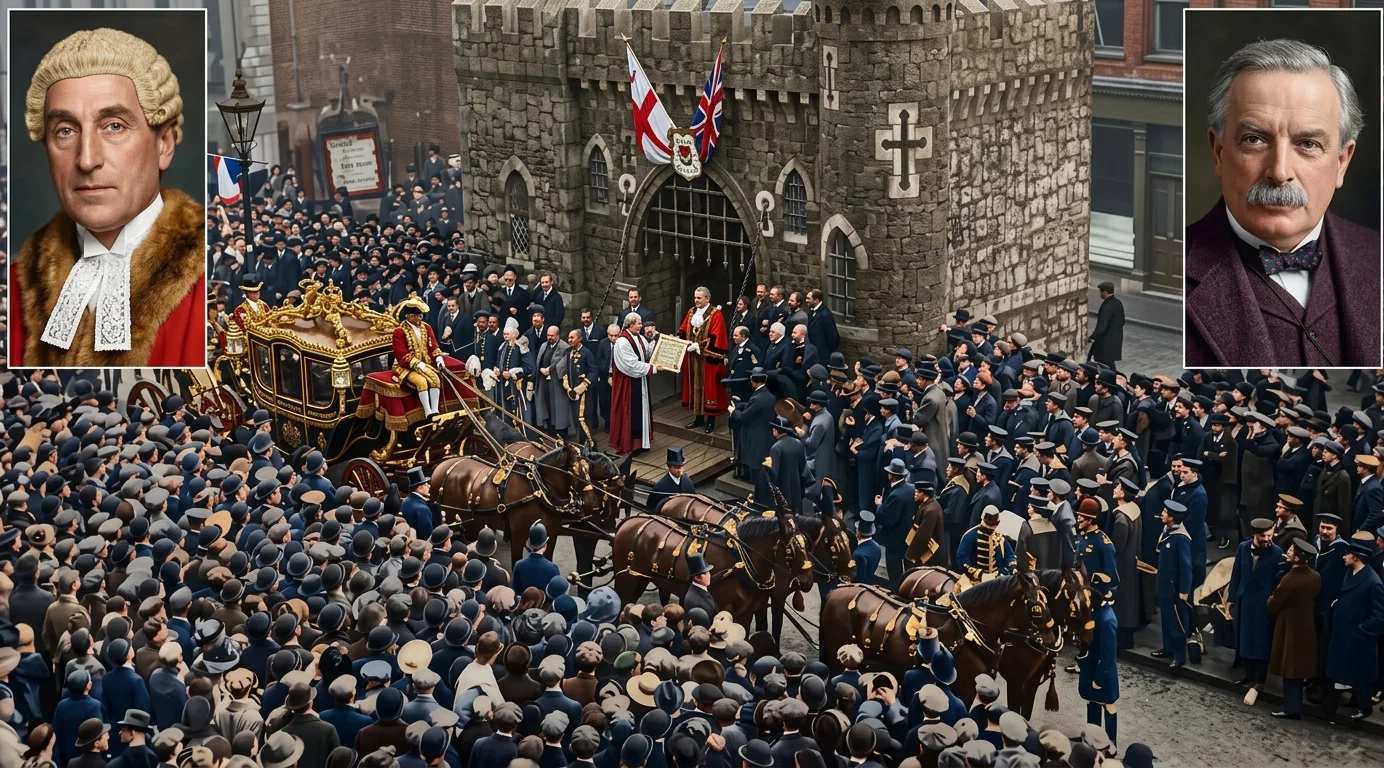
SCENE IN THE LORD MAYOR'S SHOW, LONDON, NOVEMBER 10
THIS is the regular summing up, or quarterly letter, by our London correspondent, Mr. W. T. Bartlett, editor of Present Truth.
Mr. Bartlett is in a position to take an intelligent view of conditions in England, and to study them in their relation to the larger affairs of Europe in general. His article forcibly reminds one of the experiments in paternalism that were tried in Rome during her decline and fall. Paternalism in Rome served to increase the discontent and turbulence; it appears to be working in the same manner in England to-day. History is ever repeating itself, yet few seem to be willing to learn the lesson. EDITOR.
If, as its opponents allege, the Liberal government has introduced its land reform proposals at this point with the idea of turning minds away from the Irish Home Rule imbroglio in Ulster, its tactics are certainly proving a success. Mr. Lloyd-George again fills the public eye, and easily holds the public ear. His program has been submitted in instalments in a series of striking speeches. His appeal is addressed to almost every class, in both the rural districts and the cities.

Extensive Government Landlordism

To the agricultural laborer he holds out the hope of a minimum wage, and a cottage to be rented from the state, with enough land around it to grow his own vegetables. Hitherto the laborer has almost invariably rented a cottage from his employer; when he lost his job, he had to vacate his cottage to make room for his successor. Now, if the laborer becomes unacceptable to his master, he will still be able to stay in his home and grow a part, at least, of the food he eats. He is also, if he so desires, to be supplied with a few acres of land for a small holding; and if he shows himself able to make a success of farming on a small scale, he may call upon the authorities to find for him a larger piece of land.The government proposes to build some 120,000 suitable houses throughout the country, to be let to small holders and laborers at an economic rent.

Farmers' Right of Appeal, and Higher Wages

The land reform scheme aims to make it possible for the farmer to pay his laborers an increased wage by giving him the right to appeal, if necessary, against the rent he himself pays. He may make his appeal to a land court; and he is also to have the advantage of a more secure tenure of his farm. So long as he cultivates the land properly, he is not to be turned out of his farm against his will, merely because the landlord desires to make a change. The farmer will have the right of appeal against his landlord's dictates to government commissioners who will investigate every case of alleged injustice that is reported to them, and will have power to cancel an unjustifiable notice to quit. If the landlord still insists that his farmer tenant shall leave, the farmer must be paid a fair compensation for disturbance. The tenant is also to be permitted to kill any game that may trespass on his land and injure his crops.
In view of this plan for securing their interests, the farmers are expressing willingness to pay their laborers a higher wage. At the present time there are thousands of farm laborers who receive from three to four dollars a week. The minimum rate will probably be not lower than five dollars.

Landlords May Sell to the Government

The farmer's landlord in his turn is offered some relief. If he is unable to get his land farmed at a rent that will remunerate him for his investment in it, the government is prepared to make him a reasonable offer for his freehold, and to work the land itself, either as agricultural or as forest land.
This latter portion of the scheme has been taken up promptly by several large landowners. The Duke of Sutherland, who owns a considerable part of the north of Scotland and has turned it into deer forests, has offered the government 400,000 acres of land at five and a half to six dollars an acre. The chancellor of the exchequer will not, however, wish to test his scheme on land that the great owners are anxious to sell cheap.

Extended to Tenants in Towns

The benefits of this reform are to be extended also to tenants in towns. It has been a frequent complaint among city tradesmen, that, when they have built up a successful business and desire to enlarge their premises, the landlord charges a very much higher rent for the larger building he permits them to erect. Whenever a lease falls in on property like this, the landlord, before he will renew the lease, demands an exorbitant rent, with other burdensome conditions, and the tenant feels obliged to comply because he would lose his good-will if he went elsewhere.
In future, under reasonable conditions, business premises are to be held more securely by the tenant, or he is to be paid a fair compensation for disturbance. If the tenant makes permanent improvements to the property which increase its rental value, he is to receive compensation for these. If existing leases contain restrictive covenants of an arbitrary and unreasonable character, the tenant is to be granted some relief from these covenants.
There is rejoicing over these promised reforms among many shopkeepers in London and other large cities. These have often complained bitterly about the unreasonable and covetous spirit manifested by ground landlords when their tenants prosper and desire to extend their business premises or to renew leases. One large business house in a fashionable center of London felt itself so aggrieved by the action of a certain noble landlord, that for years it kept posted up on a prominent part of the building a protest against his injustice.

The Farmer and Transportation

One of the principal obstacles in the way of making farming remunerative in England is the high cost of transportation where railway facilities exist. On account of this, it sometimes does not pay the grower to send his vegetables and fruit to market when the price is low. Multitudes would be glad to buy the produce at a fair price, but the cost of getting it to them would leave the farmer with less than nothing for his share.
The railways ought to pay well in this country, but they are heavily handicapped. When first made, they were obliged to pay such a heavy price for the land they bought that much of their large income goes in paying interest on the investment. They have lately received permission to increase their freight rates on account of the higher wages paid to employees.
Some of those associated with railway management are beginning to feel ready to sell out the railways to the government, and to let it face the problems involved in trying to satisfy the workmen who want shorter hours with bigger wages, and the customers who want better service at lower rates. An important royal commission has just been appointed “to inquire into the relationship between the railway companies of Great Britain and the state . . . and to report what changes if any are desirable in that relationship.”

Socialistic Ideals to the Front

Socialistic ideals are being realized rapidly. The government is not only attending to the education of our children and feeding them in the schools if we are unable to do so, but it has provided us with old-age pensions in case we omit to lay up anything for our declining years. It has provided medical attendance for us if our income does not exceed fifteen dollars a week, and is also insuring some of us against unemployment. Soon it may be running the railways and relieving landlords of the difficulties of managing their property. When the process is finished, there will not be much need for individual effort.

Paternalism Does Not Cure

With all the increasing paternalism of the state, however, we are still far from a reign of contentment. For months a serious strike of transport workers has been going on in Dublin, and at the present time the trade of that port has almost entirely ceased. There is a possibility that the trouble may continue until Christmas. The suffering among the poor is acute, but the lower classes of Dublin are not accustomed to luxury, and a little additional hardship does not frighten them. Over twenty thousand families live in single rooms below the poverty line. Their distress has been alleviated in part by the contributions of British trade-unions which have been sending food ships to Dublin, laden with provisions for the strikers and their families.
The leader of the Dublin strikers, Mr. J. Larkin, was arrested and tried for inciting to violence and sedition. He was found guilty of using seditious language and sent to prison for seven months, but the government has set him free after seventeen days in prison. During the short period of his incarceration the government lost heavily in popularity, as shown in two by-elections: the working classes bitterly contrasted the leniency shown to Sir Edward Carson in Ulster, and the severity with which Mr. Larkin was punished in Dublin.

Unrest and Rebellion

The forces of labor are seething with a spirit of unrest and rebellion. Some sections are crying out continually for a big general strike, but others are saying that this is a suicidal policy, that the wiser plan is to avoid sympathetic strikes which only play into the hands of the masters. Let the friends of the strikers, say they, stay in their employment and send their money to help their comrades who are engaged in conflict.
Society in England is certainly in a state of upheaval. In the labor world the spirit of war is ever coming to the front.

Europe in General

Turning to the larger sphere of European affairs, we do not know whether we may hope for peace or not. One week Mr. Winston Churchill holds out the olive-branch to Germany and declares that we long unutterably for some cessation in the armament race; the next he declares that England must aim at supremacy on the sea and under it and in the sky, and foretells a large addition to our naval budget. Some of his Liberal supporters are getting tired of this abandonment to militarism. They can plainly see that, no matter how much the Liberal government may talk of great land reforms, if the national revenue continues to be squandered on battle-ships, there will be an entirely inadequate sum left for the promotion of social reforms.

Universal Danger — Doctor Mott's Warning

This same spirit of unrest seems to be active elsewhere. Dr. J. Mott has come here, after twenty-one conferences in India, China, and Japan, to tell us that there was never a time in human history when the demand upon the church of Christ was so wide and appealing, and when at the same time the situation was so full of imminent danger. He asserts emphatically that in the gospel is the one power that can make of this world a safe place to live in. “The rising tide of racial and national life,” he says, “is creating new positions of tremendous portent, and the corruptions of Western civilization are eating like a gangrene into the life of the East.”
So long as the four winds of strife are held, the world continues to be a safe place, and even presents some pleasing prospects of future good; but if the turbulent forces should once break loose, there are elements of mischief in international relations and in social life, plentiful and powerful enough to turn this civilized world into a raging inferno.

Come Again He Surely Will

By C. P. BOLLMAN
THE time's been long, yea, very long, Since angels sang that sweet, sweet song, “Peace, peace on earth; good will to men.” 'Twas most two thousand years ago; Yet days they come, and days they go, As time creeps on — but O, how slow! And will He ever come again? Yea, come again He surely will; His word abideth faithful still. List to the angels once again; Hear what they say to sinful men — “He'll come, He'll come, He'll come again. He'll come the same, the very same, As when before to earth He came.”
O, wondrous joy! yea, joy supreme! We'll hear again that blessed name, As when from angel lips it fell, When heavenly beings came to tell The story of His wondrous birth, And herald peace and joy to earth.
He comes again earth to redeem From curse of sin, and death, and pain. Yea, praise His name, He'll come again The same, the same, the very same, As when before to earth He came. And so we'll trust, nor ask Him when, For He has said He'll come again.

Jewels from the Treasure-House of Truth

Divine Greetings to the Whole Human Family — Kindness to Foes as Well as to Friends — The Supreme Law Takes Account of Thought and Motive
BY MRS. E. G. WHITE
THE Sermon on the Mount is Heaven's benediction to the world—a voice from the throne of God. It was given to mankind to be to them the law of duty and the light of heaven, their hope and consolation in despondency. Here the Prince of preachers, the Master Teacher, utters the words that the Father gave Him to speak.
The beatitudes are Christ's greeting, not only to those who believe, but to the whole human family. He seems to have forgotten for a moment that He is in the world, not in heaven; and He uses the familiar salutation of the world of light. Blessings flow from His lips as the gushing forth of a long-sealed current of rich life.
Christ leaves us in no doubt as to the traits of character that He will always recognize and bless. From the ambitious favorites of the world, He turns to those whom they disown, pronouncing all blessed who receive His light and life. To the poor in spirit, the meek, the lowly, the sorrowful, the despised, the persecuted, He opens His arms of refuge, saying, "Come unto Me, . . . and I will give you rest."

TO THOSE WHO FEEL THEIR NEED

"Blessed are the poor in spirit: for theirs is the kingdom of heaven." Happy are they, Christ said, who recognize their spiritual poverty, and feel their need of redemption. The gospel is to be preached to the poor. Not to the spiritually proud, those who claim to be rich and in need of nothing, is it revealed, but to those who are humble and contrite. One fountain only has been opened for sin, a fountain for the poor in spirit.
The proud heart strives to earn salvation; but both our title to heaven and our fitness for it are found in the righteousness of Christ. The Lord can do nothing toward the recovery of man until, convinced of his weakness, and stripped of all self-sufficiency, he yields himself to the control of God. Then he can receive the gift that God is waiting to bestow. From the soul that feels his need, nothing is withheld.

COMFORT TO THE MOURNER

"Blessed are they that mourn: for they shall be comforted." By these words Christ does not teach that mourning in itself has power to remove the guilt of sin. He gives no sanction to pretense or to voluntary humility. The mourning of which He speaks does not consist in melancholy and lamentation. While we sorrow on account of sin we are to rejoice in the precious privilege of being children of God.
We often sorrow because our evil deeds bring unpleasant consequences to ourselves; but this is not repentance. Real sorrow for sin is the result of the working of the Holy Spirit. The Spirit reveals the ingratitude of the heart that has slighted and grieved the Saviour, and brings us in contrition to the foot of the cross. By every sin Jesus is wounded afresh; and as we look upon Him whom we have pierced, we mourn for the sins that have brought anguish upon Him. Such mourning will lead to the renunciation of sin.
The worldling may pronounce this sorrow a weakness; but it is the strength which binds the penitent to the Infinite One with links that can not be broken. It shows that the angels of God are bringing back to the soul the graces that were lost through hardness of heart and transgression. The tears of the penitent are only the rain-drops that precede the sunshine of holiness. This sorrow heralds a joy which will be a living fountain to the soul. "Unto them that mourn in Zion," He has appointed to give "beauty for ashes, the oil of joy for mourning, the garment of praise for the spirit of heaviness."

BLESSING FOR THE MEEK

"Blessed are the meek." "Though the Lord be high, yet hath He respect unto the lowly." They may be looked upon with scorn by the world, but they are of value in His sight. Not only the wise, the great, the beneficent, will gain a passport to the heavenly courts; not only the busy worker, full of zeal and restless activity. No; the poor in spirit, who crave the presence of an abiding Christ; the humble in heart, whose highest ambition is to do God's will,—these will gain an abundant entrance. They will be among that number who have washed their robes and made them white in the blood of the Lamb. "Therefore are they before the throne of God, and serve Him day and night in His temple: and He that sitteth on the throne shall dwell among them."

THE MERCIFUL AND THE PURE IN HEART

The merciful shall find mercy, and the pure in heart shall see God. Every impure thought defiles the soul, impairs the moral sense, and tends to obliterate the impressions of the Holy Spirit. It dims the spiritual vision so that men can not behold God. The Lord may and does forgive the repenting sinner; but though forgiven, the soul is marred. All impurity of speech or of thought must be shunned by him who would have clear discernment of spiritual truth.
But the words of Christ cover more than freedom from sensual impurity, more than freedom from that ceremonial defilement which the Jews so rigorously shunned. Selfishness prevents us from beholding God. The self-seeking spirit judges of God as altogether such a one as itself. Until we have renounced this, we can not understand Him who is love. Only the unselfish heart, the humble and trustful spirit, shall see God as "merciful and gracious, long-suffering, and abundant in goodness and truth."

THE PEACEMAKERS

"Blessed are the peacemakers." The peace of Christ is born of truth. It is harmony with God. The world is at enmity with the law of God; sinners are at enmity with their Maker, and as a result they are at enmity with one another. But the psalmist declares, "Great peace have they which love Thy law: and nothing shall offend them."
Men can not manufacture peace. Human plans for the purification and uplifting of individuals or of society will fail of producing peace, because they do not reach the heart. The only power that can create or perpetuate true peace is the grace of Christ. When this is implanted in the heart, it will cast out the evil passions that cause strife and dissension. "Instead of the thorn shall come up the fir-tree, and instead of the brier shall come up the myrtle-tree;" and life's desert "shall rejoice, and blossom as the rose."

CHRIST AND HIS FATHER'S LAW

Jesus had not dwelt on the specifications of the law, but He did not leave His hearers to conclude that He had come to set aside its requirements. "Think not that I am come to destroy the law, or the prophets: I am not come to destroy, but to fulfil." His mission to the world is to vindicate the sacred claims of that law which they charge Him with breaking. If the law of God could have been changed or abrogated, then Christ need not have suffered the consequences of our transgression. He came to explain the relation of the law to man, and to illustrate its precepts by His own life of obedience.
God has given us His holy precepts because He loves mankind. To shield us from the results of transgression, He reveals the principles of righteousness. The law is an expression of the thought of God; when received in Christ, it becomes our thought. It lifts us above the power of natural desires and tendencies, above temptations that lead to sin. God desires us to be happy, and He gave us the precepts of the law that in obeying them we might have joy. When at Jesus' birth the angels sang,—
"Glory to God in the highest, And on earth peace, good will toward men,"
they were declaring the principles of the law which He had come to magnify and make honorable.
Jesus takes up the commandments separately, and explains the depth and breadth of their requirement. Instead of removing one jot of their force, He shows how far-reaching their principles are, and exposes the fatal mistake of the Jews in their outward show of obedience. He declares that by the evil thought or the lustful look the law of God is transgressed. One who becomes a party to the least injustice is breaking the law, and degrading his own moral nature. Murder first exists in the mind. He who gives hatred a place in his heart is setting his feet in the path of the murderer, and his offerings are abhorrent to God.

BE RECONCILED TO YOUR BROTHER

The Saviour goes farther than this. He says, "If thou bring thy gift to the altar, and there rememberest that thy brother hath aught against thee; leave there thy gift before the altar, and go thy way: first be reconciled to thy brother, and then come and offer thy gift." Many are zealous in religious services, while between them and their brethren are unhappy differences which they might reconcile. God requires them to do all in their power to restore harmony. Until they do this, He can not accept their services. The Christian's duty in this matter is clearly pointed out.
God pours His blessing upon all. "He maketh His sun to rise on the evil and on the good, and sendeth rain on the just and on the unjust." He is "kind unto the unthankful and to the evil." He bids us to be like Him. "Bless them that curse you," said Jesus; "do good to them that hate you, . . . that ye may be the children of your Father which is in heaven." These are the principles of the law, and they are the well-springs of life.

GOD'S IDEAL FOR US

God's ideal for His children is higher than the highest thought can reach. "Be ye therefore perfect, even as your Father which is in heaven is perfect." This command is a promise. The plan of redemption contemplates our complete recovery from the power of Satan. Christ always separates the contrite soul from sin. He came to destroy the works of the devil, and He has made provision that the Holy Spirit shall be imparted to every repentant soul, to keep him from sinning.
Christ can look upon the misery of the world without a shade of sorrow for having created man. In the human heart He sees more than sin, more than misery. In His infinite wisdom and love He sees man's possibilities, the height to which he may attain. He knows that, even though human beings have abused their mercies and destroyed their God-given dignity, yet the Creator is to be glorified in their redemption.
Through all time the words that Christspoke from the mount of beatitudes will retain their power. Every sentence is a jewel from the treasure-house of truth. The principles enunciated in this discourse are for all ages, and for all classes of men. With divine energy, Christ expressed His faith and hope as He pointed out class after class as blessed because of having formed righteous characters. Living the life of the Life-giver, through faith in Him, every one can reach the standard held up in His words.
THE SERMON ON THE MOUNT

The Holy Spirit Our Helper

MANY pages have been written in which efforts have been made to define the Holy Ghost. Its office has been made a basis of research; also its all-pervading presence, equally present at all times in all places of the great dominion of God, its representative position, etc. But with all that has been written, the pen has been laid down with the task as far from completion as when it was taken up. Like the life of God, it is, and must remain, unsearchable. “Canst thou by searching find out God?” Job 11:7. A great Bible teacher has said:
“It is not essential for us to be able to define just what the Holy Spirit is. . . . The nature of the Holy Spirit is a mystery. Men can not explain it, because the Lord has not revealed it to them. Men having fanciful views may bring together passages of Scripture and put a human construction on them; but the acceptance of these views will not strengthen the church. Regarding such mysteries, which are too deep for human understanding, silence is golden.”—“Acts of the Apostles,” pages 51, 52.
We can with profit read of its different offices, to what it is likened, its power and agency. God has revealed much of these, and “those things which are revealed belong unto us and to our children forever.” Deut. 29:29.
“The Holy Spirit is the breath of spiritual life in the soul. The impartation of the Spirit is the impartation of the life of Christ.”—“Desire of Ages,” page 805.
“Jesus imbues the believer with His spiritual life, which is the Holy Ghost.”—“Spirit of Prophecy,” volume 3, page 242.
It is called “the Spirit of God” (1 John 4:2), and “the Spirit of Christ” (1 Peter 1:11), “the highest influence in the universe, emanating from the source of all power” (“Desire of Ages,” page 679), “the third Person of the Godhead,” “divested of the personality of humanity” (“Desire of Ages,” pages 671, 669).
God and Christ have the personality of humanity. Gen. 1:26. The Holy Spirit is “inspiration of God” (2 Tim. 3:16, compared with 2 Peter 1:21), the “voice of Christ” (“Desire of Ages,” page 799), “water” (Eph. 5:26; Eze. 36:25). “Rivers of living water.” “This spake He of the Spirit.” John 7:38, 39. “The words that I speak unto you, they are Spirit.” John 6:63. “There must be a power working from within. . . . That power is Christ.” (“Steps to Christ,” page 19.)
These are a few expressions concerning the Spirit. While the Scriptures thoroughly furnish unto all good works (2 Tim. 3:17), they do not authorize any one to pray to the Holy Ghost, nor is it represented as something having life in itself, independent of God and Christ. It had no part in giving the law, and does not demand obedience to itself. “Christ and the Father standing side by side upon the mount, in solemn majesty, proclaimed the Ten Commandments.” (“Hist. Sketches of Foreign Missions,” page 231.)
While, as we have seen, it is utterly impossible for man to understand this mighty power of God, we can so have its guidance that we will enter the city, and have a part in the eternal kingdom of God.
CLARENCE SANTEE.
Continue reading: This Age of Living Miracles