Your ShelfYour Projects

Signs of the Times, Vol. 32, No. 5.

TO OUR PATRONS

Signs of the Times

Jan 31, 1906

Pacific Press Publishing Company · Mountain View, California · Jan 31, 1906

TO OUR PATRONS.

Please be careful to write all names of persons and places plainly.
Send money by Post-office Money Order, Express Order, or Bank Draft on New York, Chicago, or San Francisco.
Orders and Drafts should be made payable to the Pacific Press Publishing Co.
Paper money or silver should be sent in a registered letter.
Registered mail is safe. Unregistered mail is at the risk of the sender.
Postage-stamps in five or ten cent denominations will be accepted for small amounts.
The address label on your paper will indicate the time to which your subscription is paid. In case of non-receipt of papers, or any other irregularity, please notify us immediately.
When subscriptions expire, no more papers are sent to the party except by special arrangement.
You are requested to watch the date on your label, and renew early, and save the loss of papers. We can not always furnish missing numbers.
When requesting change of address, be sure to give both old and new addresses.
Important.—If you order SIGNS, Our Little Friend, books, etc., at the same time, use a separate sheet of paper for each. If this request is complied with, it will materially assist in the prompt and accurate despatch of the business.
When writing to the editor, be sure to use a separate sheet of paper.

NEW THINGS.

"The Consecrated Way," by Alonzo T. Jones. A new work on the priesthood of Christ, showing His condescension and unselfishness in taking upon Himself the form of a servant, and being made in the likeness of sinful man. The lesson conveyed to the reader is that by His temptations and sufferings, by His prayers and tears, by His holy living and sacrificial dying, He has identified Himself with every living soul, and has consecrated for that soul a new and living way through all the vicissitudes and experiences of life, and even through death and the grave, into the holiest of all, at God's right hand forevermore. 129 pages, cloth bound, 50 cents.

The Bible or Tradition

"The Bible or Tradition." A new 32-page tract, reviewing Dr. Torrey's book on the Sabbath question. The tract is illustrated with a number of striking cartoons which speak the truth very impressively, while the subject matter is clear, dignified, and forcible. A very telling tract for the truth. Bible Student's Library No. 193, price, 2 cents each, or $1.60 per hundred, post-paid.

Signs of the End

"Signs of the End." A late revision of the old tract "Signs of the Times." It deals quite largely with the capital and labor question, as well as treating very satisfactorily many other signs of the end. Bible Student's Library No. 194, price, 1 cent each, or 80 cents per hundred, post-paid.
Address publishers of this paper.

OUR PUBLICATIONS

That our friends may become more familiar with our general line of books, tracts, etc., we purpose for a time to give the items just as they occur in our catalog. You will be instructed as well as interested by perusing this page carefully each week.

ABIDING SPIRIT

By the late Mrs. S. M. I. Henry. The object of this book is to show the necessity of having the help of the Holy Spirit in the performance of the common and every-day duties of life.
Cloth, 40 cents; Presentation edition, 75 cents.

AMONG THE NORTHERN ICEBERGS

By Emma H. Adams. Interesting sketches of Arctic expeditions of England and America in the nineteenth century. It is a book which will fascinate young folks, and add very materially to their stock of knowledge.
160 pages, illustrated, paper covers, 25 cents net; Cloth, 50 cents net.

THE ATONEMENT

By J. H. Waggoner. A critical and exhaustive treatise on the plan of salvation as revealed in the Scriptures, showing its harmony with the principles of justice and mercy, its consistency with reason, and its final results as affecting the destiny of the human race.
Third edition, revised and enlarged. Cloth, 90 cents net.

BELL'S LANGUAGE SERIES

In five books. This series gives an outline study of the English language, adapted to the training of the child from the nursery till he graduates from college. These books claim the attention of practical educators everywhere. Based upon the natural method; teaching by object lessons rather than rules, and are particularly suited to home study. This unique series consists of:
Book One, Primary Language Lessons from Life, Nature, and Revelation. 227 pages. Cloth - - - - - - - $0 65
Book Two, Elementary Grammar. 224 pages. Cloth - - - - - - - 65
Book Three, Complete Grammar. 281 pages. Cloth - - - - - - - 80
Book Four, Rhetoric and Higher English. 375 pages. Cloth - - - - - - - 1 25
Book Five, Studies in English Literature. 599 pages. Cloth - - - - - - - 1 75
Postage to be added to above prices.

BEST STORIES FROM THE BEST BOOK

Contains two departments: Primary reading for children and uneducated grown people in mission fields, and a Gospel story department for parents and elder brothers and sisters to read and explain to the children.
Paper covers, 25 cents; board, 50 cents; cloth, presentation, 75 cents.
In German, Swedish, and Danish at same prices.

BIBLE LESSONS FOR THE SABBATH-SCHOOL

Progressive series. By G. H. Bell. Eight volumes of fifty-two lessons each, covering the history of God's people from the Garden of Eden onward, as follows:
No. 1. Adam to Moses. Adapted to the capacity of the youngest scholar. Price, 15 cents.
No. 2. Egypt to Canaan. A continuation of No. 1, in a style for pupils more advanced, and opening with a review of No. 1, for the benefit of pupils who have not studied that book. Price, 20 cents.
No. 3. Moses to Solomon. With a series of maps, and other new and interesting features. Price, 25 cents.
No. 4. From the Beginning of Solomon's Reign to the Rebuilding of the Temple after Captivity. One of the most interesting volumes of the series. Price, 25 cents.
No. 5. From the Rebuilding of the Temple by Zerubbabel to the Sending Out of the Twelve by Their Lord. This number brings the student to the close of the Old Testament and the opening of the New, thus connecting the two dispensations and showing their intimate relation. Price, 25 cents.
No. 6. From the Sending Out of the Twelve Disciples to the Week of Our Lord's Passion. Price, 25 cents.
No. 7. From Our Lord's Last Passover to the Sending Out of Paul and Barnabas to the Gentiles. Price, 20 cents.
No. 8. The Acts of the Apostles. This book contains sixty-nine lessons, adapted to advanced pupils. Price, 20 cents.

Pacific Press Publishing Company

Mountain View, California 1109 E. 12th St., Kansas City, Mo. 285 Salmon St., Portland, Ore.

THE PRAYER OF HUMAN NEED.

A Lesson for To-day.

NEVER is man in more need spiritually than when he feels his need the least. Never is man in more need than when he thinks his own knowledge and judgment of right and truth sufficient.
Never is man in more need than when he depends upon his own religious experience, however rich it may be. In all these cases he is depending upon himself—poor, weak, foolish self. For experience is of little worth in spiritual things if it stand alone. The man of years may have had more than the novice, yet if human experience alone be the ground of assurance, there is but little to choose between, for—
"As the child to the child of four Is the sage to the fool, and the best of our lore Is the lore of the babe that begins to grow."
Matched against the experience of our great adversary, with his principalities and powers, of millennia of experience, ours is of little worth. He has met the experience of men of every generation, met and defeated them.
IF this prayer of David ever ought to be made the petition of another, it is now. Nay, more, the multitude need it, both teacher and pupil, both pulpit and pew, both pastor and flock, both parent and child, both prince and peasant.
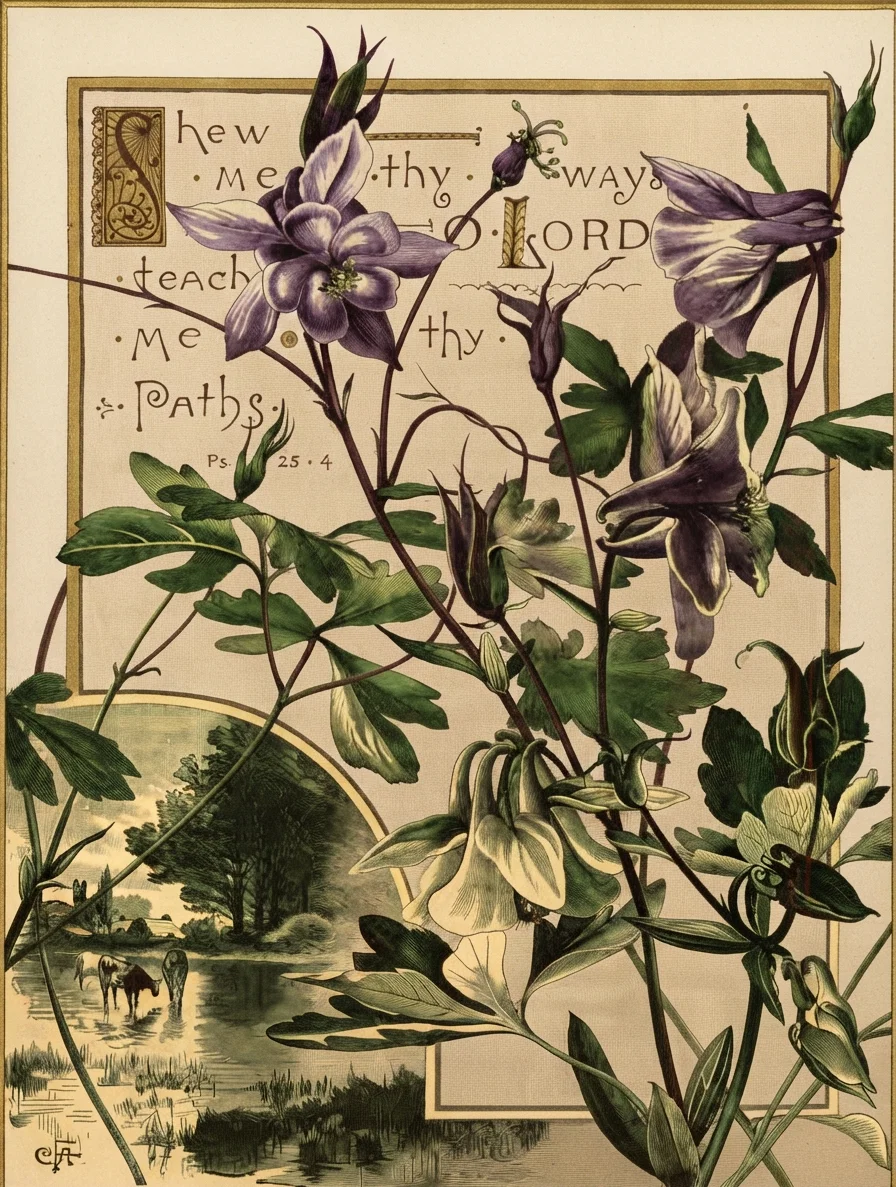
"Shew me Thy ways, O Jehovah; Teach me Thy paths." Ps. 25:4.
IT is the prayer of an unsatisfied one. "Show me." There are many such to-day who stand confused in the wilderness of sin, with no plain path before them; many who have fed upon the husks of pleasure till mind and heart are famished; many who have followed the human path of tradition till soul is barren and the heart hungry for fresher, greener pastures; many who are out in the world's great highway listening to the multitude of discordant voices each crying a way, who would be certain as to where is the true way; many who are so sunk in the sophistries and delusions of sin that they are satisfied. But it is encouraging to know that poor human nature is unsatisfied, and is desirous of being shown some way.
"TEACH me;" the prayer is that of the true learner, of one who does not wait to have some earnest, zealous teacher urge him to learn, some parent or guardian force him to study (yet not learn), some sad lesson of experience or providence, force him to acquire hard lessons which under other circumstances might have been easy and pleasant, and not the less profitable. "Show me," "teach me," are the prayers of one who senses his need, who is willing, to some extent, at least, to be taught.
BUT the prayer must go further than this. The great mass want to be shown wealthy ways, prosperous, pleasant paths, smooth roads, easy paths, sloping downward, wealth-bestrewn, flower-bordered, filled with the multitude. But he who thus pleads never improves his condition. He may find ease at the cost of strength; wealth at the sacrifice of honor, life, or character; popularity at the cost of God's companionship. The true prayer reaches beyond self, beyond man, beyond sense, beyond time, even to the infinite.
"Show me Thy ways, O Jehovah." Nothing less can suffice. Let me see God's ways. Not the ways that lead to His ways, do I desire to see, to know, but His ways, where He is, where He walks. It matters not its condition. Men in their blunders may have torn it up, as inexperienced roadmakers injure highways; there may be thorns bordering its path; the devil may have dug his pit upon one side and developed his poisonous, miasmatic slough on the other; still show me Thy way. There may be a myriad voices calling from it; I may meet men rushing backward, frightened at the perils before; it may wind up the Hill of Difficulty and down into the Valley of Humiliation, still, O Lord, show me Thy way. And God will answer such a prayer.
"TEACH me Thy paths." Not alone show me the way; I would walk therein. I shall meet perplexities; teach me how to pass through them without loss of wisdom. I shall meet difficulties; teach me how to overcome them and not dishonor Thee. Obstacles will lie in the pathway; teach me how to surmount them and not stumble. I shall meet deceived ones in the way, used by the enemy to oppose my progress; teach me how to fight loyally the battles of my King, yet bear no malice toward my opposing fellow-men. There will be others who will meet meas friends, as brethren; as children of the King, mayhap, they have journeyed a part of the pilgrim-way with me; they will assault me with the very sophistries and deceptions of Lucifer; still, O Lord, show me Thy ways, give me clear spiritual discernment, teach me how to meet them.
O FRIENDS, we want a humble, teachable heart before God in these days of perplexing, sophistical questions in state and church. No schemes of man or angel will do now; we must have God's direction. However great or high men have been or may be in the councils of men or even God, we must not depend upon them. Lucifer once stood in the councils of heaven. However great has been our own experience with God or men, it is worthless now unless it teach us greater humility, more of utter dependence upon God, stronger grasp of His great, divine, everlasting principles of righteousness and truth.
OBEDIENCE, willing, submissive obedience, must be the basis of such a prayer. Does God show His ways, enter them. "Teach me Thy way, O Jehovah; I will walk in Thy truth. Unite my heart to fear Thy name." God's law will be the chief delight of such a heart. God's Word will be his daily food. God's cause will demand whole-hearted loyalty. He will find in Jesus Christ the "Chiefest among ten thousand," "the One altogether lovely."

A GREAT LITERAL PROPHECY.

This Generation.

III. Special Signs of His Coming.

THE disciples asked: "What shall be the sign of Thy coming?" In response Jesus said: "And there shall be signs in sun and moon and stars; and upon the earth distress of nations, in perplexity for the roaring of the sea and the billows; men fainting for fear, and for expectation of the things which are coming on the world; for the powers of the heavens shall be shaken. And then shall they see the Son of Man coming in a cloud with power and great glory." Luke 21: 25-27.
Matthew and Mark are more specific as regards the signs: "In those days, immediately after the tribulation of those days, the sun shall be darkened, and the moon shall not give her light, and the stars shall fall from heaven, and the powers of the heavens shall be shaken; and then shall they see the Son of Man coming in clouds with great power and glory." Matt. 24: 29, 30; Mark 13: 24-26.
There are three specific signs mentioned here to occur before Christ's coming; for the fourth—the shaking of the powers of the heavens—takes place in direct connection with His coming. Heb. 12: 56; Joel 3: 12; Rev. 6: 14-17.
The darkening of the sun and moon from their light-relations would naturally occur together. And so they did, and they occurred just when Jesus declared they would, in those days, immediately after their tribulation. The days began A.D. 538. They ended in 1798. The tribulation ceased in 1776. Within those days, only four years after the ending of the general tribulation, May 19, 1780, the sun was supernaturally darkened. Long before noon candles were lighted, cattle came lowing from the pastures, and fowls went to roost. The following night was fearfully dark, tho the moon was at the full. Other predictions of the same signs are found in Joel 2: 31; Rev. 6: 12, 13. The latter prophecy was written twenty-five years after Jerusalem was destroyed. A volume of evidences might be given as to the historical facts; we must content ourselves with references to a few. As to the "Dark Day" Timothy Dwight, D.D., in "Connecticut Historical Collections," says:
The 19th of May, 1780, was a remarkably dark day. Candles were lighted in many houses. The birds were silent, and disappeared. The fowls retired to roost. It was the general opinion that the day of judgment was at hand. The Legislature was in session at Hartford, but being unable to transact business, adjourned.
Dr. Samuel Tenney, in 1785, wrote to the Historical Society concerning it as follows:
Altho the uncommon darkness which attracted the attention of all ranks of people in this part of the country on the 19th of May, 1780, was a phenomenon which several gentlemen of considerable ability have endeavored to solve, yet I believe you will agree with me that no satisfactory solution has yet appeared.
It was not an eclipse; for the moon was at the full, and the darkness lasted much longer than that of an eclipse could. It was God writing in the sun and in the moon what He had spoken through his Son eighteen centuries before.
The following night, altho the moon was at the full, it was as dark as tho "every luminous body in the universe," says one writer, had been "struck out of existence." When, however, the moon appeared, as it did at times, it had "the appearance of blood," says another writer. But these alone were not a sign of His coming, till the "stars fell."
The third sign came Nov. 13, 1833, in the falling of the stars, or the great meteoric shower, of that date, the like of which is not recorded in all the annals of time. Prof. Denison Olmstead, of Yale College, a celebrated scientist, says of that event:
Those who were so fortunate as to witness the exhibition of shooting stars on the morning of November 13, 1833, probably saw the greatest display of celestial fireworks that has ever been since the creation of the world. . . . The extent of the shower of 1833 was such as to cover no inconsiderable part of the earth's surface.
Abundance of historical testimony exists for all these, and many are now living who witnessed the latter. When the stars fell, the great threefold sign was complete, and it has been heralded to the world in the light of the prophecy, and thousands have thus seen it as a sign of Christ's coming.
God has thus given His own twofold witness, between which there could be no collusion, as to the signs of Christ's coming. Eighteen and three-fourths centuries ago, by the voice of His Son, He declared when the signs would come and where they would be seen. Eighteen centuries rolled their round, and then God wrote again the words in sun and moon and stars, in order that all might learn the divine mission and truth of that Son, and that He was coming again as surely as He first came.
But you say, "These signs were not seen all over the world, only in the eastern part of America." Granted. Jesus spoke the first words to only a few, but the world soon heard them. Those who looked upon these visible signs did not "see" them in the true sense. They saw awful sights in the heavens, but many knew not their import. Not until the last sign occurred and the first witness—Christ's own word—was proclaimed, could men truly see the second witness. But when the message of Christ's second coming was heralded to all the world in 1840 to 1844 the whole world saw or had the privilege of seeing, in the light of that Word, the signs of His second coming.
But there are other signs to occur in this very time of the giving of the message, comprehended in the abounding iniquity, the growing cold, the false Christs and prophets of Matt. 24: 11-13, 24-26, and the distress of nations, the perplexity, the storms and cyclones, intimated in Luke 21: 25, 26, and elsewhere. There are a score of these specific signs of Christ's coming falling within the giving of the last threefold message, the proclamation of the everlasting Gospel with the proclamation of impending judgment, the preaching of the Gospel of His kingdom. Rev. 14: 6-14; Matt. 24: 14. Thus we have not alone the specific signs in the sun, moon, and stars, in the light of His Word, but we have the cumulative evidence of all the other omens, signs, precursors, which the same Word, inspired by the same Spirit, predicted of this very time. Among these may be mentioned, increase of knowledge, of riches, of crime; capital and labor troubles, great social unrest, great corruption in church and state, spiritual declension and unbelief, growth of Socialism and Catholicism, preparation for war, peace-and-safety cry, last-day scoffers, and amid all of earth's confusion the preaching of God's great threefold message of instruction, warning, and salvation. Therefore, with all these things in mind as applying in these our days, our Lord continues His prophecy:
"Now from the fig tree ["and all the trees," Luke] learn her parable; when her branch is now become tender, and putteth forth its leaves, ye know that the summer is nigh; even so ye also, when ye see all these things, know ye that He is nigh, even at the doors. Verily I say unto you, This generation shall not pass away, till all these things be accomplished. Heaven and earth shall pass away, but My words shall not pass away." Matt. 24: 32-35.
The signs have been given, piled one on another, massed and battalioned, for this time, that all may see and know. We see not one, but many. It is not the witness of one, but many. It is cumulative evidence, piled upon evidence.
One of these events, which the Master has given as signs, may have appeared in another generation. Two or more of them may have occurred in another age. But it is safe to say that no time since the Nazarene uttered His prophecy has any generation seen all these omens as this generation now sees them, and has been witnessing them for the last three-score years. What then?—In the words of Him who spake as never man spake: "When ye see all these things, know ye that He is nigh, even at the doors." We see them, we may know.
"This Generation" will be continued in our next.

Question Corner

1769.—Questions on the Amalekites.

1. Saul destroyed all the Amalekites except Agag, who was slain shortly afterwards by Samuel. This point is brought to view in the Sabbath-School Lesson of October 21, and the inference is made there that these Amalekites increased greatly during the next twenty-three years. How could these Amalekites increase so much in twenty-three years if they were all destroyed by Saul and Samuel?
2. Where were these Amalekites to receive their punishment? When does Deut. 25 : 19 place this event?
3. How could the Amalekites become so strong in thirty years if Saul slew them all except Agag? 1 Sam. 15 : 8, 31.
1. In all probability, Saul destroyed only those who came out to fight with him or were in those cities which he took. Those who were left certainly increased in a few years enough to take Ziglag. See 1 Sam. 30 : 1, 2. The “all” were confined to those in the cities and immediate places where Saul fought.
2. The Lord designed that the Amalekites should receive their punishment when He gave Saul his commission to punish. And Deut. 25 : 19 would have been fulfilled then had Saul been faithful to God. As it was, the Amalekites increased—those who were left—until they had become strong enough in power and influence to induce others to unite with them, and they were doubtless the ones that were destroyed by the Jews in the time of Mordecai. When the issue was once understood, that Mordecai was a Jew, and that Haman was determined to slay the Jews, the whole old controversy must have been raised between Israel and the Amalekites, and doubtless at that time Amalek as a people perished.

1770.—Conduct of Vashti.

How do you know the reason Vashti would not come in before the king? The Bible is silent, and if it is the reason given in the lesson would she have been doing wrong even tho she went against custom? Please explain.
A knowledge of the ancient customs and of their manners at great feasts makes it very clear indeed as to why the king desired that Vashti should come before them. It was when they were well-drunken with wine that he commanded the queen to come to exhibit her beauty in a way that no true woman would submit to before a crowd of gross, drunken men; and that too seems evident from the record itself, “and therefore the queen Vashti refused to come at the king’s command.” We have an instance of this in which the shameless daughter of a more shameless mother, Herodias, danced before King Herod when his heart was merry with wine, and being influenced and inflamed by her beauty, commanded that any request that she should make should be given her, even to the half of the kingdom. Vashti did a noble thing in refusing. As history does not mention the name of Vashti as the queen of Xerxes or Ahasuerus it has been supposed, and may probably have been true, that she was only one of the favorite, legitimate concubines according to the customs of that time, but one evidently who prized her purity and womanliness. The world has ever honored her for the course she pursued.

INDIVIDUAL RIGHTS AND SELF-DENIAL.

THERE is such a thing as abuse of liberty. It is sometimes better to exercise self-denial than to insist on personal prerogative. The Christian will have an eye to the good—not merely the good opinion, but the good—of others, even at the sacrifice of his own liberty. Christ had a right to be set at liberty by Pilate, and He had the power to set Himself free, but the welfare of humanity was at stake. Peter and John were set at liberty by the Jewish council on condition that they would cease to preach in the name of Jesus of Nazareth; but the people were in need of the Gospel. Paul, knowing that "in every city" bonds and afflictions awaited him, was not thereby deterred from duty to others. In declaring such to be his purpose, he said: "Neither count I my life dear unto myself, so that I might finish my course with joy, and the ministry, which I have received of the Lord Jesus, to testify the Gospel of the grace of God."
When one urges his liberty as the prime consideration under all circumstances, he simply puts self foremost, which is contrary to all Christian principle. The apostle Paul would forego his right to eat whatever was proper food. In the matter of eating things dedicated to idols he says: "As concerning therefore the eating of those things that are offered in sacrifice unto idols, we know that an idol is nothing in the world, and that there is none other God but one." It would not hurt one thus fortified. The offering of the food in sacrifice to an idol would not affect the food in any way. Many of the heathen devoted every article they ate, drank, or used in any way, to their gods; therefore a Christian could not have eaten with such at all without partaking of food dedicated to an idol. "Howbeit there is not in every man that knowledge," that is, the knowledge that there is "but one God, the Father," and "one Lord Jesus Christ." So we are instructed that, altho we have such liberty in the matter of food, we should "take heed lest by any means this liberty of yours is become a stumbling-block to them that are weak."
There are two classes to whom the exercise of this liberty might be injurious: (1) The heathen, in some instances, seeing the Christian eat that which he knew was offered to an idol, might assume that it was an endorsement of his practise of thus dedicating his food. So Paul would eat without asking any questions on that subject. He would utterly ignore that issue. (2) There might be weak brethren who were over-conscientious in such matters; and they, seeing him exercise his right so freely, might be discouraged, or might become reckless for want of discrimination, and run to the extreme of outright apostasy.
As Christ, ready to sacrifice everything but allegiance to the Father’s will in order to save the lives of sinners, did not regard His own life, so the true Christian, while ever solicitous for the rights of his fellow men—believers or unbelievers—will not hinder the progress of the Gospel by always insisting on the exercise of his individual rights. Self-denial is a prime factor in Christian experience, of far more importance than the uninterrupted exercise of individual rights. While we may not sacrifice principle, or ignore the dictates of a good conscience, our acts must be modified by a proper regard for their influence upon others. We must not become stumbling-blocks to the unbeliever by stiffly demanding all that is due, or by roughly riding over their conscientious scruples; nor may we discourage the weak brother by avoidable indulgences that may offend his uneducated sense of right. It is better to instruct him than to trample upon his misunderstanding.
G.

A BROAD CONFESSION.

EVERY day the evidence increases concerning the prevalence of corruption in the world through lust. The latest is a wholesale tacit confession of being susceptible to bribes on the part of newspaper editors and legislators in Pennsylvania. The confession is perhaps unwitting on the part of some, but it is none the less flagrant. With the beginning of the year, the railroads of the state put in force a rule prohibiting passes. Now the indignant editors and legislators propose retaliation. These classes had been the recipients of such favors for twenty years, and as a result the railroad companies had been allowed whatever legislation they desired.
It is now said that bills are contemplated that would fix responsibility for accidents, and compel the railroads to provide more safety appliances. Bills to insure better sanitary arrangements in cars, to provide a seat for every person with a ticket, and to change the laws that give the railroads such a great monopoly over the state, are now under consideration. It is also said that more railroad accidents are being reported than ever before. And a measure to allow trolley lines to carry freight, that has been held up in the Legislature and discouraged by the press, is now to be taken up.
Now all these things are proper measures, and in the interest of the people; and the fact that they are to be advocated by the legislators and editors in retaliation for a withdrawal of passes, shows that they had been bribed by the passes to favor the railroad companies at the expense of the people—to the estimated extent of about two million dollars a year. And they are calling their change of attitude “independence of the railroads,” whereas they could not exercise any such independence in the face of standing passes on the cars. Retaliation is not independence; it is more in the nature of blackmail.
This is not saying that conditions are any worse in the Keystone State than elsewhere; but this specific circumstance is a marked illustration of political corruption posing as political virtue. It is a current disposition, this striving to get something for nothing; but few are willing to give anything for nothing. The plea of interest in the public welfare is a good lever with which to get official position; but it soon gives way to self-interest in most cases.
G.

THE MINOR AND THE MAJOR.

IN the great Song of Triumph there are no minor strains; for these are the echoes of defeat and sorrow. They appeal to our souls now only because of our sadness for sin. There are times in the lives of most people when they like to be by themselves and feel sad. They are extracting sympathy from defeated purposes.
The cheer of the victor has no minor strain. In the song of triumph it would be an incongruity. It comes in with sad sweetness when the victors are burying the dead; and there it is in its right place.
But when the last dead have been buried; when the last defeat has been swallowed up in eternal victory; when the scars of sin have been at last erased from the entire universe, and all is perfection and beauty again—when there is nothing more in all the universe to be sorrowful for—we will bid farewell to the sweet, sad minor, and join in the great, glad strains of the major chords. And that will be no more monotonous than the glad, sinless lives of the saints will be monotonous. He who knows how to give glad variety in the life of a ransomed soul will also know how to give joyous, harmonious variety to the music that has in it none of the memories of sin, sorrow, and death.
S.

HOW A PROMINENT BAPTIST VIEWS THE SITUATION.
[In an address at the Union Baptist Church, Greenpoint, L. I., October 29, the pastor, Dr. R. H. MacCullough, delivered some strong anti-Roman sentiments. The following will give an idea of how he interprets the growing influence of Rome in American politics]:
We must always remember that Rome and her principles never change, and that Romanism has never been so emphatically Roman as it is now.
We are on the eve of aggressive clericalism in America. Catholics as a body have offered passive resistance to the school laws and all over the country to the public school. They are getting ready to make the most strenuous resistance of their lives against the American public school.
The Vatican greatly desires to establish a nuncio at Washington. The desire of the Vatican and of Cardinal Satolli, with his three visits to America, was to be appointed papal nuncio at Washington. The American government is not ripe for such a revolutionary act. Yet it is progressing favorably toward that end. The Vatican exhibit at the Louisiana Purchase Exposition, one of the costliest and most interesting, had for its purpose the exaltation of the sovereign pontiff in America. This government and the Holy See have been brought into very close relations during the past few years. The Taft commission to the Vatican was an epoch-making event. The treaty between the insular government in the Philippines and the papal delegation in the archipelago was an event of scarcely less significance. What has been done in a few short years in the way of rapprochement encourages the hope of still greater relations.
The question of the friars in the Philippines gives a striking illustration of the changed position of the United States. In 1776 the government in its infancy forbade the pope the nomination of a single prelate, and refused to make any kind of recognition of the Holy See. To-day, the outcome of the Philippine issue is that the pope has the official nomination of 100 prelacies within American territory, with the added triumph of having received American ambassadors at the Vatican. The mission of governor Taft, it is true, was represented by the government at Washington as without any official character, but this flimsy hooding of the facts can never bear examination. As the Independent observed, Judge Taft was equipped with credentials and empowered to negotiate with the Vatican as formally and completely as any other ambassador.
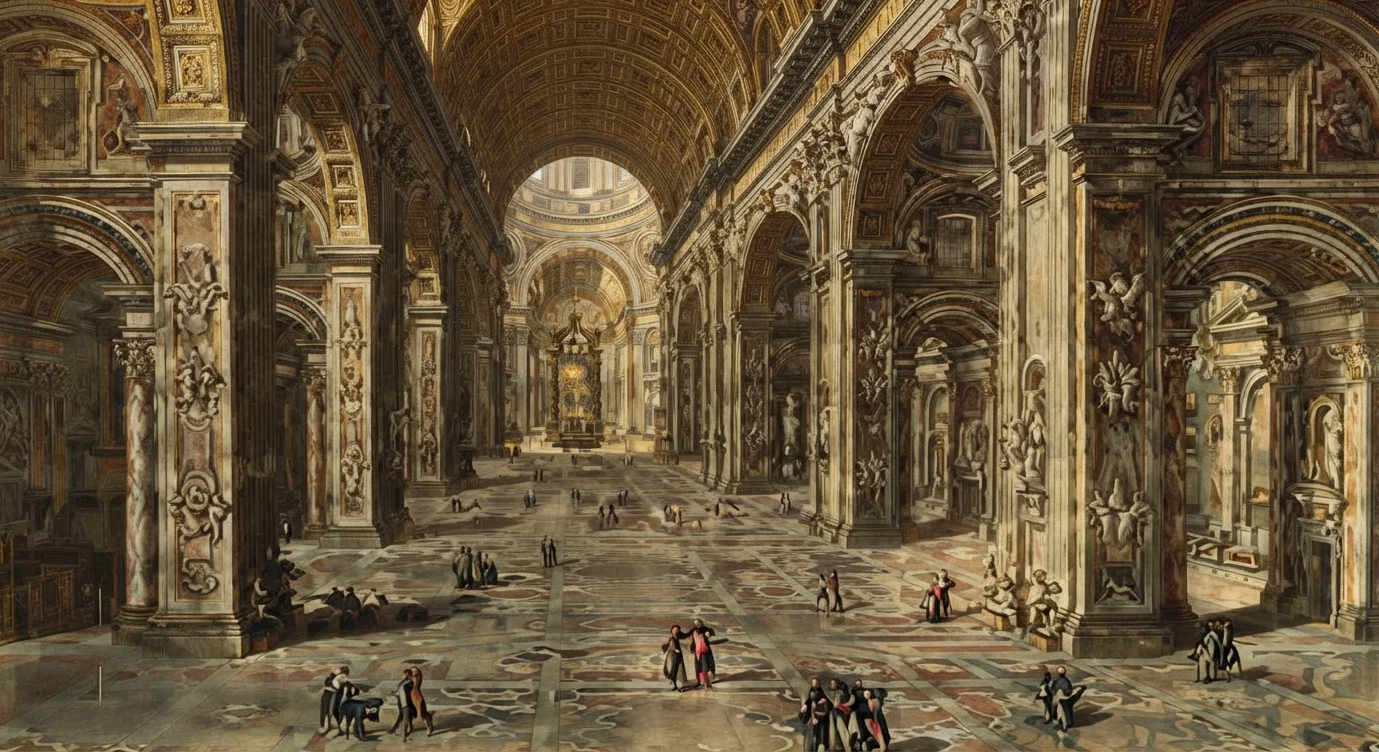
An Interior View of St. Peter's Church, Rome.
The conduct of the Catholic leaders in America at the beginning of the agitation against the friars was significant. Archbishop Ireland counseled prudence and forbearance as the course of the church, lest public apprehension should be aroused by the revelation of the power of the Catholic community, now solid and formidable in the heart of the American nation. His counsels, however, were not adopted by the Federation of Catholic Societies, then in session at Chicago. Bishop McFaul, of Trenton, led a bold arraignment of the American administration in the Philippines, declaring that it had been animated by Protestant fanaticism, and calling on the President to do his duty under the Constitution, and secure personal rights and property to the friars in the Philippines. This means that Catholicism in the United States feels itself sufficiently powerful to lay aside diplomacy.
A few years ago, and before the creation of the Taft commission, the suggestion of a papal nuncio at Washington would have raised a howl over the whole land. These are years of sudden and momentous changes in popular sentiment, and there is no telling what the future years will bring, for the papal authorities feel that a country with 12,000,000 Roman Catholics in the United States, 6,500,000 in the Philippines, and 1,000,000 in Porto Rico should not be without a representative of some kind at the Vatican. It would be as un-American to permit a nunciature at Washington as to enstate the pope in the White House. It can not be done without violating the Constitution of the United States.
But Catholic optimism has a wider vision. Archbishop Quigley has said: "Within twenty years this country is going to rule the world. Kings and emperors will soon pass away and the democracy of the United States will take their place. The West will dominate the country, and what I have seen of the western parochial schools has proved that the generations which follow us will be exclusively Catholic. When the United States rules the world, then the Catholic Church will rule the world." This is a prophetic bid for a Catholic president.
The Roman hierarchy is making itself solid in Washington, the center of our national government. They have the Indian Bureau there; the chief object is to influence legislation in favor of Rome. Cardinal Gibbons is only forty miles from Washington, and his contemporaries are fast friends with the President, and they graciously assist him in crowding the departments of government with Romanists, who owe their first allegiance to the pope of Rome.
Bishop O'Connell is in Japan on a diplomatic mission from the Vatican to establish a nuncio. A nunciature at Washington—are you ready for it, gentlemen? You answer, "No." You are right.
Continue reading: UNPOPULAR DOCTRINES