Your ShelfYour Projects

Review and Herald, Vol. 88, No. 12.

WAITING FOR THE LORD

Review and Herald

Mar 23, 1911

Review and Herald Publishing Association · Takoma Park Station, Washington, D. C. · Mar 23, 1911

WAITING FOR THE LORD

OUT of the depths have I cried unto Thee, O Lord.
Lord, hear my voice: let Thine ears be attentive to the voice of my supplications.
If Thou, Lord, shouldest mark iniquities, O Lord, who shall stand?
But there is forgiveness with Thee, that Thou mayest be feared.
I wait for the Lord, my soul doth wait, and in His word do I hope.
My soul waiteth for the Lord more than they that watch for the morning: I say, more than they that watch for the morning.
Let Israel hope in the Lord: for with the Lord there is mercy, and with Him is plenteous redemption.
And He shall redeem Israel from all his iniquities.— Psalm 130.

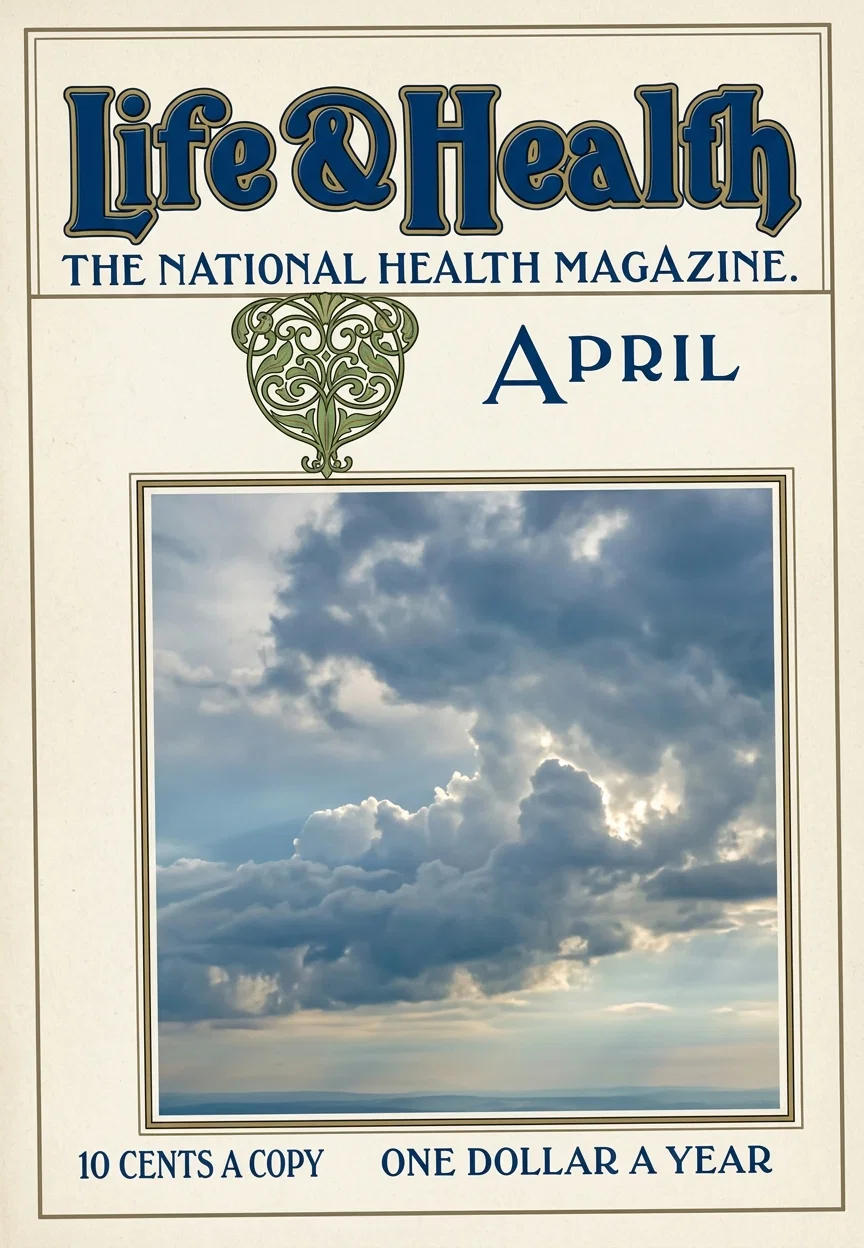
THE APRIL Life & Health

The Tuberculosis Number

Common Sense Applied Fads and Extremes Exposed

In the Discussion of

HOME Care of Consumptives: Fads in the Treatment of Tuberculosis; The Conquest of Tuberculosis; Climatic Cure of Consumption; Dangers of Tuberculosis From Meat; Things Every One Can Do to Prevent Consumption.
With these discussions on tuberculosis are associated many sensible, seasonable, sound suggestions on the Nature of Disease and Its Cure; the Law of Rest in the Healing of Disease; Common-Sense Eating and Drinking; Bilious Headaches: Cause and Cure; Infant Feeding; Good Cooking; The Voice of Leading Magazines on Hygiene and Kindred Topics; and other practical health subjects that are attracting attention at the present time.

April 23 Tuberculosis Day

April 23 has been set apart by all the popular churches in the United States as tuberculosis day. On that day the sermons in more than 200,000 churches will bear upon tuberculosis, its prevention and cure. The interest of the people will, therefore, render the circulation of the April number of LIFE AND HEALTH easy. It will be a good number for this opportune time.
All Orders for LIFE AND HEALTH Should be Sent Through the Conference Tract Society

God Goeth, Too

I go! God goeth, too! I do not go alone; And so I do not fear the unknown way, For in the midnight hour I hear God say, “I will be with thee, with thee all the time.” This is the music of the old year’s chime, These are the bells that ring the new year in, Heaven’s holy peal across a world of sin.
I go! God goeth, too! I do not go alone Into the paths untrodden and unknown.
I go! God goeth, too! I do not go alone; He knows the way, the mists before him fly; He loves me, cares, he all things will supply, Will meet all foes, will guide at every turn. I walk with him, and as I walk, I learn; For as we journey, he has much to say, And talking sweetly cheers the pilgrim way.
I go! God goeth, too! I do not go alone; He walks with me, and says I am his own.
I go! God goeth, too! I do not go alone; And so I need not trouble where he leads, Nor seek to meet the oft-recurring needs. He has been with me through the old past year, He will be with me, ever near and dear, My long-proved Friend; so in his hand I place My little hand, and looking in his face.
I go! God goeth, too! I do not go alone; My weakness goes with the Almighty One. — Selected.

MRS. E. G. WHITE

From Persecutor to Disciple—No. 2

MRS. E. G. WHITE

The conversion of Saul was marked with heartfelt repentance, thorough confession, and an earnest longing for pardon of sin. Prior to his conversion, Saul had been proud and self-confident; now he was bowed down with sorrow and shame; he abhorred himself because of the suffering he had brought upon the disciples of Jesus. In the light of the revelation that had come to him, he began to see himself as the chief of sinners.
Saul yielded himself fully to the convicting power of the Holy Spirit. With eyes anointed by the grace of God, he saw the mistakes of his life, and recognized the far-reaching claims of the law of God. He who had been a proud Pharisee, confident that he was justified by his good works, now bowed before God with the humility and simplicity of a little child, confessing his own unworthiness, and pleading the merits of a crucified and risen Saviour. Saul longed to come into full harmony and communion with the Father and the Son; and in the intensity of his desire for pardon, he offered up fervent supplications to the throne of grace.
The prayers of the penitent Pharisee were not in vain. The inmost thoughts and emotions of his sin-corrupted heart were transformed by divine grace. The nobler faculties of the soul were brought into harmony with the eternal purposes of God. Christ and his righteousness became to Saul more than the whole world.
The conversion of Saul is a striking evidence of the miraculous power of the Holy Spirit to convict a man of the error of his way. Saul had verily believed that Jesus of Nazareth had disregarded the law of God, and had taught the disciples that it was now of no effect. But at the time of his conversion, Saul recognized Jesus as the divine One who had come into the world for the express purpose of vindicating his Father’s law. Saul was convinced that Jesus was the originator of the entire Jewish system of sacrifices. He saw that at the time of the crucifixion, type had met antitype; in Jesus had been fulfilled the Old Testament prophecies concerning the Redeemer of Israel. Jesus, whose name above all others Saul had most hated and despised, revealed himself to Saul for the purpose of arresting him in his mad career, and of making, from this most unpromising subject, a powerful instrumentality by which to bear the gospel to the Gentiles. When Saul perceived that in opposing Jesus of Nazareth he had been arraying himself against the Messiah, he was overwhelmed with horror, and in the agony of his soul he cried out, “Lord, what wilt thou have me to do?” Jesus did not at once tell him of the work that had been assigned him, but sent him for instruction to the very disciples who had been so bitterly persecuted.
The marvelous light that illuminated the darkness of Saul was the work of the Lord; but there was also a work that was to be done for him by the disciples of Christ. The answer to Saul’s question was, “Arise, and go into the city, and it shall be told thee what thou must do.” Jesus sent the inquiring Jew to his church, to obtain from them a knowledge of his duty. Christ had performed the work of revelation and conviction; and now the penitent was in a condition to learn of those whom God had ordained to teach his truth.
While Saul in solitude continued in prayer and supplication at the home of Judas, the Lord appeared in vision to “a certain disciple at Damascus, named Ananias,” telling him that Saul of Tarsus was praying, and in need of help. “Arise,” the heavenly messenger bade Ananias, “and go into the street which is called Straight, and inquire in the house of Judas for one called Saul, of Tarsus: for, behold, he prayeth, and hath seen in a vision a man named Ananias coming in, and putting his hand on him, that he might receive his sight.”
Ananias could scarcely credit the words of the angel messenger; for the reports of Saul’s bitter persecution of the saints at Jerusalem had spread far and near. He presumed to expostulate. “Lord,” he answered, “I have heard by many of this man, how much evil he hath done to thy saints at Jerusalem. And here he hath authority from the chief priests to bind all that call on thy name.” But the command to Ananias was imperative: “Go thy way: for he is a chosen vessel unto me, to bear my name before the Gentiles, and kings, and the children of Israel.”
The disciple, obedient to the direction of the angel, sought out the man who had but recently breathed out threatenings against all who believed on the name of Jesus. Putting his hands on the head of the penitent sufferer, Ananias said: “Brother Saul, the Lord, even Jesus, that appeared unto thee in the way as thou camest, hath sent me, that thou mightest receive thy sight, and be filled with the Holy Ghost.“And immediately there fell from his eyes as it had been scales; and he received sight forthwith, and arose, and was baptized.”
Many have an idea that they are responsible to Christ alone for their light and experience, independently of his recognized followers on earth. But in the history of the conversion of Saul, important principles are given us, which we should ever bear in mind. He was brought directly into the presence of Christ. He was one whom Christ intended for a most important work, one who was to be a “chosen vessel” unto him; yet the Lord did not immediately impart to him the lessons of truth. He arrested his course and convicted him; but when asked by him, “What wilt thou have me to do?” the Saviour placed him in connection with his church, and let them direct him what to do.
Thus Jesus gave sanction to the authority of his organized church, and placed Saul in connection with his representatives on earth. All blessings flow from Christ, but he had now established a church as his representative on earth, and to it belonged the work of directing the repentant sinner in the way of life.
Jesus is the friend of sinners; his heart is touched by their woe; he has all power, both in heaven and upon earth; but he respects the means that he has ordained for the enlightenment and salvation of men; he directs sinners to the church, which he has made a channel of light to the world.
Saul was a learned teacher in Israel; but when in the midst of his blind error and prejudice, he is given a revelation of the Christ whom he is persecuting, he is placed in direct communication with the church, which is the light of the world. In this case Ananias represents Christ, and also represents Christ’s ministers upon earth, who are appointed to act in his stead. In Christ’s stead, Ananias places his hands upon him, and, praying in Christ’s name, Saul receives the Holy Ghost. All is done in the name and by the authority of Christ. Christ is the fountain; the church is the channel of communication.

The Certainty of God's Foundation

GEORGE I. BUTLER
True wisdom demands certainty in its hopes and aims. It is the greatest folly to devote our life to laboring for uncertain objects. The world is full of such unwise examples. Lives devoted to unattainable ends, to utter disappointment at last, are a dead failure; they are nothing less than consummate folly. Such are all merely worldly lives, ending in anguish and despair, hopes wrecked and blighted forever.
Inspiration presents a better ending: “Nevertheless the foundation of God standeth sure, having this seal, The Lord knoweth them that are his. And, Let every one that nameth the name of Christ depart from iniquity.” 2 Tim. 2:19.
By reading the connection we learn that in the wonderful apostolic church there were those who left the truth of the gospel. “But shun profane and vain babblings: for they will increase unto more ungodliness. And their word will eat as doth a canker: of whom is Hymenæus and Philetus; who concerning the truth have erred, saying that the resurrection is past already; and overthrow the faith of some.” Then comes the assurance of the certainty of God's “foundation” for the salvation of men. These had taught false doctrine, and carried off disciples after their heresy. Paul speaks of Hymenæus and others, in his first epistle to Timothy: “Of whom is Hymenæus and Alexander; whom I have delivered unto Satan, that they may learn not to blaspheme.” 1 Tim. 1:20. By the words “delivered unto Satan,” we may understand Paul to mean casting them out of church fellowship, having thus withdrawn from them the indorsement and sympathy of the church because of heresy. Paul speaks of others who had withdrawn from the church. “Demas hath forsaken me, having loved this present world.”
The beloved John had also to meet the unreasonable opposition of selfish professors in his time. “I wrote unto the church,” he says, “but Diotrephes, who loveth to have the pre-eminence among them, receiveth us not. Wherefore, if I come, I will remember his deeds which he doeth, prating against us with malicious words: and not content therewith, neither doth he himself receive the brethren, and forbiddeth them that would, and casteth them out of the church.” 3 John 9, 10. This course of ill treatment of John, the last of the twelve, is astonishing. We see, therefore, that all were not faithful in the apostolic church, to which all Christians look back with deepest respect.
One sad truth we shall ever find in this world of sin and imperfection, connected with even the true church,—there will be tares among the wheat, false professors among the true believers. It was so when Israel came out of Egypt. It was so in the early church of Christ our Lord. There was a Judas among the twelve; Ananias and Sapphira were numbered among the early believers; Hermogenes, Alexander, Philetus, and Demas flourished during the apostle Paul's experiences, and Diotrephes in the time of John's labors.
But what if there were? In the parable of the sower, representing in figure the proclaiming of divine truth, there were the stony-ground believers, who accepted with quick and great joy the truth, but did not long endure; also the thorny-ground believers, who accepted, but permitted the love of the world to choke the good seed, so that no fruit was manifested. Only the good-ground believers brought forth thirty, sixty, and a hundredfold. So it will ever be in this world. We must endure to the end, in order to be saved.
But let us more closely notice the certainty brought to view by the apostle.
Though Hymenæus and Philetus proved unworthy, “nevertheless the foundation of God standeth sure, having this seal, The Lord knoweth them that are his.” What is the “foundation” which God laid for the salvation of mankind?—Christ is that foundation. He is the Rock on which his church is built. “There is none other name under heaven given among men, whereby we must be saved.” He is the “Rock of Ages.” We are to hide in him. God laid that foundation. He is like the great rock in the mighty current of the stream of time. The rock stands firm; the currents have to turn aside in order to pass on. Christ's words have come down through the ages, strengthening, illuminating, refreshing, upholding; they are light, and they are life. They stand more fast than the mountains of earth. Those who cling fast to him and his cross can never be moved. Those who trust in him will be as Mount Zion above. The time will come when the greatest earthquake this world has ever felt will shake down every man-made structure, yea, every island of the sea, and the very mountains themselves will move out of their places. The surface of the earth will be reduced to its original chaos, without form and void. The mountains will skip like rams, and the little hills like lambs, as the mighty words of God go forth. But the foundation God laid at the beginning for man's salvation will stand sure as the throne of the Almighty. Those who cling to Christ, the foundation laid on which to base our faith, can never be moved. It is the only sure thing in this world of change.
But God in his infinite tenderness goes a step further in his statement. This great truth of the sure foundation has a seal attached to it as a still more comforting assurance. The seal is considered an all-important feature in all legal documents. It is an evidence of proper authority. Every justice of the peace, every governor of a State and national court, has his seal. Every law of the United States goes forth with the great seal of the United States attesting its validity and showing its genuineness. So the certainty of God's foundation has this seal attached, “The Lord knoweth them that are his.”
It is said of some most famous generals that they personally knew every soldier in their army. But more encouraging than such a thought is the statement that the God of heaven knows personally every true believer. The name of every one is written in the Lamb's book of life. God has forgiven the sins of every one. His eyes are over those who serve him. He loves them as “the apple of his eye.” His Son died for them on the cruel cross. He knows every trial, every weakness. He hears their earnest prayers, and sends answers of peace.
Mansions of glory more beautiful than palaces of earthly monarchs are being built for every one of God's children in the capital of the universe, the New Jerusalem. Christ himself said so just before he left this world. John 14:1-3.
“Knoweth them that are his”?—Yea, verily, God the Father knoweth every one of his children here on earth. He sees us struggling with difficulties, temptations, besetments, and many sorrows. He sends angels who excel in strength to help us meet every obstacle. Can the devil wrest any soul out of the Father's hand who will steadfastly cling to God?—No, never. Before he would permit such a soul to be torn away, God would send every angel from heaven to prevent it.
But, says the poor doubter, how, then, are so many believers lost to the cause?—They are lost because they do not cling to God, because they become careless, welcome Satan's temptations, become lovers of this present world, and give way to appetite and evil passions. They do not endure to the end. Our faith will be tested. All heaven is interested in us; Christ pleads for us. Strength awaits the earnest prayer of faith, it ever has and ever will. But we must be earnest, obey God, keep his commandments, and trust in Christ as our ever-living, ever-loving Saviour. We must put a great discount on doubts, and a large premium on faith and confidence and trust in God.
Yea, verily, “the foundation of God standeth sure, having this seal, The Lord knoweth them that are his. And, Let every one that nameth the name of Christ depart from iniquity.” Again I say, There is nothing in this world so sure as the Christian religion; nothing so certain as the Christian's hope. All worldly plans and schemes will end in the saddest disappointment. Millions in the end will wring their hands in agony to see how cheaply they have sold themselves to the god of this world.
Bowling Green, Fla.

Warning Against Extreme Views

A Study of Principles—No. 3

Warning Against Extreme Views

D. E. ROBINSON
IN some of the communications from Mrs. White early in 1895, there are found warnings and cautions against the danger of adopting wrong principles, and accepting extreme views in studying the principles of religious liberty.
In teaching the separation of church and state, some had urged that to be consistent in our dealings with the government, we should insist upon paying taxes on our church and sanitarium properties, even though these might be by law exempt from taxation.
It was also maintained and strongly urged in the American Sentinel that our brethren in South Africa would violate right principles if they were to accept from the British South African Company a gift of land that had been offered to them for mission purposes by Cecil Rhodes. It was stated that those missionaries who had accepted such grants had “sold themselves for a mess of African pottage,” and it was felt that the General Conference should insist upon their paying for the land.
When these propositions were brought to the attention of Mrs. White, she wrote the following, expressing her disapproval of the positions taken:—
“Solemn, serious times are upon us, and perplexities will increase to the very close of time. There may be a little respite in these matters, but it will not be for long. I have letters to write that must go in the next mail to Battle Creek. Our brethren there are not looking at everything in the right light. The movements they have made to pay taxes on the property of the sanitarium and Tabernacle have manifested a zeal and conscientiousness that in all respects is not wise nor correct. Their ideas of religious liberty are being woven with suggestions that do not come from the Holy Spirit, and the religious liberty cause is sickening, and its sickness can only be healed by the grace and gentleness of Christ.”
“The hearts of those who advocate this cause must be filled with the Spirit of Jesus. The Great Physician alone can apply the balm of Gilead. Let these men read the book of Nehemiah with humble hearts touched by the Holy Spirit, and their false ideas will be modified, and correct principles will be seen, and the present order of things will be changed. Nehemiah prayed to God for help, and God heard his prayer. The Lord moved upon heathen kings to come to his help. When his enemies zealously worked against him, the Lord worked through kings to carry out his purpose, and to answer the many prayers which were ascending to him for the help which they so much needed.”

Extreme Positions

“I am often greatly distressed when I see our leading men taking extreme positions, and burdening themselves over matters that should not be taken up nor worried over, but left in the hands of God for him to adjust. We are yet in the world, and God keeps for us a place in connection with the world, and works by his own right hand to prepare the way before us, in order that his work may progress along its various lines. The truth is to have a standing-place, and the standard of truth is to be uplifted in many places in regions beyond.
“Be sure that God has not laid upon those who remain away from the foreign fields of labor, the burden of criticizing the ones on the ground where the work is being done. Those who are not sent to mission fields know little about the necessities of the situation, and if they can not say anything to help those who are on the ground, let them not hinder, but show their wisdom by the eloquence of silence, and attend to the work that is close at hand. I protest against the zeal that they manifest when they ventilate their ideas about foreign fields of labor, for it is not according to knowledge.”
“Let the Lord work with the men who are in the mission fields, and let those who are not on the ground walk humbly with God, lest they get out of their place, and lose their bearings. The Lord has not placed the burden of criticizing the work upon those who have taken this burden, and he does not give them the sanction of his Holy Spirit. Many move according to their own human judgment, and zealously seek to adjust things that God has not placed in their hands. Just as long as we are in the world, we shall have to do a special work for the world; the message of warning is to go to all countries, and tongues, and peoples.”
“The Lord does not move upon his workers to make them take a course which will bring on the time of trouble before the time. Let them not build up a wall of separation between themselves and the world by advancing their own ideas and notions. There is now altogether too much of this throughout our borders. The message of warning has not reached large numbers of the world, in the very cities that are right at hand, and to number Israel is not to work after God’s order. Just as long as we are in this world, and the Spirit of God is striving with the world, we are to receive as well as to impart favors. We are to give to the world the light of truth as presented in the Sacred Scriptures, and we are to receive from the world that which God moves upon them to do in behalf of his cause.”
“The Lord still moves upon the hearts of kings and rulers in behalf of his people, and it becomes those who are so deeply interested in the religious liberty question not to cut off any favors, or withdraw themselves from the help that God has moved men to give for the advancement of his cause. We find examples in the Word of God concerning this very matter.
“Cyrus, king of Persia, made a proclamation throughout all his kingdom, and put it into writing, saying: ‘Thus saith Cyrus, king of Persia, The Lord God of heaven hath given me all the kingdoms of the earth; and he hath charged me to build him a house at Jerusalem which is in Judah. Who is there among you of all his peoples? his God be with him, and let him go up to Jerusalem, which is in Judah, and build the house of the Lord God of Israel.’ A second commandment was issued by Darius for the building of the house of the Lord, and is recorded in the sixth chapter of Ezra.
“The Lord God of Israel has placed his goods in the hands of unbelievers, and they are to be used to help in the accomplishment of the work that must be done for a fallen world. The agents through whom these gifts come may open up avenues through which the truth may go. They may have no sympathy with the work, and no faith in Christ, and no practise in his words; but their gifts are not to be refused on that account.
“It is very strange that some of our brethren should feel that it is their duty to bring about a condition of things that would bind up the means that God would have set free. God has not laid upon them the responsibility of coming in conflict with the authorities and powers of the world in this matter. The restraining hand of God has not been withdrawn from the earth. Let the leaders in the work bide their time, hide inChrist, and move and work with great wisdom. Let them be as wise as serpents, and as harmless as doves. I have repeatedly been shown that we might receive far more favors than we do in many ways if we would approach men in wisdom, acquaint them with our work, and give them an opportunity of doing those things which it is our privilege to induce them to do for the advancement of the work of God.” (Jan. 31, 1895.)

Receiving Gifts

“Who is it that owns our world? Who is the real owner of houses and lands? Is it not God? He has an abundance in our world which he has placed in the hands of men by which the hungry might be supplied with food, the naked with clothing, the homeless with homes. The Lord would move upon worldly men, even idolaters, to give of their abundance for the support of the work, if we would approach them wisely, and give them an opportunity of doing those things which it is their privilege to do. What they would give we should be privileged to receive.
“We should become acquainted with men in high places, and by exercising the wisdom of the serpent, and the harmlessness of the dove, we might obtain advantages from them; for God would move upon their minds to do many things in behalf of his people. If proper persons would set before those who have means and influence the needs of the work of God in a proper light, these men might do much to advance the cause of God in our world. We have put away from us privileges and advantages that we might have had the benefit of, because we chose to stand independent of the world. But we need not sacrifice one principle of truth while taking advantage of every opportunity to advance the cause of God.
“The Lord would have his people in the world, but not of the world. They should seek to bring the truth before the men in high places, and give them a fair chance to receive and weigh evidence. There are many who are unenlightened and uninformed, and as individuals we have a serious, solemn, wise work to do. We are to have travail of soul for those who are in high places, and go to them with the gracious invitation to come to the marriage feast. Very much more might have been done than has been done for those in high places. The last message that Christ gave to his disciples before he was parted from them, and taken up into heaven, was a message to carry the gospel to all the world, and was accompanied by the promise of the Holy Spirit. The Lord said, ‘Ye shall receive power after that the Holy Ghost is come upon you: and ye shall be witnesses unto me both in Jerusalem, and in all Judea, and in Samaria, and unto the uttermost part of the earth.’
“‘The earth is the Lord’s, and the fulness thereof.’ ‘The silver is mine, and the gold is mine, saith the Lord of hosts.’ ‘Every beast of the forest is mine, and the cattle upon a thousand hills. I know all the fowls of the mountains: and the wild beasts of the field are mine. If I were hungry, I would not tell thee: for the world is mine, and the fulness thereof.’” (Reprinted from Special Testimonies to Ministers and Workers, No. 3, pages 32-35, 29, 30.)
Mountain View, Cal.
Continue reading: England’s Responsibilities for Turkey