Pacific Press Publishing Association · Mountain View, California · Dec 12, 1911
"IF YE WILL INQUIRE, INQUIRE YE."
By Editor
This Inquirers' Department is conducted for the purpose of helping those who are studying the Bible. The answers are oftentimes only suggestive. They are never to be considered infallible, only as they agree with the infallible Word. The writer who may answer them does not consider that his opinion is infallible. He will simply give the best that he has, and plead with the inquirer to search the Word. Such questions only will be answered as, to the editors, seem to minister to the good of the readers and to the mission of the paper. We can not answer repeatedly in the same volume questions upon the same scripture. The name and address must accompany question, not for publication, but as an evidence of good faith, and that answer may be made by letter if deemed advisable. No letters are answered which do not contain the name of the writer. It is well always to enclose stamp for reply.
3617 — The Bread and the Wine
By Editor
If the bread and wine of the Lord's Supper are not changed into the actual body and blood of Christ, why did He say, "This is My body," and "This is My blood"? If we are not to value tradition, please explain what Paul meant in 2 Thess. 3:6; 1 Cor. 11:2; 2 Thess. 2:15. W. P. M. L.
The Greek did not use the term "signify," or "symbolize," or "represent," as we would in such a case as that. They simply used the direct declarative word itself. "This is My body;" that is, this represents My body. "This is My blood"—this represents My blood. We have the same form of expression in John 15: "I am the true Vine." "I am the Vine, ye are the branches." It would be more elaborate, and more verbally correct, to say, "I am represented by the vine," or, "The vine represents Me; the husbandman represents My Father; the branches represent you." We would say, "The field represents the world; the good seed represents the children of the kingdom; the tares, the children of the wicked one;" but Jesus said, "The field is the world; the good seed are the children of the kingdom; but the tares are the children of the wicked one." See the apostle Paul's directions in 1 Cor. 11:26: "For as often as ye eat this bread, and drink this cup, ye do show the Lord's death till He come." It is Jesus Himself who says, "The flesh profiteth nothing: the words that I speak unto you, they are spirit, and they are life." John 6:63. The Lord's Supper was an occasional emblem of a continual feast. The emblem was the bread and the wine; the feast is the feeding on the word of Christ, the drinking in of His Spirit.
The term "tradition" simply means that which has been received. It seems to us that the apostle's words clearly indicate just what was meant—not only his own teaching which God gave to him, but that which had been delivered to him,—that which had come down from the past, which might be either oral or written. Says Vincent in his "Word Studies" on 2 Thess. 2:15: "Not emphasizing a distinction between written and oral tradition. 'Tradition' in the Scriptural sense may be either written or oral. It implies on the part of the teacher that he is not expressing his own ideas, but that he is delivering, or handing over, a message received from some one else." It is therefore of an authority external to the teacher. It may have been taught by the Word of God, and it may have been of the teaching of Christ or His apostles. But it was not like the traditions which men emphasize nowadays, simply that which has been handed down through the ages from one man to another, having the authority of the human; but that which was truly authoritative in the beginning, and comes down to us unchanged.
Explain why David was so cruel. Has not the Roman Church a right to do likewise?
The mere fact that the record of David's wars and the results of those wars are in the Bible is not an excuse for David's conduct. David may have treated the children of Ammon more cruelly than he ought. He simply followed the customs of those days. Ammonites were enemies of God, and enemies of the children of Israel, enemies when there was no reason why they should be enemies, and God gave him victory over those enemies, and David treated them as he did. The record neither excuses nor accuses him. It is well to remember this,—that David lived under the theocracy. It was God Himself who ruled the people, and David was simply one under God. God uses men the best He can for the time, and the best men He can get, but the men He uses are not perfect. Samson was anything but a perfect man, yet God used him. We must not take the imperfections of men as excusing ourselves. David's greatness consisted in his loyalty to God, and in his
doing all the will of God as he saw it, and when he sinned, in taking the reproof which God sent, instead of trying to justify himself. One other thing in this warfare of David: it was not a matter of religion. He was not warring against people because of religion. He was simply warring against the enemy of God's country. The Lord did not interfere with the religion of the peoples who were outside of Israel's domain. They were allowed to go on with their idolatry and meet all its awful results. David did not make a war against people because they did not believe as he did, and no religious body on the face of the earth has the right to do this. Jesus is our example. He said, "If any man hear My words, and believe not, I judge him not: for I came not to judge the world, but to save the world." No Christian church, Catholic or Protestant, has the right to go beyond the Master.
If the heathen have received the law in their hearts, why is the Sabbath not found, as well as other precepts? Rom. 2:14, 15.
The scripture itself reads, "For when Gentiles that have not the law do by nature the things of the law, these, not having the law, are the law unto themselves; in that they show the work of the law written in their hearts, their conscience bearing witness therewith, and their thoughts one with another accusing or else excusing them." The great principles of the law summed up in the Old Testament, and by our Saviour approved, are, supreme love to God and equal love to our fellow men. The heathen that has that to the fullest sense of his capacity certainly will be excused by his own conscience.
Yet during that very time he might have a multitude of wives. During that very time he might be doing other things that conventionalities of this age would not permit, that greater light from the Word of God would condemn, just as did Abraham, just as did Jacob. The law written in their hearts is primarily not complete knowledge, but complete principle of doing right. God has expressed this in 2 Chron. 16:9: "For the eyes of the Lord run to and fro throughout the whole earth, to show Himself strong in the behalf of them whose heart is perfect toward Him." That is what God asks—the perfect affection, the perfect heart. The one dominant thing that moves the man, is his affections, his love. He may know scarcely anything; he may have seen but one ray of light from the throne of God, but that ray of light dominates his life, and the man who yields himself to that ray of light is accepted of God. But the man who may have a knowledge of all the Ten Commandments of God's law, and yet yields himself to one sin, however small it may seem, turns away from the light, and will be rejected. It is not knowledge that saves us—that is, mental knowledge, intellectual knowledge; it is the life of God in the soul which comes by yielding ourselves absolutely to all that we see. The heathen who has that in his heart, will yield to all the light that comes to him, to the sixth commandment, the seventh commandment, the eighth commandment, the fourth commandment. It is to him then only a matter of revelation as testing the love that is in his heart, and that love is held by the Master for obedience to God's law.
3618 — The United States Not a Christian Nation
Can you give me an authoritative statement in regard to the United States not being a Christian nation? M. E. M.
Treaties in the United States Government have the force of fundamental law. According to Article 6 of the Constitution of the United States, "All treaties made, or which shall be made, under the authority of the United States, shall be the supreme law of the land, and the judges in every State shall be bound thereby, anything in the Constitution or laws of any State to the contrary notwithstanding." Article 11 of that treaty made between the United States of America and the bey and subjects of Tripoli, Barbary, communicated to the Senate May 26, 1797, reads as follows:
As the Government of the United States of America is not in any sense founded on the Christian religion, as it has itself no character of enmity against the laws, religion, or tranquility of Mussulmans, and as the said States never entered into any war or act of hostility against any Mohammedan nations, it is declared by the parties that no pretext arising from religious opinions shall ever produce an interruption of the harmony existing between the two countries.
Now this was in perfect harmony with the opinions of the fathers of the Republic. In the act for establishing religious freedom in Virginia, Jefferson says that "when the preamble declares that coercion is a departure from the plan of the Holy Author of our religion," an amendment was proposed by inserting the words "Jesus Christ," so that it should read, "a departure from the plan of 'Jesus Christ,' the Holy Author of our religion." The insertion was rejected by a great majority, in proof that they meant to comprehend within the mantle of its protection the Jew and the Gentile, the Christian and Mohammedan, the Hindu and infidel, of every denomination. (Works of Thomas Jefferson, volume 1, page 45, quoted in "American State Papers.")
Madison touched the crucial point of the thing when he said, in his memorial and remonstrance, "Who does not see that the same authority which can establish Christianity in exclusion of all other religions, may establish with the same ease any particular sect of Christians to the exclusion of all other sects?"
The treaty with Tripoli, it may be well to say, was signed and sealed in Tripoli on the 4th day of November, 1796, and at Algiers January 3, 1797, by Hassan Bashaw, Dey of Algiers, and Joel Barlow, consul-general of the United States.
Bible Games
By W. P. M. L.
3620 — W. P. M. L.—Bible Games.—There are several card games on the Bible which are helpful in memorizing many, very many of the great events and characters of the Bible. There is one, for instance, that brings out the characteristics of the different books, one that treats of noted characters in the Old and New Testaments. A very pretty pictorial game is published by Mr. Pedro Lemos, 824 Athens Ave., Oakland, California, and others at almost any large religious general bookstore.
3621 — Rag-Time Music
By Editor
Is it right for Christians to play rag-time music?
Replying to this, it would seem as if time could be very much better employed. There may be those who do this, and this kind of music may come into their lessons; but those who think upon it seriously, who take time to consider it, it seems to us would not want to use for any such purpose as that the valuable time which God gives us.
We can not take time to make extended comment on these various epistles. We shall remember Hebrews by its wonderful examples of faith, which are given us in this week's reading; the general epistle of James, written to Christians scattered abroad, by the exceedingly practical tone of the letter. It not only applied in the apostle's own day, but it also looked forward to our time, when the coming of the Lord is near.
The first epistle of Peter is also an intensely practical one of deep spirituality, exalting our Lord Jesus Christ and His Word, and also pointing out the importance of Christ's second coming. The second epistle pertains almost wholly to Christ's second coming and the great day of the Lord, the consummation of all things.
The first epistle of John is also general in its scope, written not to any one church, but to all; filled full of the importance of love in the service of God,—of a love that is manifest not merely in sentiment, but in practical, godly living, and in loving obedience to all the commandments of God. And there are faithful warnings against all specious philosophy which would lead away from this. 2 John seems to have been written to some particular person, symbolical of the church. Some commentators regard the name Cyria, or Kyria, as a term by which the apostle means the church. Its emphasis is laid upon the keeping of God's commandments, and walking in love before Him. His third epistle is written to a friend, Gaius, pointing out the dangers of false teachers and warning against their sophistry and error.
The epistle of Jude is quite similar to that of 2 Peter. Its great and important thought is the great day of the Lord, and of judgment which is sure to come, which will reveal and punish sin; and the emphasis laid upon the great truth that we are kept only through Jesus Christ.
We turn again, in this week's reading, to the Psalms, 120 to 131 inclusive.
Lowliness and Godly Sorrow
By Mrs. E. G. White
By Mrs. E. G. White
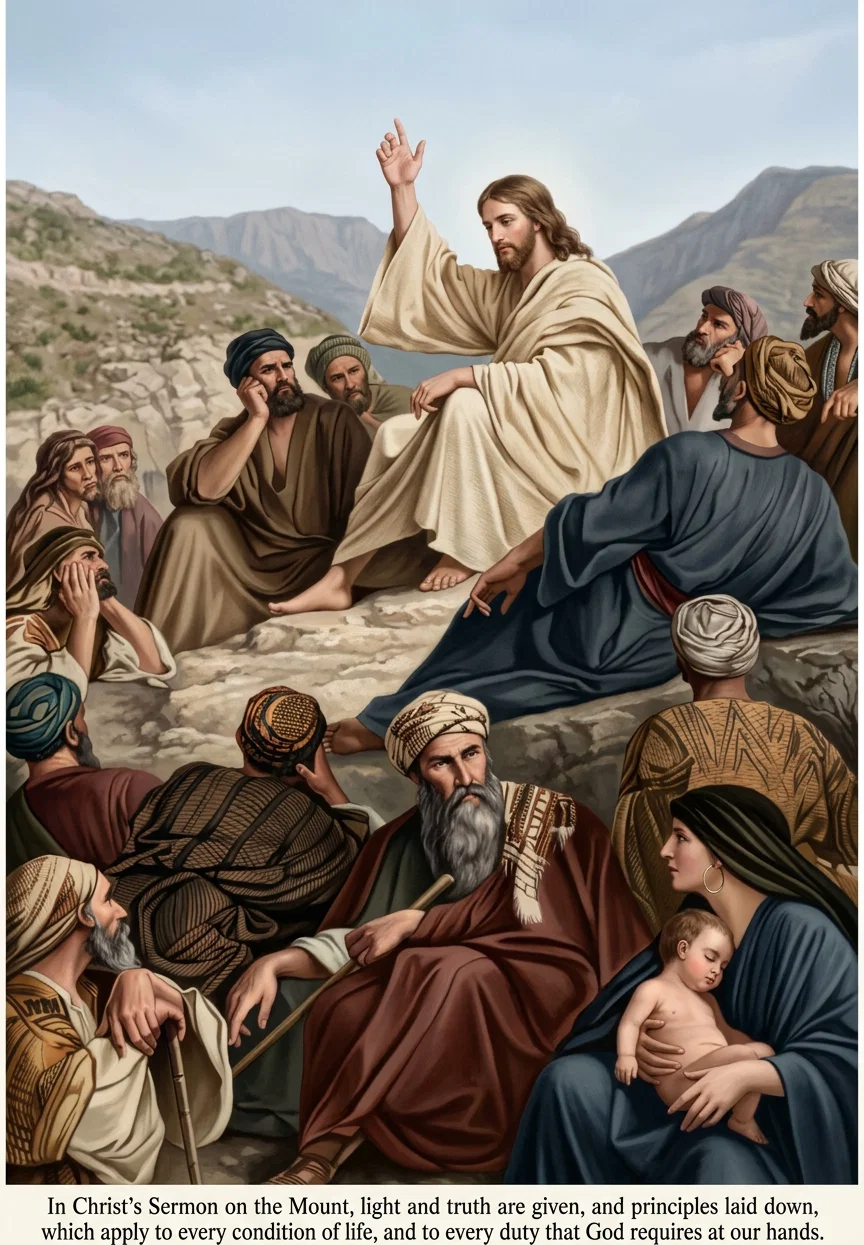
IN Christ's Sermon on the Mount, light and truth are given, and principles laid down, which apply to every condition of life, and to every duty that God requires at our hands. Christ had come to magnify and make honorable the law that He Himself had proclaimed from Mount Sinai to His chosen people during their wilderness wandering. He laid aside the glory which He had with the Father before the world was, and clothed Himself with humanity, that He might minister to the sons of men.
In all His lessons Christ sought to impress upon the minds and hearts of His hearers the principles which underlie His great standard of righteousness. He taught them that if they would keep God's commandments, love for God and for their fellow men must be manifested in their daily life. He sought to instil into their hearts the love He felt for humanity. Thus He sowed the seeds of truth, the fruits of which will produce a rich harvest of holiness and beauty of character. The holy influence of love will not only be far-reaching while time shall last, but its results will be felt and appreciated throughout eternity. It will sanctify the actions, and have a purifying influence wherever it exists.
Seated upon the mount, surrounded by His disciples and a large and promiscuous gathering, Jesus "opened His mouth, and taught them, saying, Blessed are the poor in spirit: for theirs is the kingdom of heaven." These are not murmurers and complainers, but those who are content with their condition and surroundings in life. They do not cherish the feeling that they deserve a better position than that which Providence has assigned them, but manifest a spirit of gratitude for every favor bestowed upon them. Every proud thought and exalted feeling is banished from the soul.
The True and the False
Just here we might distinguish between genuine and false sanctification. Sanctification does not consist in merely professing and teaching the Word of God, but in living in conformity to His will. Those who claim to be sinless, and make their boast of sanctification, are self-confident, and do not realize their peril. They anchor their souls upon the supposition that having once experienced the sanctifying power of God, they are in no danger of falling. While claiming to be rich and increased in goods, and in need of nothing, they know not that they are miserable, and poor, and blind, and naked.
In Christ's Sermon on the Mount, light and truth are given, and principles laid down, which apply to every condition of life, and to every duty that God requires at our hands.
But those who are truly sanctified have a sense of their own weakness. Feeling their need, they will go for light and grace and strength to Jesus, in whom all fulness dwells, and who alone can supply their wants. Conscious of their own imperfections, they seek to become more like Christ, and to live in accordance with the principles of His holy law. This continual sense of inefficiency will lead to such entire dependence upon God, that His Spirit will be exemplified in them. The treasures of heaven will be opened to supply the wants of every hungering, thirsting soul. All of this character have the assurance of one day beholding the glory of that kingdom which as yet the imagination can only faintly grasp.
A Dangerous Error
Those who have felt the sanctifying and transforming power of God, must not fall into the dangerous error of thinking that they are sinless, that they have reached the highest state of perfection, and are beyond the reach of temptation. The standard the Christian is to keep before him is the purity and loveliness of Christ's character. Day by day he may be putting on new beauties, and reflecting to the world more and still more of the divine image.
"Know ye not that the unrighteous shall not inherit the kingdom of God? Be not deceived: neither fornicators, nor idolaters, nor adulterers, nor effeminate, nor abusers of themselves with mankind, nor thieves, nor covetous, nor drunkards, nor revilers, nor extortioners, shall inherit the kingdom of God. And such were some of you: but ye are washed, but ye are sanctified, but ye are justified in the name of the Lord Jesus, and by the Spirit of our God." And the apostle Paul, writing to the church at Colosse, says, "And you, that were sometime alienated and enemies in your mind by wicked4works, yet now hath He reconciled in the body of His flesh through death, to present you holy and unblamable and unreprovable in His sight."
It is a matter of rejoicing that some have subjected their will to the will of God, have cast off the works of darkness, and have consented to walk in the light as Christ is in the light. But even to these the testing of God will continue until probation ceases. He wants to determine whether we will endure hardness as good soldiers of Jesus Christ.
We are opposed by a subtle foe. The world, with its customs, its attractions and corruptions, is to be resisted. The power of Satan will be exercised toward every soul, to overcome and destroy him. The way of safety, for the strong as well as for the weak, is to seek daily for heavenly wisdom, to take hold of divine strength. By this means we may obtain grace to enable us to manifest a Christlike spirit under every difficulty and trial.
"Blessed are they that mourn: for they shall be comforted." By these words Christ would not lead us to think that mourning in itself has any power to remove the guilt of sin. He gives no sanction to bigotry, to pretense, or to voluntary humility. Mourning is not to be manifested in melancholy looks, or expressed by crying and lamentation; nor does He desire that we shall deprive ourselves of social intercourse. While our hearts may be filled with sorrow as we see wickedness defiling the souls of men, we are to cherish a spirit of cheerfulness in keeping with the precious privilege granted us of being sons and daughters of God. We can not hope to draw souls to Christ while we surround ourselves with an atmosphere of gloom.
Cheerful, Yet Sober
There was nothing unsocial in the life and character of Christ. He did not seclude Himself from the world; but at the same time He did not conform to its habits and customs. He was cheerful, yet sober. He sympathized with those who were in sorrow, and rejoiced with those who had cause for rejoicing. Wherever He went, His presence diffused light and blessing.
Much of the sorrow that is felt among men to-day is sorrow that their evil deeds have been brought to light, and that, as a consequence, they themselves have been placed in unpleasant circumstances. But this is not that godly sorrow which works repentance.
Judas did not carry out in his life the faith he professed. He cultivated a spirit of selfishness, which grew into covetousness and dishonesty, and led him to sell his Master for thirty pieces of silver. He did not realize what he was doing until it was too late to undo the fearful work. He mourned for the result of sin, but had no real sense of its grievous character. Pharaoh, too, repented when he saw the result of his hardness of heart, in the plagues that were visited upon his people. But his repentance was not sincere; for when at his request the plagues were removed, his heart was not humble, his proud spirit and determined will were not placed in submission to God. David sinned grievously against God; but he "sorrowed after a godly sort." He prayed that the Lord would remove the cause of His displeasure. "For Thy name's sake, O Lord, pardon mine iniquity; for it is great." And Peter's sorrow for his apostasy was sincere. He brought to God a broken and contrite heart; and this, God has promised that He will not despise. His repentance was accepted of Heaven, and Jesus entrusted to him the care not only of the sheep of His flock, but also of the tender lambs, the young converts to the faith.
Godly Sorrow
The apostle Paul describes true sorrow when he says: "Godly sorrow worketh repentance to salvation not to be repented of: but the sorrow of the world worketh death. For behold this selfsame thing, that ye sorrowed after a godly sort, what carefulness it wrought in you, yea, what clearing of yourselves, yea, what indignation, yea, what fear, yea, what vehement desire, yea, what zeal, yea, what revenge!"
This is genuine repentance. It will lead to a transformation in the life. It is the absence of this true sorrow that makes many of the conversions of this time superficial. Reformations are not made in the life. But when sin is viewed in the light of God, and its true character realized, it will be put away from the heart and life.
We who were dead in trespasses and sins, God has quickened and renewed by His own power. He has elevated and ennobled us, not because we were worthy, but because goodness and mercy are the attributes of His character, because of the great love wherewith He hath loved us.
This love, which is without a parallel, brought the Son of God from the courts of heaven, to suffer and die that we might live through Him. The horror of darkness that enshrouded the Saviour in Gethsemane, and forced from His pores great drops of blood, was experienced by Him on account of our sins. Here, indeed, we have reason to mourn, that our sins have caused such inexpressible agony to God's dear Son.
True sorrow for sin brings the penitent soul near to the bleeding side of Jesus. There he may effectually plead for pardon, and obtain grace to conquer; there his darkened understanding may be enlightened, and the stony heart transformed to a heart of flesh. There the rebellious sinner is subdued, and his will brought into conformity to the will of God.
Christian Science
By Walter Clair Thompson
By Walter Clair Thompson
V—As a Therapeutic Agency
CONSISTENT with the theory that matter does not exist, that bone, tissue, and blood are only aberration of mortal mind, Christian Science teaches that disease is only an illusion. Assuming that "nothing is matter," this theory of no disease is a logical conclusion. Deny the reality of matter, and you must deny the existence of disease, which is manifest only in matter.
The following quotations from "Science and Health" set forth its teachings with regard to disease:
Man is never sick.—Page 322.
All disease is the result of education.—Page 69.
The evidences of the senses are not to be accepted in the cure of disease.—Page 334.
Sometime it will be learned that mind constructs the body, and with its own materials. Hence no breakage or dislocation can occur.—Page 400.
This is to say that there are no such things as colds, aches, or pains. Cancer preying upon the vitals exists only in the imagination; consumption, manifested in the hectic glow of the sunken cheek, and emaciated body, is only a delusion. A train, freighted with humanity, is wrecked, mangling some of its victims into unrecognizable fragments, dissevering the limbs of some, and bruising the bodies of others; but it is all only an illusion—no accident has occurred!
If you have friends among these victims, stop your ears to their dying groans, lave not their fevered brows, and shed no tears of sympathy, but pity them only as victims of "mortal mind." Tho some of their limbs may be picked up in baskets, assure them that it is all an illusion; and to every appeal for aid, answer by quoting to the imaginary (!) sufferer the energizing text which teaches: "The mind constructs the body. . . . Hence no breakage or dislocation can occur."
This picture has not been drawn for the purpose of ridicule, but simply to show what such a doctrine demands of its votaries when carried out to its logical conclusion. The picture is consistent with its teachings. How many of our Scientist friends are willing to accept the issue under such circumstances? If unwilling, their first steps to such conclusions should be repudiated as unsafe and inconsistent.
Christian Science Practitioners
Notwithstanding this doctrine of no disease, Christian Science practitioners number into the thousands, and find the treatment of disease a very lucrative profession. The wealth acquired from this source, and from instructing those who covet the "gift" of healing to the extent of paying a large tuition for such knowledge, is such as would excite the predatory lusts of human nature. This commercial advantage of the profession furnishes a potent factor as an attraction, and students are encouraged to purchase at a stipulated price.
If this healing were not done in the name of religion, Christians would make no protest; but when done in the name of Christianity—the religion of inherent aversion to predatory exploits, and a most beautiful record of altruism—it gives rise to a feeling of indignation in the breasts of those who jealously guard the holy virtue of the Christ religion.
Why These Physicians?
But why physicians when disease does not exist? Ah, it is the physician's mission to disabuse the patient's mind of the illusion of disease. They are educators commissioned to disillusion humanity. Yes, and the lower animals also; for they, too, are victims of "mortal mind," and imagine they have ills. However, man, with his "false education," is perhaps responsible for the error that a dog has mange; but step on his5tail, and he howls, proving this illusion to be purely his own. But if a man's opinion concerning his physical condition is to be discounted one hundred per cent, I suppose we must ignore the dog's convictions altogether. But in "Science and Health" we learn that there is help even for the dog. It is possible for him to attain to a higher plane of mentality, beyond the ken of ills.
In view of the following, however, is not the genus homo a little previous in boasting of his superiority over the lower strata of animal life? We quote from "Science and Health," page 489:
The less mind there is manifested in matter the better. When the unthinking lobster loses a claw, the claw grows again. If the science of life were understood . . . it would be found that the senses of mind are never lost, and that matter has no sensation. Then the human limb would be replaced as readily as the lobster claw.
We take it from this that the lobster, innocent of the "crime of thinking," is a fitter subject for the reception of this science than is the ordinary human being.
But let us quote further from "Science and Health":
Physiology is one of the apples from the "tree of knowledge."—Page 165.
Where ignorance is bliss, it is folly to be wise.—Page 176.
Heredity is not a law.—Page 178.
The so-called laws of health are simply laws of mental belief.—Page 184.
We say man suffers from the effect of cold, heat, fatigue. This is human belief, but not the truth of being, for matter can not suffer.—Page 184.
Many would denounce such teachings as the product of the madhouse, undeserving of anything but contempt; but as thousands of men and women of ordinary intelligence are so seriously affected thereby, we are disposed to be more charitable, and find an explanation in the fact that suffering humanity, ever looking for a remedy for earth's ills, is blinded to the observation of causes while under the stimulus of apparently good effects.
The Secret of Its Hold on Humanity
It is to its work as a physician, and not as a religion, that Christian Science owes its hold upon humanity. Take from it its great claims as a healing agency, and as a religion it would not survive a day. It is because the world is groaning under a burden of disease, brought on by its own sins, that this so-called physician is admitted to intelligent society.
To such as are suffering, it seems to hold out a new hope. Teaching the same old falsehood that seduced our first parents—"Ye shall not surely die; . . . ye shall be as God"—it deceives them into believing that in it they will find the elixir of life and the fountain of youth; while at the very moment, the inexorable laws of sin and death are wasting their bodies and leading their reluctant feet to the inevitable pit where dust returns to dust.
In our experience we have met scores of the adherents of this belief who, even while incurable disease was preying upon their vitals, and slowly penciling the picture of death on their features, at the same time, while under the spell of this subtle power, still protested that they were enjoying the blessings and comforts of health. Such scenes certainly furnish a sad picture of the power of deception.
Ignorance always furnishes a most congenial soil for the growth and cultivation of the weeds of false religion and philosophy.
And like weeds, rank and luxuriant in promise, but in harvest yielding no golden grain, false religion gives promise of reward in its season of springtime; but when the summer is past and the harvest ended, there is nothing that can be garnered from it that will feed the soul and sustain the spiritual life.
A Unique Position
With regard to learning, the Christian Scientist's position is unique. In this it stands against the verdict of all the most eminent scholars. Copernicus, Newton, and Pasteur, instead of giving to the world, through scholarly research, a fund of knowledge of inestimable value, are by this philosophy set aside, not only as being in error, but also as guilty of wandering farther into darkness than the most stolid menial, whose intellectual apathy and lack of ambition have wedded him to the position that makes him a brother to the ox and the ass. Accepting Christian Science, there is no escaping this conclusion. If we are willing to repudiate all history, stamp as false all past experience, ignore all environment, and the verdict of the senses, then and only then can we consistently accept such a doctrine.
Some Scriptural Reasons
To the Christian there are even stronger reasons against this so-called science. These are Scriptural reasons. As has been shown in the previous article, it is in constant conflict, not only with science, but with Bible truth. Here are a few additional proofs:
To the statements that "man is never sick," and "all disease and death are only illusions," the Bible answers, "The soul that sinneth, it shall die." Eze. 18:4, 20.
That the Bible recognizes sickness and death, not as false belief and illusions, but as actual experiences, will be seen by the following texts:
And He healed many that were sick with divers diseases. Mark 1:34.
But Simon's wife's mother lay sick of a fever. Mark 1:30.
In those days was Hezekiah sick unto death. . . . And Hezekiah wept sore. . . . And Isaiah said, Take a lump of figs. And they took and laid it on the boil, and he recovered. 2 Kings 20:1-7.
In the last text cited, there are three points to be especially noted: first, Hezekiah was sick unto death; second, the disease is named—a boil; third, medicine was applied and the patient recovered. Isaiah did not tell Hezekiah that he was suffering under an illusion; but he recognized his sickness as a real experience, gave him medicine as a remedy, and it healed him. Certainly Bible history does not sound much like Christian Science theory.
The Evidence of Healing
Having shown this philosophy to rest upon a false hypothesis, and to be diametrically opposed to Bible truth, we could rest our case, feeling confident that we have clearly proved to the satisfaction of any candid mind that Christian Science is one of the grossest errors ever foisted upon humanity by the adversary of souls. However, we wish to notice one more question which is always resorted to as a final plea for justification. It is frequently asked in all sincerity, even in the face of overwhelming evidence against its philosophy, Do not Christian Scientists heal the sick? and is not this a great and good work?
It is true that they seem to have about as good success at healing the sick as a dozen other so-called healers, among which we might name mesmerists, magnetic healers, and heathen enchanters whose names are legion. These all profess to heal the sick, all get results, and each one seems to enjoy about as much success as its rivals. None of them, however, seem to enjoy greater success than did Simon the sorcerer, of whom it is written:
But there was a certain man, called Simon, which beforetime in the same city used sorcery, and bewitched the people of Samaria, giving out that himself was some great one: to whom they all gave heed, from the least to the greatest, saying, This man is the great power of God. Acts 8:9, 10.
To this great (?) man the apostle Peter said, "Thy heart is not right in the sight of God. . . . For I perceive that thou art in the gall of bitterness, and in the bond of iniquity."
Let us also notice the testimony of Christ upon this point:
Not every one that saith unto Me, Lord, Lord, shall enter into the kingdom of heaven; but he that doeth the will of My Father which is in heaven. Many will say to Me in that day, Lord, Lord, have we not prophesied in Thy name? and in Thy name have cast out devils? and in Thy name done many wonderful works? And then will I profess unto them, I never knew you: depart from Me, ye that work iniquity. Matt. 7:21-23.
If, then, the performing of apparent good works furnishes no positive proof of divine sanction, what is to be the test? The answer is:
To the law and to the testimony: if they speak not according to this word, it is because there is no light in them. Isa. 8:20.
This standard, dear reader, is to be our test for truth. In this day of great darkness, the Word of God should furnish a lamp to our feet and a light to our path.
Beware lest any man spoil you through philosophy and vain deceit, after the tradition of men, after the rudiments of the world, and not after Christ.
What Is the Book to You?
By George E. Hollister
By George E. Hollister
To me it is truth,
For its words have been
A friend that is tried and true;
It never has failed
To warn me of sin.
Say, what is the Book to you?
To me it is help,
For it tells of One—
And the story is always new—
Who has pardoned all.
O, that gracious One!
Friend, what is that Book to you?
To me it is strength,
For when I am weak,
It inspires my heart anew
With help that comes
Whenever I seek.
Say, what is the Book to you?
To me it is light,
For its pages tell
Of kingdoms and empires too;
As it said they would,
They rose and fell.
Friend, what is that Book to you?
To those who believe
And its words receive,
It will be a witness true;
But if you scoff
And disbelieve,
O, what will it be to you?