Your ShelfYour Projects

Review and Herald, Vol. 80, No. 18.

THE YOUTH'S INSTRUCTOR

Review and Herald

May 5, 1903

Seventh-day Adventist Publishing Association · Battle Creek, Mich. · May 5, 1903

THE YOUTH'S INSTRUCTOR

PUBLISHED BY THE
REVIEW AND HERALD PUBLISHING COMPANY
BATTLE CREEK, MICHIGAN
An eight-page illustrated weekly paper. Especially adapted to the daily needs of the youth. Lively, interesting, instructive, entertaining, and entirely free from all cheap reading so common in most of the young people's papers. For fifty years the recipient of the hearty support of the Sabbath-schools and the general confidence of the people, is sufficient testimony of its merits.

SUBSCRIPTION RATES

YEARLY SUBSCRIPTION ................................ $ .75 SIX MONTHS ........................................ .40 THREE MONTHS ...................................... .20 To Foreign Countries ................................ 1.25

CLUB RATES

5 to 9 copies to one address, each ............ $ .55 10 to 100 copies to one address, each ............ .50 100 or more copies to one address, each ........ .45

OUR SPECIAL PREMIUM OFFER

To those sending us new yearly subscriptions for the Instructor, we offer the COMBINATION TEACHERS' BIBLE, AS FOLLOWS:—
For one new yearly subscription and $2.10. For two new yearly subscriptions and $1.75. For three new yearly subscriptions and $1.40. For four new yearly subscriptions and 70 cents. For five new yearly subscriptions alone.

DESCRIPTION OF THE BIBLE

The Old and Revised Versions of the Bible in One Volume without Increasing the Size or Weight, or Diminishing the Size of the Type.

SELF-PRONOUNCING

A teachers' Bible, enabling its readers to use and study the changes embodied in the Revised Version (heretofore only made possible by using a large parallel family Bible, or a separate revised Bible). A Bible which, without omitting a feature, or disturbing the text, points out all the words and passages wherein the two versions differ, giving the Revised Version of each at the foot of the page, as illustrated in the cut, which also represents the size of the type, and the general make-up and style of the book. The text is the old or authorized version. At the foot of the page is shown every change made by the revisers. The letters RV in the text denote that the word or passage following is changed in the Revised Version as shown in the foot-note of the same verse. The letters RO denote that the word or passage following is omitted in the Revised Version as shown in parenthesis () in foot-note. When two or more changes occur in the same verse, they are divided by a dash in the foot-note.
It is substantially and attractively bound in imperial seal, divinity circuit, leather lined to edge of circuit, round corners, carmine under gold edges.

THE COMBINATION TEACHERS' BIBLE

SELF-PRONOUNCING
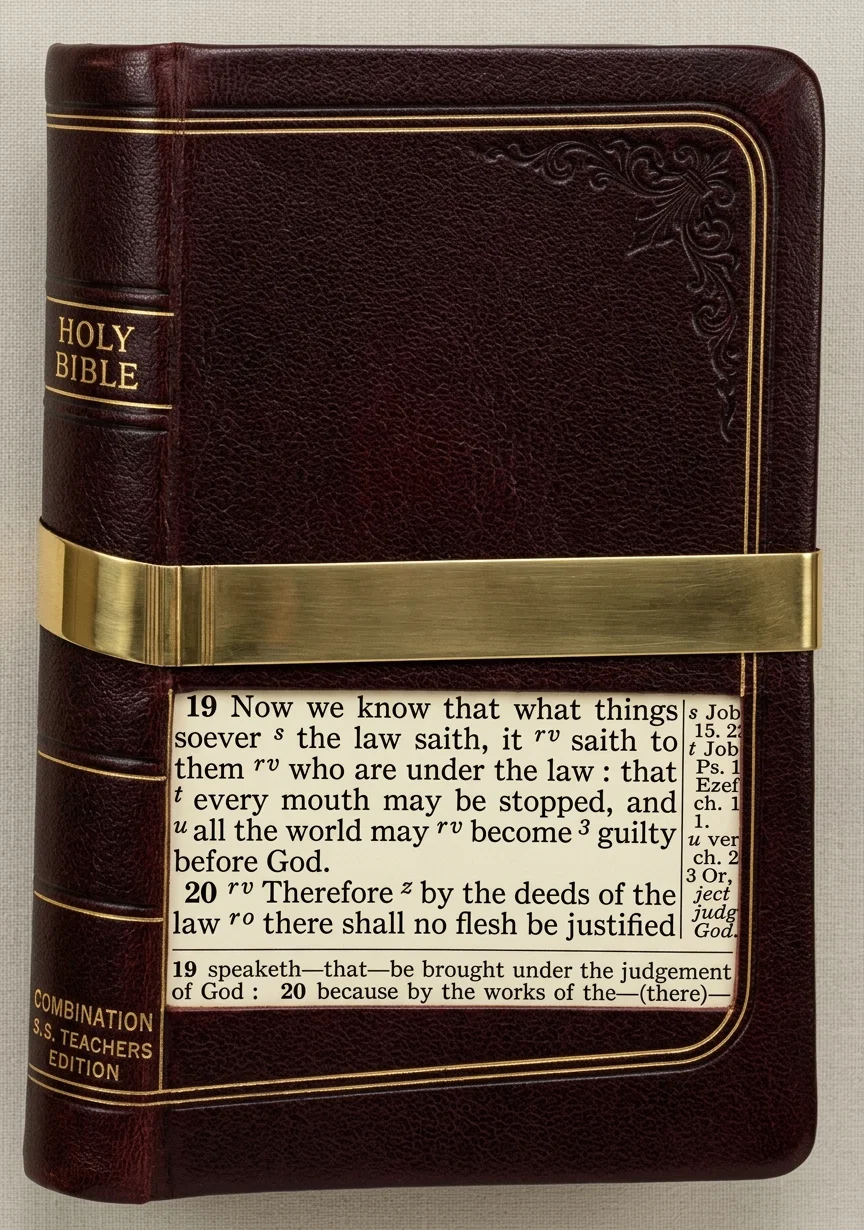
Size, 6 x 8 x 1½ inches.
It contains all the standard helps to the study of the Bible, a complete series of new maps illustrating the geography of Palestine and the surrounding countries from the earliest times, and embodying the most recent discoveries, together with a very full concordance, containing over 40,000 references, history and summary of the books of the Bible, historical, chronological, and geographical tables, new subject index to the Bible, dictionary of the Scriptural proper names with their pronunciations and meanings, table of miracles, parables, etc., etc.
The type is large, the paper excellent, and the binding good. The newest and best teachers' Bible published in every particular. Its construction is simple, compact yet comprehensive. Any child can readily compare each, the old and the Revised versions.

TESTIMONIALS

Every student of the Bible ought to know what the revisers did. Whoever gets this Bible gets the most complete one extant.—Rev. Hiram C. Haydn, Cleveland, Ohio.
One of the most valuable editions of the Holy Scriptures ever published, and no other can claim to be its equal.—Rev. Milton S. Terry, Evanston, Ill.
The combination and self-pronouncing features make it the most practically useful Bible that has ever been published.—Bishop Spaulding, Denver, Colo.
I know of no Bible that contains within itself so much of real value to every Biblical student as your “Combination Bible.”—Rev. D. D. MacLaurin, Detroit, Mich.
Unique in plan, extraordinary in scope, and exceptional in value. The arrangement of the two editions is most helpful.—Bishop Huntington, Syracuse, New York.

The Peace of God

Editorial

The Peace of God

There is personality in the peace of God. It is not simply a passive condition. Of Jesus it is written, “He is our peace.” And as there is personality, so there is power in the peace of God. For he who is our peace is “the power of God.” It is in the power of its personality as found in the Prince of peace that “the peace of God, which passeth all understanding, shall keep your hearts and minds through Christ Jesus.” It is thus evident that there is no such thing as the peace of God (God’s peace) apart from Christ, who has been sent unto us to make peace by being our peace. A blessing is pronounced upon peacemakers. The blessing, or the happiness, consists in sharing the peace which they convey to others. No one can make peace for others without enjoying it himself. Thus it is impossible for him to be deprived of the reward of his labor. The first place in which the peacemaker makes peace is in his own heart, and after that in the hearts of others. What a blessed experience to know the peace of God! What a blessed experience to share this peace with others!
“It is enough: earth’s struggles soon shall cease, And Jesus call to heaven’s perfect peace.”

After the Storm

The storm clouds have gathered in the sky, and the whole face of the sky was darkened by them. The sun was still shining up above the clouds, but we could not see it, and we waited with a certain degree of dread for the bursting of the storm. It came with much fury. It may be that the wind wrought much havoc, and the pelting rain beat down the standing crops and washed away many foundations. But suddenly there was a change. The rain ceased, the clouds broke away, and the sun again shone forth. The storm is over, and the sky puts on a new face. Thus it is in our experiences. There come times of stress and strain, and the whole being seems to be on the rack. But in the very midst of the crisis the grace of God does “much more abound,” the sunshine of his love breaks through the dark clouds of trouble, and peace comes again. It is the victory of the cross—the victory of self-surrender. Such experiences reveal the power of divine grace, and show up in a powerful light the beauty of the divine character. And this is Christianity—a Christianity which establishes itself and proves itself. And all this is wrought by the presence of Jesus, who quiets the storm. On one occasion when the disciples were on the water, “the sea arose by reason of a great wind that blew.” Jesus drew near and said, “It is I; be not afraid. Then they willingly received him into the ship: and immediately the ship was at the land whither they went.” It is the presence of Jesus which makes the storm a calm, and enables us to make progress toward the desired haven. How terrible is the storm! How blessed is the quiet after the storm! How gracious is the Master who brings quiet and rest after the storm!

The End

Prophecies fulfilled indicate that the end is near. The signs of the times emphasize the same fact. The people are “in expectation,” and many are consenting in their own minds that “the end of all things is at hand.” It is quite possible, however, that many persons think of the end as merely a time of destruction, the ushering in of nothingness. We all ought to remember that the end brings us to the beginning. This is clearly shown in the Scripture. Revelation brings us around again to Genesis. After describing the judgment scene and the second death,—the end of the reign of sin,—the revelator says, “And I saw a new heaven and a new earth.” But this is simply a return to the experiences at the beginning, for “in the beginning God created the heavens and the earth.” The end of the old order of things means the beginning of the new order of things, and the end of sin brings the reign of righteousness. “According to his promise, we look for new heavens and a new earth, wherein dwelleth righteousness.” There will be an end to sin and sorrow, pain and death, while righteousness will take the place of sin, joy will take the place of sorrow, comfort will take the place of pain, and immortality will take the place of death. The end is simply the gateway to the beginning. Let the end come in order that we may be at the beginning. If we prepare for the end, we shall be ready for the beginning. And the preparation both for the end and for the beginning is the recognition of God. “Behold your God!” “Behold, the Lamb of God that taketh away the sin of the world.”
“Look unto him, and be ye saved! O weary, troubled soul; O, look to Jesus while you may! One look will make thee whole.”

The Gospel Message for To-day

(Concluded)
Now as soon as these successive revelations are made, and the light shines clearer concerning God’s purpose, then the effort is always to pervert or hide that purpose; so the sanctuary service was perverted in the days of Israel, and so the heavenly sanctuary service was perverted. It began to be perverted in the early church. The mystery of iniquity, which began to work in Paul’s day, was simply the working out of a definite plan on the part of the enemy of God’s truth that he should hide from the people the light and the blessing and the power for salvation from sin that were revealed in this new opening up of the truth of the sanctuary question. The church and the world went into the darkness of the Dark Ages, because the light that would shine from him who sitteth between the cherubim was shut off from them.
Now, after eighteen centuries, we have come to a third step in the development of this truth, set forth in the sanctuaryquestion, and that is this: According to the prophecy of the twenty-three hundred days, we have come to the time of the cleansing of the sanctuary. Now mark that in the prophecies these several things all come at the same time: the cleansing of the sanctuary, as set forth in Dan. 8:13, 14; the coming of the Son of man to the Ancient of days, as set forth in the seventh chapter of Daniel; the coming of the Lord to his temple, as set forth in the third chapter of Malachi; the coming of the bridegroom, as set forth in the parable of the virgins, in Matthew 25. All deal with the same grouping of events, and they all center in that time in 1843 and 1844. At that very time comes the message to the church concerning him who “openeth, and no man shutteth; and shutteth, and no man openeth;” and the message to the church, “Behold, I have set before thee an open door, and no man can shut it.”
Now that was at the beginning of this message and this work,—the word that was to prepare the way for the coming of the Lord. When that transfer of the ministry was made from the holy to the most holy place in the heavenly sanctuary, as set forth in these scriptures, it marked a new step in the development of the gospel. And it marked a phase of truth that the people ought to know.
Now note the history of that time. First came what we call the first angel’s message, a message that went forth to prepare the way of the Lord,—a definite time-message concerning the fulfillment of prophecy and the coming of the Lord. And in the preaching of that message the position was definitely taken that the prophecy of the twenty-three hundred days would expire in the year 1843 to 1844.
After 1843 had passed, and the Lord did not come, there was a general agreement of the Advent believers that the Lord would come in the spring of 1844, with no effort to fix a definite date, and that time also passed. And then the light came again, and they fixed upon a definite day, the tenth day of the seventh month, the twenty-second day of October, 1844. And then came in the message of the second angel and the midnight cry. And in that short time, the summer and early autumn of 1844, there went forth a message of wonderful power. But the tenth day of the seventh month came, and the Lord did not come to this earth, and they experienced that most bitter disappointment.
But those whose faith held to the prophecies, whose personal experience in the message was the experience of deliverance from sin, who had found in that message personal salvation, could not believe that they were all wrong in that work, and they waited upon God, and they studied his word for light, and light came; and what was the light that came?—It was the light on the sanctuary question. When they took up the study of the sanctuary, light was thrown upon the past, upon the present, and upon the future. And the people of God arose with new courage, with fresh hope, to go forth to give the final message.
Now the question is always raised, If they were so certain in their time that the Lord was coming on that day, and preached it, and he did not come, and they were mistaken about it, how do you know that you are not mistaken in preaching the message now of his soon coming? And the answer to that question is found in the study of the sanctuary. I mean not merely in the fact that after twenty-three hundred days, then shall the sanctuary be cleansed, not merely in the fact of a date, but in the nature of the work set forth in the services of the sanctuary, and that is this:—
The work of Christ as our Mediator in the atonement for sin is the work to be followed all the way through; through his work as Mediator, through the atonement provided, we have redemption, even the forgiveness of our sins, according to the riches of his grace.
But there is a difference between the forgiveness of sins and the blotting out of sin. There is a difference between the gospel being preached for the forgiveness of sins and the gospel being preached for the blotting out of sin. Always, and to-day, there is abundant provision for the forgiveness of sins. In our generation comes the provision for the blotting out of sin. And the blotting out of sin is what will prepare the way for the coming of the Lord; and the blotting out of sin is the ministry of our High Priest in the most holy place in the heavenly sanctuary; and it makes a difference to the people of God to-day in their ministry, in their message, and in their experience, whether they recognize the change of the ministry from one apartment to the other, or whether they recognize and experience the fact of the change.
The very center and heart of the advent message for this generation is found in the ministry which Christ, our High Priest, is carrying forward in the heavenly sanctuary in behalf of his people in this generation. That ministry began, that change in the ministry took place, in A. D. 1844, according to the prophecy. It has been continued until this present time; it is to be carried forward until an end is made of sin, until it is blotted out, until all that rebellion that would cast God down from his throne, and put the creature in place of the Creator, is utterly removed from the universe, and the universe is clean, so that out of the heart of every created being has been cast even the lurking thought of that sin.
And that is the ministry of our High Priest in this generation; and our co-operation with that ministry of our High Priest in this generation will prepare the way of the Lord in this generation.
A word further concerning that blotting out of sin: It is the revelation of the glory of God that blots out sin. The time for the blotting out of sin has come when our High Priest takes all the sins of the people upon himself, and goes into the most holy place, and stands in the immediate presence of the glory which blots out sin. The sins blotted out are the sins confessed, confessed upon the Priest,—not that by arbitrary act of ours we can lay our sins upon him; God has laid on him the iniquity of us all. Our confession is that we personally confess that our sins are on him. We agree to that, and, having confessed that, and agreed to that, we let go of them; we say our sins are on him. Our very agreement with him, in the confession that our sins have been laid upon him, is God’s means of removing them from us, and letting them be upon him in our behalf.
Now I want to put together the prophecies and the facts concerning this advent movement in 1843 and 1844. Note, now, the pairs of events: The first message, the second message, and the midnight cry, and the third message; and now, in our time, the message of Revelation 18 uniting with the message of the third angel. Those are definite facts in the development of this advent message in this generation.
Note, on the other hand, in 1844, exactly that happened which the Scripture said would happen, and our High Priest changed his ministry from the holy place to the most holy place. The Bridegroom came at just the time the cry was raised, “Behold, the Bridegroom cometh.” The messages that were given were in God’s order, and they were to do just the work that God had in mind, and fulfill his definite purpose for that time.
So it is with the third angel, and so it is with the union of all three and the angel of Revelation 18, in the wonderful manifestation of power that will bring the coming of the Lord.
Now, is there any relation between these things?—Certainly, a most definite and clear relation. You mark the steps. The first angel’s message prepared the people for exactly the thing that did take place. It was given under God’s providence; it was under his guidance. It prepared the people, that they might unite intelligently with our High Priest in his change of ministry. They did not know it at the time, but that was God’s purpose. The midnight cry prepared them to step right over with the High Priest into the most holy place. The third angel’s message, with all these other messages united with it,should make perfectly clear and distinct the way into the holiest of all, and should fasten the minds of the people directly and definitely upon the present work of Christ, our Mediator and High Priest, in the most holy place in the heavenly sanctuary above as a definite fact.
Now that should be distinctly brought out in the third angel’s message; and with that, of course, will come the clearest revelation of the gospel ministry for this time, the blotting out of sin in this generation, thus preparing the way of the Lord.
These events did not come by chance. The facts of history concerning this advent movement and the facts of prophecy come together according to God’s purpose. And we find ourselves now facing the very next and last development in these steps of experience in the advent message; and what is that?—It is the hour of temptation that is to come upon all the world, to try all them that dwell upon the face of the earth; and the message of Revelation 18, united with the message of the third angel, will prepare a people to stand in that hour of temptation. If the third angel’s message is understood and preached as the gospel for this day, it will bless the people in the very experience through which they are passing.
Now that preaching of Christ, and him crucified, that preaching of the righteousness of Christ as the gift of God through faith in Jesus, which does not extend to and take in these definite developments of advent history, of advent experience, and these definite developments of the truth for this generation, is not the preaching of righteousness by faith, or Christ crucified, that God would have preached to the people now.
Now do not misunderstand me. I will speak in the plainest manner. You know I am not preaching against the forgiveness of sin, the righteousness of Christ, and the glory of the cross of Christ. But what I want to emphasize is this, that not by going off on one side, and ignoring all the historic truth, and all the prophetic truth, and simply preaching a general message of salvation through faith in Christ, without applying God’s message of salvation through faith in Christ to this generation, is not the preaching that God wants in this generation. [Congregation, “Amen.”] The preaching of the glory of the cross of Christ, the preaching of the light that shines from Calvary’s cross, the preaching of the righteousness of Christ as our only hope of salvation, must in this generation extend to a definite application and enforcement of these truths, in the light of advent history and advent prophecy. And when those truths are preached in the light of advent history and advent prophecy, they will save people from sin and from sinning now. They will prepare a people to stand in the hour of temptation that faces us, and will prepare a people to meet the Lord in the air, and so to be ever with the Lord; and that is the message to be preached in this generation.
Let us make as clear as possible what God’s definite purpose for his work is now, that we may all unitedly co-operate with God’s purpose for this time, that there may be just as much the one voice that shall speak the one message, “Prepare ye the way of the Lord, make straight in the desert a highway for our God,” as was heard when the one man, John the Baptist, went forth with his message. Thus we shall not have a message of one sort on this coast, and a message of another sort on the other coast, and a message of some other sort in some other country. There will be one world-wide message, with only one voice, ever preaching salvation from sin through faith in God’s provision,—a complete deliverance from sin, the blotting out of sin, and the salvation of God fully revealed.
And that is what I believe is the message for this time. We have simply looked at it; we have simply opened it up, to look at it; but I want to add that not one truth of the Bible is shut out of the third angel’s message. I want you to think of that. I mean that not one truth from the first verse of the first chapter of Genesis to the last verse of the twenty-second chapter of Revelation is in any way shut out from this message. But now let us add another thing, and that is that every truth from the first verse of the first chapter of Genesis to the last verse of the last chapter of Revelation, in this generation is to be preached in the light of those few verses of Rev. 14:6-12. Those few verses cast a light upon the whole question; and when we begin to enter into the study of it, and to find what it opens up to us, we shall find ourselves face to face with every truth of the Scriptures, with the light of all the ages concentrated, as it were, upon this time, and we shall have a message to bear that will have the power in it to save to the uttermost.

Devoted to the Proclamation of “the Faith which was once delivered unto the Saints”

ISSUED EACH TUESDAY BY THE
Seventh-day Adventist Publishing Assn.
_Terms : In Advance_
_One Year.......$1.50_ _Four Months.....$ .50_
_Eight Months... 1.00_ _Three Months.... .40_
_Six Months..... .75_ _Two Months...... .25_
No extra postage is charged to countries within the Universal Postal Union.
Address all communications and make all Drafts and Money Orders payable to—
REVIEW AND HERALD, Battle Creek, Mich.
[ENTERED AT THE POST OFFICE AT BATTLE CREEK]

Persia and the Eastern Question

THE London press is still discussing the definite passing of Persia under Russian influence. The statement is made that Russia to-day “rules the shah’s finances, and even commands his army.” Russian officers are working to fashion the Persian army after the Russian model. The London Times says:—
Far on into the nineteenth century our predominance at the court of Teheran was undisputed. Throughout the dominions of the shah, British influence was supreme. It is only within the last forty years,—only since the very time when Persia began to assume a new importance in the world as a weighty factor in the question of Asiatic policy as a whole,—that we have suffered that influence to languish, until in wide portions of the Persian empire it has been extinguished forever. . . . “Hasten the decadence of Persia, penetrate to the Persian Gulf, re-establish the ancient commerce of the Levant, and advance to the Indies, which are the treasure-house of the world,” wrote the author of the apocryphal testament of Peter the Great more than a century and a half ago. The scheme has been kept steadily in view, and decade after decade has witnessed the accomplishment of some fresh stage toward the desired goal.
And during the last forty years, since this third angel’s message has been gathering force and spreading into all the world, the development of this phase of the Eastern question has been especially marked. The time has come for all the powers of earth to take their position in the lining up of nations for the fast-approaching Armageddon. And by the same token we may know that the time has come for the message of the gospel to go among these nations.
In the same prophecy, of Eze. 37 : 38, 39, in which Persia is associated with the great power ruling over the “north parts,” the Lord declares that he will gather his people “from among the heathen [the nations], whither they be gone, and will gather them on every side, and bring them into their own land.” With the agents of the god of this world working day and night in these parts to gather the people to the battle of the great day, how long shall it be ere missionaries of this gospel of the third angel shall be gathering out God’s children in Persia and the regions round about? Two of our Armenian brethren, a doctor and a nurse, and, first of all, missionary evangelists are watching for the way to open for them to get into Persia. They will soon be in Russian Armenia, on the Persian border. Let us pray God to help us to get a foothold there.
W. A. S.

Bridges of Wood Over Rivers of Fire

YEARS ago there was committed to the church a commission to carry the gospel to the ends of the earth. A great gulf was to be bridged, and men—earnest, God-fearing men—set about to accomplish the task.
The gospel has been preached; companies of believers have been organized, and the workers have passed on to new fields. They felt that the bridge was being built. Soon it would be possible to encircle the world with the truth.
Thirty, forty, and even fifty years have passed. Some of those first companies are still in existence, but it is a sad fact that many of them are almost wholly extinct. The children, born of Seventh-day Adventist parents, have grown to manhood and womanhood, and havedrifted into the world. The parents have died or apostatized, and if any trace of former organization remains, it is only the smoking embers of the burned bridge.
What was wrong? That the river is one of fire, no one passing through this world can doubt. The “fiery trials” of which Peter speaks have tested our souls. But if the work is of God, if this gospel is to be preached to the world before Christ comes, then something more than wooden bridges must span this river of fire. An indestructible structure must be erected.
If, thirty or forty years ago, those children, who should have become pillars of the church, had been educated in the truths of the gospel; if instead of training them for the world, parents had trained them for Christ and his kingdom, we should to-day be in the kingdom of God.
If, to-day, we wish to do a constructive work, a work that will stand the test of fire, let us build as God has said. Let us do the first works by educating the children according to divine principles.
What are we told, if not that the education of this world is as wood, hay, and stubble? Are you thus building? Are the faces of your children turned toward Sodom? If so, to you the injunction is given, “Remember Lot’s wife.”
That the children may be saved,—the thirty thousand of those already in the church and the thousands outside,—we must have Christian teachers, hundreds of well-trained teachers, true to the principles of Christian education. The training of teachers is a serious matter. Bridge-builders must be master mechanics.
The Southern Education says: “If the aldermen of a city or a town should employ an engineer to build a bridge, and should spend the people’s money in paying that engineer, and it should afterward turn out that the bridge was worthless, and that the so-called engineer was no engineer after all, what would the people say?—They would say that it was the duty of the aldermen to have employed a trained engineer, so that their money would not have been wasted. Is it not as important to employ a trained expert to deal with souls as it is to employ a trained man to build a bridge?”
Many realize that this constructive work must be vigorously pushed. Conference presidents, educational superintendents, and all who feel the needs of the children, are working toward universal free Christian schools. But to carry into operation the plan for such schools, there must be a corps of well-trained teachers. The summer schools offer special advantages to teachers. Instead of spending the vacation in mere enjoyment, the energetic Christian teacher devotes those weeks to self-improvement.
How will the young people in our churches spend the coming summer months? Do they receive any encouragement to prepare for teaching?
E. A. SUTHERLAND.

Juvenile Suicide?

ARE we not truly living in a time when the hearts of the fathers need to be turned to the children, and the hearts of the children to the fathers (Mal. 4:6), when such a condition of things exists as is pointed out in the following from the Chicago Tribune, under the heading, “Juvenile Suicide?”—
It probably never has occurred to sociologists who make a study of homicide that the crime of self-murder is increasing much more rapidly than that of murder, and out of all proportion to the increase of population, and that this is so the world over. Statistics recently published in England show that in France the rate has increased during the last twenty-five years from 157 to 224 per million of population, and in Germany the rate is about the same. In Austria during the same time it has increased 39 per million, in Hungary, 27; in Scotland, 18; in England, 15; and in Ireland, 8. Russia is the only country in Europe which shows no increase in the rate. What the increase has been in the United States during twenty-five years it is not possible to state, as the statistics for that period are not at hand. The increase, however, in 1902 and 1901 was 1,000, the total being 8,245. At the ratio of increase for the first three months the number for 1903 will be considerably larger than that for 1902. It is a melancholy feature of the suicide record for 1902 that three times as many women committed suicide as in 1901. That proportion is maintained during the first quarter of 1903.
A still more melancholy feature of the record is the large number of children and young people who commit suicide. During the ten years from 1887 to 1897 in Europe over four hundred persons under fifteen years of age killed themselves, and seventy-six of these were girls. The number of children committing suicide in this country is increasing year by year. Within the last two weeks a boy of thirteen at Marine City, Mich., shot himself rather than go to church; a young married woman only sixteen drowned herself at Port Jervis, N. Y., because her husband of eighteen would not give her an Easter bonnet; a boy of fifteen at Baltimore shot himself because he had to work; a boy of eighteen at Hamilton, Ohio, hanged himself because he was cheated in a horse trade; a girl of seventeen in Chicago poisoned herself because her mother forgot to deliver a message to her boy lover; and a young man of eighteen also poisoned himself in this city because he failed to find his sweetheart at home when he called. These are only a few of the many cases of juvenile suicide. It is easy in most cases of adults to understand the motive which leads to suicide, irrational though it may be, but it is not easy to understand what it is that is urging so many children and young persons to take their lives at a time when life is full of promise, and they are in the heyday of physical strength and enjoyment, and have had none of the cares, and trials, and disappointments which afflict their elders. Among all the hard questions put to civilization none is harder than these: Why is suicide increasing so fast, and why are so many women and children committing suicide? What is wrong?

Note and Comment

The New York Christian Advocate calls attention to the growing insecurity of life and limb in the United States, due to the increasing prevalence of accidents. “Recent reports of the Census Bureau about accidents in this country,” it says, “are alarming. In 1900 the proportion of deaths from accidental causes was 57.6 in a total of 1,000 deaths from all causes. But in 1890 the proportion was only 53.7. The death rate due to accidents and injuries is highest among persons forty-five years old and over. The average age of death from accidents is about thirty-three and one-half years. The warmer months show a larger proportion of fatal accidents than the cooler ones. . . . On the whole, nearly six per cent of all deaths in the United States are due to accidental injuries. On the average, persons are twice as likely to die from accident as from old age. The number of railroad and trolley accidents is increasing constantly.”
The use of stimulants and narcotics, which to a greater or lesser degree paralyze the brain faculties, is likewise increasing constantly, and between these two facts there may be, and we believe there is, a direct relationship.

Amazing Superstition

The Pittsburg Christian Advocate thinks it is amazing that in this enlightened age of the world, this twentieth century, superstition should still so sway the minds of the people as is shown by statistics pertaining to the pilgrimages to the Catholic shrine at Lourdes, France. Under the heading, “Amazing Superstition,” the Advocate gives the following:—
Here are the statistics of last year’s pilgrimages as we find them in a Catholic exchange. The number of visitors was four hundred thousand, including sixty bishops or archbishops, one hundred and seventy religious processions, and two hundred and forty special trains; forty thousand masses were said; there were four hundred and eleven thousand communions; two million two hundred ninety-one thousand and two prayers were offered for special benefits; fifty-one thousand six hundred and forty thanksgivings for special graces were received; there were six thousand and twenty sick people; of pilgrims unable to pay their way there were twenty thousand seven hundred and twelve males and forty-six thousand seven hundred and fourteen females; the number of bottles of Lourdes water sent to America and other countries, one hundred and two thousand five hundred; four hundred and sixty-four tablets were set up recording miraculous cures; and the basilica received eighteen golden cups and a large number of precious stones from grateful pilgrims.
And this is the twentieth century!
And the reason for it is that not scientific enlightenment, but faith, is the safeguard against superstition. Faith is on the decline, and, naturally, superstition is on the increase.
Continue reading: Our Privilege in Service