Your ShelfYour Projects

Review and Herald, Vol. 91, No. 12.

THE WORK

Review and Herald

Mar 19, 1914

Review and Herald Publishing Association · Takoma Park Station, Washington, D. C. · Mar 19, 1914

THE WORK

AND THE WORKERS
THE beautiful April or "Sanitation" and "Business Man's" number of Life and Health is now ready. Cover design shows the famous "Royal Gorge" in the Rockies. Order early!
SISTER, why not spend a few hours each week selling Life and Health, and have that washing done by some one who cannot do missionary work?
ONE Y. M. C. A. secretary in a large Western city sends his check for payment of ten yearly subscriptions for Liberty. Where is your list of ten names of leaders among men?
THE April number of the Protestant Magazine contains startling proofs, photographic and otherwise, of Rome's un-American "church and state" teachings in her own schools; also cartoons and much other valuable matter. Goes well with the March issue.
Two additional lists of Ohio clergymen have been received from the Ohio Tract Society with the request that we send the February Protestant Magazine to these 1,668 pastors. Other conferences are preparing to do the same by their clergymen. Let the good work go on! It is bearing much fruit already!
ALL in one day! The manager of the Protestant Magazine ordered printed on March 8 the fifth edition (20,000) of the February, the second edition of the March, and the first edition of the April numbers respectively. Total number of copies of the February number ordered to date, 70,000! Over half of the fifth edition was sold in advance of its delivery.
PROF. L. L. CAVINESS, of Washington Missionary College, was recently walking through the great National Museum in Washington, D. C. One of the guards, who saw a copy of the Protestant Magazine in his hand, asked if he was selling it. The guard was so desirous of getting the magazine that the professor finally let him have his copy, which was well blue-penciled. He gladly paid the price, one dime.
ELDER H. C. HARTWELL, president of the Massachusetts Conference, writes under date of March 10: "I think you can count on an order for about 6,000 of the February Protestant. Will mail you addresses and quantity orders for our different churches as soon as returns are all in." Up to March 12 we had shipped 3,876 copies to that conference. Massachusetts will evidently reach the 10,000 mark before the campaign is over.

The Protestant Magazine Advertised

THE Washington Post for February 18 contains a ten-inch article on page 3, with bold-type heading and three sub-heads, the first three lines of which read as follows: "In a letter to W. W. Prescott, editor of the Protestant Magazine published here, President Wilson has denied emphatically," etc. A good advertisement for the March Protestant. The Washington Herald, same date, announced the same news in a six-and-one-half-inch article on the editorial page.
A HEAD professor in the famous Washington and Lee University, Lexington, Va., writes, under date of January 26: "I have read your February number of the Protestant Magazine carefully, and inclose $1.00 for ten more copies, if you have them. I wish I could send $1,000.00 to have a year's subscription sent to that many people. I expect to lend this copy to various friends here. I wonder whether President Wilson has read it?" Yes, we are confident he has.

The Tennessee Sunday-Law Case

THE trial of J. S. Rooker, a member of the Seventh-day Adventist Church, who was indicted by the grand jury of Humphreys County, Tennessee, for hoeing corn in his own field on Sunday, took place in the courthouse at Waverly,
worked regularly on Sundays and were never prosecuted.
3. The national and State constitutions are subordinate to the judicial decision of the State supreme court.
4. The plea for the rights of con-
bring in a verdict of guilty.

Attorney for the Defendant, Mr. Simmons

Your Honorable Court and Gentlemen of the Jury: We have a question here that involves a principle, and it is a principle upon which the government of the United States is
J. S. ROOKER AND FAMILY, OF HUSTBURG, TENN.

Attorney-General Bowman's Speech to Jury

Please, Your Honor, for Mr. Rooker and his religious belief I have the utmost respect, and I have no word of criticism to make either of Mr. Rooker or of the faith which he follows. I am charged
people of the land, then it is obligatory on the people.
You are going to follow the law of Tennessee in this case, if you know it. You took oath to follow it. What does the law say? The laws and ordinances have been uniformly upheld by this court. It
ing to observe God's laws." I don't blame him for that; but when the laws of the land say he should observe Sunday, then if he is a good citizen, notwithstanding what he believes to be divine law, he is going to obey those laws, too.

More Persecution in Tennessee

Their Only Offense the Law of Their God

IN some particulars this world moves, and in others it seems to stand still. We are far ahead of Nebuchadnezzar's time and the time of Darius in wireless telegraphy and general education, but in some other things this generation stands about
Son of God went through the fire with them and brought them out unharmed.
While the bigoted Pharisees were stoning Stephen, God was giving him a revelation of the saints' reward and the glories that await the overcomer.

Liberty Magazine Features

"Just a Taste" of Two Thrilling Articles in the Current "Liberty" Magazine, Which Also Contains Eighteen Others Just as Interesting!
You have missed a great treat if you have not read the current or "Thomas Jefferson," "Religious Persecution," and "National Prohibition" number of Liberty magazine. Read the rest of Attorney-General Bowman's speech to the jury, the speech of Mr. Simmons, attorney for the defendant, Brother Rooker, the judge's charge to the jury, and the verdict of the jury, all written up by Prof. Chas. S. Longacre, our editor, who attended the trial. Read also Thomas Jefferson, President Wilson, Speaker Clark, Secretary Bryan, and other noted men on Human Liberties. Profusely illustrated. Cartoon showing unfaithful church leaning on the arm of the state, well worth $1.00. Note also two-page photograph in the center, showing the vast audience on the United States Capitol steps listening to Senator Sheppard and Captain Hobson speaking on the proposed amendment to the Constitution to abolish the manufacture, sale, importation, or exportation of liquor. Tear out the Petition Blank and start the list of signatures with your own name. Full text of the proposed amendment appears on the back of the blank. Send $2.00 for 50 or $1.00 for 20 copies of this great number. Circulate it everywhere. Ten yearly subscriptions, to ten different addresses, only $2.00. Regular price, $3.50. Send in your lists of legislators, college professors, public-school teachers, clergymen, attorneys, sheriffs, and judges today. Address your tract society or Liberty Magazine, Washington, D. C.

Clear the King's Highway

H. A. ST. JOHN
BEFORE the Lord Jesus can come in his glory, an image must be made to the beast, and the deadly wound healed; four angels must loose the four winds of strife and commotion; seven angels must pour out the seven last plagues successively; Satan and evil spirits must gather the nations to the great battle of Armageddon; and the voice of God must shake the heavens and the earth mightily. In none of these great events have the saints any part to act. But, strange as it may seem, every one of them is being held, delayed, waiting for the remnant church to awake, to put off the works of darkness and to put on the armor of light, and to give to all the world the last gospel message, with great divine illumination and power. Thus we may see clearly that as long as we remain lukewarm, we are not only failing to do our part in clearing the King's highway, but we are actually obstructing it.
Surely it is high time that we awake, and put on the Lord Jesus Christ. Then we shall have on the whole armor of light; then we shall be all light in the Lord, and in us will be no darkness at all; then the closing message of salvation will quickly go to all nations and peoples, shining with the brightness revealed in and through his dear people. Thus will the saints soon finish the work of Jesus assigned them. Then—
"With his radiance splendid Shall your light be blended When his glory shall appear."
The Lord Jesus, in his infinite love, is now rebuking us, and, it may be, chastening some of us, but—
"Affliction, though it seem severe, In mercy oft is sent; It stopped the prodigal's career, And caused him to repent."
May the Lord grant that in our cases it may afterward yield the peaceable fruits of righteousness; and it surely will, if we are rightly exercised thereby. Otherwise, we shall be spewed out of the mouth of the Lord, and forever lost. O, let us now, by zealous repentance, permit Jesus to come in and abide with us! Then when he comes in glory, he will change us to his own likeness, and take us to dwell with him forevermore. Sanitarium, Cal.

Before and After Pentecost

D. H. KRESS, M. D.
THAT a remarkable change took place in the men to whom had been intrusted the preaching of the gospel on the day of Pentecost, was observed by all the people assembled at Jerusalem; for we are told "they were all amazed, and were in doubt, saying one to another, What meaneth this?"
That remarkable results followed is also apparent; for after Peter had preached his first sermon, the people who heard were pricked in their hearts, and said to the apostles, "Men and brethren, what shall we do?" Peter replied, "Repent, and be baptized every one of you in the name of Jesus Christ for the remission of sins, and ye shall receive the gift of the Holy Ghost." "And the same day there were added unto them about three thousand souls."
But this was not all. "As many as were possessors of lands or houses sold them, and brought the prices of the things that were sold, and laid them down at the apostles' feet." Such a mighty impetus did the preaching of the word receive that a few years later, Paul, in writing to the Colossian church, could say, "We give thanks to God and the Father of our Lord Jesus Christ . . . for the hope which is laid up for you in heaven, whereof ye heard before in the word of the truth of the gospel; which is come unto you, as it is in all the world." In a comparatively short space of time the gospel had reached the then-known world.
What made this change? and what brought about these results? Samuel the prophet, in anointing Saul king and setting him apart to his sacred office, said, "The Spirit of the Lord will come upon thee, and thou shalt prophesy with them, and shalt be turned into another man." Here we have the secret of the apostles' success. The Spirit of the Lord had come upon these men, and they, too, were turned into other men. To be convinced of this, study the lives of these men before and after Pentecost, and note what a remarkable change had taken place.
There was a time in the experience of all these men when they cheerfully separated themselves from their earthly possessions—their homes and friends—in order to become followers of Christ. They did not even inquire how their relatives who were dependent upon them would be provided for. Andrew and his brother Simon did not consider it a great act of self-denial to leave their nets and boats at a time when business was at its best and their nets were full of fishes. "They beckoned unto their partners, which were in the other ship [James and John], that they should come and help them. And they came, and filled both the ships, so that they began to sink." "And when they had brought their ships to land, they forsook all, and followed him." Luke 5: 7, 11.
These men were imbued with the Spirit of God, and were able in their newfound power to cast out devils, heal the sick, and do other mighty miracles. After being sent out on their first missionary tour, they "returned with joy, saying, Lord, even the devils are subject unto us through thy name."
The time came in their experience when they lost their first love, and consequently the first works were no longer witnessed. The following appeal was made by a father in behalf of his son: "Master, I beseech thee, look upon my son: for he is mine only child. And, lo, a spirit taketh him, and he suddenly crieth out. . . . And I besought thy disciples to cast him out; and they could not." Instead of having in view the glory of God, at this time they were "reasoning among themselves as to who of them should be the greatest." They were striving for positions of honor. With them it was a question of who would sit on Christ's right hand and who on his left in his kingdom. It is evident that the wage question, or the question of remuneration, also arose. Jesusminded them of the change that had come over them. He said, "When I sent you without purse, and script, and shoes, lacked ye anything?" They had to admit that they lacked "nothing." John and James had so far lost sight of their mission that they were ready to command fire to come down out of heaven and consume those whom Jesus came to save. Peter made use of the sword to protect the cause with which he was connected. But Jesus said, "Ye know not what manner of spirit ye are of."
It is evident that they needed conversion, or a change of heart. They were no longer able to represent their Lord and Master, neither could they do his works of mercy and compassion. Jesus said to Peter, "Satan hath desired to have you. . . . When thou art converted, strengthen thy brethren." In addressing the twelve, he said, "Except ye be converted . . . ye shall not enter into the kingdom of heaven." Matt. 18: 3.
With the church and its leaders unconverted, God could not work to bring people into the church, because of their influence upon these new converts. A radical change was necessary within the church before God could work as he desired to on the outside. They had to pass through experiences which would reveal to them their weaknesses in order to lose all confidence in the flesh. These experiences came to them at the crucifixion. They all fled and denied him whom they reverenced and loved. He knew that after this they would be in a position to take his counsel.
When he took his departure from them, Jesus admonished them to remain at home until they experienced a change of heart, or until the love of God should be shed abroad in their hearts by the Holy Ghost, for obedience and service. He "commanded them that they should not depart from Jerusalem, but wait for the promise of the Father." He said, "For John truly baptized with water; but ye shall be baptized with the Holy Ghost not many days hence," and, "Ye shall receive power, after that the Holy Ghost is come upon you: and [then] ye shall be witnesses unto me both in Jerusalem, and in all Judea, and in Samaria, and unto the uttermost part of the earth." They tarried, but while they were tarrying, they had a work to do; the time was spent in prayer, in the confession of past sins, in putting away all differences. As the Spirit of God revealed their unlikeness to Christ, a longing such as they had never had before, took possession of them to be like their Lord and Master, to manifest his mercy and compassion, and to be in possession of his love. They hungered and thirsted after righteousness. "When the day of Pentecost was fully come," they had reached the point where they "were all with one accord in one place." They were fully united, and each was now willing to take the lowest place. No longer did they think of honor, position, or reward. They were completely emptied of self. The rubbish which had been piled up against the door of their hearts was removed.
The door could now be swung back. Christ no longer would walk by their side, but they were to experience a much closer and more precious union than this: from henceforth he would abide in them. He would be more fully formed within. Then they would be able to do that which before was impossible,—to manifest his Spirit, live his life, and do his works. This was the change which took place on the day of Pentecost. Up to this time they had known Christ after the flesh, but henceforth they were to know him no more after the flesh. This was an experience which went beyond anything they had had before.
For the first time they could say, "We are of the circumcision, which worship God in the spirit, . . . and have no confidence in the flesh." They saw that the only thing that availed was a new creation, and that for men and women to enter the kingdom of God, they must be born from above; that there is no other way. It was only after they themselves were truly converted that they could appreciate the need of conversion. To all, the appeal came after this, "Repent ye therefore, and be converted." By the working of mighty miracles God could now call the attention of the world to his church. With converted leaders God could throw back the door of the church and invite those who were on the threshold to step in. This he did, and thousands were converted.
We are looking forward to the time when again thousands will be converted in a day. But we are told that "the Lord does not now work to bring many souls into the truth because of the church members who have never been converted, and those who were once converted but who have backslidden. What influence would these unconsecrated members have on the new converts? Would they not make of none effect the God-given message?" It is evident that the words addressed to the apostles before Pentecost apply today with equal force: "Except ye be converted, and become as little children, ye shall not enter into the kingdom of heaven;" and, "When thou art converted, strengthen thy brethren." There must first be a converted ministry and a converted people before God can bring the church prominently before the world through signs and miracles.
Conversion is what is called for in the message of the "faithful and true witness." To the minister of the church of the Laodiceans write: "Thou sayest, I am rich, . . . and have need of nothing; and knowest not that thou art wretched, and miserable, and poor, and blind, and naked: I counsel thee to buy of me gold tried in the fire, that thou mayest be rich; and white raiment, that thou mayest be clothed, and that the shame of thy nakedness do not appear; and anoint thine eyes with eyesalve, that thou mayest see. As many as I love, I rebuke and chasten: be zealous therefore, and repent. Behold, I stand at the door, and knock: if any man hear my voice, and open the door, I will come in to him, and will sup with him, and he with me. To him that overcometh will I grant to sit with me in my throne, even as I also overcame, and am set down with my Father in his throne. He that hath an ear, let him hear what the Spirit saith unto the churches."
This "testimony of the true witness," we are told, "has not been half heeded. The solemn testimony upon which the destiny of the church hangs has been lightly esteemed, if not entirely disregarded. This testimony must work deep repentance; all who receive it will obey it, and be purified." "Some will not bear this straight testimony. They will rise up against it, and this is what will cause a shaking among God's people."—"Early Writings," page 270.
We certainly have reached the time in the history of this church when the message must go to its members, "Repent ye therefore, and be converted, that your sins may be blotted out, when the times of refreshing shall come from the presence of the Lord." To all who respond, the assurance comes: "And ye shall receive the gift of the Holy Ghost. For the promise is unto you, and to your children, and to all that are afar off, even as many as the Lord our God shall call."
When this solemn testimony, upon which the destiny of the church hangs, has been fully received, God can again swing back the portals of the church, and call the attention of the world to her, and invite those that are on the threshold to step in. He will then do a speedy work. This is the experience for which every one should pray.

A. G. DANIELLS

Does the History of Turkey and Egypt Since 1798 Fulfill the Prophecy of Dan. 11: 40-44?—No. 21

A. G. DANIELLS
"BUT tidings out of the east and out of the north shall trouble him: therefore he shall go forth with great fury to destroy, and utterly to make away many." Dan. II:44.
The part of the prophecy we are now considering states that "tidings out of the east and out of the north shall trouble him." From this we understand that the prophet foresaw developments of a serious character taking place in the eastern and northern parts of the territory of the king of the north, which, we believe, is the Turkish Empire.
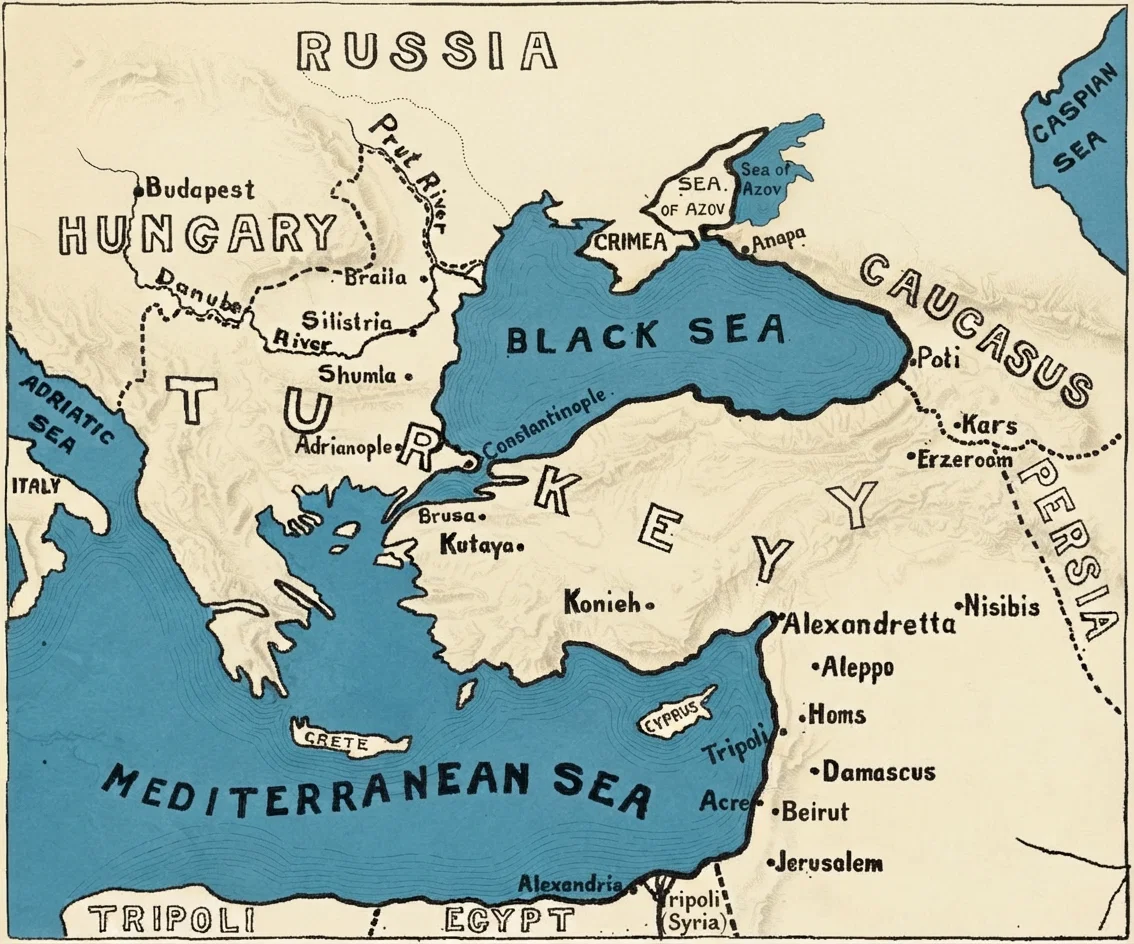
The history being given in these studies shows that ever since the beginning of the year 1828 events have been taking place in the eastern and northern parts of Turkey that have imperiled the very existence of that empire. Note the ominous statements given in the preceding article; the Egyptian army had crossed the Taurus Mountains and completely routed the Turkish army at the ancient city of Konieh. This was in Asia Minor, and only three hundred miles southeast of Constantinople. With this victory the Egyptian general became, says Paton, "master, not only of Syria, but of AsiaMinor, which was the center of Turkish power and resources."
A glance at the accompanying map will show the territory that had now fallen into the hands of the Egyptians. Asia Minor is all that territory east of Constantinople between the Mediterranean and Black Seas as far east as the Taurus range.
From Konieh, the Egyptian army advanced to Kutaia, from which it menaced the capital only one hundred and fifty miles distant. The tidings of this advance filled Constantinople with consternation, and the sultan implored Russia for help. Russia responded by placing 12,000 soldiers in Scutari, just across the Bosporus from Constantinople.
The result was two treaties, one with Egypt and the other with Russia. Egypt got all of Syria and a part of Asia Minor. Russia secured a preponderant position at Constantinople above all the other European powers. "Thus a great part of the empire," says one of the writers already quoted, "was virtually severed from its trunk, and a power [Russia] aggrandized that might at any time be turned against the remainder." Creasy, already quoted, says, "It was the general opinion in Europe at this time [1833] that Turkey was irretrievably ruined, and that the attempts of her reforming sovereign to resuscitate her power had been the mere galvanizing of a corpse."
All these perilous developments, it should be remembered, were in the eastern and northern sections of the empire, from whence tidings of trouble were to come.
After the signing of the treaty of peace at Kutaia, 150 miles southeast of Constantinople, the Egyptian army was withdrawn from Asia Minor into Syria. But there was no peace. "The quarrel between Egypt and Turkey was not settled, it was only slumbering; both sides, foreseeing a rupture, were actively pushing their armaments and preparing in silence."—"Historian's History of the World," Vol. X, page 452.
"The convention of Kutaia had never been considered by either of the contracting parties as establishing a permanent settlement. The very form of the concessions made by Sultan Mahmud was significant of his intention to reverse them at the earliest opportunity. . . .
"The Russian squadron had scarcely left the Bosporus, after the signing of the treaty of Unkiar-Skelessi, before rumors were rife as to the sultan's intention of taking advantage of the promise of eventual Russian aid to renew the war with Mehemet Ali. . . .
"Mehemet Ali, for his part, was credited with stirring up the formidable insurrection that broke out in Albania, and intriguing at Constantinople for the deposition of Mahmud and the proclamation of his son."—"Cambridge Modern History," page 558, 559.
"Mehemet declined to continue the payment of tribute to the Porte; and his removal of the Turkish guards from the Prophet's Tomb, and substitution of his own Arab soldiers, constituted a still more open denial of the sovereignty of the sultan, as chief of Islam.
"Attempts at negotiation only led to mutual complaints and recriminations; and the sultan at last sent a final summons to the pasha, requiring him to reestablish the Turkish guards at the Tomb of the Prophet, to pay regularly his tribute, and to renounce all sovereignty over Egypt, save so far as the sultan might concede it to him. On obedience to this being refused, Mahmud directed his generals and admirals to attack his refractory vassal." See "History of the Ottoman Turks," Creasy, pages 521-526.
"It was not, however, till the spring of 1834, when the discontent of the Syrians had issued in widespread revolt, that the crisis became acute. . . . The first to revolt were the Turks, [who were] resentful of the loss of their ancient privileged position. . . .
"On the first news of the insurgent successes, Mahmud struggled, like a hound straining at the leash, to break the diplomatic bonds that prevented him from hurrying to their assistance. He protested that it was his duty as sultan to go to the help of his subjects when oppressed by one of his servants. Even when, in his great wrath, Russia refused to support him, in the event of his being the aggressor, he pressed on the preparations for war. . . .
"The sultan's accumulated passion had, however, placed him beyond the control of any argument but that of hate; the hand of death was upon him, and he was determined at all hazards at least to attempt to revenge himself upon his enemy before he died. 'I would rather die,' he exclaimed, 'or become the slave of Russia, than spare my rebellious vassal.'"—"Cambridge Modern History," Vol. X, pages 559-561.
"A great council was held at the Porte on the twenty-second of January, 1839, in order to discuss the question of peace or war with the Egyptians; and thereafter measures were taken on a large scale for arraying an imposing force to be employed against Mehemet Ali. Eighty thousand men were ordered to be levied, in addition to the force already under arms. . . .
"Mahmud at length resolved on war, and a message was sent to the Great Council to the following purport: 'Hafiz Pasha informs me that my army is able to defeat the Egyptian army in Syria. The Capudan Pasha tells me that my fleet is strong enough to defeat and destroy the Egyptian fleet. It remains for you to be courageous and do your duty.' To this Hati-Sherif, the Great Council, returned for answer, 'that His Highness's ministers would do everything in their power to act in conformity with the pleasure of their master.' . . .
DISTANCES FROM CONSTANTINOPLE
"In Syria, Ibrahim Pasha displayed his well-known activity in preparing for the storm. . . . In the end of April, rumors having reached him that the sultan's troops had crossed the Euphrates, Ibrahim immediately held a council of war in Aleppo, which was his headquarters at this period in consequence of its large resources and its vicinity to the northern frontier."—Paton's "History of the Egyptian Revolution," pages 127-130.
"A numerous and well-appointed Turkish army had been collected at Bir, on the Euphrates; and by the strenuous exertions of many years, a well-disciplined and well-manned fleet of thirty-sixvessels of different rates, twelve being ships of the line, had been formed and collected in the harbor of Constantinople.
"But venality and treachery baffled all the preparations of the Ottoman sovereign. When his army under Hafiz Pasha met the Egyptian under Ibrahim, at Nezib, on the twenty-fifth June, 1839, whole battalions and squadrons, whose officers had taken the gold of Egypt, deserted the sultan's standard, and ranged themselves with the enemy. The remainder was hopelessly routed, with the total loss of artillery, camp, baggage, and military stores of every description." See "History of the Ottoman Turks," by Creasy, pages 521-526.
"Such was the disastrous battle of Nezib. The Turkish army left on the field more than a hundred pieces of artillery, besides its camp, baggage, and ammunition, only the military chest being saved. The number of killed and wounded Turks was estimated at four thousand and the number of Egyptians at three thousand, in round numbers; but the actual loss of the Turkish commander was incalculable, and the army of the sultan may be said to have ceased to exist—a demoralized and disorganized rabble, destitute of artillery, commissariat, and baggage, having preceded and accompanied Hafiz Pasha in his retreat to Marash." See "History of the Egyptian Revolution," by A. A. Paton, pages 127-135.
The city of Nezib, where this great disaster befell Turkey, was the old "Nisibis, an ancient city and fortress in the north of Mesopotamia, near a point where the Mygdonius leaves the mountains by a narrow defile. . . .
"Nisibis (Nezib) appeared for the last time in history in 1839, when the Egyptians under Ibrahim Pasha defeated the Turkish army under Hafiz Pasha, on the twenty-fourth of June, in a battle at which von Moltke was present."—Encyclopedia Britannica, article "Nisibis."
The battle of Nezib, in the far eastern part of the Turkish Empire, practically wiped out the Asiatic division of the sultan's army, leaving him without any means to prevent the Egyptian forces from marching to his capital. Thus, a second time the whole of the eastern part of the empire fell into the hands of Mehemet Ali, of Egypt.
"The road to Constantinople once more lay open to Ibrahim, who pressed on the defiles of the Taurus, and there halted, pending the development of the diplomatic situation. For Sultan Mahmud had not lived to hear of this crowning disaster, the news of which reached Constantinople as he lay unconscious on his deathbed. He died on July 1, leaving his empire to Abdul-Medjid, a lad of sixteen."—"Cambridge Modern History," Vol. X, page 562.
Continue reading: The King's Business Requires Haste