Your ShelfYour Projects

Signs of the Times, Vol. 38, No. 39.

SIGNS OF THE TIMES

Signs of the Times

Oct 3, 1911

Pacific Press Publishing Association · Mountain View, California · Oct 3, 1911

SIGNS OF THE TIMES

Warfare of Truth

A friendless warfare! lingering long Through weary day and weary year; A wild and many-weaponed throng Hang on thy front and flank and rear.
Yet nerve thy spirit to the proof, And blanch not at thy chosen lot; The timid good may stand aloof, The sage may frown — yet faint thou not.
Nor heed the shaft too surely cast, The foul and hissing bolt of scorn; For with thy side shall dwell, at last, The victory of endurance born.
Truth, crushed to earth, shall rise again — The eternal years of God are hers; But Error, wounded, writhes in pain, And dies among his worshipers.
Yea, tho thou lie upon the dust, When they who helped thee flee in fear, Die full of hope and manly trust, Like those who fell in battle here!
Another hand thy sword shall wield, Another hand the standard wave, Till from the trumpet's mouth is pealed The blast of triumph o'er thy grave. —William Cullen Bryant.

Question Corner

"IF YE WILL INQUIRE, INQUIRE YE."

This Inquirers' Department is conducted for the purpose of helping those who are studying the Bible. The answers are oftentimes only suggestive. They are never to be considered infallible, only as they agree with the infallible Word. The writer who may answer them does not consider that his opinion is infallible. He will simply give the best that he has, and plead with the inquirer to search the Word. Such questions only will be answered as, to the editors, seem to minister to the good of the readers and to the mission of the paper. We can not answer repeatedly in the same volume questions upon the same scripture. The name and address must accompany question, not for publication, but as an evidence of good faith, and that answer may be made by letter if deemed advisable. No letters are answered which do not contain the name of the writer. It is well always to enclose stamp for reply.

3572 — Is It Spurious?

It is said that Rev. 20:5 is not in any of the Greek versions, and is an interpolation. Is this true?
We condense from "Questions and Answers," page 15:
The earliest New Testament manuscripts are as follows: 1. The Codex Sinaiticus, now in St. Petersburg. It contains the whole of the New Testament. It was discovered by Tischendorf in the monastery of St. Catherine, on Mount Sinai, in 1859. It was written, in all probability, in the fourth century, and once contained the whole Bible. 2. Codex Alexandrinus, written in the fifth century. Contains the whole Bible. 3. Codex Vaticanus, now in the Vatican, known as No. 1209. Probably written in the fourth century. Contains the whole Bible, with the exception of parts of the New Testament, among which is the Apocalypse. 4. Codex Ephraemi Rescriptus. This is what is called a "palimpsest," the original writing of which has been erased in order to use the parchment for another. It was probably written in the fifth century, and contains about two thirds of the New Testament. 5. The Peshito Syriac version, a very old version.
Now of the above, Rev. 20:5 is found in the first, and in the second and fourth. The third does not contain the Revelation at all. The Syriac omits the passage, as does Vatican MS. No. 1160, of the eleventh century. The three oldest Greek copies which contain the Revelation at all have the text. The Emphatic Diaglott, based on Griesbach's text, has the following foot-note on Rev. 20:5: "These words were probably omitted by oversight in Vatican MS. [No. 1160], as they are found in A, B, C, tho not in the Syriac." By "A" is meant Codex Alexandrinus; by "B," Codex Vaticanus, No. 2066, of the seventh or eighth century; by "C," Codex Ephraemi Rescriptus. Finally, the best Greek text, that of Westcott and Hort, contains the passage; and neither have the Revised Versions or any of the critics, so far as we know, even questioned it. The revisers adopted for their revision the text "for which the evidence is decidedly preponderating." The clause in question is considered spurious only by those who have a doctrine to prove which the text condemns.

3573 — Husband and Wife

What are the proper relations of husband and wife to each other, as to control and direction in work, etc.?
1. Before marriage there ought to be a proper conception of what the very solemn step and contract mean on the part of both husband and wife. There ought to be sufficient acquaintance with each other and with each other's tendencies, that each party to the contract might understand somewhat of the marriage relationship, what it should mean. This, however, is not always possible. In the very nature of the case, both woman and man are on the best of behavior, in the desire of each to please the other, before marriage; and the real man or woman, among the stress and trials and conflicts of life, is not seen until after marriage.
2. There ought to be a proper conception of what the marriage vows and bond mean, in which each has pledged to take the other for better or for worse, and to love, honor, and cherish until death separates. That means mutual love, mutual forbearance, mutual patience, mutual interest. It does not mean the lordship of a husband over his wife; she is not his slave. He did not marry her that she might be such. Neither is she his plaything. She is to be a help meet for him, fitted for him; and he is to treat her as such.
3. The same is true on the part of the wife. No true-hearted woman would feel that she was to be a helpless creature, that all the burdens of life would rest upon the husband, that all the cares and provisions of life would be his, and that she was to be a mere butterfly in idleness. She ought to help to bear the burdens of life in her own way, and according to the strength which God gives.
4. As regards business and domestic relationship: Naturally, the husband would attend to the outside affairs. For instance, if he were a farmer, he would look after his own men and his own crops, and plan his own work. And yet it is always well for him to talk over these things with his wife, get her counsel and weigh it carefully, because she is interested with him in that. But the details of the work she ought to leave with him, and he ought to bear them, and not burden her with them. That is a part of his work.
5. The internal affairs of the household ought to be borne by the woman, as the outside work is by the man. In a general way, it is well for her to counsel with her husband. She should consult his tastes in regard to food, etc. He ought to arrange the inside of the house, just as far as lies in his power with prudence and economy, so that it would be convenient and handy for her, so as to make her work as light as possible. He ought to be willing that she should have just as good a stove as he does a mowing-machine, just as good a sewing-machine as he does a gasoline engine. Things should be made as convenient for her within the house as with him on the farm, and each ought to take a mutual interest with the other in the purchase of such things. But the husband should not interfere with her general management of the household. Unless she insists upon his doing it, she should be taught to do her own purchasing of food and supplies. She needs that business experience. She can do it in counsel with her husband; but a certain part of his wages, or income, should be turned over to her each week or each month, and she should manage the household on that amount which she receives, if it is sufficient; and the division ought to be so justly made that it would be sufficient, that is, if there be sufficient income at all. She would probably make mistakes, but no more than would the husband outside. His mistakes might be bigger and not so many, but after all might be a great deal more costly. But she has rights within her domestic circle which he ought to respect; and mutual respect and helpfulness in this matter would cement hearts, and tend to make home happy, much better than it would for the husband to be constantly interfering in little, petty things with his wife.
6. In large matters of business, in new plans, in broader plans, in sale or purchase of property, in the granting of deeds or mortgages, in building and furnishing a home, there ought to be mutual counsel, mutual regard, and mutual study.
Now these suggestions are given regarding normal conditions. Sometimes a wife does not know how to purchase very well, and is extravagant, and does not understand the use of money. She ought all the more, then, to counsel with her husband, and learn to overcome her weaknesses. Sometimes the husband is just as defective as a woman can be; he does not know how to use money, and is extravagant and foolish; and in that case he ought to depend upon his wife. They ought to seek God together, she helping him by cheerfulness and her woman's intuition, he helping her with his strength and encouragement. It would not hurt him to help in the heavy work in the house, if it is more than she ought to do. He ought to be just as willing and anxious that she should have help for the doing of her work, as he has for his.
Many a wife has been spoiled and health ruined by the inconsiderate treatment of a husband. Many a husband has died and left a wife without any knowledge of business whatsoever, because he has insisted in caring for it all himself. The time for the wife to learn these things is when the husband is alive and well; and she can do it better at that time than any other, in the conduct of her own household. Read Proverbs 31.

3574 — Noah and His Work

Did Noah have a set time in which to build the ark? In comparing Gen. 5:32; 7:6, 11; and 11:10, I can not get any 120 years. How is it? Was Gen. 6:3 spoken to Noah, or to some one else?
The texts cited do not cover 120 years, it is true; but there is nothing whatever to show that the Lord did not instruct Noah concerning what was to come before the 500th year of his life. The 500th year of his life is simply mentioned because at that time his sons were begotten, just the same as with the other patriarchs and their sons in the verses previous. Gen. 6:3 compared with these other scriptures would simply show that twenty years before Noah was 500 years old God told him the condition of the world — doubtless told not only Noah but told others as well. Methuselah lived until the very year of the Flood, and seems to have been a righteous man. He was told. Lamech lived until near the time of the Flood. Evidently these righteous men helped Noah, and understood that the Flood was coming.

3575 — "Ye Which Have Followed Me"

Please explain Matt. 19:28. 1. Does not the statement of Jesus, "Ye which have followed Me," imply that those who have done so have been regenerated, or born again? And if this is true, what is the force of meaning of "in the regeneration"? Does it mean that after the Saviour makes His second advent and sits in the throne of His glory, the process of regenerating man will continue for one thousand years, called the "millennial age"? and that the apostles will sit in twelve thrones ruling over the wicked nations of earth? In what way are all nations gathered before Christ? Is it not literally so, as much so as Christ sits literally in His throne?
1. "Ye which have followed Me" would indicate that those who followed Christ were truly His own children, converted men, born again.
2. According to the Bible before us, the translators understood "in the regeneration" to have reference to the time when Christ shall sit in the throne of His glory, in the re-creation of all things, when there shall be a new heavens and a new earth. "Verily I say unto you, That ye which have followed Me, in the regeneration when the Son of Man shall sit in the throne of His glory, ye also shall sit upon twelve thrones, judging the twelve tribes of Israel." The text does not pertain to the thousand years at all.It pertains to this life only in the following of Christ, and those who suffer with Him here shall reign with Him hereafter. 2 Tim. 2:12. The judging is not used in the sense of condemning, but in the sense of ruling, of leading, of standing at the head of, even as Christ reigns; they will be subject rulers. We learn in the 21st chapter of Revelation that the capital city of the new earth has twelve foundations, and each one of those foundations named after one of the twelve apostles of the Lamb. They will have a part in His kingdom; they will be commemorated in the very city itself. There will be in that new earth peoples and nations and tribes, proper divisions in all parts of God's wonderful kingdom, and these divided into twelve tribes, after each of which a gate of the city is named; and over these twelve tribes, will be the twelve apostles. This is clear and comprehensive, it seems to us. There is absolutely nothing in the scripture to show that this is a work of regeneration which goes on through a long period of time. It does not say, Ye which follow Me in the work of regeneration, but, "in the regeneration," after the re-creation has taken place, they shall reign with Christ.
The last question seems to refer to two scriptures — Matt. 12:28 and Matt. 25:31, 32. The gathering of all nations before Christ will be when they come before Him, not only in the record which is given, but in every one of the books — the only way in which all nations could come before Him, as individuals, not only those who wake, but those who are in death. And in that judgment the separation comes. Then in the execution of that judgment, when all shall stand before the great white throne, there will be the division, the righteous with Christ in the holy city, the wicked cast out, as clearly shown in Revelation 20.

3576 — The Seed

Please explain Ps. 22:30, "A seed shall serve Him; it shall be accounted to the Lord for a generation." Who is this seed? Is it Christ, or His followers? When does it apply?
The 22d Psalm is predictive of Christ. Read as in the Revised Version: "A seed shall serve Him; it shall be told of the Lord unto the next generation. They shall come and shall declare His righteousness unto a people that shall be born, that He hath done it." The thought of the "it" is that this story shall be told of the Lord to the next generation — this story of the suffering of the Lord Jesus, of what He did, of His work. And the seed that shall serve Him are those who receive Him by faith (Gal. 3:29), and the story of Christ shall be told to generations to come, and they will repeat it. It is simply the carrying forward of the Gospel that is meant by the "it."

3577 — Moses and Elijah

If Christ was the first man who came down from heaven, where and what were Moses and Elijah?
The text to which our inquirer evidently refers is John 3:13: "And no man hath ascended up to heaven, but He that came down from heaven, even the Son of Man which is in heaven," the context of which clearly shows that the point to which our Saviour refers is that no one has ascended up to heaven to obtain information of God's plan concerning man, and reveal it to man, but the Son of Man. Christ Jesus our Lord came down from heaven to impart to us the great things of God. No other has done this. Moses and Elijah ascended into heaven; but they did not come back to bring any message with them, or salvation for men. We read in one instance of where they did come back to talk with the Saviour. They then became examples of the resurrection and translation, when Christ shall come the second time; but that is all.

OUR BIBLE BAND

Schedule for Week Ending October 14 Sunday October 8 Luke 21, 22 Monday " 9 " 23 Tuesday " 10 " 24 Wednesday " 11 Mark 1, 2 Thursday " 12 " 3, 4 Friday " 13 " 5, 6 Sabbath " 14 " 7, 8
—★—
The first three days of the week closes the wonderfully interesting book of Luke. Marvelous indeed are its closing records of our Lord's suffering, crucifixion, and resurrection, and the wonderful lesson taught the two disciples who went down to Emmaus, journeying with Jesus and yet not knowing Him.
The book of Mark was written by him whose name it bears, between the years 60 and 70. It is difficult to locate it exactly, but scholars are generally agreed as to that. He who wrote it was not one of the twelve. His full name was John Mark. (See Acts 12:12, 25; and 15:37.) He was the son of Mary, at whose house in Jerusalem the early Christians seem to have met frequently. He was a cousin, also, of Barnabas. Col. 4:10, A.R.V. He attended Paul and Barnabas on their first missionary journey, and left them at Perga, on account of which later a sharp contention arose between the two apostles, he going with Barnabas, and Silas with Paul. It is good, however, to know that he was restored to favor in the heart of the great apostle, because we find him with Paul during his first imprisonment at Rome (Col. 4:10; Philemon 24), and Paul asked that Mark might come to him before his death (2 Tim. 4:11), as one profitable to him for the ministry. Peter refers to Mark as with him when he wrote his first epistle, probably at Babylon. See 1 Peter 5:13. He there calls Mark "my son." Some have supposed that he learned the facts of the Gospel from his association with Peter. His Gospel is brief and emphatic in its expression. He hurries from one event to another; "immediately," or kindred words, are common. Very graphic, however, is he in his details. He throws light upon some of the striking things by giving us the very original words themselves, as, for instance, when Jesus raised the daughter of Jairus from the dead, and the words of our Lord on the cross.

Entrusted With the Gospel

"Even as we have been approved of God to be entrusted with the Gospel, so we speak; not as pleasing men, but God, who proveth our hearts."

"Shall I Not Drink It?"

By Emma Hildreth Adams
IN the appalling accounts of the fierce fires which, but a few weeks ago, swept clean of shrub, tree, and flower wide acres of the noble forests of Southern California, readers of the daily papers were thrilled by the magnanimous efforts put forth by relief parties to convey water to fainting men engaged in fighting the furious, speeding, driven flames.
One can imagine the gratitude, the gladness, which filled the hearts of the singed, blistered, almost swooning heroes at sight of the hurrying relief men, at taste of the cool, refreshing liquid. One can imagine with what zeal they turned again to the mighty conflict, forgetting self, risking life, working from lofty principle.
But not always, in the fiery conflicts of life, are there held out to the wearied, threatened fighters cups brimming with cool, sparkling water, with restoring milk, with refreshing drink seasoned with fragrant juice of orange or lemon.
Not always are there pressed to heated lips cups quick to quench thirst, to alleviate pain, to quiet nerves, to impart strength, to renew courage.
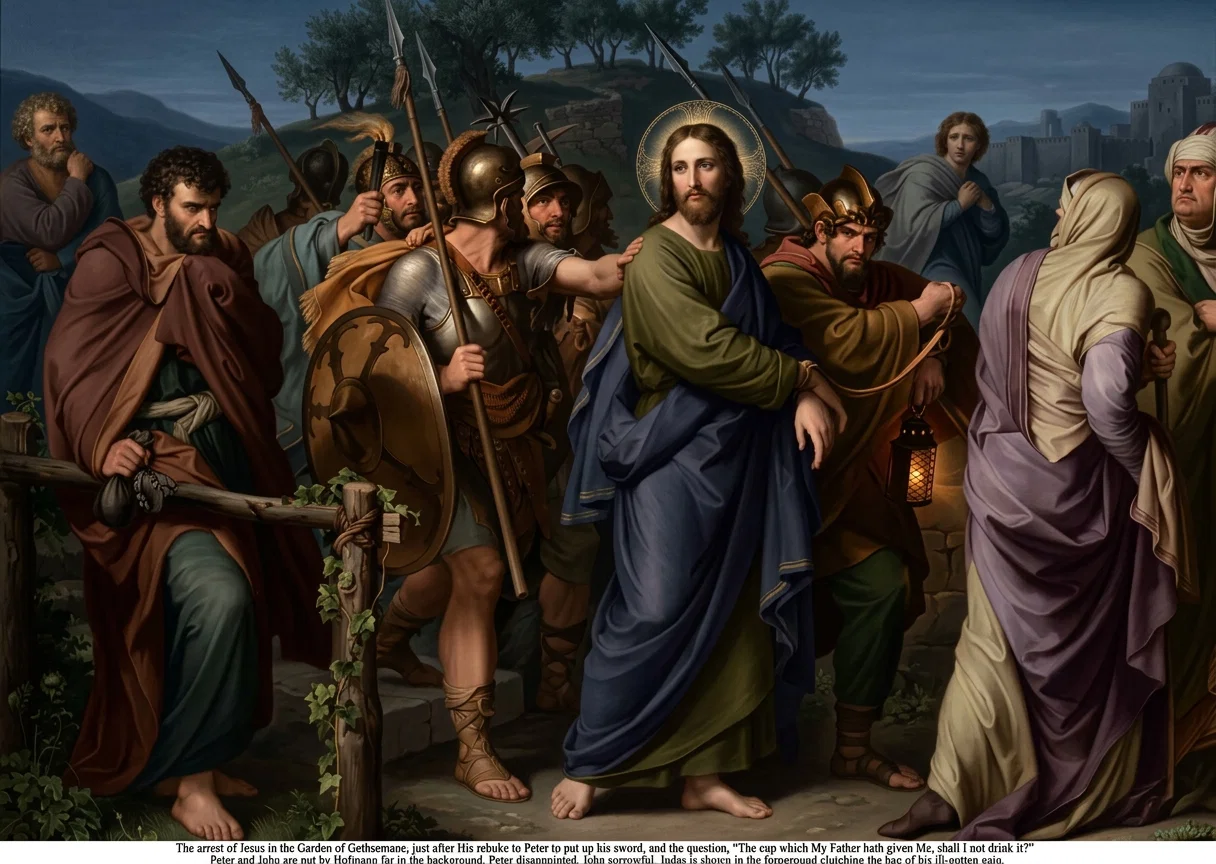
The arrest of Jesus in the Garden of Gethsemane, just after His rebuke to Peter to put up his sword, and the question, "The cup which My Father hath given Me, shall I not drink it?" Peter and John are put by Hofmann far in the background, Peter disappointed, John sorrowful. Judas is shown in the foreground clutching the bag of his ill-gotten gain.
Sometimes, oftentimes, in one's life experiences, when battling with strong, invisible conflagrations, when struggling to extinguish raging fires in heart, in soul, a cup is presented whose contents are distasteful, unwelcome, highly colored, and repulsive, but of which it is needful, it is urgent, it is salvation, that one drink.
Sorrow of heart, grief of mind, keen disappointment, serious want, sudden losses,—one or all of these may impart the dismal tint, the bitter taste, which so stir his aversion. Notwithstanding, the mixture may be designed for his greatest good, his highest welfare. It may be held forth as the one admissible test of obedience, of submissive will.

Should He Not Then Drink It?

In such case, the hand which extends the testing cup is a kind hand, a pitiful, merciful hand. He who holds it forth knows the remedial power of the liquid it contains; knows the radical fault it will correct, will extinguish; knows the serious blemishes of character it will amend, the discipline of soul and spirit it will achieve.

Should He Not Then Drink It?

The pathetic words which form the headline for these paragraphs were spoken by the Son of Man in Gethsemane, the night of His betrayal, when Simon Peter, in defense—as he thought—of his sorrowful Master, drew his sword and criminally smote the servant of the high priest.
Jesus said to him instantly: "Put up thy sword into the sheath: the cup which My Father hath given Me, shall I not drink it?"
For every member of Christ's body—the church—there lies in this touching, revealing, unveiling question, a profound lesson in the lofty calmness, in the nobly submissive spirit, manifested by the great Master, the mighty Creator of the earth, in that hour of trial unimaginable by those for whom He was about to give His life.
Christ's question to Peter leads us back a little to the scene in which figure the sons of Zebedee, their mother, and the ten other disciples. To the ambitious plea of the mother Christ gave answer—to her sons—in the pointed, startling question, "Are ye able to drink of the cup that I shall drink of, and to be baptized with the baptism that I am baptized with?" They, having at that hour no conception of the deep meaning, the vast inclusion, the far-reaching significance, of the act of baptism just beginning for their Lord, answered thoughtlessly, "We are able"!
The Man of Sorrows, knowing what completely testing cup awaited both Himself and them, replied, "Ye shall drink indeed of My cup, and be baptized with the baptism that I am baptized with: but to sit on My right hand, and on My left, is not Mine to give."
With hearts weighted with sympathy for Him who was beginning to drink an appalling cup for both the reader and the writer, let us, with careful, reverent tread, again enter the Garden of Gethsemane.

In the Garden

We find there, probably not far from the entrance, Christ and eleven of the disciples, all having come from the supper room in the city. Judas was busy elsewhere.
Selecting Peter and the two sons of Zebedee, perhaps because those three had profoundest need of witnessing the Gethsemane portion of the bitter cup He would finish drinking next day, Christ led them aside a few paces for companionship while He prayed.
Then He "began to be sorrowful and very heavy," saying to them, "My soul is exceeding sorrowful, even unto death: tarry ye here, and watch with Me."
Advancing a few steps, He "fell on His face, and prayed, saying, O My Father, if it be possible, let this cup pass from Me; nevertheless not as I will, but as Thou wilt."
Then—one of the most regrettable and sad things on the part of the disciples—returning to the three chosen ones, He found them asleep! And "He left them, and went away again, and prayed, . . . saying the same words."
Being very human, and not yet partakers of the Pentecostal baptism, they could not drink of Christ's painful yet willingly accepted cup. Later, in their noble self-abnegation, their heroic service to Him, their giving up of life for His sake, they drank of His cup.
A little later than to-day, after a few more years have sped, undoubtedly, should our lives be continued, there will come to both the reader and the writer of these paragraphs, opportunity to drink deeply of the cup of Christ's sorrow and suffering.
SHALL WE NOT DRINK IT?
—**—

A Spectacle to the World

By Mrs. E. G. White
For our Gospel came not unto you in word only, but also in power, and in the Holy Ghost, and in much assurance; as ye know what manner of men we were among you for your sake. And ye became followers of us, and of the Lord, having received the word in much affliction, with joy of the Holy Ghost: so that ye were ensamples to all that believe in Macedonia and Achaia. For from you sounded out the word of the Lord not only in Macedonia and Achaia, but also in every place your faith to Godward is spread abroad; so that we need not to speak anything. For they themselves show of us what manner of entering in we had unto you, and how ye turned to God from idols to serve the living and true God; and to wait for His Son from heaven, whom He raised from the dead, even Jesus, which delivered us from the wrath to come.
THE apostle wrote these words of encouragement in order that we upon whom the ends of the world have come, might receive benefit. Through the grace of Christ such a transformation of character is to take place in us that the word of the Lord may leave an impression upon many minds, that "in every place your faith to Godward is spread abroad." When the people of God yield themselves to be controlled entirely by the Holy Spirit, in them will appear that Christlikeness which is in accordance with the richness and grandeur of the truth. But in order that Christ shall be revealed in the human agent, self must die. The believer is to study the life and character of Christ, that by beholding he may become changed into His divine image in life and character.
How cautious should each one be lest he cultivate an unsanctified independence! The enemy is vigilant, working with tremendous power to subvert souls who have had presented before them the light of truth. Satan watches that he may take advantage of every unconsecrated element of character in the human agent, in order that he may use him who professes to be a servant of Christ to further his satanic designs. He will take advantage of prejudice, of preconceived opinion, of side issues, that he may make of no effect the words of God's messenger to the church. Contention and strife will be aroused, and the message of heaven will be rendered of no effect through the working of this evil leaven.
In the days of Paul there was need of warning the churches against bringing in their own ideas and opinions, of setting their stakes, and of holding the measuring tape in their hands, so that if the message or the messenger differed in some little degree from their preconceived ideas, they closed the door firmly against the light and the light-bearer. In the words of Paul, the Lord warns every man to take heed as to entertaining this spirit of jangling and strife. He says: "As I besought thee to abide still at Ephesus, when I went into Macedonia, that thou mightest charge some that they teach no other doctrine, neither give heed to fables and endless genealogies, which minister questions, rather than godly edifying which is in faith: so do. Now the end of the commandment is charity [love] out of a pure heart, and of a good conscience, and of faith unfeigned: from which some having swerved have turned aside unto vain jangling; desiring to be teachers of the law; understanding neither what they say, nor whereof they affirm." "And they that have believing masters, let them not despise them, because they are brethren; but rather do them service, because they are faithful and beloved, partakers of the benefit. These things teach and exhort. If any man teach otherwise, and consent not to wholesome words, even the words of our Lord Jesus Christ, and to the doctrine which is according to godliness; he is proud, knowing nothing, but doting about questions and strifes of words, whereof cometh envy, strife, railings, evil surmisings, perverse disputings of men of corrupt minds, and destitute of the truth, supposing that gain is godliness; from such withdraw thyself. But godliness with contentment is great gain."

A Lesson for Our Time

From the words of Paul we can see that he had the same difficulties to deal with in his day that we have to deal with in our day. There were in the early church those who made much of matters of minor importance, and wrought mischief among the believers in creating strife and contention. Through pride men and women are led to take the position that rendering service to a brother or sister in certain ways has a degrading tendency; but it is just as commendable to serve in what are called menial positions as to minister from the pulpit. There is no degradation in doing the duties that must be done in the house, and there is no humiliation in being able to do well and thoroly the duties that devolve on a housemaid or a man of all work. It will never injure self-respect to be a good servant if the right view is taken of the subject.
But in whatever branch of the Lord's work you are, you should study to show yourself approved unto God, a workman that needeth not to be ashamed, willing to be taught, ready to learn, faithful in your work, and ever growing in power and efficiency.
There is no safety for any of us unless we trust fully in God, and take a decided stand, guarding the avenues of the will, resisting the first insinuations of Satan, rejecting his counsel to yield to questionable impulses. This requires watchfulness, perseverance, and continual adherence to the Word of God under all circumstances. We are here as probationers, and are—

Deciding Our Own Eternal Destiny

Then how important it is that we daily educate and train the will-power to render obedience to God in the least as well as in the greatest tests! How important to remember ever the fact: "Thou God seest me. Thou knowest every thought, and art acquainted with every action"! How important that we regard ourselves as pupils in the school of Christ, that we learn to repress every vain, trifling word! Jesus has been tempted in all points like as we are, and it is our Saviour who admonishes and warns us concerning evil. He has identified His interest with that of suffering humanity, and He bids us, "Watch ye and pray, lest ye enter into temptation." We should esteem His counsel as of the highest value.
You are not to be off guard for an instant, but as a faithful sentinel to stand at your post of duty, and having done all to stand. But with all our watchfulness we are to remember that "except the Lord keep the city, the watchman waketh but in vain." Man must coöperate with the heavenly agencies; he must use his God-given abilities to their utmost in earnest endeavor to keep his own soul from being degraded by sin; but he must not trust in his own finite strength, for it will be as a broken staff, a bruised reed. With his human endeavor he must mingle faith in a divine Deliverer, and express his dependence upon God in prayer. The promise is given, "Let him take hold of My strength, that he may make peace with Me; and he shall make peace with Me." There is no safety for us outside of entire dependence on Jesus Christ. His wisdom, His power, His grace, His love, must be our only support. We are to unite prayer with watchfulness, and thus lay hold upon His mighty power, feeling our insufficiency to cope with self and the powers of darkness.
Then looking unto Jesus, who is the Author and Finisher of our faith, with perfect assurance we may commit the keeping of our souls to Him, while we coöperate with divine agencies. Every soul may say: "Lord, without Thee I can do nothing in saving or keeping my soul from sinning against Thee; but Thou art able to keep me from falling, and to present me faultless before the presence of Thy glory with exceeding joy. To Thee I commit the keeping of my soul as unto a faithful guardian, and I leave all in Thy hands, knowing that Thou doest all things well."

Faith

I will not doubt, tho all my ships at sea Come drifting home with broken masts and sails; I will believe the Hand which never fails, From seeming evil, worketh good for me. And tho I weep because those sails are tattered, Still will I cry, while my best hopes lie shattered, "I trust in Thee." —Anon.

Honesty Is Noble

“He who is honest is noble.”

Love Makes Every Path Easy

"ALL paths are easy to feet shod with love."
Continue reading: The Sabbath a Perpetual Institution