Your ShelfYour Projects

Review and Herald, Vol. 80, No. 6.

A Model of Solomon’s Temple

Review and Herald

Feb 10, 1903

Seventh-day Adventist Publishing Association · Battle Creek, Mich. · Feb 10, 1903

A Model of Solomon’s Temple
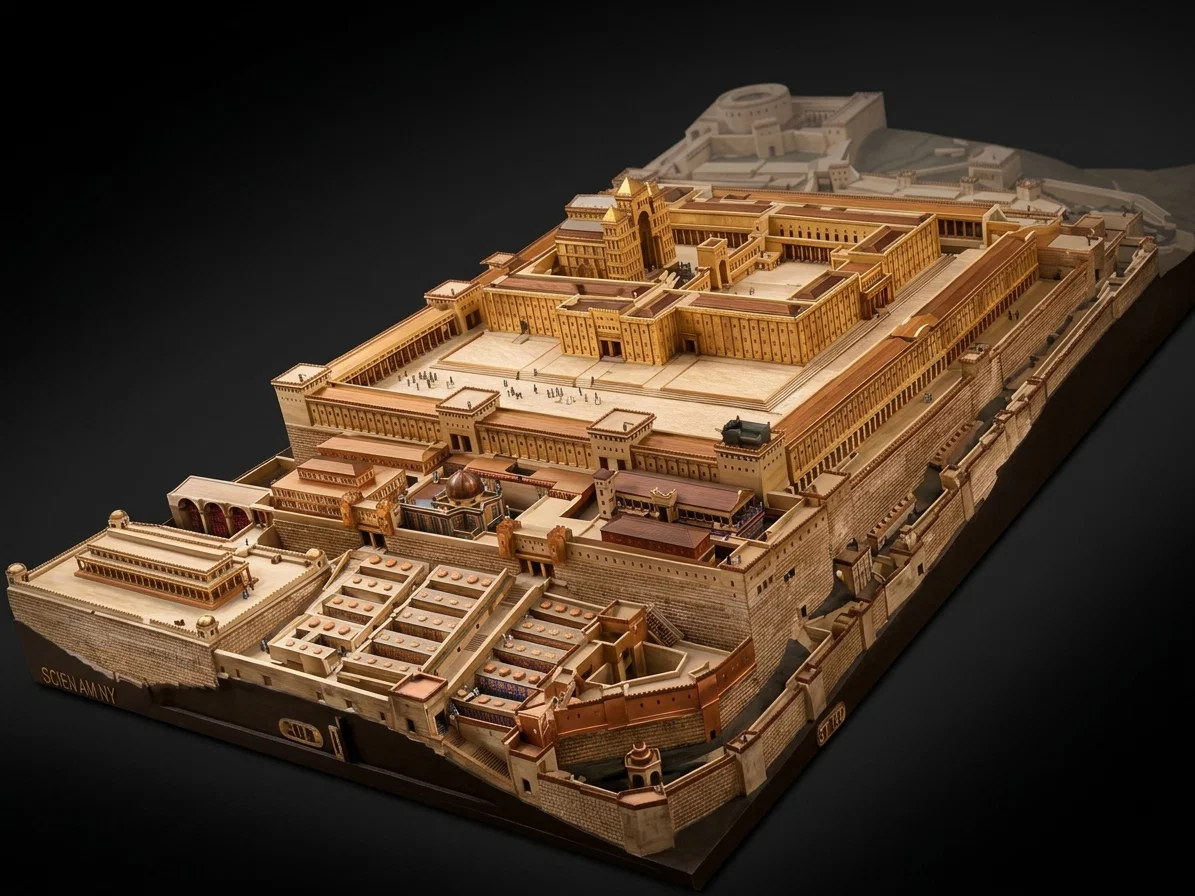
SOLOMON'S TEMPLE, BUILT 1000 B. C.
This picture is from a photograph of a model of Solomon’s Temple made by the late Dr. Schick, who lived fifty years in Jerusalem, and gave thirty-two years’ patient study to the locality and to the literature dealing with the buildings which have been erected on this historic spot.
The following description of the picture is from The Scientific American: “Beginning at the southeast corner, we see part of the mount rising in rock steps up to the city wall, the valley of Kedron to the right, and the Tyropoean valley to the left and inside, the wall of the mills bastion and the ‘house mills.’ Following up are two streets leading to the double and triple gates of the ‘king’s house.’ On the higher terrace is the palace of the king, Solomon. Here to the left is the ‘house of the forest of Lebanon,’ and crossing above the double passage, we reach the judgment hall, in which was the throne of the king, and, farther, after crossing the triple passage, the king’s private lodging. Above this terrace of palaces and on a higher level are the outer temple walls and porches, forming a great square.
“Inside the porches extends the outer court, or court of the Gentiles, behind which none but Jews could go. A rise of twelve steps brings us to another platform, or terrace, called Chel, or the Rampart, on which stands a large building with three wings and three stories high. Inside this building are the middle court and the inner court. Fifteen steps, on which the Psalm of Degrees was chanted, led up to this inner court, and thence up five steps to the court of the priests, and there, on the holy rock of Sakhra, stood the altar of burnt offerings and the brazen sea. Up twelve steps more, on the highest platform, stood the House of the Lord, where the ark of the Covenant reposed, beneath the outspread wings of the cherubim in the holy of holies. The house faces to the east. On the north, outside the temple inclosure, we see the fortress with the towers Mea and Hananeel, mentioned by Nehemiah.”

Publishers' Page

Conducted by the Department of Circulation of the Review and Herald Publishing Company

Special Sale of Slightly Damaged Books

In recent issues of the Review, we have given quite a full description of the following slightly damaged books, and as these works are well known to the majority of our readers, we omit further descriptions of those heretofore presented, and quote only the regular and reduced prices:—

Desire of Ages

In the cloth binding, reduced from $3.50 to $2.60, postpaid.

Great Controversy

In the cloth binding, reduced from $2.75 to $2. Full morocco, from $4.50 to $3.30.

Patriarchs and Prophets

Cloth binding, reduced from $2.75 to $2.

Easy Steps in the Bible Story

Cloth binding, reduced from 50 cents to 35 cents.

Looking unto Jesus

The cloth binding, reduced from $1 to 75 cents.

Marvel of Nations

Cloth binding, reduced from $1.25 to 75 cents, postpaid.

Home Hand-Book

Cloth binding, reduced from $4.50 to $3.35; the library from $5.50 to $4.10, postpaid.

Ladies' Guide

Cloth binding, reduced from $3 to $2.25, postpaid.

Man, the Masterpiece

Cloth binding, reduced from $3 to $2.25, postpaid.

Prophecies of Jesus

Cloth binding, reduced from $1.75 to 85 cents; library, marble edges, from $3 to $1.40; Russia, $3.75 to $1.90.

Empire Series

Containing Empires of the Bible, Great Empires of Prophecy, and Ecclesiastical Empire

Reduced from $6 to $4, for the set.

The Abiding Spirit

By Mrs. S. M. I. Henry. Neatly bound in cloth, with plain edges; 316 pages. As good as new. Reduced from 40 cents to 30 cents, postpaid.

Here and Hereafter

Neatly bound in cloth; 357 pages. Reduced from $1 to 75 cents, postpaid. The damage is scarcely noticeable on this book.

Gospel Workers

Cloth binding; 480 pages. Reduced from $1 to 75 cents. As good as new.

The Nonsuch Professor

In a nice cloth binding, with 367 pages. Price reduced from $1 to 40 cents postpaid.

Drummond's Addresses

Especially good for boys. Price reduced from 75 cents to 30 cents, postpaid.

The Master's Greatest Monosyllables

The faith-maker and the soul-winner. Reduced from 50 cents to 35 cents, postpaid.

Prophetic Charts in Series

Reduced from $4 to $2.50 per set.

Facts for the Times

A compendium of important facts in a simple form for ready reference; 329 pages; cloth binding. Price reduced from 75 cents to 50 cents.

Story of Daniel the Prophet

We have only 160 copies of this excellent book in stock. The average sale is 50 copies per month. At this rate our stock will last only a short time. Those who desire a copy of this book should order at once. It will soon be out of print. Neatly bound in cloth; 295 pages; 75 cents, postpaid.

Other Damaged Books

The following books are only slightly damaged; the defect is scarcely noticeable on many volumes, yet the reduction in price is sufficient to cover larger damages.

Heralds of the Morning

An unusual chance to secure at one-half price a book that sets forth the evidences of the soon coming of Christ in a clear and dignified manner, the signs of our times being forcibly portrayed, established beyond contradiction by ample facts and figures, and pleasingly impressed with a profusion of appropriate illustrations.
. Every book offered is practically as good as new. They are attractively bound in cloth with marble and gilt edges, printed with new, large type on extra fine paper; 280 large pages. Reduced from $1.25, marble edges, to 60 cents; and from $1.50, gilt edges, to 75 cents, postpaid.
Orders for these special books should be sent in early, as our supply for bargains is limited.

Living Fountains or Broken Cisterns

By Prof. E. A. Sutherland
This book gives the history of the two systems of education, Christian and pagan. “All thy children shall be taught of the Lord.” Isa. 54: 13. “Now as never before we need to understand the true system of education. If we fail to understand this, we shall never have a place in the kingdom of God.”
“Living Fountains” tells us the cause of the failure and apostasy of Israel, of the early church, the Reformers, the modern Protestants; and also the weakness of the remnant church can be traced to no other source and accounted for on no other grounds than pagan methods and wrong principles of education instilled into the minds and hearts of the children and youth of the past and present generations.
President Harper, of the Chicago University says: “It is difficult to prophesy what the result of our present method of education will be in fifty years. We are training the mind in our public schools, yet the moral side of the child's nature is almost entirely neglected. The Roman Catholic Church insists on remedying this manifest evil, but our Protestant churches seem to ignore it completely. They expect the Sunday school [and we the Sabbath school] to make good what our public schools leave undone.”
“The world bows to Plato, and lays at his feet our educational system.” Chambers' Encyclopedia, article Plato, says: “Since the French Revolution particularly, the study of Plato has been pursued with renewed vigor, in Germany, France, and England; and many of our distinguished authors, without expressly professing Platoism,—as Coleridge, Wordsworth, Mrs. Browning, Ruskin, etc.,—have formed a strong and growing party of adherents, who could find no common banner under which they could at once so conveniently and so honorably muster as that of Plato.” Christians are to be gathered under the ensign of Christ.
The book contains 428 pages; printed from new type; substantially bound in cloth. On account of being slightly damaged, the price of this book has been reduced from $1.25 to 65 cents, postpaid. The books are practically as good as new. Only good, clean copies will be sent.

A Critical Harmony of the Gospels

For 75 Cents Each

In our last advertisement for this book a mistake was made in the price; it was quoted at $1.25, postpaid. Though it is an excellent work, and the damages are very slight, the price should have been stated as 75 cents, postpaid. Certainly this is the time to secure an excellent book on the harmony of the Gospels at half the retail price. These books are as good as new to place in the library. While they last, we will mail them for 75 cents, postpaid.

Mothers' and Teachers' Manual

This is the time to get one of these excellent books, written by Prof. C. C. Lewis, and especially designed to assist in the home and church school. It contains valuable suggestions for mothers and teachers; and the prices at which we quote them now are certainly within the reach of all. Paper covers, 25 cents; cloth binding, 35 cents. All as good as new. Our supply at these prices is limited.

History of Sabbath, in Three Volumes

The same signatures that are used in the regular “History of the Sabbath” are bound in three separate volumes with paper covers. The matter in every particular is the same as in the regular bound books. These paper volumes are only slightly damaged; they are practically as good as new. 40 cents
Make all orders for the books described above, on the Review and Herald Publishing Co., Battle Creek, Mich.

A Final Message

Editorial

A Final Message

Century after century has passed since sin entered into the world. At different times in the development of the gospel work special warnings and invitations have been announced, as though heaven had drawn a little nearer to earth than usual in the effort to save lost humanity. But the world has always looked for another opportunity, and so the day of decision has often been deferred. Many a soul has trembled under the faithful preaching of the word, but has said, “Go thy way for this time; when I have a convenient season, I will call for thee.” And generally the “convenient season” never comes. But we face the fact that the whole world is having its last opportunity. In this generation the whole world must decide for or against the gospel of the coming Saviour. We have reached the last of the last days. This advent message is the last message. It is now almost threescore years since “the judgment was set, and the books were opened.” We must be in the very closing scenes. But this final message must be faithfully given. This last call of mercy must be known in every land. When this work is accomplished, “then shall the end come.” What an incentive to earnest work is found in these facts! The goal of many generations is now in sight. “The advent message to all the world in this generation” means the coming of the Lord in this generation, for this is the closing message. The world is tottering to its ruin, but the dissolution of the old earth prepares the way for the new earth. Our faith must now lay hold of that power which renews and upholds us though everything about us should fail. This last message of “the everlasting gospel” is “the power of God unto salvation to every one that believeth.” It is the last hope of a lost world in these last days. Last message, last hope, last days! Last, last, last!

The Meaning of the Cross

The cross is at the very center of Christianity. In it the Christian may glory. “Far be it from me to glory, save in the cross of our Lord Jesus Christ, through which the world hath been crucified unto me, and I unto the world.” It is at the cross that we meet with Jesus the Saviour from sin. It is in taking up the cross that we become the disciples of Jesus. It is therefore most important that we should know the meaning of the cross. It may help us to enter into this experience more fully by keeping it more constantly in mind, if we make the word itself a reminder of what is bound up in it. Let us arrange it this way—
C is for Crucifixion; R is for Resurrection; O is for Obedience; SS is for Self-Surrender.
Now let us call to mind a few scriptures which deal with this experience: “I have been crucified with Christ; and it is no longer I that live, but Christ liveth in me.” “If we have become united with him in the likeness of his death, we shall be also in the likeness of his resurrection. . . . If we died with Christ, we believe that we shall also live with him.” “Through the obedience of the one shall the many be made righteous.” “Yield yourselves unto God, as those that are alive from the dead, and your members as instruments of righteousness unto God.” In all this experience we are to be one with Christ. It is through his crucifixion, it is through his resurrection, it is through his obedience, it is through his self-surrender, that we can learn the meaning of the cross. And this is the cross without which there can be no crown.

Feed the Flock

One of the duties of a shepherd is to see that his flock is supplied with food. It is not enough that he should prevent the wolves from eating the sheep; he must provide something suitable for the sheep to eat. It is not enough that he should keep that which is poisonous from them; he must see that they actually have access to food that is nourishing. The same is true of the under-shepherds, who, under the leadership of the Great Shepherd, are placed in charge of every one of the flock of God. And so Paul said to the elders of the church at Ephesus, “Take heed unto yourselves, and to all the flock, in which the Holy Spirit hath made you bishops, to feed the church of the Lord which he purchased with his own blood.” The food which the shepherds should place before the flock is the pure truth, the living word. The shepherd does not feed his own flock by exhibiting before them the bad food which some other shepherd supplies to his flock. Both flocks will die under this treatment. It does not build us up in righteousness to prove that some one else is teaching a false view of righteousness. Dealing with some particular form of error is no defense against error. While we are proving, for the hundredth time, it may be, to those already convinced of it, the unsoundness of some particular teaching, the devil is clothing that same error with new and attractive forms in order to catch those who are still arguing against the old form. The only sure defense against error is to know the truth. The only way to make the flock healthy and strong is to feed them with pure food. In this time of peril it is the solemn duty of the shepherds to feed the flock with winnowed food. Those who do not do this are unfaithful to their trust.

Former Things — Fifth Paper

The reminiscences in our last paper brought us to the great light (Matt. 4: 16) which arose upon Adventists after the bitter disappointment of 1844. The solution of the difficulty was the discovery of the fact that the earth, which we had supposed to be the sanctuary, was not the sanctuary that was to be cleansed at the end of the twenty-three hundred days of Dan. 8: 14, and that the cleansing of this sanctuary was not the destruction of this earth by fire, at the second coming of Christ; and, therefore, that we had no reason to expect the appearing of Christ in the clouds of heaven in 1844. It was this mistake which led to the great disappointment of the Adventists at that time, and led the world and all who did not love the appearing of the Saviour to the conclusion that Adventism was a failure, and caused them to shut the door against the blessed hope, and the revival which accompanied it. In all this, they were the sole losers.
But Adventists, who believed that God was in the past movement, and would in due time make all plain, were the ones who “took oil in their vessels with their lamps” (Matt. 25: 4); and they weresaved from the error of giving up their past experience, and making shipwreck of their faith. Of course the attention of Adventists was centered on the question, What is the sanctuary? And on this point, following the proneness of the human mind to run into extremes, some have erred from the truth as far as they did who said in 1844 that the earth was the sanctuary.
The New Testament has much to say about our bodily relation to God and to the Holy Ghost: “What, know ye not that your body is the temple of the Holy Ghost which is in you, which ye have of God, and ye are not your own? for ye are bought with a price: therefore glorify God in your body, and in your spirit, which are God’s.” 1 Cor. 6: 19, 20. Again: “Know ye not that ye are the temple of God, and that the Spirit of God dwelleth in you? If any man defile the temple of God, him shall God destroy; for the temple of God is holy, which temple ye are.” 1 Cor. 3: 16, 17. The apostle takes up the subject again in 2 Cor. 6: 16, 17: “Ye are the temple of the living God; as God hath said, I will dwell in them, and walk in them; and I will be their God, and they shall be my people. Wherefore come out from among them, and be ye separate, saith the Lord, and touch not the unclean thing; and I will receive you, and will be a Father unto you, and ye shall be my sons and daughters, saith the Lord Almighty.”
Thus plainly speaks the New Testament about our bodies being the temple of God and of the Holy Spirit. And we are to keep our bodies clean and pure; for Paul further says, “Having therefore these promises, dearly beloved, let us cleanse ourselves from all filthiness of the flesh and spirit, perfecting holiness in the fear of God.” 2 Cor. 7: 1. But this is not the “cleansing of the sanctuary.” It is, however, a great work laid out before the Christian, to “perfect holiness in the fear of God;” and we cannot be too careful of our bodies as the temple of God; but the cleansing of these is not the “cleansing of the sanctuary;” and to make such an application reduces the testimony of the Scriptures respecting the “cleansing of the sanctuary” to a mere travesty. It is our duty to bring our bodies into as healthy a condition as possible, press the health reform to its true limits, avail ourselves of the use of the X-rays, and of other of the discoveries of science, but this is not the “cleansing of the sanctuary;” and by these means we cannot make ourselves exempt from disease, and possibly from death. This result can only be accomplished by that means which will be available when that time comes of which the apostle speaks when he says, “For our conversation is in heaven; from whence also we look for the Saviour, the Lord Jesus Christ: who shall change our vile body [this body of our humiliation], that it may be fashioned like unto his glorious body, according to the working whereby he is able even to subdue all things unto himself.” Phil. 3: 20, 21. It is not anything that we can do, in the line of health reform, or any works of our own, that will be able to shield us from the seven last plagues, and save us at last from death; but it will be by receiving the seal of the living God, which seal we are to secure by accepting the message to the Laodicean church. Rev. 3: 14-22.
But the question is not yet answered, What is the sanctuary? This we might have learned, and may even now learn, by studying Mal. 4: 4: “Remember ye the law of Moses my servant, which I commanded unto him in Horeb for all Israel, with the statutes and judgments.” In this scripture we are pointed back to the typical law of Moses, with its beautiful and impressive sanctuary, which surpassed any other object on this earth in sublimity and grandeur, holding before the world an object-lesson calculated to touch the hearts of men as it brought to their view the love of Christ, and revealed to them the object, nature, and modus operandi of the work of Christ in his surpassingly glorious office of mediation for the rescue of sinful and lost men.
There is no subject more glorious, and more worthy of the study of mankind, than the subject of the sanctuary. We have here only touched upon the vital point that bridged us over the mistake, and gave us our bearings again in our prophetic journey.
But into what a glorious temple of truth were we brought by this new revealing of light! What new fields and new themes of study were opened before us, inviting us to enter in and explore! This is more than hinted at in the passage quoted from Mal. 4: 4, “the statutes and judgments,” as though the Old Testament could not close without calling our attention to the great moral law, on which we needed more light and radical reformation in practice. The New Testament, all through, harmonizes with the new light from the Old, and buttresses on every side the new truths brought out from the Old. This is new light we always rejoice in. When we can see on every side new points made, and advancement gained, we receive strength and courage. But when anything claims our indorsement as new light, but to accept of which makes it necessary to go over our back tracks, and tear up and readjust much that we have considered settled by the Scriptures, in the past,—such a course tends to unsettle and involve us in deeper gloom. Such we cannot see to be new light, nor the advancement that attends that which is given as a lamp to our feet, and a light to our path.
Great light was almost immediately shed upon that all-important subject, the law of God; for when “the temple of God was opened in heaven, there was seen in his temple,” says Rev. 11:19, “the ark of his testament,” and the nature and the obligation of the law of Jehovah were opened to our view. And then, what errors and delusions peculiar to these last days have been exposed and laid bare! The nature of man, exalting Christ and exposing Spiritualism, takes its place by the side of the law of Jehovah, and shows more clearly our whereabouts on the stream of time.
There is a service, or ministration, connected with the sanctuary, which, if studied as it should be, will enable all who are to be saved from this generation, to perfect holiness in the fear of God. “Blessed are the pure in heart; for they shall see God.” U. S.

The Threefold Message of Rev. 14: 6-12

“The Everlasting Gospel”
There is only one gospel. There is only one way of salvation. There is only one name “wherein we must be saved.” This one gospel is “the gospel of God . . . concerning his Son, who was born of the seed of David, according to the flesh, who was declared to be the Son of God with power, according to the spirit of holiness, by the resurrection from the dead.” The great truth of this gospel is, that “God hath sent his only begotten Son into the world that we might live through him.” “For God so loved the world, that he gave his only begotten Son, that whosoever believeth on him should not perish, but have eternal life.” The one way of salvation is through faith’s acceptance of this gift. “As many as received him, to them gave he the right to become the children of God, even to them that believe on his name.” The one name wherein we are saved is the name of Jesus. “To him bear all the prophets witness, that through his name every one that believeth on him shall receive remission of the sins.” This is “the everlasting gospel.”
The one great purpose for which God gave his Son was to provide a means of salvation from sin. “Thou shalt call his name Jesus,” said the angel; “for it is he that shall save his people from their sins.” “The broken law of God demanded the life of the sinner. In all the universe there was but one who could, in behalf of man, satisfy its claims. Since the divine law is as sacred as God himself, only one equal with God could make atonement for its transgression. None but Christ could redeem fallen man from the curse of the law, and bring him again into harmony with heaven. Christ would take upon himself the guilt and shame of sin,—sin so offensive to a holy God that it must separate the Father and his Son. Christ would reach the depths of misery to rescue the ruined race.” “He was manifested to bear sins.” “Who his own self carried up our sins in his body to the tree.” “If we walk in the light, as he is in the light, we have fellowship one with another, and the blood of Jesus his Son cleanseth us from all sin.” This is “the everlasting gospel.”
As it was impossible for Satan to stay the tide of God’s love and to hinder the provision for the forgiveness of sin, he has sought in every way to cast his hellish shadow over man, and to hide from him Jesus, the sinner’s friend. By interposing himself between man and God, the devil has persistently endeavoredto hide even the glorious light which streams from the cross of Calvary, and to make of none effect the wondrous sacrifice for sin. Upon that false sense of independence of God which he has himself implanted in man’s mind, he has based the false gospel of self-salvation. This principle he has with satanic ingenuity adapted to the varying circumstances and natures of men in all countries and in all ages. It is the foundation principle of heathenism. By self-punishment, by works of merit of various kinds, by a long process of evolution and survival of the fittest, man seeks to save himself without acknowledging his utter helplessness and his dependence upon Jesus the divine Saviour. It is much more pleasing to the natural heart to pay for salvation than to receive it as a gift. And thus men have undertaken the impossible, and have died without hope, because Jesus, the only begotten Son, the gift of God, the Saviour from sin, has been hidden from their view.
Even that which God has instituted as a means of revealing this gift to the world has been perverted into a means of concealing the gift. The system of worship in sacrifices and offerings in which was presented the great truth of the divine sacrifice as the one efficacious offering for sin was turned from its purpose and changed into a plan for self-salvation. But whether it be the untutored heathen or the highly educated Pharisee who has fallen into this snare, the result is the same,—there is no barrier against sin. Satan laughs at the failures of the actors in the farce which he himself has put upon the stage, and sin has dominion over the souls of men. And this condition of things constitutes the ever-present demand for the preaching of “the everlasting gospel.”
The gospel of the threefold message of Rev. 14: 6-12 is the same gospel that was preached in the garden of Eden in these words: “I will put enmity between thee and the woman, and between thy seed and her seed: he shall bruise thy head, and thou shalt bruise his heel.” It is the same gospel that was preached to Abraham. “And the Scripture, foreseeing that God would justify the nations by faith, preached the gospel beforehand unto Abraham, saying, In thee shall all the nations be blessed.” It is the same gospel that John the Baptist preached. “And as the people were in expectation, and all men reasoned in their hearts concerning John, whether haply he were the Christ; John answered, saying unto them all, I indeed baptize you with water; but there cometh he that is mightier than I, the latchet of whose shoes I am not worthy to unloose: he shall baptize you in the Holy Spirit and in fire: whose fan is in his hand, thoroughly to cleanse his threshing-floor, and to gather the wheat into his garner; but the chaff he will burn up with unquenchable fire. With many other exhortations therefore preached he the gospel unto the people.” It is the same gospel that was preached by Jesus himself. “Now after John was delivered up, Jesus came into Galilee, preaching the gospel of God, and saying, The time is fulfilled, and the kingdom of God is at hand: repent ye, and believe in the gospel.” In these different statements the one gospel is taught. For the triumph of the Seed over the serpent; justification by faith; complete salvation from sin through the baptism of the Spirit, and the destruction of the wicked; and the fulfillment of prophecy in the coming of the kingdom, are all found in “the everlasting gospel.”
In our next article we will consider the special significance of the preaching of “the everlasting gospel” under the direction of the angel “with a great voice.”

Two Contrasted Conceptions

A professor in the Northwestern University (Methodist) of Evanston, Ill., has written a book under the title, “The Religion of a Mature Mind.” We have not seen the book, but its publication suggests to the Outlook (New York) a view of the differences which exist between what it is pleased to call “two contrasted conceptions of the universe;” namely, the theological and the scientific. The Outlook says:—
“Without undertaking to state either of these conceptions fully or accurately, a task quite impossible in a brief space, if not indeed quite impossible, as yet, in any space, we will venture to indicate the contrasts between them by suggesting certain of them in parallel columns, thus:—
The Theological The Scientific
An Absentee God. The Universal Presence.
The miraculous. The divine order.
A saintly fellowship. A universal brotherhood.
A book revelation. Spiritual consciousness
Individual salvation. The evolution of humanity.
Heaven hereafter. God’s kingdom on the earth.
The scientific conception, as we here hint at its definition, is no less religious than the theological. It equally starts from God and leads to God. . . . It is more present and practical, but it is also more undefined and mystical.”
This is in some respects the clearest and most definite statement of the real platform of the “Higher Criticism” which we have yet seen, and as it is put forth by a journal which is a recognized exponent of the scientific conception of the universe, or in other words, of the “Higher Criticism,” it is worthy of attention.
In the first place we do not think it a fair presentation of the case to make it appear that all who do not accept the conclusions of “Higher Criticism” regard the object of their worship as “an Absentee God.” But it may be true that it is this view of God which is largely inculcated in the theological seminaries; for it is certain that an altogether wrong conception of God is taught in many professedly Christian schools.
We wish, however, to emphasize two of the expressions used in the outline of the scientific conception of the universe, and to point out two conclusions which follow, and which are really admitted in this same article. In apparent contradistinction to “an Absentee God,” but in practical contradistinction to “the Personal Being of God,” we have “the Universal Presence.” In apparent contradistinction to “a saintly fellowship,” or the fellowship of the saints, but in practical contradistinction to any class of “saved” sinners, we have “a universal brotherhood.” From these two scientific views of God and of man, conceptions which grow out of a scientific treatment of the whole question of religion, it follows at once that religion must be a universal experience, and that the final salvation of all men is assured. That is to say, in the teaching of the “Higher Criticism” there is no place for the atoning work of Christ the divine Saviour, no demand for a divine sacrifice for sin, no necessity for the Comforter and his work, and no actual cleansing of the universe from sin by the destruction of sinful beings. Instead of “individual salvation” we have “the evolution of humanity.” These conclusions are, in effect, accepted by the Outlook in urging the need of “frankly reconstructing the whole intellectual framework on a basis of a universal God, a universal religion, a universal authority [“spiritual consciousness”], and a universal issue in the final culmination of God’s work in the world.”
It is noticeable that those who accept and teach this view of religion have much to say about “God,” but have very little demand for Christ and his cross. They present very beautiful ideals of a life of devotion to truth, but present only a natural and scientific way of attaining to these ideals. Instead of pointing helpless humanity to “the Lamb of God, that beareth the sin of the world,” and encouraging sinners to expect the indwelling Spirit through the new birth, they insist that every man is already the temple of the Holy Spirit, as is proved by the wonderful processes which are continually carried forward in the body outside the control of the will. Inasmuch as these processes are just as wonderful in other animals as in man, the logical conclusion is next reached that there is not simply a brotherhood of man, but a brotherhood of being, and the other members of the animal kingdom at once become “our inferior brethren.” Then killing an animal becomes “murder,” and one who takes the life of an animal is “an assassin.” This is the teaching of Hinduism, and yet, strange to say, the records of history show that no people have been more cruelly regardless of the value of human life than have the people of India. One who has made a study of Buddhism writes thus: “The teachings of the new school Buddhism, as far as I am able to judge, have no effect on the hearts of those who believe and trust in it.”
There is certainly a demand to-day for teaching the fundamental truths of Christianity. There is need of preaching Christ and him crucified as the only hope of the sinner. There is a call for sturdy and courageous work in brushing aside these false hopes of self-salvationby mere conformity to natural law, and of preaching repentance and remission of sins through faith in Christ, the one only Mediator. Beware of such a teaching of “the Universal Presence,” as results in weakening your faith in the personal being of God. Beware of that teaching of “a universal brotherhood” which leads to the conclusion that there is no difference between the holy and the profane. Beware of that teaching of “the divine order” which leaves no room for a miraculous manifestation of the gifts of the Spirit in the church. Beware of that teaching of “God’s kingdom on the earth” which leaves no demand for the speedy coming of our blessed Lord to establish his kingdom of righteousness in a new earth. Beware of every effort which is put forth to settle questions of religious experience upon a scientific basis. “The foolishness of God is wiser than men.”
Continue reading: A Present Danger