Your ShelfYour Projects

Signs of the Times, Vol. 38, No. 4.

Leading Articles in This Number

Signs of the Times

Jan 24, 1911

Pacific Press Publishing Association · Mountain View, California · Jan 24, 1911

Leading Articles in This Number

A Question of Principles . . 10 Lessons in Liberty . . . 5 The Law Given to Israel . . 3 The Sabbath and the Moral Law . 4 Visions of Goa. Revelation 4 . . 6 The Christian Race . . . 8 Our Lord Is Coming Again . . 9 Our Bible Reading . . . 8 Question Corner . . . 2 Missions . . . 14
(For full Table of Contents see last page)

"IF YE WILL INQUIRE, INQUIRE YE."

This Inquirers' Department is conducted for the purpose of helping those who are studying the Bible. The answers are oftentimes only suggestive. They are never to be considered infallible, only as they agree with the infallible Word. The writer who may answer them does not consider that his opinion is infallible. He will simply give the best that he has, and plead with the inquirer to search the Word. Such questions only will be answered as, to the editors, seem to minister to the good of the readers and to the mission of the paper. We can not answer repeatedly in the same volume questions upon the same scripture. The name and address must accompany question, not for publication, but as an evidence of good faith, and that answer may be made by letter if deemed advisable. No letters are answered which do not contain the name of the writer. It is well always to enclose stamp for reply.

3328.—Question of Calendars

Have we any record of the change of calendar in ages past, so as to change the day of the week?
There is no record of such change. All important changes in calendars, save that of infidel France, have affected only the year and the month, never the week. There hangs before the writer a chart giving in 160 languages and dialects the following: the name of the week; the order of days in the week; the names of the days in the week. These languages range throughout the Eastern hemisphere, and in several cases from nations which have had no communication with each other. They are pagan, Jewish, Mohammedan, and Christian. In them all, the week is a period of seven days. In them all, the order of the days of the week is the same. In 108 of the 160, the seventh day is known as the Sabbath, or by a term nearly equivalent. Fifty-three of the languages are European, and twenty-six of these call the seventh day the Sabbath. Changes of calendar have been made for the purpose of correcting sun time regarding the year. Russia reckons by Old Style, Julian Calendar; the rest of Europe by New Style, Gregorian Calendar. But the days of the week are the same in each. No change in the great calendars of the world have affected the week or the order of its days.

3329.—The Hare

Will you kindly explain Lev. 11:6? According to the Bible Dictionary, as well as the National Encyclopedia, the animal we know as the hare, as well as the one mentioned in the Bible, is a rodent, and not a ruminant, or cud-chewing animal. What conclusion can one come to, or what explanation can you give regarding this?
The Companion Bible, which has excellent notes, says regarding the Hebrew word arnebeth, translated "hare" in Lev. 11:6 and Deut. 14:7, that it is "not yet identified;" in other words, it is quite impossible to say to just what animal it does refer. Whatever the animal may be, it evidently refers to a ruminant. Others tell us that it is apparently a ruminant, because of the motion of the jaws, which seems to indicate that it chews a cud. The Septuagint translation renders the word "hedgehog," with the uncertainty of knowing what is meant. We can certainly bring no charge against the Scriptures.

3330.—The Tabernacle, Sanctuary, Priests

Were the tabernacle and sanctuary and priests anything like they are to-day?
The description of the ancient tabernacle, etc., may be found in Exodus, chapters 25 to 31. It will there be seen that there is no likeness between that ancient sanctuary and modern churches, tho Jewish synagogs endeavor to retain some of the features. Some of these features are partially imitated by Roman Catholics. The ancient tabernacle was constructed for the purposes of ministration in sacrifices and offerings, all of which passed away when Christ came and suffered and died once for all. Heb. 10:9, 10. The great temple which that ancient sanctuary typified is on high, where Jesus our Lord now ministers. Heb. 8:1, 2; 9:11.

3331.—Sell It unto a Foreigner

Will you help us on Deut. 14:21? The special point is regarding raising swine.
According to the passage in question the Lord permitted His people to give or to sell to those of other nations that which they might not use themselves. There is, however, but one thing mentioned—that which dies of itself. Doubtless the same principle would apply to unclean meats, as to that of the swine and the camel. But in selling or giving such meat there must of course be no deception. They sold it for what it was. That is better than meat eaters are often served now. The keeping of hogs raises this question: Is it right for one to make a business of producing and selling that the use of which he believes to be injurious? For ourselves—and we could speak for many others—we could not. We would not wish to engage in business upon which we could not ask the fulness of God's blessing. We would not care to have aught to do with the unwholesome, unclean beast. It is not, however, for us to condemn others.

3332.—Baptized for the Dead

I would like an explanation of 1 Cor. 15:29. I do not understand either the first or the last of the verse.
The middle part holds the key—"if the dead rise not at all." The whole chapter is an argument for the resurrection. Jesus died, was buried, and arose from the dead. Verses 1-4. These are the great facts of the Gospel. These great facts are set forth in baptism—death, burial, and resurrection. Rom. 6:3-6. Christ's death is of no avail, or one's faith in that death of no effect,—if He did not rise from the dead. Preaching and faith are both vain. 1 Cor. 15:12-19. Into the death of Christ believers are baptized—"buried with Him by baptism into death" (Rom. 6:4), but in faith of the resurrection. Now what good would this faith in Christ's death do, if there were no resurrection? Why would they be baptized with that in view? The "dead" of the text, it seems to us, is Christ. In reference to His death we are baptized. Through Him, too, are we raised from the dead.

3333.—Eating Swine's Flesh

Is it a sin for saints to eat swine's flesh?
Yes, and no. It depends. If one eats it in all the light of the Bible and modern science when he can get better food, it looks pretty much like transgression. If he have no better food than that, as many have found, let him eat it. Swine's flesh is condemned by God's Word, not arbitrarily, but because of the nature of the beast itself. It is unhealthy in itself, and unwholesome for food. In many cases the knife of the butcher barely precedes death from physical causes. That the beast has not changed its nature modern science abundantly proves. The very term "sow," the female of the swine, is in its origin akin to "scrofula." There are thousands who can testify to the benefits of abjuring it as a matter of diet. Why then eat it? In the light of Bible and science and despairing practise, is it not always a sin against physical law? And if eaten to please a perverted appetite, is it not a transgression of moral law? But the soul must decide for himself. But in deciding the only safe way is to follow the Word.

Weekly Bible Reading: Exodus

Schedule for Week Ending February 4, 1911

Sunday January 29 Exodus 2-4 Monday “ 30 “ 5-7 Tuesday “ 31 “ 8-10 Wednesday February 1 “ 11-13 Thursday “ 2 “ 14-16 Friday “ 3 “ 17-20 Sabbath “ 4 “ 21-23
EXODUS 2 to 23 are the chapters for this week's reading. Wonderful chapters they are, too, inviting extended comment on almost every one. The going out from Egypt is filled with tremendous events; but with the amount of reading each day, it is impossible for the SIGNS to give extended comment.
OUR first chapters deal with the early life of Moses, his understanding that he was to be the deliverer of God's people, his self-sent mission and utter failure, his flight to Midian, and his post-graduate course of forty years' schooling in the wilderness tending sheep, and God's call to Moses at the end of the forty years. He felt all-sufficient, with his knowledge of warfare and Egyptian education, in the beginning of the forty years, and met failure. He felt utterly insufficient when God called him, but his mission was successful.
IN the various expressions concerning the hardening of Pharaoh's heart, follow the American Revised Version. God hardens hearts only by withdrawal of His Spirit which the heart utterly rejects. He did not cease pleading with the Egyptian king until all hope was gone.
THERE are some striking features in the plagues that are worthy of note. First, they came largely against the idolatry of Egypt to show that their gods were utterly worthless and that the Lord Jehovah was above them. The first nine plagues are divided into series of three, the first two of each of which came with warning, the last without. In every warning which God gave Pharaoh there was salvation until we come to the very last, and he had so turned from God that the only thing God could do was to show His mighty power in punishment for the deliverance of His people.
THE word "borrow" in chapter 11:2 and elsewhere in this record should be "ask."
THIS wonderful deliverance was to be kept in mind by the children of Israel in the yearly observance of the Passover, until the coming of Christ Jesus our Lord, who is our Passover, whose blood alone can keep us from the destroying judgments which we deserve. 1 Cor. 5:7.
CHAPTER 15 records the wonderful deliverance from earthly power. Chapter 16 shows that the Sabbath was known and understood before the Decalogue was spoken from Sinai. In chapters 19 and 20 we have the record of the sublime manifestation of God's glory in giving His holy law. It is worthy of note that it is not said Jehovah spoke, the covenant God of His people, but God (Elohim) spoke all these words. If Jehovah, it would have limited the law to His people; but Elohim the Creator of the heavens and the earth speaking, makes the law of universal application. Israel by wholly yielding to God in simple faith might have had that law written in their hearts. They were, however, afraid of God's glory, and begged that He should not speak, but that Moses should be the one who should speak to them. Consequently they received the law simply from Moses, the man, who had no power to write it in the hearts; whereas if they had received it from God, the glory of condemnation would have been swallowed up in their hearts and life by the glory of righteousness; and the law, instead of being condemnatory prohibitions, would have become enabling acts, furnishing power through faith for the doing of the thing demanded. Following the law to the close of chapter 23 we have various laws and judgments given to Israel.

The Law Given to Israel

By Mrs. E. G. White
WHEN the Lord was about to deliver His people from Egyptian bondage, He selected Moses as their leader. Moses was learned in all the knowledge of the Egyptians, and was a skilled and mighty warrior. He had also been fitted for his duties by long years of quiet meditation and communion with God in the wilderness of Horeb. Through Moses the Lord wrought many signs and wonders in the land of Egypt. He brought His people out of the house of bondage “by a mighty hand, and by a stretched out arm, and by great terrors,” even parting the waters of the Red Sea to make a way for them.
At length they came to the wilderness of Sinai, and camped before the mount; and there, in the most solemn manner, the Lord made a covenant with them. Moses was called up into the mountain, and given this message for the people: “Ye have seen what I did unto the Egyptians, and how I bare you on eagles’ wings, and brought you unto Myself. Now therefore, if ye will obey My voice indeed, and keep My covenant, then ye shall be a peculiar treasure unto Me above all people; . . . and ye shall be unto Me a kingdom of priests, and an holy nation.” Moses returned to the camp, and laid before the people all the words that the Lord had commanded him to utter; and they answered together, and said, “All that the Lord hath spoken we will do.”

Not a New Law

The Lord then graciously condescended to come down upon Mount Sinai, not to give a new law, but to speak with an audible voice, in the hearing of all the people, the law which had been from the beginning the foundation of His government. He would not permit even angels to communicate these sacred precepts to men, nor did He trust them to the memory of a people who were prone to forget His requirements. He would remove all possibility of misunderstanding, of mingling any tradition with the Ten Commandments of the moral law, or of confusing the divine requirements with the practises of men; and to do this, He not only spoke the ten words of the moral law in the hearing of all Israel, but He wrote them with His own finger upon tables of stone.
The Lord made the occasion of speaking His law a scene of awful grandeur and sublimity, in accordance with its exalted character. The people were to be impressed that everything connected with the service of God must be regarded with the greatest reverence. They were required to sanctify themselves and wash their clothes, and “be ready against the third day,” when the Lord would “come down in the sight of all the people upon Mount Sinai.” Bounds were set about the mountain that was so soon to be honored with the divine presence; and it was commanded that if so much as a beast touched the mountain it should be stoned or thrust through with a dart.
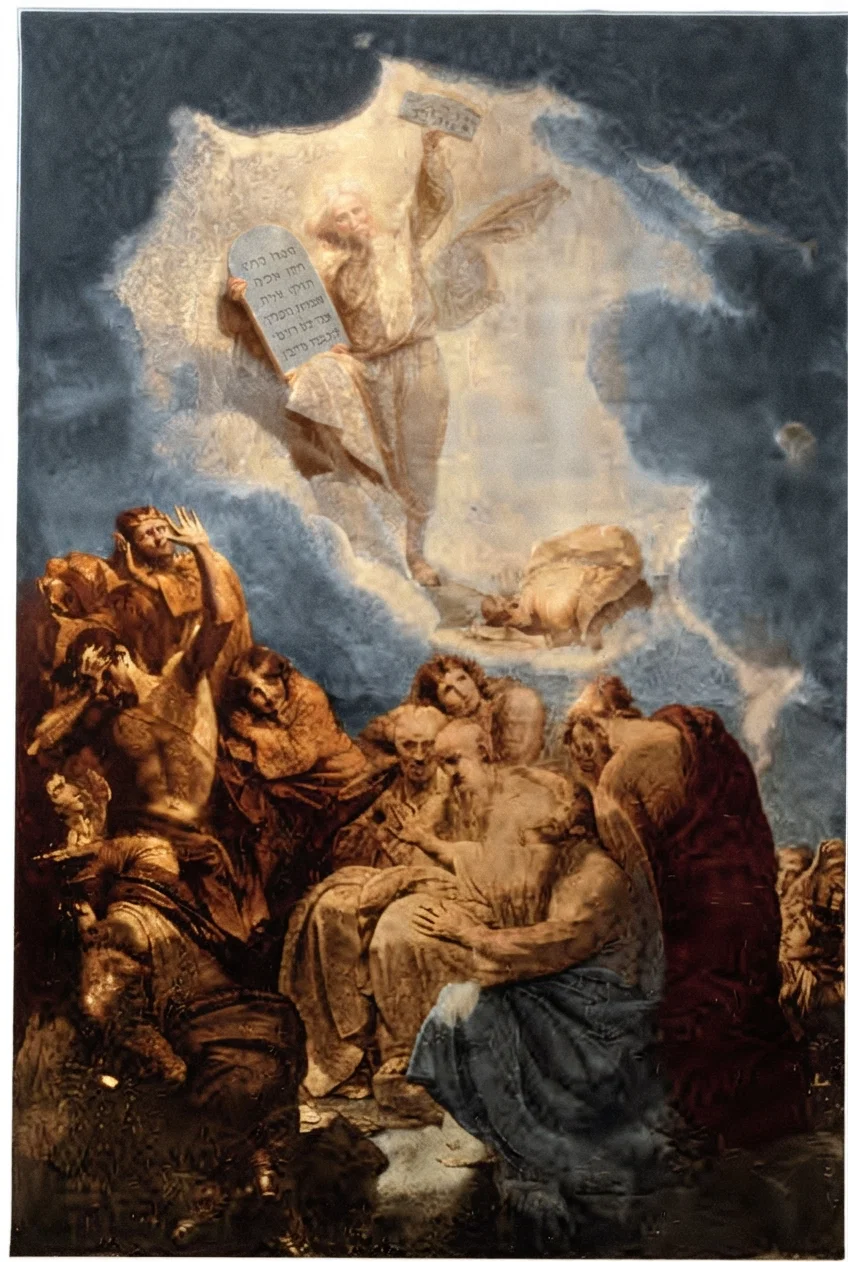
MOSES RECEIVING THE LAW FOR ISRAEL
The third day came; and there were “thunders and lightnings, and a thick cloud upon the mount.” “And Mount Sinai was altogether on a smoke, because the Lord descended upon it in fire; and the smoke thereof ascended as the smoke of a furnace, and the whole mount quaked greatly.” The glory of the Lord was like a devouring fire on the top of the mount in the sight of the assembled multitudes. So terrible were the tokens of Jehovah’s presence that the hosts of Israel shook with fear, and fell upon their faces before the Lord. Even Moses exclaimed, “I exceedingly fear and quake.”

The Voice of God

Then above the warring elements was heard the voice of Jehovah, speaking the ten precepts of His law. The people of Israel were overwhelmed with terror. The awful power of God’s utterances seemed more than their trembling hearts could bear. They entreated Moses: “Speak thou with us, and we will hear: but let not God speak with us, lest we die.” For as God’s great rule of right was presented before them, they realized, as never before, the offensive character of sin, and their own guilt in the sight of a pure and holy God.
Speaking out of the thick darkness that enshrouded Him, as He stood upon the mount surrounded by a retinue of angels, the Lord made known His law. Moses, describing the scene, says: “The Lord came from Sinai, and rose up from Seir unto them; He shined forth from Mount Paran, and He came with ten thousands of saints; from His right hand went a fiery law for them.” Thus were the sacred precepts of the Decalogue spoken amid thunder and flame, and with a wonderful display of the power and majesty of the great Lawgiver. God accompanied the proclamation of His law with these exhibitions of His power and glory, that His people might never forget the scene, and that they might be impressed with profound veneration for the Author of the law, the Creator of the heavens and the earth. He would also show to all men the sacredness, the importance, and the permanence of His law.

Not to Israel Alone

The law of ten precepts was by no means given exclusively to the Hebrews, but God highly honored them by making them the depositaries of His law for future generations. Those who trample upon God’s authority, and show contempt for the law given in such grandeur at Sinai, virtually despise and set at naught the Lawgiver. For that law is Heaven's great standard of right, with which we are to compare our lives and characters. Because the law points out our sins and declares our guilt, we are not to trample it under our feet, nor to turn away when our characters stand revealed in all their moral deformity. But we are called upon to exercise repentance toward God, and faith toward our Lord Jesus Christ. We must be doers of the Word, and not hearers only. The heart, the seat of the affections, must be transformed; the moral nature must be renewed by grace. And it is a precious truth that the only one who can give peace to the weary, sin-sick soul is the Originator of the law the sinner has violated.

Studies on the Sabbath

III. The Sabbath in the Light of the Moral Law

Remember the Sabbath day, to keep it holy. Six days shalt thou labor, and do all thy work: but THE SEVENTH DAY IS THE SABBATH OF THE LORD THY GOD: in it thou shalt not do any work, thou, nor thy son, nor thy daughter, thy man servant, nor thy maid servant, nor thy cattle, nor thy stranger that is within thy gates: for in six days the Lord made heaven and earth, the sea, and all that in them is, and rested the seventh day: wherefore the Lord blessed the Sabbath day, and hallowed it. Ex. 20: 8-11.
THIS is the only divine weekly Sabbath law ever given to man, which is incorporated into the bosom of the moral law, known as the Ten Commandments, which are recognized as the basis of all just laws among the nations of earth.
God has a plan for His amenable created intelligencies; hence the moral law. The Bible reveals the moral law; it does not create it. The moral law is higher than either physical or organic law. The moral law existed prior to the creation of man. The moral law is the constitution of the government of the Almighty. It embraces fundamental rules that lie at the foundation of God's moral government, and enter into the solution of all moral questions. This law is designed to secure happiness to man and all amenable creatures as long as it is strictly obeyed.
The moral law recognizes accountability and responsibility; whereas in the operation of the physical law, there is no such distinction, for an innocent victim thrust into the fire is burned the same as the greatest criminal, unless a higher power intervenes to avert its effect.

Expression of Eternal Principles

The statute of the moral law is but the clothing of righteous principles in human language. It is the expression of the mind of God. The thought of God for the government of His created intelligencies has ever been to secure to all His subjects infinite happiness. The Author of the moral law says, "I alone know the thoughts that I entertain respecting you, saith the Lord, thoughts of peace and not of evil, to give you a happy future and hope." Jer. 29: 11, Jewish translation.
The moral law is the reflection of the character of God, holy, just, good, unchangeable, and as enduring as eternity. Of this law Blackstone says: "The moral law is summarily contained in the Decalogue written by the finger of God on two tables of stone, and delivered to Moses on Mount Sinai. Exodus 20."
Chambers's Encyclopedia says: "The moral law is that perceptive revelation of the divine will which is of perpetual and universal obligation. It is summed up in the Ten Commandments."
John Wesley says: "The moral law, contained in the Ten Commandments and enforced by the prophets, He (Christ) did not take away. It was not the design of His coming to revoke any part of this. This is a law which never can be broken. It stands fast as the faithful witness in heaven." "Every part of this law must remain in force upon all mankind in all ages, as not depending either on time or place, nor on any other circumstances liable to change; but on the nature of God and the nature of man, and their unchangeable relation to each other."—Wesley's Sermons, Vol. 1, Sermon 25.
Luther says: "He who pulls down the law, pulls down at the same time the whole framework of human polity and society. If the law be thrust out of the church, there will be no longer anything recognized as sin in the world, since the Gospel defines and punishes sin only by recurring to the law. I never rejected the law."—"Life of Luther," page 214.

A Distinction in Laws

It is sometimes said that the Ten Commandments, the Golden Rule, and the Lord's prayer, embrace all that is in the Bible. The Ten Commandment law is distinct from the code of laws sometimes called the ceremonial law. James calls it the perfect royal law of liberty. James 1: 25; 2: 8, 12.
It is the law by which the conduct of all men will be measured in the great assize of human affairs when God shall bring every known and secret act into judgment. The wise man summed up its breadth and place in the government of God thus:
Let us hear the conclusion of the whole matter: Fear God, and keep His commandments: for this is the whole duty of man. For God shall bring every work into judgment, with every secret thing, whether it be good, or whether it be evil. Eccl. 12: 13, 14.
The Ten Commandment law, being moral, is, in the nature of things, unchangeable and eternal. It is the moral looking-glass, which reveals, condemns, and convicts of sin. "By the law is the knowledge of sin." Christ has said: "It is easier for heaven and earth to pass, than one tittle of the law to fail." Luke 16: 17.
It was to uphold the government of God, to magnify the moral law, and to set the transgressor into the ways of righteousness, that Christ died for the transgressor. Christ's pledge that the earth should be filled with the glory of God (Num. 14: 21) could only be fulfilled when His death assured, "Forever, O Lord, Thy word is settled in heaven." Ps. 119: 89.

The Law in the Light of the Cross

The greatest testimony in the universe to the honor and unchangeable character of the moral constitution of the throne of God is the scene of Calvary. "Do we then make void the law through faith? God forbid: yea, we establish the law." Rom. 3: 31.
Universal peace and love can not be dethroned by vice and hate forever. The malaria of sin can not rob life of its sweetness without end. The sense of right and virtue will not always be trodden under foot. The whisperings of conscience and the promise of God are the premonition of a great assize, when injustice shall be terminated, and every wrong righted, innocence vindicated, and righteousness exalted. Then the law now transgressed will be obeyed.
Reader, is it possible that through ignorance you have been trampling under foot one of God's commandments? Are you keeping the Sabbath day "according to the commandment"? By this law we are to be judged. May our prayer be that of David, and our change like his: "Open Thou mine eyes, that I may behold wondrous things out of Thy law." "I thought on my ways, and turned my feet unto Thy testimonies. I made haste, and delayed not to keep Thy commandments." Ps. 119: 18, 59, 60. If this is our experience it will be well with our souls.

Trust God in Unexpected Ways

“TRUST God, O child of God; and if He does not send thee help in the way thou art expecting, He will send it in a way thou art not.”

Kneeling in Prayer

Two LITTLE girls were playing they were in church. "Now we are to have prayer," said one. "You kneel down and be a real Christian; I'll just sit down, and put my hand up to my face. I'll be a stylish Christian."
The simple remark of this little girl is quite to the point, and suggests a thought that older people might consider with profit. Kneeling in prayer, either by preacher or layman, is practically a thing of the past in orthodox Protestantism. Catholics get on their knees frequently, and the heathen bow down to wood and stone; but orthodox Christians have about ceased to kneel, it is easier and more stylish to sit.—Selected.

Lessons in Liberty

By W. M. Healey

IV. Two Diverse Kingdoms

WHEN Christ said, "My kingdom is not of this world: if My kingdom were of this world, then would My servants fight" (John 18:36), He was contrasting the two systems of government in the universe. There are but two principles underlying all authority and government. In one the subjects serve from choice, they obey because they love the law that rules them and the King that governs them. There is no coercion, no compulsion. It is the kingdom of God, and in it is perfect liberty. "Where the Spirit of the Lord is, there is liberty." 2 Cor. 3:17. There is love, joy, and peace.
The other kingdom is the kingdom of bondage, of slavery, of compulsion. Its subjects hate their king and his laws; and yet they serve him, because they are his slaves. There is hatred, strife, and war. It is Satan's dominion, which he has built upon the kingdom received from Adam. It is called the "kingdom of this world," because it is confined to this world, and here it will come to its eternal end, when "the kingdoms of this world are become the kingdoms of our Lord, and of His Christ; and He shall reign forever and ever." Rev. 11:15.
Then the Christian's prayer will be answered: "Thy kingdom come, Thy will be done in earth, as it is in heaven."
In that kingdom will be those, and only those, who have served God from choice. In that kingdom "dwelleth righteousness." No one can be made righteous by force. It may be possible to compel one, in some measure, to act as tho he were righteous, but the real character would be very different from appearances.

Powerlessness of Compulsion

If the State could make laws to compel men to go to church, to be baptized, to rest on the Sabbath, etc., and should enforce them so that people would have the appearance of being Christians, it would not make a single Christian; they would be as so many dummies, machine-made, and in no way fitted for the kingdom of God.
In the kingdom of Christ there is no glory for those who have taken the sword to compel obedience and worship. "He that taketh the sword shall perish with the sword." There is no mistaking these words; and it is plain that those who would compel others to worship, by force, by the sword, by the power of civil government, will perish in their own kingdom, and have no part in the kingdom of liberty, where dwell the "lowly in heart." There it will be seen that "blessed are the meek: for they shall inherit the earth."
God made man to be a king, and rule on the earth, and over the earth, first ruling himself in harmony with the principles of the divine government. That he might do this the principles of the kingdom must be first in man, then man in the kingdom. "He that is slow to anger is better than the mighty; and he that ruleth his spirit than he that taketh a city." Prov. 16:32. Many men have taken cities who did not have power to rule their own spirit. To-day men are desiring to make laws and to compel others to worship, who do not possess sufficient power to rule themselves according to the laws of God. Their work is not of God.

Man Not Commissioned to Rule Conscience

God has never commissioned man to compel his fellow man to worship. The teachings of Christ upon this point are very clear; and just before His ascension He gave an emphatic lesson upon it. He was telling Peter what his work would be, and Peter, seeing John, asked Jesus what he was to do, and received a strong rebuke from his Lord. "Peter seeing him saith to Jesus, Lord, and what shall this man do? Jesus saith unto him, If I will that he tarry till I come, what is that to thee? follow thou Me." John 21:21, 22.
Christ has not changed His nature or the nature of His kingdom since He uttered those words to Peter. It is claimed by the church of Rome that Peter was the first pope, and to him was given authority to rule the church; but Christ refused to give him authority over one man, to say nothing of giving it to him over the whole church. Not only did Jesus refuse to give Peter authority over a single disciple, but He even refused to tell him what He Himself required of another. Why then will professors of Christianity not only ask about the duty of others, but themselves define what that duty is, and demand that it be performed under penalties? The asking for laws to compel men to rest on Sunday, is first defining another's duty to God, and then usurping authority over him to compel him to do that which they have created for him. "Who art thou that judgest another man's servant? to his own master he standeth or falleth." Rom. 14:4.

Calvary and Eternity

By Mabel Craker
O CALVARY! Sweet Calvary! My heart responds at thought of thee! Tho weird the scene when midday's sun Refused the place to shine upon, And darkness blacker than at night So speedily usurped its right, 'Tis there, in fancy, I can see My Saviour dear on Calvary, O Calvary, dark Calvary!
No eye could pierce the settled gloom Ere He had graced one Joseph's tomb, Save when fierce lightnings, circling Him, His form revealed,— His eyes grew dim,— Yes, Death, grim monster, claimed his prey, And our dear Saviour died that day On Calvary, dread Calvary.
So, proud to low'r the Sinless One, And bind the Father's lovely Son, Death reigned supreme.— O, black despair, Had our dear Lord remained there. Filled now would be the earth with gloom; Yes, sealed for aye the sinner's doom, And none could hope for victory Beyond the hills of Calvary, O sad and awful Calvary!
God's heart of love could not forget The One His favor true had met — And angels from the throne on high Sped swiftly through ethereal sky. All nature sympathized, indeed; Earth shook with their increasing speed, As on they came with conq'ring tread, Gladly to wake their sleeping dead Who gave His life on Calvary.
As calmly wakes the slumb'ring child, Obedience gives sweet sleep a while. So rose our Lord, triumphantly, When called of Heaven ever to be Victor with God eternally.
Praise ye His name, exalted ones! Sinners, rejoice! Hold not your tongues! For all from sin may cleansed be, With blood that flowed at Calvary, To all who trust, blest Calvary!
Linked by His death are earth and heav'n, Saved by His life so freely giv'n Through ages of eternity. Can man ere cease to sing of thee, O Calvary, sweet Calvary!
Turk, Washington.

Cleansing the Leper

And there came a leper to Him, beseeching Him, and kneeling down to Him, and saying unto Him, If Thou wilt, Thou canst make me clean. And Jesus, moved with compassion, put forth His hand, and touched him, and saith unto him, I will; be thou clean. And as soon as He had spoken, immediately the leprosy departed from him, and he was cleansed. Mark 1:40-42.
It was a horrible case. Luke says that he was "full of leprosy." Yet no case, however bad, was too bad to be healed by Him. The sufferer himself believed this. Bad as his case was, and utterly incurable as it was thought, he yet believed that Jesus could make him clean. "Lord, if Thou wilt, Thou canst make me clean."
The man does not actually ask Jesus to cleanse him. He only declares his belief in His power to do so. Incurable as he knew himself to be by any one else, he yet says, "If Thou wilt, Thou canst make me clean." He believed that Jesus could do for him what no one else could. Yet there is an "if." His faith was less strong about the will than about the power. He had no doubt that Jesus could cure him; but would He? or would He shun him and avoid him as did others?
There was his doubt. "If Thou wilt, Thou canst." And the Compassionate One touched him and healed him.
We, too, want cleansing. Till cleansed by the Lord Jesus, we are all lepers spiritually, "full of leprosy," the leprosy of guilt and sin.
He can cleanse us by His precious blood. We are incurable by any other means; but He can make us perfectly whole. There is no "if" in the matter.
Our gracious Lord and Saviour invites all sinners to come to Him. He can forgive them, and He will. O, who will lose all, for want of asking? Taught by the leper, and by what the Lord did for him, let each draw near and beseech the same gracious Lord; with no "if," but in humble contrition and faith. He can, and He will, make us clean.
ARTHUR V. FOX.
Continue reading: XII. Visions of God