Signs of the Times, Vol. 41, No. 23.

A Disastrous Wreck and a Dream

Signs of the Times

Jun 16, 1914

Pacific Press Publishing Association · Mountain View, California · Jun 16, 1914

A Disastrous Wreck and a Dream

A Ridiculous Classification — Quite as Absurd as the Evolutionists' Theories of the Flood

GEORGE McCREADY PRICE
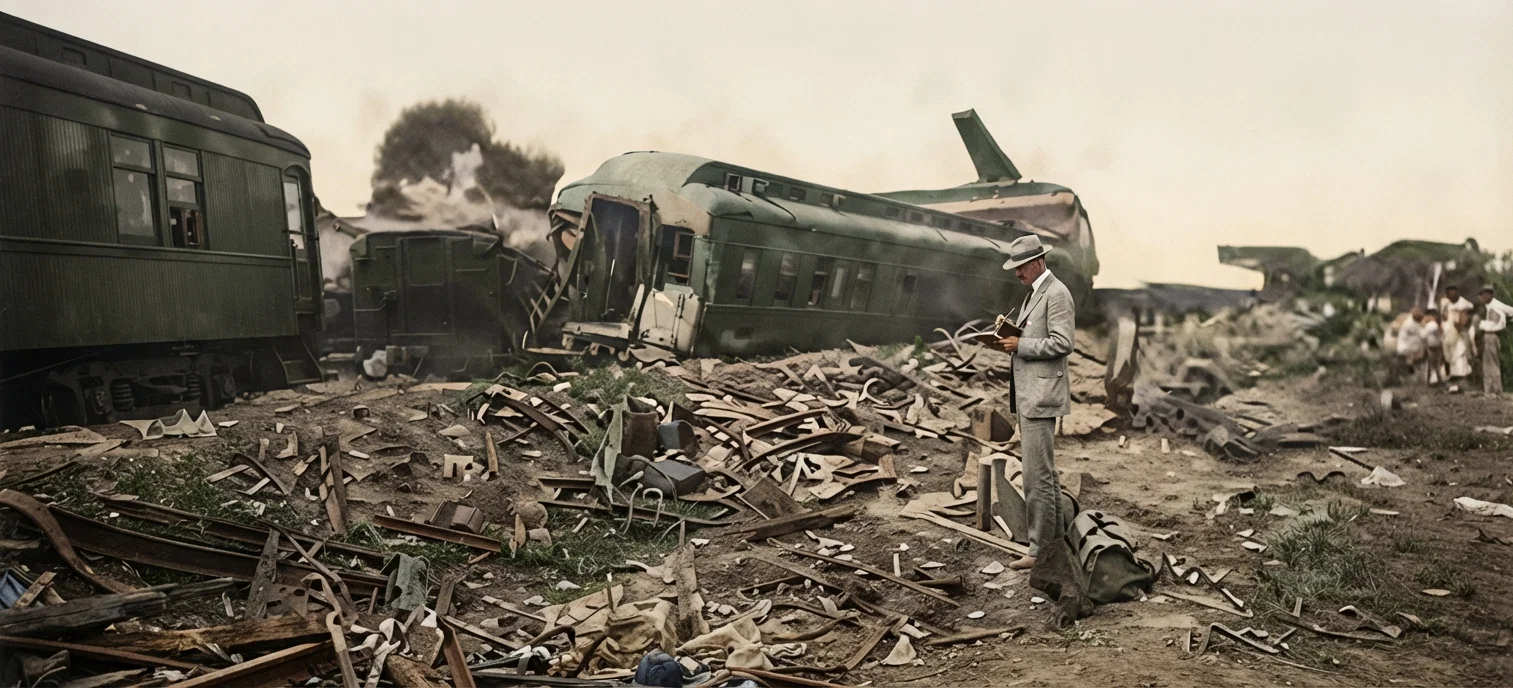
WHEN we heard of the horrible railway wreck at —, only five miles down the line, all our pupils were eager to see it.
Most of us teachers decided that we would have to stay home and keep things level at the school; but in small parties of six to ten the pupils were going and returning all that afternoon and evening.
As usual, I had been reading geological literature quite closely during the day, and this may have had something to do with my rambling thoughts while sleeping. At any rate, that night I had a strange dream, which, however, seemed to illustrate the peculiar methods employed by the popular geologists in classifying the fossils into the various ages.

THE CURIOUS DREAM

I dreamed that I visited the scene of the railway disaster, and saw the improvised morgue, composed of a large tent hastily erected by the railway people, where nearly half a hundred marred and mangled bodies were arranged side by side for ease in inspection and identification. They were all numbered, and so far as possible the names were attached.
While we were standing there in melancholy silence, thinking of the sad uncertainty of human life and human plans, we were startled by the noisy entrance of three men. One tall, scholarly looking fellow with a very professional air carried a note-book and a pencil, and gave jerky, peremptory orders to the other two, who seemed to be merely his subordinates, and did without question what they were told.
'Now, it is very important for us to do this just right,' he was saying, in his rapid, excited manner; 'for on the results of our work will be based the awards for compensation to be paid to the surviving relatives of the deceased.'
He walked up and down the line of dead bodies two or three times, looking here and there with his sagacious, piercing eyes.

CLASSIFICATION MUST NULLIFY THE WRECK

'Humph! What a senseless method of classification!' he muttered. 'This doesn't show anything at all about the order in which these people died; for it would almost seem, from the way these bodies are placed, that they were all killed at once. We'll have to bring them all over here on this side and arrange them properly.
'This Italian seems to be the smallest; and I see, by the record, that he is right from Italy, and has no friends or relatives in this country. We'll put him here and call him No. 1. This girl, also, has no relatives, and we don't even know her name. She will be No. 2.
'All these Italians will go in a group by themselves; for they have few relatives or friends in this country, and doubtless they were the first to die — or the first to be killed, as some would say.
'Then these Armenians ought to come next; for I see, by the record, that each one has two or more relatives in this country. But they are almost as poorly dressed as the Italians, and we will number them 11 to 20 inclusive. Just five pairs, even, and all men! Very significant — very!

HARD TO PASS UPON

'But these Scandinavians are harder to classify. They are all larger and better dressed than the Italians and the Armenians, and they have lots of relatives in this country, who will insist on heavy damages. I really suppose we ought to arrange them in three subgroups, according to whether they came from Sweden, Norway, or Denmark; but we will let that go for the present. You can number them from 21 to 32.
'But now we come to the hard part. These native Americans have hosts of relatives, and they are all well dressed in modern clothes. There are twenty-three of them all together. We'll simply have to arrange them on the percentage plan as best we can.'

HE GOES OVER HIS WORK CAREFULLY

After this general classification had been adopted, the learned doctor spent a considerable time in going over each group again and examining minutely the record of each individual. Often he would find occasion to change the order of two or three bodies in the group of Armenians or Scandinavians, as the case might be; for he insisted on getting them arranged so as to show the proportion of surviving relatives each had left behind in this country. But as the matter of size and complexion, of quality and style of clothing, was also to be considered, it often became a very perplexing matter as to just how certain individuals ought to be placed.

HIS SATISFIED AIR AND ABSURD CONCLUSIONS
Finally it was all done, and he looked them over once more with a satisfied, pompous air.
'Well, there! I fancy the work is all done as well as any one can do it.
'These Italians were certainly the first to die. Their bodies are all weak and badly nourished, and there is every evidence that they died of slow starvation — progressive anemia. Doubtless they were all dead before they got here — they had been gradually dying all the way from New York. Nobody ever heard of so many people dying of anemia all at once, so they at least were not affected by the little accident that occurred here to this railway train.
'But these Armenians are very different. They are all quite full-blooded, and so did not die of anemia. But Armenians are notoriously pugnacious and quarrelsome. And two or three of them still have guns or knives or other weapons on their persons. Doubtless they all carried such things to begin with, but in many cases these have been lost, so that we can't find them. Thus we see that the many wounds they all have were mutually inflicted. But it is unreasonable to suppose that they all fought together and killed one another in a pitched battle all at once. Universal experience is against such a supposition. No; the quarrel doubtless started soon after they left New York, andinvolved a few of the most aggressive. After these had killed one another, others took part, until finally there were left but two, and these, like the famous Kilkenny cats, were at last mutually destructive.

THE ACCIDENT NOT RESPONSIBLE

"Thus this little railway accident was in no way the cause of their deaths, and the company can not be held in any way responsible for damages in these instances either.
"These Scandinavians are somewhat different. They are probably all suicides. For papers have been found on several of them indicating that they thought they were being brought out here against their will; and being resolute, desperate characters, they had resolved never to reach California alive.
"But these native Americans are more perplexing. Numbers of them lived at places only a short distance back on the road, some of them in Arizona and New Mexico, and some here in California.
"But several of them are badly burned or scalded. These were quite obviously violating the rules by riding in the cab with the fireman, and the engineer, and had only themselves to blame for their injuries. Ten others all have their heads badly crushed, which shows that they had carelessly exposed themselves in going through the various tunnels or in crossing the numerous bridges along the road.
"Only eight individuals are left, and they are all badly crushed and mangled. It is not quite clear how they met their death; but one of their number may have been carrying a quantity of dynamite or other high explosive concealed about his person or in a suit case, and the jar of the car set it off with disastrous results. At all events, even if it should turn out that some of this group were injured by the train itself, it does not follow that the railway wreck was the direct cause of their death. You know that the engine and the cars all ran into a big sand heap; and it is absolutely certain that the soft sand could not damage—"

AS RIDICULOUS AS EVOLUTION

The alarm-clock woke me up and cut short this ingenious lecture, so that I never knew whether the old doctor intended to explain away all the deaths as due to natural causes, or whether he intended to admit that possibly one or two had been killed by something that happened to the railway train.
But all that day I could not help thinking of the analogy between this old doctor's reasoning and the methods employed by evolutionists to explain away the plain marks of a great world catastrophe that are to be found in the rocks of every country on the globe, and which show that we have had a universal flood.
"For this they wilfully forget, that . . . the world that then was, being overflowed with water, perished." 2 Peter 3:5, 6.

Two Words

Unkind

I ROAM at large, as I have great dominion. I oft invade the palace and rude cot. The stalwart man bows low as I approach him. The form of a Napoleon fear I not. At one sharp blow, strong friendships can I sever. More deadly my attack than adder's sting, More fatal than the death-tipped arrows dealing Their basest cruelty on fleeting wing. The wife's faint sobs to me are sweetest music. I cause brave husbands pain and deep despair. The prattling child cow'rs low when in my presence, And those of many winters roughly fare. The man who keeps me chained within his bosom Excels the one before whom monarchs fall; And he who rules me with a rod of iron, No enemy doth fear, but conquers all. But when on ether waves I have my freedom, No force my fiendish tirade can retard. 'Tis then I seek my prey like beasts long fettered When clanking shackles break as flax well charred. And when at last my spectral mem'ry lingers, It haunts the chaos that I left behind. How strange that I can make such lasting havoc! I'm but a little thing — a word unkind.

Kind

Long, long ago, 'mid peaceful scenes celestial, Where dwell the holy, there I had my birth. And when this world was young, Christ's work completed, He sent me here, His sweetest gift to earth. My cheering voice lends courage to the infant Whose wav'ring step the new-found path begins. And when, perchance, his sun has reached its zenith, My tender care his onward progress tends. And should the shadow show nocturnal settlings, And angry breakers prove the coming storm, 'Tis then my quiet presence sheds a blessing As sweet as angel's breath on dewy morn. And he who sends me forth upon my mission, A gift more precious than rare gems bestows. A fragrance round my sacred mem'ry lingers, Surpassing far the attar of the rose. I seem so small to bring such lasting blessings! I'm but a word — a word in kindness bound; Yet those who learn to speak in heaven's language, Must first with lisping tongues my accents sound. MABEL CORINNE CRAKER.

The Purpose Is to Remove Sin

He Asks Us to Know Him Really — He

Assumes Our Frailties and

Imparts His Strength

C. P. BOLLMAN
THE name "Jesus" was divinely given to our Lord before His birth, for the reason that He would "save His people from their sins." Matt. 1:21.
To save "from sin" certainly does not mean to save in sin. "Ye know," says the apostle John, "that He was manifested to take away our sins; and in Him is no sin." 1 John 3:5. That this means not merely escape from punishment for sin, but separation from sin itself, freedom from the reigning power of sin, is made clear by the next verse: "Whosoever abideth in Him sinneth not."

"THAT YE SIN NOT"

There can be no doubt concerning the meaning of these words. The language used admits of no interpretation. It teaches the actual and absolute putting away of sin — that is, the putting of it out of the heart and out of the life. "My little children," says the apostle, in 1 John 2:1, "these things write I unto you, that ye sin not." That was the goal to which he would point every believer. He would have every man who names the name of Christ know that such an experience is possible of attainment. Yet he would discourage no one, for he adds: "If any man sin, we have an advocate with the Father, Jesus Christ the righteous: and He is the propitiation for our sins: and not for ours only, but also for the sins of the whole world."
But while the apostle would have none sink under discouragement, even though overtaken by sin, he would give no encouragement to sin; therefore he adds: "And hereby we do know that we know Him, if we keep His commandments. He that saith, I know Him, and keepeth not His commandments, is a liar, and the truth is not in him. But whoso keepeth His word, in him verily is the love of God perfected: hereby know we that are in Him." Verses 3-5.

ASKS US TO KNOW HIM

To have merely a theoretical faith in Christ is to be in possession of only the shell of Christianity. We must not only know about Jesus, but we must know Him. "And this is life eternal, that they might know Thee the only true God, and Jesus Christ, whom Thou hast sent." John 17:3.
It is well to believe the Bible as history, to know the story of the Gospels as we know the history of our own families; but we may know all this and yet miss the life-giving power in the divine Word. Jesus Christ wants us to enter with Him into the inner circle; to know Him as the disciples knew Him after the day of Pentecost. He wants us to become one with Him by being born into the same family, so that we shall be joint heirs with Him of all that the Father has given Him as the second Adam. He invites us to the experience described by the apostle in these words: "I am crucified with Christ: nevertheless I live; yet not I, but Christ liveth in me: and the life which I now live in the flesh I live by the faith of the Son of God, who loved me, and gave Himself for me." Gal. 2:20.

WISHES TO BE OUR GUEST

This description of Christian experience is from the standpoint of the human subject. Rev. 3:20, 21 gives us the divine side. "Behold," says our Saviour, "I stand at the door, and knock: if any man hear My voice, and open the door, I will come in to him, and will sup with him, and he with Me. To him that overcometh will I grant to sit with Me in My throne, even as I also overcame, and am set down with My Father in His throne."
He sups with us by partaking of our frailties, bearing our griefs, carrying our sorrows, being touched with the feeling of our infirmities. He gives us to sup with Him by bringing to us His own perfections, which He not only imputes to us in answer to our faith, but which, by the incomprehensible alchemy of grace, He actually instills into our lives. How this work is wrought we can not know. No Bible writer has sought to explain it further than to tell us that it is by the transforming power of the divine Word. "Grace and peace be multiplied unto you," writes the apostle, "through the knowledge of God, and of Jesus our Lord, according as His divine power hath given unto usall things that pertain unto life and godliness, through the knowledge of Him that hath called us to glory and virtue: whereby are given unto us exceeding great and precious promises: that by these ye might be partakers of the divine nature, having escaped the corruption that is in the world through lust." 2 Peter 1:2-4.

MAY HAVE RICH EXPERIENCE

It is a sad fact that very many Christians are satisfied with a poor, weak experience, when they might have an experience rich in everything that goes to beautify Christian character, to give power to missionary endeavor, and to honor the Master by giving Him opportunity to manifest His power to overcome sin in human flesh now, as He overcame sin in human flesh when He Himself was bodily upon earth.
The fifty-ninth chapter of Isaiah gives the only possible reason for suffering defeat in that wherein the Lord would have us gain victory: "Behold, the Lord's hand is not shortened, that it can not save; neither His ear heavy, that it can not hear: but your iniquities have separated between you and your God, and your sins have hid His face from you, that He will not hear." Verses 1, 2.
But the Lord wants to give forgiveness and victory; and to His people now He says, as He said to His people anciently, "If ye be willing and obedient, ye shall eat the good of the land."

Ending Church Strife

WHERE no fuel is, the fire goes out. Church strife will thus cease when every member learns to attend to his own spiritual business by putting in faithful work behind closed closet doors, cutting up the weeds in the garden of his own heart. T. E. B.

The King's Dream Interpreted

The Events of History Fulfil the Prophecy — Four World-Wide Kingdoms, Then a Division — No More World Empire till the Close of Time

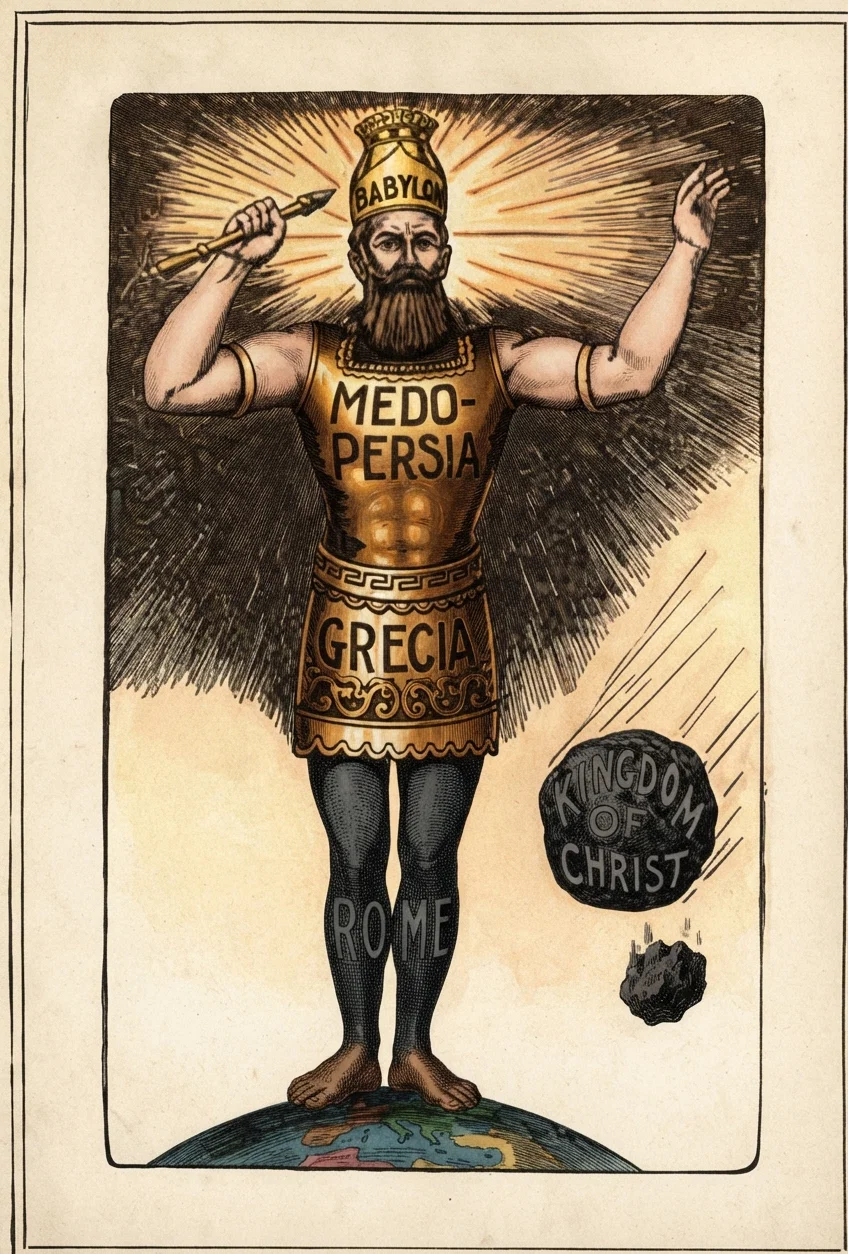
HISTORY in hand, we find that the vision has been fulfilled with absolute accuracy from the days of Daniel down to our own.

BABYLONIAN HEAD OF GOLD

The Babylonians, 625-538 B. C., were well symbolized by the head of gold. Their capital — as described by Rollin, Lenormant, and Sayce, following Herodotus, and the cuneiform inscriptions discovered within the last fifty years — was a city of marvelous size and wealth. Its walls three hundred fifty feet high, eighty-seven feet wide, and sixty miles in circumference, made it impregnable. Its hanging gardens; its palaces, several miles around; its fifty streets, fifteen miles long, crossing each other at right angles; the temple of Bel, containing sacred vessels and statues in gold to the amount of over one hundred million dollars, — all this justified the words of prophecy, "Thou art this head of gold." The empire of Babylon lasted eighty-seven years.

THE PERSIAN BUST OF SILVER

In 538 B. C., after a long and memorable siege, Babylon was conquered by Cyrus, general-in-chief of the Medo-Persian armies, and the world passed into the hands of the kingdom of silver. The splendor of the Medo-Persian empire, compared with the Babylonian, was to be what silver is to gold. Next to the power of Nebuchadnezzar comes the glory of Darius, Xerxes, and Artaxerxes, the Medo-Persian kings. Next to the glory of the city of Babylon comes that of Shushan and Persepolis, Persian palaces that were marvels of wealth. The royal vestures of Xerxes and his son, according to Plutarch, were worth respectively twelve thousand and ten thousand talents, which represents thirty and twenty-five million dollars. This Persian power lasted two hundred seven years.

THE BRASS OF THE IMAGE AND THE EMPIRE OF GREECE

In 331 B. C. the world again changed masters, and passed under the scepter of a Greek conqueror, Alexander the Great. The brass empire had come. Less ductile and malleable than gold or silver, but with a quick passing brilliancy, this metal fittingly represents the third great monarchy. It was reared in eight years of the swiftest triumphant march ever recorded in history, and at the end of it the founder suddenly disappeared. But it continued 183 years without glory, until 148 B. C., passing through continuous wars between the Seleucidae, or Syrian kings, and the Ptolemies, or Egyptian kings, the two remaining divisions of the empire.

LEGS OF THE IMAGE — THE IRON MONARCHY OF ROME

One century and a half before Christ, still again the world changed masters, and passed under the iron rule of Rome. This symbol indicated that the fourth empire was to outdo the first three in political despotism, brutal force, and devastating instincts. "The fourth kingdom," says the prophecy, "shall be strong as iron, forasmuch as iron breaketh in pieces and subdueth all things, . . . shall it break in pieces and crush." Verse 40.
Such was the power established by Marius, Sulla, and Caesar. The terror of the Roman name has become proverbial. Listen to this prayer: "O God, I thank Thee that I was not born a Roman, so as to be still human." Not only did the Romans conquer and plunder the world, but their heavy, crushing, iron yoke rested for six long centuries upon the nations of the world.

THE IRON KINGDOM BROKEN

Then, weakened by corruption bred of wealth and leisure, the empire tottered and fell. Several barbarian nations, which had for some time been incorporated into the armies of the empire, conquered it, and have since formed the large and the small powers of Europe.
Here is the list of the ten nations that divided the Western Roman Empire among themselves between the years 300 and 476 A. D.: 1. the Alemanni, who settled in South Germany; 2. the Franks, in northern and central Gaul; 3. the Burgundians, on both sides of the Jura; 4. the Suevi, in Galicia and Portugal; 5. the Vandals, in Andalusia (Vandalicia); 7. the Saxons, in Great Britain; 8. the Ostrogoths, between the Danube, the Po, and the Adriatic; 9. the Lombards, in Lombardy; and 10. the Heruli, in southern and central Italy.
This new phase of universal history is introduced by the prophecy as follows: "And whereas thou sawest the feet and toes, part of potters' clay, and part of iron, it shall be a divided kingdom." Verse 41. The parts composing this division were to be marked by two characteristics.

"PARTLY STRONG AND PARTLY BROKEN"

First characteristic: "There shall be in it of the strength of the iron, forasmuch as thou sawest the iron mixed with miry clay. And as the toes of the feet were part of iron, and part of clay, so the kingdom shall be partly strong, and partly broken." Verse 42.
Indeed the nations that took the place of the Roman Empire have always been divided into two classes, the large and the small powers. Among the large powers must be ranked France under Charlemagne, Francis I, Louis XIV, and Napoleon; Germany under Frederick Barbarossa in the twelfth century, and the Hohenstaufen in the nineteenth and the twentieth; Austria under the Hapsburg; Spain under Charles V; England under the Tudors; Italy since King Victor Emmanuel I. Among the small powers can be mentioned the Swiss cantons, the kingdoms of Bavaria, Portugal, Holland, Wurtemberg, Saxony, and Belgium.

THEY SHALL NEVER BE UNITED AGAIN

Second characteristic: "And whereas thou sawest the iron mixed with miry clay, they shall mingle themselves with the seed of men; but they shall not cleave one to another, even as iron doth not mingle with clay." Verse 43.
It is an undeniable fact that all the political history of the Middle Ages and of modern times is overshadowed by one persistent idea on the part of the leading rulers; that is, the reconstitution of the Roman Empire or of some kind of universal empire. The custom of intermarriage among the various reigning families is one leading feature in this policy. Charlemagne was crowned "emperor of the Romans" at Rome in the year 800. The German emperors still call their power "the Holy Roman Empire of Germany." The title of "Roman emperor" was taken by Napoleon from the Austrian court, and he called his son "king of Rome."

INTERMARRIED AND COMMINGLED

It can be safely said that all the courts of Europe are intermarried with each other, and thus "mixed with the seed of men"; but notwithstanding that, they are hopelessly divided by rivalries, jealousies, and bitter enmities, of which the present-day armaments are a sufficient evidence. "But they shall not cleave one to another, even as iron doth not mingle with clay." So says the prophetic text.

The King's Question

"The king answered and said to Daniel, whose name was Belteshazzar, Art thou able to make known unto me the dream which I have seen, and the interpretation thereof?"

Daniel Replies Without Hesitation

"Daniel answered before the king, and said, The secret which the king hath demanded can neither wise men, enchanters, magicians, nor soothsayers, show unto the king; but there is a God in heaven that revealeth secrets, and He hath made known to the king Nebuchadnezzar what shall be in the latter days."

Tells the King His Thoughts

"Thy dream, and the visions of thy head upon thy bed, are these: As for thee, O king, thy thoughts came into thy mind upon thy bed, what should come to pass hereafter; and He that revealeth secrets hath made known to thee what shall come to pass. But as for me, this secret is not revealed to me for any wisdom that I have more than any living, but to the intent that the interpretation may be made known to the king, and that thou mayest know the thoughts of thy heart."

The Prophetic Image of the King's Dream

"Thou, O king, sawest, and, behold, a great image. This image, which was mighty, and whose brightness was excellent, stood before thee; and the aspect thereof was terrible. As for this image, its head was of fine gold, its breast and its arms of silver, its belly and its thighs of brass, its legs of iron, its feet part of iron, and part of clay. Thou sawest till that a stone was cut out without hands, which smote the image upon its feet that were of iron and clay, and brake them in pieces. Then was the iron, the clay, the brass, the silver, and the gold, broken in pieces together, and became like the chaff of the summer threshing-floors; and the wind carried them away, so that no place was found for them; and the stone that smote the image became a great mountain, and filled the whole earth."

The Interpretation a Succession of Kingdoms

"This is the dream; and we will tell the interpretation thereof before the king. Thou, O king, art king of kings, unto whom the God of heaven hath given the kingdom, the power, and the strength, and the glory; and wheresoever the children of men dwell, the beasts of the field and the birds of the heavens hath He given into thy hand, and hath made thee to rule over them all: thou art the head of gold. And after thee shall arise another kingdom inferior to thee; and another third kingdom of brass, which shall bear rule over all the earth."

The Fourth Kingdom Permanently Broken

"And the fourth kingdom shall be strong as iron, forasmuch as iron breaketh in pieces and subdueth all things; and as iron that crusheth all these, shall it break in pieces and crush. And whereas thou sawest the feet and toes, part of potters' clay, and part of iron, it shall be a divided kingdom; but there shall be in it of the strength of the iron, forasmuch as thou sawest the iron mixed with miry clay. And as the toes of the feet were part of iron, and part of clay, so the kingdom shall be partly strong, and partly broken. And whereas thou sawest the iron mixed with miry clay, they shall mingle themselves with the seed of men; but they shall not cleave one to another, even as iron doth not mingle with clay."

The Eternal Kingdom Succeeds All

"And in the days of those kings shall the God of heaven set up a kingdom which shall never be destroyed, nor shall the sovereignty thereof be left to another people; but it shall break in pieces and consume all these kingdoms, and it shall stand forever. Forasmuch as thou sawest that a stone was cut out of the mountain without hands, and that it brake in pieces the iron, the brass, the clay, the silver, and the gold; the great God hath made known to the king what shall come to pass hereafter: and the dream is certain, and the interpretation thereof sure."

A World-Wide Reform

It Encircled the Earth in Mighty Power—The Bible Sabbath, a Central Theme—A Striking Providence in It
GEORGE I. BUTLER
THERE was a time when, for at least fifteen centuries, there was no weekly Sabbath observed in this world but the seventh day of the week. That period commenced at the giving of the law on Mount Sinai, and reached to the crucifixion of Christ. All intelligent Christians admit this.
The writer has no doubt that the same condition existed from the creation to the Exodus, and for more than one century after Christ. Some might dispute this last statement, but none will dispute the first. There is no possible escape from the fact that for fifteen centuries, as stated, the seventh day was the only Sabbath in existence.

A CHANGE HAD COME

Another fact all must admit, is that somewhere between Christ's ascension and A. D. 1000 a change had occurred, and the great mass of professed Christians observed the first day of the week as the sabbath of the Christian dispensation.
Of course there were some exceptions to the general practise. The Jews everywhere observed the day their forefathers had always observed. And very plain evidences exist showing that a comparatively few Christians still kept the seventh-day Sabbath. But we are speaking of the general observance of the first day of the week by the great mass of professed Christians.
This brief article is not designed to enter into any argument for the observance of the seventh or the first day of the week, but merely to call attention to some facts of general interest in regard to the modern movement concerning the restoration of the original Sabbath. Since the first thousand years of the Christian dispensation, but little public stir has taken place relative to the observance of the original Sabbath, until the latter portion of the nineteenth century.
To be sure, the Seventh-day Baptists existed for centuries in the past. Many of them were earnest Christians, and should be highly respected for their faithfulness in holding to the original Sabbath of the Lord. Some noble men among them gave their lives as martyrs because of their faithful observance of the fourth precept of Jehovah's law. For one, this writer holds the deepest respect for those faithful souls who, amid the ignorance upon the claims of the fourth commandment, yet with the knowledge they had, thought their lives not too precious to give to show their faith in God's eternal truth.
But the Seventh-day Baptists did not accomplish very much in moving people to observe the Sabbath of the Lord. They had a hard time to hold their own. Yet they were intelligent and educated, a people who had much light upon the Scriptures. But evidently God's time had not come when the world should be moved to see the claims of the law of Jehovah upon men's consciences. That people failed to exalt the great Sabbath truth as it should be exalted.
God evidently permitted this important truth to remain largely unnoticed until the second advent of Christ should be proclaimed with power. This message was to be a great reform movement—a completion of the great reformation commenced by Luther and the other reformers, but which was only a reformation in part. Other great truths, of which the Sabbath is a prominent one, must be brought out with power just previous to the second coming of our Saviour-King. When He ascended, He left a church with all the great truths He had proclaimed in their purity. When He returns to take His people home and close up human probation, He will find a people keeping all "the commandments of God and the faith of Jesus."

A WORLD-EMBRACING MESSAGE

The third angel's message of Rev. 14: 6-12, embodying one great message with three prominent features, is the last great movement in the gospel plan. It embraces all the truths of the Old Testament and the New applicable to this time. This message is going to every nation, tongue, and people on this globe. It is going with a loud cry. It will be a testing movement preparatory to the close of human probation. Its development is under full headway. It is being proclaimed in over ninety different languages to all the great nations of our globe. All must hear it.
The Sabbath of the Lord is a prominent part of the message that is now being so powerfully promulgated to the ends of the earth. It is the grand creation Sabbath, the Sabbath of Adam, of Noah, of Abraham, Isaac, and Jacob, of Moses and all Israel, of Daniel and every prophet of the Bible, of Christ and all His apostles, and of all Christians until the church began to pass under the cloud of apostasy.

RISES FROM BENEATH ENEMIES' FEET

What a wonderful fact this is! The Sabbath seemed to lie dormant, practically unnoticed, trampled upon. Priests and kings, pagan, Catholic, and Protestant alike, apparently obliterated its glories. But in the fulness of time, when the Saviour's speedy return is proclaimed to all the earth, this downtrodden truth is exalted to its original position. And before every community, in cities great and small, in hamlets and country neighborhoods—yea, to earth's remotestbounds—it is held forth with its original luster, stirring to their depths the hearts of the obedient, and arousing the sleepy church-members. Waking up to the fact that they are breaking God's commandments, they hear in thunder tones, "Take your feet off the holy Sabbath of the Lord."
Dear reader, can you not see the hand of God in all this? Is not this a wonderful sign of the times? Let us be prepared for the coming of the King by helping to make up the breach in the law of God.

"Living Epistles"

THE success of Christ's work in the earth rests with His individual followers. To the extent that we live in close personal touch with the Master from day to day, allowing Him to possess and control our lives, will we be able to convince those about us of the reality of Christianity.
Our lives are the only Bible that the majority of persons read. Many do not attend church, and therefore can not be reached through that agency; nor will they converse upon religious themes; nor can they be induced to read religious literature; but they will read our lives. Christianity will be to those with whom I associate just what I in my life represent it to be. It is impossible for persons to disbelieve in God so long as they are in the presence of godly men and women.
How does the world read the Bible in your life? "What is the gospel according to you?" F. D. E. S.

Mistakes and Folly

"Any man may make a mistake, but none but a fool will continue in it."

Heart Searchings

We read that when Deborah was judge in Israel, and the army was about to go to battle, at the watercourses of Reuben there were great searchings of heart. The Israelites remembered their past lives of disobedience to God's commands, and realized that their vows had been broken. They saw clearly that if they had obeyed the Lord, they would have been kept from many tribulations. They made vows and resolutions for the future, and were blessed of God.
In crises and extremities, we call upon God, and vow that if He will give us the desire of our hearts, we will henceforth be His faithful followers; but too often those vows are forgotten when the thing desired is attained. Memory, which has been called "God's phonograph," speaks back to us the history of our lives, and God's Spirit comes into our hearts, that we may examine our ways.
It is easy to excuse and cover up sin. But when we consider that the transgression of one man, hidden though it was, prevented the blessing of the Lord from descending upon a whole people, as in the case of Achan, it stands us in hand individually to be right with God; for if we do not "clear the King's highway," all obstacles will be removed by an overwhelming scourge from the Almighty.
"Search Thou my heart, O God, Let me see all my sin, And then will I confess The hidden thought within. "O, let Thy Spirit come, With all its old-time power. Accept and bless and save This very day and hour." Eliza H. Morton.
Continue reading: Capernaum Was Deeply Moved