Your ShelfYour Projects

Signs of the Times, Vol. 39, No. 9.

THE BENEDICTION

Signs of the Times

Feb 27, 1912

Pacific Press Publishing Association · Mountain View, California · Feb 27, 1912

THE BENEDICTION
"For Thine is the kingdom, and the power, and the glory, forever. Amen."
By Llewellyn A. Morrison
The prayer of the Master is over and ended; The passion is quelled and the bondage is done; My soul in the mood of Jehovah is blended; My Father and I, by the Son, are at one.
I worship before Him! I praise and adore Him! All blessing and fulness unto Him belong; “For Thine is the kingdom, The power, and the glory;” I sing the glad story in rapturous song.
The peace and the freedom for all men abiding, The presence, divine, in the human is found; Our hearts in the holy of holies still hiding, The strength and the patience for all things abound.
We worship before Him! We praise and adore Him! All prudence and wisdom unto Him belong; “For Thine is the kingdom, The power, and the glory;” We sing it forever in triumphant song.
The prayer of the Leader is ever ascending; The lips of the frailest but lisp its refrain; The calm and the quiet come earthward unending; The help and the healing for mortals remain.
We worship before Thee! We praise and adore Thee! All honor and greatness unto Thee belong; “For Thine is the kingdom, The power, and the glory;” The love is the story—salvation the song.
San Francisco, California.

"IF YE WILL INQUIRE, INQUIRE YE."

This Inquirers' Department is conducted for the purpose of helping those who are studying the Bible. The answers are oftentimes only suggestive. They are never to be considered infallible, only as they agree with the infallible Word. The writer who may answer them does not consider that his opinion is infallible. He will simply give the best that he has, and plead with the inquirer to search the Word. Such questions only will be answered as, to the editors, seem to minister to the good of the readers and to the mission of the paper. We can not answer repeatedly in the same volume questions upon the same scripture. The name and address must accompany question, not for publication, but as an evidence of good faith, and that answer may be made by letter if deemed advisable. No letters are answered which do not contain the name of the writer. It is well always to enclose stamp for reply.

3675 — Beginning and Ending of the Sabbath

Why do Seventh-day Adventists think the Sabbath day begins at sundown, instead of at midnight? Can you refer me to any scriptures on this subject? R. Z.
First, in the record of the first week of time, Genesis 1, we are told that the day is composed of two parts,—the evening and the morning, and this is repeated regarding the six days mentioned,—"The evening and the morning were the first day," and "the second day." We read in Lev. 23:32, "From even unto even, shall ye celebrate your sabbath." The evening begins at sunset, as clearly shown by the Gospels themselves. For instance, we read in Matthew 8 that Jesus healed some of the sick on the Sabbath day, even tho the Jews themselves were prejudiced against it, but some of them would not come until the day was over. "When even was come, they brought unto Him many possessed with demons: and He cast out the spirits with a word, and healed all that were sick." See verse 16. Mark, in recording this very event (1:32) says: "And at even, when the sun did set, they brought unto Him all that were sick, and them that were possessed with demons." And Luke is equally clear in chapter 4:40, placing the close of the day "when the sun was setting."
We have another illustration of this in the 13th chapter of Nehemiah. The Jews had become lax regarding the Sabbath, and Nehemiah was determined to bring about a reform, especially in Jerusalem, over which he was governor; and therefore we read, "And it came to pass, that when the gates of Jerusalem began to be dark before the Sabbath, I commanded that the gates should be shut, and charged that they should not be opened till after the Sabbath." When the gates were shaded by the high wall of the city, at the time of the setting of the sun, Nehemiah commanded that they should be shut, showing very clearly that the Sabbath began when the sun was setting, as taught in the Gospels. The Gospel accounts clearly show when the Sabbath ended. Nehemiah teaches when it began, and of course this is also clearly taught in Genesis 1.

3673 — Elijah

Who is Elijah, spoken of in Mal. 4:5? The late Dr. Dowie, in Zion City, claimed that he was. Will it be some man, or was it Christ?
W. L. H. and E. F.
The Elijah predicted in Malachi is both an individual and a class. The fulfilment of the prophecy in an individual was met in John the Baptist. Jesus, evidently referring to this prophecy, told the Jews, while mentioning John the Baptist, "If ye will receive it, this is Elijah, which was for to come." Matt. 11:14. And the angel said of John the Baptist before he was born that he was to go before Christ "in the spirit and power of Elijah, to turn the hearts of the fathers to the children," etc. Luke 1:17. That is, Elijah in his work was a type of John the Baptist, in bearing a message to an apostate people, to a king who had wandered from God to the world, to a king who had married contrary to God's express instruction. This was true in the case of both Elijah and John, with the plea that sinners should turn to God with repentance and reformation of life. And yet John the Baptist tells us himself, as recorded in John 1:21, "I am not" Elijah; that is, he was not Elijah in person; he was the antitype, however, of Elijah the prophet to that one nation. But that nation is a type of God's professed people in the last days, and John the Baptist and Elijah are also types of messengers to God's professed people in the last days. The same characteristics of apostasy, of Baal- or sun-worship, of utter disregard of God's law, are manifest in these last days, just as they were in the days of Elijah the prophet, just as they were in the days of John the Baptist; and God's last reform message will be carried forward "in the spirit and power of Elijah" just the same as it was in the days of John the Baptist, and those who bear that message to the world will be the antitype of Elijah for the last days, but like John the Baptist they will not be boasting that they are Elijah. They will simply be content to be the voice of God through His prophets, in declaring the everlasting Gospel of Jesus Christ.

3674 — The Rest of the Dead

Is it true, as a certain writer claims, that the expression, "But the rest of the dead lived not again until the thousand years were finished," is spurious, and is not found in the oldest and most reliable Greek manuscripts,—the Sinaitic, the Vatican Nos. 1209 and 1160, nor the Syriac manuscript? W. H. B.
See "Questions and Answers," page 15. In the first place, one of the oldest manuscripts, the Vatican No. 1209, known as the Codex Vaticanus, does not contain the Revelation at all. The Sinaitic manuscript evidently contained the whole Bible, but some parts are missing now. But the Codex Alexandrinus, of about the same age, contains the whole Bible, and the clause in question. The Syriac omits the passage, and so does the Vatican manuscript 1160, of the eleventh century. The Emphatic Diaglott, based on Griesbach's text, has the following foot-note on the first part of Rev. 20:5: "These words were probably omitted by oversight in Vatican manuscript No. 1160, as they are found in A, B, C, tho not in the Syriac." By "A" is meant Codex Alexandrinus; "B," Codex Vaticanus, No. 2066, of the seventh or eighth century; and "C," Codex Ephraemi Rescriptus—a very early manuscript, which contains about two thirds of the New Testament. The best Greek text, that of Westcott and Hort, contains the passage; and neither of the revised versions or any of the critics, so far as we know, even question it. The revisers adopted for their revision the text "for which the evidence is decidedly preponderating;" and when that differed from the Greek text "from which the Authorized Version was made, the alteration be expressed in the margin." (See preface to Revised New Testament.) But there is not even an indication of doubt over Rev. 20:5. That is considered spurious only by those who have a doctrine to prove which the text condemns.

3676 — What Does It Mean?

In the last reading for the recent week of prayer, there is a statement to this effect: "Shall we not, then, on the last day of this week, with devotion consecrate ourselves and everything we have to the Lord?" Does this mean that we shall sell everything we have, and give the money to missions, and we ourselves go as missionaries among our fellow men?
It might mean that, and it might not mean that. Presumably it would not mean that, for we might not be ready to go at all. God tests missionaries for foreign lands by their work in the home land. He might not call for everything that we have to-day; He might call for it to-morrow. Some men may have property that would develop far more for God if properly used and increased, and the increase given, than to sell it. Sometimes we could put property in the market and realize almost nothing from it, but we could secure profits in the proper use of that, which would enable us to do far more for God, and our talent may lie in doing that very thing. These are the things which each individual soul himself must consider. Sometimes God calls Barnabas, and Barnabas gives all that he has, and the Lord sends him on a foreign mission. Sometimes He may call some other man who has large property, and ask him to devote all the income of that property, beyond his own living, to foreign missions, and there are those who are doing that, and God is equally blessing both cases. What we want to be sure of is that all is laid on God's altar, to use for Him as seems wise and best.

3677 — The Hundred Years of Isa. 65: 20

How could a child be considered 100 years old when it dies, if it is born and dies within 100 years? O. O.
This is not the thought of the answer of the question. The 100 years pertains, if we understand it correctly, to that little period of time between the resurrection of the wicked and the utter destruction of all sin and sinners.
Now in that great multitude that shall come up there will be the hardened sinners, and there will also be children who have rejected God, and are therefore responsible to Him for that rejection. We do not know that any children will be born during that period, but there may be those there who would really be called children, and yet who were morally responsible, that shall live during that time, and demonstrate during that time that there is no repentance in their heart for the sins committed.
The thought is that this will be manifest in both the young and the old, and in all that great, wicked host that are there raised from the dead. But after that there shall be no more thence any of these things; all will have passed away in that last great judgment.

3678 — Memorable of Creation

Have other worlds that are inhabited a memorial of their creation?
Presumably. We would reason from analogy that such is the case. We read concerning God's desire toward mankind that "He hath made His wonderful works to be remembered." See the 111th Psalm. God has made them to be remembered on this earth by a worship day, and that day will call to mind God's great creative power and goodness. It would seem that He who is no respecter of persons would have His wonderful works remembered by His creatures in other worlds, and remembered on a worship day also.

3679 — Sons of God — Daughters of Men

Please explain Gen. 6:2. W. G.
The text reads, including the first verse, "And it came to pass, when men began to multiply on the face of the earth, and daughters were born unto them, that the sons of God saw the daughters of men that they were fair; and they took them wives of all which they chose."
Who the sons of God are may be learned from the 4th chapter, the last clause: "Then began men to call upon the name of Jehovah." Or, as the margin reads, "Then began men to call themselves by the name of Jehovah;" that is, a true, faithful people who believed in God and eschewed evil were called "the sons of God." Others, who did not, simply called themselves by the names which men gave them. And the daughters of men were the daughters of the unbelievers; and the sons of God made the sad mistake of taking to themselves unbelieving wives, and consequently the standard of religion was lowered, and the earth became corrupt. That is the simple explanation of it.
Schedule for Week Ending March 9, 1912

Schedule for Week Ending March 9, 1912

Schedule for Week Ending March 9, 1912
Sunday March 3 Numbers 22, 23, 24 Monday " 4 Deuteronomy 1 Tuesday " 5 " 2 Wednesday " 6 " 3 Thursday " 7 " 4 Friday " 8 " 5, 6 Sabbath " 9 " 7; Job 28

Lessons from Numbers and Deuteronomy

Our first day's reading has to do with the most interesting narrative of Balak's attempt to curse Israel through Balaam, and the futility of that attempt. It is well to note, tho it does not come into this narrative, that what Balaam could not do to earn his ill-gotten gain by prophesying, he did to a limited extent by inducing the children of Israel to sin. This was wrought through the ungodly women of the Midianites.
We omit the remaining chapters of Numbers, and yet it would be well if our readers could take time to compare chapter 26 with chapter 1, and see the changes that took place between the numbering of the tribes at the beginning of the forty years' wandering and at the end. Some of these tribes, more faithful to God, prospered marvelously; some of them fell off in numbers.
The remaining lessons of the week include Deuteronomy, chapters 1 to 7. Deuteronomy is named from Greek terms, meaning "the repetition of the law." It was Moses repeating the law again to the children of Israel, and recounting to them God's wonderful deliverances by the way. All the great moral principles there set forth are applicable to us, in our day and our time. It is well to note that Moses does not give always, or even often, the exact words of the laws which God had before given; it is not his object to do that. Those laws had been written, and he was calling the attention of the children of Israel to those laws, and sometimes giving additional reasons as to why they should keep them. This is true regarding the Sabbath as set forth in chapter 4. It is the duty of all men to keep the Sabbath as children of the great Creator of the heavens and the earth, of whom the Sabbath is a memorial. But—Israel was under even greater obligations to keep it, having been redeemed from the slavery of Egypt.
Our reading for the last day of the week includes Job 28,—a wonderful panegyric on the wisdom of God, a wisdom which His children must learn by walking in the fear of Him.

"We Ought to Obey God Rather than Men"

CHRIST declared of the Jews, "In vain they do worship Me, teaching for doctrines the commandments of men." This is being done to-day. The commandments of men are exalted, and men are trying to force their fellow men to render obedience to them. But in no case are we to take the word of men before the Word of God. "We ought to obey God rather than men," declared Peter. And Christ, in His Sermon on the Mount, spoke clearly and distinctly regarding the importance of God's commandments. "Think not," He said, "that I am come to destroy the law, or the prophets: I am not come to destroy, but to fulfil. For verily I say unto you, Till heaven and earth pass, one jot or one tittle shall in no wise pass from the law, till all be fulfilled. Whosoever therefore shall break one of these least commandments, and shall teach men so, he shall be called the least in the kingdom of heaven: but whosoever shall do and teach them, the same shall be called great in the kingdom of heaven."

No Compulsion

But God never compels men to obey Him. Together truth and error take the field. The light shines forth amid moral darkness, and men are left to choose their own leader.
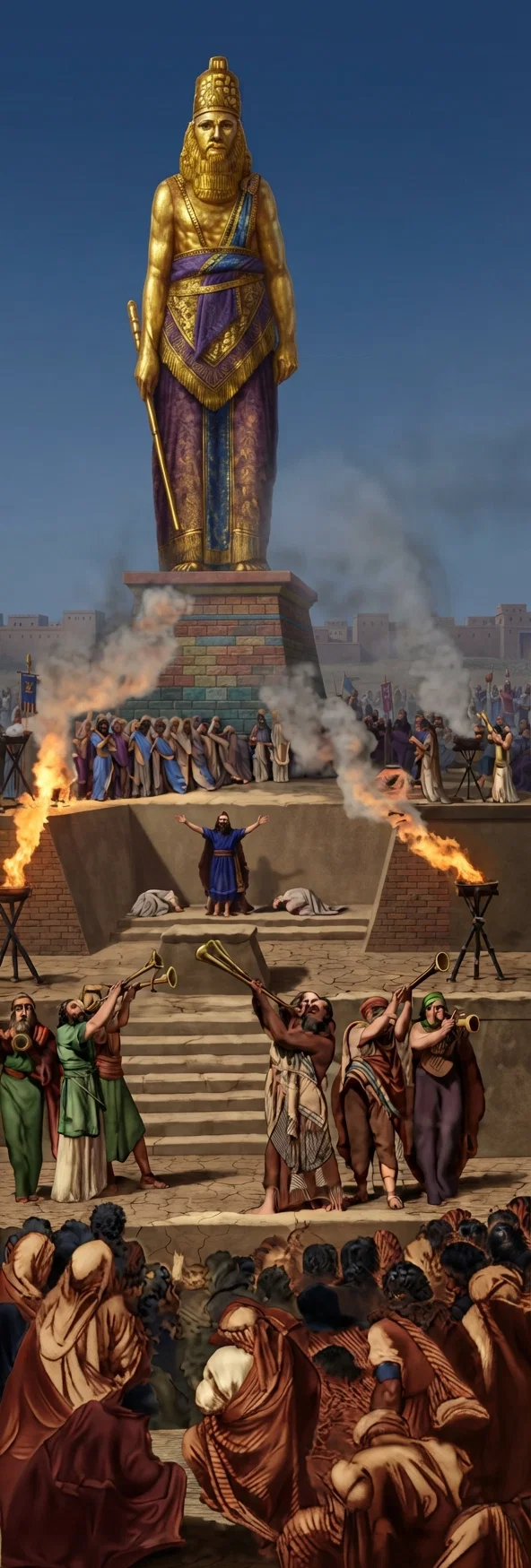
After the king of Babylon had witnessed the wonderful deliverance wrought by God for His faithful servants, and had seen the men walk unhurt from the fire, he published a decree that any one speaking a word against the God of Heaven, who had so wonderfully saved His servants, should be cut in pieces, "because," he declared, "there is no other god that can deliver after this sort." Thus, through the deceiving power of the enemy, God's truth is misinterpreted and misapplied, and His way confused by human inventions.
The king had a right to worship the God of Heaven, and to do all in his power to exalt Him above other gods; but he had no right to use his authority in compelling his subjects to change from the worship of idols to the worship of the true God. He had no more right to threaten men with death for not worshiping the true God than he had to make the decree consigning to the flames all who refused to worship the golden image.
To-day, as in the days of Babylon, the accuser of the brethren is working through human agencies to hurt and destroy those who are dear to the Lord. Men in power do not realize that they can not in justice control the minds of their fellow men, and Satan works through them to corrupt right dealing. Those who try to keep the commandments of God, will meet with much opposition. Satanic attributes will take possession of the hearts of men, making them as hard as steel; and all who depart from evil will make themselves a prey to the hatred of those that refuse to obey the law of God.
But when the State forms laws directly opposed to the laws of Jehovah, and thus strives to compel men to obey them, it is following the example set by the king of Babylon. When it takes the guardianship of the religious interests of the nation, a spirit of intolerance is manifested if men seek to practise the truth which, by earnest study, they have found in God's Word. Those who are actuated by such a spirit of oppression can not understand what religious liberty means.
NEBUCHADNEZZAR'S GOLDEN IMAGE
Every man has a right to worship God according to his own convictions; no one is called upon to obey laws that are opposed to the laws of God; and the only position the State can take, and have the approval of God, is to guard the rights of every individual, permitting no oppression to come upon any one because of religious belief.
As Nebuchadnezzar tried to force his subjects to obey his mandates, so men will try to force us to disregard the Word of God. They will endeavor to compel us to render homage to man-made statutes; but in God's strength we are to refuse to dishonor Him. The laws of earthly kingdoms are to be obeyed only when they do not conflict with the laws of God. When governments are tyrannical and overbearing, when they trample on God's law, their laws are contemptible in His sight. And when they try to control the minds and consciences of those whom Christ died to make free, God's children are to show their loyalty to Him by refusing to disobey His commandments.
When the judgment shall sit, and the books of heaven shall be opened, all will be judged, not by the laws that human minds have enacted, but by the law of God, which existed before the foundations of the world were laid. And the men who have been co-workers with the first great rebel, and who have not, as guardians of the State, searched the Word of God, that as rulers they might deal righteously and mercifully, will be judged by the law they have disregarded and dishonored.

In That Great Day

In that day when every work shall be brought into judgment, when the Lord Jesus, with the marks of the crucifixion on His body, shall come in the clouds of heaven with power and great glory, those who, while holding positions of trust, have caused God's people to suffer, will cast their idols of silver and gold to the moles and to the bats; "to go into the clefts of the rocks, and into the tops of the ragged rocks, for fear of the Lord, and for the glory of His majesty, when He ariseth to shake terribly the earth." "For, behold, the Lord cometh out of His place to punish the inhabitants of the earth for their iniquity: the earth also shall disclose her blood, and shall no more cover her slain."
They have shown no respect for God, no fear to transgress His commandments; but have refused to give their fellow men rights equal to their own, and have tried to make them disobey God. They have stubbornly adhered to man-made commandments, and they will be judged accordingly. Those who persist in enacting laws which men can not obey without dishonoring God, and those that obey these laws, and trample on the law of the eternal God, must prepare for the result; for God will not change, nor alter the thing which has gone out of His mouth.
"As the Father hath loved Me," said Christ, "so have I loved you: continue ye in My love. If ye keep My commandments, ye shall abide in My love; even as I have kept My Father's commandments, and abide in His love. These things have I spoken unto you, that My joy might remain in you,and that your joy might be full." "He that saith, I know Him, and keepeth not His commandments, is a liar, and the truth is not in him. But whoso keepeth His Word, in him verily is the love of God perfected: hereby know we that we are in Him. He that saith he abideth in Him ought himself also so to walk, even as He walked." "Whosoever committeth sin transgresseth also the law: for sin is the transgression of the law." "And he that keepeth His commandments dwelleth in Him, and He in him."

The Honored of God

God honors those who honor Him by obedience to His precepts. John, the beloved disciple, was banished to the isle of Patmos for his faithfulness. "I John," he writes, "who also am your brother, and companion in tribulation, and in the kingdom and patience of Jesus Christ, was in the isle that is called Patmos, for the Word of God, and for the testimony of Jesus Christ. I was in the Spirit on the Lord's day." Did John here mean Sunday? — There is but one day called the Lord's day, and that is the seventh day of the week, the Sabbath instituted at creation. God created the world in six days, and on the seventh He rested
and was refreshed. He blessed and sanctified this day, and set it apart to be observed as a memorial of creation. And on the seventh day John heard behind him "a great voice, as of a trumpet, saying, I am Alpha and Omega, the first and the last: and, What thou seest, write in a book, and send it unto the seven churches." "And I turned to see the voice that spake with me. And being turned, I saw seven golden candlesticks; and in the midst of the seven candlesticks one like unto the Son of Man." Thus Christ honored John for his steadfast obedience to Him.
Adam and Eve lost all access to Eden and to the Tree of Life because they took the word of another before the word of God. By this act of disobedience they opened the flood-gates of wo upon our world. But those who steadfastly adhere to God's Word, will hear the benediction, "Blessed are they that do His commandments, that they may have right to the Tree of Life, and may enter in through the gates into the city." No flaming sword guards that tree from those who, after the light has been given them, in the face of all opposition turn from the commandments of men to obey the commandments of God.

What Shall We Do with the Fourth Commandment?

By Mrs. L. D. Avery-Stuttle

II—The Reasonableness of the Entire Ten Commandments

“Come now, and let us reason together.”
NOW to the question, “Why don’t you talk about the binding force of the other nine commandments, as much as you do about the Sabbath?”
I think I can make it plain by the use of a homely illustration:
There was once a poor man who was suffering intense pain from a bad wound upon one of his fingers.
The doctor came.
“Do you think, doctor, that you will be able to discover which of my ten fingers is wounded? I am quite satisfied with my other nine fingers, and it would be a pity to waste valuable time and medicine upon them, as long as I acknowledge them to be good, sound fingers.”
But the doctor sat down — he was a very foolish doctor — and began industriously applying bandages and liniment to all the fingers alike.
“I must treat them all the same, of course, because they are all of equal value and importance to you,” insisted the foolish doctor.
It is quite needless to guess that this doctor was not called again.
All over the Christian world — with small exception — any man who would openly advocate the breaking of any other of the Ten Commandments save the fourth, would be considered unsafe to the public welfare, and to say the least, an undesirable citizen.
What would be thought of a minister of the Gospel who would stand up in his pulpit week after week and protest very solemnly that he believed the commandment which prohibited stealing to be just as binding upon man as it was before the cross; also that it was his deep conviction that it was wrong to commit murder or adultery, or to make images to worship, and that he hoped to be able thus to convince his hearers? How long before this minister would be adjudged insane?
Why?
Both the answer and the application are too plain to excuse explanation.
Once a very respectable appearing young man presented himself before Christ. He was very wealthy. But he thought he would like to possess not only this world, but the next also; and he asked, “What shall I do to inherit eternal life?”
At once Christ referred him to a certain law as the rule by which he must order his life. At that time there were three laws in force, the moral, the ceremonial, and the civil; therefore in answer to the young man’s request, Christ specified a few of the ten commands as indicating the law to which He referred.
“Yes; but He said nothing at all about the Sabbath, or about the keeping of Saturday; hence presumably it was about to be done away.”
Wait a moment. Since the Master mentioned none of the first four at this time, shall we conclude that He gave the young man liberty to violate them?
Shall we infer that it then became right and pleasing to God to blaspheme His name, or to make graven images? — Never! This view of the situation proves too much, consequently proves nothing.
“Come now, and let us reason together.”
Do you think that the Almighty would place one commandment in the very heart of His law, and then take it away, or abolish it, or change it in any way whatever, and never make mention of the fact in the remotest manner — that very law, the keeping of which, as Christ told the young man, would insure the favor of God and life eternal?
Or do you think that God was so desirous of getting rid of the fourth commandment, that He would abolish the whole ten, and then re-enact some of them? Why, even the most whimsical human lawmaker would hardly act so foolishly. Indeed, can any one imagine any reason why the almighty Framer of the earth and skies could wish to cover up or hide the fact from man, that HE IS THE CREATOR? Does He so intensely desire to turn our minds away from Himself, that He should abolish the one memorial of His creative work? The thought is as God-dishonoring and repulsive as the logic is erroneous.
But we can readily understand why the arch-enemy of all good should want to do this very deed — should maneuver and plot to banish a knowledge of the true God from the earth. Hence he seeks to abolish God’s memorial — the seal of Jehovah — by which God had intended to keep fresh in the heart of man a knowledge of Himself and His almighty creative power.
“Come now, and let us reason together.”
It would fare badly with any man or set of men who undertook to tamper with the great seal of the State. Why? — Because the power of the State is embodied in its seal. But what is the seal of a country? — It is the official signature. What is the seal of the law of God? — It is His signature — the sign of His authority — His name as Creator. Is it necessary that the great seal of the State should be affixed to its laws? Then a thousandfold more necessary is it that the Almighty should affix His eternal seal to His eternal law. Shall we charge Him with the sublime folly of neglecting to do, in His law, that which is so necessary even in the laws of earthly kings or lawmakers? Never. Impute not folly to the infinite in wisdom.

Go, Ye Reapers

By Edson Carpenter
The resurrection day is near, The day by prophets long foretold, When Christ shall in the clouds appear To reap the harvest of the world.
Go, warn the world of coming doom, Ye servants of the Lord Most High; Bid men repent while there is time, And to the arms of mercy fly,
While yet the Saviour intercedes Before His Father's throne above, While His atoning blood He pleads, The sacrifice He made in love.
Soon will His priestly work be done; His ministry will soon be o'er; Then as a King upon His throne, He'll reign in glory evermore.
The years are passing swiftly by; The day of grace will soon be past. Improve the moments as they fly, Each day as if it were the last.
O, go ye forth in Jesus' name Wherever sinful man is found; Go, and the Gospel's truths proclaim Unto the earth's remotest bound.
The Lord will give you your reward; So struggle on with prayers and tears. Ye shall be kings and priests of God, And reign with Him through endless years.

Encouragement for Children

GIVE your children encouragement rather than criticism, sympathy rather than reproof, and, while they are in the awkward age, at least, do not add to their self-consciousness by constantly drawing attention to their faults. — The Continent.
Continue reading: The Testimony of Jesus