Your ShelfYour Projects

Signs of the Times, Vol. 36, No. 28.

Conduct for Christians

Signs of the Times

Jul 21, 1909

Pacific Press Publishing Association · Mountain View, California · Jul 21, 1909

Conduct for Christians

Be ye therefore imitators of God, as beloved children; and walk in love, even as Christ also loved you, and gave Himself up for us, an offering and a sacrifice to God for an odor of a sweet smell. But fornication, and all uncleanness, or covetousness, let it not even be named among you, as becometh saints; nor filthiness, nor foolish talking, or jesting, which are not befitting: but rather giving of thanks. For this ye know of a surety, that no fornicator, nor unclean person, nor covetous man, who is an idolater, hath any inheritance in the kingdom of Christ and God. Let no man deceive you with empty words: for because of these things cometh the wrath of God upon the sons of disobedience. Be not ye therefore partakers with them; for ye were once darkness, but are now light in the Lord: walk as children of light (for the fruit of the light is in all goodness and righteousness and truth), proving what is well-pleasing unto the Lord; and have no fellowship with the unfruitful works of darkness, but rather even reprove them; for the things which are done by them in secret it is a shame even to speak of. But all things when they are reproved are made manifest by the light: for everything that is made manifest is light. Wherefore He saith, Awake, thou that sleepest, and arise from the dead, and Christ shall shine upon thee. Look therefore carefully how ye walk, not as unwise, but as wise; redeeming the time, because the days are evil.

Question Corner

[TO OUR INQUIRERS.— (1) The name and address of all who ask questions must accompany questions, not necessarily for publication, in token of good faith, and that we may reply by letter if thought best. All communications will be considered confidential if so desired, and no name will be published unless requested. But we have no time to give to anonymous or unsigned epistles or articles. (2) Let the questions be to the point. Do not say, “Explain Josh. 7:1-8,” but state the thing upon which help is desired. (3) Questions can not be answered immediately in this department. Sometimes it will mean a month or more of waiting. We can not reply to the same question frequently. Read answers to other questions; you may find reply to yours. (4) Members of the Bible Band will kindly enclose stamp if answer is desired by letter. Others will please enclose ten cents. This does not begin to meet expenses oftentimes. (5) “Foolish . . . questions avoid.”]
2892.—Praying in Meeting.
Is it Biblical to ask any one to pray in meeting? Is it not better to pray according as the Spirit teaches, whereby we are free in the Spirit of the Lord? T. N. A.
The Bible does not give us particular directions regarding all places and times. It deals with great principles. Yet God leaves His children to carry out these principles as the time, and the place, and the need may indicate. We read in Paul's writings again and again: “Pray for us.” In such case would it not be proper in a public meeting to ask some one to pray? The Spirit of God may move the one who is leading the meeting to ask some one to pray just as truly as that same Spirit would lead some one to pray without being asked. There may be times when the matter is overdone; other times, when some one is asked to pray who has no burden of prayer or no particular faith. And yet the very fact that he is asked to pray and does not himself feel in the mood to pray may lead him to consecrate himself to God more fully than before. In such meetings as that, presumably, all are there to pray or to take part and all ought to be in a spirit of prayer, where they certainly could pray for the general and great blessings which every such meeting would need. It is for the Spirit to guide on such occasions. It may guide one in one way, another in another.
2893.—Priests in the New Earth.
What office will priests have in the new earth? Rev. 5:10. A. K.
Just the same office they would have had if sin had never entered. We get a wrong conception of the eternal priesthood by looking at the office solely from the standpoint of sinful conditions. One of the great purposes of priests, according to Mal. 2:7, is teaching. “For the priest's lips should keep knowledge, and they should seek the law at his mouth; for he is the messenger of Jehovah of hosts.” And so God will have a ministering, teaching priesthood to the undeveloped tho sinless in character throughout all eternity. The blessed office of unselfish ministry will go on forever.
2894.—Our Affliction and the Lord.
Had God forsaken Job when he was so afflicted? A. K.
Surely He had not. What reason is there to even intimate that such is the case? “Whom the Lord loveth He chasteneth, and scourgeth every son whom He receiveth.” Read the first part of the 12th chapter of Hebrews. God's Son was afflicted, but the Father did not forsake Him during His affliction. He loves His children just as well in their affliction as He does in their brightest prosperity. His eye was upon Job in all his affliction.
2895.—Who Is Melchisedec?
Will you please explain who Melchisedec is, or was? Is he Christ or another person? I am truly puzzled on the third verse of Hebrews 7, last clause. If he be Christ, why do the Scriptures say that he was made “like unto the Son of God”? SUBSCRIBER.
It is one of the great puzzling questions—the Melchisedec priesthood—which has been explained much more fully than we will be able to reply to here, in past numbers of the Signs. Replying, however, to the questions, the Melchisedec who met Abraham was not Christ, and yet Christ is our Melchisedec, that is, our King of Righteousness; and because He is King of Righteousness, He is also King of Salem, or King of peace. The Melchisedec priesthood, or priesthood of king-priests, was an order forever perpetual in each Melchisedec priest, but an order in the sense that in every world of God's creation there is normally a Melchisedec priesthood. These priests are sons of God. Sonship is equivalent to priesthood. Heb. 5:5, 6. The Melchisedec who met Abraham was one of the order of this priesthood, and therefore a perfect figure of our Lord Jesus Christ.
Adam would have been our Melchisedec priest as a “son of God,” Luke 3:38. He, however, failed, and our Lord Jesus Christ became the second Adam—our Melchisedec priest, as well as the Melchisedec priest of the universe. The Melchisedec of Heb. 7:1 could not have been the Son of God, for he was made “like unto the Son of God,” but that there must have been other Melchisedec priests is shown from the fact that an order consists of more than one.
These hints will, we hope, give our inquirer some light in the further study of the question upon which we will have more to say in the future.
2896.—Children and Parents.
Will you explain through the Question Corner 1 Cor. 7:12, 13? Will children that die in infancy be raised if both parents are lost? Does the Bible say that every grave shall be opened? C. D. C.
The aim of God's word is to reveal to His intelligent, responsible creatures the way of life and salvation, not to satisfy our curiosity. The command to obey is given to responsible persons. The exhortation to believe and follow Christ is given to responsible persons. The Lord will care for all irresponsible entirely apart from us. Consequently, He has not revealed to us His dealing with irresponsible creatures, such as children and insane. And yet He has also revealed this, that upon parents to a great extent rests the salvation of their children. They are to do their part in training up children, and He has given us to understand again and again that He regards the prayers and efforts of godly parents, and will work with them.
This seems to be one of the reasons which He uses in strengthening His appeal to husband and wife who are not agreed. “If any brother hath an unbelieving wife, and she is content to dwell with him, let him not leave her. And the woman that hath an unbelieving husband, and he is content to dwell with her, let her not leave her husband.” And then He tells us that “the unbelieving husband is sanctified in the wife, and the unbelieving wife is sanctified in the brother; else were your children unclean; but now are they holy.” That is, two heathen parents would not be very likely to dedicate their children to God or bring them up in the nurture and admonition of the Lord, whereas if but one of the parents was truly godly, these children would be given or set apart to the Lord's service.
Children being innocent of all wrong, we see no reason why they should not come up in the resurrection and be taught of God.
Regarding the raising of all the dead, we have a strong, striking expression in John 5:28, 29. “The hour cometh, in which all that are in the tombs shall hear His voice, and shall come forth; they that have done good, unto the resurrection of life; and they that have done evil, unto the resurrection of judgment.” Again we read in 1 Cor. 15:22, “For as in Adam all die, so also in Christ shall all be made alive.”
2897.—Questions Concerning Sin.
Would one sin unconfessed have the same effect as one commandment trespassed, as to shutting one away from salvation? 2. Give a few instances of what kind of sin needs to be confessed publicly; what kind to our neighbor; and what kind in the family circle. E. R.
The unconfessed sin is cherished, or else pride of heart is so cherished that it leads us to keep the sin rather than confess it. God's means of taking sin from His children is through confession. “If we confess our sins, He is faithful and just to forgive us our sins, and to cleanse us from all unrighteousness.” 1 John 1:9. David said: “I acknowledged my sin unto Thee, and mine iniquity did I not hide: I said, I will confess my transgressions unto Jehovah; and Thou forgavest the iniquity of my sin.” Ps. 32:5. All sin is transgression of God's law, the transgression of some one or more commandments of that law. Therefore, to commit sin and retain the sin instead of putting it away by confession, is just the same as the transgression of one of the commandments of His law.
Wisdom should be used in the confession of sin as well as thoroughness. The confession should be made as broad as the sin if possible. If the sin, the wrong, is against God alone, we should confess it to God. For instance, if one has cherished hatred in his heart against a neighbor, if he has coveted that which belongs to another, and yet has not offended humanity in thus doing, it would be sufficient to go to God and tell Him of this and pour out the heart before Him. If one's sin has been an open sin before the public, if he has been an open Sabbath-breaker or user of profane language, a covetous man, or a thief, he should make that confession before the public, should take such a stand that the public before whom he had committed these sins would know that he had turned from these sins and was obedient to God.
If he has sinned directly against his neighbor in his language or in his treatment of that neighbor, a sin known to his neighbor, he should certainly confess to his neighbor his sin. So in regard to family matters. There is a homely illustration that the plaster should be made large enough to cover the sore, and so the confession should be made large enough to cover the sin. Satan would be glad to have souls confess before the public secret sins that lie between them and God only or between man and one or two individuals. This the Lord does not demand.

OUR BIBLE BAND

Schedule for Week Ending July 31, 1909.

Morning. Evening.
Su. July 25 Ps. 37, 38, 39 Acts 26
Mo. “ 26 “ 40, 41, 42 “ 27: 1-26
Tu. “ 27 “ 43, 44, 45 “ 27: 27-44
We. “ 28 “ 46, 47, 48 “ 28
Th. “ 29 “ 49, 50 Rom. 1
Fri. “ 30 “ 51, 52, 53 “ 2
Sa. “ 31 “ 54, 55, 56 “ 3

Suggestive Notes.

Our morning readings still continue in the Psalms, beginning with the 37th and closing with the 56th. What a lesson of encouragement God gives to His faithful children in the first of these! Note also throughout the Psalms how the experience of Christ is in many cases brought in. It was His Spirit that inspired the Psalmist. Psalms 42, 45, 46, 50, 51 are well worth learning by heart. No experience ever gets beyond these blessed lessons which God here gives us. No circumstance in life but is met by the teaching of the Psalms.
Our evening readings begin with the 26th chapter of Acts and close with the third of Romans. Chapter 26 opens with Paul's speech before Agrippa, the appeal which he makes to the king. Chapter 27 relates his voyage to Rome, his shipwreck and the Lord's marvelous working with His servant; the last chapter telling of his imprisonment at Rome and the opportunity there given him to teach the Gospel. Romans was written by the apostle Paul to the church at Rome, composed of both Jews and Gentiles. It is a masterly argument upon the perpetuity and universality of God's law, its binding obligation upon every soul, and the relationship of the law to the Gospel; the latter of which is the power of God to bring every longing soul into perfect harmony with God's government.

The Fruitless Fig-Tree

By Mrs. E. G. White
The Withered Fig-Tree
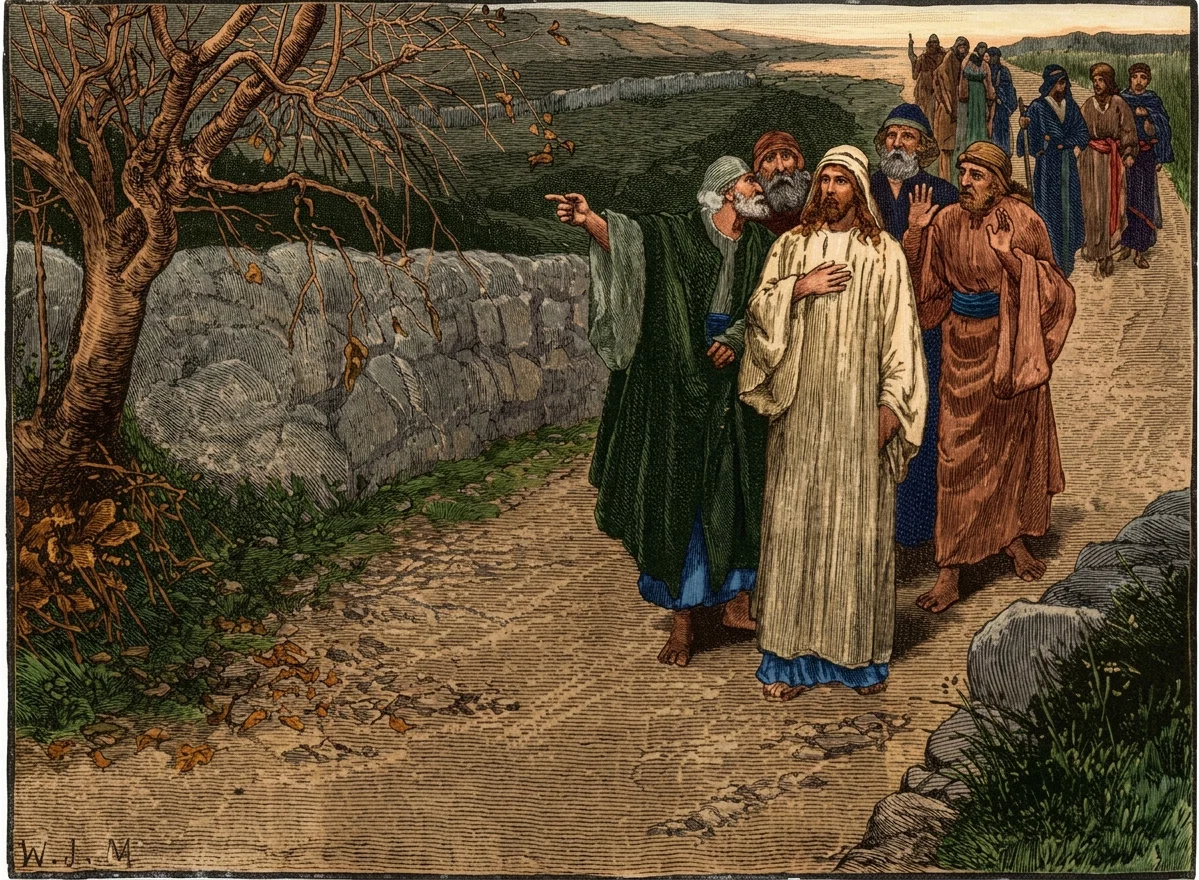
The parable of the fig-tree was given to represent the condition of all who do not bear fruit to the glory of God. With His disciples Christ was on His way from Bethany to Jerusalem. On the way He passed a fig orchard. He was hungry, “and seeing a fig-tree afar off having leaves, He came, if haply He might find anything thereon; and when He came to it, He found nothing but leaves; for the time of figs was not yet.”

The Incident

It was not the season for ripe figs, except in certain localities; and on the highlands about Jerusalem it might truly be said, “The time of figs was not yet.” But in the orchard to which Jesus came, one tree appeared to be in advance of all the others. It was already covered with leaves. It is the nature of the fig-tree that before the leaves open, the growing fruit appears. Therefore this tree in full leaf gave promise of well-developed fruit. But its appearance was deceptive. Upon searching its branches, from the lowest bough to the topmost twig, Jesus found “nothing but leaves.” It was a mass of pretentious foliage, nothing more.

The Curse

Christ uttered against it a withering curse. “No man eat fruit of thee hereafter forever,” He said. The next morning, as the Saviour and His disciples were again on their way to the city, the blasted branches and dropping leaves attracted their attention. “Master,” said Peter, “behold the fig-tree which Thou cursedst is withered away.”
Christ’s act in cursing the fig-tree had astonished the disciples. It seemed to them unlike His ways and works. Often they had heard Him declare that He came not to condemn the world, but that the world through Him might be saved. They remembered His words, “The Son of Man is not come to destroy men’s lives, but to save them.” His wonderful works had been done to restore, never to destroy. The disciples had known Him only as the Restorer, the Healer. This act stood alone. What was its purpose? they questioned.

An Acted Parable

The cursing of the fig-tree was an acted parable. That barren tree, flaunting its pretentious foliage in the very face of Christ, was a symbol of the Jewish nation. The Saviour desired to make plain to His disciples the cause and the certainty of Israel’s doom. For this purpose He invested the tree with moral qualities, and made it the expositor of divine truth. The Jews stood forth distinct from all other nations, professing allegiance to God. They had been specially favored by Him, and they laid claim to righteousness above every other people.
But they were corrupted by the love of the world and the greed of gain. They boasted of their knowledge, but they were ignorant of the requirements of God, and were full of hypocrisy. Like the barren tree, they spread their pretentious branches aloft, luxuriant in appearance, and beautiful to the eye, but they yielded “nothing but leaves.” The Jewish religion, with its magnificent temple, its sacred altars, its mitered priests and impressive ceremonies, was indeed fair in outward appearance, but humility, love, and benevolence were lacking.

The Gentiles as Leafless Trees

All the trees in the orchard were destitute of fruit; but the leafless trees raised no expectations, and caused no disappointment. By these trees the Gentiles were represented. They were as destitute as were the Jews of godliness, but they had not professed to serve God. They made no boastful pretensions to goodness. They were blind to the works and ways of God. With them the time of figs was not yet. They were still waiting for a day which would bring them light and hope. The Jews, who had received greater blessings from God, were held accountable for their abuse of these gifts. The privileges of which they boasted only increased their guilt.

The Jews as the Fig-Tree

Jesus had come to the fig-tree hungry; to find food. So He had come to Israel, hungering to find in them the fruits of righteousness. He had lavished on them His gifts, that they might bear fruit for the blessing of the world. Every opportunity and privilege had been granted them, and in return He sought their sympathy and cooperation in His work of grace. He longed to see in them self-sacrifice and compassion, zeal for God and a deep yearning of soul for the salvation of their fellow men. Had they kept the law of God, they would have done the same unselfish work that Christ did.
But love to God and man was eclipsed by pride and self-sufficiency. They brought ruin upon themselves by refusing to minister to others. The treasures of truth which God had committed to them, they did not give to the world. In the barren tree they might read both their sin and its punishment. Withered beneath the Saviour’s curse, standing forth sere and blasted, dried up by the roots, the fig-tree showed what the Jewish people would be when the grace of God was removed from them. Refusing to impart blessing, they would no longer receive it. “O Israel,” the Lord says, “thou hast destroyed thyself.”

A Warning for All Time

The warning is for all time. Christ’s act in cursing the tree which His own power had created, stands as a warning to all churches and to all Christians. No one can live the law of God without ministering to others. But there are many who do not live out Christ’s merciful, unselfish life. Some who think themselves excellent Christians do not understand what constitutes service for God. They plan and study to please themselves. They act only in reference to self. Time is of value to them only as they can gather for themselves. In all the affairs of life, this is their object. Not for others but for themselves do they minister. God created them to live in a world where unselfish service must be performed. He designed them to help their fellow men in every possible way.
But self is so large that they can not see anything else. They are not in touch with humanity. Those who thus live for self are like the fig-tree, which made every pretension, but was fruitless. They observe the forms of worship, but without repentance or faith. In profession they honor the law of God, but obedience is lacking. They say, but do not. In the sentence pronounced on the fig-tree Christ demonstrates how hateful in His eyes is this vain pretense. He declares that the open sinner is less guilty than is he who professes to serve God, but who bears no fruit to His glory.

A Limit to God’s Grace

In every age there is given to men their day of light and privilege, a probationary time in which they may become reconciled to God. But there is a limit to this grace. Mercy may plead for years, and be slighted and rejected; but there comes a time when mercy makes her last plea. The heart becomes so hardened that it ceases to respond to the Spirit of God. Then the sweet, winning voice entreats the sinner no longer, and reproofs and warnings cease.
That day had come to Jerusalem. Jesus wept in anguish over the doomed city, but He could not deliver her. He had exhausted every resource. In rejecting the warnings of God’s Spirit, Israel had rejected the only means of help. There was no other power by which they could be delivered.

Our Alarm Clock

Not many years ago a student, desiring to rise early in the morning, bought an alarm clock. For a few days it worked well. But one morning, after being aroused by its alarm, he turned over and went to sleep again. On the subsequent mornings the clock failed to wake him. He placed it under the head of his bed, in close proximity to his ear. There it woke him till the time he disobeyed its summons; ever afterward it was a failure—he slept through its call with perfect regularity. Yet, on the other hand, many a mother wakes on the faintest voice of her child, and many a watcher on the slightest movement of his patient. They have trained themselves to heed such calls.
In like manner the conscience may be deadened or trained. Let the Christian disregard its voice, and soon it will become unable to arouse him at all. Let him carefully heed its faintest remonstrance, and it will become to him a most valuable mentor. Take good care of your conscience; it is a most delicate apparatus.—Selected.

The Church

III. Errors in Church Government

By C. S. Longacre
Fruitful Fig-Tree, showing figs and few leaves

Individual Independence in the Church

While it is true that the Head of the church is Christ, and that no human being or earthly representative is to take the place of this Head, it is just as true that the church is a unit, a body, an organization in which all its members are “fitly framed together.” This of necessity defers individual independence, for in that case each individual is a head, and there would be as many heads as there are individuals. In this case the organization would not be “fitly framed together.”
Individual independence is forbidden in laymen as well as in church officers. To the laymen the Lord says: “Obey them that have the rule over you, and submit yourselves.” To those who bear rule over others the Lord says: “Feed the flock of God which is among you, taking the oversight thereof, not by constraint [force], but willingly; not for filthy lucre, but of a ready mind; neither as being lords over God’s heritage, but being ensamples to the flock.” Because government and authority have been perverted into tyranny, it does not follow that these are evil in themselves.
Only as the Holy Spirit is the motor in church machinery is the machine a safe and profitable one. Without this vital factor, the machine will kill its master and organization becomes a coffin which encloses a corpse. If the Spirit of God dwells in the men who make the plans, and again when they execute them, then there will be fulfilled the vision of Ezekiel the prophet, “When the living creatures were lifted up from the earth, the wheels were lifted up; . . . for the spirit of the living creatures was in the wheels.”

Commercialism in the Church

In the modern methods of church administration in many denominations, it is the spirit of commercialism that controls instead of the spirit of holy consecration and truth. Many a minister has the boldness to stand before a poor and needy flock and tell them that the Lord has called him to another field, when the sole inducement is a “fatter salary.” Men are elected as trustees and treasurers who have a reputation for hoarding money. In this way the church often puts a premium upon covetousness. The business men of the church are often the shrewdest policy workers in the business methods of the world, and under the maxim, “Business is business,” they nurture a dark brood of evils which drive away the Holy Spirit from the courts of the house of the Lord. Mr. Moneybags is pitted against Brother Rich-in-Faith, whose purse is neither long nor full. Mr. Worldly, in such a church, has more to say in determining the methods and measures of church life than Mr. Meek. Thus the church organization becomes a ponderous machine, and is “run” as any other machine. The crucial and only question to settle is: “Does it pay?” If the minister does not make it pay, if he is not a good “drawing-card;” if he does not smooth down the rugged text to “itching ears,” he is quietly handed his resignation papers, and another is engaged who will make it pay. In order to make it pay, every foul spirit and method is invited into the sacred sanctuary, and it is transformed into a den of robbers and money exchangers.
No wonder D. L. Moody, the great evangelist, denounced the present church administration in the following scathing words: “Your fairs and your bazaars won’t do, and your voting, your casting ballots for the most popular man, or the most popular woman, just helping along their vanity. It grieves the Spirit; it offends God. They have got so far now that for twenty-five cents young men can come in and kiss the handsomest woman in the room. Think of this! Look at the church lotteries going on in New York. Before God, I would rather preach in any barn, or in the most miserable hovel on earth, than within walls of a church paid for in such a way.”
This grieving away of the Holy Spirit as the guide of the church and these moral corruptions were mentioned alike by Paul, Peter, John, and Jude, as indeed they had been by Christ Himself, as prevailing conditionsof unbridled profligacy in the last days, the “perilous times” of the great “apostasy” and “mystery of iniquity.” O, what a world of trouble and evil consequences the churches could have avoided if they had allowed the Lord to guide them in financing the church. “Return unto Me, and I will return unto you.” “Ye are cursed with a curse: for ye have robbed Me!”—“in tithes and offerings.” Mal. 3: 7-10.

God Would Guide the Church

As of old the church needs to be “hewed by the prophets.” Hosea 6: 5. For centuries the church has been “tossed to and fro, and carried about by every wind of doctrine, by the sleight of men, and cunning craftiness, whereby they lie in wait to deceive.” Eph. 4: 14. This precious “gift” was and still is God’s chosen agency to guide His church directly and visibly. O, that the church to-day might remember that the things which befell Israel in rejecting God’s chosen messengers anciently, will befall them if they imitate their stubborn course. “Now all these things happened unto them for ensamples: and they are written for our admonition, upon whom the ends of the world are come.” 1 Cor. 10: 11.
What was it that befell ancient Israel? Let the Lord Himself answer: “And the Lord God of their fathers sent to them by His messengers, rising up betimes, and sending; because He had compassion on His people, and on His dwelling-place: but they mocked the messengers of God, and despised His words, and misused His prophets, until the wrath of God arose against His people, till there was no remedy.” 2 Chron. 36: 15, 16. Our attitude to-day toward God’s chosen instruments determines our attitude toward God, and where we would have stood anciently—on the side of rebellion or on the side of submission.

Is the First Day the Sabbath?

The Second Meeting with the Disciples

WE learned in our last study that Jesus did not set apart the first day of the week as a Sabbath; that He did not meet with the disciples until that day had passed; that His disciples at that meeting did not believe He had risen from the dead. Here is the record of the next meeting:
“And AFTER eight days again His disciples were within, and Thomas [absent at the last meeting] was with them: then came Jesus, the doors being shut, and stood in the midst, and said, Peace be unto you.” John 20: 26.
After eight days. We are sure it was on the evening following the first day that He met with them the first time. He walked with the two disciples who went to Emmaus, and when they drew near the village it was toward evening and Jesus went in and sat down to the evening meal with them, and after this you know they walked seven and one-half miles back to Jerusalem to tell the apostles He had arisen. Luke 24: 29-34. Now “after” means, behind, subsequently to, following; as “After I am risen again, I will go before you into Galilee.” Matt. 26: 32. “And Sarah died in Kirjatharba; And after this, Abraham buried Sarah his wife in the cave of the field of Machpelah.” Gen. 23: 2, 19.
Yet we are told that “after eight days” means the next first day! Is it difficult to understand the meaning of after in the texts above quoted?—Certainly not. There is no other place in the Bible or outside it where after is given the meaning of before or on except in John 20: 26. But it has its usual meaning there. “After eight days” would certainly carry us forward to the next week, Monday or Tuesday. When God says after He means it.
The record of the Gospels does not in any way support a first-day Sabbath.
The passage in Acts 20: 7 merely records a night meeting on the first day of the week, the rest of which day was spent in travel.
In 1 Cor. 16: 1, 2, instruction is given by the apostle to the early Christians to look over their account, and lay by themselves, store up, funds to be handed to the apostle when he came. In every mention of the first day of the week there is nothing to even indicate it was a holy day. Let God be true.
LUCILLA L. HARMON.

“Arise, Shine”

By *
ARISE, shine; for thy light is come, and the glory of the Lord is risen upon thee.” Isa. 60: 1. This wonderful command is addressed by our Lord to every son and daughter of God at this present hour. Every tendency in the Christian’s environment to-day seems to be to sit still, to be inactive in the work of the Master, to allow a spirit of drowsiness to possess the soul, until every effort at progress appears to be an impossibility, and the precious talents which Heaven has so graciously and abundantly entrusted to its children are being buried in the earth, hidden in the napkin of spiritual discouragement and faint-heartedness. With Gethsemane’s struggles right upon the church of God, a strange spirit of sleep, a death-like stupor, a marvelous, incomprehensible apathy, a fearful insensibility, is settling in gloomy midnight shades upon the souls of her children. How intense must be the activity of the enemy of all righteousness! Truly he knows that he has but a short time, and in furious wrath, employing his most crafty, hellish arts and deceptions, he goes about as a mad and roaring lion, seeking whom he may devour, until the very elect, the precious heritage of Christ, are in danger.
But thanks be to our God, who has foreseen all this and in mercy provided a way of escape from the net, a remedy for the latter-day soul diseases that are threatening to sweep away to destruction men and women bought with the precious blood of the Lamb. Preceding the above command He assures His children once and for all, that “when the enemy shall come in like a flood, the Spirit of the Lord shall lift up a standard against him.” And then follows that wonderful promise: “And the Redeemer shall come to Zion, and unto them that turn from transgression in Jacob, saith the Lord.” But let us listen to the still more marvelous manifestation of the divine good will brought to our view in the next sentence: “As for Me, this is My covenant with them, saith the Lord; My Spirit that is upon thee, and My words which I have put in thy mouth, shall not depart out of thy mouth, nor out of the mouth of thy seed, nor out of the mouth of thy seed’s seed, from henceforth and forever.”
With this unmistakable assurance of God’s abiding Spirit upon His children, there comes the admonition: “Arise, shine; for thy light is come, and the glory of the Lord is risen upon thee.” “Arise, shine!” What hopeful and comforting words to the despondent, downcast soul! How immediately it brings to our mind that Sabbath scene at the pool of Bethesda where lay the helpless sufferer of thirty-eight long, weary years, waiting, waiting for relief, and well-nigh given over to utter despair. How similar the message to this poor cripple, “Rise, take up thy bed, and walk.” Notice the result: “And immediately the man was made whole, and took up his bed, and walked.”
Ah, he arose and shone physically. Realizing his helpless condition, and discerning in the voice of Jesus the mighty power of God, he obeyed, and was made whole. Thus it will be in our day spiritually. By His Spirit Jesus again is walking upon the earth, with His great heart of love drawn out toward suffering, sin-sick, despairing humanity. Again He is visiting the despondent, downcast, impotent members of His flock, asking each one in tones of tenderest sympathy, “Wilt thou be made whole?” and bidding them: “Arise, shine,”—rouse yourself from your lethargy, break the spell which Satan has cast over your soul; become a bright spiritual light in your Master’s cause; shed forth the beams of His love and glory to those that sit in the shadows of sin and despair. Then, tho “darkness shall cover the earth, and gross darkness the people,” “the Gentiles shall come to thy light, and kings to the brightness of thy rising,” for “the Lord shall rise upon thee, and His glory shall be seen upon thee.”
What a glorious prospect before every child of God. How it ought to rekindle hope and courage in the downcast soul. May the command “Arise, shine,” be heeded, and of every one who obeys the call it shall surely be a fact that God’s glory shall be seen upon him.

For Christ’s Sake

He held the lamp of truth that day So low that none could miss the way; And yet so high, to bring in sight That picture fair—the world’s great Light— That, gazing up, the lamp between, The hand that held it scarce was seen.
He held the pitcher, stooping low To lips of little ones below; Then raised it to the weary saint, And bade him drink when sick and faint. They drank—the pitcher thus between, The hand that held it scarce was seen.
He blew the trumpet soft and clear, That trembling sinners need not fear; And then, with louder note and bold To raze the walls of Satan’s hold. The trumpet coming thus between, The hand that held it scarce was seen.
But when the Captain says, “Well done, Thou good and faithful servant—Come! Lay down the pitcher and the lamp; Lay down the trumpet—leave the camp,” These weary hands will then be seen Clasped in those pierced ones, naught between.
— Selected.
Continue reading: But One Thing Is Needful