Signs of the Times, Vol. 38, No. 33.

THE TRUE VINE AND THE BRANCHES

Signs of the Times

Aug 22, 1911

Pacific Press Publishing Association · Mountain View, California · Aug 22, 1911

THE TRUE VINE AND THE BRANCHES

I am the True Vine, and My Father is the Husbandman. Every branch in Me that beareth not fruit He taketh away: and every branch that beareth fruit, He purgeth it, that it may bring forth more fruit.
I am the Vine, ye are the branches: he that abideth in Me, and I in him, the same bringeth forth much fruit: for without Me ye can do nothing.
If ye abide in Me, and My words abide in you, ye shall ask what ye will, and it shall be done unto you.

"IF YE WILL INQUIRE, INQUIRE YE."

This Inquirers' Department is conducted for the purpose of helping those who are studying the Bible. The answers are oftentimes only suggestive. They are never to be considered infallible, only as they agree with the infallible Word. The writer who may answer them does not consider that his opinion is infallible. He will simply give the best that he has, and plead with the inquirer to search the Word. Such questions only will be answered as, to the editors, seem to minister to the good of the readers and to the mission of the paper. We can not answer repeatedly in the same volume questions upon the same scripture. The name and address must accompany question, not for publication, but as an evidence of good faith, and that answer may be made by letter if deemed advisable. No letters are answered which do not contain the name of the writer. It is well always to enclose stamp for reply.

3536—The Law in Galatians

Will you give me a little light on a couple of passages in Galatians, chapter 3, verses 9 to 13, and chapter 4:24, 25?
A part of the passage in Galatians 3 was quite fully explained in a recent number of the SIGNS. We will therefore touch upon it lightly.
Verse 9 declares that they that are of faith are blessed with faithful Abraham. God counts them one in His family, because they have the same faith. Verse 10: "As many as are of the works of the law are under a curse." That is, those who are depending upon the law for salvation. Why? Because they are sinners, and the law condemns them to death because they are transgressors, and no law can save the man who is transgressing it. Consequently the justice of the conclusion in the 11th verse, "No man is justified by the law: . . . the righteous shall live by faith." That is always true; it has always been true; it was true before sin ever entered that the only way by which man could live was faith in God, with a heart open on the God-ward side, receiving life and blessing from Him, and pouring it out to others. And since man has sinned it is still true. The only hope for justification is by faith in Christ, and the only hope in right living is by the same faith. But the man who has that faith in God will live according to God's law. That law is the reflect of God, and faith will appropriate the power of God for the obedience to His law. But the law does not justify; it is the righteousness of God in Christ which justifies. If a man could do the law he would live by it, but he can do it only through Christ. Christ therefore redeemed us from the curse of the law, having become a curse for us. And He did that that upon every soul in this world, Gentiles as well as Jews, might come the blessing of Abraham in Christ Jesus; and that blessing was that Abraham believed God, and God counted it to him for righteousness.
And the same faith brings also the Spirit of God. Now God made a covenant with Abraham to give him all that, and the law did not take away from the covenant. The law was not designed to take away from the covenant. The covenant was given in order that that law might be established in the heart, and that covenant abides in Christ Jesus.
The Seed of Abraham. Abraham had different posterities, but the blessing comes through one posterity—Christ—wholly and solely by promise. Why, then, was the law given?—In order that sin might be seen to be exceeding sinful, so that man might flee from the wrath and find refuge in Christ Jesus. See SIGNS of July 25, 1911, question No. 3516. Verses 24 and 25 of the 4th chapter emphasize this. Paul gives a parable of Abraham's two sons—the one by Hagar, the bondwoman, the other by Sarah, a freewoman. The one was born after the flesh, through the work of man wholly; the other was born after the Spirit, through promise and power of God, and man coöperating with that promise. God gave His promise to Abraham that through his seed all should be blessed. Abraham fixed it up in his own way, and in order to carry out his own way he had a son by Hagar, his bondmaid. God said, "This shall not be the seed." Abraham's plan brought sorrow and trouble only to his family. And that plan and scheme of Abraham's through Hagar was a type, or figure, of the covenant from Mt. Sinai that gendered, or bore, children to bondage. What the apostle means by the covenant at Sinai was Israel's promise to do God's will, promising by power which they possessed of themselves: "All that the Lord hath said will we do, and be obedient." They felt that they could work it out of themselves (see Exodus 19). They left the Lord out of the question, save in the blessings. They wanted God's blessings, but they wanted to buy those blessings, or obtain them through their own works.
But the child which was born through Sarah is a type of the new covenant, in which God promises, if we will but receive the promise, if we will but coöperate with Him by yielding wholly and absolutely to His plan, to save us. So He brought the promised seed to Abraham by miraculous power through Sarah. And so God brings to all His children deliverance from sin when they yield wholly to His own plan. We can see what the results of the two are. If the first were successful, man would glory in himself. If Abraham had been successful in his scheme, he would have taken the glory in himself. But as there is no success in that, but success lies wholly through God and His power, all the glory is given to God.
Hagar stands for that type of religion possessed by those who would work out their own salvation, not through God working in them, but through their own power. Sarah, or Isaac, stands for the mighty power and promise of God that is able to work above all appearance, and bring out of what seems to be utterly impossible that which is eternally true and will eternally abide. Therefore the comfort, "Now we, brethren, as Isaac was, are children of promise."

3537 — The Worm Shall Not Die

Will you kindly explain the last verse of Isaiah, chapter 66:24? It has been brought to me as an evidence of everlasting punishment, and we couldn't explain it. A Subscriber.
Well, it is an evidence of everlasting punishment, but not an evidence of everlasting punishing. There is a difference between punishment, a completed process, and punishing, a process which goes on to all eternity, and is never completed. How could it be said that the wicked are punished, if that punishing never ceases? The Lord speaks of it as a finality. "The wages of sin is death," not dying. One could conceive that that dying would last a long time; but God does not speak of the process, but of the ultimate result. The dying results in death. It is the death, the deprivation of life, which is the punishment. This scripture is in harmony with that statement, "And they [the righteous] shall go forth, and look upon the carcasses of the men that have transgressed against Me: for their worm shall not die, neither shall their fire be quenched; and they shall be an abhorring unto all flesh."
Note, first, that it does not say that the righteous shall go forth and look upon living men, but upon the carcasses of men that have transgressed. The carcass is the dead body. The terms referring to the undying worm and to the unquenchable fire were very common to the Jews. The valley of Gehenna was just outside of Jerusalem. It was in that valley where all the refuse and offal of the city were cast. Upon this mass of refuse the worm constantly preyed, and what the worm did not consume was consumed by constant fires, which were kept burning, into which this was cast. The worm devoured what it preyed upon; the fire burned up what was cast into it. Consequently, to the Jew that was one of the strongest terms to denote everlasting destruction. See the prophet's use of it in another place, Isa. 51:8: "For the moth shall eat them up like a garment." The garment eaten up by the moth is destroyed; it is not eternally preserved. Jeremiah gives us the meaning of the fire. In the 17th chapter, the 27th verse, God declares by the prophet that if they will not harken, to hallow the Sabbath day, but not to bear a burden, even entering in at the gates of Jerusalem on the Sabbath day, "then will I kindle a fire in the gates thereof, and it shall devour the palaces of Jerusalem, and it shall not be quenched." This is like the expression found in Isaiah. Is that fire still burning?—Not at all. What is meant by it?—It meant that no human power could prevent that fire from doing its work. Its fulfilment is recorded in 2 Chron. 36:19-21: "And they burned the house of God, and brake down the wall of Jerusalem, and burned all the palaces thereof with fire, and destroyed all the goodly vessels thereof. . . . to fulfil the word of the Lord by the mouth of Jeremiah, until the land had enjoyed her Sabbaths." This shows clearly that the figure of the worm, as also the figure of the fire, meant absolute and certain destruction.
We have another term, equally strong, in Jude 7. Referring to Sodom and Gomorrah, the apostle says that they "are set forth for an example, suffering the vengeance of eternal fire;" but those cities are not now burning, and the fires which destroyed them have long since gone out. But what was the result?—That fire swept the cities out of existence, and just as long as they can not exist again they are under that sentence. Read Peter's explanation of it: "And turning the cities of Sodom and Gomorrah into ashes condemned them with an overthrow, making them an ensample unto those that after should live ungodly." 2 Peter 2:6. The eternal fire of Jude was the fire which Peter declares turned the cities into ashes. The fire that will prey upon the carcasses of the wicked will utterly sweep away sin, as declared by Malachi: "For, behold, the day cometh, that shall burn as an oven; and all the proud, yea, and all that do wickedly, shall be stubble; and the day that cometh shall burn them up, saith the Lord of Hosts, that it shall leave them neither root nor branch." Mal. 4:1. The root is Satan, the branch those who have identified themselves with him. The same thing is expressed in Matt. 3:12: "Whose fan is in His hand, and He will thoroly purge His floor, and gather His wheat into the garner; but He will burn up the chaff with unquenchable fire."

Bible Reading Schedule

Schedule for Week Ending September 2, 1911
Sunday August 27 Zechariah 5-9
Monday " 28 " 10-14
Tuesday " 29 Nehemiah 1-4
Wednesday " 30 " 5-7
Thursday " 31 " 8-10
Friday September 1 " 11-13
Sabbath " 2 Psalms 73-77
Our reading for this week is found in three books. We finish Zechariah, chapters 5 to 14, the first part of which pertains almost exclusively to the work that was then being wrought by God's people in Jerusalem, the latter part looking forward to the final restoration. It has been thought by some textual critics that from the 9th chapter of Zechariah to the close belongs to the book of Jeremiah; first, because of the passage which is quoted from Zechariah and attributed to Jeremiah in Matt. 27:9. This is not found in Jeremiah's prophecy, but in Zechariah. Also from the difference in style. Jeremiah uses "the burden of the Word of the Lord," with which Zechariah 9 opens, while the prophecies in the first part of Zechariah are introduced by the expression "the Word of Jehovah came unto Zechariah." This, however, does not affect its prophecy, altho it would give a different setting in its origin. There are some very hopeful outlooks, in the closing passages, for the people of God who will truly seek Him and grasp by faith the promises of the Spirit. There are also foretold the sad judgments which will come upon all those who reject Him.
The book of Nehemiah was probably written by Nehemiah himself. His name means "comfort of the Lord," or "aid of the Lord;" and truly he brought aid from the Lord to Israel. He evidently was born in Babylon, and was the chief cup-bearer of Artaxerxes. The fact that he presented wine to his royal master before the queen, would show that he was in high favor before the king; and tho in the court of an idolatrous master, he seems to have been a true worshiper of God. Hearing of the condition of things and the backsliding of Israel, gave him great concern and sadness, of which the king, noticing, asked him the cause. He told the king the cause of his sadness, and in response to prayer received permission to return to Jerusalem with a colony of Jews in 445 B.C. Here, as governor of Judea, he rebuilt the city walls, in spite of all the opposition of the Samaritans and others, organized the service of God, and returned to Persia in 430.
The last day of this week returns again to the Psalms—Psalms 73 to 77, the beginning of Book 3. These are all psalms of Asaph, a noted singer in Israel.

3538 — Believing and Unbelieving Partners

Please explain 1 Cor. 7:15. J. R.
The scripture reads, "But if the unbelieving depart, let him depart. A brother or a sister is not under bondage in such cases: but God hath called us to peace." The connection will show that the apostle is talking of husband and wife. Sometimes the husband is unbelieving, sometimes the wife. He is explicit in his instruction that if the unbelieving desire to remain with the believer, let him remain, let her remain. That very thing might be the means of saving the unbeliever, as he or she beheld the faithful life of the Christian. But, on the other hand, if the unbeliever did not wish to remain, no coercion was to be used in keeping him or her. Let him depart. A man is not under bondage to hold an unbelieving wife, a woman is not under bondage to hold an unbelieving husband. God called us to peace; and if they are determined to break their marriage vows and leave, it is not for us to hold them.
Schedule for Week Ending September 2, 1911

Growth in Christian Experience

By Mrs. E. G. White
JESUS had given the lesson concerning the sower and the seed. He had said, "Behold, a sower went forth to sow; and when he sowed, some seeds fell by the wayside, and the fowls came and devoured them up: some fell upon stony places," and made a pretentious show of life, but "because they had no root, they withered away." And some fell among thorns and briers, and the rank growth of the thorns choked out the seed, and it yielded no fruit; but some fell upon soil prepared for its reception, and it sprang up and increased, and bore
fruit, some a hundredfold, some sixtyfold, some thirtyfold.
When the soil has been prepared for the reception of the seed, the sower casts it in; and by processes which men can not control or understand, the seed begins to grow, and advances to maturity. Jesus compared the growth of the kingdom of God to the sowing of seed; and to its development into the full measure of maturity. The seed is the Word of God; and the soul who receives it, is said to be born again, not of corruptible seed, but of incorruptible, which lives and abides forever. "And He said, So is the kingdom of God, as if a man should cast seed into the ground; and should sleep, and rise night and day, and the seed should spring and grow up, he knoweth not how. For the earth bringeth forth fruit of herself; first the blade, then the ear, after that the full corn in the ear."

The Growth of Character Illustrated

This parable of the kingdom was designed to illustrate to the disciples the growth and progress of Christian character. The good seed of the Word falls into the heart, and at once the first development of Christian experience is made manifest. This experience is likened to the tender blade, and to the young child. The blade is beautiful, and the child is attractive; but should there be no further development, we would look upon the plant as stunted, and the child as dwarfed. The young convert is to advance in knowledge, to grow in grace. Christ looks upon His children, and He is not ignorant as to how the seed is developing. Temptations will come, and it will be only through constant trust in his Redeemer that perfection of Christian character can be attained. The convert is to look to the mighty Helper, lest he be surprised off guard, and seduced by the enemy. He is not to be ignorant of Satan's devices, nor rest satisfied with the knowledge he has attained; for "this is life eternal, that they might know Thee the only true God, and Jesus Christ, whom Thou hast sent."
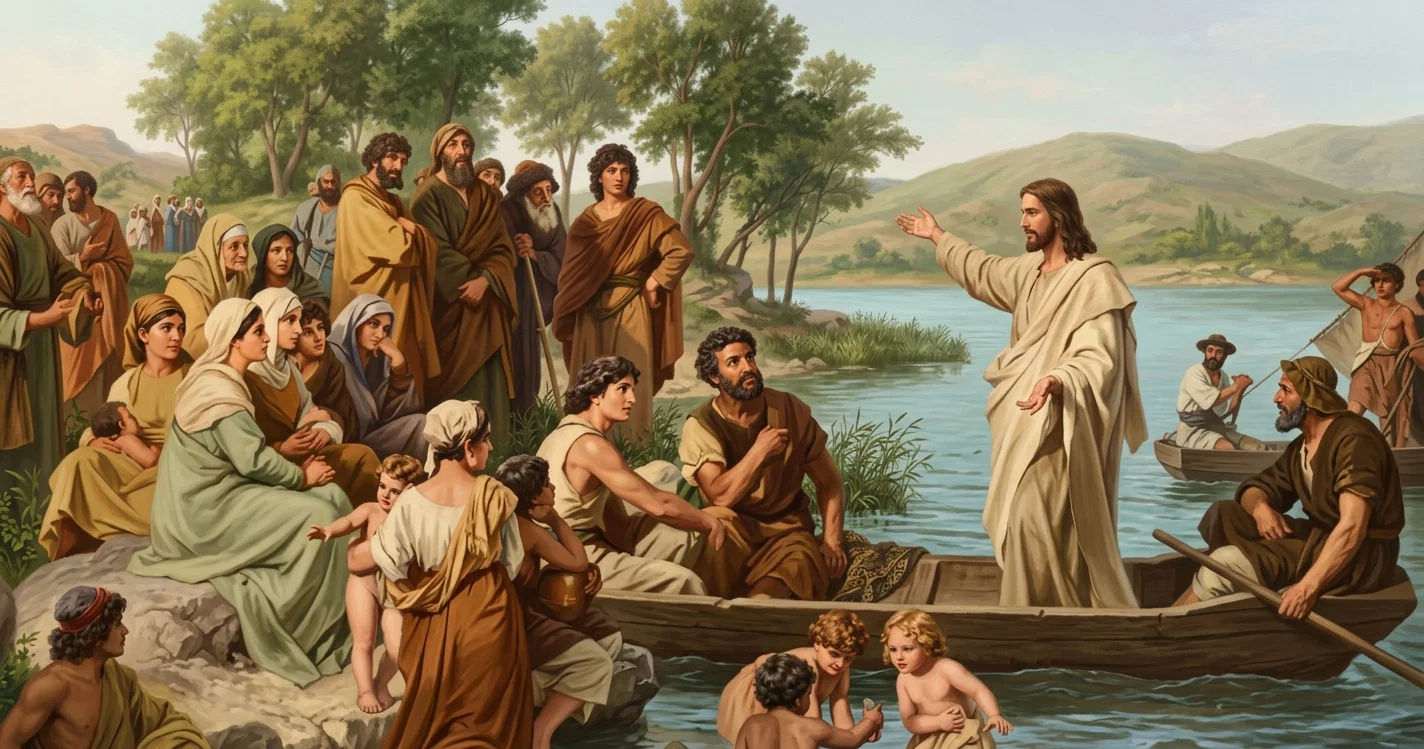
“And great multitudes were gathered together unto Him, so that He went into a ship. . . . And He spake many things unto them in parables, saying, Behold, a sower went forth to sow.” Matt. 13: 2, 3.
The experience of the Christian in his earliest love is full of simplicity and freshness; but as his opportunities multiply, his experience should enlarge, and his knowledge increase. He should become strong to bear responsibility, and his maturity should be in proportion to his privileges. But the young convert is not to worry or perplex his mind with questioning as regards his advancement and growth. He is to trust himself wholly to Jesus, and with fear and trembling work out that which God works in; for it is God that works in you, both to will and to do of His good pleasure. Advancement in Christian experience can be accomplished only through coöperation with heavenly agencies, for it is a result of growth in grace. Feeling his helplessness, the young Christian is to place himself in the channel of light, and improve all the
opportunities that are graciously bestowed upon him, that he may gain a deeper experience, and take deep root in Christ, as the plant roots in the soil. His faith must increase, his consecration be maintained, his love be made perfect, as is represented by the blade, the ear, and the full corn in the ear. His zeal should be ardent and tireless; and with unwavering trust in Christ, his growth may be unmarred, for a genuine experience will result in the development of a Christlike character.

Our Dependence Must Be Constant

But unless there is an hourly dependence upon Christ, increasing knowledge and privileges will result in self-trust and self-righteousness. The young Christian is indanger of forgetting that it is Christ that has begun the good work in him, and that it is Christ that must finish it. The soul must renounce all merit, and trust wholly in the merit of Him who is too wise to err. Man of himself can do no good thing. Said Jesus, "Without Me ye can do nothing." The soul is to stay itself upon God. In the gift of Christ all heaven was poured out, and through Christ the Holy Spirit is promised to the believer. Jesus said to His disciples, "The Comforter, which is the Holy Ghost, whom the Father will send in My name, He shall teach you all things, and bring all things to your remembrance, whatsoever I have said unto you." Christ not only offers pardon to the believing, repenting soul, but He promises him the constant aid of the Holy Spirit.

Unseen Agencies Develop the Plant

In the growth of the seed in the soil, man can not see the working of unseen agencies that develop the plant to perfection, bringing up first the blade, then the ear, then the full corn in the ear. But tho young in the faith, you may know that you have passed from death to life, if the fruits of the Spirit are made manifest in your life. If you are growing in faith and hope and love, you may know that your spiritual vision has been cleared. If you delight to dwell upon the plan of salvation, upon the glorious manifestations of the divine character,—if your heart, in contemplation of the love of God, glows with thankfulness and joy,—you may be sure that you have been illuminated by the beams of the Holy Spirit, and heavenly agencies are bringing your character up to maturity of Christian life. You may not realize that you are growing up into Christ, your living Head. Your part is simply to submit your ways and your will to God. You are to trust yourself fully to God, knowing you can not make yourself grow. A Paul may plant, and an Apollos may water; but it is God that gives the increase.

The New Creation and the Sabbath

For in six days the Lord made heaven and earth, the sea, and all that in them is, and rested the seventh day: wherefore the Lord blessed the Sabbath day, and hallowed it. Ex. 20:11.
ERE the seventh day is set forth as a sign of the Creator's rest, a seal of creative power, vested only in Him; as a memorial of His distinguishing title, which is, Creator.
In Ps. 111:4 we read that God "hath made His wonderful works to be remembered." Just as this nation has made its independence to be remembered, by setting apart the fourth day of July as a memorial, so God has set apart the seventh day of the week as His memorial.
Just as the signing of the Declaration of Independence on the fourth of July fixed that day unchangeably as Independence Day, so God's resting on the seventh day fixed that day unchangeably as the Sabbath day.
Just as long as creation stands, just as long as God's wonderful works endure, His memorial should and will stand; and any new manifestation of creative power must only give the memorial, if possible, a surer footing.
When God undertook the deliverance of the children of Israel from Egyptian bondage, Pharaoh denied the existence of the God of Israel as the Creator and supreme Ruler. He said: "Who is the Lord, that I should obey His voice to let Israel go? I know not the Lord, neither will I let Israel go." Moses was teaching the people to observe the Sabbath, the memorial of God's name as Creator. Therefore Pharaoh charged Moses with making the people rest; and he not only laid more work upon them, in requiring them to gather stubble for straw, but also insisted that they deliver a certain number of bricks every day. This made it impossible for them to keep the Sabbath. Thus Pharaoh not only denied God as Creator, but also set aside the Sabbath, His memorial.
In Ex. 9:16 God says, "And in very deed for this cause have I raised thee up, for to show in thee My power; and that My name may be declared throughout all the earth." The issue being thus squarely set forth, God proceeds to vindicate His right as Creator and supreme Ruler. He gave exhibitions of the superiority of His power over all the gods of the Egyptians. He showed His power to control the elements, and cause them to do His bidding, as the hail, lightning, darkness, etc.

Creative Power Exercised

He exercised creative power in producing frogs, lice, flies, locusts, etc., and later by feeding the multitudes in the wilderness with quails and manna.
During all this, great prominence was given the Sabbath, that being the point of controversy before they left Egypt, being made the test of their obedience before they reached Mount Sinai, and finally receiving its place of prominence in the bosom of the law spoken by the voice of God amid the thunders of Sinai and afterward written with His finger on two tables of stone.
It is also worthy of notice that the Lord, in feeding the people with bread from heaven, followed the same course pursued by Him in creating the world; for He did not create manna on the seventh day.

The Promised Rest Remains

In Heb. 3:11-18; and 4:1-3, in reference to the experience of the children of Israel, we read: "So I sware in My wrath, They shall not enter into My rest. . . . And to whom sware He that they should not enter into His rest, but to them that believed not? So we see that they could not enter in because of unbelief. Let us therefore fear, lest, a promise being left us of entering into His rest, any of you should seem to come short of it. For-unto us was the Gospel preached, as well as unto them: but the word preached did not profit them, not being mixed with faith in them that heard it. For we which have believed do enter into rest." Also in Heb. 3:7-13 we read: "To-day if ye will hear His voice, harden not your hearts, as in the provocation, . . . in the wilderness. . . . But exhort one another daily, while it is called To-day." And in Heb. 4:7: "He limiteth a certain day, saying in David, To-day, after so long a time; as it is said, To-day if ye will hear His voice, harden not your hearts."
Thus we find that God offered His rest to the people in the wilderness, and in David's day, and in the apostle's day; and by the Holy Ghost He is still offering it even in our day, saying that to-day, if you will hear His voice, you may enter into rest. We also learn by Heb. 4:2 that this rest is presented in the Gospel. Hence ever since the Gospel was first proclaimed in the promise that the seed of the woman should bruise the serpent's head, even to the last lingering moment of probationary time, it has been and will be, "To-day." For now is the acceptable time; to-day is the day of salvation; and to-day, just as it has been in all the past, those who believe do enter into His rest, while others shut themselves out through unbelief. As stated in verse 9, "There remaineth therefore a rest to the people of God."

How We May Enter into Rest

Verse 10 tells us that we must cease from our own work to enter this rest, even as God ceased from His. But our works are works of sin; hence to enter God's rest we must cease from sinning. The only way to do this, is in Christ Jesus. But "if any man be in Christ, he is a new creature," or creation, and can then enter into God's rest; for as God rested and was refreshed while He contemplated the work of a new creation, even so the one who can look into his own heart, and see the transforming power of the Spirit of God creating him anew in Christ Jesus, can and does rejoice in a new creation, and is thus entering into God's rest.
But altho this rest remains, and is an abiding, continual rest, excepting where it is broken by sin, God has set apart the seventh day as the outward sign of this rest; for the apostle says that God's works were finished from the foundation of the world. As proof of this he cites the fact that one "spake in a certain place of the seventh day on this wise, And God did rest the seventh day from all His works."
Altho sin came in and disturbed this abiding rest, still God did not do away with the outward sign, but permitted it to remain, not only as a sign, but also as a pledge of the final restoration of all things. Hence He says of His people, "Moreover also I gave them My Sabbaths, to be a sign between Me and them, that they might know that I am the Lord that sanctify them." Eze. 20:12. Thus the Sabbath becomes at once the sign both of creative power in calling the world into existence at the first, and also of creative power manifested in redemption.

How Are You Related to God's Rest?

But the children of men are making many mistakes in this matter of God's rest. Some are ignoring both the rest and the sign; others are ignoring the rest and wearing the sign; while still others are seeking the rest but ignoring the sign. O that the first class would acknowledge God, and obtain His rest, and wear His sign! O that the second class would retain the sign, and allow God to flood the soul temple with His rest! and that the third class, accepting the fulness of His rest, may not be ashamed of His sign, lest in so doing they find themselves among those who are denying God's name.A young Scotchman, being required to pass through territory belonging to a clan antagonistic to his own, removed from his person the badge by which his clan was identified, and by so doing he certainly denied his name.

Do Not Set Aside God's Rest

We are now in an enemy's land. Let us be very careful not to set aside the memorial of our Father's name, that which He has established to be the distinguishing sign of citizenship in His country. For when the last one has been found who will allow himself to be made a new creature in Christ Jesus; when Jesus shall come to set up His kingdom; when the work of re-creating shall be completed, and the earth shall stand forth in all its Edenic beauty,—then shall God, together with every loyal subject of His eternal kingdom, enter into the fulness of His rest, by rejoicing in this renewed and finished creation. Then shall the seventh day be observed by all the redeemed throng as the outward sign of their eternal, abiding rest; for we read in Isa. 66:22, 23: 'For as the new heavens and the new earth, which I will make, shall remain before Me, saith the Lord, so shall your seed and your name remain. And it shall come to pass, that from one new moon to another, and from one Sabbath to another, shall all flesh come to worship before Me, saith the Lord.' There remains therefore a rest and the keeping of the Sabbath to the people of God.

The First Place of Christ's Kingdom

The Kingdom of Christ—No. 1

The First Place of Christ's Kingdom

IN the Word of God, Christ's kingdom is presented to us under three distinct phases. Under the third and last it is fully developed, and rounded out in completeness, and it will stand forever. The subjects of Christ's kingdom in this world are the members of His body, His church; and their names are written in heaven. Their King is a Priest-King on the throne of grace in heaven. The law of His kingdom is the Word of God. His ministers are the Holy Spirit and the holy angels.
Every subject of Christ's kingdom has become such by a deliverance from the power of darkness, the kingdom of Satan, and a translation into the kingdom of God's dear Son. Col. 1:13. This translation is a conversion, a regeneration, a transformation, which brings the kingdom of Christ into the heart and life of each individual subject. The Father, Son, and Holy Spirit, as one, are said to abide in the true believer; and hence the principles of the kingdom of Christ, righteousness, peace, and joy in the Holy Ghost, all abide in the soul. They have the mind of Christ. Their thought life is brought into obedience to Christ. Likewise their word life, their deed life, yea, their whole life, is brought into sweet harmony with the divine will.
Thus to such the kingdom of God has come, and the will of God is done by them on the earth. Every true child of God is a miniature kingdom of God on earth. Christ dwells within them, and rules over every desire, purpose, and aspiration of the heart, and over every member of the body, and faculty of the mind.
This first phase of Christ's kingdom is contemporary with the first phase of Satan's kingdom on the earth, and every subject thereof is a constant target for the darts, snares, and temptations of the great adversary; and they can only hope to be overcomers, by setting their faces as flints Zionward, and drawing grace and strength every day, according to need, from the throne of grace, which is always and everywhere accessible.
The King of Grace has made ample provision for the triumphant life of all His subjects. Exceeding many, great, and precious promises are given them, whereby they may become partakers of the divine nature, and escape all the corruptions that are in the world. They may fall in death, and be shut up in the prison-house of their great enemy. But their glorious King has the keys to the grave, and the gates of hell can not prevail against His subjects. When this first phase of Christ's kingdom shall end, there will come a day of deliverance and everlasting triumph over their last enemy.
H. A. ST. JOHN.
Continue reading: Theosophy