Your ShelfYour Projects

Signs of the Times, Vol. 27, No. 47.

BEGGARS

Signs of the Times

Nov 20, 1901

Pacific Press Publishing Company · Oakland, California · Nov 20, 1901

BEGGARS
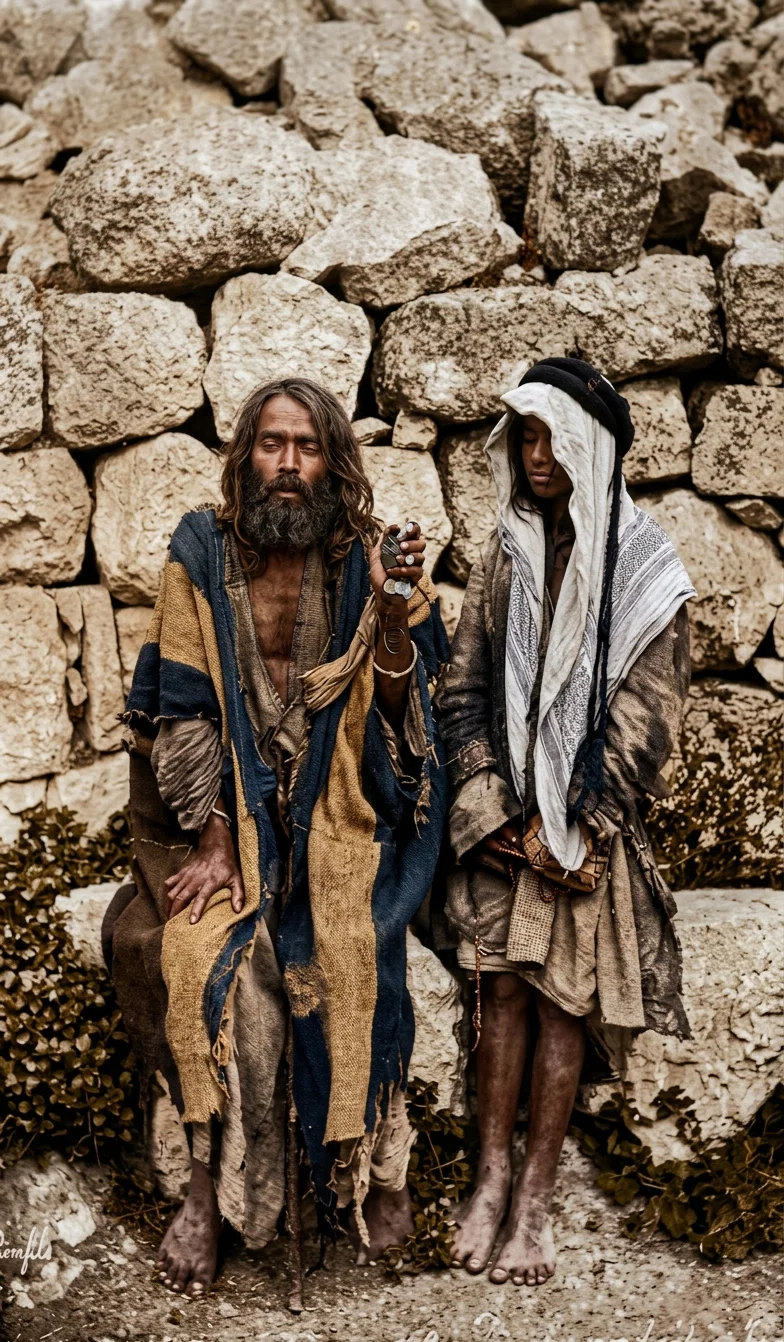
Only two beggars, that is all, Poor and blind, by the ruined wall; Thus to live and thus to die, Asking an alms of the passers-by; Earthly dole for their hungry moan, Bits of bread or a half-picked bone, The smallest coins that men can give Strained through a fine-meshed conscience sieve; Given to ease a conscience smart; Given to soothe a pricking heart, That’s taken more than a righteous part In the buy and sell of earthly mart; That hopes to save a stingy soul By giving alms, a meager dole; That gathers in pounds the gifts of God, That gives in farthings that men may laud; That worships at the shrine of Greed, Recking naught of the beggar’s need. How will such fare when by and by They stand before the Judge on high?
BLIND BEGGARS OF JERUSALEM.
Only two beggars, that is all, Limned against the broken wall; Sitting beside the great highway, Begging a pittance day by day; Pitied and helped by the needy poor, Hated and shunned by the wealthy boor. And yet God’s poor are these destitute, With blinded eyes or voices mute, With deafened ears or crippled frame,— Their utter need pleads in His name.
“Not pleasing?”—Surely not. To grace With silks the form, to adorn the face Dire poverty hath no means to spare; ’Tis daily dole for the daily fare.
Ragged, dirty, and ugly withal, Are these beggars twain by the broken wall.
Yet who notes what pain the soul passed through Ere he came to beg? How oft the clue Was almost within his eager grasp, But lost to sight ere the hand could clasp! And o’er and o’er and o’er again, Up hill and down, through bog and fen, In the murky air of a starless night, In the day’s full glare by foes affright, He strove and journeyed, fought and fell,— O, we could not the full tale tell Of the man who failed and lost his all Who now is the beggar by the wall, Or a mendicant by Dives’ gate; But place him with the rich and great, Clothe in royal robes the dole-fed man, And, lo, there is lifted all the ban. Men cringe, and bow the supple knee To him they refused small charity. ’Tis place and dress that make the man, Or place him under the proud world’s ban.
Only two beggars, that is all, Poor and blind by the city’s wall, Called all day in the long ago By the road that ran through Jericho; Called for alms from the passers-by, Called with insistent, clamorous cry, When the sounds of gathering throngs they hear Drawing the city’s gates anear. They ask the tumult; they get reply, “Jesus of Nazareth passeth by.” They’ve heard the fame of His wondrous love, Of the light and life brought from above; And from out the dark of a blinded night, They plead that His power may give them sight. O, He came, He died, to save the lost; The awful Need made the fearful Cost.
And His ear ne’er dulled to faintest cry, His heart e’er touched by the soul’s faint sigh, His hand that hurled forth the spheres above, Filled with the life of an infinite love, Touched the sightless eyes with tender grace, And bathed the soul in light of His face. And He changed the beggar by the way From a child of night to a son of day, And lighted the darkened soul of strife With the light of love, the gift of life.
O, we are mendicants, one and all, As beggars blind by the ancient wall; Are poor, whatever of coin we claim, Are wretched, whate’er may be our fame, Are ragged, whate’er may be our dress, Garbed in the rags of our righteousness; Are blind, whatever we claim to see, Are nothing, whatever we claim to be. Aye, all that we need, we lack it all Truly as the beggars by the wall. But all that we need in Him we find, For the weary, rest; sight for the blind; To the poorest soul He granteth wealth, To the sickest soul He giveth health; From beggared soul takes its own mean dress, And clothes it in robes of righteousness.
’Tis by character God measures men, By character He will judge them when They stand before His judgment bar, Not what they think, but what they are. Then Dives, who lived on sumptuous fare, Who worshiped himself in praise and prayer, Who to the glories of truth was blind, Will be left to self with all its kind, Will be left to feed on self’s poor store, With self shall perish forevermore. But he who suffered affliction’s fire Shall hear the voice, “O friend, come higher;” From his beggar’s bed at Dives’ gate He’ll reign in realms of a new estate; He trusted God in his direst need, And shall of His choicest viands feed, Shall sit with Christ upon His throne, No more to utter the beggar’s moan; For the poor who enter heaven’s door, Who have begged of God, shall beg no more.

THE LAW OF GOD

THE LAW AS A WHOLE.

What do we mean by the term “law”? We speak of the law of gravitation. But when we say “law of gravitation,” do we mean to say that the three written words composing that phrase are the law referred to?—O, no. We mean that force in nature which is in operation between all separate bodies, and which, under favorable circumstances, draws the smaller to the larger,—the force which draws the apple to the earth, severing it from the tree as soon as ripe. It is true that throughout the entire realm of so-called natural law, the living force, and not the written description of that force, is the law. And this is why it is suicidal for anything less than the law to attempt a permanent resistance of it.
The eagle may think his strength sufficient to resist the law of gravitation indefatigably; but if so he is deceived, for sooner or later the muscles tire, they lag, and finally succumb to the ever-present, never-tiring power which bids them surrender. If he contends too long, his life will pay the penalty.
The locomotive, on his track of steel, may speed his way for a time, with screams of defiance; but within a few short years he is as docile as a lamb. Overcome by that law which we call “friction,” his bones are at last strewn by the wayside, or consigned to the junk-shop. These simple illustrations from the natural may aid us to form right conclusions in our brief study of the spiritual.
We have all read in the Bible that “God is love.” We have also read that “love is the fulfilling of the law.” It is therefore evident that God Himself is the fulfilling of His law. We have read again that “God is a Spirit,” and that “the fruit of the Spirit is love,” against which “there is no law.” It is therefore again evident to all that God has no law against Himself.
It is “the carnal mind” which “is enmity against God; for it is ‘not subject to the law of God, neither indeed can be.’” “The law is ‘spiritual; but I am carnal, sold under sin.’” Apart from Satan and his angels, carnal (natural) man is the only thing in the entire universe of which we know, that has attempted a resistance to the God of heaven as He is manifested in His law of love. But resistance is transgression, transgression is sin; and “the wages of sin is death.”
Did you note the reason given why it is that the carnal mind is enmity against God? It was this: Because “it is not subject to the law of God.” Now there was a time when the natural man was spiritual: “And God said, Let us make man in our image, after our likeness, ‘and let them have dominion. . . . So God created man in His ‘own image, in the image of God created He him; male and female ‘created He them.’”
“In the image of God”—“after our likeness,” Jehovah said. Every impulse of such a man, mental, moral, physical, all in perfect unison with his Creator. “God is a Spirit.” That man and his wife must have been spiritual. “The law is spiritual.” The Creator, the created, the law, all in harmony.
For such a man, a written prohibition of all the sundry sins which we now know, was unnecessary. One prohibition only—and that merely to test his love, for love untested is weak: “And the Lord God ‘commanded the man, saying, Of every tree of the garden thou mayest ‘freely eat; but of the tree of the knowledge of good and evil, thou ‘shalt not eat of it; for in the day that thou eatest thereof, thou shalt ‘surely die.’” “Love envieth not, . . . seeketh not its own.” How, then, can love consent to take that which is another’s—and that also which has been denied it?
But the woman was “beguiled” by the tempter. Adam’s love to her decided him to share her fate. The chord of love was broken; the law of love transgressed. “By one man sin entered into the ‘world, and death by sin.’” Now “sin is the transgression of the ‘law;” and, “Where no law is, there is no transgression;” nor yet is sin “imputed when there is no law.”
Recalling the fact that God is the fulfilling of the law, it is readily seen that anything contrary to the character of God is sin—transgression of the law. Therefore the first ungodlike thing that our first parents did was to partake of the forbidden fruit. However, notwithstanding the fact that there was at that time but one prohibitory command given, yet the law of God was just as broad in that day as at any subsequent time; and that because God’s character was as infinite then as now. “I am the Lord, I change not.”
To name in detail every separate virtue, and command it, or to name every sin which might be committed, and forbid it, would mean a statement of every separate virtue of the Infinite One, with its antipode. It seems reasonable, then, that spoken or written law must needs deal in principles more than in specific details.
The written law was not given until the days of Moses. “Nevertheless death reigned from Adam to Moses.” “Death” came “by ‘sin,” and “sin is the transgression of the law.” So death, sin, and law, yes, the law (for sin is not simply the transgression of law, but “sin is the transgression of the law”)—all these reigned from Adam to Moses. But death has not yet ceased; therefore sin is here, and so is the law.
When asked, “Which is the great commandment in the law?” the Son of God replied: “Thou shalt love the Lord thy God with all thy heart, and with all thy soul, and with all thy mind. This is the first and great commandment. And the second is like unto it, Thou ‘shalt love thy neighbor as thyself. On these two commandments ‘hang all the law and the prophets.’” “The law and the prophets,” or, “Moses and the prophets,” is a term understood by all to include all the Holy Scriptures then written. Now love to God is not one thing and love to fellow-man another; for, “By this we know that we ‘love the children of God, when we love God, and keep His commandments. For this is the love of God, that we keep His commandments; and His commandments are not grievous.”
But did not Jesus give a new commandment, one which has been termed an “eleventh”? and did it not supersede all that were given before it? He said: “A new commandment I give unto you, That ‘ye love one another; as I have loved you, that ye also love one ‘another.’” “Love is the fulfilling of the law.” Therefore, the so-called “eleventh” is but the fulfilling of the ten, and is also called by the Saviour the first commandment of the law, as we have so recently seen.
But the statement that we should love the Lord with all the heart was not first written in Matthew 22. It was written in Deut. 6: 4–6: “Hear, O Israel: The Lord our God is one Lord; and thou shalt love ‘the Lord thy God with all thine heart, and with all thy soul, and with ‘all thy might. And [in this condition] these words, which I command ‘thee this day, shall be in thine heart; and thou shalt teach them diligently unto thy children.’”
As a result, then, of loving the Lord with all the heart, the commandments which were given them that day would be in the heart. Now anybody knows that that which love, real love, God’s love, would bring into the heart at one time, simply by its presence being there, it would bring at all times whatsoever.
What were the commandments given them that day? For it is expressly stated that “these words which I command thee this day” are the words which will be in the hearts of all who love the Lord with all the heart. This was the occasion: “And Moses called all Israel, ‘and said unto them, Hear, O Israel, the statutes and judgments ‘which I speak in your ears this day, that ye may learn them, and ‘keep, and do them.’” Then, after a few preliminary statements, he follows with the blessed words which the Lord our God spoke with His own voice to sinful man. “These words,” says faithful Moses, “‘the Lord spake unto all your assembly in the mount out of the midst ‘of the fire, of the cloud, and of the thick darkness, with a great voice; ‘and He added no more. And He wrote them in two tables of stone.’” Then follows a statement of their terror at the glory, majesty, and power of that transcendent time; and then, the reply of Jehovah: “‘I ‘have heard the voice of the words of this people, which they have ‘spoken unto thee; they have well said all that they have spoken. O ‘that there were such an heart in them, that they would fear Me, and ‘keep all My commandments always, that it might be well with them, ‘and with their children forever!’” And without any break at all in the theme, Moses says, “Now these are the commandments, the stat- ‘utes, and the judgments, which the Lord your God commanded to ‘teach you, that ye might do them in the land whither ye go to possess ‘it.’” Another exhortation or two, and then, in direct reference to what is under consideration, he says: “Hear, O Israel: The Lord our ‘God is one Lord; and thou shalt love the Lord thy God with all thine ‘heart, and with all thy soul, and with all thy might. And thesewords, which I command thee this day [the Ten Commandments ‘being those words], shall be in thine heart.”
“The Lord came from Sinai, and rose up from Seir unto them; ‘He shined forth from Mount Paran, and He came with ten thousands ‘of saints; from His right hand went a fiery law for them. Yea, ‘He loved the people.” He gave the holy law, the Ten Commandments, because He loved the people; the people receive, and keep, and do it, when they love God. “I delight to do Thy will, O My God; ‘yea, Thy law is within My heart.”
The question may arise in some mind why it was that the law of God was not given in a written form until about twenty-five hundred years after the creation. The answer is not hard to find. It took time so to mar and corrupt the “image of God” in man’s mind and character, that he could not accurately and readily receive, and correctly transmit ideas and thoughts which had been spoken to him.
Have you ever wondered at the phonograph—its wonderful accuracy in receiving impressions of words and sounds of every kind? Have you ever thought of the possibility of the Creator having formed man in the beginning, that way? Have you thought of the camera, and of its accuracy in taking impressions of all things visible? and have you thought that man’s mind was equal also to that? Man was God’s masterpiece in the creation of the earth; for He gave him dominion over all. The Almighty is the greatest inventor, and man was His greatest invention.
We have already shown that the law of God existed every moment of the time between Adam and Moses; that it is the character of God Himself, and therefore co-existent with Him. Do you not think Him wise enough to know when to give it in the written form? We have also noticed that a naming of every separate transgression which it would be possible to commit would involve the naming of everything which is opposite to God’s way of doing. Shall we not, then, agree that He knew how many commands to give in order to cover the principles of righteousness?
Had man retained the perfect image of God, he would understand every duty in the one word “love.” As he departed farther, the word needed to be expanded to, “Love God, and love fellow-man.” Then, “Love the Lord thy God with all thy heart, and thy neighbor as thyself.” After that, the Ten Commandments. And these had to be still further drawn out in detail in order that sinful man could understand their definite application to his personal case. Thus it is, and thus it will ever be, that the farther man is removed from his Maker, the more numerous will need to be the commands and prohibitions; and the nearer he draws to God, the fewer the commands necessary.
All the commands ever given are comprehended in the ten; the ten are all comprehended in the two; and the two are both in the one, namely, “love.” And “God is love.” Let us worship Him.
E. J. Hibbard.

“THE GREATEST THING IN THE WORLD.”

(Concluded.)
[Sermon by Pastor G. E. Fifield, preached at the camp-meeting at Ellsworth, Me., 1900, and written out for publication in the SIGNS, by request of the editor, who was present.]
TEXT.—“And now abideth faith, hope, charity, these three; but the greatest of these is charity.” 1 Cor. 13:13.

Love’s Transforming Power.

THIS is the love of God, and in this love is our only hope. We read, “God so loved the world, that He gave His only-begotten Son.” The word “world” is in the original “cosmos.” Cosmos means order, arrangement, symmetry, beauty. But the world was out of order, out of harmony, out of symmetry, almost a chaos instead of a cosmos. But underneath the rubbish of evil, underneath the chaos which sin had made, God’s keen eyes of love saw the beauty of the possible cosmos, and loved it so that He gave His own life in His Son to bring it out and make it eternal.
In the very beginning of the inspired Word we read that “the Spirit of God brooded over the chaos.” Ah! this brooding love, this love not of what is, but of what is to be, this love not of the present, but of the possible. Why does the hen brood over the eggs? Why but that she may bring out the possible chick? Why does she brood over the little chick? Why but that she may develop it into the possible hen? It is thus that God’s love even now broods over the chaos in every human heart, that it may bring forth the new creation where all is joy and beauty eternal.
It was thus that Jesus, in manifesting the love of God, brooded over the rebellious Jewish nation. “O Jerusalem, Jerusalem, . . . how often would I have gathered thy children together, as a hen gathereth her brood under her wings! and ye would not!” This is the love of God. When the Scripture speaks of the love of God, it does not mean simply our love to God, but rather God’s love in us, and acting the same in us that it does in Him,—giving itself here in and through us for others to bring out the possible in them. This is the only true way of looking at men. Even of the best men, John says, “Beloved, now are we the sons of God, and it doth not yet appear what we shall be.” The best man, then, is but an embryo of some future glory beyond our utmost dreaming. “Eye hath not seen, nor ear heard, neither hath entered into the heart of man” the full glory that God hath prepared for him. Christ is the light that lighteneth every man that cometh into the world. So, also, in the worst man, until he entirely crucifies it, is the germ of this Christ life,—this eternal and beautiful life. Each man, then, is a promise and prophecy of some future possible glory. How this heightens the interest with which we should behold men. I go out into the fields and woods, and pick up first a little pebble, and then an egg from some song-bird’s nest. Which is the most interesting object? They are of the same size, and shape, and color, and degree of smoothness. Why is the egg so much more interesting? It is because now I see the pebble at its best estate, it will never be anything but a pebble, but the egg is a prophecy of future glory. Give it a chance, and it will develop into a beautiful song-bird to sail the air and pour forth its song of praise.

Seeing as God Sees.

So man, suffering, sinning man, takes on a new interest and a new glory when we behold him thus. Carlyle beautifully says, “With other eyes could I now behold my fellow-men, with an infinite love, an infinite pity. Poor wandering, wayward man! Art thou not tired and beaten with stripes even as I am, and ever, whether thou wearest the royal mantle or the beggar’s garbardine, thou art so weary and so heavy laden, and thy bed of rest is but a grave. O my brother, my brother! why can I not take thee in my bosom and wipe all thy tears away! Man with his so mad wants and so mean endeavors had become the dearer to me, and even for his sufferings and his sins I now first named him brother.”
Every man, look we but keenly enough, carries written in his face the tragedy, the comedy, the history of a human life, with its struggles, its hopes, its fears, its joys and disappointments; but alas, this is all written in the hieroglyphics of the heart, and in these days of commercialism, when the veins of too many men seem to run not a warm life blood, but a sort of detestable copperas banker’s ink, this is becoming an unknown tongue. A few years ago men did not understand the arrow-head inscriptions. The men of Assyria and Babylonia seemed an infinite distance removed from us in the misty labyrinths of a traditionary past. Yet the rocks of their native lands were covered with these inscriptions. Men were not even sure that they were a language. But the Orientalists reproduced the language and the grammar of a far-off age, and, translating these inscriptions, wrote the history of those peoples till they now seem to us real and near and a part of the human brotherhood. O, that some new student, learned in the lore of human experience, might decipher these heart hieroglyphics, and so bring us sympathetically nearer to the sinning, suffering brotherhood of the human race. It is well that we do not understand these signs while we are selfish ourselves, for we would misuse the knowledge we should gain. But Christ will become our interpreter as we partake of His Spirit, and under His tuition we may become so keen of vision as to see Him in all men. For is He not there? Did He not say that His life was the true light that lighteneth every man that cometh into the world? and, Inasmuch as ye do it unto one of the least of these My brethren, ye do it unto Me?
Only the pure in heart can see God. If I can not see Him, it is not that He is not omnipresent, but it is the evidence of my own impurity and consequent blindness. Jesus lived the life of God perfectly here in human flesh. He said, “He that hath seen Me hath seen the Father.” But the jealous, envious, self-seeking Jews put Him to death because they said He had a devil. Hatred and envy can look straight in the face of God and see a devil there. But “blessed are the pure in heart; for they shall see God.” We go too far to find God and render Him service. He is not in heaven only, that we should ascend to bring Him down. He is not in the deep, that we should go down to bring Him up. He is nigh thee. We try to push our love off into space, hoping it will find Him somewhere; but it is here in the persons of the sinning and the suffering that He is hungry and thirsty for our love.
You have all heard of the legend of the Holy Grail so beautifullywrought into poetic verse by James Russell Lowell in “The Vision of Sir Launfall.” The Holy Grail was the bowl out of which Christ partook of the last supper with His disciples. It had been lost, and whoever should find it would perform a meritorious act, and, in finding the Grail, they would find the Lord. As I remember the poem, Sir Launfall took upon himself the pledge to leave his ancestral home in pursuit of the Grail and never return until he had found it. One bright June morning, splendidly mounted on a magnificent charger, he left the palace and the castle of his fathers, and went upon his search. As he rode down the hill from his home, he saw a beggar cowering in the street, and asking an alms. Sir Launfall flung the coin to him haughtily, with averted face, and went upon his way. For many, many years he searched, ever with failure and loss and disappointment. He did not find the Holy Grail. He did not find the Lord. Finally, grown old and poor and weary and discouraged in his fruitless search, he turned back toward his childhood’s home. In his heart he said, “I took upon myself the pledge never to go back to the old home till I had found the Grail; but it is of no use for me to seek longer. I may as well give up the pledge, and see the old place once more before I die.” So one bleak December morning finds him, worn and weary and old, slowly climbing on foot the hill to the old mansion. At the same turn in the road he finds a beggar as disreputable looking as the one he barely remembers of old. He said to himself, “Well, here is a failure, a disgusting failure,” and was about to pass by. Then the thought came to him as he looked at himself, “Well, here is another failure. Am I not a failure, a disgusting failure too?” His heart had to own that he was. A feeling of sympathy grew in his heart for the poor beggar. It was as if he said to himself, “Well, there are two of us here, two of a kind.” He felt in his pocket for his last coin. He gave it to the beggar, and this time he gave his heart with the coin. It went out to the beggar in sympathy and love. The legend says that instantly the old beggar was transformed into the image of the Lord and Saviour Jesus Christ, and he found there at his very door what he had sought in vain all the years of weary wandering. Ah yes! we seek too far for the Lord. He is all around us in the persons of His suffering ones; and it is here that He most needs our love.

The Meaning of Charity.

That this love which gives itself to bring out the possible in others is the real meaning of the word “charity” in my text, every verse of the chapter from which it is taken shows. “Tho I speak with the tongues of men and of angels, and have not charity, I am become as sounding brass and a tinkling cymbal. And tho I have the gift of prophecy and understand all mysteries, and all knowledge; and tho I have all faith, so that I could remove mountains, and have not charity, I am nothing. And tho I bestow all my goods to feed the poor, and tho I give my body to be burned, and have not charity, it profiteth me nothing.” All this, without the motive of love in the heart, is external and formal. Men have become so proud because they were humble that they would stand for years on a pillar and let the people worship them. But spiritual pride is not love, but rather the meanest kind of pride. No motive but this love of which we have spoken will ever accomplish the work which we as a people have undertaken under God. It is love only which will preach this Gospel of the kingdom in all lands. All other motives are the strange fire which desecrates the altar. If anything I say to you to-day shall be of permanent benefit to you, it will not be because of any beauty or eloquence of language; it will rather be because some of the love which the blessed Christ has put into my heart has thrilled along the line of the words which I have spoken, and so got into your heart to abide there.
“Charity suffereth long.” Yes, says some one, “I have suffered long.” Well that is not enough. Did you keep sweet about it? That is the real question. “Charity suffereth long, and is kind.” “Charity envieth not.” Envy is the feeling of discomfort that comes to us when we see others advanced in positions of power and trust. But how can we feel that discomfort if we love them so as to be willing even to give our lives to bring out these capabilities, and make them worthy of such advancement? Nothing is clearer now than that charity can not envy.
“Charity vaunteth not itself, is not puffed up.” The egotist is always the small man. He is so narrow and near-sighted for lack of love that he does not see the good in others, and so imagines that it is all centered in himself. Charity sees so much good in all men that it can not but keep humble.
Charity: “doth not behave itself unseemly, seeketh not her own, is not easily provoked, thinketh no evil.” Charity, as we have seen, is too busy seeking the good of others, too full of love for all, ever to be selfish or petulant. How can she think evil, when she is thinking good of all men, and wishing good for all men. She would rather be mistaken a thousand times in thinking a man good when he is really evil, than once in thinking him evil when he is good. He that thinks good of one helps to make him good, and is a part of God’s great plan to save him; while he who thinks evil of a man is a part of Satan’s plan to destroy him.
Charity “rejoiceth not in iniquity, but rejoiceth in the truth.” How often we see a pious (?) church-member who, when some one has fled to Canada, perhaps with another man’s wife, or with some money that is not his own, can not wait to do up the breakfast dishes. She must leave them standing while she goes the rounds of the neighborhood telling every one the delicious morsel of scandal, and, because she wants a monopoly of it all herself, making each one promise not to tell. This is rejoicing in iniquity. Sometimes I have thought it would be impossible to hold a successful tea party or sewing circle in the New Jerusalem. There will be no moral or spiritual corpses there to dissect, and, thank God, there will be no one there who wishes the employment of dissecting them. Charity refuses to believe evil until compelled to by the evidence, and then receives the word with reluctance, with tears.
Charity “beareth all things, believeth all things, hopeth all things, endureth all things. Charity never faileth: but whether there be prophecies, they shall fail; whether there be tongues, they shall cease; whether there be knowledge, it shall vanish away. . . . When I was a child, I spake as a child, I understood as a child, I thought as a child; but when I became a man, I put away childish things. For now we see through a glass, darkly; but then face to face; now I know in part; but then shall I know even as also I am known.”
Prophecies were only the secondary means of communion with God when sin had denied us the first. With them we see here as through a glass, darkly, but then face to face. We know not, perhaps, in what language man first spoke of God and sung His praise. We do know that sin, beginning at Babel and extending to the present time, has been the separating, confusing power which has divided and multiplied earth’s languages, thus breaking up the human brotherhood. Some day all these languages will give place to that one perfect and universal speech in which eternity can best hymn God’s praise. Then there will be no longer Jew or Greek, but all will be one in Christ Jesus. Our knowledge, too, it shall vanish away. True, all truth is eternal; for God is the truth. But we know so little as yet of the absolute truth. We talk learnedly of gravitation and of electricity, and we know not even what they are. We hide our ignorance, even from ourselves, under sounding words, and so feel wise. An ordinary lamp will illuminate our bed-chamber so we can see to disrobe; but if we set it, still burning, in the eastern window while we sleep, when we awake, and the great sun has arisen, flooding the earth with its light, we shall notice that in those powerful rays the very flame of that lamp will cast a shadow on the wall. It is thus that our little knowledge will vanish away in the great in-coming flood-tide of eternal truth, when “we shall know even as also we are known.” Shall we not pray with the poet,
“Awake, winds of heaven, and blow The mists of earth away; Shine out, O Light divine, and show How wide and far we stray.”
After all these things have vanished with this child-life, charity, love, such as we have sought to describe, will be the language and law of eternity and of heaven. Surely, “Now abideth faith, hope, charity, these three; but the greatest of these is charity.”

WHEN WAS THE SABBATH CHANGED?

[Here is a very good answer to the question from a secular paper, the New York Tribune of Wednesday, February 23, 1898:]—

Seventh Day.

J. M. (Red Creek, N. Y.): (1) When did they change the Sabbath from the seventh day of the week to the first day? (2) Why did they do so?
(1) THE first observance of Sunday that history records was in the fourth century, when Constantine issued an edict (not requiring its religious observance, but simply abstinence from work) reading, “Let ‘all the judges and people of the town rest and all the various trades be ‘suspended on the venerable day of the sun.” At the time of the issue of this edict, Constantine was a sun-worshiper; he refused to unite with the church until on his death-bed (337). At the church council in 538 the religious observance of Sunday was recommended, but very little attention was paid to it. In 780 Alcuin, an English prelate, became the spiritual adviser of Charlemagne, when for the first time it was formally declared that the fourth commandment coveredthe first day of the week; but this declaration was observed by comparatively few, and for eight centuries thereafter Sunday was observed far more as a day of sport and festivity than as a religious one. The English parliament sat on Sundays, and English courts were held on that day, down to the reign of Elizabeth. In 1595 Dr. Nicholas Bound, of Suffolk County, England, published a work called “The ‘True Doctrine of the Sabbath,’” in which he maintained, not that Sunday was divinely appointed as a Sabbath, but that the obligation to observe a Sabbath was divine. It was as late as at the opening of the seventeenth century when the Puritans in England began the practise of calling Sunday the Sabbath.
(2) There never were, and are not now, any satisfactory reasons given for the calling and observing of Sunday as the Sabbath day. Says Bishop Potter: “Their [the Puritans’] warrant for what they did [with reference to the observance of Sunday as a Sabbath], whether we look for it in the pages of the New Testament or in the traditions of Catholic Christendom, was neither substantial nor sufficient.”
Continue reading: CALLED TO VICTORY