Your ShelfYour Projects

Signs of the Times, Vol. 41, No. 15.

China's National Christianization and Its Reaction

Signs of the Times

Apr 21, 1914

Pacific Press Publishing Association · Mountain View, California · Apr 21, 1914

China's National Christianization and Its Reaction
The Remarkable Transformation from Established Customs and Prejudices to "a Modern Christian Republic" — A Mighty Backward Current Has Set In — Struggling Forces in Terrific Conflict
By Ross C. Porter
MR. PORTER is in charge of the Asiatic division of our missionary operations, with headquarters at Shanghai, China, and therefore writes from the standpoint of first-hand information. Revolutions in this time, whether forward or backward, go with marked intensity.
A LITTLE more than two years ago, China was in the throes of one of the greatest revolutions of history. This revolution is quite generally conceded to have been the result of years of missionary operations, which had created a sentiment in favor of Christianity and Western civilization.
When the revolution reached the point that its success was assured, there was a great swing, on the part of the new government party, toward Christianity and republicanism. Cues were cut off, idols were destroyed, temples were demolished, and the traditions and customs of forty centuries were abandoned by large numbers of heathen Chinese. The world has furnished no parallel of a heathen empire of so long standing, with its religious customs so deeply grooved in millennia of tradition, turning from the beaten track of many centuries, in so marked a revolution, in the space of a few months.
At the setting up of the republic in China, the idols were removed from a number of the large temples, in order that the buildings might be used for schools or barracks.

Eloquently Spoke of Fabled Millennium

Statesmen paused, marveled, approved, applauded the marvelous transformation from the old heathen Manchu dynasty to the new Christianized republic, and talked more eloquently of the fabled millennium of peace on earth when nations shall learn war no more. Missionaries who had toiled in the midst of plague, famine, persecution, riot, raid, and revolution, hailed with delight the indications that their labors had been rewarded and brighter days were dawning for the heralds of the cross.
The more pessimistic class seriously raised the question, Will this reformation movement be lasting? Can a people who have not trained themselves in self-control, operate successfully a self-governing republic? Can a great empire so suddenly turn bodily from heathenism and imperialism to Christian civilization and republicanism without a relapse? They supported their query with the scripture, "Can the Ethiopian change his skin, or the leopard his spots? then may ye also do good, that are accustomed to do evil."
Many were the good offices rendered, by enlightened statesmen, in the interests of good government and the prosperity of the new republic. Christendom devoutly praised God for the national Christianization of China, and most sincerely prayed that this reformation movement might be lasting.
But a great change has come. A reactionary spirit now permeates the new republic. The reaction is twofold,—first, against the method of operating the government; second, against the new religious movement that accompanied the formation of a constitutional government.
The republic was born under conditions of internal revolt against the old dynasty on account of misrule. Those looking toward a constitutional government for relief, have looked and hoped in vain. The officials chosen by the people to direct the affairs of the new ship of state had not become so far Christianized as to love their enemies. Old animosities were settled by executions without due process of law. The old conditions of unrest, which are the first stages of revolution, revived.
Last summer several of the leading cities started a revolution, which was the most stubbornly defended at Nanking. Here the general in command of the government forces in the hour of victory remembered an old slight from that city during the revolution of the preceding year, and turned the city over to the unrestrained passions of thirty-five thousand soldiers for three days. The outer city having been burned, the city within the wall, one of the finest in China, was the scene of barbarous outrages. Chinese womenwere raped publicly in the streets, while their friends were guarded off by soldiers with bayonets. Every Chinese place of business in the city was looted of everything worth carrying away. Private dwellings were then likewise universally raided and looted. If citizens offered resistance in protection of their wives, daughters, or property, they were thrust through with bayonets.
Such conditions did not indicate that the great empire which had swung so far toward Christian civilization in its theory of government was yet Christian. Other disorders followed on account of the discontent which had arisen from what was interpreted as a continuance of the old forms of misrule under the new form of government.

THE IDOLS AND BUSINESS INTERESTS

One serious difficulty that confronted the new republic, of which little account was taken at the time the new government was launched, was the number of business men affected by the movement away from idol-worship. Large numbers of those engaged in the manufacture and sale of idols and incense, soon entered strong complaints on account of the falling off in their business receipts. At first little attention was paid to their demands that some steps be taken by the government looking toward the revival of the old Manchu customs of worship. Unrest and revolution followed in various places.

DISAFFECTED GENERAL LEADS REVOLT

The most serious feature of the present reactionary movement began early in the winter. White Wolf, formerly a prominent general, but now seeking revenge against the government, with a company of disbanded soldiers, began raiding the helpless country people in the interior of central China, in the provinces of Hupeh, Honan, and Anhui. At first the government was too busy with its consideration of other problems to give much attention to affairs affecting only two or three provinces; but the movement grew as it advanced, until from fifteen to twenty thousand soldiers are playing the role of bandits in central China. They not only have robbed their own people, but they have plundered foreign missions, captured missionaries, carried off one child—who was returned for a ransom—and shot down in cold blood the superintendent of a Catholic mission. The object of this interference with foreigners was doubtless twofold,—first, to secure booty; second, to involve the central government in difficulty with foreign nations.

GOVERNMENT TROOPS INEFFECTIVE

The government has recently sent forward thirty thousand troops to subdue these bandits and quell the rebellion. But so far, either from fear or out of sympathy with the bandits, the government troops have made no decided advance upon the revolutionists. When the advance lines have come near enough to skirmish, they have compelled lines of citizens or coolies to form in advance to meet the fire and protect the troops. It is reported that White Wolf's soldiers lashed a number of girls on horses, with kerosene cans opened and lighted to spill the blazing contents over the girls and the animals as they advanced. Thus prepared, the maddened animals were rushed into the lines of the advancing government column for the purpose of throwing them into confusion. Such methods of warfare, such inhuman torture, if the report be correct, is a revelation of present conditions in China.

RETURNING TO CONFUCIUS

In order to steady revolutionary conditions throughout China, President Yuan Shih Kai, after dissolving congress and calling a constitutional amendment conference, has introduced measures which are reported in the China Press, Shanghai, February 22, as follows:
"Regulations for the veneration of Confucius have been promulgated. The hereditary title and all honors are restored to his lineal descendant.
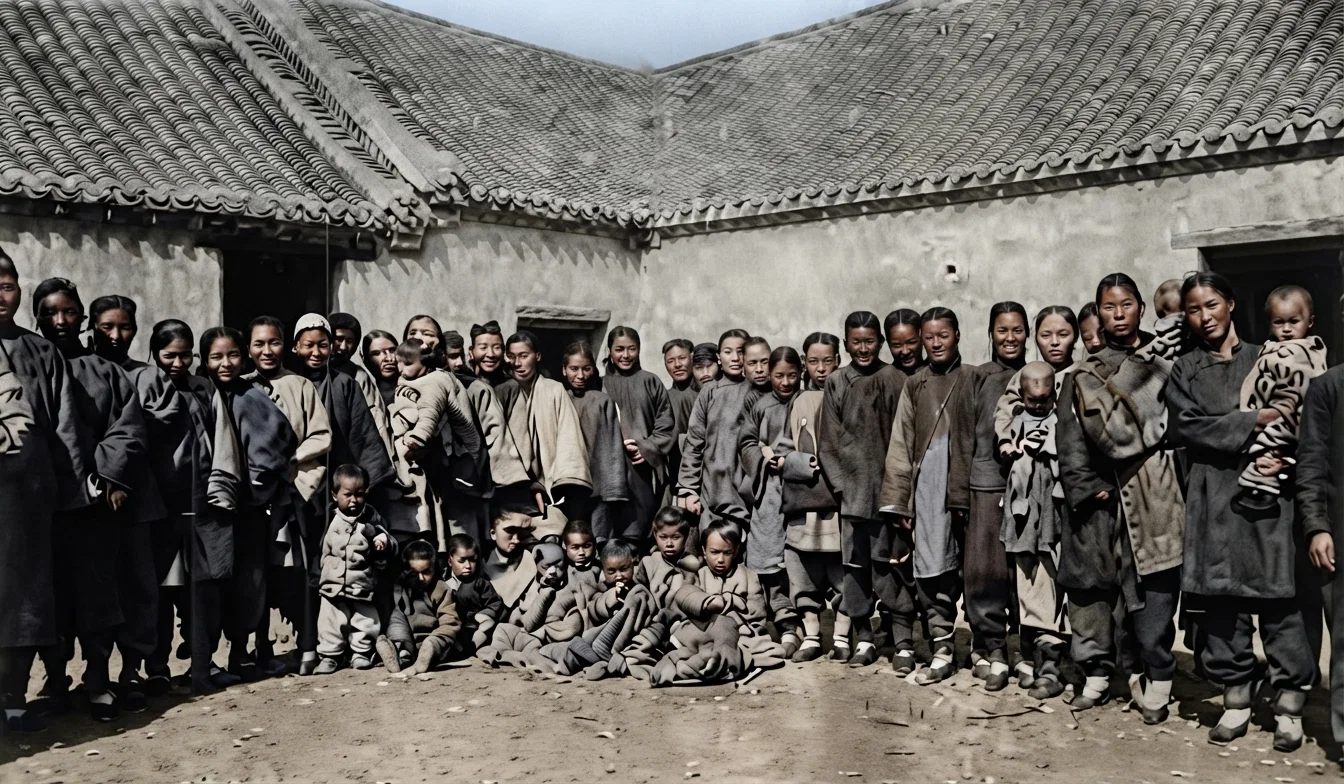
CHINESE SISTERS, WITH SOME OF THEIR CHILDREN, WHO ATTENDED OUR RECENT GENERAL MEETING AT YENCHENG, HONAN, CHINA
"The regulations also grant an annual pension of one thousand dollars to him, whilst the expenditure upon the offering of sacrifices to Confucius is fixed at six thousand dollars a year. Eight sacrificals are being appointed from his direct descendants. These posts will be hereditary.
"A presidential mandate contains the regulations about the Confucius veneration. According to them, forty priests employed by the government in the temple at Kufu, are given a silver seal. Two thousand dollars a year are provided for the upkeep of the mausoleum of Confucius."

THE FOUNDATION FOR ANOTHER REVOLT

Thus the pendulum which swung so far toward Christianity in the formation of the republic is now swinging backward. The dream of China becoming a Christian nation does not appear so promising as it did on October 10, 1913, when the first president was inaugurated. On the contrary, the present conditions indicate that China's reaction is laying the foundation for another revolt against Christianity and its advocates, which will evidently follow sooner or later.
The reaction, supporting Confucianism, as it does, is another step toward the final conflict of nations, when awakened heathenism shall assemble her forces for the Armageddon battle just before the second advent of Christ. See Joel 3:9-17; Rev. 16:12-21.

NO DIVINE LAW FORBIDDING WORK ON THE FIRST DAY OF THE WEEK

Some Questions for Both Catholic and Protestant

Christ Crucified on Friday—Disciples Would Not Anoint His Body on the Sabbath

By GEORGE W. REASER
THAT the Saviour was crucified on Friday, is clearly proved by the Scriptures. In the afternoon of the day of His crucifixion, a small group of holy women, His devout disciples, sadly followed His remains to the tomb. There was still time before the closing of the day, marked by the setting of the sun, to go and prepare spices and ointments for the anointing of the body; but the remaining moments of that sixth day of the week did not permit the performing of that rite, without trespassing on the sacred hours of the Sabbath, which "drew on." Rather than violate God's holy law, they "rested the Sabbath day according to the commandment." Luke 23:50-56.
Every one who has any knowledge of the Bible will recognize that "the commandment" to which they were obedient while the Lord lay in the tomb, was the fourth of the Decalogue, which specifies that the seventh day of each recurring week is the Sabbath of Jehovah. Perhaps some persons would justify an act like that of anointing the body of the Lord of glory on the Sabbath; but the consciences of these devoted women, made tender in the school of Christ, would not permit them to perform this last act of love for their Lord on His holy day.
The record informs us (Luke 24:1) that very early in the morning of the first day of the week, with consciences void of offense toward God, they came to the sepulcher to perform the manual labor involved in the anointing of the body of Jesus.

NO DIVINE LAW FORBIDDING WORK ON THE FIRST DAY OF THE WEEK

In considering the faithful keeping of the Sabbath on the part of these personal associates of Christ's, and their planning to perform labor upon the first day of the week, regarding that day as secular, we may well raise the following questions: Was there a law of Heaven making the performance of manual labor upon the Sabbath sinful? All will agree that there was such a law. See Ex. 20:8-11 with 1 John 3:4. Was there any law of Heaven to forbid labor upon the first day of the week?—None whatever, nor is there at the present time any divine law making sinful the performance of secular labor on that day; and where there is no divine law, there is no sin. Therefore there was no sin imputed to these holy women in deliberately planning to work upon the first day of the week, nor would it have been sinful to perform the work planned. In fact, the fourth commandment stipulated that secular labor should be performed upon the first day of the week.

NO CHANGE IN SABBATH LAW

After a few days passed, those same conscientious, commandment-keeping women were brought to the Sabbath following the day of the resurrection. In the meantime Jesus had met with them, assured them that He had actually risen, and given them certain instruction. Question: With the passing of the first week after the resurrection, had the law pertaining to the Sabbath changed, so that the performance of secular labor upon the Sabbath of Jehovah was an act of righteousness, and labor on Sunday, the first day of the week, was sinful? Every Bible student knows that there was no law of God or of Christ either stating or implying that labor on the Sabbath was not sinful, and that labor performed on Sunday was sinful.

THE FIRST LAW CONCERNING SUNDAY

The first law to that effect was made by an apostate church, nearly three centuries after the resurrection of our Lord. The church that exalted itself to think to change the law of Jehovah, became so abominable in the sight of Heaven, that inspiration denominates it "antichrist," "the man of sin." Was it not well named "the man of sin," when it professed to make not sinful that which Jehovah had decreed was sinful, and contrariwise professed to make sinful what Jehovah had declared in the fourth commandment was not sinful?
As there is still no law of Heaven declaring sinful the use of Sunday as a secular day, and advising us that labor on the Sabbath is not sinful, are professed followers of Christ consistent and loyal to God in their practise of violating the Sabbath and in keeping Sunday?
Sunday is sometimes erroneously called "the Christian Sabbath." Every institution which can consistently be called "Christian," must be authorized by Christ. As Sunday never received the sanction of Christ as the Sabbath, it can not be "the Christian Sabbath." The Saviour Himself kept the Sabbath according to the commandment. Therefore the seventh day of each recurring week is the Christian Sabbath. Shall we follow Christ in Sabbath-keeping, or shall we accept the leadership of "the man of sin"? Is not our loyalty to Jehovah tested by the day we keep?

To Save Individual Men

THE purpose of the gospel is not to save society, but to save men. It does not appeal to men in the mass, but as individuals. The word of God speaks to all because first of all it speaks to each man singly. "Son, give Me thine heart." "God so loved the world, that He gave His only-begotten Son, that whosoever [the individual who] believeth in Him should not perish, but have everlasting life." "If any man be in Christ, he is a new creature." "If any man hear My voice, and open the door, I will come in to him, and will sup with him." "And the Spirit and the bride say, Come. And let him that heareth say, Come. And let him that is athirst come. And whosoever will, let him take the water of life freely."

THEY APPEAL TO THE INDIVIDUAL

All these texts appeal to the individual. They all speak to men not in the mass, but as individuals. Each person must act for himself. Each must come into personal relation to God. Each must for himself respond to the Saviour's invitation. Each must decide for himself the answer he will give to the gracious invitation to come to Christ. Each must have an individual, a spiritual birth, if he ever gets into the kingdom of God.
The gospel commission is, "Go ye into all the world, and preach the gospel to every creature"—that is, to every individual. "He that believeth and is baptized shall be saved; but he that believeth not shall be damned." Thus the decision is left to each individual. One man can not decide this matter for another. He can decide it only for himself.
All these texts simply emphasize the folly of attempting to regenerate men in the mass, or, in other words, of attempting moral reforms by legislation. Civil rights may be defined and safeguarded by civil law, but only the word and Spirit of God can change the heart and transform the character. This work is done "not by might, nor by power, but by My Spirit, saith the Lord of hosts." C. P. BOLLMAN.

Significant Verse in the Book of Revelation

A People Who Are Different from All Others — Beloved of Both the Father and the Son — They Live at the Close of Human Probation — Many Lines of Prophecy Show Them to Be Due upon the Earth
By WILLIAM MAYHEW HEALEY
"Here is the patience of the saints: here are they that keep the commandments of God, and the faith of Jesus." Rev. 14: 12.

A PECULIAR COMPANY

In this scripture, attention is called to a class, or company, of peculiar people, who are different from all others of their time. They have patience such as only saints possess. They "keep the commandments of God," while others keep the "commandments of men." Jesus said: "He that hath My commandments, and keepeth them, he it is that loveth Me: and he that loveth Me shall be loved of My Father." And again: "If a man love Me, he will keep My words: and My Father will love him, and We will come unto him, and make Our abode with him." John 14: 21, 23.
This company, according to these words of Christ, are the loved ones of both the Father and His Son Jesus Christ, who are making Their "abode" with them. Their faith is the same as the "faith of Jesus." As Christ has taken up His abode in them, He is working out His faith and practise through them.

THE HARVEST OF THE EARTH TO BE REAPED

After John had seen this company, he said: "And I looked, and behold a white cloud, and upon the cloud One sat like unto the Son of man, having on His head a golden crown, and in His hand a sharp sickle. And another angel came out of the temple, crying with a loud voice to Him that sat on the cloud, Thrust in Thy sickle, and reap: for the time is come for Thee to reap; for the harvest of the earth is ripe. And He that sat on the cloud thrust in His sickle, on the earth; and the earth was reaped." Rev. 14: 14-16.
This company of faithful followers of Jesus are seen just before, and up to, the coming of the Lord to reap the harvest of the earth.

SPECIAL MENTION OF INDIVIDUAL MEN

From time to time, in the ages past, God has had some soul who has risen far above his fellows in true righteousness and holiness of life, such as Abel, Noah, Abraham, Job, Moses, Joseph, Daniel, and many others. God often makes mention of some of these, and calls them by name, as in Job 1: 8: "Hast thou considered My servant Job, that there is none like him in the earth, a perfect and an upright man, one that feareth God, and escheweth evil?"

A WHOLE COMPANY WHO ARE DISTINGUISHED

In Rev. 14: 12 God is not calling attention to some single individual who has developed a character above that of all others in the earth; but He says, "Here are they"—a plural number, more than one, a company, who have attained to this high standard of perfection, and are ready and waiting for the coming of the Lord. In thus calling attention to this people, God is showing us what His people must be who are living at the close of human probation.

THE CONDITIONS DEMAND SUCH A PEOPLE

Since the fall of man, sinners who have sought the Lord have found Him ready to forgive; but when Jesus rises up and leaves the throne of grace, and comes in glory for His people, then neither heaven nor earth will have a mediator to stand between the transgressor and the law he has broken, the time limit of the atonement has been reached, character has been formed and fixed for all, and there can be no change.
Those who are saved at this time must be just such a people as are described in Rev. 14: 12.
From the many lines of prophecy showing the coming of the Lord to be very near, we may properly conclude that we are in a time when we should begin to look for the people who are at least seeking to reach these high attainments. They are here, or soon will be here; for the Lord showed them to John.
Let us more fully study the meaning of the words applied to this people who are waiting for Christ, that we may find the way to be with them.

Sanctification and Knowledge

"SANCTIFICATION does not close the avenues of the soul to knowledge, but expands the mind, and inspires it to search for truth as for hidden treasure."

SALVATION to the JEWS

By MRS. E. G. WHITE
Paul Carried a Heavy Burden for the Jews as Well as for the Gentiles— God Still Has a Special Care for the Descendants of Abraham—Many Will Come to the Saviour Through the Power of His Closing Message
AFTER many unavoidable delays, Paul at last reached Corinth, the scene of so much anxious labor in the past, and for a time the object of deep solicitude. He found that many of the early believers still regarded him with affection, as the one who had first borne to them the light of the gospel. As he greeted these disciples, and saw the evidences of their fidelity and zeal, he rejoiced that his work in Corinth had not been in vain.

FOUND THE CHURCH STRONG

The Corinthian believers, once so prone to lose sight of their high calling in Christ, had developed strength of Christian character. Their words and acts revealed the transforming power of the grace of God, and they were now a strong force for good in that center of heathenism and superstition. In the society of his beloved companions and these faithful converts, the apostle's worn and troubled spirit found rest.

PLANNED A JOURNEY TO ROME

During his sojourn at Corinth, Paul found time to look forward to new and wider fields of service. His contemplated journey to Rome especially occupied his thoughts. To see the Christian faith firmly established at the great center of the known world was one of his dearest hopes and most cherished plans. A church had already been established in Rome, and the apostle desired to secure the cooperation of the believers there in the work to be accomplished in Italy and in other countries. To prepare the way for his labors among these brethren, many of whom were as yet strangers to him, he sent them a letter, announcing his purpose of visiting Rome, and his hope of planting the standard of the cross in Spain.
In his epistle to the Romans, Paul set forth the great principles of the gospel. He stated his position on the questions which were agitating the Jewish and the Gentile churches, and showed that the hopes and promises which had once belonged especially to the Jews were now offered to the Gentiles also.

JUSTIFICATION BY FAITH IN CLEARNESS AND POWER

With great clearness and power the apostle presented the doctrine of justification by faith in Christ. He hoped that other churches also might be helped by the instruction sent to the Christians at Rome; but how dimly could he foresee the far-reaching influence of his words! Through all the ages, the great truth of justification by faith has stood as a mighty beacon to guide repentant sinners into the way of life. It was this light that scattered the darkness which enveloped Luther's mind, and revealed to him the power of the blood of Christ to cleanse from sin. The same light has guided thousands of sin-burdened souls to the true Source of pardon and peace. For the epistle to the church at Rome, every Christian has reason to thank God.

IS BURDENED FOR THE JEWS

In this letter, Paul gave free expression to his burden in behalf of the Jews. Ever since his conversion, he had longed to help his Jewish brethren to gain a clear understanding of the gospel message. "My heart's desire and prayer to God for Israel is," he declared, "that they might be saved."
It was no ordinary desire that the apostle felt. Constantly he was petitioning God to work in behalf of the Israelites who had failed to recognize Jesus of Nazareth as the promised Messiah. "I say the truth in Christ," he assured the believers at Rome, "my conscience also bearing me witness in the Holy Ghost, that I have great heaviness and continual sorrow in my heart. For I could wish that myself were accursed from Christ for my brethren, my kinsmen according to the flesh: who are Israelites; to whom pertaineth the adoption, and the glory, and the covenants, and the giving of the law, and the service of God, and the promises; whose are the fathers, and of whom as concerning the flesh Christ came, who is over all, God blessed forever."

SHOULD HAVE BEEN FIRST TO UNDERSTAND

The Jews were God's chosen people, through whom He had purposed to bless the entire race. From among them God had raised up many prophets. These had foretold the advent of a Redeemer who was to be rejected and slain by those who should have been the first to recognize Him as the Promised One.
The prophet Isaiah, looking down through the centuries, and witnessing the rejection of prophet after prophet and finally of the Son of God, was inspired to write concerning the acceptance of the Redeemer by those who had never before been numbered among the children of Israel. Referring to this prophecy, Paul declares: "Esaias is very bold, and saith, I was found of them that sought Me not; I was made manifest unto them that asked not after Me. But to Israel He saith, All day long I have stretched forth My hands unto a disobedient and gainsaying people."

STILL A REMNANT TO BE SAVED

Notwithstanding Israel's failure as a nation, there remained among them a goodly remnant of such as should be saved. At the time of the Saviour's advent, there were faithful men and women who had received with gladness the message of John the Baptist, and had thus been led to study anew the prophecies concerning the Messiah. When the early Christian church wasfounded, it was composed of these faithful Jews who recognized Jesus of Nazareth as the one for whose advent they had been longing. It is to this remnant that Paul refers when he writes, "If the first-fruit be holy, the lump is also holy: and if the root be holy, so are the branches."

TO BE GRAFTED IN

Paul likens the remnant in Israel to a noble olive-tree, some of whose branches have been broken off. He compares the Gentiles to branches from a wild olive-tree, grafted into the parent stock. Through unbelief and the rejection of Heaven's purpose for her, Israel as a nation had lost her connection with God. But the branches that had been separated from the parent stock God was able to reunite with the true stock of Israel—the remnant who had remained true to the God of their fathers.
"They also," the apostle declares of these broken branches, "if they abide not still in unbelief, shall be grafted in: for God is able to graft them in again." Thus Paul shows that God is abundantly able to transform the hearts of Jew and Gentile alike, and to grant to every believer in Christ the blessings promised to Israel. He repeats Isaiah's declaration concerning God's people: "Though the number of the children of Israel be as the sand of the sea, a remnant shall be saved: for He will finish the work, and cut it short in righteousness: because a short work will the Lord make upon the earth. And as Esaias said before, Except the Lord of Sabaoth had left us a seed, we had been as Sodoma, and been made like unto Gomorrha."

DISTINCT FOR EIGHTEEN CENTURIES

At the time when Jerusalem was destroyed and the temple laid in ruins, many thousands of the Jews were sold, to serve as bondmen in heathen lands. Like wrecks on a desert shore, they were scattered among the nations. For eighteen hundred years the Jews have wandered from land to land throughout the world, and in no place have they been given the privilege of regaining their ancient prestige as a nation. Maligned, hated, persecuted, from century to century, theirs has been a heritage of suffering.

SAW SIGNIFICANCE OF PROPHECIES CONCERNING HIM

Notwithstanding the awful doom pronounced upon the Jews as a nation at the time of their rejection of Jesus of Nazareth, there have lived from age to age many noble, God-fearing Jewish men and women who have suffered in silence. God has comforted their hearts in affliction, and has beheld with pity their terrible situation. He has heard the agonizing prayers of those who have sought Him with all the heart for a right understanding of His word. Some have learned to see in the lowly Nazarene whom their forefathers rejected and crucified, the true Messiah of Israel. As their minds have grasped the significance of the familiar prophecies so long obscured by tradition and misinterpretation, their hearts have been filled with gratitude to God for the unspeakable gift He bestows upon every human being who chooses to accept Christ as a personal Saviour.
It is to this class that Isaiah referred in his prophecy, "A remnant shall be saved." From Paul's day to the present time, God by His Holy Spirit has been calling after the Jew as well as the Gentile. "There is no respect of persons with God," declared Paul. The apostle regarded himself as "debtor both to the Greeks, and to the barbarians," as well as to the Jews; but he never lost sight of the decided advantages possessed by the Jews over others, "chiefly, because that unto them were committed the oracles of God." "The gospel," he declared, "is the power of God unto salvation to every one that believeth; to the Jew first, and also to the Greek." It is of this gospel of Christ, equally efficacious for Jew and Gentile, that Paul in his epistle to the Romans declared he was not ashamed.

MANY JEWS WILL ACCEPT THE GOSPEL MESSAGE

When this gospel shall be presented in its fulness to the Jews, many will accept Christ as the Messiah. Among Christian ministers there are only a few who feel called upon to labor for the Jewish people; but to those who have been often passed by, as well as to all others, the message of mercy and hope in Christ is to come.
In the closing proclamation of the gospel, when special work is to be done for classes of people hitherto neglected, God expects His messengers to take particular interest in the Jewish people whom they find in all parts of the earth. As the Old Testament Scriptures are blended with the New in an explanation of Jehovah's eternal purpose, this will be to many of the Jews as the dawn of a new creation, the resurrection of the soul. As they see the Christ of the gospel dispensation portrayed in the pages of the Old Testament Scriptures, and perceive how clearly the New Testament explains the Old, their slumbering faculties will be aroused, and they will recognize Christ as the Saviour of the world. Many will by faith receive Christ as their Redeemer. To them will be fulfilled the words, "As many as received Him, to them gave He power to become the sons of God, even to them that believe on His name."

WILL PROCLAIM THE LAW WITH POWER

Among the Jews are some who, like Saul of Tarsus, are mighty in the Scriptures, and these will proclaim with wonderful power the immutability of the law of God. The God of Israel will bring this to pass in our day. His arm is not shortened that it can not save. As His servants labor in faith for those who have long been neglected and despised, His salvation will be revealed.
"Thus saith the Lord, who redeemed Abraham, concerning the house of Jacob, Jacob shall not now be ashamed, neither shall his face now wax pale. But when he seeth his children, the work of Mine hands, in the midst of him, they shall sanctify My name, and sanctify the Holy One of Jacob, and shall fear the God of Israel. They also that erred in spirit shall come to understanding, and they that murmured shall learn doctrine." Isa. 29: 22-24.

The Resurrection Day

By WORTHIE HARRIS HOLDEN
THEY come, they come, the vast unnumbered throng, From caverns where the ocean-sighs prolong, From mountain peaks and vales both far and near — The great unsepulchered array appear, Forth summoned by the mighty clarion call Of Him before whom all His creatures fall. Attended by the host of angels white, In threefold glory of effulgent light, The King, in vestment clad of majesty, Proclaims death conquered, and the captive free. And, quick as eye can wink, the living rise Immortalized, triumphant, to the skies; While souls who spurned Love's gift, despairing call That rocks and mountains be their burial pall.

The Mind of Christ

Let this mind be in you, which was also in Christ Jesus; who, being in the form of God, thought it not robbery to be equal with God: but made Himself of no reputation, and took upon Him the form of a servant, and was made in the likeness of men: and being found in fashion as a man, He humbled Himself, and became obedient unto death, even the death of the cross.—Paul.
Continue reading: THE SONG