Your ShelfYour Projects

Signs of the Times, Vol. 37, No. 39.

Christ Our High Priest

Signs of the Times

Oct 4, 1910

Pacific Press Publishing Association · Mountain View, California · Oct 4, 1910

Christ Our High Priest

Now of the things which we have spoken this is the sum: We have such an high priest, who is set on the right hand of the throne of the Majesty in the heavens: a minister of the sanctuary, and of the true tabernacle, which the Lord pitched, and not man. Hebrews 8:1, 2

"IF YE WILL INQUIRE, INQUIRE YE."

This Inquirers' Department is conducted for the purpose of helping those who are studying the Bible. The answers are oftentimes only suggestive. They are never to be considered infallible, but only as they agree with the infallible Word. The writer who may answer them does not consider that his opinion is infallible. He will simply give the best that he has, and plead with the inquirer to search the Word. Such questions only will be answered as, to the editors, seem to minister to the good of the readers and to the mission of the paper. We can not answer repeatedly in the same volume questions upon the same scripture. The name and address must accompany question, not for publication, but as an evidence of good faith, and that answer may be made by letter if deemed advisable. No letters are answered which do not contain the name of the writer. It is well always to enclose stamp for reply.

3253.—What Is the Soul?

Referring to an article in the Signs of July 12, page 7, entitled, "What Is the Soul?" I can hardly harmonize it with Matt. 10:28. Does the soul share the body's material corruption? I know "the soul that sinneth it shall die," but am not clear as to the soul that sinneth not.
The difficulty with the article and the difficulty with many who are more or less Bible students, is to endeavor to make one definition cover what is meant by the soul. In all its various uses in the Bible, after very many years of study, it seems to us no one definition can be found that will tell us just what the soul is. It seems, however, that the soul would fall within one of three definitions. First, it is the whole man, the entire being. "Man became a living soul" (Gen. 2:7); "every living soul died in the sea" (Rev. 16:3); in the ark "eight souls were saved through water" (1 Peter 3:20). It will be very readily seen in these cases and in others that the whole of the individual person is meant. Secondly, the soul means life—natural life, life that is possessed by the natural man and every living creature. It is thus used largely in the New Testament. Take, for instance, Matt. 16:25, 26. The word rendered "soul" is psuche. The same word is rendered "life" in verse 25. It simply means man's natural life, and ought to be rendered "life" in both cases, as it is in the Revised Version. The same word is rendered "soul" also in Matt. 10:28. Men may kill the body, but they are not able utterly to destroy life. Of course, killing the body would temporarily take away the life, but in God's hands rests the future life. The natural man, as before stated, has the soul life. See 1 Cor. 2:14: "Now the natural man receiveth not the things of the Spirit of God." This is literally the soulical man; he has soul life, but not spiritual life. See again chapter 15, verse 44, "It is sown a natural body," literally it is sown a soulical body. Jude uses the same expression, verse 19, "These are they who make separations, sensual, not having the Spirit," literally soulical, not having the Spirit. All the life they have is the soul life. The Christian who is in Christ has the Spirit life. Thirdly, soul is sometimes used of mind, emotion, faculties, appetites, desires, etc. "Bless the Lord, O my soul, and all that is within me bless His holy name." We think in the light of this our correspondent will have no trouble in understanding the terms as found in the Scriptures. "Soul" will fall under some one of these three heads.

Schedule for Week Ending October 15

Sunday October 9 Luke 23
Monday " 10 " 24
Tuesday " 11 Mark 1, 2
Wednesday " 12 " 3, 4
Thursday " 13 " 5, 6
Friday " 14 " 7, 8
Sabbath " 15 " 9, 10
WE have yet two chapters in Luke, dealing with the trials of our Lord, His crucifixion, His triumph over death, and His parting instruction to His disciples. The remainder of the week brings to us the first ten chapters of Mark. Mark, or Marcus, is the Latin surname of the writer of the second Gospel. The Hebrew name is John. He was the son of Mary, whose house at Jerusalem became the refuge and earliest meeting-place of the Christian community in that city. See Acts 12:12. He was the nephew, or cousin, of Barnabas, one of the later apostles, and attended Paul and Barnabas on their first mission, but returned home from Perga, and therefore was not allowed by Paul to join them on their second mission. Acts 13:5, 13. He then attached himself to Barnabas alone, but was afterward reconciled to Paul. Col. 4:10. The apostle then speaks of him as one who was profitable to him for the ministry. Peter also mentions him in his first epistle, 5:13; and tradition tells us he was the founder of the Alexandrian church.
MARK'S Gospel was probably written between the years 63 and 70, and seems to have been written primarily for the Gentiles, for he omits all reference to the Jewish law, gives no genealogy of our Lord, explains many Hebrew words which could not be understood by the Gentiles, such as Boanerges and Talitha cumi. His descriptions are very graphic. "Immediately," or "forthwith," and other words of similar import, are characteristic of his Gospel. He does not give the longer discourses of Jesus, but passes from event to event in rapid succession. He plunges right into the work of Christ at the very beginning, saying nothing of His infancy, introduces Him at once almost with John the Baptist. He piles miracle upon miracle, giving in much less space the miracles and parables that are related by the longer synoptists. The healing of Simon's wife's mother, cleansing of the leper, the cure of the paralytic, of the withered hand, choosing of the twelve, parables relating to the kingdom, casting out of demons, healing of Jairus's daughter, the woman with an issue of blood, sending out of the twelve, and many other things are told with wonderfully graphic force. The nature of Christ's kingdom is also emphasized in the lessons of humility which He taught His disciples and the emphatic declaration that He Himself was to suffer.

3254.—The Beast that Was

Will you please explain Rev. 17:8-14, where it speaks of the beast that was, is not, and yet is; also of the seven kings from which five are fallen, one is, and the other is not yet come? When is that to be? Who are these kings?
We can give only the briefest suggestive comments on this question, and will ask our inquirer to wait until we reach the scripture in our study of the book of Revelation. In brief, however, first, the beast represents that system of church-and-state government, or state religion, which has dominated the world from Babylon's time down under seven different heads. See Revelation 12, 13. The character of the beast is always determined by the character of the head, because the head is the seat of intellect, or mind, and rules the body. Under the Babylonian head the beast was Babylon; following Babylon came Medo-Persia; Medo-Persia succeeded by Grecia, then Rome pagan, then Rome papal; and Rome papal is the beast that was, and is not, and as the Revised Version and many other versions have it, "shall be," and "shall be present," and not "yet is." The Revised Version has "shall come." The papal dominion was lost in 1798; following that came the church-and-state régime of apostate Protestant churches; individual governments connected with the church and interfering in matters of religion. Following that which exists now will come the restoration of the Papacy. Five are fallen, one is, the other is not yet come. Much fuller exposition of this prophecy will be given in the future.

3257.—The Matter of Copyrighting

Can I as a follower of Jesus of Nazareth have my books or works copyrighted or covered by civil law? W. A. O.
To put the question in another form, Has a man a right to guard his property? If one has written a book from his own mind, which is truly his own work, the right of property vests in that as truly as if he had builded him a barn or purchased a horse with the fruit of his labor. His house is protected by always remaining in the same place, or else being occupied by himself or others to whom he has leased it. His right of property is recognized by all. However, if that house were scattered broadcast, or were subject to removal in a hundred different places, dishonest people might not recognize the right of ownership, and occupy it without compensation. The products of one's brains in books are scattered to the ends of the earth. It has been a notorious fact demonstrated for years, that there are many who will take what others have thus produced, use it freely, profit by it, and without any acknowledgment whatsoever. Surely a man has the right to protect that which belongs to him, and of which God has made him steward. He has as much right to conserve it and reap legitimate profits from it as does the farmer his crops, the builder his house, or the merchant his goods. Then, too, the copyright prevents the garbling of one's ideas.

3255.—On the Mount of Olives

It is stated in "Desire of Ages," page 830, that when Jesus "shall come again," His feet will rest upon Mount Olivet. Is that in harmony with Zech. 14:4?
The passage in "Desire of Ages" evidently includes, in its reference to Christ's coming, the whole great day of the Lord. When He comes the second time in the clouds of heaven, that is, when His redeemed saints arise from the dead, He does not come to this earth. His people are caught up to meet Him in the air. This is at the beginning of the thousand years. At the end of the thousand years He will come to the earth. Events of the thousand years are very often closely united, because they all pertain to the one thing of rewarding every one according as his work shall be, with all that is involved in that. Consequently they are referred to as one event, and are evidently so referred to in "Desire of Ages." But by a study of all the scriptures pertaining to Christ's work we would place that definite event at the close of the day of the Lord. When Christ's feet shall stand on the Mount of Olives, the mount shall divide and make a plain for the city which shall come down out of God from heaven. Revelation 21.

3256.—The Lesson of Acts 10:15

Please explain Acts 10:15 regarding the cleansing of all manner of beasts.
The lesson of Acts 10 to Peter was not that all kinds of beasts were fit for food. It was no arbitrary rule of God that discriminated between the clean and unclean beasts in Leviticus 11. God made that division because there existed in the beasts themselves the very things that demanded the law. Yet it is in God's power to cleanse that which is unclean. Comparing men with beasts, Peter counted the Jewish nation as among the clean. He counted the Gentiles as among the unclean, and no doubt likened them, as did other Jews, to dogs and other vile creatures. The natural prejudices of the Jews were such that even none of the disciples had any burden to labor for the salvation of the Gentiles. Peter imbibed this strong race prejudice, and therefore God had to give him a threefold vision in order that Peter might understand that God could cleanse Gentiles just as well as He could Jews. It was not the object of the Saviour to teach Peter to eat everything. Peter tells us just what the object was in verse 28, "Ye yourselves know how it is an unlawful thing for a man that is a Jew to join himself or come unto one of another nation; and yet unto me hath God showed that I should not call any man common or unclean." That is the Lord's lesson to Peter and to us.

In the Downward Path

By Mrs. E. G. White
The disgraceful fact was soon made known to the inhabitants of the city, who were eager to be avenged upon their dreaded foe. Fearing to attack him, however, they sent for reinforcements, and kept a vigilant watch at the gate of the city, determined by some means to put him to death in the morning.
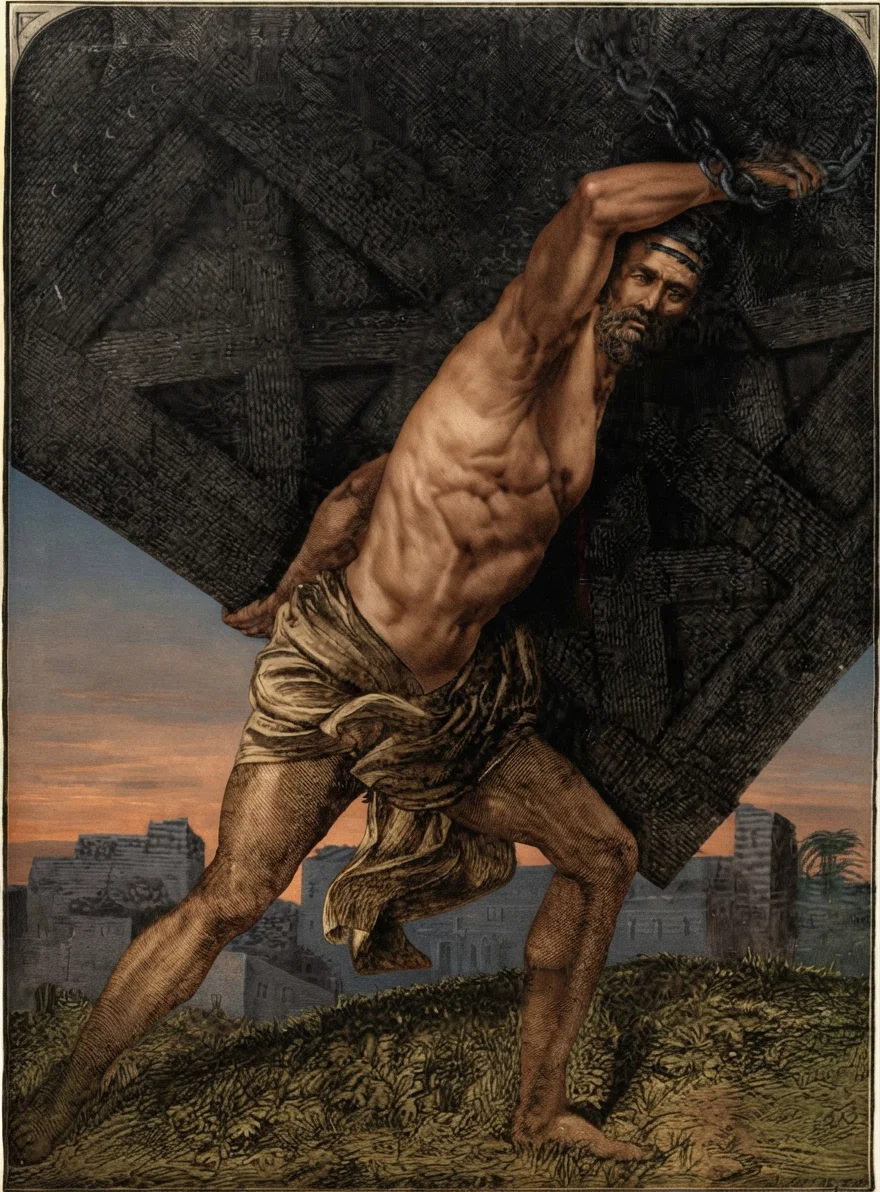
At midnight Samson was aroused. The accusing voice of conscience filled him with remorse, as he remembered that he had broken his vow as a Nazarite. But despite his sin, God's mercy had not forsaken him. His great strength again served to deliver him. Wrenching the city gate from its place, he took it entire, with its posts and bars, and carried it several miles, to the top of a hill on the way to Hebron; the guards meanwhile being too much surprised and terrified to intercept or pursue him.

Lured to Ruin

But even this narrow escape did not serve to stay him in his evil course. The third step downward soon followed the second. He did not again venture into the territory of the Philistines, but sought at home those sensuous pleasures that were luring him on to ruin. "He loved a woman in the vale of Sorek." Her name was Delilah, which fitly signifies consuming, or lustful. In the society of this enchantress, the judge of Israel squandered precious hours that should have been sacredly devoted to the welfare of his people. But the blinding passions which make even the strongest weak, had gained control of reason and of conscience. The vale of Sorek, a little valley not far from his own birthplace, was celebrated for its vineyards. These also had a temptation for the wavering Nazarite, who had already indulged in the use of wine, thus breaking another tie that bound him to temperance, to purity, and to God.
The Philistines were well acquainted with the divine law and its condemnation of sensual indulgence. They kept a vigilant watch over all the movements of their enemy; and when he degraded himself by this new attachment, and they saw the bewitching power of the enchantress, they determined, through her, to accomplish his ruin.
Accordingly, a deputation consisting of one leading man from each of the five Philistine states was sent to the vale of Sorek. It was not their purpose to seize him while in possession of his great strength, but to learn if possible some means by which that strength might be taken away. Such marvelous power far exceeded anything which they had ever known before; that of the famed descendants of Anak, who dwelt among them, could not be compared with it, and the Philistine lords decided that it must be supernatural, the result of some condition that might be changed, or some charm that might be broken. They therefore bribed Delilah to discover the secret of his strength, and reveal it to them, offering her eleven hundred shekels of silver from each of their number, aggregating a sum of more than three thousand dollars.
As the betrayer plied Samson with her questions, he deceived her by declaring that the weakness of other men would come upon him if certain processes were tried. When she put the matter to the test, the imposition was discovered. Then she accused him of falsehood, saying, "How canst thou say, I love thee, when thine heart is not with me? thou hast mocked me these three times, and hast not told me wherein thy great strength lieth."

The Power of Sin to Degrade

Samson's infatuation seems almost incredible. At first he was not so wholly enthralled as to reveal the secret; but he had deliberately walked into the net of the betrayer of souls, and its meshes were drawing closer about him at every step. Three times he had the clearest evidence that the Philistines had leagued with his charmer to destroy him; but when her purpose failed and his strength returned, she had treated the matter as a jest, and he blindly banished all fear of danger.
Day by day Delilah pressed and urged him, until "his soul was vexed unto death," yet a subtle power kept him by her side. Her heart was set upon the tempting bribe, and she exerted all her blandishments to secure it. Overcome at last by the bewitching spell which he seemed to have no power to break, Samson made known the secret: "There hath not come a razor upon mine head; for I have been a Nazarite unto God from my mother's womb; if I be shaven, then my strength will go from me, and I shall become weak, and be like any other man."
Eagerly the betrayer listened to his words, fully convinced by his serious and earnest manner that he had told the truth; and she determined to profit by it. A messenger was immediately despatched to the lords of the Philistines, urging them to come once more to her chamber without delay. She nextsent for a man who, while the warrior slept with his head upon her knees, shaved off the heavy masses of his hair. Then, as she had done three times before, she called, "The Philistines be upon thee, Samson!" Suddenly awakening, he thought to exert his strength as before, and destroy them all; but his powerless arms refused to do his bidding, and then he knew that the Lord had departed from him.

The Victor a Slave

When he had been shaven, Delilah began to annoy him and cause him pain, thus making a trial of his strength; for the Philistines dared not approach him till fully convinced that his power was gone. Then they seized him, and having put out both his eyes, they took him to Gaza. Here he was bound with strong fetters of brass, and kept in their prison-house as a trophy of their victory, and compelled to drudge in hard labor.
What a change to him that had been the judge and champion of Israel!—now weak, blind, imprisoned, degraded to the most menial service! Little by little he had violated the conditions of his sacred calling. God had borne long with him, but when he had so yielded himself to the power of sin as to betray his secret, that moment God departed from him. There was no virtue in the length of his hair, in itself, but it was a token of his loyalty to God, and when the symbol was sacrificed in the indulgence of lustful passion, the blessings of which it was a token were also forfeited. Had Samson's head been shaven without fault on his part, his strength would have remained. But his course had shown contempt for the favor and authority of God as much as if he had in disdain himself severed his locks from his head. Therefore God left him to endure the results of his own folly.

Repentance and Victory in Death

In his sufferings and humiliation, a sport for the Philistines, Samson had opportunity for reflection, and he learned more of his own weakness than he had ever known before. As his afflictions led him to repentance, his hair began gradually to grow, indicating the return of his extraordinary powers; but his enemies, regarding him only as a fettered and helpless prisoner, felt no apprehensions.
As the Philistines exulted over their great victory, they ascribed the honor to their gods, praising them as superior to the God of Israel. The contest, instead of being between Samson and the Philistines, was now between Jehovah and Dagon, and thus the Lord was moved to assert His almighty power and His supreme authority. A favorable opportunity for this was soon presented. The Philistines held a feast in honor of their god Dagon. A vast company was assembled, and in the height of their sacrilegious festivities, they ordered the captive to be produced, that the people might have a new source of amusement. The multitude greeted his appearance with shouts of triumph, and praised their god who had thus subdued the "destroyer of their country." Samson had been made the sport of the people before; but now even the rulers of the nation mocked at his misery.
The immense building was thronged with the brave and the fair. Even the roof was crowded with thousands of spectators. After a time, as if weary, Samson asked permission to rest against the two central pillars which supported the temple roof. Then he breathed the prayer, "O Lord Jehovah, remember me, I pray Thee, and strengthen me, I pray Thee, only this once, O God, that I may be at once avenged of the Philistines for my two eyes." With these words he seized the pillars in his mighty arms, and with the cry, "Let me die with the Philistines," he bowed himself, and the roof fell, destroying at one dread crash all that vast company. "So the dead which he slew at his death were more than they which he slew in his life."

Failing of God's Purpose

God designed that Samson should accomplish a great work for Israel. Hence the utmost care had been taken at the very outset of life to surround him with the most favorable conditions for physical strength, intellectual vigor, and moral purity. Had he not in after years ventured among the ungodly and the licentious, he would not so basely have yielded to temptation. Physically he was the strongest man upon the earth; but in self-control, integrity, and firmness, he was the weakest of men. His passions were not held in subjection to reason and the fear of God. The blandishments of beautiful women often have dangerous temptations to the young. Those who do not make God their strength will be overcome by Satan's devices.
The youths of to-day can bless or blight their future life. God calls young men in the strength and glory of their manhood to do service for Him. But many whom God could use refuse to obey. They desire to secure worldly gain and worldly honor. To become a servant of Christ they consider as requiring too great a sacrifice.
The history of Samson conveys a lesson for those whose characters are yet unformed, who have not yet entered upon the stage of active life. The youth who enter our schools and colleges will find there every class of mind. If they desire sport and folly, if they seek to shun the good and unite with the evil, they have the opportunity. Sin and righteousness are before them, and they are to choose for themselves. But let them remember that "whatsoever a man soweth, that shall he also reap." "He that soweth to his flesh shall of the flesh reap corruption; but he that soweth to the Spirit shall of the Spirit reap life everlasting."

A Lesson from Samson

ONE wrong step prepares the way for another. Samson had transgressed the command of God by taking a wife from the daughters of the Philistines, and ere long he ventured again among that people — now his deadly enemies — in the indulgence of his unlawful passions. Trusting confidently to his great strength, which had inspired the Philistines with such terror, he boldly entered Gaza, one of their largest and most powerful cities, and visited a harlot of that place.

Religion and Atheism

RELIGION assures us that our afflictions shall have an end; she comforts us, she dries our tears, she promises us another life. On the contrary, in the abominable worship of atheism, human woes are the incense, death is the priest, a coffin the altar, and annihilation the deity.—Chateaubriand.

Missionaries as Saviors of Men

Delavan Leonard Pierson in S. S. Times
It is these wise, God-fearing, man-loving men and women that have gone all over the world founding hospitals to save men's bodies; it is the missionaries like Livingstone that have aroused the world to put an end to slavery; they have led the way in the emancipation of woman; it is the missionaries like John G. Paton who have fought the sale of strong drink to the child-races; missionaries have been pioneers in world-saving by their work of translation, education, exploration; they are working to-day to save the Kongo natives from destruction; they are caring for the lepers and the famine sufferers and plague-stricken. Where the missionary goes, and his God-given advice is heeded, there peace supplants war, ignorance is crowded out by knowledge, vice gives way to virtue, civilization drives out barbarism, love destroys hate, and life reigns in place of death. Even those who do not receive the full blessing of the missionary's Gospel partake of the benefits that come from the missionary's fellowship.
A striking illustration of the secondary benefits that come from having a missionary in the midst is given by Mr. H. J. Whigham, a war correspondent. He was in Manchuria after the Boxer rebellion, when the Russians were restoring order by destroying towns and cities. At Liao-wang, the Boxers refused to yield, and opened fire on the Muscovite troops. The general was just about to order the town destroyed, and every inhabitant put to the sword, when a missionary, Mr. Westwater, appeared before him and asked leave to advise with the leaders of the town. Having obtained permission, the missionary went alone and unarmed into the midst of the "roaring hive of armed Boxers." His bravery and their knowledge of his truthfulness so impressed the leaders that they laid down their arms, and their lives were spared. It was one of the few towns to escape the frightful excesses of the Russian soldiers.
In body, mind, and soul, the people of the world are being saved by the missionary servants of God.

The Inspired Book

By Nellie M. Butler
Its light shines all along the stream of time, Illumines its story with its light sublime. We find in it true record of the past; And, too, are brought to view the very last Scenes on this earth, when all will pass away, And soon will usher in the coming day, When sin on earth shall never be again, But peace and happiness shall ever reign. Then should we thank our Father good and kind That He has given unto all mankind A Book that warns us of the dangers here, And tells of One, a Pilot, ever near, Whom we can trust, and who will safely guide Us to the home beyond the swelling tide. How anxious should we be the light to give To those who have it not; to those who live In darkness and in fear and constant gloom, Who have no hope of life beyond the tomb. O, hasten to them e'er the day is done. The night is coming, soon will set the sun. O, hasten with the Book, the precious guide That tells of Jesus, once the Crucified. O, hasten with the Book that tells of home Where sickness, sorrow, sin, or death ne'er come, Where Jesus waits to welcome every soul To life and joy while endless ages roll.

Man's Sin and Saviour

By E. J. Hibbard

XIII. Christ's Coming and Kingdom

FOLLOWING the judgment scene, as described by Daniel in the seventh chapter, and the destruction of that power which has opposed Christ and His people, which has made war with the saints and prevailed against them, there comes another and brighter scene. Daniel described it thus: "I saw in the night visions, and, behold, one like the Son of Man came with the clouds of heaven, and came to the Ancient of Days, and they brought Him near before Him. And there was given Him dominion, and glory, and a kingdom, that all people, nations, and languages, should serve Him: His dominion is an everlasting dominion, which shall not pass away, and His kingdom that which shall not be destroyed." Dan. 7: 13, 14. This kingdom of Christ will not be set up in heaven, for at the end of the reign of antichrist, it is stated (in Dan. 7: 27) that "the kingdom and dominion, and the greatness of the kingdom under the whole heaven, shall be given to the people of the saints of the Most High, whose kingdom is an everlasting kingdom, and all dominions shall serve and obey Him."
It is further evident that the judgment takes place before the end of the reign of antichrist, for in verse twenty-six Daniel declares that "the judgment shall sit, and they shall take away his dominion, to consume and to destroy it unto the end." The judgment in heaven began in 1844, when God inspired the searching of Scripture on the part of many, and brought out the truth of the Gospel as contained in the sanctuary, thus revealing God's law, which antichrist had thought to change, and leading to the acceptance on the part of many of that part of the Ten Commandments which had been perverted by the power of the Papacy. It also established, upon the firm Protestant foundation of "the Bible and the Bible only," a class of people who have grown and multiplied, and extended the Gospel, which recognizes God's Word as a standard, to every nation and kindred and tongue and people which inhabits this globe.
This is exactly what one would expect from the prophecies we have briefly considered. But opposed to this law stands the dragon mentioned in Rev. 12: 17, and the beast, or antichrist, mentioned in Dan. 7: 25, the agent through which God's law was changed. Revelation 13 and 14 reveal earthly powers which will combine against the people and commandments of God in the final issue; and contrasted with these powers John announces, "Here is the patience of the saints: here are they that keep the commandments of God, and the faith of Jesus." Rev. 14: 12.
This conflict will continue until Christ's work in the heavenly sanctuary is finished; and when it is finished, John says, "The temple was filled with smoke from the glory of God, and from His power; and no man was able to enter into the temple, till the seven plagues of the seven angels were fulfilled." Rev. 15: 8.
The temple service concluded, we must know that probation is ended; and that probation will end before Christ returns we are sure from the following words: "He that is unjust, let him be unjust still: and he which is filthy, let him be filthy still: and he that is righteous, let him be righteous still: and he that is holy, let him be holy still. And, behold, I come quickly; and My reward is with Me, to give every man according as his work shall be." Rev. 22: 11, 12. By this we know that the time will come when no person will change his condition. The righteous will be righteous still, and the unjust will be unjust still. And after that, "behold, I come quickly." Revelation 16 describes the plagues which take place during that time in which no one may enter the temple of God in service for guilty man; and the seventh of these plagues brings the Son of God to earth, for by comparing Rev. 16: 17-20 with Rev. 6: 14-17 it will be seen that the events connected with the seventh plague are events which occur at the visible, personal appearing of the Son of God the second time to this earth. Rev. 19: 19-21 declares that at His coming every opponent of God will be destroyed. Revelation 20 speaks of a thousand years in which Satan will be bound. The risen saints are translated, and will reign with Christ a thousand years, and the rest of the dead live not again until the thousand years are finished. And when the thousand years are finished, Satan with the resurrected hosts of evil will make their last stand against Christ and His redeemed, ending in the destruction of sin and Satan, the melting of earth and germ-polluted atmosphere in one vast sea of fire and brimstone. Rev. 20: 7-13. Then, after that, John adds, in Rev. 21: 1-5: "And I saw a new heaven and a new earth: for the first heaven and the first earth were passed away; and there was no more sea. And I John saw the holy city, New Jerusalem, coming down from God out of heaven, prepared as a bride adorned for her husband. And I heard a great voice out of heaven saying, Behold, the tabernacle of God is with men, and He will dwell with them, and they shall be His people, and God Himself shall be with them, and be their God. And God shall wipe away all tears from their eyes; and there shall be no more death, neither sorrow, nor crying, neither shall there be any more pain: for the former things are passed away."
The lake of fire and brimstone, with Satan and the wicked, were found on the old earth, the present world. This was burned until it "passed away," and out of its elements God calls into being a new earth with the atmospheric heavens surrounding it as in the beginning; but on this new earth there is no lake of fire, no devil, no sin, no sickness, no death, and no crime; for "the former things are passed away."
In the beginning God pronounced His creation good. But sin entered, and with sin the curse. About six thousand years have rolled their weary course around, and the time is at hand for God to destroy that which has caused all this misery and havoc. And when it is destroyed, as we have just read, then shall come the new earth. "And there shall be no more curse: but the throne of God and of the Lamb shall be in it; and His servants shall serve Him: and they shall see His face; and His name shall be in their foreheads. And there shall be no night there; and they need no candle, neither light of the sun; for the Lord God giveth them light: and they shall reign forever and ever. And he said unto me, These sayings are faithful and true: and the Lord God of the holy prophets sent His angel to show unto His servants the things which must shortly be done." "He which testifieth these things saith, Surely I come quickly. Amen. Even so, come, Lord Jesus." Rev. 22: 3-6, 20.

A "Clear Title" to Heaven

You have a valuable house or farm. It is suggested that the title is not good. You employ counsel. You have the deeds examined. You search the records for mortgages, judgments, and liens. You are not satisfied until you have a certificate, signed by the great seal of the state, assuring you that the title is good. Yet how many leave their title to heaven an undecided matter! Why do you not go to the records and find it? Give yourself no rest day or night until you can read your "title clear to mansions in the skies."—T. DeWitt Talmage.

The Meaning of Tact

TACT is the knack of keeping quiet at the right time; of being so agreeable yourself that no one can be disagreeable to you; of making inferiority feel like equality. A tactful man can pull the sting from a bee without getting stung.—G. H. Lorimer.
Continue reading: The Lord's Preparation Day