Pacific Press Publishing Company · Oakland, California · Dec 16, 1897
Editorial
By Ellet Joseph Waggoner
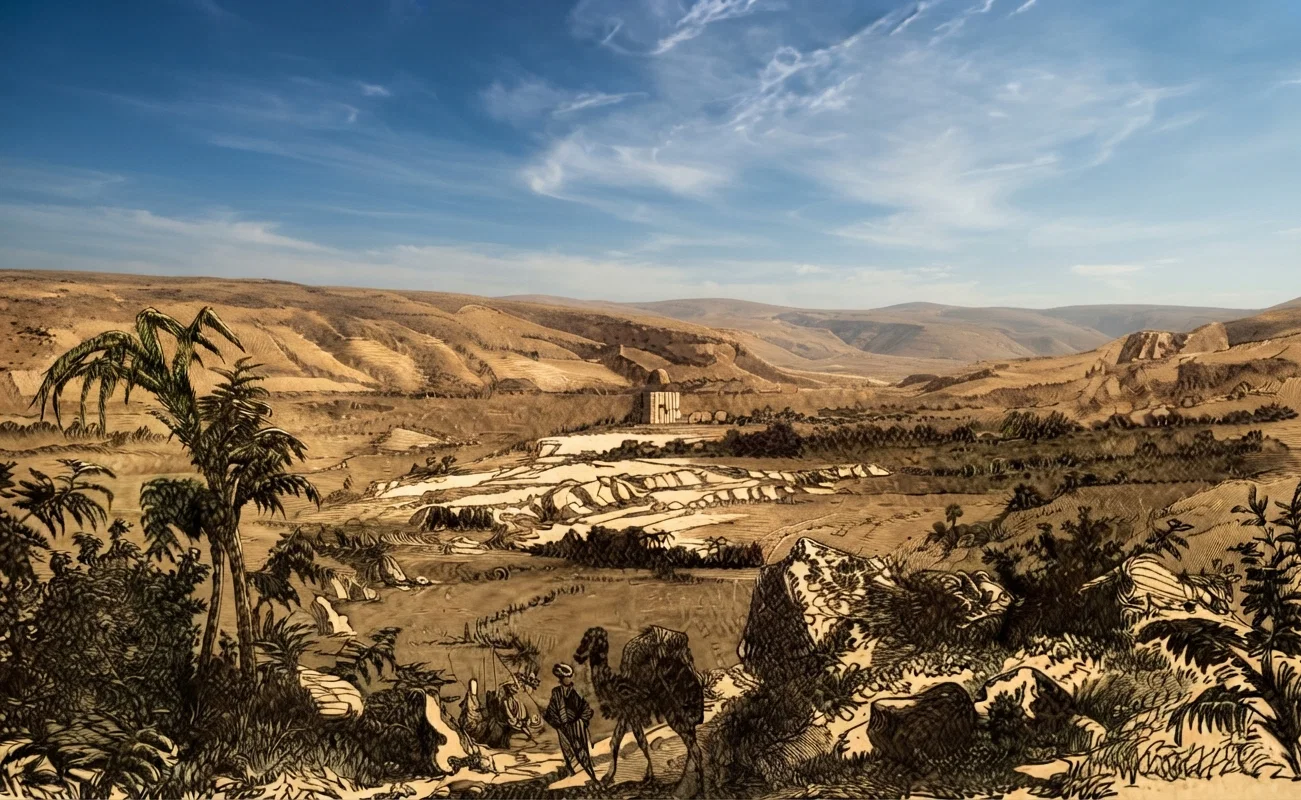
VALLEY AND SITE OF THE ONCE GREAT CITY OF JERICHO.
THE LESSON OF HISTORY.
WE do not say "a lesson from history," but "the lesson of history;" for there is but one great lesson that history teaches, yet it is one that is rarely learned. For want of learning this one lesson, thousands study history in vain; while he who learns the simple, fundamental lesson in the beginning of his study will read to profit.
The reason why the lesson referred to is so almost universally overlooked, is that the records that are usually studied are so crowded with details that the mind becomes confused; history becomes to the student only a mass of occurrences, in which the underlying truth taught by history is lost. This melancholy result would be avoided if people began at the right place to study, taking the simplest history first, and afterwards that which is more complex.
"The fear of the Lord is the beginning of wisdom," and the Bible is the book that teaches the fear of the Lord; therefore it is in the Bible that the beginning of wisdom is found. It is the simplest book in the world, as would naturally be expected of a book of beginnings. That it is really a book very easy to be understood is proved by the fact that it teaches the way to the kingdom of heaven, which can be entered only by children and those who become like children. See Matt. 18:3. It is manifest, therefore, that the Bible can be understood by children, and consequently must be an easy book. It is the first book that children should study. But the whole of a thing is found in the beginning, just as the entire tree exists in the germ; and so the Bible, which teaches the fear of the Lord, contains the sum of knowledge, and may be studied by the gray-haired sage as profitably as by the little child. Its treasure of wisdom is inexhaustible.
Now for the first lesson in history. Very fittingly it begins with the beginning of time. We will quote a page from it, that we may clearly see what is the simple, underlying truth taught by all history since the creation of the world. Here it is:—
"This is the book of the generations of Adam. In the day that God created man, in the likeness of God made he him; male and female created he them; and blessed them, and called their name Adam [man], in the day when they were created.
"And Adam lived an hundred and thirty years, and begat a son in his own likeness, after his image; and called his name Seth. And the days of Adam after he had begotten Seth were eight hundred years; and he begat sons and daughters; and all the days that Adam lived were nine hundred and thirty years; and he died. And Seth lived an hundred and five years, and begat Enos; and Seth lived after he begat Enos eight hundred and seven years, and begat sons and daughters; and all the days of Seth were nine hundred and twelve years; and he died. And Enos lived ninety years, and begat Cainan; and Enos lived after he begat Cainan eight hundred and fifteen years, and begat sons and daughters; and all the days of Enos were nine hundred and five years; and he died." Gen. 5:1-11.
Thus the record continues to the end of the chapter, of which we have quoted just one-fourth; yet the chapter covers a period of more than fifteen hundred years.2
What is the sum of history, as indicated by this record?—Simply this, that men lived a certain number of years, and then died. With this first historical record agree all that have been written since. The whole of history can be summed up in the words, They lived so long, and then they died. The one thing, therefore, that history teaches, is that a man's life is but "a vapor, that appeareth for a little time, and then vanisheth away." Yet this is the thing that is seldom thought of in reading history. Histories written by man are so filled up with accounts of the incidentals,—the things that people did, the battles fought, the kingdoms established, the cities built, and the "glory" gained,—that unless one has begun the historical study with the primary book, that is, the Bible, he will lose the main point.
Secular history alone is sufficient, if one reads it thoughtfully, to show that it is utterly impossible for man to inherit or possess this earth. "For he seeth that wise men die, likewise the fool and the brutish person perish, and leave their wealth to others." Notwithstanding this, "their inward thought is, that their houses shall continue forever, and their dwelling-places to all generations; they call their lands after their own names." "This their way is their folly; yet their posterity approve their sayings." Ps. 49:10-13. Each generation imagines that it is an exception, and that its works will stand forever.
Dull Students.
People refuse to learn the lesson of history, even when it is spread out before their eyes. They contemplate the ruins of former greatness, and even while looking, think: "How superior we are to those who lived in ancient times! Their empires have all vanished, and their cities are in ruins, or utterly extinct." But that is most short-sighted reasoning. A man might as well claim to have more vitality than Methuselah, because he himself is living, in the possession of full strength, while Methuselah, forsooth, is long since dead! Ah, but wait, my friend, and time will tell a different story! You will not have to wait one-tenth the length of Methuselah's life, to learn your mistake.
So with the works of which men boast today. There are now no structures so massive and so strongly built as many of those of ancient days, that have been utterly demolished by time. Should time continue as much longer as it has already continued, nothing would remain of the glory of the nations that now inhabit the earth, and their names would be forgotten unless some new fragments of stone preserved them.
No; this earth is under a curse, and unsuited for man's dwelling-place. He can not live here. Do what he will to establish himself here, he is swept away before he can fairly get a foothold. The princes of the earth are brought to nothing, and the judges of the earth are as vanity. "Yea, scarce are they planted, scarce are they sown, scarce hath their stock taken root in the earth, when He bloweth upon them, and they wither, and the whirlwind taketh them away as stubble." Isa. 40:24, R. V., margin.
In spite of this truth, which is the one thing that is most evident in all history, men go on planning for this earthly life as tho they were to abide here forever. We see them throwing all their energies into a political struggle, fiercely excited over the outcome, scrambling and crowding for a place, perfectly oblivious to the fact that even if they succeed in attaining the coveted object, it will disappear, and they themselves with it, almost as soon as they seize it. So it always has been, and so it will be to the end. They are as foolish as children on the beach, fighting over the sand houses they have built, which the next wave of the incoming tide will wash away, and at the same time overwhelm them.
What hope is there then for man?—Much, every way. Go back again to our elementary history book. Surely we can believe a record that is so conclusively substantiated by facts. That tells us that God created the earth not in vain, but to be inhabited (Isa. 45:18), and that when he had completed it, with man upon it, he "saw everything that he had made, and, behold, it was very good." Gen. 1:31. The critical eye of the Master could detect no flaw, nothing that could be improved, either in man or his condition and circumstances. Everything was as good as God himself could make it.
Now we know that "whatsoever God doeth, it shall be forever." Eccl. 3:14. Therefore the condition of the earth in the beginning, and of man as well, is that which is to be through all eternity. God did not place men on the earth in order that they should be swept away like gnats, but that they should possess it forever, even forever and ever. Therefore, "we, according to his promise, look for new heavens and a new earth, wherein dwelleth righteousness." 2 Peter 3:13. Even tho there were not many repetitions of that promise, the fact that in the beginning God placed a perfect man in a perfect earth, is sufficient promise that so it will be. In view of this promise we can confidently say, even when about to be carried away by the flood of time, "God will redeem my soul from the power of the grave; for he shall receive me." Ps. 49:15.
Who will begin to read history from the beginning, and learn the great lesson that it teaches? Who will cease to chase the bubble that collapses as it is grasped, and begin to plan and live as citizens of a better country, that is, an heavenly, whose capital is a city that has everlasting foundations, whose builder and maker is God? E. J. W.
FOR WHOM IS THERE HOPE?
By Editor
FOR every soul who truly desires God's pardon, God's fellowship, God's righteousness, there is hope.
There are many who desire pardon for sin, who desire to have the shame removed, and the pangs of conscience relieved. They do not wish to reap the logical fruit of their sin; and yet they do not want the righteousness of God after all. They do not care to be filled with the Spirit of God. There are certain things in their possession, in their life, in their habits, which they do not wish to relinquish. Based on such desires there can be no sure hope.
But for every soul who desires to be forever free from sin, who longs to be made like Christ, there is all hope. It matters not what he has done, how deeply he has sinned, the Lord will receive him. Hear what the Lord says to all:
"Come now, and let us reason together, saith the Lord; tho your sins be as scarlet, they shall be as white as snow; tho they be red like crimson, they shall be as wool. If ye be willing and obedient, ye shall eat the good of the land." Isa. 1:18, 19.
"For God so loved the world, that he gave his only-begotten Son, that whosoever believeth in him should not perish, but have everlasting life." John 3:16.
"This is a faithful saying, and worthy of all acceptation, that Christ Jesus came into the world to save sinners; of whom I am chief." 1 Tim. 1:15.
In the light of these assurances (and there are many more), who then may not be saved?
"But What about the Backslider?"
Well, there is hope for the backslider. Hear the Lord:—
"With the Lord there is mercy, and with him is plenteous redemption." Ps. 130:7.
"He is good; for his mercy endureth forever." Ps. 107:1.
"Let the wicked forsake his way, and the unrighteous man his thoughts; and let him return unto the Lord, and he will have mercy upon him; and to our God, for he will abundantly pardon ['he will multiply to pardon,' margin]." Isa. 55:7.
"He delighteth in mercy. He will turn again, he will have compassion upon us; he will subdue our iniquities." Micah 7:18, 19.
Man's idea of great mercy is to forgive a brother "seven times," but God says man ought to forgive "seventy times seven," evidently an unlimited number of times. Matt. 18:21, 22. Our Lord is infinitely more merciful than man.
"Wherefore I say unto you, All manner of sin and blasphemy shall be forgiven unto men: but the blasphemy against the Holy Ghost shall not be forgiven unto men. And whosoever speaketh a word against the Son of man, it shall be forgiven him; but whosoever speaketh against the Holy Ghost, it shall not be forgiven him, neither in this world, neither in the world to come." Matt. 12:31, 32.
"For it is impossible for those who were once enlightened, and have tasted of the heavenly gift, and were made partakers of the Holy Ghost, and have tasted the good Word of God, and the powers of the world to come, if they shall fall away, to renew them again unto repentance; seeing they crucify to themselves the Son of God afresh, and put him to an open shame." Heb. 6:4-6.
"For if we sin wilfully after that we have received the knowledge of the truth, there remaineth no more sacrifice for sins, but a certain fearful looking for of judgment and fiery indignation, which shall devour the adversaries. He that despised Moses' law died without mercy under two or three witnesses; of how much sorer punishment, suppose ye shall he be thought worthy, who hath trodden underfoot the Son of God, and hath counted the blood of the covenant, wherewith he was sanctified, an unholy thing, and hath done despite unto the Spirit of grace?" Heb. 10:26-29.
The Holy Ghost, or Spirit of God, is the power of God. It is that by which God operates. By it he created the earth, and garnished the heavens. By it every miracle has been wrought. By it man is changed from sin to righteousness. The Spirit of God and the sacrifice of Jesus Christ is God's means for saving men,—"through sanctification of the Spirit, unto obedience and sprinkling of the blood of Jesus Christ" (1 Peter 1:2); "through sanctification of the Spirit and belief of the truth" (2 Thess. 2:13).
To express the matter in a few words: He who rejects God's means of salvation, leaves himself without hope. He who sees as did the Jews the most marked manifestations of the Spirit of God, who heard such teaching as the world never before heard, and then right in the face of it all says that Jesus wrought his miracles by the prince of devils, puts himself where God can not save him. Having rejected the mightiest evidence, nothing else will move him.
Having known in himself the mighty power of God and the deep experience indicated in Heb. 6:4, 5, if he choose in the light of that3the things of the world and Satan, by what means can he be renewed? He has turned from God's means; there is nothing left by which he can be reached. He counts the blood or life of Christ as common with sin; and he slights the Spirit of grace as of no account. He who would save all by his gracious Gifts, is rejected. It is as tho a life-boat should rescue a drowning man, and he should deliberately plunge from the boat. The life-line is thrown him, but he will not grasp it. He who perishes without hope perishes of choice.
"The Lord taketh pleasure in them that fear him, in those that hope in his mercy." Ps. 147:11. If you have desire for the holiness to be found in Christ, God is drawing you. John 6:44. Follow on. "Him that cometh to me," says Jesus, "I will in nowise cast out." Verse 37. The trouble is not that God will fail, but man will harden his heart against God. Hope in his mercy, and keep the heart tender by obeying his will through faith.
WHAT WAR IS.
By Ellet Joseph Waggoner
IT is a most singular thing, yet it is a fact, that the loudest calls for war that have been heard within the last two or three years, have come from the ministers of the Gospel. From thousands of pulpits appeals have been made for any or all of the Powers to proceed to annihilate the Turks, in the interest of the Armenians; later, the Cretans have been encouraged in their efforts to throw off Turkish rule, and Greece has been applauded for taking the part of Crete in order that she might get the whole; while many of the same preachers unsparingly berated the English Government for not joining the Greeks in their war with Turkey.
What a strange spectacle,—professed ministers of the Gospel of peace, to say nothing of thousands of church-members, clamoring for war! Do you know what war is? Let us just take the barest glance at it, as it really is. One of the war correspondents with the Turkish army, in the course of his description of the battle of Mati, says:—
"The guns were already clouded in smoke and dust. Now and again a dot came traveling up towards us with painful slowness—a wounded artilleryman; now moaning convulsively; now silent, and swallowing an invisible lump, with twitching eyes."
Who can not see the picture of the strong man striving to repress any expression of the pain that was nevertheless overmastering him? Later on, the correspondent says:—
"The ambulances drove forward to pick up our wounded, and Edhem Pasha pushed on behind his victorious troops. I passed a Turkish soldier who lay with both legs broken, sobbing piteously with pain. And then I hated war."
And who would not? For war means those same scenes magnified, and multiplied a thousand times. It means men helpless and suffering with wounds, lying in some spot for hours and even days, in the heat and cold, famishing for water. In short, it means wholesale murder, aggravated by the fact that many of the victims are not killed outright.
We are charitable enough to believe that most of this call for war, from the lips of professed Christians, would cease if those who do the calling could be placed for a season in the front ranks. Not that they are cowards, but that they do not stop to think what they are talking about. The fact is that every man who shouts for war is simply an aider and abettor of murder. One famous general declared that "war is hell," and it is a fact that the spirit of war is the spirit of Satan. An officer in the Franco-Prussian war said that if he had led a regiment of angels into the battle they would have come back devils. How can Christians be in any way whatever accessories to such fiendish work?
It is for the purpose of warning, not of condemning, that we write. We know that there are thousands of sincere Christians who "know not what manner of spirit they are of" when they call for war, to avenge wounded honor or even outrage; and some with whom we have talked have been shocked, on having their attention called to the matter, to find that they were unconsciously being inspired by the spirit of the devil; for it is the spirits of devils that go about to stir up war. See Rev. 16:14. The man who shouts for and applauds murder is at heart a murderer. In this time when the nations are preparing war, "great plainness of speech" is necessary, in order that some at least may be awakened to their danger, and may forever break loose from the fierce, murderous, Satanic spirit that is benumbing the senses of the world's millions, and carrying them to everlasting destruction. E. J. W.
THE WORK OF CHRIST.
By Ellen G. White
IT may be surprising to some that Christ's work was confined to so small a circumference, that it was not extended to the heathen nations surrounding Palestine. But the heathen nations were not prepared for his work. And had he devoted his time to the conversion of the Gentile world, he would have closed the door whereby he could bear his message to the Jewish nation. As it was, Jewish prejudice against him was strong. One discourse given by him in Nazareth so enraged the people that they would have killed him if divine power had not saved him from their wicked purposes. The mob drove him out of the synagog, and pushed him hither and thither, quarreling among themselves as to how they could stop his voice entirely. But presently they lost sight of him. He was gone, they knew not whither.
Christ was surrounded by religious enemies. "He came unto his own, and his own received him not." Why did not the Jewish people receive their Lord?—Because truth did not languish on his tongue. They were displeased with him because he did not receive his instruction from the religious teachers of the nation. Yet he showed that he had a perfect knowledge of the Jewish economy as represented in the Scriptures.
The scribes and Pharisees taught the law, but they taught also the commandments of men, mingling human traditions with the divine precepts, covering the genuine requirements of God with man-made forms and ceremonies. Thus their true religious service was corrupted.
Christ gave the true interpretation of the law and the prophets, and the true significance of every type and symbol. While the professed teachers of the law made this law a rigorous burden by their unimportant exactions, Christ stood alone, living the law of God. Altho4rejected by his own people, he did not fail nor become discouraged. His discrimination between true and false religion was so clear and sharp that the Pharisees were reproached by his words. He did not spare their pretentious godliness, which was mingled with selfishness, hypocrisy, covetousness, and unfair dealing. He did not try to obliterate the distinction which should exist between the righteous principles that should ever govern the lives of those who claim to be children of God, and the principles of the world.
Christ taught that the idea of remodeling the religion of the scribes and Pharisees was out of the question. A new piece of cloth can not be sewed on an old garment; for the new will draw away from the old, and the rent will thereby be made worse. So the religion of Christ could not be joined with false religions; for the new principles to be introduced would not harmonize with the old.
The temple service, formed after the divine pattern, and once so pure, so sacred and so holy, had been tainted with evil. It could not be remodeled. It was mingled with the defective plans of men, and could not be rebuilt by human power. The true heavenly Architect, he who created men, "so loved the world, that he gave his only-begotten Son, that whosoever believeth in him should not perish, but have everlasting life." One sent from heaven came to restore the ruined temple to its sacred and beautiful proportions.
While the Pharisees loaded the people with grievous, man-made exactions, Christ revealed the love of God. The untainted purity of his life, his humility and meekness, his sympathy with all classes, high and low, rich and poor, showed the Pharisees to be whited sepulchers, deceiving the people by their profession of sanctity. The contrast between Christ's life and the lives of the religious teachers shed rich light on the pathway of those who claimed to worship God. In his person and mission he revealed the love and holiness of God, and priests and rulers should have set before him an open door; but they chose darkness rather than light.
While Christ's field of labor lay among the Jews, he instructed his disciples to go forth to those without the camp, bearing to them the message of a Saviour's love. Frequently the people of other nations came to him to be healed, or to make some request for their relatives and friends. They listened to Christ's instruction, and as they heard his words of truth, they were deeply impressed. These people represented the great human family, who knew not God or the truth, but who felt a soul-longing for something they had not. In speaking words of hope to these weary, unsatisfied souls, in healing their infirmities, Christ was setting an example to be followed from one end of the world to another. He was speaking and acting for humanity at large. He was giving a message to those who would afterward become his disciples. In the few years of his work he must set forth the object of his mission, and lay the foundation of the work that was to be taken up by his disciples. He must show that his work was to set souls free from the slavery of sin. And, altho generation after generation would pass away, his lessons of practical service would be repeated by his witnesses. He was to ascend to heaven, but his work was to be carried forward with greater power than before, because he and his Father would co-operate in doing greater things for his people than they had seen while he was among them.
"Go ye into all the world, and preach the Gospel to every creature," is Christ's command to his workers. He himself descended from heaven in the garb of humanity that he might give power to man, enabling him to be a partaker of the divine nature, having escaped the corruption that is in the world through lust. His long human arm encircled the race, while with his divine arm he grasped the throne of the Infinite. By living, not to please himself, but to please his heavenly Father, by spending his life for others, by seeking to save suffering humanity, Christ gave practical lessons of self-denial and self-sacrifice.
We are to work while it is day; for the night cometh, in which no man can work. Our life is represented as a day. When night comes to us, we fall asleep. But tho the worker ceases his busy activity, the work goes on; for others take it up. Human agents may pass away, but Christ's work does not cease; it goes forward, each worker doing God service by working as Christ worked.
We often feel that in the work of God there are greater interests to be handled, that we are unable to touch. We seem to be bound about. Let all remember that Christ's work while on earth was confined in a narrow compass. Yet multitudes from all parts of the world heard his lessons.
Christ worked out before his disciples and before the world a perfect example of true religion. And when men show that patience, sympathy, and love for the souls of their fellow-men that Christ showed, Christ will be revealed in his followers. "We are laborers together with God," writes Paul; "ye are God's husbandry, ye are God's building." By his Holy Spirit God is framing the building, using sanctified men and women to compose his temple. But none can do a good work, at home or abroad, unless they receive power from above. If we would work as Christ worked, we must look to Christ to give our work efficiency and perfection. We must depend upon Christ, our risen and ascended Saviour, our substitute, our surety, our power, and our sufficiency.
MRS. E. G. WHITE.
Falling Away
Falling Away.—'If they shall fall away' (Heb. 6: 6), does not imply falling because of discouragement or ignorance. It is deliberate apostasy. The class indicated by the pronoun 'they' had been enlightened, had tasted of the heavenly gift, Christ Jesus, had been made partakers of the Holy Ghost, had eaten of the good Word of God, and the powers of the world to come had come into their lives. Verses 4, 5. Their falling away is deliberate choice of sin. Having known God's means of salvation, and turned from them, by what means can God or his servants renew them again? Only the Word of God can truly point out sin (Rom. 7: 7), but they have turned from that. Only the Spirit of God can bring conviction (John 16: 7-11), but this they have relinquished after knowing its power. It is deliberate choice of sin. It is sinning wilfully, or willingly, that is, of choice (Heb. 10: 26), and God will not force our will.
Sincerity
Sincerity.—The apostle desired that God's children should be "sincere till the day of Christ. "Sincere" comes from the Latin sine, without, and cera, "wax," and means without wax. Wax can be molded. It takes the imprint of the last thing with which it comes in contact. God would not have a wax people, a people molded by worldly opinion, expediency, or policy. Without wax he would have them. His description of Christians is "living stones," grown onto the foundation Rock, Christ Jesus. Reader, what are you for Christ, wax or a stone: one whose character is molded by every change of environment, or one which is unchanged save by the life of Christ within? This is a question worthy of consideration.
The Best Things That Happen
"ALMOST every one in his turn has lamented over something which afterwards turned out to be the very best thing for him that could have happened, or rejoiced at an event which became the source of his greatest sufferings."
FAR AWAY WHERE THE ANGELS DWELL.
By Mrs. M. L. O'Reilly
I LONG for a home where sin is not,
And o'er me comes the spell;
My heart yearns so for the blessed spot
Far away where the angels dwell.
I long for the mansion He's gone to prepare,
The beautiful mansion that's "over there,"
And the bridal robes we all shall wear
To the heavenly city of rest.
There's a glorious day that soon will come
When we'll walk through the gates ajar;
The angels, too, will welcome home
The pilgrims from afar.
Far away, away where the angels dwell,
And notes of heavenly music swell,
Where sin comes not with its blighting spell,
O, there is the home I love!
Far away where the angels dwell—
O, I long for an entrance there,
The glory whereof no tongue can tell
Till we pass through the gates so fair!
There then is rest for the pilgrim's feet,
There is joy for the saved at the mercy-seat,
And the music of heaven divinely sweet,
No sorrow from earth shall mar.
O, the music of God forever rolls
Far away where the angels dwell,
And the fathomless longings of our souls
No mortal tongue can tell!
When the ransomed ones are welcomed there
The harpers of God strike a higher air.
Then come with me to that land so fair,
Far away where the angels dwell.
MRS. M. L. O'REILLY.
Vassar, Mich.
SATAN AND HIS ANGELS.
By F. M. W.
It has been shown in the preceding article that there are spiritual beings in the universe called the angels of God. These are ministering spirits, assistants of the Father and the Son, in the accomplishment of man's redemption. To every struggling soul the thought that just beyond the curtain of his vision, working in the unseen, but working just as really and truly, are friendly intelligences, is indeed cheering. But the happiness of this thought is somewhat marred by the further thought and knowledge that there are likewise evil agencies at work, counteracting the efforts of the good.
As our world is now constituted, the influence of every positive power is counteracted in a degree by the influence of a negative. There is darkness as well as light; misery as well as bliss; evil the same as good. And while there are good angels, the angels of God, there are also evil angels, the agents and emissaries of Satan, the arch deceiver.
The study, from the Word of God, of the origin of evil, and the course it has run in connection with the history of man, is more interesting than a fairy tale or a story of adventure. There was a time in the history of God's fair universe when no chilling breath of winter or darkening shadow of night blighted springing hope or clouded the luster and glory of right-eousness divine. The universe of God was peopled with myriads of holy, happy, and guileless beings. Hence there was a time when Satan, in his character of to-day, did not exist. The lot he chose was of his own seeking, free and voluntary on his part. In God's providence, his creatures were made free moral agents. This was necessary to the development of character. God chose not to be worshiped by machines, or in slavish fear, but voluntarily and of free choice. He says of Satan, through the prophet Ezekiel, "Thou wast perfect in thy ways from the day that thou wast created, till iniquity was found in thee." And then the reason for Satan's downfall is indicated as pride of heart on account of the beauty of his person and the position he occupied. Eze. 28:12-19. That position, next to the throne of God, that beauty, made resplendent by the beams of glory radiating from the person of divinity, should have inspired in the heart of Satan deeper love and gratitude to his great Benefactor. On the contrary, it led to exaltation of self. He fell from his high and holy estate of purity, and for the first time in the history of heaven, the presence of sin and death was felt in its quiet and peaceful domain.
Satan's Ambition.
The designs of Satan in his departure from God are brought to view in the fourteenth chapter of Isaiah, verses 13 and 14. His heart led him to desire equality with God, to become ruler of his companions, "the stars of God," the angels of heaven. In thus seeking to establish an independent rule and government of his own, and in drawing away followers from the government of God, he must, in the very nature of the case, have brought charges against the Most High, representing his government as unjust, oppressive, and tyrannical, and promising to those who would accept his own leadership increased privileges and greater freedom. A division was created in the heavenly host. The issue was sharply drawn, and every intelligence took his stand for or against this usurper of God's prerogatives. When the pleadings of love could no longer avail, and divine forbearance could be no further prolonged, Satan was expelled from the heavenly courts. 2 Peter 2:4; Rev. 12:3, 4. He and his evil host were separated from the loyal and true.
He who had created the angelic host by the word of his mouth could have forever blotted from existence this arch-rebel and his wicked followers. Why did not God do this? Perhaps an answer may be found to this inquiry in the consideration that God performs all of his acts not alone with reference to himself, but with reference to the minds of his created intelligences throughout the universe. God understood the designs and purposes of Satan. Not so, however, with many who had still remained loyal to the right. Loyalty to God and integrity to principle had kept them from joining forces with their former companion. But while they deprecated his course, his charges against God and his government had not been without effect. The minds of the loyal and true were still harrowed with the thought that possibly there was a shadow of truth in the representations of Satan. Should God destroy at once the arch deceiver, it would but strengthen this doubt in their minds. Hence God proposed to let Satan run his course, to permit him to follow his own plans and policy, demonstrating to all the universe the falseness of all his charges and the integrity of the divine government. Hence God does not restrain Satan, but allows5him untrammeled liberty in the pursuit of his purposes.
This earth is created in its Eden beauty and freshness. Man in the image of his Maker is given it as a possession. He likewise is placed upon probation. In an evil hour he falls a prey to the wiles of the deceiver. In love the plan of salvation is devised, and Christ is promised as man's Saviour and Redeemer. He comes to the earth as a representative of the government of God. At every point he is besieged by Satan and his minions. With hellish cunning and fury they dog his footsteps and seek to sully his integrity. But at every point they are repulsed. Again and again Christ reiterates the statement, "I came not to do my own will, but the will of the Father that sent me." In his forbearance, his love, his patience, he demonstrates to the inhabitants of this earth, and to the intelligences of all the universe, that the government of God is built on principles of love and liberty. Satan accomplishes His death, but that death was in itself a victory. From it he rose in glory triumphant, ascending to the Father, to forever stand as man's advocate against the charges and representations of the "accuser of the brethren." That lowly life on earth, a living representation of the character of God and of the principles of his government, that ignominious but triumphant death on the cross, that glorious resurrection from the tomb and ascension to the Father, together with the spirit of malignity, hatred, and wicked design exhibited by Satan, showing more strikingly its utter wickedness in contrast with the pure, spotless life of Christ, sounded the death-knell of sin, and presaged future redemption from sin's contaminating influence.
In the person of his followers, Christ is still crucified by Satanic hatred. With an intellect strengthened by exercise and sharpened by use, Satan will work with all deceivableness until the end of the world. When every soul shall have taken a stand, then shall the final expression of divine justice take place. Satan and his followers will have proven themselves unworthy of further mercy or leniency. It will have been demonstrated to the entire universe that the effects of sin are only baneful in their results, that a further prolongation of Satan's existence would be an insult to justice, a blot upon the fair escutcheon of heaven.
Satan and his host are summoned forth to their doom. The fires of the last day that restore the earth to its Edenic beauty consume sin and the originator of sin. God says of Satan (Eze. 28:19) that he shall never be any more. He, with the wicked hosts who have followed him in his mad career, shall be as tho they had not been. Once more the banner of heaven will float over a clean universe, and from every heart shall rise songs of praise and adoration to the One who has demonstrated his love and proven the integrity and justice of his government. Col. 1:20; Eph. 1:10. Then will it be that every creature that is in heaven, and in the earth, and such as are under the earth, and those that are in the sea, will be heard saying, "Blessing, and honor, and glory, and power, be unto Him that sitteth upon the throne, and unto the Lamb forever and ever." Rev. 5:13. May the reader and the writer have a part in that glorious praise service at that time.