Your ShelfYour Projects

Review and Herald, Vol. 87, No. 2.

Baby’s Smile

Review and Herald

Jan 13, 1910

Review and Herald Publishing Association · Takoma Park Station, Washington, D. C. · Jan 13, 1910

Baby’s Smile

FULL hard his face; for pelf and place, Rough rivalry in bargains keen Had made a man the mere machine To grind and get of profits’ net Enough to keep his balance clean. To such a face a baby smiled: The thing of iron became a child!
Full false her face; with rapid pace The alchemy of fashion’s wiles, Transforming graces into guiles, Made beauty’s tryst, once angel-kissed, The sportive haunt of hollow smiles. Yet lo, when baby laughed and cooed, A soul from out that face was wooed!
So any face, how low or base, How marred or scarred by any ill, To semblance of God’s image will Return again the instant when Of baby’s smile it drinks its fill. For baby’s smile is Love’s device To lure us back to paradise!
— Louis M. Waterman.

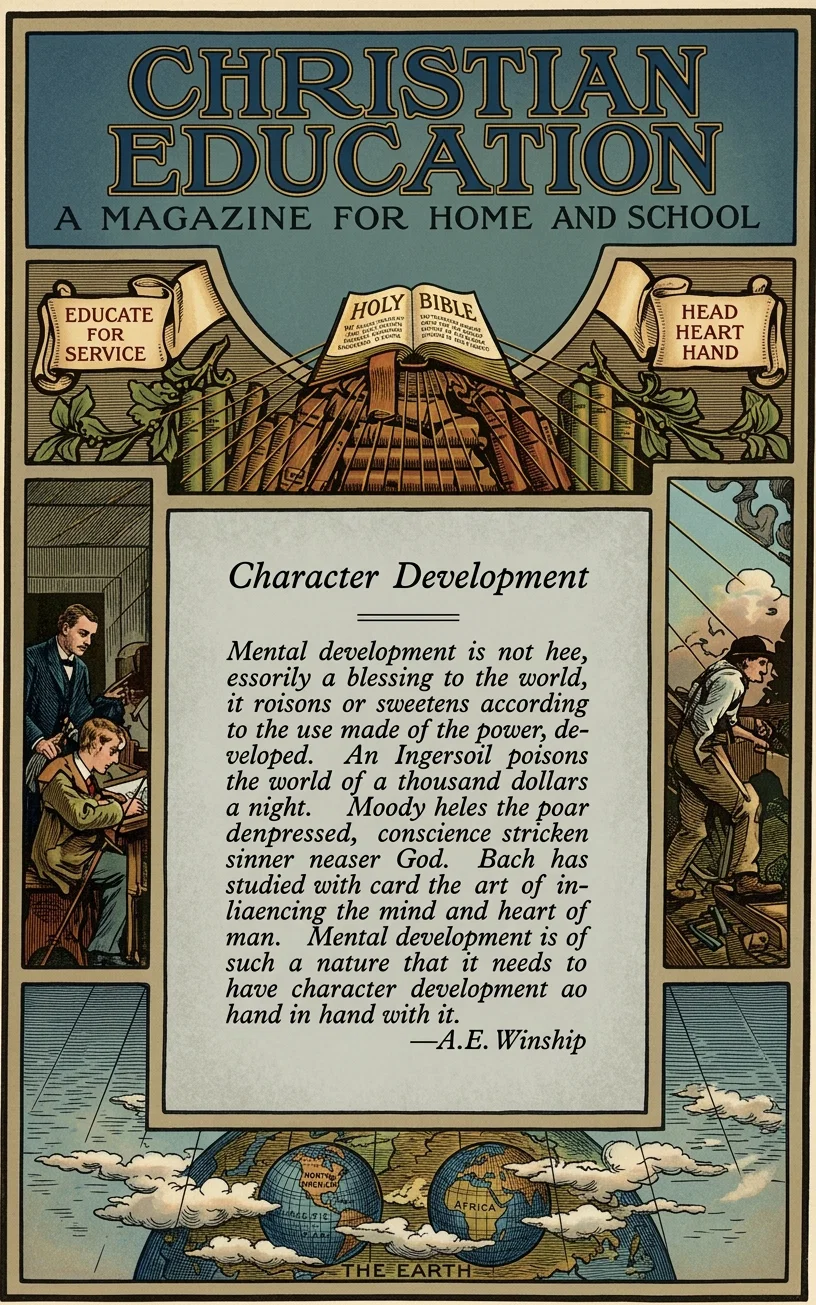
CHRISTIAN EDUCATION

in Magazine and Book Form

“Christian Education”

The Organ of the Educational Department of the General Conference of Seventh-day Adventists

ITS PURPOSE

Issued for the promotion of a broad, thorough, and rational education, based upon true Christian principles, expanding and enriching the present conception of education, to the harmonious development of the physical, the mental, and the spiritual powers.
IT PLANS for the individual growth; the betterment of the home; the improvement of the school; the development of the church; and the general advancement of ideal living.
IT ADVOCATES a system of education that builds up faith in God, and centers its highest aim upon moral character.
IT AIMS to reveal the correct view of all the duties and responsibilities of life, and to encourage the moral force to rightly discharge them.

WHAT IT WILL DO

IT WILL assist teachers.
IT WILL instruct parents.
IT WILL inspire confidence.
IT WILL educate for character.
IT WILL promote spiritual and physical health.
IT WILL qualify for effective service.
IT WILL encourage students and workers.
IT WILL stimulate a desire for education.
IT WILL expose fallacies and fanaticisms.
IT WILL encourage the science of true education.
IT WILL develop and maintain an interest in the progress of general educational work.
IT WILL assist in lifting the standard of education in our schools.
IT WILL be a strong teacher, a good counselor, and a safe guide.
IT WILL keep the rank and file of the people in touch with the advancement of our educational work.

THE THIRD NUMBER

While the third number of Christian Education is especially prepared with a view to the needs of our own denominational school work, it presents principles suited to the general public needs, in an applied way, that renders the journal as applicable to others as to ourselves. It, as well as all succeeding numbers, will be, therefore, of general public interest, and will be readily received and appreciated by outside people, who need its help as much or more than our own people. It bears a distinct and essential phase of the message. It will insure our workers a hearty welcome to the majority of the homes of the people. The third number deals with some of the most practical topics associated with individual, home, and school work.

PRICES

Yearly subscription, 50 cents; single copy, 10 cents.

CLUBS

Five or more subscriptions to one address, cash with order, 35 cents each.

COPIES TO SELL

Ten or more copies of any one issue, 6 cents a copy.

First Principles

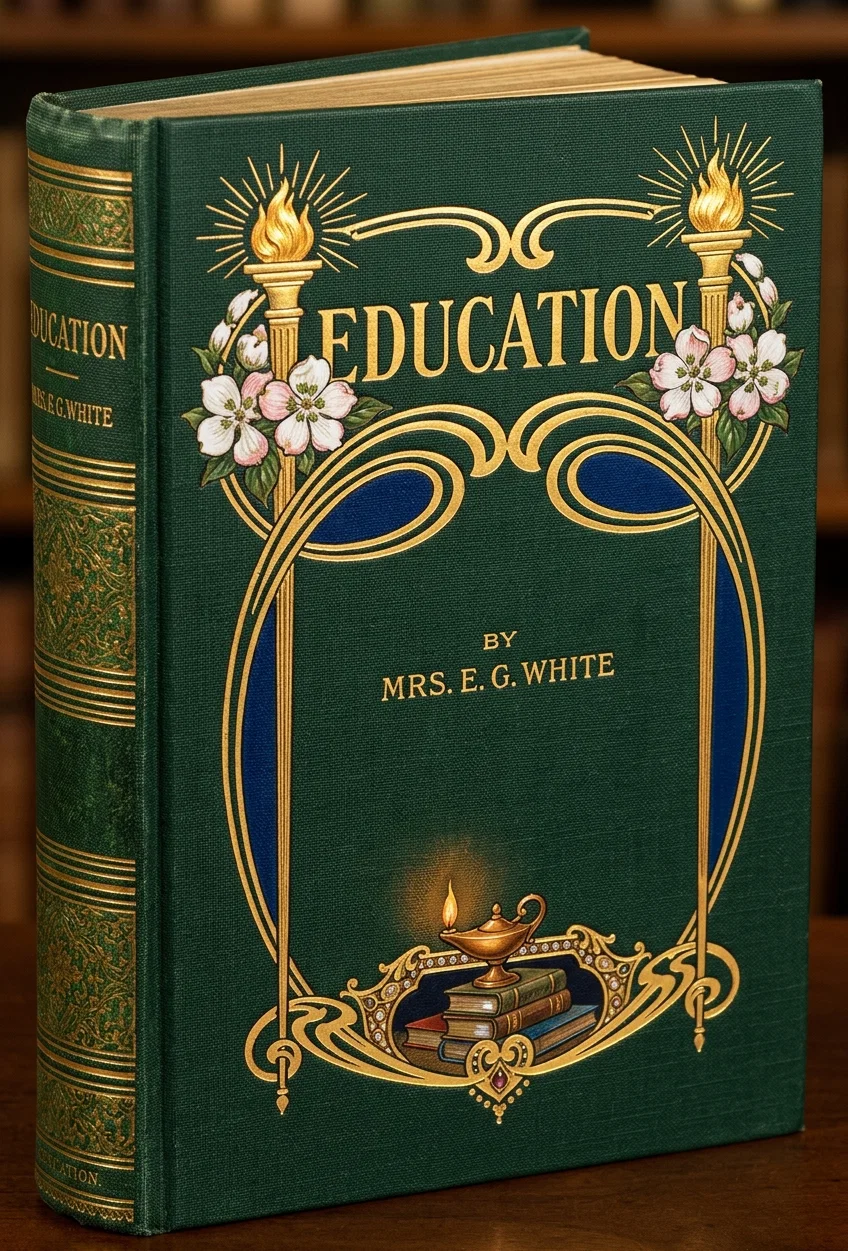
Education

BY MRS. E. G. WHITE
A book of 321 pages, filled from cover to cover with the choicest instruction on that all-important subject to every person — education. The reader can not fail to partake of the inspiration of the author, and be lifted up and ennobled by reading this book. The subject is not dealt with from a purely mental standpoint. The author says that education is “the harmonious development of the physical, the mental, and the spiritual powers. It prepares the student for the joy of service in this world, and for the higher joy of wider service in the world to come.”
Following the example of the great Master Teacher, the author of this book has drawn from nature many illustrations to enforce the thoughts presented. The Book of all books is made the basis of all true knowledge. The book is divided into nine sections, as follows: —

First Principles

Source and Aim of True Education; The Eden School; The Knowledge of Good and Evil; Relation of Education to Redemption.

Illustrations

The Education of Israel; The Schools of the Prophets; Lives of Great Men.

The Master Teacher

The Teacher Sent from God; An Illustration of His Methods.

Nature Teaching

God in Nature; Lessons of Life; Other Object-Lessons.

The Bible as an Educator

Mental and Spiritual Culture; Science and the Bible; Business Principles and Methods; Bible Biographies; Poetry and Song; Mysteries and the Bible; History and Prophecy; Bible Teaching and Study.

Physical Culture

Study and Physiology; Temperance and Dietetics; Recreation; Manual Training.

Character-Building

Education and Character; Methods of Teaching; Deportment; Relation of Dress to Education; The Sabbath; Faith and Prayer; The Life-work.

The Under-Teacher

Preparation; Co-operation; Discipline.

The Higher Course

The School of the Hereafter.
We can not too highly recommend this book to every parent, teacher, and student. Price, post-paid, only $1.25.

Cheering News

Editorial

Cheering News.—All value highly the reports sent in for our World-wide Field and Field Work departments. Nothing is more cheering than news of progress. So Paul and Barnabas realized: “And when they were come [to Antioch], and had gathered the church together, they rehearsed all that God had done with them, and how he had opened the door of faith unto the Gentiles.”
Our First Reports.—When the little paper, Present Truth, was sent out, reports soon began to come in. Small though the paper was, the editor felt that he must pass on the good news. Following the first report from the field ever published by us (in No. 4, September, 1849), Elder White wrote: “I did not intend to publish letters from the brethren, but it does seem to me that such cheering news as Brother Bowles’s letter contains, should be published.”
Michigan First.—That first report was from Jackson, Mich., written by J. C. Bowles, who had evidently been leader of a group of believers in the second advent. He wrote:—
Your first and second numbers of the Present Truth are received, and we are thankful to our Heavenly Father for the light of the truth. I would say for your encouragement, that the little band here have received the truth on the Sabbath, without an exception. And we thank God for ever inclining Brother Bates’s mind to come to Jackson. O, sound the alarm, and let the message fly! We herein send you ten dollars for the spread of the truth. If you need it all, use it; if not, let Brother Bates have a part of it to travel with.
Working for a Neighbor.—From Sutton, Vt., Harvey Childs wrote that when the little paper came, it did him so much good that he passed it on to a neighbor, who had been much opposed to the Sabbath. “It convicted him very much.” Then a tract by Hiram Edson came to Brother Childs, which he likewise sent to his neighbor. Here is the interesting sequel:—
I sent it to him on the Sabbath. He had been at work all the morning; but he came in and sat down and read it. He came here the next day in distress, and said there was such a mighty blaze of light that shone out, that he trembled in every limb while he read. He told his wife they could go no further in that course, and they sat down and kept the rest of the day. He has come out and confessed his faith publicly.
First Fruits.—It is interesting to read in the few numbers of Present Truth the reports of the early progress of the cause, as the tiny band of workers went out. The word of the Lord did not return void. We are still reaping from that first seed sowing. The last lines in the last number of Present Truth (November, 1850) were the closing words of a letter from Joseph Bates, reporting a tour in Vermont and New Hampshire which had established believers in a number of places, including Joseph Baker, who later preached the message, and E. P. Butler, of Waterbury, one of the stand-bys in the early times. Captain Bates’s closing words fitly closed the first volume of our first paper:—
So you see, dear brother, that in places where all was dark and dreary a few weeks since, light is now springing up. Then let all the swift messengers that God has called, and still is calling into the field, to give the loud cry of the third angel, move forward.
Continue reading: To the Fields in 1909