Your ShelfYour Projects

Signs of the Times, Vol. 27, No. 45.

HE IS NOT HERE; HE IS RISEN

Signs of the Times

Nov 6, 1901

Pacific Press Publishing Company · Oakland, California · Nov 6, 1901

“HE IS NOT HERE; HE IS RISEN.”
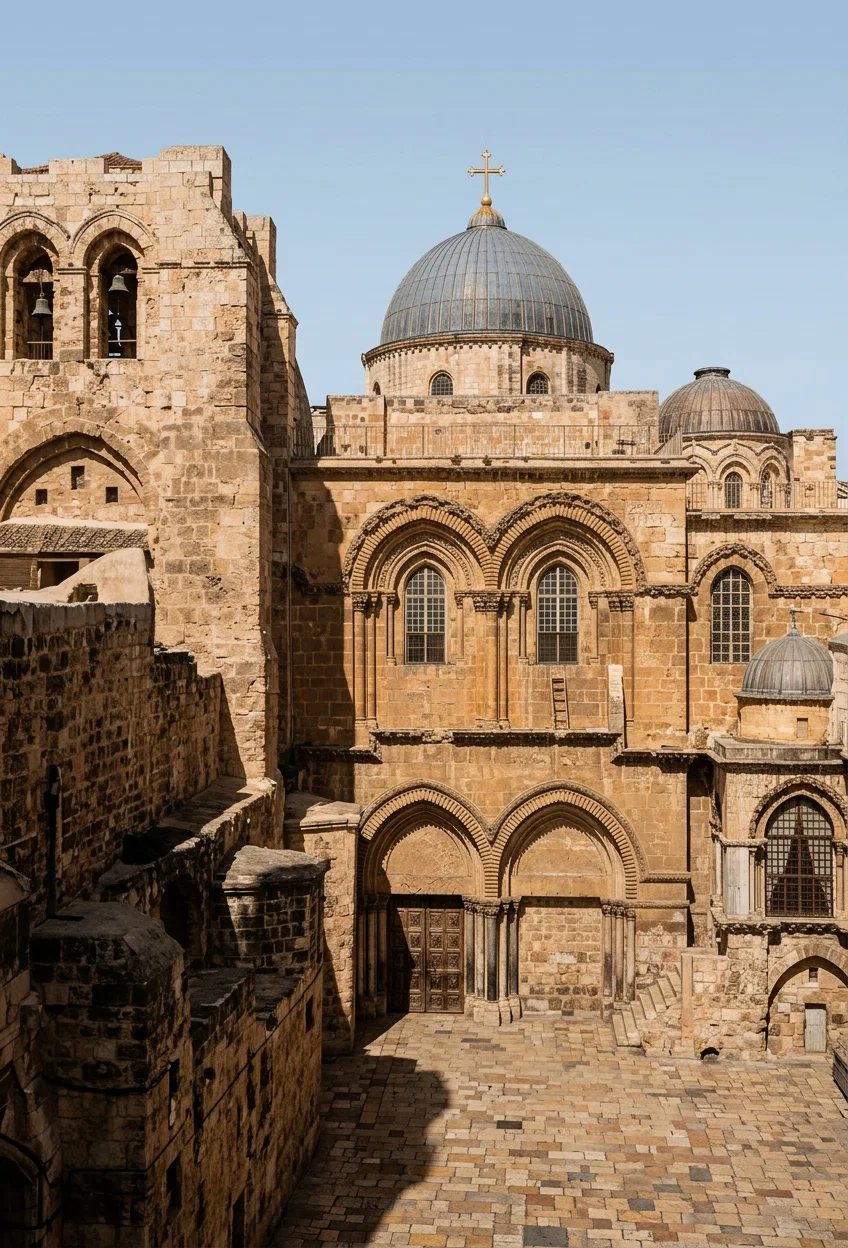
A CHARACTERISTIC evidence of departing from the true way of the cross and losing the power of the Spirit of life, is manifest reverence and adoration for the material things of the past. It is not even necessary that these “sacred relics” should be proved to be genuine; it is sufficient that the claim be made, that this claim be traced back for a century or more, and that an alleged miracle or so be wrought to substantiate the tradition.
The Church of the Holy Sepulcher, Jerusalem.
THE early church evidently knew where our Lord was buried. One of their number owned the sepulcher. Several others were present at His burial, and visited the spot after His resurrection. But they left us no record of the place, they uttered no word as to its holiness. It was not until the power of the Gospel of life had departed from the church that people began to seek for virtue to the places which had witnessed the presence and power of the Son of God or His devoted servants.
IT was the corrupt, cruel, half-pagan emperor Constantine who built the first church of the Holy Sepulcher, and on ground within Jerusalem, where our Lord was certainly not buried; for “He suffered ‘without the gate,’ and “in the place where He was crucified there ‘was a garden, and in the garden a new sepulcher. . . . There ‘laid they Jesus.” Heb. 13:12; John 19:17, 41, 42. But there was no word in the Scriptures of Truth as to its holiness. Constantine, in true pagan way, wishing perhaps to atone for some of his evil deeds and to ingratiate himself with the then superstitious church, erected a rotunda over the supposed tomb, and close by, on the supposed spot of the crucifixion, a magnificent basilica was built, and consecrated in 336. These were burned in 614, when Chosroes II. invaded the Holy Land. In 626 new buildings—three in number—were finished, begun ten years before by the abbot Modestus. These the Mohammedans burned in 936; they were rebuilt in 1048. These stood till 1808, when they were burned in the great conflagration of that year. The present buildings were begun by the Greeks and Armenians in 1810, planned by a Greek architect, Komnenos Kalfa, of Constantinople.
FOR more than a century and a half—1096 to 1250—the European crusaders sought to wrest the Holy Sepulcher and other places from the hated Moslem. Their great waves, filled with religious enthusiasm and the drift-wood of superstition, greed, hatred, avarice, lust, and fanaticism, beat on the shores of little Palestina or lost themselves in the hostile regions between; sometimes victorious at the expense of myriads of lives, but ending at last in the froth of defeat, with Jerusalem still in the hand of the hated followers of Mahomet, the armed soldiers of the prophet still keeping peace between the factions of professed Christians, who know not the power of Christ Jesus, and are vainly seeking it where He is not.
WHERE lies the difference between the early church and that which for long centuries has builded and garnished the sepulchers of the holy? The secret of both is revealed in the Gospel. The angel said to the women as they came to the empty tomb on that morning of the resurrection: “I know that ye ‘seek Jesus, which hath been crucified. He is not here; for He is risen, ‘even as He said. . . . He goeth before you into Galilee; there ‘shall ye see Him.” Here are the secrets of both actions.
UNBELIEF grasps the material, and looks to the past. It walksby sight, not faith; by sense, not the principles of divine truth. It saw the sepulcher; it saw Jesus laid there; it helped to enwathe Him in aromatics and place Him there; it saw the stone rolled to the door; it returned there to find a dead body, a crucified Lord. Such has always been the case. Forgetting God’s living, present word, men turn to the past. Forgetting what Christ “had said,” the hearts of His disciples were still in the empty sepulcher. Backslidden, unbelieving Israel hoped while transgressing God’s law to be saved by the ark in which the dead cold letters of the law were enclosed. They fell to worshiping the serpent of brass centuries after Moses made it. The same want of faith, the same sensuous religion, seeks virtue and help in charms, in amulets, in relics, in bones, in pieces of wood “of the ‘true [?] cross,” in empty tombs, in places once hallowed by the presence of the Holy, in empty forms and empty prayers, in once effectual methods of work, fitted for the lame and blind, but now inadequate and unadaptable, in outworn creeds and constitutions of men’s devising, in a thousand other things which physical eyes can see and physical hands can grasp, things once associated with Power from on High, but of themselves nothing. All their worth in the past has been their use by those who looked beyond them and grasped the ever-living truth, the ever out-flowing life of God.
“HE is not here,” making an abiding place in the past. He is not dead in Joseph’s tomb. “He is risen;” He is “alive forevermore.” He goes before, out beyond Jerusalem; out beyond the little center of the past, where the children met; out beyond the constant Gospel-hearer, Gospel-hardened, to the great needy “Galilee of ‘the nations.’” “THERE shall ye find HIM.” By the sick-beds, by the prisoner’s side, at the widow’s cot, before the sin-sick souls, ministering to all of His abounding grace—“There shall ye find Him.” He does not love to dwell in the cold rock, when there are warm hearts longing for Him. Above all temples wherein He delights to dwell is “the upright heart and pure.”
THE longing, the seeking, the struggle, for power is not over. Still Jerusalem is greater among the “holy cities” than Rome. The Church of the Holy Sepulcher is to be preferred to St. Peter’s. To place there the head of ritual religion, there will be crusades enlisting organized armies instead of mad, half-famished hordes. And when that is done, in one form or another, many will be deceived. But then the true church, obedient to every known truth of God, following in the footsteps of Jesus Christ, will draw from Him “the light and life ‘and love of heaven.” Their blameless regenerated life will be the mightiest witness to the world that “Christ is risen indeed.”

“WATCH AND PRAY.”

TO the people of God comes the injunction, “Watch and pray, ‘that ye enter not into temptation.” Temptations born of selfishness and covetousness will come to us constantly, and constantly we are to resist them, strengthened by the grace of God. Before a world that is watching professing Christians, ready to make capital of any inconsistencies, those who put on Christ will work out the pure principles of heaven.
The church of God is to be the light of the world, shining amid the moral darkness. Let nothing unlike Christ be allowed to make the least appearance among the people to whom God has given the work of revealing His character to those opposed to Him. We are to bring pure principles into all our dealing with believers and unbelievers. Christians are to treat their fellow-workers as they would wish to be treated, being careful not to take the least advantage of them. They are not selfishly to seize opportunities which will place their brother at a disadvantage. Fathers, masters, rulers, are never to take advantage of their position to bring about such a condition of things that questionable principles shall bear sway.
I speak to you in the words of the great Teacher: “Watch ye ‘therefore; for ye know not when the Master of the house cometh, at ‘even, or at midnight, or at the cockcrowing, or in the morning; lest ‘coming suddenly He find you sleeping. And what I say unto you I ‘say unto all, Watch.” I lift my voice in warning. Hear the words of Jesus. In all business transactions, watch. Ministers and presidents of conferences, watch unto prayer. Work out your own prayers, and you will find that you are co-operating with Christ.
My brethren, you can not afford to make one move on the wrong side, one move that will in any way vindicate the principles which God condemns. Turn away from wicked examples, by whomsoever they may be set; for they should not be followed. God is at work, calling attention to the laws of His kingdom. Bow to no human authority, unless a plain, “Thus saith the Lord,” makes it safe for you to do this. When those who claim to have authority in business lines deviate in the slightest particular from mercy and justice, do not follow in their ways, or seek to vindicate their actions.
Those who will be most exalted in the kingdom of God are those who in this life love the Lord Jesus and their fellow-men, those who are always ready to honor Him who made so great a sacrifice for them. He laid aside His kingly crown and royal robe, and stepped from His high command to take His place at the head of a fallen race. Clothing His divinity with humanity, He came to a world all seared and marred with the curse, to become one with humanity, to endure in behalf of humanity the temptations of the wily foe. He came to show men that they may stand on vantage-ground with God, keeping all the laws of His kingdom, acting out His will in love and kindness and loyalty, doing good and not evil.
Nothing has been so difficult for the people of God to learn as loyalty to the pure, elevated, unselfish principles of heaven. And as a result, sin and suffering make up a large part of their history. The words spoken to Daniel by the angel are positive: “Many shall be ‘purified, and made white, and tried; but the wicked shall do wickedly, ‘and none of the wicked shall understand.” Be assured that Satan, as a strong man armed, is continually on the watch, seeking to penetrate to the very heart of God’s working force, striving to bring in questionable methods of dealing, and thereby mar the work of God. He works with all his power to bring his suspicious, evil theories into the business dealing of God’s people. He would be well pleased to eclipse the brightness of God’s principles by the selfishness of the principles on which he works. If he possibly can, he will tarnish the pure gold of character. If he can place the false where the true should be, his object is gained.
The originator of all evil, Satan comes with stealthy tread, presenting plausible theories to the people of God, telling them that if they do this or that, even tho it may be questionable, they will gain great advantage, and the end will justify the means. He tries to persuade them that the eating of the forbidden fruit will be to them a source of great good. When men listen to him, the spiritual eyesight is dimmed, and the power of distinguishing between good and evil is lost.
MRS. E. G. WHITE.

THE POWER OF A SINLESS PURPOSE.

UNTO man He said, Behold, the fear of the Lord, that is wisdom; and to depart from evil is understanding.” To just the extent that a man, by faith, pursues a sinless purpose, a sinless character will be developed in his life. “For if there be first ‘a willing mind, it is accepted according to that a man hath, and not ‘according to that he hath not.” 2 Cor. 8:12. This is the whole of the starting point. There is no good thing in us. So we have to get our standard, our ideal, our goal, somewhere else. To the extent, and in just the degree, and with just the earnestness that we pursue a sinless purpose, and only in that degree and to that extent, shall we realize the sinless character,—a character whose only purpose and object is to honor and glorify God. And the more earnestly we continue to pursue that sinless purpose, and keep our eyes upon our sinless Pattern, to the greater extent will a sinless character be developed in us.
But this wisdom of God is not something we can see. We can see the “foolishness of man” on every side, but the fear of the Lord is wisdom. The Lord says that the man who will exercise understanding will depart from evil. The man who is departing from evil can read the handwriting on the wall; can see the finger of God in his daily experiences; can understand humanity around him; can understand what God is doing in his own personal experience. “To depart ‘from evil is understanding.” Read Deut. 4:6: “Keep therefore and ‘do them; for this is your wisdom and your understanding in the sight ‘of the nations, which shall hear all these statutes, and say, Surely ‘this great nation is a wise and understanding people.” Even our wisdom and our understanding in the sight of the nations is dependent upon this very thing; for the thing that makes us acceptable to God, will in His providence make us most useful and acceptable to the nations. “Ye are the salt of the earth,” and “the light of the ‘world.”
Many think that in order to be popular in this world we must, when in Rome, do as the Romans do. You who have settled the question of the fear of the Lord, which is wisdom, can leave the question of what people think in the Lord’s hands. The Lord does nothold us responsible for results. In all the commissions of the Gospel He says, “Go and preach”—not for conversion, but “for a witness.” Here is the great distinction between true and false miracles. False miracles and signs and wonders either go before or accompany the proclamation of a message, and are urged as proof of the authenticity of that work. The true and genuine follow on behind, because of the change that has taken place in the hearts of the people who accepted the truth that went before. Truth, and nothing but the truth, is necessary to prove the truthfulness of truth. When a man has accepted the truth, there begins the initial miracle in a great series of signs and wonders that cause even angels to wonder in amazement at the sanctifying power of divine grace and the eternal word of truth.
To the eye of faith the very acceptance of truth is one of the greatest of miracles. On the other hand, there are a great many people who are worried because-things do not just suit them, because they do not see a great demonstration. Spiritual things are invisible. They must be taken by faith; for “the just shall live by faith,” and “without faith it is impossible to please God.” The understanding we need is the consciousness that with body, soul, and spirit we are departing from evil. In order to understand the handwriting of God upon the wall; in order to enjoy and enter into the divine providences; in order to appreciate our own acceptance in Christ, thank God it is not necessary that we should have already reached perfection. It is simply necessary that we shall daily be conscious of the fact that we are departing from evil. To the extent that we have our eyes upon a sinless purpose, there will be developed within us, day by day, a sinless character. This character will be formed of our thoughts, feelings, and purposes; and when our purpose becomes a sinless one, it will be the most powerful factor to make our thoughts and feelings sinless. By the power of a sinless purpose, our sinful thoughts and feelings will be transformed; then the character being developed within us is having woven into its texture sinless threads.
We preside at the loom in which a character for eternity is being woven, and it is our privilege to have every purpose, thought, emotion, and sentiment of the soul so elevated, noble, and grand, that every thread that is woven into this garment of character will be a thread that was first woven in the loom of heaven. The development, growth, that comes from the Spirit, is not always a growth that can be seen by the human eye. There are forms of good, the bestowal of which is evidenced only by a greater sense of need. The goodness of God and the righteousness of Christ, when bestowed upon a man, are evidenced only by that man’s realization of a greater sense of his need of them. When Christ’s humility is given to a man, the only evidence the man will ever have of the fact, will be that he feels a greater sense of his need of it than ever he had before. So, if he is walking by sight, he will be bemoaning the fact that he has got less than he had before. As we progress in the Christian life, things look brighter and grander to the eye of faith, but more and more hopeless and discouraging to the eye of sight. Then let us not walk by sight. Let us put away those thing that belong to the childhood of our Christian experience. Let us begin to get hold of some of the things that belong to and accompany salvation. With the eye of faith look straight ahead. Let our purpose be high, holy, and exalted, and while the days are going by, a high, holy, and exalted character will be developed within us.
W. S. SADLER.

GOD'S EVER-PRESENCE.

Do we realize as we should the infinite nearness of God's presence? There are no more comforting words that come ringing down the ages than those tender words of our Saviour, "Lo, I am with 'you alway, even unto the end of the world.'" That does not mean a God afar off. It does not mean spiritual loneliness for the believer, but an ever-present Christ, the brooding tenderness and companionship of the great Overheart to fill our lives with gladness and with joy.
This is one of the great charms of a life that is hid in Christ; it has always the sense of a protecting Presence of infinite love and care, of moving on with Christ to that better life, where we shall see Him as He is, and rejoice forever in His visible presence.
But here, in this earth life, the earnest Christian has an abiding sense of the nearness of the Saviour. There are no solitary places where he has to walk alone; no Sloughs of Despond that faith can not bridge for him; no Hill Difficulty that he may not climb, and no Valley of the Shadow of Death that shall not be brightened by the angels of love and mercy.
Christianity is not a mere theory, but a living fact, a glorious reality to glorify life and to uplift humanity. It is that which keeps alive the divine spark in the soul and makes man great and enduring. It leads to the unfolding of man's better nature; it is the burial of self as the supreme object of affection. To do good for the love of Christ is not hard; for this love is all-compelling, and it takes the whole world into its embrace.
But how shall I become a Christian? you ask. My heart is hard and unfeeling, and I don't have the proper sorrow for sin, and I don't believe that I shall ever be any better than I am now.
Ah, my friend, it is just here where the trouble lies. It is the sin of unbelief that keeps you from Christ. You do not take Him at His word when He says, "Tho your sins be as scarlet, they shall be 'as white as snow,'" but you say, "I must try to make myself a 'little better before I go; I must get into a different frame of mind 'before I ask Him to receive me.'" And all the while He is saying, "Come."
“The Spirit and the bride say, Come. And let him that heareth say, Come. And let him that is athirst come. And whosoever will, let him take the water of life freely.”
That is all you have to do, a weary and heavy-laden sinner. Listen to the voice of our Redeemer and trust His willingness and power to save. Like the returning prodigal, let the language of your heart be, this very hour, “I will arise and go unto my Father.”
ELIZA A. OTIS.

A PLEA FOR THE BIBLE SABBATH.

[Mrs E. M. Peebles, in World-Herald, Omaha, Neb.]
Remember the Sabbath day to keep it holy. Six days shalt thou labor, and do all thy work; but the seventh day is the Sabbath of the Lord thy God. In it thou shalt not do any work, thou, nor thy son, nor thy daughter. . . . For in six days the Lord made heaven and earth, the sea, and all that in them is, and rested the seventh day; wherefore the Lord blessed the Sabbath day, and hallowed it.” Ex. 20 : 8–11.
Thus reads God’s Sabbath law, and He has never repealed it. There are in progress in the world at the present time two movements aiming at a reformation in the observance of the “Sabbath.” One of these depends for its success upon the enforcement of laws by which all shall be compelled to observe a day, while the other could not if it would call to its aid the arm of civil power. It depends wholly upon the spiritual power of divine truth drawn from Scripture. Both are making progress, but the latter is in principle a direct contradiction to the other.
With the vast preponderance of numbers, influence, and wealth on its side, the movement for a stricter observance of Sunday, claims that legislation and prosecution are necessary; while that for the observance of the Bible Sabbath asserts that legislation instead of being a help is a positive and formidable hindrance, and proceeds independently without it. It proceeds in spite of it, and of every obstacle which naturally lies in the pathway of that which is unpopular; and, contrary to common belief and custom, thus demonstrates that true Sabbath reform depends upon an enlightened conscience rather than upon State legislation.
If a movement which has neither wealth, numbers, social influence, or popular custom to back it, but must move against all these, can do so without the aid of legislation, why can not a movement which has all these in its favor proceed without it? Certainly it is because it is lacking in some vital point, and it has some inherent weakness that is fatal to its life.
The movement which calls people to observe the Bible Sabbath is unpopular. It calls upon men even as did Christ, who was its Author, to give up money, position, social standing, and worldly honor; but it promises also, as did Christ of old, spiritual rest and blessing, as many texts which might be cited abundantly prove.
The difference between the two rival Sabbaths lies in the fact that the Sunday institution, even tho it be hoary with age, is based entirely, as its name indicates, upon ancient sun-worship, being perpetuated by the Roman power, yet never donning the Christian garb until several centuries after Christ was on earth. It comes to us by tradition, not by a thus saith the Lord. Even its adherents are unanimously compelled to acknowledge this, while the Sabbath of the fourth commandment has for its author no other than the Almighty Himself, who spoke it from the fire-mantled and shaking mountain of Sinai with an audible voice. But this was not enough. He wrote it with His own finger upon tables of stone, the fourth commandment being placed in the bosom of the law thus written, and being the only one in which God’s name is given as Creator. This is the only specimen man has had of God’s handwriting, and Jesus said that not a jot or tittle should pass while heaven and earth remain. It must therefore still be in force, altho so entirely disregarded.

A PROPHECY OF THE NATIONS.

God in History.

DANIEL VII. will be divided into two lessons: (1) The Four Beasts; (2) The Little Horn. Read the first seven verses of the chapter in the center of this page. Let the vivid picture be stamped upon the mind.
The vision is given in the first year of Belshazzar, three years before Babylon fell, or B.C. 541. Belshazzar had just been appointed joint-ruler with his father, Nabonidus. The father was engaged in building temples and shrines to the gods; the son seemed to be the active public ruler.
On this occasion the dream and vision came to Daniel. “If there be a prophet among you,” the Lord declares to His people, “I Jehovah will make Myself known unto him in a vision, and will speak unto him in a dream.” God was speaking in His regular appointed way through Daniel, that the ages might know, that the people in “the latter days” might read of God’s foreknowledge and power, and thus learning, believe His Gospel and be saved. “Remember the former things of old; for I am God, and there is none else; I am God, and there is none like Me, declaring the end from the beginning, and from ancient times things that are not yet done, saying, My counsel shall stand, and I will do all My pleasure.” Blessed is the man who yields to God’s holy purpose, that God may work in him His good pleasure, after the counsel of His own will, to the praise of the glory of His grace.
Read again the vision of the four beasts. Let the whole scene enter the mind. Put yourself in the prophet’s place. See yourself the vision of God. You are standing upon the shore of the great sea, lashed into fury and made to boil in tumult by fierce and opposite winds. As you watch the raging waters, you see four wild beasts come up out of the sea, all alike fierce and cruel, yet totally different in form and kind. Each beast of the first three is unnatural, even of its kind, in form, in members, or in attitude.
By a great and magnificent image God impressed the mind of the idolatrous king Nebuchadnezzar. By wild and cruel beasts God revealed to His prophet and people the true nature of earthly empires.
What do these beasts symbolize? The angel of God answers the question: “These great beasts, which are four, are four kings, which shall arise out of the earth.” (Read verses 15–17.) The Septuagint reads: “These four beasts are four kingdoms that shall rise up on the earth; which shall be taken away.” They represent the four great kingdoms of earth; the same four that had been revealed to Nebuchadnezzar in the four parts of the great metallic image—the gold, the silver, the brass, the iron, and iron and clay. The great sea, the mighty, restless, surging water, is a fitting symbol of the restless, heaving, tossing tides of humanity’s great sea, divided among the nations and tribes of the earth. The winds are fitting symbols of the strife and war among nations and governments. As the result of the strife and war, four great kingdoms, or dynasties, appear.
The first of these beasts, the lion, represents Babylon, or Chaldea. So when Jeremiah saw in vision the army of Babylon marching upon Jerusalem, he declared: “The lion is come up from his thicket, and ‘the destroyer of the Gentiles is on his way.’” And as to the eagle’s wings, the same prophet declares: “Behold, he shall fly as an eagle.” The lion with the eagle’s wings represented Babylon, that “mighty nation,” that “ancient nation,” the beginning of kingdoms. The word ancient means from time not known, whose antiquity is hidden. The record in Genesis clearly intimates that it was the very first city after the flood,—the beginning of the kingdom of Nimrod, the first of the rebel kingdoms against God. Erech (Ur) and Accad and Calneh and Assyria and Nineveh came later. The first of all, the mother of all the cities of pride, was Babylon, who by the wine of her lustful idolatry hath “made all the earth drunken.” “Their judgment and their dignity proceed from themselves.” The lion is the king of beasts; he borrows from no other, he imitates no other. The eagle is the king of birds; his habits, his heart, is changed by no other. Even so Babylon, in her distinctive character, has been molded by no other nation, but has molded all.
In all the ancient world it was the great seat of learning. Its universities surpassed all others. Wherever the mightier warriors might be, Babylon ruled. Assyria might be dominant in the martial field; Babylon reigned in character-molding power, in religious influence. The center of influence might sometimes change to some other great center for a few years or centuries, but in its origin it was Babylonian.
Until 1820, forgetting or not believing the Bible, men had supposed that Babylon was an empire which began at a late date in the world’s history; founded, in fact, on the ruins of the old Assyrian empire. In this conception they had ignored the Bible, and the State archives of Babylon and Nineveh had not yet been unlocked to the world. Now it is clearly seen by the historical records of Babylon that she was among the most ancient of cities.
The archæologists tell us that its first inhabitants were not Semitic, but called by some scholars Sumerian (from Shinar, as given in the Word), by others Accadian. One theory is that these were Mongols, others that they were a mixed people. Rogers tells us that, “The solution of the question is not yet found.” How much better it would be to go to the old Book, and find that the first builders of Babylon belonged to the Hamitic branch of Noah’s family, and that among the first cities built by them were Babel (Babylon), Erech (Ur), Accad, and Calneh, in the land of Shinar (hence Sumer, Sumerians). Shinar was the name the land retained to Biblical times. Accadian, now considered a Sumerian dialect, was from the name of a tribal city.
From these Hamitic tribes came the cuneiform text, the perversion of true religion to nature-worship, and the inerasable scarlet of fornication,—unlawful union of religion with the State,—by which Babylon has stained all the nations of earth. Even the Assyrian kings, in the time of Nineveh’s greatest glory, honored Babylon, counting it one of the highest privileges to bow before the great god Marduk, and receive the kingdom from his hand. Rogers says:—
The origin of the city of Babylon is veiled in impenetrable obscurity. The first city founded upon the site must [?] have been founded fully four thousand [?] years before Christ, and it may have been much earlier. . . . From about 2300 B.C. the influence of the city extends without a break to the period of the Seleucides. No capital in the world has ever been the center of so much power for a period so vast.
Babylon’s reign as a world’s empire ceased with the joint rule of Nabonidus and Belshazzar. Darius the Mede succeeded to the throne B.C. 538, to be followed by Cyrus, the great Persian. A century and a half before his coming to power, Isaiah, by the inbreathing of God, predicted the fall of Babylon and the deliverance of God’s people through him. In that deliverance he was the type of the greaterDeliverer, from a greater captivity, even that of sin. Here is a part of the record:—
“Thus saith Jehovah thy Redeemer, . . . I am Jehovah that maketh all things; that stretcheth forth the heavens alone; that spreadeth abroad the earth; . . . that saith of Cyrus, He is My shepherd, and shall perform all My pleasure; even saying of Jerusalem, She shall be built; and to the temple, Thy foundation shall be laid. Thus saith Jehovah to His anointed, to Cyrus, whose right hand I have holden, to subdue nations before him, and I will loose the loins of kings, to open the doors before him, and the gates shall not be shut. I will go before thee, and make the rugged places plain; I will break in pieces the doors of brass, and cut in sunder the bars of iron; and I will give thee the treasures of darkness, and hidden riches of secret places, that thou mayest know that I am the Lord, which call thee by thy name, even the God of Israel. For Jacob My servant’s sake, and Israel My chosen, I have called thee by thy name; I have surnamed thee, though thou hast not known Me.”
Immediately on his coming to the throne Cyrus issued his decree for the release of the Judean captives and the rebuilding of Jerusalem. Here expired the seventy years’ captivity foretold by Jeremiah. This was God’s object-lesson of the glorious Gospel.
Under Cyrus were united the two kingdoms of the Medes and Persians, extending “from India even unto Ethiopia, over an hundred and seven and twenty provinces.” Cyrus was killed in a battle with Tauranians, B.C. 529, and was succeeded by a most unworthy son, Cambyses, known in Ezra 4:6 as Ahasuerus.
The great Persian empire held sway till the battle of Arbela. In the year 335 B.C. Darius Codomanus, or Darius III., came to the throne. In his second year a new figure appears in Persia. Alexander the Great had crossed the narrow strip of water which separates Europe from Asia with but 30,000 foot and 5,000 horse, for the purpose of conquering a world empire. He met the Persian forces at the river Granicus, and defeated more than five times the number of his army. The next conquest, the year following, came at Issus, where Alexander defeated a Persian army of 600,000. The next year Darius mobilized an army of 1,000,000 men, but was utterly defeated at the battle of Arbela, B.C. 331, the end of the Persian empire. Medo-Persia is well represented by the slow, tenacious, but not less cruel bear. Raising itself up upon one side indicates the manner of its coming up, one part, the Median, coming to power first. The three ribs in the bear’s mouth, represented as saying to the bear, “Arise, devour much flesh,” are thought to refer to the provinces of Babylonia, Lydia, and Egypt, which Medo-Persia greatly oppressed, the evil acts of which incited it to more cruelty.
Grecia is symbolized by the swift leopard, with its soaring wings, indicative of rapidity of conquest and soaring pride. The four heads symbolize the four divisions into which Grecia divided soon after the death of Alexander. After a few brief years of strife, and plot and counterplot (B.C. 301), the great Grecian empire is found divided as follows: In the north, Thrace, Bithynia, and some smaller provinces of Asia Minor; in the east, Syria and the country to the Indus; in the south, Egypt, Libya, Arabia, and Palestine; in the west, Macedon and Greece; ruled respectively by Lysimachus, Seleucus, Ptolemy, and Cassander.
The fourth beast, “dreadful and terrible,” finds no symbol in nature, not even with unnatural additions, to adequately represent the empire it symbolizes. From Revelation 13 it seems to be a combination of the lion, the bear, and the leopard, with the addition of the ten horns. It was more cruel than all the beasts before it. What it did not break in pieces and devour, it trampled underneath its feet. The symbol can apply to but one power, namely, Rome. Every specification fits Rome, and no other. Note the following:—
1. It was a power to succeed Grecia. This was true of Rome.
2. It was more oppressive and cruel, especially toward the saints of God, than all that were before it. This is pre-eminently true of Rome in both Pagan and Papal forms.
3. It had ten horns, symbolizing ten kingdoms. Rome was divided into ten kingdoms by the incursions of the northern barbarians between the years A.D. 351 and 476, as follows: Allemanni, Franks, Burgundians, Vandals, Suevi, Visigoths, Saxons, Ostrogoths, Lombards, and Heruli. There were not less than ten; there were no more.
4. This nondescript, terrible beast was to be “the fourth kingdom ‘upon earth,’” a positive proof that Assyria and Egypt are not counted among its predecessors. It is (1) Babylon; (2) Medo-Persia; (3) Grecia; (4) Rome.
5. This kingdom lasts in one form or another to the end, when it is destroyed in the fierce wrath of the day of God, to be succeeded by God’s everlasting kingdom. Truly it is a part of the Gospel of the kingdom to know that these cruel kingdoms will not stand forever, but are to give place to the righteous kingdom of peace.
The next article will be a consideration of “The Little Horn.”
Continue reading: THE GREATEST THING IN THE WORLD