Your ShelfYour Projects

Signs of the Times, Vol. 31, No. 24.

THE GIFT OF GOD

Signs of the Times

Jun 14, 1905

Pacific Press Publishing Company · Mountain View, California · Jun 14, 1905

THE GIFT OF GOD.
NEVER, in all the history of this world, was there a sane man who could look up at the stars in their eternal courses, and not feel welling up in his soul the intense desire to live forever. So the great question of this sin-bound race has been, "If a man die, shall he live again?"—Yea, verily, by virtue of the Bread of Life, he may. Christ declares of Himself, "I am that Bread of Life. . . . I am the living Bread which came down from heaven; if any man eat of this Bread, he shall live forever." John 6:47-51. And again: "He that believeth in Me, tho he were dead, yet shall he live." John 11:25. And here is His promise through the trumpet of the Old Testament: "Thy dead men shall live, together with My dead body shall they arise. Awake and sing, ye that dwell in dust; for thy dew is as the dew of herbs, and the earth shall cast out the dead." Isa. 26:19.
JESUS CHRIST left earth for the one purpose of bringing the bread of life to the people of this dying world. Ever since the leaves of Eden withered; ever since the shadows of death threw a pall over the erstwhile tenants of Paradise; ever since the covetousness of the carnal heart made merchandise of a brother's need; the children of this world have toiled and striven and wept for bread. Every herb or vegetable the stomach would endure; every fruit that was not a poison; every nut; every grain; every creature that has walked upon, crawled over, or flown above the earth, has been used by some people at some time to sustain life or ease the pangs of hunger. The burden that has bowed the back of the world has been the burden of keeping from the door of its homes the gaunt, gray wolf of hunger. The "necessaries of life" are the first consideration in every household; and so has it always been. Since the fall of man the business of brain has been to see that stomach did not lack; and the moulding of bread has been a perpetual process in nearly every tribe or people or nation in the world.
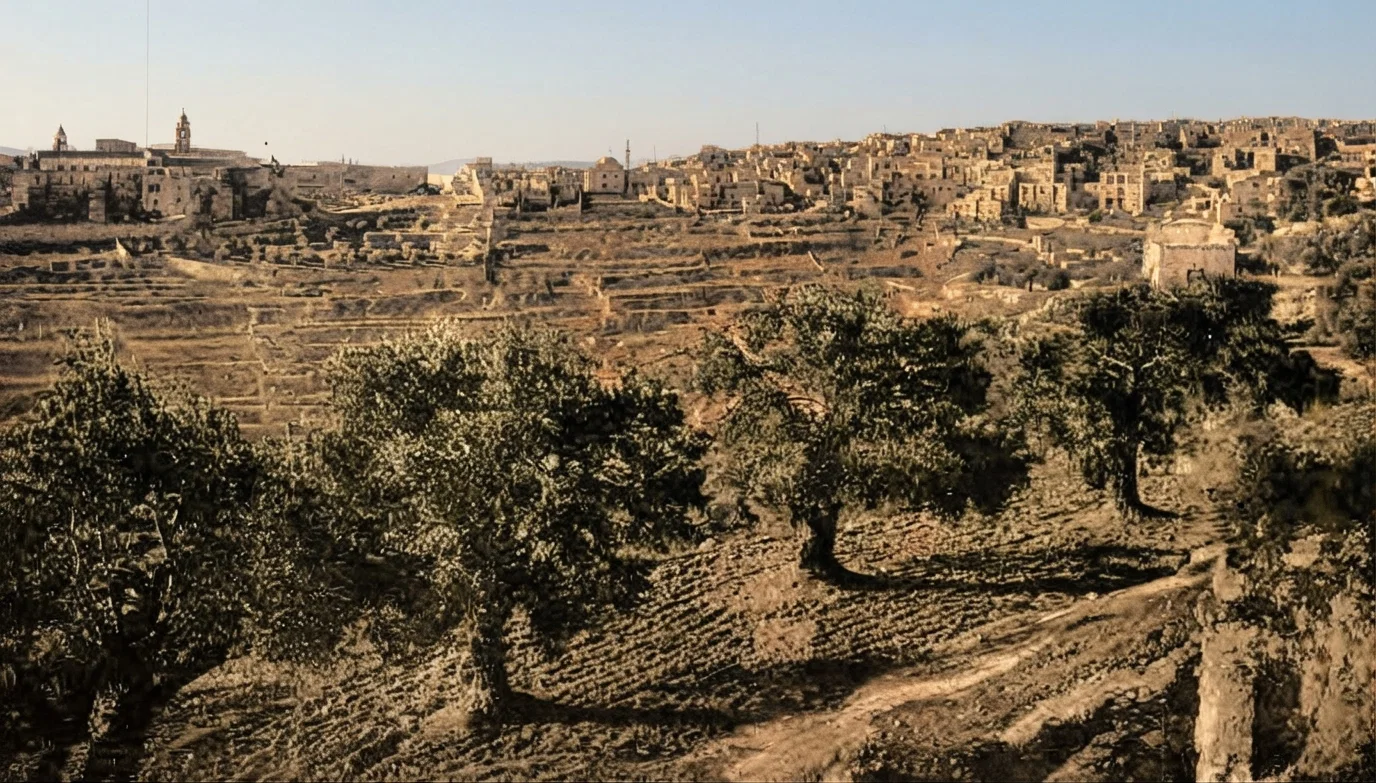
Beth-lehem,—House of Bread,—birthplace of Him who is the Bread of Life.
As SARAH, the wife of Abraham, mixed meal, and baked cakes upon the hearth for their heavenly visitors, so the peasant girls and women of Palestine to-day sit by their hearth-fires, and bake bread for the household. Day in and day out, year in and year out, the women are "grinding at the mill," heating their primitive ovens, and turning their flattened loaves upon the heated stones; or the great mills of civilized nations are turning out their millions of barrels of flour, and modern machinery and modern ovens are building and baking the loaves. This is the unceasing process whose beginning was decreed in Eden, when man was sent out to wage war with the thistle and the thorn for the wherewithal to live.
But this was not to be the bread of life. Men ate of it, and died. Men toiled for it for themselves and for their families, till, bent and beaten in the struggle, they were laid away, and left the same heritage to their children. So mortal man has passed his little day, and fought his losing fight in the long battle for bread—and life.
INTO this whirlpool of stress and struggle and strife there came one day the good news of deliverance—the Bread of Life had come. Moving among men as one of them was One to whom the Father had given "to have life in Himself" sufficient for the needs of all the world. Man had been struggling to force the unwilling earth to yield him sustenance for his temporal life; but even this must come through the power and the merciful forbearance of God. But the life which Jesus Christ has come to give was the life of which sin had robbed the race, and that was life eternal. The bread that man had eaten in the sweat of his face was thebread that he had earned. It could sustain only for a time the life that God had put in man; so that man never could, through his own labors, "eat, and live forever"—never could win eternal life by works that he might do. That must be "the gift of God." And so the record reads: "The wages of sin is death; but the gift of God is eternal life through Jesus Christ our Lord." Rom. 6:23. That "gift" came in Christ, the Son of God, the Son of Man, binding in one the attributes of both, humanity and divinity, and so reconciling man to God. "This is the record, that God hath given to us eternal life, and this life is in His Son. He that hath the Son hath life; and he that hath not the Son of God hath not life." 1 John 5:11, 12.
BLESSED be that Bread of Life that satisfies the hunger of the soul. Mankind has eaten to the full of the "bread of affliction," and struggled from the cradle to the grave for the bread of temporal sustenance; but now, out of the largeness of the abundance of the mercy of God comes the free gift of the bread of eternal life, which, if any man eat, "he shall live forever." We were shackled to sin; Christ has burst the shackles for us, and set us free. We were bound by transgression to the prison-house of the dead; but Christ is risen, and holds the keys of the grave, and will set at liberty every soul that has put his trust in Him. We have eaten of the fruit of our labor that could not give us life; He has given us in its place the life of God, that makes eternity ours, and will permit our feet to tread this earth when sin has been consumed. All this has come—has come to us—through Him who is the Bread of Life.
S.

THE CONFUSION OF "SUNDAY" AND "SABBATH."

A CONTRIBUTOR to the Christian Statesman, in endeavoring to persuade men that they ought to use the name "Sabbath" instead of "Sunday" in speaking of the first day of the week, presents some really boomerang arguments. Some of his contentions lay bare the false claim of the first-day institution in a most remarkable manner. For instance, he says:
We have no specific Bible record of when, how, or why the seventh-day Sabbath was discarded for the first-day Sabbath.
To claim divine origin for a Sabbath of which the Lord has said nothing, is about as bold an assumption as any one could make. When the Lord did make a Sabbath day, He left a very plain record of when, how, and why it was instituted. The fact that He has left no such record of a change of the day is the best of evidence that He never made such change. For "surely the Lord God will do nothing, but He revealeth His secret unto His servants the prophets." Amos 3:7.
Another assertion, which is without a shadow of authority in the Scriptures, is this:
The Christian world has simply perpetuated what the apostles did in recognizing the first day of the week as the Christian Sabbath.
Apostolic authority is Rome's stock argument for all her unscriptural dogmas, and there is as much ground for her claims concerning any of her other institutions as there is for apostolic example in the matter of Sunday observance. Admit her claim in the absence of Scripture proof in one point, and one is logically bound to accept the entire Roman Catholic creed. There is no escape from it, and that is to-day the conspicuous trend of the professed Protestant churches that maintain the Sunday institution. The locking arms with Catholicism is more and more marked as the years go by.
Another stultifying proposition, that no one would dream of advancing except in a desperate emergency, is the following:
It was not requisite that six secular days should always intervene between Sabbaths. It would appear that when a fixed feast-day Sabbath fell upon any intervening day of the cycle of seven, a new starting point for the weekly cycle was recognized.
The fallacy of this assumption is proved by the Sabbath commandment, "Six days shalt thou labor, and do all thy work; but the seventh day is the Sabbath of the Lord thy God." It is further proved by the falling of the manna for forty years in the wilderness. The command was, "Six days ye shall gather it; but on the seventh day, which is the Sabbath, in it there shall be none." If the intervening of a feast-day Sabbath during the week had marked the beginning of a new week there would have been no "sixth day" on which to gather the double quantity of manna, according to the commandment in Ex. 16:29. "God is not the author of confusion," but such confusion of the ceremonial or typical Sabbaths with God's memorial weekly Sabbath, which is "perpetual" in its character (Ex. 31:16, 17; Isa. 66:22, 23), would cause an interminable confusion not only of weeks, but of months and years. Suppose we apply it to our own time. It would work just as well with Sunday and the other holidays. When we run against another holiday in the middle of the week, suppose we begin counting another week. This will give us some idea of the confusion it would cause. Then take it in Mexico, where one-fourth or more of all the days in the year are holidays, and we have the system more fully illustrated. But men who want to argue for Sunday observance, always evade the logic of their arguments against the Sabbath of the Lord. This unwarranted confounding of the weekly Sabbath, sanctified in Eden for all time, with the temporary Sabbaths of the ceremonial system of worship, is a latter-day scheme for confusing the minds of the people with regard to the law of God.
But the last proposition in the article to which we have referred recoils, if possible, more forcibly than any of the others upon the Sunday institution. We give it as an instance of smiting Sunday observance in the house of its friends. We do the italicizing:
The Sabbath—its very name—was intended to be, and is, a sign. (Eze. 20:12). Those who call it Sabbath signify their regard for it, and those who try to keep it holy signify that they desire to keep the commandments. "Sunday," on the contrary, is not a sign of anything. The more secular and irreligious a man is the more certain he is to say "Sunday" instead of "Sabbath." To re-write the Fourth Commandment and insert "Sunday" for "Sabbath," would surely make grotesque reading and would inevitably create a grotesque feeling in the reader's mind, yet it would be better to do this than to keep up a distinction, which produces the "confusion" which certainly exists.
Yes, the Sabbath is "a sign." God so calls it Himself. He says, "It is a sign between Me and the children of Israel forever." God's covenants and promises are all with the true "Israel;" for they are all yea and amen in Christ. The Sabbath to which He refers in Exodus 31 and Ezekiel 20 is, of course, the Sabbath of the commandment. As to Sunday's being "not a sign of anything," that depends upon the standpoint from which it is viewed. God never gave it as a sign of anything, but the name is a sign that in heathen worship it was dedicated to the sun, as other days were named in a similar way; but Sunday was a pre-eminent holiday, and for that reason was admitted into the church, some time after the apostolic age, in rivalry of the true Sabbath. Sunday as an institution is a sign sad to contemplate. It is a sign of the fulfilment of a prophecy, given through a vision to Daniel, that a certain blasphemous power would arise that would "speak great words against the Most High," and would "wear out the saints of the Most High," and even "think to change the times and the law." Dan. 7:25, R. V. And that power to-day holds up the Sunday institution as a sign that it has changed the law of God, and that it has the power to do so at will. Yes, "Sunday" is a sign of something, but it is not a God-given sign.
As to re-writing the Fourth Commandment with "Sunday" inserted instead of "Sabbath," it would indeed "make grotesque reading." But why would it be any more grotesque than to write "first-day" instead of "seventh day." And this would certainly be legitimate if the alleged change had been duly authorized. But no observer of the Sunday-sabbath has ever yet dared to so write or print the Fourth Commandment. By some means the line has been drawn at that point. In lieu of it, however, men are trying to make it appear that Sunday is the seventh day of the week. But here again they stultify their position. For Sunday observers quite generally claim that they keep the day because Christ rose from the dead on the first day of the week. So every attempt to overthrow the commandment of God ends in confusion.
G.

NOTES ON THE CONFERENCE.

A S stated in our last report, this is truly a missionary conference. The very first notes struck have been dominant all through the meetings thus far. The writer has listened to many mission reports, but he has heard none more thrilling than that presented by the Foreign Mission secretary, published in the Review and Herald of May 18, entitled "A Review of the Mission Fields." We would be glad to publish it in whole, but this is impossible. We can only refer our readers to that number. The good, strong missionary appeal made in the president's address was simply carried further out into the regions beyond. It touched the thought so strongly impressed upon all who have attended past conferences, that this one stands out above all others as a missionary conference, pre-eminently. The following excerpts from the report is indicative of growth:
How hearts would have been stirred, even twenty years ago, at the suggestion of a conference made up with such delegations from the uttermost parts of the earth. Truly there is danger that many will fail to read the significance of the things now becoming common among us in the evidences of the rapid spread of this movement from land to land.
Twenty years ago is not a long time, even to some of the younger of us. The cause of this message was a great work in those days. But, brethren, our fellow-believers rejoicing in this truth to-day in fields outside of North America are a larger body than our entire membership was twenty years ago. So mightily has grown the Word of God and prevailed in a score of years.
Ten years ago the first mission was opened in heathen lands. Matabeleland is now sending trained helpers into other fields. These ten years have been years of constant growth everywhere, and our missions girdle the earth. There are wide gaps to be filled in, and the fields long to see the breaches made up. Asia has but nine ordained ministers for its 800,000,000 of souls—which is as tho there were one minister in all the United States. On the west coast of South America two ministers hold a line that stretches as far as from Maine to California. Our battle plan must be like Gideon's—not a large body together, but a slender line thrown out until it surrounds the entire field of conflict. Then shall quickly come the showing of the light, and the shout of victory. We must work to the plan that will win. One military authority recently said that Japan had won her victories not because she had the most men in the field, but because she had the most men in the right place. That is it. God must guide our forces to the right place for winning the speedy triumph. Just one thing will do it. When this Gospel of the kingdom is preached as a witness unto all nations, the end will come.
THE work of the General Conference is now thoroughly divided into departments, as follows: Publishing Department, Educational Department, Sabbath-school Department, Religious Liberty Department, and Medical Department. The heads of these departments are elected by the body. The other members constituting the general committee in charge of each department, are chosen by the General Conference committee.
THE reports of these departments are all very encouraging; the Publishing Department shows constant increase, and the plans now being laid will develop much more in the year to come. The Religious Liberty Department has been very active in Washington, especially in meeting the various issues which have risen in connection with Sunday laws and religious teaching in the public schools. Both of these have been before the District of Columbia, and both, by enlightening the people and their representatives, have been defeated, the glory of which belongs to God and the simple teaching of His truth concerning religious liberty and the rights of the individual.
THE reports from the foreign missionaries have been of great interest, and have given greater and better knowledge of these fields than anything else could. China, Japan, Egypt, South Africa, South America, Polynesia, and other parts of the great field are all represented here. Some of the dark lands scarcely entered, have had no representatives here, but reports show that more than 150 have embraced the truth in these lands during the last year.
THE home field reports, through the District presidents, also show encouraging growth and many omens of good, but there is a need of greater consecration, more devotion, broader and simpler plans for the work, and this, we are sure, will be met in the year to come. New plans are under consideration which will greatly enlarge the scope of missionary work in the home fields and in the fields beyond. One of the good omens is in seeing conferences in the home field dividing equally both laborers and money with foreign fields, and this spirit of sacrifice will be more than met by our lay brethren everywhere, we are sure. Of the help thus received, the secretary's report says:
Many of the additions to the force must have been deferred had not special help come from conferences that have released workers and continued their salaries. The growth of this sentiment and plan is a token of the oneness and solidarity of the world-wide work that has gladdened hearts in all the fields. It is a new reserve force wheeling into line with the advance of missions. It has brought relief to many a hard-pressed point. Like beleaguered garrisons at last relieved, workers in some of the fields have wept tears of joy as they saw the fresh faces of the new recruits coming to their help. And still the Macedonian cry comes from over every sea. As in the siege of Lucknow the Scottish maid listened with her ear upon the ground, and caught the far-off notes of the Highland bagpipes, and the tramp of Havelock's men coming to the rescue, so, and we may know it, our comrades in far-off lands are listening now to hear if from this missionary conference shall come the sound of marching reinforcements.
Even as they fall in death, their thoughts are with us. What a word is that which comes to this conference from inland China! Dr. Maude Thompson Miller has fallen in death, meeting the crisis as the true and loyal soldier of the cross that she ever was in life. She fell with her face toward the front, and with words of cheer upon her lips. With all that pressed upon her at the last moments—thoughts for her loved ones, thoughts of God, and of the eternal world—it was yet in her heart to pause on the threshold of eternity and think how the news of her death just at the time of this conference might weaken or discourage the sending of needed help.
And she sent her salutation to this missionary conference in the message to the Mission Board: "I gladly give my life for the work in China. While it would have been a pleasure for me to have worked till the work was finished, yet if my work is ended for this people whom I love, I hope others will take up the burden."
There was no faltering or weakness there. Such appeals from the falling workers shall but send the line of advance forward more swiftly than ever. Britain claims the admiralty of the waters by virtue of her dead that sleep beneath every sea. The graves of our missionary dead now mark our way into every continent, from that of first foreign missionary, J. N. Andrews, in the heart of Europe, to the last mound of consecrated earth in far Honan. The issue is joined. The whole world is marked for this message. It is ours to take possession of all fields in the name of the Lord.

The Opening of the World.

And how grandly the way has been prepared! The great prophetic period of 1,260 years ended in 1798, and ushered in "the time of the end." Round that date cluster the events which Professor Warneck, of Halle, recently summed up as marking "the beginning of the missionary age." Another
great prophetic period ended in 1844, and brought the rise of this advent movement. Round the same time cluster the events that have definitely prepared before us the ways through the foreign lands in which we are walking to-day. A divine Providence on earth has moved the train of world-events to fit the great time-table of divine prophecy.
The year 1845, in which Joseph Bates found the Sabbath truth, was the year in which Livingstone, pressed by a force he could not understand, turned his face definitely northward to open the secret of the Dark Continent. It has been one swift succession of opening doors. The revolutions of 1848 changed the face of Europe, and began a new era of constitutional government that has made for liberty and progress. In the five years between 1853 and 1858, as this message was gathering strength, seven vast, closed countries, representing half the population of the world, opened wide to missionary effort. As late as 1888, one year after our work reached Cape Town, South Africa, Professor Henry Drummond said in his "Tropical Africa:" "The Africa of Livingstone and Stanley is still fitly symbolized by the vacant look upon our maps." Now the steam locomotive waits to carry our missionaries into several points within that very African interior. In 1888 no one could pass the customs line of Ecuador with a Bible. To-day Brother T. H. Davis is selling all our literature in that land, and people ask why we did not come before. As late as 1888, edicts forbade the public teaching of Christianity in Korea. Now think of what God is doing for us there. The whole world is laid at the feet of this message.
Some of the greatest fields yet to be warned are heathen, it is true. But we have a message that the heathen can understand. Do not fail to catch the significance of the fact which Dr. Selmon reported in the Review a few weeks ago. The heathen of Honan have begun to call our mission in inland China the mission of "the true doctrine."
Thank God for the simplicity of this truth. Simple souls can understand it. There is a compelling conviction that goes with the truth of the Sabbath and of the coming of the Lord, where minds are open and unprejudiced. The true-hearted among all the nations are waiting for this Third Angel's Message. And the same message that has made us a people is the message that will finish the work.
It will not take long for the news to go when once the witnesses are placed throughout the earth. In all the darkest and most populous lands, news passes swiftly from lip to lip. Rumor sweeps over dark Asia as on the wing of the wind. In Africa, informations travels through the wilds from village to village and tribe to tribe. When caravan meets caravan, every man asks his neighbor, "What have you heard?" "What do you know?" This message will be talked about in all the earth one day, and God's Spirit will convict honest hearts, so that as they see the signs of the great day breaking upon the earth, they will look up to God. "And it shall come to pass, that whosoever shall call on the name of the Lord shall be delivered." We can answer the world's Macedonian cry by the grace of God. We can carry this message to every nation within this generation.
It seemed pleasing to the conference, in view of the false statements which are constantly made as to our attitude toward civil government, that a deputation should wait upon the chief magistrate of our country, and lay before him, in a brief address, just what the position of the denomination is in this respect. We quote the following from the Washington Post of May 23:

ADVENTISTS AT WHITE HOUSE.

Conference Committee Offers Greeting to the President. Views on Civil Government Embodied in Memorial Presented at the White House. Forty delegates, constituting an official committee of the Seventh-day Adventist Conference, in session at Takoma Park, yesterday visited the White House and presented the President an address, extending him the greetings and best wishes of the denomination, together with their views respecting civil government. The memorial, presented by A. G. Daniells, of Washington, who headed the delegation, read as follows:
To His Excellency President Roosevelt: The World's Conference of Seventh-day Adventists is now in session at Takoma Park, in this city. From this body we have the honor of being a deputation chosen to extend to you the greetings of our people. While our Saviour is the King of kings and Lord of lords, still, as Christians, we recognize that civil government is of divine ordinance, and while, in accordance with His command, we render to God the things that are God's, we also, according to the same command, cheerfully "render unto Caesar the things which are Caesar's." As Protestants, we believe in the American idea of civil government. The principles upon which this national government was founded are our principles. We, therefore, honor the names of Washington, Jefferson, Madison, Lincoln, and others of your predecessors who stood for the great principles of civil and religious liberty; and approve your own position on the side of the rights of the people. We wish you long life, and success in all that makes for the glory of God and for the peace and prosperity of this nation and of the world.
The following-named persons constituted the deputation: A. G. Daniells, president, Washington, D. C.; W. W. Prescott, vice-president, Washington, D. C.; W. A. Spicer, secretary, Washington, D. C.; I. H. Evans, treasurer, Washington, D. C.; S. N. Haskell, general missionary; G. A. Irwin, Australia; O. A. Olsen, England; G. I. Butler, Tennessee; A. T. Jones, Michigan; L. R. Conradi, Germany; H. W. Cottrell, Massachusetts; J. N. Loughborough, California; R. M. Kilgore, Georgia; A. J. Breed, Washington; R. A. Underwood, Canada; W. S. Hyatt, South Africa; J. O. Corliss, California; E. T. Russell, Nebraska; Luther Warren, Chicago; J. E. Jayne, New Jersey; W. H. Thurston, Canada; N. P. Nelson, Texas; E. E. Andross, England; W. J. Stone, Indiana; W. C. White, California; W. A. Wentworth, Scotland; M. C. Wilcox, California; E. W. Farnsworth, England; C. H. Edwards, New York; J. N. Anderson, China; J. L. Shaw, India; F. W. Field, Japan; J. W. Westphal, South America; W. H. Wakeman, Egypt; A. J. Haysmer, West Indies; K. C. Russell, Washington, D. C.; W. A. Colcord, Washington, D. C.; J. S. Washburn, Washington, D. C.; G. B. Thompson, Washington, D. C.; and S. B. Horton, New Orleans, La. The address was very neatly written upon parchment paper, and all tastefully tied together with red, white, and blue silk ribbon. The President received the deputation very cordially, expressing his appreciation of the call and of the courteous language in which the address was couched. They were very graciously received by the President, who read the address, and told the committee that he was very thankful indeed to receive it, and for the expressions of principles and loyalty which it contained. Many others took occasion on that day to visit the White House and greet the President.
ANOTHER thing which will rejoice our people is this: For years, owing to the unfounded prejudice of religious denominations in Turkey, they have refused to class our people with Protestants. The Greek Church, Roman Catholic, and Protestant sects have standing in Turkey, because they have been so defined by governments, and Turkey has recognized this definition.
A committee of the conference have laid before the State Department in Washington a declaration as to what our standing is, and the principles we hold, and the State Department has certified to the Turkish minister that we are a Protestant people, and are entitled to the same rights as other Protestants in Turkey. It is not asking the government for any advantages, but simply for a recognition of equal rights, a mere defining of the position which we occupy in the religious world. This will, we hope, result in the releasing of Brother Baharian in Turkey, where he is suffering, not from any crime which he has committed, but on account of the religion not having any standing in the empire. This action of our State Department, we hope, will give him the privilege of proclaiming the message of salvation to those who are in darkness.
THE election of officers of the General Conference has taken place, and most of the committee have been elected. The following have been elected at the present writing: President, A. G. Daniells; Vice-presidents, L. R. Conradi and G. A. Irwin; Secretary, W. A. Spicer; Treasurer, I. H. Evans. Executive Committee: A. G. Daniells, L. R. Conradi, G. A. Irwin, the presidents of union conferences and union mission fields at present acting, as follows: H. W. Cottrell, G. I. Butler, Allen Moon, R. A. Underwood, E. T. Russell, N. P. Nelson, W. B. White, W. H. Thurston, O. A. Olsen, P. A. Hansen, W. S. Hyatt, J. W. Westphal, W. H. Wakeham, and the president of the Australasian Union Conference; additional members elected by this conference—W. A. Spicer, I. H. Evans, W. W. Prescott, W. C. White, W. C. Sisley, S. N. Haskell, Geo. B. Thompson, W. A. George, M. D., F. Griggs, K. C. Russell. We hope to give complete report in our next.

General Conference of Seventh-Day Adventists
Washington, D. C. May 22, 1905.
To His Excellency President Roosevelt:-
The world's Conference of Seventh-Day Adventists is now in session, at Takoma Park, in this city. From this body we have the honor of being a deputation chosen to extend to you the greetings of our people.
While our Saviour is the King of kings and Lord of lords, still, as Christians, we recognize that Civil Government is of Divine ordinance, and, while, in accordance with His command, we render to God the things that are Gods, we also, according to the same command, cheerfully "render unto Caesar the things which are Caesar's." As Protestants, we believe in the American idea of Civil Government. The principles upon which this national government was founded are our principles. We therefore honor the names of Washington, Jefferson, Madison, Lincoln, and others of your predecessors who stood for the great principles of Civil and Religious Liberty, and approve your own position on the side of the rights of the people.
We wish you long life, and success in all that makes for the glory of God and for the peace and prosperity of this nation and of the world.

A SPANISH BISHOP VERSUS RELIGIOUS LIBERTY.

BY M. JEAN VUILLEUMIER.
In Barcelona, Spain, Rosellon Street, a Protestant chapel is in process of erection, and its formal opening and dedication are to take place in the near future. Until now, no Protestant church building or chapel has been allowed in Spain to have its entrance right on the street, or wear in its architecture any signs of its religious character.
Great, therefore, is the alarm of his "eminence the Cardinal Casañas, bishop of Barcelona." And nothing is left undone by him to prevent such a sacrilege as is now threatening the city committed to his pastoral watchcare. He tells, in a recent pastoral letter, of his earnest and multiplied efforts in this direction.
He has invited the Catholic associations of Barcelona to present a remonstrance to the government "showing the necessity of wiping off from public gaze a church building which is an offense to the feelings of the whole Catholic community of Barcelona."
Not hearing any results from this effort, the bishop has addressed to his youthful Majesty, King Alfonso XIII., a long message in five parts, in which the prelate expresses the hope that, "by virtue of his religious sentiments and of the existing contracts with the Holy See," the ruler will not "tolerate the existence of a Protestant church building." He then goes on into an extended exposition of the Spanish Constitution and of the teachings of the Catholic Church, showing her "rights in demanding that said Protestant chapel shall disappear." I translate from the pastoral letter as summed up in Las Noticias of May 7, 1905.

The Spanish Constitution and Treaties on Religious Liberty.

The bishop first refers to the fact that Article II. of the Spanish Constitution states that "the religion of the state shall be the Catholic religion, and, altho no one shall be disturbed in the service of another worship, still no public manifestations shall be allowed except those of the Catholic Church."
He then quotes Article First of a treaty made with the Papacy in 1851, which says: "The Catholic, apostolic, and Roman religion shall continue to be, exclusive of every other one, the only religion of the Spanish nation, and shall enjoy, in all the dominions of his Catholic Majesty, all the privileges granted her by the law of God and the sacred canons."
Cardinal Casañas then exclaims: "How can we therefore consent to a Protestant chapel whose outward adornments shall say to every one passing by: Come in, this is a house dedicated to prayer! How can I, your bishop, tolerate that you, my beloved grey, shall be deceived into such a building, and find yourselves attending a Protestant worship! Does not such a deception call for God's vengeance and the indignation of the Christian people?"
Coming to the direct teachings of the church, the cardinal says: "Liberty of worship is in itself impious and absurd, because it is an impiety and an absurdity to suppose that man has the right not to worship God or not to worship Him in the way which He requires from all." "Quite another thing is civil toleration of worship. This does not imply the approbation of evil nor the right of doing it, but simply a permission granted in certain cases in which greater evil would result to the church or the state from complete prohibition than from toleration."
Notice that freedom of worship, wherever granted in Catholic lands, is only a matter of policy, and never of principle.
The cardinal goes on: "Until now, true philosophers have always said that nothing was so intolerant as truth. It remains for the advocates of freedom of thought and worship to declare that religious truth must be tolerant, and that we must admit as equally true both sides of a religious question. For instance, that Mary was always a virgin, as Catholics believe, and that she was not a virgin, as Protestants pretend. For that reason the Catholic, who is in possession of revealed truth, can never consent to admit that truth is not divine truth. Thus you see what becomes of the objections raised against Catholic intolerance."

Romish Sophistry.

From the above quotations the intelligent reader will see, with a little thought, that the argument of the Catholic prelate is based on a threefold confusion. First, he confuses our relations to God with our relations to man; next, he confuses the church with the state; and thirdly, he confuses truth and error as abstractions with the persons holding them.
In the first place, he declares that no man has a right to ignore or disobey God, which is perfectly true from the standpoint of man's relations with God. Then he affirms that truth can not tolerate error, or, in other words, that it would be absurd for the truth to say that error was right, which is also correct. And finally, he says that the Catholic Church can not admit that she is not in possession of absolute divine truth, which is certainly her privilege if she so desires.
This done, the shrewd disciple of Escobar cleverly turns around, and draws from each premise a wrong and wicked conclusion. To simmer down his threefold arguments into syllogisms, we have the following:
  1. An impious man has no right to dishonor God by his godlessness; therefore the pious people must force him to be pious, too.
  2. Truth is intolerant of error; therefore Catholics should refuse religious freedom to Protestants.
  3. The Catholic Church can not admit that she is wrong or that Protestants are right; therefore every Catholic state should persecute Protestantism and every dissenting religion.
May 2nd, Cardinal Casañas had the joy of receiving a very polite letter from Villaverde, one of the Spanish ministers, informing him that he had taken great pains to present his letter to the government, and that the council of ministers had decided not to allow the opening of the chapel without first ordering the taking off of all the external signs obnoxious to his eminence.
The English Government, which had intervened in favor of said chapel, has been answered negatively by the Spanish Government.
Thus Spain is still clinging devoutly and blindly to the Mistress on the Tiber, the cause of so much of her shame and suffering. Paris, France.
Continue reading: Repeal Bad Laws