Your ShelfYour Projects

Signs of the Times, Vol. 24, No. 26.

INDEPENDENCE—LIBERTY

Signs of the Times

Jun 30, 1898

Pacific Press Publishing Company · Oakland, California · Jun 30, 1898

INDEPENDENCE—LIBERTY
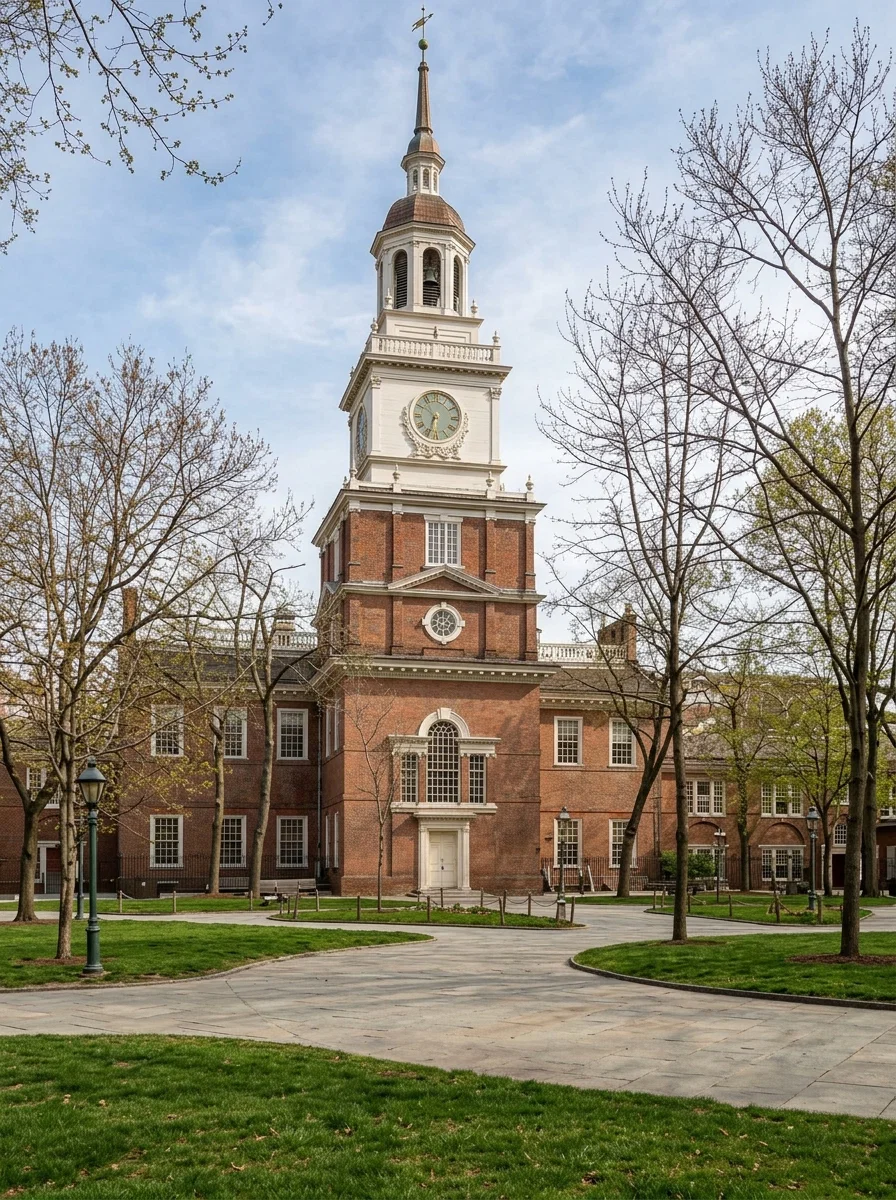
THERE are principles and symbols of principles. It is the principle itself which ought to be loved or hated, not the symbol of the principle.
“Independence Hall,” Philadelphia, where the Declaration of Independence was signed July 4, 1776.
American Symbols.—Thus “Independence Hall”—the “Old State House” in Philadelphia—in itself is no more than many another building; but it stands for a principle, and that principle was at one time considered of vital worth to the people of this country. The flag of itself is no more than any other tri-colored cloth, but the principle of freedom for which it stands is of tremendous value. The old “Liberty Bell,” about which so much has been said, is worth no more of itself than so many pounds avoirdupois of bell-metal, but the principle of liberty for which it is supposed to stand is of infinite worth.
The great danger is that people get to worshiping the symbol and the thing symbolized is forgotten. Men will revere Independence Hall and Liberty Bell as sacred, when the principles they stand for are trampled underfoot. They will worship the flag, will speak of its trinity of colors, and liken them to the trinity of Deity; they will bow before “Old Glory” as it waves in the breeze as the aboriginal does before his idol, while the principles of liberty which in a measure gave birth to the flag are set aside as out of date, and the flag itself is used to foster tyranny and slavery.
The Lessons of History.—There are not wanting many lessons of this kind in history.
Here is one from the Book of God: As long as Israel was faithful to God, cherishing His holy law and His rich mercy in their hearts, the ark of God, containing the tables of that law, under the mercy-seat, was a symbol of God’s presence and their strength to withstand all foes. Before that ark Jordan’s rolling flood was stayed, and Israel passed through on dry ground. In its presence, while shouting victory by faith, the strong walls of Jericho crumbled to dust. But when Israel had forgotten the principles of pure righteousness, God’s presence in the life, for which that ark stood as symbol, they worshiped the ark as a sort of charm, or idol, or fetish, while they forgot God.
And when they went out against the Philistines to battle, they thought the presence of the ark would insure success, even tho it were borne by unrighteous priests. What was the result? Israel was defeated; the ark was taken by the enemy; and Israel’s true condition was written in the word “Ichabod,” “the glory is departed.” See Joshua 3:14–17; 6:1–5; 1 Sam. 4:3–22.

“Nehushtan.”

—Again, when poor sinning Israel were bitten by the fiery serpents of the wilderness, fit representation of sin, the Lord told Moses to make a serpent of brass, and place it upon a pole high enough so that all who desired to look upon it could behold and live. Many looked and were healed. They saw in the uplifted brazen serpent the symbol of God’s power and mercy and love. It was a symbol of the lifting up of Jesus Christ, through whom alone healing and virtue come to man. But centuries after, when Israel forgot God’s mercy and goodness, they worshiped the brazen serpent as tho there were virtue in it. But Hezekiah, true reformer that he was, in breaking down the high places and images of the licentious sun-worship, also “brake in pieces the brazen serpent that Moses had made; for unto those days the children of Israel did burn incense to it; and he [Hezekiah] called it Nehushtan,” that is, “a piece of brass.” See Num. 21:7–9; 2 Kings 18:4.
In how many nations and lands can we trace the images they now worship as having virtue or efficacy back to some good principle which the original image symbolized! But later generations forgot the principle and worshipedthe image; and the more the principle was forgotten, the more elaborately was the image worshiped, and the more sacredly was it regarded, till it became a proper symbol of persecution against all who did not agree with its worshipers.
Independence Hall, Liberty Bell, and the Old Flag stood for something in the days of 1876. They stood for two principles dear to the heart of every lover of humanity and liberty. The first of these is equality of man, embodied in the Declaration of Independence: “We hold these truths to be self-evident, that all men are created equal; that they are endowed by their Creator with certain inalienable rights; that among these are life, liberty, and the pursuit of happiness.” Equality of man was the basic principle of the grand document signed by the fathers of this country July 4, 1876, in the Old State House, Philadelphia. “To secure these rights governments are instituted among men, deriving their just powers from the consent of the governed.” Man yields no unalienable right in being a subject of true civil government. A just government protects him in these rights and secures them to him. Another principle is involved in the Declaration of Independence; but it was thought necessary especially to emphasize it in the First Amendment to the Constitution of the new nation; and that was the principle of religious liberty, the right to worship or not to worship, to believe or not to believe, to be wholly untrammeled in religious worship by human interference. Thus it is guarded in the Constitution: “Congress shall make no law respecting an establishment of religion, or prohibiting the free exercise thereof.” And later on in Amendment XIV: “No State shall make or enforce any law which shall abridge the privileges or immunities of citizens of the United States; nor shall any State deprive any person of life, liberty, or property without due process of law; nor deny to any person within its jurisdiction the equal protection of the laws.”
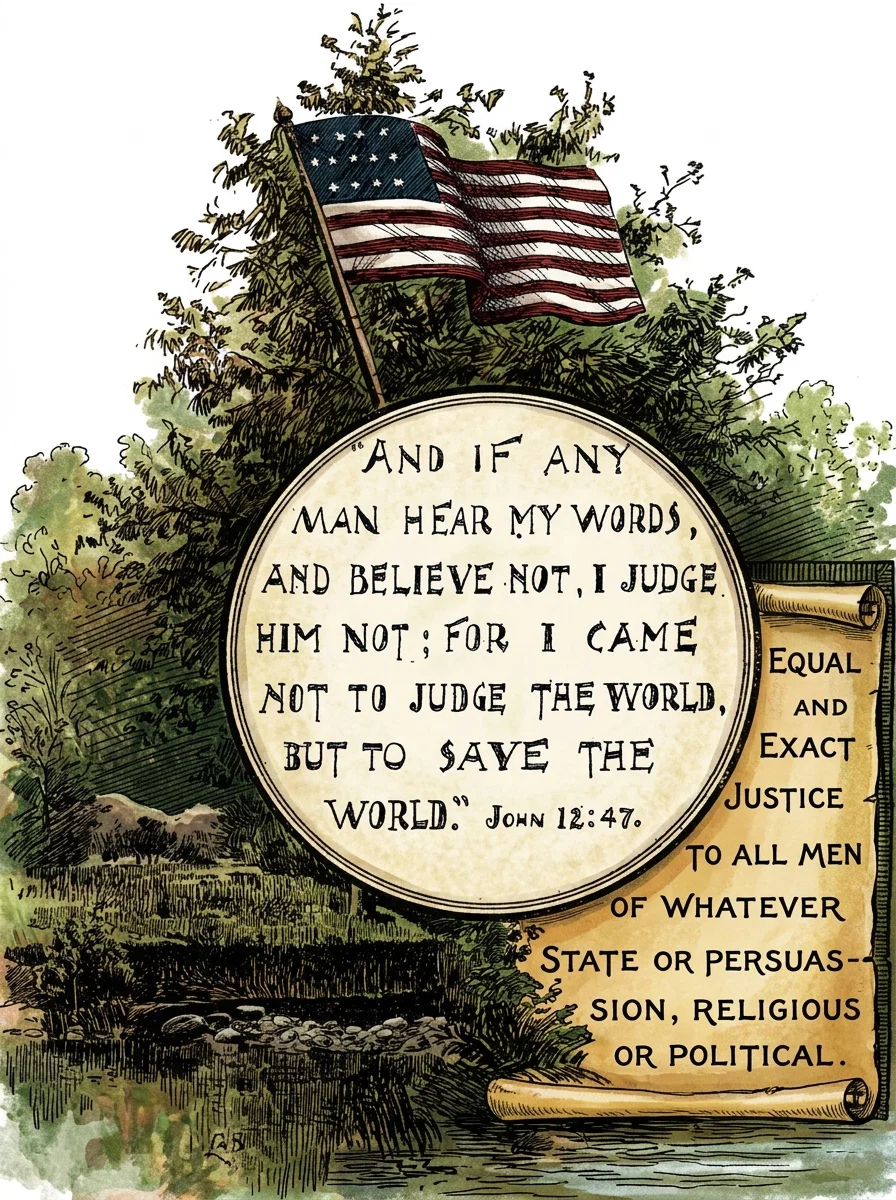
Christlike.—Both of these principles are Christian in their origin. Equality of man without and within the church is expressed in such scriptures as these: “God is no respecter of persons;” “God . . . hath made of one blood all nations of men for to dwell on all the face of the earth;” “For one is your Master, even Christ, and all ye are brethren.” And the second grand principle of religious or non-religious freedom is thus expressed by Jesus Christ and the apostle Paul: “If any man hear My words, and believe not, I judge him not; for I came not to judge the world, but to save the world.” “Knowing therefore the terror of the Lord, we persuade men.”
What the Founders Said.—That these principles were what these symbols stood for in 1776 the founders of the nation speak abundantly. See the sixteenth section of the Declaration of rights of Virginia, adopted June 12, 1776. The Presbytery of Hanover, Va., with the Baptists and Quakers, addressed a memorial in the same year to the General Assembly of Virginia, in which they say that they “are governed by the same sentiments which have inspired the United States of America,” and in which among many other good things they declare:—
Certain it is that every argument for civil liberty gains additional strength when applied to liberty in the concerns of religion; and there is no argument in favor of establishing the Christian religion but may be pleaded with equal propriety for establishing the tenets of Mohammed by those who believe the Alcoran; or, if this be not true, it is at least impossible for the magistrate to adjudge the right of preference among the various sects that profess the Christian faith without erecting a claim to infallibility, which would lead us back to the Church of Rome. . . .
The duty we owe to our Creator, and the manner of discharging it, can only be directed by reason and conviction, and is nowhere cognizable but at the tribunal of the universal Judge.
And the one who penned the Declaration of Independence said:—
Our civil rights have no dependence upon our religious opinions, more than our opinions in physics or geometry.—Thomas Jefferson.
Thus also spake Madison, Washington, and others. Thus also spake Congress in 1829, when misguided men thought it duty to endeavor to induce the government to ally itself with religion under the guise of a law closing post-offices and post-roads on Sunday.
On the reverse side of the great seal of the United States is the Latin motto, “Novus ordo seclorum,” “A new order of ages.” And so began in the United States a new order of ages in government. Every man was the peer of his fellow. Here was a “State without a king and a church without a pope.” Religion was free, to live or to die as its devotee willed. The government protected the man, not the religion. If worthy, if of God, the religion would stand of itself without the support of civil government. If unworthy, let it die. So the founders of this government considered, and so they expressed it in the charters of our liberty.
But “the new order of ages” is passing away, and the old order of the Dark Ages is reviving. He who has carefully read the history of the first five centuries of the Christian era may see Rome’s life being lived over again in this country. The religious element of the country, having lost the pentecostal power, is seeking affiliation with the State, and State aid to religious institutions. Not knowing the power of godliness, they are seeking the power of the civil arm. They are bringing strong pressure to bear upon politicians, municipal officers, State Legislatures, the national Congress, the State, District, and Federal Courts. All these institutions have bent under the pressure.
The fulcrum over which the strongest lifting has been done is the Sunday law in a hundred different phases. Judges in our State courts have yielded; the Supreme Court yielded in 1892 enough to declare this to be a Christian nation; Congress and Chief Executive yielded the same year in the closing of the World’s Fair on Sunday. Scores have been imprisoned in different States for the simple exercise of the unalienable rights vouchsafed of God to every human being, and supposed to have been secured by the Magna Charta of American liberty.
Just now there is a lull in the persecution. But honest and misguided souls are working through our young people’s societies, through law-and-order leagues, through so-called “Christian Citizenship,” through various organizations and federations, to secure what will finally culminate in the fullest union of Church and State in this country, and which will result in the utter ruin of both Church and State.
Now is the time for every lover of liberty to be alarmed and aroused. Now is the time for these religio-political reformers to examine anew the ground and motive of their work in the light of past history and in the blazing brightness of New Testament teaching. We can not afford to be mistaken. “Eternal vigilance is the price of liberty.” Already the flag, which should be a symbol of liberty existing, is made an instrument of tyranny in some parts of our land in compelling its worship in public schools. So is every principle of right becoming perverted.
It is the symbol and not the principle which is honored by the backslider in every true cause. It is the principle, the truth, God-given, which is honored by the true reformer in both Church and State.

THE FLAG.

Be he man or boy, he gazes agape At the rippling, ruffling flutter and flap Of the flag that floats far over his head, With its mingling blue and white and red— A star for a State, and a stripe to show How many we were when, long ago, Our nation breathed its first faint prayer, And ventured a flag on the untried air. But now it rides on each breeze that blows, Till the farthest land our history knows; For the tale it tells as it waves on high The wild wind whispers in hurrying by.
’Tis not an idol, nor should it be A thing that calls for the bended knee, Or the forced salute, or a mimic prayer, As it flies, or droops, from the flagstaff there. But what does it tell as it floats on high ’Tween the trembling earth and the peaceful sky? And what does it mean to you and to me, This beautiful, tri-colored flag of the free, Swinging and swaying from spire and dome, From a President’s house to a peasant’s home?
It tells of the struggle, the blood that flowed Down the rugged hill, on the frozen road, When first the feet of the nation trod In ragged rank o’er the reeking sod. It tells of the grief and the scalding tear. For the men who fell, and the boding fear Whose murky wings cleaved the sullen night, While the warriors waged uncertain fight. It tells the tale of the victory won, When the guns were hushed, and the fighting done, And the soldier returned to his peaceful toil To garner the fruits of his blood-stained soil.
But this were slight did the flag not tell Of the liberal laws they framed so well, Of the wondrous code her statesmen drew, To shield the weak, to protect the few, To grant to your neighbor, where’er it flew, The same broad freedom it grants to you. What the words of that code to you declare The flag speaks out on the buoyant air.
It tells you of freedom to worship God, Of a smoother path than the martyr trod. It tells you the fagot no more shall blaze For the man who would walk in his Maker’s ways; That never a rack shall wreak again The wrath of a man on his fellow-men, And that never a vein again shall bleed To pay the price of a broken creed.
It tells us that; and he who stands With a bigot’s chain in his willing hands, To shackle the soul that will not drink At his stagnant well, or deigns to think For himself, and read A higher law than a human creed— He never has guessed the guarantee Which the flag holds out to you and to me; He has never read in its folds unfurled The message it bears to the wide, wide world.
He has yet to learn that in this fair land No creed recruits with a bloody brand, Or a shackle, or gyve, or a clanking chain, Or a surging pulley, or bed of pain. Our flag proclaims it on every breeze That the dark, dark past holds enough of these. And he who dooms to a cell or chain The humblest child of this vast domain For worshiping God with a conscience free From the creeds of men and their bigotry— He has heaped reproach on our martyred dead, And sullied the flag in its every thread.
So speaks the flag, and so let it wave O’er a people free, and strong, and brave— Free from the stroke of a tyrant’s hand, And free to follow their God’s command; Strong in their power to do the right, More than strong to slay where armed men fight; Brave to do what the right demands, And brave to refuse where wrong commands. Let our Constitution forever stand, The boon of the free, the pride of the land; And its ringing words, forever true, Speak out in the red, the white, and the blue.
Oakland, Cal. CHARLES M. SNOW.

CHRISTIAN PROFESSION AND ANTI-CHRISTIAN PRACTISE.
[By Alonzo T. Jones, author of “The Two Republics,” “The Rights of the People,” etc., and former editor of The American Sentinel.]
IN the United States there are multitudes of people who profess to be Christians. The vast majority of this multitude are diligently endeavoring to secure legislation enforcing their religious views upon all the people. They desire and require that religion shall dominate politics, shape the laws, and control the State: they want a union of religion and the State. In truth, they want a religious State, an earthly, political kingdom of God, with “Christ reigning as king on Capitol Hill” and throughout the nation, through themselves as His representatives. All this is seriously proposed by people who seriously profess to be Christians.
What, then, is it to be a Christian? What is Christianity? In the Scriptures it is written that Christ left us “an example that we should follow His steps;” and that “He that saith he abideth in Him ought himself also so to walk, even as He walked.” It is Christianity to follow His steps alone, to walk only as He walked; for again it is written, “As My Father sent Me, even so send I you;” “As He is, so are we in this world;” and we are “in Christ’s stead.”
What steps, then, did Christ take toward the domination of the politics of His day? What steps did He ever take to gain control of the government, or to dictate in the affairs of the state?—Just none at all. Everybody knows that He never in any way gave the slightest indication of any such thing. This, too, in spite of many solicitations of different kinds. He was not only more than once openly invited to do so, but it was the longing expectation of the whole people to whom He came. So strongly was this implanted that they were willing to take Him by force and set Him at the head of the government. Yet never by a word, a look, or any sign whatever, would He countenance any such thing. On the contrary, He openly repudiated every suggestion of the kind, and withdrew Himself from the people who were bent on having it so, and went away by Himself alone and prayed for the people that they might have better views of Himself and of His mission to the world.
Was this because politics were so pure, laws so just, and government so altogether correct, that there was no call for any readjustment, no room for any reforms? Was there at that time no need of careful watching to see that none but good men should hold office? Were such as these the reasons why Christ had nothing to do with politics, nor with affairs of government in any way?—Not by any manner of means. Corruption in politics and in office was never more rife than at that very time, and in Judea. Then, as it was altogether from choice, and not at all from lack of necessity or opportunity that Jesus had nothing whatever to do with politics nor any of the affairs of the government, wherein do the churches, leagues, and societies of the United States to-day follow His steps in their persistent intermeddling in these very things? And when they do not walk as He walked, wherein are they Christians?
It was His steady refusal to countenance the political aspirations of the people, which, more than anything else, caused the scribes, the Pharisees, the lawyers, the priests, and the Herodians, to reject and persecute Him.
These were the church leaders of that time, and correspond to the sects, leagues, unions, and Endeavor societies of the present day.
It was to the Pharisees with the Herodians that He announced the everlasting principle of the separation of religion and the State, in the words, “Render to Cæsar the things that are Cæsar’s, and to God the things that are God’s.” And when the whole combination together had made against Him the false charge that He would make Himself a king, He answered them and all other combinations for all time, “My kingdom is not of this world;” “My kingdom is not from hence.”
Such were ever His word and His attitude. Such has been His will concerning His church, from the foundation of the world. He is “the same yesterday, and to-day, and forever;” and it was impossible that, when He came into the world, He should walk contrary to all the instructions that He Himself had given before He came into the world.
And now to all the church combinations, leagues, unions, and Endeavor societies, that are afflicting this nation with their mischievous schemes for molding the politics, shaping the laws, and directing the government of the country, he pointedly exclaims, “Why call ye Me Lord, Lord, and do not the things which I say?” Why do you call Him Lord, and then do your own will? Why do you profess to hold His Word in reverence, and then utterly disregard that which from beginning to end is one of the great vital principles of that Word? Why do you bear the name of Christ, while in this great matter you walk directly opposite to the way in which He walked?
Since the Bible, from beginning to end, treats so fully and so plainly on this subject; and since all history speaks with one continuous voice, warning all men of the essential evils that follow in the train of every step that is taken to unite religion and the State, it is difficult to understand how anybody who professes to have any respect for the Bible, or has knowledge of the A B C of history, and cares at all for mankind, can for one moment countenance any suggestion of a connection between the pulpit and politics, between church and civil government, between religion and the State.
Yet the ones who profess to be the only true believers of the Bible, and the ones who profess to be the best qualified to gather the true lessons of history—these are the very ones who are most diligently engaged in forcing upon this nation the evils of a union of religion and the State, of church and government, of the pulpit and politics.
Surely nothing can explain this contradiction between profession and practise, but religious bigotry that can never learn anything, and worldly ambition that is never content without power.
Yet, tho this may explain the contradiction between profession and practise on the part of those who are seeking to afflict the nation with this great evil, what suggestion can possibly be made in explanation of the indifference and unconcern on the part of the rest of the people? How is it that they can view with a listlessness almost absolute the steady, grasping growth of this power that is determined to bring the whole nation under the curse of a religious despotism after the very image of that of the Dark Ages itself?

DO YOU BELIEVE IN RELIGIOUS LIBERTY?

To THIS question almost every man will give an affirmative answer. Even Cardinal Gibbons declares himself in favor of religious liberty. But what does the cardinal mean by this term? He says:—
A man enjoys religious liberty when he possesses the free right of worshiping God according to the dictates of a right conscience, and of practising a form of religion most in accordance with his duties to God.—Faith of our Fathers, p. 264.
But the reader will say, and say truly, that the cardinal’s declaration amounts to nothing, since, from his standpoint, “a right conscience” must be a conscience educated in the Roman Catholic faith; and that from the same standpoint, a man to practise that “form of religion most in accordance with his duties to God,” must worship according to the forms of the Roman Catholic Church; in other words, that the cardinal has, in effect, declared himself only in favor of religious liberty for himself and for those who hold the same faith and worship in the same manner that he does.
But, reader, how is it with you? Do you believe in religious liberty as broad as the Golden Rule? Are you willing to accord to every other man, woman, and child in all the world the same liberty in faith and practise that you demand for yourself? Are you willing that your neighbor shall worship when and what he will? And is there nothing in your heart that rises up and says, “If I only had the power I would soon show him that he can not thus outrage my religious sensibilities; I would at least compel him to show a decent respect to my religion”?
Are you willing that other denominations shall use the schoolhouse or town hall for meetings on exactly the same terms as your own denomination? or would you exclude one or more of the smaller sects, possibly the Mormons, because their faith and practise are different from yours? Do you favor the exemption of church property from taxation when yourown church, and possibly a few others, are involved, while wishing in your heart that there was some way to make the Catholics pay a good round sum on their valuable churches, convents, and schools?
Do you take the same pains to see that all under your care show the same outward respect to the worship of others that you feel should be shown to yours? or are you willing that your children should be less reverent in a Seventh-day Adventist meeting than you feel that the Adventist should be in your meeting?
Do you work just the same on the seventh day of the week that you do on the sixth, knowing the while that your seventh-day neighbor is resting, and then demand, even in your inmost soul, that he shall rest on the first day of the week out of respect to your feelings and practise?
Such questions might be extended indefinitely, but it is unnecessary, since it is the principle we are after and not specific acts. The fact is that religious liberty, like religious bigotry and intolerance, has its seat first of all, not in statute-books nor in constitutions, not in this or that form of government, not even in this denomination nor in the other, however much they may profess in that direction, but in the heart of the individual.
It is a good thing to have religious liberty written in our law books; it is a better thing to have it written in our own hearts. For while religious bigotry, supported by civil law, may bind the bodies of men, only disregard of the divine law which requires each man to love his neighbor as himself, can fetter the soul. “If the Son therefore shall make you free, ye shall be free indeed.” And he only who knows the joys of this freedom can heartily and uniformly accord to every other man the same rights which he claims for himself. C. P. B.

RELIGIOUS LIBERTY IN THE UNITED STATES.

In the United States liberty of worship and of belief in matters of religion is not a concession or a privilege; it is a fundamental right recognized as being inherent in every individual, and the federal government is pledged not to abridge it or in anywise interfere therewith. This is the signification of our national Constitution. Had the Constitution remained silent upon the subject, religious liberty would still have existed under and by reason of it; yet, in that event, what would have been the subject of construction has been placed beyond cavil or dispute, so that even if a less liberal spirit should prevail, Congress could not assume the right to legislate sectarianism, Protestantism, Romanism, or any form of religion into civil life. The statesmen who framed our Constitution were too well read in the history of other governments, and had before them too clearly the sufferings of the people in their colonial state, not to dread and anticipate the abuse of authority resulting from the greed of power and the selfishness of sects, so they wisely guarded against this contingency by express enactment, whereby it is provided that “no religious test shall ever be required as a qualification to any office or public trust under the United States.” —Hon. Oscar S. Straus, in “Religious Liberty in the United States.”

DANGERS WHICH THREATEN.

ROMANISM is now regarded by Protestants with far greater favor than in former years. There is an increasing indifference concerning the doctrines that separate the reformed churches from the papal hierarchy; the opinion is gaining ground that, after all, we do not differ so widely upon vital points as has been supposed, and that a little concession on our part will bring us into a better understanding with Rome. The time was when Protestants placed a high value upon the liberty of conscience which has been so dearly purchased. They taught their children to abhor popery, and held that to remain at peace with Rome would be disloyalty to God. But how widely different are the sentiments now expressed!
The defenders of popery declare that she has been maligned; and the Protestant world is inclined to accept the statement. Many urge that it is unjust to judge the Romish Church of to-day by the abominations and absurdities that marked her reign during the centuries of ignorance and darkness. They excuse her horrible cruelty as the result of the barbarism of the times, and plead that civilization has changed her sentiments.
Have these persons forgotten the claim of infallibility for eight hundred years put forth by this haughty power? So far from relinquishing this claim, the church in the nineteenth century has affirmed it with greater positiveness than ever before. As Rome asserts that she has never erred, and never can err, how can she renounce the principles which governed her course in past ages?
The papal church will never relinquish her claim to infallibility. All that she has done in her persecution of those who reject her dogmas, she holds to be right; and would she not repeat the same acts, should the opportunity be presented? Let the restraints now imposed by secular governments be removed, and Rome be re-instated in her former power, and there would speedily be a revival of her tyranny and persecution.
It is true that there are real Christians in the Roman Catholic communion. Thousands in that church are serving God according to the best light they have. They are not allowed access to His Word, and therefore they do not discern the truth. They have never seen the contrast between a living heart-service and a round of mere forms and ceremonies. But God looks with pitying tenderness upon these souls, educated as they are in a faith that is delusive and unsatisfying. He will cause rays of light to penetrate the dense darkness that surrounds them. He will reveal to them the truth as it is in Jesus, and they will yet take their position with His people.
But Romanism as a system is no more in harmony with the Gospel of Christ now than at any former period in her history. The Protestant churches are in great darkness, or they would discern the signs of the times. The Roman Church is far-reaching in her plans and modes of operation. She is employing every device to extend her influence and increase her power in preparation for a fierce and determined conflict to regain control of the world, to re-establish persecution, and to undo all that Protestantism has done. Catholicism is gaining ground in our country upon every side. Look at the number of her churches and chapels. Look at her colleges and seminaries, so widely patronized by Protestants. These things should awaken the anxiety of all who prize the pure principles of the Gospel.
Protestants have tampered with and patronized popery; they have made compromises and concessions which papists themselves are surprised to see, and fail to understand. Men are closing their eyes to the real character of Romanism, and the dangers to be apprehended from her supremacy. The people of our land need to be aroused to resist the advances of this most dangerous foe to civil and religious liberty.
Many suppose that the Catholic religion is unattractive, and that its worship is a dull, stupid round of ceremony. Here they mistake. While Romanism is based upon deception, it is not a coarse and clumsy imposture. The religious service of the Romish Church is a most impressive ceremonial. Its gorgeous display and solemn rites fascinate the senses of the people, and silence the voice of reason and of conscience. The eye is charmed. Magnificent churches, imposing processions, golden altars, jeweled shrines, choice paintings, and exquisite sculpture appeal to the love of beauty. The ear also is captivated. There is nothing to excel the music. The rich notes of the deep-toned organ, blending with the melody of many voices as it swells through the lofty domes and pillared aisles of her grand cathedrals, can not fail to impress the mind with awe and reverence.
This outward splendor, pomp, and ceremony, that only mocks the longings of the sin-sick soul, is an evidence of inward corruption. The religion of Christ needs not such attractions to recommend it. In the light shining from the cross, true Christianity appears so pure and lovely that external decorations only hide its true worth. It is the beauty of holiness, a meek and quiet spirit, which is of value with God.
Brilliancy of style is not an index of pure, elevated thought. The highest conceptions of art, the most delicate refinement of taste, often spring from minds wholly earthly and sensual. They are often employed by Satan to lead men to forget the necessities of the soul, to lose sight of the future, immortal life, to turn away from their infinite Helper, and to live for this world alone.
A religion of externals is attractive to the unrenewed heart. The pomp and ceremony of the Catholic worship have a seductive, bewitchingpower by which many are deceived; and they come to look upon the Roman Church as the very gate of heaven. None are proof against her influence but those who have planted their feet firmly upon the foundation of truth, and whose hearts are renewed by the Spirit of God. Thousands who have not an experimental knowledge of Christ will be swept into this deception. A form of godliness without the power is just what they desire. The Romanist feels at liberty to sin, because the church claims the right to pardon. To him who loves self-indulgence, it is more pleasing to confess to a fellow-mortal than to open the soul to God. It is more palatable to human nature to do penance than to renounce sin. It is easier to mortify the flesh by sackcloth and nettles and galling chains than to crucify fleshly lusts. Heavy is the yoke which the carnal heart is willing to bear rather than bow to the yoke of Christ.
There is a striking similarity between the Church of Rome and the Jewish Church at the time of Christ’s first advent. While the Jews secretly trampled upon every principle of the law of God, they were outwardly rigorous in the observance of its precepts, loading it down with exactions and traditions that made obedience painful and burdensome. As the Jews professed to revere the law, so do Romanists claim to reverence the cross. They exalt the symbol of Christ’s sufferings, while in their lives they deny Him whom it represents.
Papists place crosses upon their churches, upon their altars, and upon their garments. Everywhere is seen the insignia of the cross. Everywhere it is outwardly honored and exalted. But the teachings of Christ are buried beneath a mass of senseless traditions, false interpretations, and rigorous exactions. The Saviour’s words concerning the bigoted Jews apply with still greater force to the Romish leaders: “They bind heavy burdens and grievous to be borne, and lay them on men’s shoulders; but they themselves will not move them with one of their fingers.” Conscientious souls are kept in constant terror, fearing the wrath of an offended God, while the dignitaries of the church are living in luxury and sensual pleasure.
Satan instigates the worship of images, the invocation of saints, and the exaltation of the pope, to attract the minds of the people from God and from His Son. To accomplish their ruin, he endeavors to turn their attention from Him through whom alone they can find salvation. He will direct them to any one that can be substituted for the One who has said, “Come unto Me, all ye that labor and are heavy-laden, and I will give you rest.”—Mrs. E. G. White.

WHAT LIBERTY IS NOT.

Liberty, says the American Banner, is not the privilege of following the majority, but it is the inalienable right of the individual to go contrary to the majority, if conscience so dictates. To claim that the majority is always right, is to fall into the old Roman error of “Vox Populi, Vox Dei” (“The voice of the people is the voice of God”), which makes fallible men equal with an infallible God. If every living man were to support a wrong principle, it could not change it to right.

THE CRISIS.

The crisis presses on us; face to face with us it stands, With solemn lips of question, like the Sphinx in Egypt sands! This day we fashion destiny, our web of fate we spin; This day for all hereafter choose we holiness or sin; Even now from starry Gerizim or Ebal’s cloudy crown, We call the dews of blessing or the bolts of cursing down!
By all for which the martyrs bore their agony and shame, By all the warning words of truth with which the prophet came; By the future which awaits us; by all the hopes which cast Their faint and trembling beams across the blackness of the past; And by the blessed thought of Him who for earth’s freedom died, O my people! O my brothers! let us choose the righteous side.
—Whittier.
Continue reading: CHURCH AND STATE