Your ShelfYour Projects

Signs of the Times, Vol. 32, No. 25.

EARTHQUAKE and FIRE SPECIAL

Signs of the Times

Jun 27, 1906

Pacific Press Publishing Company · Mountain View, California · Jun 27, 1906

EARTHQUAKE and FIRE SPECIAL
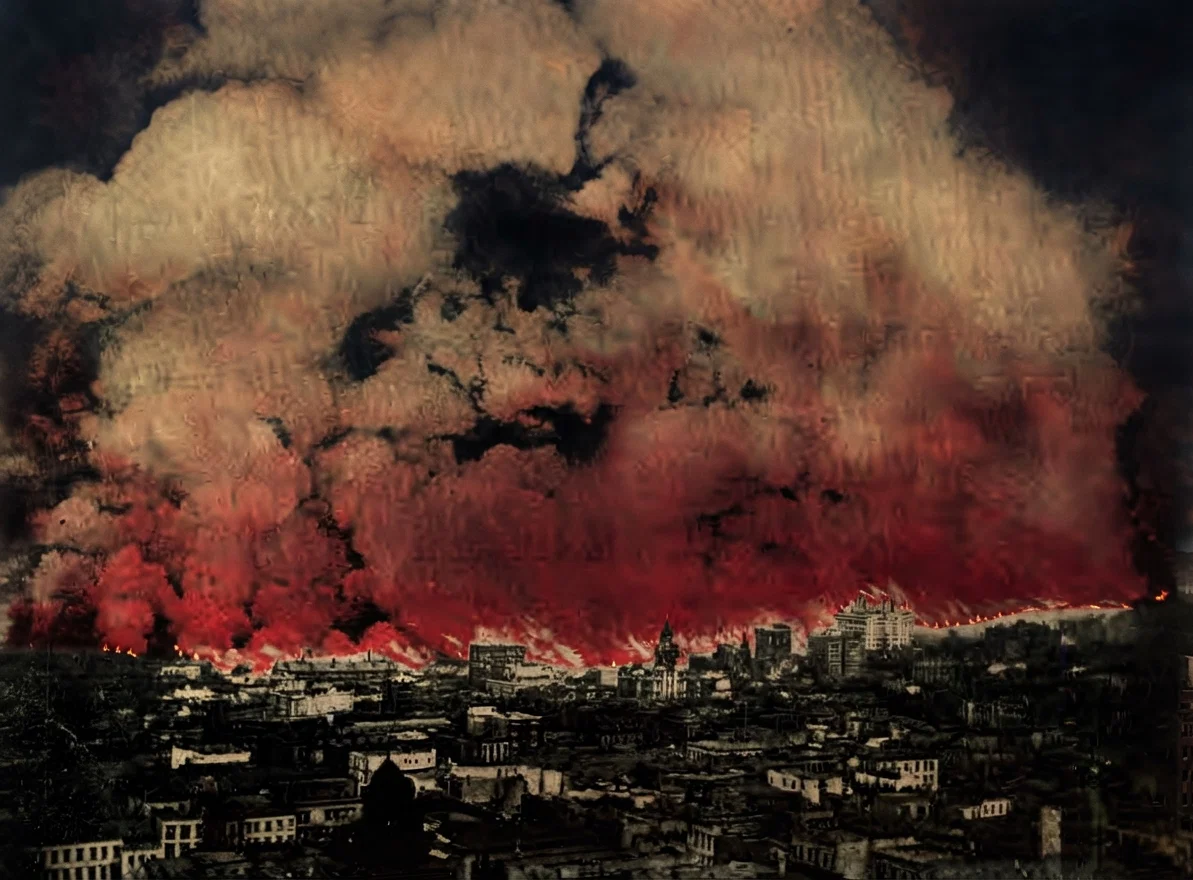
THE BURNING OF SAN FRANCISCO

“And after the Earthquake a Fire”—1 Kings 19:12

Complete Story of the Great Calamity

BY EYE-WITNESSES
Fully Illustrated with Original Half-tone Engravings
Seismographic Records, Maps, Etc.

The Seven Churches and the Seven Seals

In the sixth chapter of Revelation there is a great earthquake referred to. Would you like to learn more of that and the other great events of the seven-sealed book and of the seven churches of chapters two and three? Then send for the pamphlet entitled "The Seven Churches and the Seven Seals." It is illustrated with colored diagrams. The price is only 15 cents post-paid.

CALIFORNIA: HER CONDITION AND RESOURCES.
CALIFORNIA with one hundred millions of acres is greater in area than New England, New York, and Pennsylvania. On the eastern sea-board its coast line would extend from Boston on the north to Charleston on the south.
In some localities the notion is prevalent that all this great state was shaken by the recent earthquake. Such is not the fact. The earthquake was severe in only about two per cent. of the area of the state, and as a disturbing factor was confined to a district seventy-five miles north, one hundred and twenty-five miles south, and fifty miles east from San Francisco.
Even in this narrow strip of California's expanse, the damage from the earthquake was small in comparison with that of the fire in San Francisco.
The California's chief city is momentarily in distress, her people are undaunted by the great misfortune, and San Francisco will arise, as other cities have arisen, from the ashes of her former greatness. So far as California is concerned it is needful only to note that Illinois was not ruined by Chicago's fire; that South Carolina did not suffer permanently from Charleston's troubles; and that Texas, the only state larger in area than California, did not even pause in her marvelous progress because of the Galveston flood. So California's two million people are not bankrupt nor seriously affected in their courage or resources as a result of the damage to her principal city.
California is rich in her gold-bearing mountains and gravel deposits, in her great valleys of unmeasured fertility, upon which every vegetable product can be grown; in her more than thirty cities of five thousand or more population each, centers of rich localities; in her mighty and extensive forests of redwood and fir; in her abundant oil fields, yielding millions of barrels annually; in electric power generated by the never-falling streams from the Sierras;
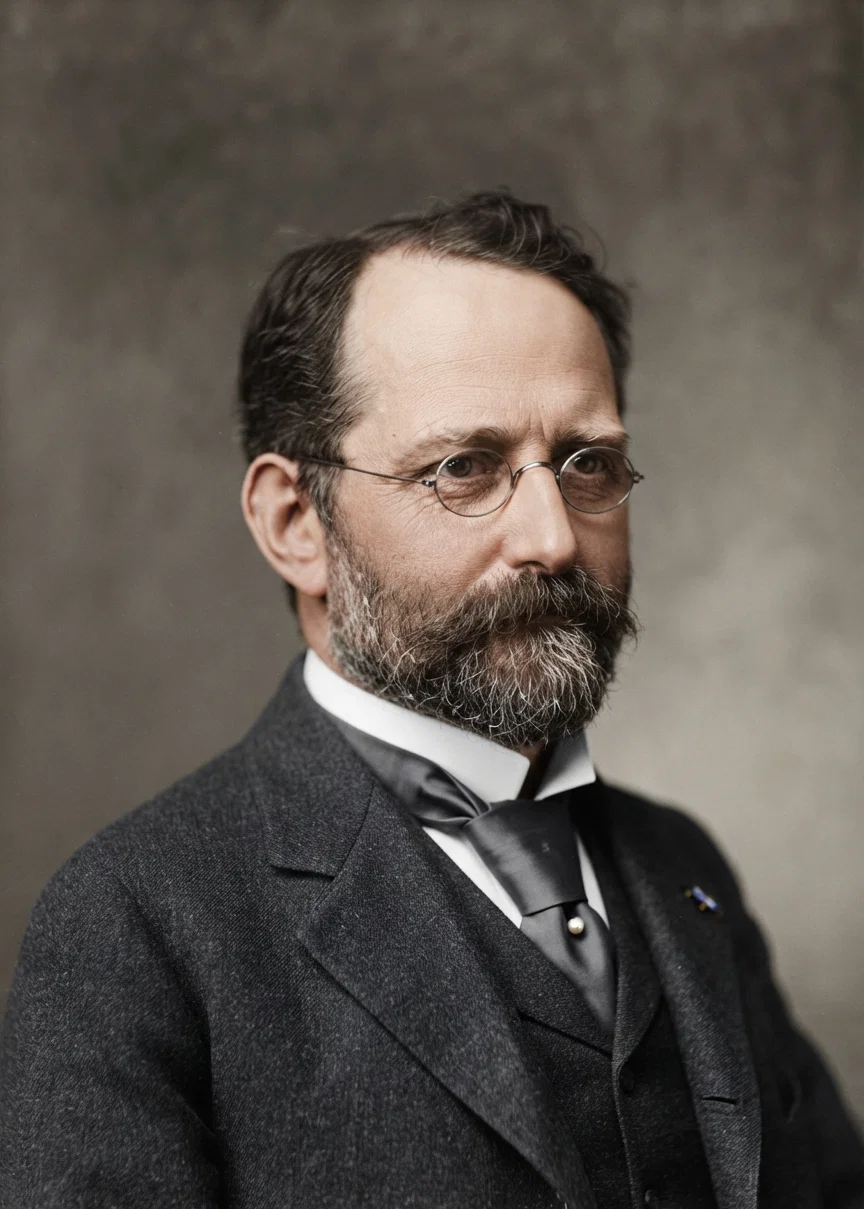
California's Chief Magistrate, HON. GEORGE C. PARDEE,
in her Oriental commerce; in her magnificent harbor and its railway connections; marketing her abundant fruitfulness in all the world; in her universities and schools,—in all these and more California is rich, and still remains, as always, "the land of opportunity."
Permit me to convey to all your readers the heartfelt thanks of San Francisco's stricken people and all California for the prompt and generous aid extended to us, and to this I wish to add my official and personal thanks. Should occasion occur, which God forbid, California will show in actions far better than any one may in words, its immeasurable appreciation of the generous gifts the citizens of our country, unasked, have showered upon us.
GEORGE C. PARDEE, Governor of California.

Terms of Subscription.

Per Year, post-paid. . . . . . . . . . . . . . . $1.50 Six Months, 75 cts. Three Months, 40 cts. To Foreign Countries, per year, $1.75.

SPECIAL TERMS.

1. One new yearly subscription and one renewal, or two new yearly subscriptions, sent at one time, $2.50.
2. Two new yearly subscriptions and one renewal, or three new yearly subscriptions, sent at one time, $3.25.
3. Three new yearly subscriptions and one renewal, or four new yearly subscriptions, sent at one time, $4.00.
Sample copies sent on application.

San Francisco Proves Prohibition Practical

Two things San Francisco has forever demonstrated in temperance problems; namely, that prohibition of the liquor traffic is not a fanciful dream; and (2) that it is both practical and beneficial, and does prohibit.

Pictures of the California Earthquake and Fire

We have published a neat little booklet containing over thirty pictures of the California earthquake and fire field. It is nicely printed, and very convenient to preserve. Only 25 cents.

Governor Pardee’s Response to Crisis

California's chief magistrate, Hon. George C. Pardee, did able and faithful work during the days of California's severest trouble. He immediately went to Oakland, took up his office in the City Hall, and was there day and night during those days of awful agony in San Francisco, responding to the city's every need so far as the human could respond. We talked with the gentleman who rents the governor's house in Oakland. He told us that he had offered the governor entertainment, the best that he could provide, but the governor could not accept it. His duty was at that place where he could be easily reached and could most quickly respond. His disposition of the national guard for police duty seems to us to be highly commendable; his action in declaring legal holidays eased the half-crazed and despairing people over what would have proved to many financial difficulty and ruin; and the extra session of the Legislature, called at an opportune time, seems to be doing efficient, needed work. Thank God for government; thank God for a good governor.

The Military in the Crisis

The military are to be commended, notwithstanding the blunders and crimes of a few. There are always foolish, rash, untrustworthy men in the army. Doubtless rash deeds were done, and at times criminal deeds. Such was to be expected at such a time. But we know not what conditions would have been if it had not been for the strong arm of military power just at the crisis, ably directed by General Funston, General Greely, and other officers. And among their best deeds which made for peace and quiet was the pouring of the whisky into the gutters.

Railroads’ Relief Work

The railroads did noble work. The Southern Pacific was especially active in assisting the suffering and the city in the many and able ways a railway company can assist,—in free transportation, in laying temporary tracks through the city, in hauling away the débris, in carrying refugees to any point on its lines, and in other ways. Its efforts and results were most commendable.

Mayors and the Order to Kill

Mayor Schmitz and the mayors of other cities all did good work, and were ably seconded by the best citizens. But was the broad order to "kill" right?

PROCLAMATION BY THE MAYOR OF SAN FRANCISCO.

The Federal Troops, the members of the Regular Police Force, and all Special Police Officers have been authorized to KILL any and all persons found engaged in looting or in the commission of any other crime.
I have directed the Gas and Electric Lighting Companies not to turn on Gas or Electricity until I order them to do so; you may therefore expect the city to remain in darkness for an indefinite time.
I request all citizens to remain at home from darkness until daylight of every night until order is restored.
I warn all citizens of the danger of fire from damaged or destroyed chimneys, broken or leaking gas pipes or fixtures, or any like cause.
E. E. SCHMITZ, Mayor
Dated April 19, 1906.

The Sabbath Question Pamphlet

One of the moot questions of this present day which will not down either in church or state is the Sabbath question. This office publishes a pamphlet on this subject which presents it in a novel and conclusive manner. It takes up the Lord's day as a "test of the ages" in the light of the various priesthoods and dispensations. How did the patriarchs regard the day? What was Israel's attitude? What is ours? This pamphlet takes in the scope of the Sabbath question from Genesis to the present. You need to know the truths it contains. Illustrated; price, post free, 15 cents.

Our Souvenir Earthquake and Fire Special
THE SIGNS OF THE TIMES has the largest circulation in the East of any journal printed on the Pacific Coast. Its office of publication is in the very heart of the earthquake district, forty miles south of San Francisco, six south of Palo Alto, eleven north of San Jose. Its publishers believe it duty to issue a special number devoted largely to the great calamity which befell the fairest section of the Pacific Coast April 18, and it did so; and, greatly crippled as it was by the earthquake, it was the first weekly in the field.
Eastern journals, notably Leslie's, Collier's, and Harper's followed with fine numbers, but their editions were soon exhausted, while the public demanded more.
Our first and second editions have reached nearly 700,000, and still the sale continues, and the demand comes to us for a third edition.
This Souvenir number is the result. Our former articles have been revised. New ones have been obtained, and the whole field has been better covered by picture and pen. Eye and ear and heart witnesses tell the story.
The reader can see to some extent with his own eyes the damage that was wrought when the mighty forces of a perverted nature reached up out of the earth and seized California and shook her for a brief one-half minute.
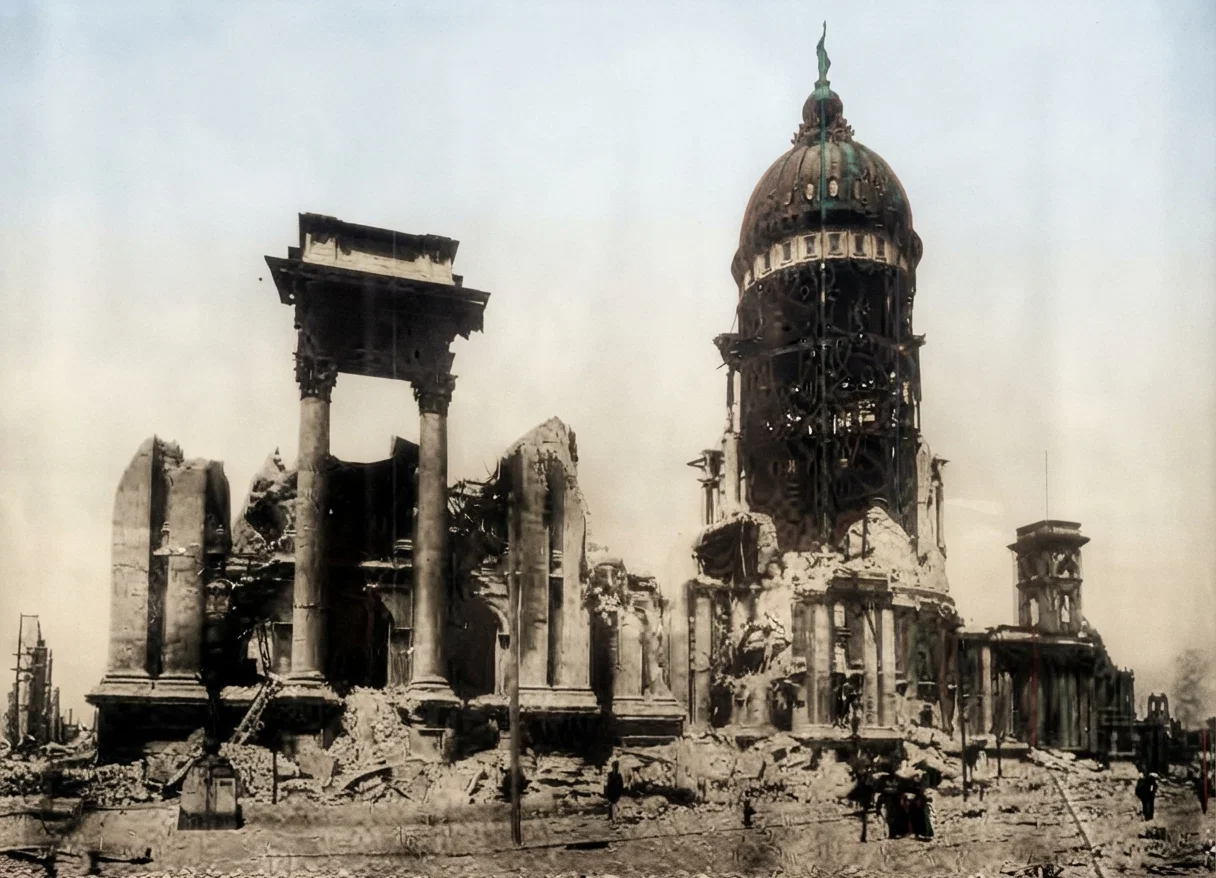
RUINS OF THE CITY HALL, SAN FRANCISCO.
The millions in the East will wish to see and know what the thousands of the West are seeing and feeling, many of them with mighty courage still fighting bravely the battles of life, many in hopeless despair, many, alas! are beyond the seeing and the feeling and knowing, crushed into unrecognizable mass, burned in desolating fires, dying in various forms as result of earthquake and holocaust.
The fearful cataclysm still seems to many a horrible dream from which they wonder if they will ever waken; or waking find it an even more terrible reality, clasping in its appalling agony and crushing tentacles the years of the future.
Many, very many, have no hope in the life or the world beyond this existence and this poor earth; and when the earthquake crushed their building or the fire fiend doomed it, they lost their all.
It is to give these simple, heart-rending, heart-touching, awful facts, which, on every hand, stare one in the face, that this paper is printed by those among the losers.

THE EARTHQUAKE.

TUESDAY night, April 17, the people in one of the fairest sections of the Pacific Coast, stretching, roughly speaking, from old San Juan Mission in the south to undefined regions in the mountains, beyond Ukiah in the north, went to rest as usual, expecting to awake to a usual day on the morrow.
The most of them were awakened with an awful shock which brought from many lips, "The world has come to an end!" "The judgment day has come!"
After the first shock was over, at 5:15, where were prosperous business centers, builded of brick or stone, were ruined walls, and piles of brick and mortar, while everywhere broken and falling chimneys and crushed and toppling water tanks met the eye, so mighty was the shake.
All who could get out-of-doors left the houses, clad or half clad, often in their night garments and barefooted.
It seemed as if an infuriated giant demon had reached up from the interior of the earth, buried his steel talon-fingers in the fibers of California's heart, and crushed and tore and shook her into the agonies of death.
Short work did the demon make of it,—only from 28 to 48 seconds (the scientists differ) and the work of destruction was wrought. Never Titan so wroughtbefore in modern Western history of which the books tell. And when the paroxysm of his rage was over, the business portions of the beautiful towns of San Jose, Gilroy, Santa Rosa, Hollister, Redwood, San Mateo, Santa Cruz, and others, were wholly or in part in ruins, and San Francisco's entire business portion was doomed. From east to west some say the convulsion came; others, from north to south. The great temblor's signature on another page will show that the movements were in every conceivable direction, straight impulses, gyratory, circular, twisting, up and down, wrenching, pounding like a mad demon, till exhaustion came and the weary, nervous earth was permitted to rest.
"Terra firma" we denominate this rolling sphere; those who experienced the shock of April 18, 1906, will call this planet "firm earth" no longer. They have seen it more restless than the sea, and far less merciful in its abnormal moods.
But the stars still glow in the evening sky, and the sun still shines, and trees still point heavenward, and grass and flowers are still kissed by the sun and dew, and nod in the spring breeze.
God rules still, and is above the storm and the tempest and the earthquake—and from this awful blow will He bring good to those in harmony with Heaven.

The Queen City of the West in Sackcloth and Ashes

The Awful Quake and Holocaust.
IT is yet hard to be believed that the Queen City of the Golden West, which yesterday was reigning in wealth, in beauty, in pride, in voluptuousness, in glory, is to-day low in the dust. Yesterday "the gayest city in the United States:" to-day she is the saddest, as she mourns by the urnless, wind-swept ashes of her treasures.
Yesterday, like Babylon of old, she was the glory of cities, and the beauty of California's excellency. Her magnificent public buildings, her gilded palaces, her beautiful and extensive parks with their evergreen foliage, their ever-blooming flowers, vied with the famed gold-covered palaces and hanging gardens of the city of nations of old. And like Babylon's king of old, her merchant and mining and marine princes said, "Is not this great San Francisco, which we have built by the might of our power for the honor of our name?" forgetting God, who ruleth over the kingdoms of men.
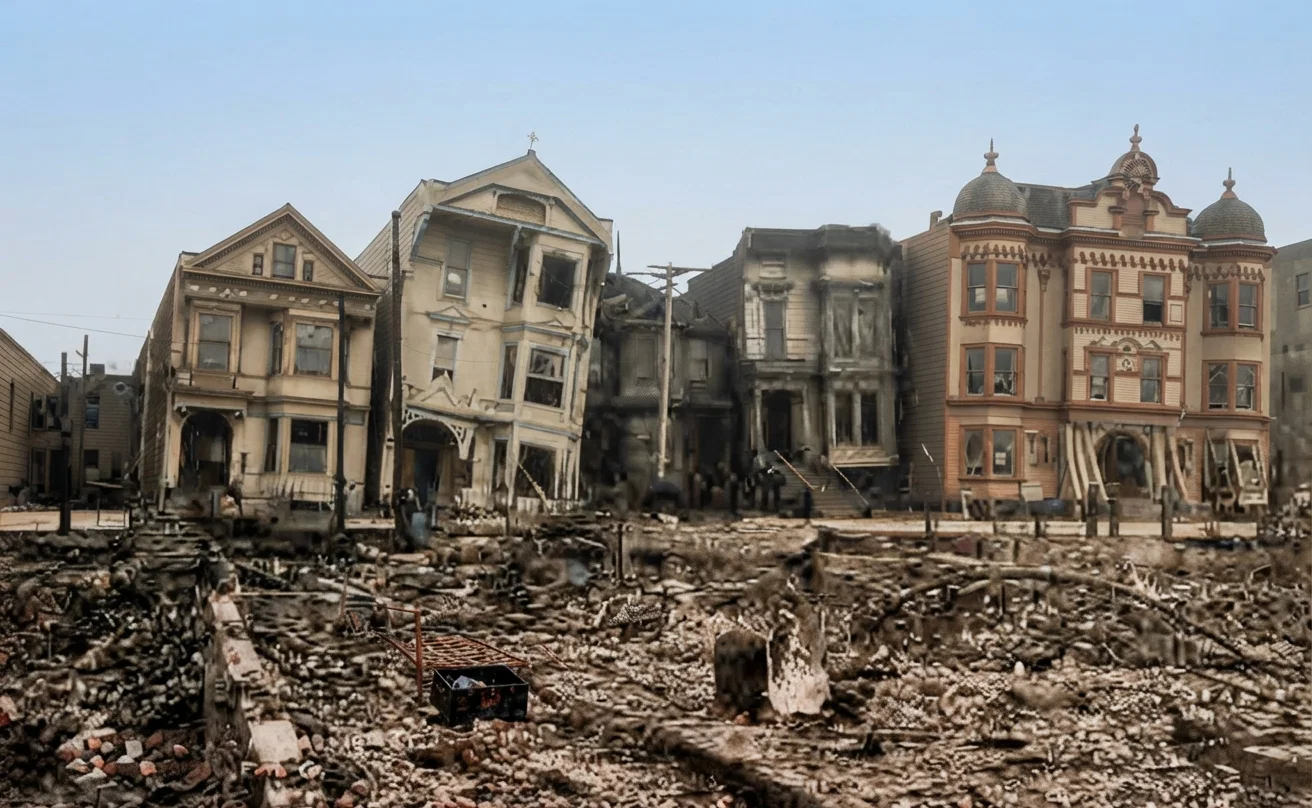
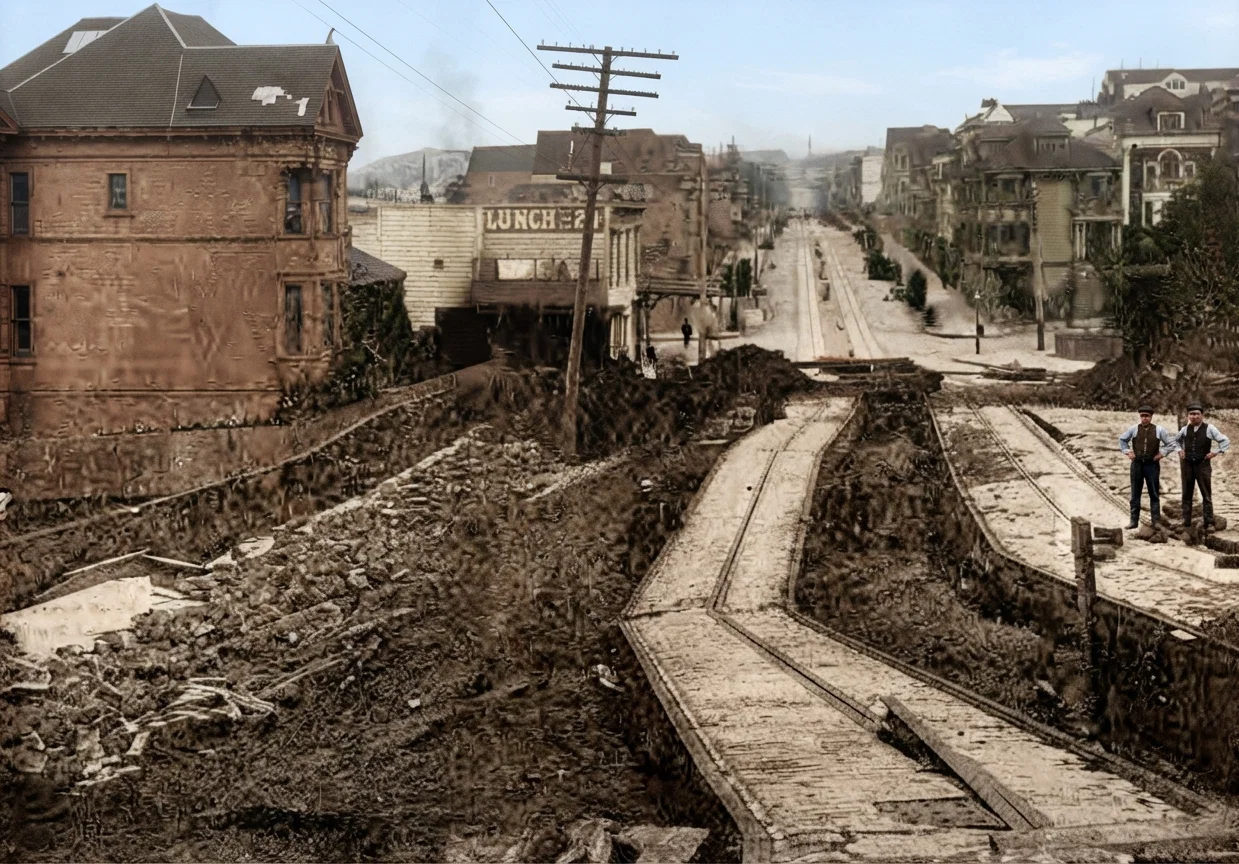
Union Street near Van Ness Avenue. This street was formerly straight, as may be seen from the track in the foreground and that in the distance forming a direct line between the two. It will be seen that the track at the left has been forced out much more than the track on the right. The depth of the cavities remaining may be seen from the men who are standing on either side of the track. This street is not on made land, but high up on the hills of northwestern San Francisco. This is one of the most striking street break-ups we have seen.
Like Tyre of old she was a "merchant city," aye, the "merchant city" of the West; like Tyre, she dwelt, at "the entry of the sea," "the merchant of the people unto many isles;" and to her, as to Tyre, came a multitude of all kinds of merchandise and riches. Her bank clearings exceeded that of all the great combined cities of the West, to Salt Lake City and Helena. The value of her buildings erected yearly increased from $6,300,000 in 1900 to $21,900,-000 in 1905. Her increase in shipping the last five years was in imports more than $4,900,000; in exports, $23,500,000; in tonnage 972,000.
All California was dependent upon her. For all large orders local merchants depended on her wholesale houses. It was the great central market, the emporium, the trade center of the West. When the awful blow fell upon our modern Tyre, California north of Tehachapi was for several days paralyzed.

The Power of the Earthquake

was incredibly awful. Now a fair growing city of a half-century's building; in a half-minute a wreck. Mighty walls of brick and stone crumble and fall; great steel girders are twisted and broken like straws, streets heave and sink and fall and rise; the half-minute is over, buildings, small and great, are in ruins, hundreds are dead and dying, the greatest earthquake of modern history, measured in gold, is over; and men stare and cry and gaze, stunned and broken and helpless before such dynamic forces, the coming and going and power of which none ever measured.

The Awful Holocaust.

Then followed, before the earth had ceased her trembling, the awful holocaust with the city for the sacrifice. Its hungry and insatiate maw devoured with appetite unappeasable till over 7,000 acres were devastated and desolated, much of it stripped of everything standing save occasional chimney stacks and iron telegraph poles. Sometimes a ruined wall, all that is left of a noble pile, faces you like a gaunt, drear relic of an age past and gone.

Noted Buildings.

The City Hall, which cost $6,000,000, is a wreck; and the after heat of the fire of the city, which poured its inferno over the mighty pile, cracked the granite fence next to the sidewalk near no consumable material save green grass, till it peeled like poor plaster from a wall.
The Palace Hotel, costing $7,000,000, the St. Francis, and the Fairmont, all of which withstood the earthquake, were burned out, and their windowless ruins stare upon you in a silent agony. The walls of the Spreckels, the Flood, the Mutual Savings Bank, the new Flood, and the new Chronicle, buildings are standing seemingly little injured, but everything consumed on the inside. But such buildings are few; gray, smoky desolation marks ten to twelve square miles in the Tyre of the West. A score of churches, the great playhouses,—the Tivoli, the California, Alcazar, and Orpheum theaters, and the Grand Opera House,—are in utter ruin, or stand as empty walls, wreck and ruin peering out of the eyeholes of windows and doors.

The Loss in Dollars?

No one knows. It has been estimated at $300,000,000; at $500,000,000; at $1,000,000,000. Insurance men say $300,000,000, with probable insurance at $175,000,000. It is thought that most of this will be paid.

The Loss of Life?

Nor can any one tell this. Not till God's judgment books their records unfold will we know the number who perished as the result of that awful cataclysm. San Francisco papers persist in placing the list at not over 500. But their own records indicate more. For instance, in the awful holocaust of Telegraph and Russian Hills, which the fire encircled so quickly that all hope of escape was cut off, it is said that more than 150 perished. For instance, 200 bodies were found in the Potrero district south of Channel Street, and were cremated. For instance, forty bodies were taken from a house, 119 Fifth Street, a four-story wooden building. Again and again we are told that hundreds and hundreds must have perished in the instant wrecks of big lodging-houses, hotels, etc., where they were immediately cremated. The dead must have numbered from 1,000 to 1,500. God alone knows, He only can tell the number.

Was It an "Avenging God,"

as a newspaper man remarked?—Rather, was it not the fruitage of earth's awful load of sin, which God's mercy and justice could restrain no longer and the consequences of perverted law were permitted to develop. Certainly in San Francisco, as in Babylon and Sodom of old, there was open, flaunting, God-defying wickedness; and yet, adapting the words of the Master, "Think ye these Americans were sinners above all the Americans, because they have suffered these things? I tell you, nay; but, except ye repent, ye shall all likewise perish." See Luke 13:1-5.
Not to San Francisco alone comes the calamity and its lessons. Many times to all the sinners and cities and towns and people of the nation have the warnings come in every way God could send them. So came they to Babylon unheeded until the hand of fire wrote her doom upon the palace wall, "Weighed, and wanting." Read, fellow pilgrim of earth, Isaiah 13; Jeremiah 51 and 52; and Ezekiel 26 and 27. These are lessons for us, for New York, for Chicago, for every other place and person forgetting and defying God.
Will the lesson, the fear, awaken only impulse to do better, or the principle to do right?

Come Unto Me

"Come unto Me, all ye that labor and are heavy-laden, and I will give you rest. Take My yoke upon you, and learn of Me; for I am meek and lowly in heart; and ye shall find rest unto your souls. For My yoke is easy, and My burden is light." Matt. 11: 28-30.

Oakland, Berkeley, and Alameda

TOUCHED by the sad plight of their sister city, San Francisco, the Bay cities came nobly to her assistance. Oakland, Berkeley, Alameda, and other sister cities less afflicted, vied with each other in their warm-hearted efforts to extend shelter, treatment, food, and comfort to the refugees from San Francisco. Tho badly shaken up, Oakland escaped with the loss of only seven lives. Her large public buildings were greatly damaged. Yet she forgot her own woes in the effort to relieve the awful distress. Homes, churches, hospitals, public halls, and the parks, were thrown open to the refugees; and rich and poor strove with each other to excel in deeds of kindness. Storekeepers stripped their shelves and gave their goods away; householders emptied their wardrobes and pantries to relieve distress. Every citizen seemed to belong to the Relief Committee. The popular churches threw aside their thumb-worn creeds, and forgot their large profession and their little deeds, in their zeal to minister to afflicted humanity the milk of human kindness. All told, these cities cared for about 50,000 refugees.
Earthquake ruins on Howard Street, between 17th and 18th. The house at the right on the corner is set over fully five feet from its foundation. This is fairly typical of the same conditions in other parts of the city. At the left of the last building standing was a house which totally collapsed, in which one woman was killed.
All of the great San Francisco newspaper plants having been wiped out of existence by the great temblor and the flames, the Call, Chronicle, Examiner, and Bulletin, were obliged to remove their headquarters to Oakland. The publishers immediately had their papers printed at the offices of the Oakland Tribune and Herald. Thursday morning, April 19, in fact, the three leading dailies of San Francisco printed a combination, four-page paper, entitled The Call Chronicle Examiner.
A hopeful spirit pervades the atmosphere. The newspapers breathe a spirit of buoyancy and good cheer, and seem to hurl proud defiance even at the elements, boasting of their tall sky-scrapers as "great, scarred giants that withstood the shock of earthquake and the destructive flames."

So Many People Are Blind

to the meaning of these catastrophes. They refuse to accept them as warning from the Almighty to get ready for the great consummation of all things earthly. I was standing with a physician on Washington Street, Oakland, when another prominent physician stepped up to talk the situation over with us. My friend and I remarked that this great disaster was but an introduction to other worse ones that are to precede the second coming of Christ. The newcomer sneered and said: "I don't think God had anything to do with this earthquake! If I thought He did, I would have no respect for such a God."
We answered: "No doubt, my friend, many people in Noah's day said they had no respect for a God who would ever bring a great flood upon the earth."
"I don't believe there ever was a Flood," rejoined the physician. So many are determined to ridicule and scoff at the Bible and all that it predicts concerning the last days. On the other hand,

Many Interpret Aright

the catastrophe of Wednesday, April 18, 1906. Scores have said, within my hearing: "God wants to remind us that He is running things." "I thought surely the end of the world was upon us!" "God made the country; man made the cities." "This made us remember our God." "We all began to pray to our forgotten God." And other like expressions.
Governor Pardee, who immediately took up headquarters in Oakland, issued, from day to day, a proclamation making every day a legal holiday, thus closing all banks in the state until the great San Francisco banks were opened.
The cities about the Bay became great military camps. Every attempt to enter a public building without the proper pass from the police or military authorities, was promptly met by a soldier presenting the flat of his gun to your chest. Instructions were to shoot to kill. Every one in San Francisco was at liberty to leave the city, but no one from the other cities about the Bay was allowed to enter the ruined city without a military pass from the governor. Each morning a line of about 2,000 men and women might be seen slowly winding in and out of the City Hall in Oakland, waiting for a permit to go to the burned metropolis, searching for lost ones, curiosity seekers, relief workers. By recommendation of the Relief Committee, any destitute person was secured free transportation to any part of the state, and often to remote parts of the United States, all of the great railways being generous to the extreme. The railway officials collected no fares from refugees on all out-bound trains from San Francisco, on either side of the Bay. One paid if one chose—otherwise it was all right. The great ferry systems did likewise on the Bay.
Each day the newspapers were filled with long lists of names and addresses of the dead, of relatives missing and found, and other desired information—page after page, each page containing nearly 1,000 names and addresses, etc. Nailed on the walls of each church or public building were to be found alphabetical lists of the refugees housed within.

Oakland's Probable Gain in Population.

Not counting the thousands who will return to San Francisco to help rebuild the ruined city, many other thousands will, without doubt, make Oakland their future home. The fact that it escaped most of the evils of the great disaster, together with its proximity to San Francisco for business purposes, will aid materially in building up Oakland, Berkeley, Piedmont, and Alameda. But, who can say where the next earthquake will be? There is safety only in Him who is our Rock.
A. J. S. BOURDEAU.

STANFORD UNIVERSITY.

President Jordan Makes Statement about Earthquake.

THE injuries to Stanford University by the earthquake of April 18 are in brief as follows:
1. Wreckage of the Memorial Church by the fall of the heavy spire, which crashed through the nave, the air blowing off the upper part of both ends of the church. The walls, generally of steel construction, are intact, but the building is ruined.
2. Wreck of the unfinished library. The great dome and its steel supporters are unharmed; their swaying completely wrecked the rest of the building.
3. Wreck of new gymnasium, brick stone-faced.
4. Wreck of parts of art museum which were made of brick faced with cement. The central part of concrete strengthened by steel rods is intact.
5. The Stanford residence in San Francisco, a huge wooden structure, heavily built, was not harmed by the earthquake, but is completely consumed by fire.
6. The inner quadrangle and engineering shops, of heavy masonry and one story high, are unharmed.
7. The outer quadrangle contains four large buildings reinforced by steel, the laboratories of zoology, botany, and physiology, with the temporary library and assembly hall. These are virtually unharmed.
8. The power-house was wrecked by the tall stone chimney, which was snapped off like the lash of a whip.
9. The Memorial Arch had its upper part snapped off and is split almost to the base, so that it is an entire wreck. This structure was of brick, reinforced with steel and faced with stone.
10. The chemistry building lost all its chimneys and is externally damaged by the fall of part of its stone facing. The building and its contents are little injured.
11. The four large buildings of the outer quadrangle, of brick unreinforced, and faced with stone, are somewhat damaged, the history building least, the incomplete mining building most.
12. Roble Hall, women's dormitory, of concrete with steel wires, is absolutely unharmed except for the fall of two ornamental chimneys.
13. Encina Hall, men's dormitory, a very large, finely-built stone building, was injured by the fall of stone chimneys, one young man being killed. The building also has a serious crack in each of two corners but is otherwise unharmed.
The wooden buildings on the grounds lost only chimneys and parts of plastering. No injury was done to books, and very little to apparatus or collections. The working part of the university as distinct from its architectural effects is little harmed. The most effective part of its architecture, the inner arcades with their Spanish arches and towers, is wholly undisturbed. DAVID STARR JORDAN.
Doctor Jordan adds in a later note:
The quadrangles, chemistry building, and dormitories will be at once repaired. The Memorial Church, not so badly wrecked as was supposed, will have a temporary roof and will be protected. No attempt will be made to restore that or other large outside buildings for a long time to come—probably not until some donation is made for the purpose.
Continue reading: How San Jose Fared