Your ShelfYour Projects

Signs of the Times, Vol. 23, No. 13.

Asking in His Name

Signs of the Times

Apr 1, 1897

Pacific Press Publishing Company · Oakland, California · Apr 1, 1897

Asking in His Name

Editorial
Asking in His Name.—In John 16:23 we read in the words of our Lord, “Whatsoever ye shall ask the Father in my name, he will give it you.” A wonderful promise, yet little realized!
What It Is Not.—This does not mean using the mere word “Jesus” or “Christ.” It is not a use of the word to conjure with, a mere charm to drive away evil spirits and accomplish good results. And yet it is often used as the superstitious man uses his horseshoe or rabbits’ foot or dried potato, to insure good luck or to ward off disease. And, like all these idolatrous, superstitious, foolish things, its use in this way amounts to nothing but disappointment, for the prayers go unanswered. The petitioner moans, “Did I not ask in Jesus’ name? and did he not promise my request?”
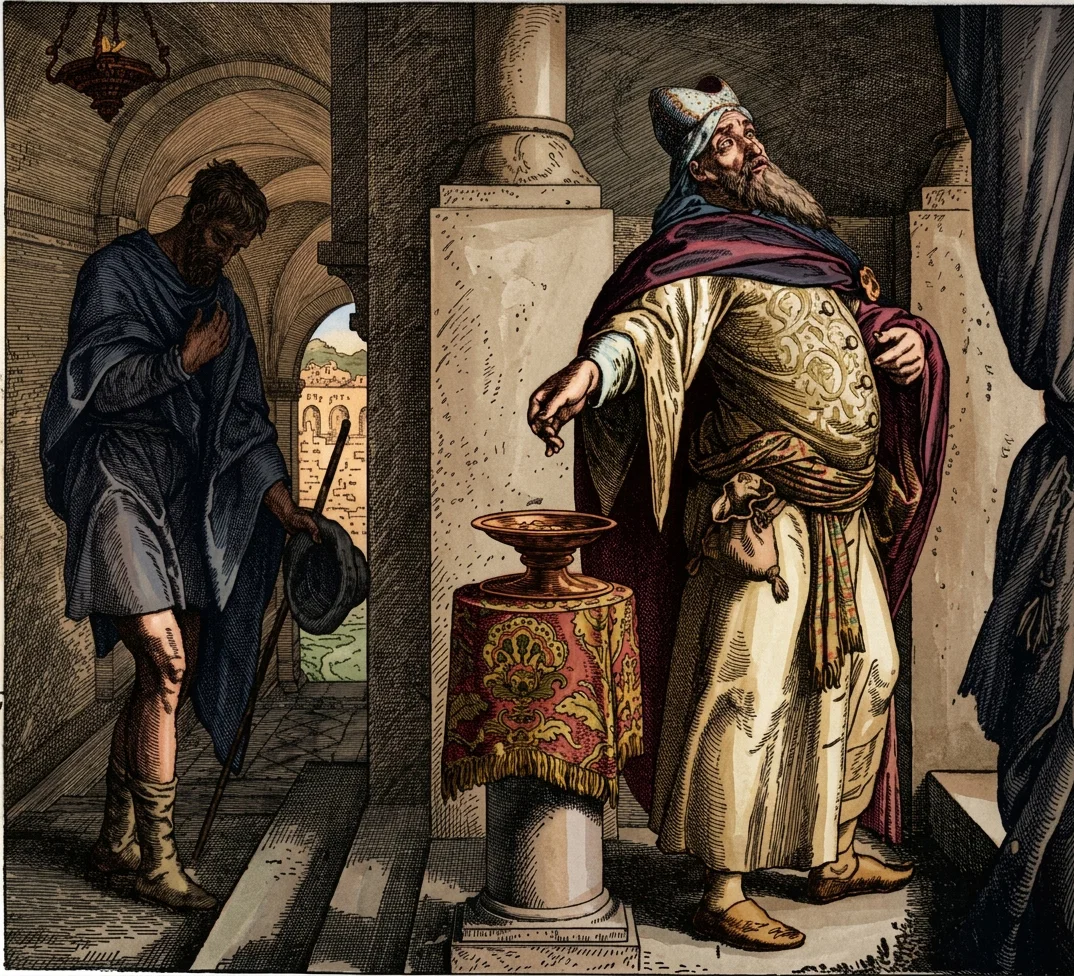
PUBLICAN AND PHARISEE AT PRAYER.
What Names Mean.—Names, when given of God, are indicative of character. “Jacob” means “supplanter,” and well described the overreaching, mercenary, covetous character of Isaac’s younger son, who, taking advantage of Esau’s appetite, purchased his birthright and obtained by fraud the father’s blessing, designed for his brother. (See Genesis, chapters 25 and 27.) But when the supplanter met God at the Ford Jabbok on that eventful night, and by persevering faith won the victory of his life, his character was transformed, and his name could “be called no more Jacob, but Israel; for as a prince hast thou power with God and with men, and hast prevailed.” Gen. 32:28. In Jer. 20:3 we have another instance of God’s naming men. To the persecuting priest Pashur, whose name meant “prosperity everywhere,” on account of his sins God gave the name of Magor-Missabib, “Fear roundabout,” showing the character and the fear that would possess him in the future. “Michael,” the name of Christ, as the chief of all the angels, means “who is like God.” “Gabriel” means “man of God;” Elijah, “my God is Jehovah.” These are illustrations of names of those whose characters were true to their names.
The Name of the Son of God.—Before his birth in this world it was said: “Thou shalt call his name JESUS; for he shall save his people from their sins.” “They shall call his name EMMANUEL, which being interpreted is, God with us.” Matt. 1:21, 23. Jesus therefore means “one who saves.” Its equivalent in the Hebrew is Joshua, defined to mean “Jehovah is salvation.” So Jesus became our Saviour, by Jehovah becoming his Saviour. He was God with us. He became one of us, one with us, a partaker of flesh and blood, “born of a woman, born under the law,” “in all things . . . made like unto his brethren.” Such was Jesus, having all the weaknesses of humanity . He “suffered being tempted,” “in all points tempted like as we are.” In other words, the mind, the character, that was in Jesus Christ, was to empty himself, make himself of no reputation, yea, give up all of self, all of hope in self, till the climax of the demonstration of his unselfishness was reached,—his death upon the cross. All these wondrous facts we may read in Hebrews, chapters 2, 4, and 5, Gal. 4:4 (R.V.), Phil. 2:5–8 (R.V.), and other scriptures. His name therefore means absolute self-denial, self-abnegation, self-effacement, that God might be manifested and glorified. He emptied himself; this was his mind, his name, his character; and God filled him with all the infinite fulness of the Godhead, and was glorified in him. In other words, Jesus yielded himself to do the will of God, wholly, without reserve. Thus, as he stood in man’s place, for man, Jehovah was his salvation, that Jesus might be our Saviour.
In His Name.—Asking in the name of Jesus is, therefore, asking with a heart and will submitted to God’s will. It is asking in self-denial, in self-effacement, in self-abnegation, in self-emptiness. Praying in the name of Jesus is seeking above all things else God’s will, or pleasure; for he whose name it is, declares: “I seek not mine own will, but the will of the Father which hath sent me” (John 5:30); “I have glorified thee on the earth” (John 17:4); and we are to ask in Jesus’ name “that the Father may be glorified in the Son” (John 14:13).
If in our human longing we desire some blessing of comfort, life, or health, yet above the petition in which we ask for it will rise the one that God’s will shall be done. We may pray with agonized prayer, “Let this cup pass,” but if we pray in Jesus’ name, above that will we plead, “Nevertheless, not my will, but thine be done.”
Unqualified Petitions.—There are some things for which we may pray with the profoundest assurance. We may plead for forgiveness of sin, for a new heart, for the outpouring of God’s Spirit, for increase of faith, for a better, truer knowledge of his Word, for our sanctification; for all these things we have the express promise of God’s Word. We know that it is his will to grant all these. To grant them will glorify him through us. If we do not receive, it is because our own hearts do not really desire the things we ask; we do not ask that God may be glorified. And yet we may ask in the fullest assurance of faith if self and sin are surrendered to God.
The Prayer of the Publican.—The publican asked in the name of Jesus, altho it is not recorded that he mentioned the name. But self was left out of the question. In fact, he saw in himself only a poor, wretched, lost, undone sinner, hopeless only for the loving mercy of God; and from the broken, contrite heart there wells forth the petition, “God, be merciful to me the sinner.” Luke 18:13, R.V. He felt as feels every other truly contrite soul, asfelt the apostle Paul, as tho he were the chief of sinners. He saw not others, he compared not himself with others; he saw but himself revealed in the light of the presence of God, in whose temple he worshiped. He was empty of all good, a recipient of mercy; God was everything. He prayed most truly in the name of the Son of God; and he went down to his house justified.
The Prayer of the Pharisee.—How different the prayer of the Pharisee, who “stood and prayed thus with himself, God, I thank thee, that I am not as other men are, extortioners, unjust, adulterers, or even as this publican. I fast twice in the week, I give tithes of all that I possess.” He probably told no lie as to his outward performances; but he did not pray in Christ’s name. Nay, he did not pray to God at all. He prayed “with himself.” There was no room for aught else. He could see but self, and therefore he praised self, and exalted self. Had he seen God, he would have abhorred self. But he came with self, he went away with no other justification than self could give.
“Into My Name.”—Note the promise our Lord gives: “Where two or three are gathered together in [literally “into”] my name, there am I in the midst of them.” Gathered together into his name does not mean a gathering of mere professors; but those who come together with the mind of Christ, with hearts submitted to God’s will, with desire that he alone may be glorified, will be heard of God; they will have his presence; he will guide them in judgment. The name of Jesus is his mind, his character. It means humility, meekness, self-denial, self-sacrifice, self-extinguishment, and simple faith and trust in God. Coming to the Father in his name is asking according to God’s will always; and such prayers can never be denied. Then, Christian, present thy petitions in his name, nothing doubting.

ENACTING AND ENFORCING GOD'S LAW.

Mr. Walters, a member of the Kansas Legislature, has introduced into the Assembly of that commonwealth the following bill, copy of which Mr. Walters kindly furnished us (the Ten Commandments are from the version used in the Episcopal prayer-book):—
An Act to Give Statutory Force to the Ten Commandments:
Whereas, The men of the present generation have become doubters and scoffers; and,
Whereas, They have strayed from the religion of their fathers; and,
Whereas, They no longer live in the fear of God; and,
Whereas, Having no fear of punishment beyond the grave, they wantonly violate the law given to the world from Mount Sinai;
Therefore, Be it enacted by the Legislature of the State of Kansas:—
SECTION 1. Thou shalt have none other gods but me.
SEC. 2. Thou shalt not make to thyself any graven image, nor the likeness of anything that is in heaven above, or in the earth beneath, or in the water under the earth; thou shalt not bow down to them, nor worship them; for I the Lord thy God am a jealous God, and visit the sins of the fathers upon the children unto the third and fourth generations of them that hate me; and show mercy unto thousands in them that love me and keep my commandments.
SEC. 3. Thou shalt not take the name of the Lord thy God in vain; for the Lord will not hold him guiltless, that taketh his name in vain.
SEC. 4. Remember that thou keep holy the Sabbath day. Six days shalt thou labor, and do all that thou hast to do; but the seventh day is the Sabbath of the Lord thy God. In it thou shalt do no manner of work; thou, and thy son, and thy daughter, thy man-servant and thy maid-servant, thy cattle, and the stranger that is within thy gates. For in six days the Lord made heaven and earth, the sea and all that in them is, and rested the seventh day; wherefore the Lord blessed the seventh day and hallowed it.
SEC. 5. Honor thy father and thy mother; that thy days may be long in the land which the Lord thy God giveth thee.
SEC. 6. Thou shalt do no murder.
SEC. 7. Thou shalt not commit adultery.
SEC. 8. Thou shalt not steal.
SEC. 9. Thou shalt not bear false witness against thy neighbor.
SEC. 10. Thou shalt not covet thy neighbor's house, thou shalt not covet thy neighbor's wife, nor his servant, nor his maid, nor his ox, nor his ass, nor anything that is his.
SEC. 11. Any man who shall violate any of the provisions of this act shall be punished as follows: For violating section one, $1,000 fine; for violating section two, $1,000 fine and one year in the penitentiary; for violating section three or four, $500 fine; for violating section five, $500 fine and six months in the penitentiary; for violating section six, hanged by the neck until dead; for violating section seven, penitentiary for life; for violating section eight, fine or imprisonment, in the discretion of the court; for violating section nine, imprisonment in the discretion of the court; for violating section ten, fine and imprisonment in the discretion of the court.
SEC. 12. This act shall take effect and be in force from and after its publication in the statute book.
There is no question but that the preamble is true from beginning to end in general and in particular. The third chapter of Romans tells us the same thing with respect to the whole world. After speaking of the heathen, the apostle says:—
“What then? are we better than they? No, in nowise; for we have before proved both Jews and Gentiles, that they are all under sin; as it is written, There is none righteous, no, not one; there is none that understandeth, there is none that seeketh after God. They are all gone out of the way, they are together become unprofitable; there is none that doeth good, no, not one. . . . And the way of peace have they not known; there is no fear of God before their eyes. Now we know that what things soever the law saith, it saith to them who are under the law; that every mouth may be stopped, and all the world may become guilty before God.”
The portion omitted but adds to the indictment. It is even stronger than the preamble of our Kansas resolution. After this fearful recital of sin the Word continues: “Therefore by the deeds of the law there shall no flesh be justified in his sight; for by the law is the knowledge of sin.” It is certain, therefore, that the proposed Kansas law can not make just those whom the preamble condemns. But we wish briefly to show the futility and wickedness of such legislation.
1. The Ten Commandments are the law of God, given of God, the expression of his own character. Ex. 24:12; Ps. 19:7; 119:172. The law is therefore the law of love, and is “spiritual.” 1 John 4:8; Deut. 33:2, 3; John 4:24; Rom. 7:14.
2. But a civil government can not enforce spiritual law. “The law is spiritual” is the declaration. This does not mean that one part is spiritual, another something else; it is all spiritual in every part. But that which is spiritual pertains not to mere outward acts, but to the spirit, the mind, the heart, the motives. Civil law, however, can only take cognizance of that which is outward, the overt act. Civil government can not, therefore, enforce God's spiritual law.
3. Take illustrations of this. Section one reads, “Thou shalt have none other gods but me.” Who is the “me”?—Of course in the original law it is the great Jehovah; but in the above if passed it is the State of Kansas. Where has the great God authorized Kansas to arrogate to herself his prerogatives? But if Kansas says the “me” refers to God, where has God made Kansas or any other State his vicegerent? Further, worship of God, acceptable worship, must be a matter of faith and the heart; for “without faith it is impossible to please Him,” and man must love him with all the heart. He who does not thus truly worship and love God certainly has another God to whom he renders a superior homage, even tho it be but himself. How will the executors of law in Kansas, or the Kansas courts, condemn the worst transgressor, providing he is skilled in hypocrisy? Some men frame their gods of wood and stone; others embody them in creeds; still others fashion them in their own hearts; but they are all false gods. The Kansas government could punish only the first, while the last two would be equally guilty.
4. Section three provides that the name of the Lord shall not be taken in vain, under penalty of $500. This would, of course, take in all that a judge would term profane swearing, in which the name of the Lord was used. But what about the myriads of times it is taken altogether “in vain” by professed Christians, who in mere form repeat their meaningless, faithless prayers? How would the law distinguish these from those who use the ineffable Name not in vain?
5. Section four provides that the Sabbath day (namely, “the seventh day”) shall be kept “holy,” under penalty of $500 fine. Of course this means not the enforcement of Sunday, but of the day of the week previous, commonly called Saturday. There could be no other meaning to the law. This is admitted, as by the Christian Work, in SIGNS of last week. But the law is that the day be kept “holy.” It demands, under penalty of $500 fine, that every inhabitant of Kansas amenable to law shall keep the seventh-day Sabbath “holy.” Holiness has reference to intrinsic quality, not to outward act. It is an act which can be performed only by a holy heart willingly. Civil power can neither make a heart holy nor willing. It, therefore, can not enforce the fourth commandment.
6. The sixth section forbids murder. Civil law can restrain and forbid outward killing, but the commandment of God forbids hatred of another. 1 John 3:15. The seventh commandment forbids lustful thoughts. Matt. 5:27, 28. This is what is meant in God's law by “Thou shalt not kill; Thou shalt not commit adultery.” What law can prohibit hatred or lust? And who can compel honor to parents, the stealing of reputation, the bearing of false witness by implication, and coveting?
Earthly government may attempt all this, but it can not succeed. It may make men cowards and hypocrites; it may persecute the better man than the hypocrite; it may put itself in the place of God, and so become antichrist; but it can never make man better nor society holier. This only can be done by the Gospel of Christ applied by faith. But, it may be said, no one expects a Legislature to attempt to enact and enforce the Decalogue. Why not? Men are working might and main to enforce “sabbath laws.” Mr. Walters, with inexorable logic, takes the whole law; for it is just as consistent to attempt to enforce every part of God's law as one part. But God has abdicated to no one. His glory is not yielded to another. He has no vicegerent among earthly rulers.

THE KNOWLEDGE OF WANT.

THE Word says, “There is no want to them that fear Him.” That is because that when we know the Lord, we no sooner have a knowledge of want than the want is supplied. The revelation or sense of want comes from him. So when we feel the want in our soul, it is God’s way of saying he has that thing to give us.
You want righteousness, do you? That is, you feel the lack of it. How did you find out that you wanted it? who told you your need?—The Lord let you know that want. How did he make you know it?—Simply by the revelation of the thing which will supply the want.
If we were to go into the wilds of Africa, out of the tract of civilization entirely, where the people know absolutely nothing of the conveniences of modern life, should we find the people begging for watches, for instance?—Of course not; they would know nothing about such things. But in our cities a boy doesn’t get very old before he wants a watch. The knowledge of that thing, and the possibility of it, create the want.
Why is it that you want righteousness?—It is only because the Lord has revealed righteousness to you, the knowledge of right; for there can be no knowledge of wrong without the corresponding knowledge of right. We know a thing is wrong because it is contrary to the right.
In every heart there are desires, greater or less, for a better life. We do not know how many discouraged souls there are longing to be delivered from the degradation into which they have fallen. They do not know how to get deliverance; and the reason is that they do not know love. They have not learned that God is love, and they have not seen God’s love manifested in those with whom they have associated, and so they do not know how to have their longings supplied. But every desire of the human heart for anything better, every longing for righteousness, has been created by the Lord, and created in order that the soul might look to him for the supply of the want.
Whenever we want to be better than we are, the very moment that want comes, it is the plain language of God to us, saying, “Here is something that you lack; take it.” This is why there is no want to them that fear God; for every want is supplied in the very knowledge of it, if we but know it. In Christ there is everything, even the fulness of God. He is the “Desire of all nations,” and in him is all that men can desire.

Illegitimate Desire.

Men may, it is true, desire many things that are not in Christ. But we can all testify from our own experience that the receiving of those things did not satisfy the desire. There was still a want there. Then that was not the real thing that we wanted, after all. We thought it would satisfy us, but a trial of it showed that there was no satisfaction in it.
It is as if we should sit at a table, hungry, and should try first one thing and then another, without finding the hunger satisfied. At last we find just the thing which the taste seemed to be calling for and which satisfies. There are longings as of the intemperate man for drink. He drinks; but he is not satisfied. The more he drinks, the more the longing is cultivated. There is this and that pleasure that men desire and indulge in, which do not satisfy. The Lord says, “Wherefore do ye spend money for that which is not bread? and your labor for that which satisfieth not? hearken diligently unto me, and eat ye that which is good, and let your soul delight itself in fatness.” Isa. 55:2.
There is not a longing in man that is not, unconsciously to himself it may be, really a drawing out after God, and for something which God can supply. So David says, “My soul longeth, yea, even fainteth for the courts of the Lord; my heart and my flesh crieth out for the living God.” Ps. 84:2. The nature of the flesh is sinful, and always sinful. But all this longing of the flesh is dissatisfaction. There is only one thing that can satisfy, and that is God. He is the Desire of all nations, and he satisfies “the desire of every living thing.”
If you really do want to be better, if you want God’s righteousness, just stop and thank him that he has given it to you. “His divine power hath given unto us all things that pertain unto life and godliness.” E. J. W.

Question Corner

“Enquire, and make search, and ask diligently.”

No. 515. The Book of Mormon.

WHAT do you think of the Book of Mormon, published by the Latter-day Saints? Your views on the subject are what I want. W.
There seems to be good authority for believing that it was first written as a romance by an invalid minister, and afterward altered by Joseph Smith to adapt it to his plan. In our opinion the Word of God is much better, and all-sufficient.

No. 516. Heb. 10:26.

PLEASE explain Heb. 10:26: “For if we sin wilfully after that we have received the knowledge of the truth, there remaineth no more sacrifice for sins.” S. S. R.
God washes men from their sins by the blood of Jesus. Rev. 1:5. He sanctifies them by the power of his Spirit in his Word. Heb. 10:29. Both of these may be summed up in the life of Jesus Christ, given to the world. The receiving of “the knowledge of the truth” is knowing the cleansing, sanctifying power of the atonement. True knowledge is not theoretical, but experimental. See Heb. 6:4, 5. God has no other means of saving men, no other sacrifice, save Jesus Christ. Now if he who has truly known this in his own life turns from it all, there is no more hope for him. He turns from the only means by which God can reach him. This does not mean that a believer who has sinned can not find pardon; for it is forever true that “if we confess our sins, he is faithful and just to forgive us our sins, and to cleanse us from all unrighteousness.” 1 John 1:9. “My little children, these things write I unto you, that ye sin not. And if any man sin, we have an advocate with the Father, Jesus Christ the righteous.” 1 John 2:1. Being overcome in sin is one thing; turning away willingly, deliberately, from the known power of God is another. The context of Heb. 10:26 shows that he who turns away after having received a knowledge of the truth turns from the only means by which God can save him. In other words, he wills not to be saved. He who continues to trust, tho he fall, will not be left of God to die.

No. 517. The Two Witnesses.

WHAT is meant by the two olive trees and candlesticks in Rev. 11:3-13? And does not the remaining part of Revelation 11 refer to our day? F. O.
WILL the two witnesses of Rev. 11 be two literal men sent to prophesy before the end? and who are they supposed to be? L. D.
No, not two men; the two witnesses are the manifestation of the two phases of God’s living word in the earth. The 1,260 days refer to the period of the Dark Ages, from 538 to 1798. Rev. 11:14-19 refers to the time of the judgment, beginning at 1844, and ending when the work of judgment is done. We shall have an article within the year on the subject. See “Great Controversy,” chapter 15, and “Daniel and the Revelation.”

No. 518. The Sealed Book.

WHAT is the book written within and on the back side in Revelation 5? Is Ex. 32:15, 16 the key that unlocks that chapter? MRS. L. D.
The book is the book of the Gospel of Jesus Christ. The key that unlocks it is the eternal sacrifice and victory of the Son of God. See verses 5-7. We have not time for fuller explanation now; study it in the light of the suggestion. We shall have more to say later.

No. 519. The Matter of Usury.

WILL you please explain Deut. 23:19; Eze. 18:8, 17? Does it not mean to give or take interest on money? A SEEKER AFTER THE TRUTH.
The scriptures above do certainly forbid the taking of usury or increase either upon money or victuals. Should these laws be followed now? That is for each person to answer for himself. In Israel each male had his portion of land. He was not dependent upon the interest of his money. Now many poor men are wholly dependent on the loaning of money. Here is a man that is ill. He has $5,000. His interest on that, at 8 per cent, is $400 a year. He may not be able to live upon less than that. Is it not right that he should receive interest from a brother who is better able to pay it than he is to lose it? Where men have money and can loan it to deserving poor or to the cause of God without increase, we believe they would receive a great blessing if they would thus do wholeheartedly. When we have had money to loan, we have loaned it without interest. When we have borrowed, we have often paid interest. The only way to have it right is for each one to do just right, whatever others may do.

No. 520. Heb. 7:12 again.

A CORRESPONDENT refers to answer to question 490 on Heb. 7:12 and asks, “Does not this [Heb. 7:12] refer to a change in the ministration of the law?” and then speaks of the two ministrations of 2 Cor. 3:6-9, as tho one applied to the Levitical dispensation, and the other to the Christian. He asks, “Is there not quite a difference in the meaning of ‘change of the law’ and ‘change in the law’?”
The fact is that Moses and every other truly justified man had the ministration of the Spirit, and the law written within. The unbelieving knew only that glory accompanying the law in its outward form. The priesthood from the Exodus to the Crucifixion was vested in the tribe of Levi, after the order of Aaron. Jesus came of the tribe of Judah after the order of Melchizedek. The Aaronic priesthood was established by law for that age, till type should meet antitype. Ex. 40:15; Num. 3; 25:12, 13, etc. During that dispensation it was a sin for those of another tribe to minister in the priest’s office. (See 2 Chron. 26:16-19.) But when our Lord entered upon his priesthood, after his humiliation (Heb. 2:14, 17, 18; 5:1-9), out of the tribe of Judah, the priesthood became changed; and “the priesthood being changed, there is made of necessity a change also of the law; for he of whom these things are spoken pertaineth to another tribe, of which no man gave attendance at the altar. For it is evident that our Lord sprang out of Judah; of which tribe Moses spake nothing concerning priesthood. And it is yet far more evident; for that after the similitude of Melchizedek there ariseth another priest, who is made, not after the law of a carnal commandment [now passed away], but after the power of an endless life,” constituted priest by the oath of God. There is yet more, but we do not see in the light of this how our correspondent can refer the law of verse 12 to the moral law. God’s moral law knows no change, can know no change. It differs with different men solely because of their different attitudes to it. The everlasting or age-lasting priesthood of Aaron antedated the age-lasting priesthood of Christ, whose priesthood began after his identification with humanity. Heb. 5:1-10.
Yes; there is a difference between the expressions “change of the law” and “change in the law.” But change of the law is just what is meant in Heb. 7:12. The law of the Aaronic priesthood passed away then, and gave place to the oath of God. It was not a change in a perpetual law, but a change from one law to another, the expiration of one in the operation of another.

“GO WORK TO-DAY IN MY VINEYARD.”

“Work out your own salvation with fear and trembling; for it is God which worketh in you both to will and to do of his good-pleasure. Do all things without murmurings and disputings; that ye may be blameless and harmless, the sons of God, without rebuke, in the midst of a crooked and perverse nation, among whom ye shine as lights in the world.” “For in Jesus Christ neither circumcision availeth anything, nor uncircumcision; but faith which worketh by love.”
In our efforts for salvation, we are accountable only to God. Forgiveness for our sins is possible only because of the atoning sacrifice of Jesus. He died for us; and this has linked us to God in continual dependence. Those who desire forgiveness must present their prayers to God, trusting in the merits of Jesus Christ, the only mediator between God and man. Their confessions must not be given through any human channel, as priest or pope; they must be presented to God, who has given Jesus as a sacrifice for the sins of the world. And if we confess our sins in humility and contrition, we receive full forgiveness. “I Jesus have sent mine angel to testify unto you these things in the churches. I am the root and the offspring of David, and the bright and morning-star. And the Spirit and the bride say, Come. And let him that heareth say, Come. And let him that is athirst come. And whosoever will, let him take the water of life freely.”
But the fact that we receive forgiveness through the grace of Jesus Christ, does not free us from taking a part in the struggle for immortal life. There are many false teachers in the world to-day who teach that belief alone is necessary for salvation. These grow in popularity because they please the people. False doctrines are received in the place of truth. A spurious faith is shown instead of the faith that works by love and purifies the soul.
But heaven’s first law is obedience in all things. By creation and by redemption we are God’s property, and we are to submit to the working of his Holy Spirit, co-operating with it, but not attempting to work it ourselves. Under its guidance we are made contrite in heart. Our souls are not lifted up in vanity, but are humbled before God.
When mind and heart are yielded in perfect obedience to God, we feel a repentance that needeth not to be repented of. The stubborn heart is subdued. The change of which Christ told Nicodemus when he said, “Ye must be born again,” is wrought in us. But we can learn this lesson from God only. It is not enough that the outward conduct is reformed, while sin is cherished and indulged in the heart. The change must commence in the heart, and work outward.
The repentance of those who truly seek forgiveness will lead them to work for Christ. It will be a living, working, transforming grace. Those who feel this repentance will reveal it in their lives. Every power of mind and soul and body will be brought into obedience to Christ. The sincerity of their prayers will be proved by their endeavors to serve God. This change, from unrighteousness to righteousness, is wrought by co-operation with God.
“This is life eternal,” said Christ, in his prayer to his Father, “that they might know thee, the only true God, and Jesus Christ whom thou hast sent.” But we can not gain a knowledge of God and of Jesus Christ if we neglect to study the Scriptures. The mind is God’s purchased possession. This gift is to be appreciated by us, and used as a treasure house, in which to store the knowledge of God. We need to do much thinking as we work for God. The psalmist says, “I thought on my ways, and turned my feet unto thy testimonies.” God would have us store our minds with the principles of his holy word, that we may know “what saith the Lord.” He would have us train our minds to wrestle with difficulties, taxing them to remember Scripture until remembering is no longer an impossibility, until the word of God is to us a harmonious whole. If the mind is habitually given difficult tasks, it acquires efficiency and power.
Train your mind to search the Scriptures. In this way you can gain a knowledge of God, and work out your own salvation. Fill it with divine truth. It will then be in perfect harmony with the heart, which, cleansed from all selfishness and moral defilement, rejoices to render homage to the law of God.
“I must work the works of him that sent me, while it is day,” said Christ; “the night cometh, when no man can work.” This is the example Christ has left us to follow. He was the Majesty of heaven, the King of glory, yet he came to this earth, and went about doing good. He was the greatest Teacher the world ever knew. Tender, compassionate, ever considerate for others, he represented the character of God, and was ever engaged in service for him. And as Jesus was in human flesh, so God means his followers to be.
“We are laborers together with God,” declares Paul, writing by the inspiration of the Holy Spirit. In the struggle against evil, we must put every muscle to the stretch, exercising every God-given qualification for the right, in order that we may resist temptation and advance step by step in the Christian life. Saved in indolence, in inactivity, we can never be. It is not possible for us to drift into heaven. No sluggard can enter there. If we do not strive to gain an entrance into that kingdom, if we do not seek earnestly to learn what constitute its laws, we are not fitted to take part in it. Those who enter there must be loyal and faithful servants of God, yoking up with Christ, working his works, overcoming as he overcame, wrestling day after day with hereditary and cultivated tendencies to wrong, which must be oft crucified. They must be “laborers together with God,” unwearied in prayer, their minds constantly turned heavenward for the assistance of the Holy Spirit, using at the same time every means that God has provided for their help.
If you would work as Christ worked, if you would overcome as he overcame, go straight to him for help needed to subdue the inclinations of the carnal mind and the passions of the natural heart. Resist every sinful indulgence, every inclination to gratify wrong desires, remembering that Christ is all and in all, and that he is able to do “exceeding abundantly, above all that we ask or think.”
As agents for Jesus we are to work for him. Why then are so many acting as did Meroz,—doing nothing,—while those sitting in darkness receive no light, no help from the children of God? How much do such idlers resemble the angel who is represented as flying in the midst of heaven, proclaiming the commandments of God and the faith of Jesus? To these idlers in the market-place, Christ is saying, “Go work to-day in my vineyard.” Angels who minister to those who shall be heirs of salvation are saying to every one, There is work for you to do. “Go, stand and speak . . . to the people all the words of this life.” If those addressed would heed this injunction, diffusing the knowledge which they have, and presenting Christ as the only Mediator, the Lord would prepare their way before them.
The hearts of those who work with Christ must throb in unison with the heart of Christ. They must be wholly consecrated to his service, ready to do his bidding, to go wherever his Providence leads them, to speak the words he gives them to speak. As they do this work, their spiritual faculties are awakened and energized. Knowing that they are in harmony with God, they feel joyous and happy. Under the guidance of the Holy Spirit they obtain an experience that is invaluable to them. Their intellectual and moral powers attain their highest development; for grace is given in answer to the demand.
As God said to Moses, so he says to us, “Go forward.” We are to give to others the unsearchable riches of Christ, working in faith, and realizing our responsibility as God’s human agents, to whom he has given this work. In God’s service we shall meet with obstacles and difficulties. But these must not be allowed to discourage us. Events belong to God, and his servants will meet with difficulties and opposition; for these are his chosen methods of discipline, and his appointed conditions of sure progress and success. In spite of trials, do your God-given work in sincerity and faith, that your character may be formed after the divine pattern. “Behold, I come quickly,” said Christ; “and my reward is with me, to give every man according as his work shall be.” He will render to all according to their deeds. “To them who by patient continuance in well-doing seek for glory and honor and immortality,” he will render eternal life; “but unto them that are contentious, and do not obey the truth, but obey unrighteousness, indignation and wrath. . . . But glory, honor, and peace, to every man that worketh good.”
MRS. E. G. WHITE.

“I AM HERE.”

AN incident which illustrates the presence of God always within hearing of those who will but call upon him, is found in the Young People’s Weekly:—
I once crossed the Atlantic in the midst of a violent storm. The most of the passengers were kept below; in fact, all of them, except another man and myself. We wished to watch the sea in its fury, and so were lashed to the rail under the bridge, upon which our brave captain stood, watching with equal care the ship and the storm. As our vessel plungeddown into the depths, sinking, as it seemed, into an endless abyss of whirling woe, and rose again on the crest of a mountainous wave, between the gasps I shouted to the captain above, “Are you there?”
Words can not tell what a sense of security filled my heart as I heard, above the roaring of the storm and the beating of the waters, his voice, calm, steady, and cheerful, “I am here.” More than once during that fearful storm I asked the same question, and always there came back to me upon the gale the same cheerful, reassuring answer, “I am here.”
Is there not in this incident a reminder of our Great Captain above, whose loving care guides our lives through all the storms and turmoil of this world, and who, if his children would but realize it, is always within call?
Continue reading: PEACE, BE STILL!