Signs of the Times, Vol. 35, No. 15.

Love for the Erring

Signs of the Times

Nov 11, 1908

Pacific Press Publishing Company · Mountain View, California · Nov 11, 1908

Love for the Erring

"Then drew near all the publicans and sinners for to hear Him. And the Pharisees and scribes murmured, saying, This man receiveth sinners, and eateth with them.
"And He spake this parable unto them, saying, What man of you having an hundred sheep, if he lose one of them, doth not leave the ninety and nine in the wilderness, and go after that which is lost, until he find it? And when he hath found it, he layeth it on his shoulders, rejoicing.
"And when he cometh home, he calleth together his friends and neighbors, saying unto them, Rejoice with me, for I have found my sheep which was lost. I say unto you, that likewise joy shall be in heaven over one sinner that repenteth, more than over ninety and nine persons which need no repentance."
IN the company about Jesus there were shepherds, and also men who had money invested in herds, and all could appreciate His illustration. The wide-spreading tablelands on the east of Jordan afforded abundant pasturage for flocks, and through the gorges and over the wooded hills had wandered many a lost sheep, to be searched for and brought back by the shepherd's care.

Seeking the Lost.

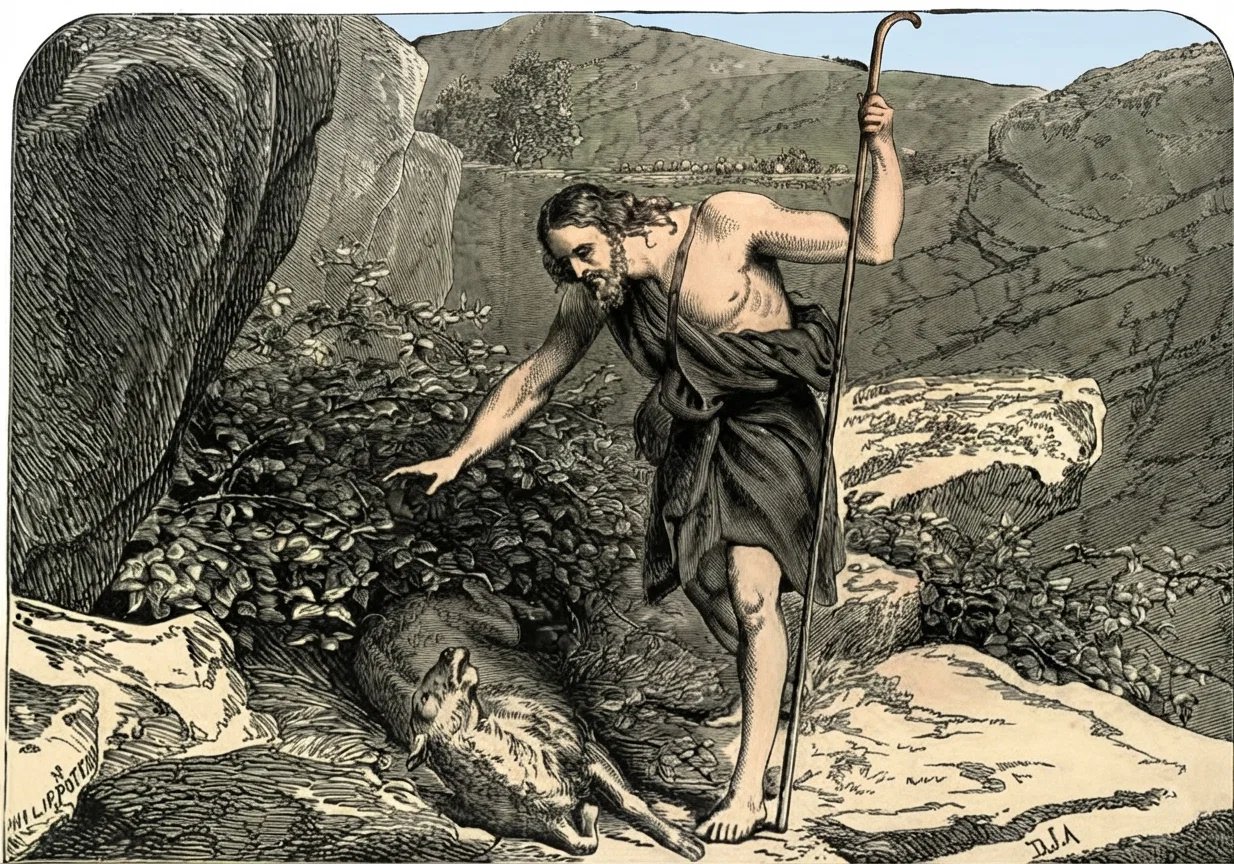
The shepherd who discovers that one of his sheep is missing does not look carelessly upon the flock that is safely housed, and say, "I have ninety and nine, and it will cost me too much trouble to go in search of the straying one. Let him come back, and I will open the door of the sheepfold, and let him in." No; no sooner does the sheep go astray, than the shepherd is filled with grief and anxiety. He counts and recounts the flock. When he is sure that one sheep is lost, he slumbers not. He leaves the ninety and nine within the fold, and goes in search of the straying sheep. The darker and more tempestuous the night, and the more perilous the way, the greater is the shepherd's anxiety, and the more earnest his search. He makes every effort to find the one lost sheep.
With what relief he hears in the distance its first faint cry. Following the sound, he climbs the steepest heights, he goes to the very edge of the precipice, at the risk of his own life. Thus he searches, while the cry, growing fainter, tells him that his sheep is ready to die. At last his effort is rewarded; the lost is found. Then he does not scold it because it has caused him so much trouble. He does not drive it with a whip. He does not even try to lead it home. In his joy he takes the trembling creature upon his shoulders; if it is bruised and wounded, he gathers it in his arms, pressing it close to his bosom, that the warmth of his own heart may give it life. With gratitude that his search has not been in vain, he bears it back to the fold.
He leaves the ninety and nine within the fold, and goes in search of the straying sheep.
Thank God, He has presented to our imagination no picture of a sorrowful shepherd returning without the sheep. The parable does not speak of failure, but of success and joy in the recovery. Here is the divine guarantee that not even one of the straying sheep of God's fold is overlooked, not one is left unsuccored. Every one that will submit to be ransomed, Christ will rescue from the pit of corruption and from the briars of sin.

God Will Forgive.

Desponding soul, take courage, even tho you have done wickedly. Do not think that perhaps God will pardon your transgressions and permit you to come into His presence. God has made the first advance. While you were in rebellion against Him, He went forth to seek you. With the tender heart of the shepherd, He left the ninety and nine and went out into the wilderness to find that which was lost. The soul, bruised and wounded and ready to perish, He encircles in His arms of love and joyfully bears it to the fold of safety.
When the straying sheep is at last brought home, the shepherd's gratitude finds expression in melodious songs of rejoicing. He calls upon his friends and neighbors, saying unto them, "Rejoice with me; for I have found my sheep which was lost." So when a wanderer is found by the great Shepherd of the sheep, heaven and earth unite in thanksgiving and rejoicing.
"Joy shall be in heaven over one sinner that repenteth, more than over ninety and nine just persons, which need no repentance." You, Pharisees, said Christ, regard yourselves as the favorites of Heaven. You think yourselves secure in your own righteousness. Know then that if you need no repentance, My mission is not to you. These poor sinners who feel their poverty and sinfulness are the very ones whom I have come to rescue. Angels of heaven are interested in these lost ones whom you despise. You complain and sneer when one of these souls joins himself to Me; but know that angels rejoice, and the song of triumph rings through the courts above.

The One Lost Sheep—the World.

The rabbis had a saying that there is rejoicing in heaven when one who has sinned against God is destroyed; but Jesus taught that to God the work of destruction is a strange work. That in which all heaven delights is the restoration of God's own image in the souls whom He has made.The rabbis understood Christ's parable as applying to the publicans and sinners; but it has a wider meaning. By the lost sheep Christ represents not only the individual sinner, but the one world that has apostatized and has been ruined by sin. This world is but an atom in the vast dominions over which God presides; yet this little fallen world—the one lost sheep—is more precious in His sight than are the ninety and nine that went not astray from the fold. Christ, the loved Commander in the heavenly courts, stooped from His high estate, laid aside the glory that He had with the Father, in order to save the one lost world. For this He left the sinless worlds on high, the ninety and nine that loved Him, and came to this earth, to be "wounded for our transgressions" and "bruised for our iniquities." God gave Himself in His Son that He might have the joy of receiving back the sheep that was lost.
"Behold what manner of love the Father hath bestowed upon us, that we should be called the sons of God." And Christ says, "As Thou hast sent Me into the world, even so have I also sent them into the world,"—to "fill up that which was behind of the afflictions of Christ, . . . for His body's sake, which is the church." Every soul whom Christ has rescued is called to work in His name for the saving of the lost. This work had been neglected in Israel. Is it not neglected to-day by those who profess to be Christ's followers?
How many of the wandering ones have you, reader, sought for and brought back to the fold? When you turn from those who seem unpromising and unattractive, do you realize that you are neglecting the souls for whom Christ is seeking? At the very time when you turn from them, they may be in the greatest need of your compassion. In every assembly for worship, there are souls longing for rest and peace. They may appear to be living careless lives, but they are not insensible to the influence of the Holy Spirit. Many among them might be won for Christ.
If the lost sheep is not brought back to the fold, it wanders until it perishes. And many souls go down to ruin for want of a hand stretched out to save. These erring ones may appear hard and reckless; but if they had received the same advantages that others have had, they might have revealed far more nobility of soul and greater talent for usefulness. Angels pity these wandering ones. Angels weep, while human eyes are dry and hearts are closed to pity.
O, the lack of deep, soul-touching sympathy for the tempted and the erring! O for more of Christ's spirit, and for less, far less, of self!

The First Commandment

By J. O. Corliss
"THOU shalt have no other gods before Me." This first requirement of the Ten Commandments was spoken from the midst of a cloud which hung over and about the mountain of Sinai. The people to whom these words were spoken were the descendants of Abraham, the "friend of God." Their ancestors had become bond-servants of the king of Egypt more than two centuries before, and these listeners at the base of Sinai had been reared amid the grossest rites and ceremonies of sun-worship.
God had called them forth from these surroundings, to serve Him in a land of His own choosing; namely, Palestine. When this command was uttered, they had been miraculously delivered from their task-masters; had passed between high walls of water, supernaturally piled up, at the crossing of the Red Sea; and for more than a month had eaten the bread of heaven, while traversing the barren sands of the desert. At every turn an unseen hand had provided for their safety and comfort. They were doubtless impressed with their singular experience, without being able satisfactorily to account for all its details.
In fact, these people were semi-heathens, and were being thus led of God for a single purpose. They were altogether below the standard of morals which was pleasing to God, but His word had been pledged to Abraham that his posterity should be redeemed from bondage and returned to the land of Canaan. Gen. 15:13-16. This assurance was, however, but a reiteration, in part, of a larger promise previously made to the same patriarch, in which God covenanted to deliver to his seed, not only the land of Canaan, but also the whole earth. Gen. 13:14, 15; Rom. 4:13.
It mattered not what the moral status of Abraham's progeny might be when the time of their deliverance came, God must fulfil His own word regarding them. But He could not even then take them to Canaan unconditionally. They must be made acquainted with their heavenly Benefactor, and so, in addition to their wonderful deliverance from Egypt and the marvelous daily gift of food, they were brought out to the quiet of the rocky ramparts of Sinai to learn the source of their remarkable deliverance from rigorous bond-service.
Great caution was observed by placing bounds about the mountain lest in the attempt of God to reveal Himself to these children of nature, their curiosity should lead them to destroy themselves by rushing toward the intended display. When everything was ready, and the people were stilled for the occasion, all at once the mountain of Sinai was observed to be enveloped in a great smoke, and the whole structure trembled as though shaken by an earthquake.
At this juncture the voice of God was heard from the midst of the fire and smoke. His first words were: "I am the Lord thy God, which have brought thee out of the land of Egypt, out of the house of bondage." Ex. 20:2. The sight and sound of the occasion were nearly overwhelming. Immediately the people began to retreat to a safe distance, and pleaded with Moses to speak to them, rather than God, that they might not die. The reply of their leader was: "Fear not; for God is come to prove [try] you, that His fear may be before your faces, that ye sin not." Verses 18-20.
Having satisfied the people of His glory and greatness by the moving of Sinai, the shaking of the earth, and the lowering of the heavens, to bring down the thousands upon thousands of angels (Ps. 68:8, 17), God made known His first command to them: "Thou shalt have no other gods before Me." It matters not that you have been reared to venerate the sun, because of its light and heat, which add to the soil's fruitfulness; do not be misled to prefer it before Me as a god. Do not make any god of gold or silver, in imitation of Egyptian deities. These can not talk with you from heaven as I am doing. Ex. 20:22, 23. I am the God of salvation; unto Me belong the issues from death. Ps. 68:20.
So well did the Lord know the inbred learning of the people before Him, and so anxious was He to guard their weaknesses, that He gave them instruction even to make their altar of sacrifices of earth, lest they might build in imitation of the ornate ones left behind in Egypt, which were associated with the sun-worship of that country. They might make an altar of stones provided they would build it of natural boulders without any attempt to chisel it into form. Indeed, every safeguard possible was thrown about them to prevent them from imitating theworship of those from whose midst they had been rescued.
But these precautions were unheeded, to the disgrace of the people and to the distress of Moses; for while the servant of the Lord was some days communing with God in the mount, and the camp was held in waiting, the rumor circulated that he who had been their leader was gone, perhaps for all time, and the people at once lost their self-control. They had trusted Moses as their god, because he was recognized as leader above any other one apparent to their physical sight, and now that he was no more in evidence, they must have a visible god to lead them on their way. So taking their gold ornaments in hand which they brought from Egypt, Aaron was approached and required to form a golden figure which they might recognize as the god to lead them to their anticipated refuge.
We wonder, no doubt, how that people so soon after witnessing the display at Sinai, and experiencing the keeping power of God on their journey from bondage, could so far depart from the instruction received. But theirs was an experience which has been, and is still, being repeated by those who profess to be led by Providence in life's journey. So long as prosperity attends their way, they do not object to giving God credit for it. But let their plans be thwarted, or some calamity attend them, and they immediately resort to some known physical force to relieve the situation, apparently forgetting that help can come alone from Him who rules in the heavens, and who has said: "Thou shalt have no other gods before Me."
It is very evident, when we stop to consider the matter, that this commandment broadly applies to all such cases as just cited, the same as to those to which we have been so apt to suppose it was confined; namely, the constant and continuous worship of the sun, or some living earthly creature. Must we not so conclude when we seek help, in time of distress, from some source outside of God's appointment, and so put some other being or thing before, or in place of, God?
This is not to say that there are not natural agencies which may be employed as helps all along the journey of life. But even in using these, why should not the Christian recognize them simply as mediums through which God can and will operate for our benefit, providing that we ask Him so to do? In such case God always will be recognized as protector and preserver, and the recipient of His favors may always chant with the psalmist, with the deepest confidence:
"The Lord is my Shepherd; I shall not want. He maketh me to lie down in green pastures: He leadeth me beside the still waters. He restoreth my soul: He leadeth me in the paths of righteousness for His name's sake. Yea, tho I walk through the valley of the shadow of death, I will fear no evil: for Thou art with me; Thy rod and Thy staff they comfort me. Thou preparest a table before me in the presence of mine enemies: Thou anointest my head with oil; My cup runneth over. Surely goodness and mercy shall follow me all the days of my life: And I will dwell in the house of the Lord forever."—Psalm 23.

Christ and Human Helplessness

“Christ can do nothing for you till you can do nothing for yourself.”

Accepted and Answered Prayer

“An accepted prayer is not always an answered one—in one way.”

The Marriage of the Skies.

By Mrs. L. D. Avery-Stuttle.
O, RING the bells of heaven high! The marriage feast has come; The glorious jubilee is nigh, The saints are going home. The mighty pennons of the skies Are waving in the air, And o'er the gates of Zion rise Her battlements so fair.
The King is mustering His guests; I see His glorious band; I see the shining habitants Of far-off Beulah-land. They come, they come on wings of light, I hear the bugle blast; I know the reign of sin's dark night Forevermore is past.
From cloud to cloud, from dome to dome, The myriad army cries: "The marriage of the Lamb has come— The marriage of the skies." Come, bring the linen white and clean, The wedding guests prepare, Garments which gleam like silvery sheen,— The bridal robes so fair.
The Bridegroom, too, methinks I see, While myriad voices ring: "Chiefest among ten thousand He— Immanuel, my King!" "Thrice blest are they who hear the call," A mighty angel cries, "Haste to the supper of the Lamb— The marriage of the skies."

The Formation of Child-Character

By A. Delos Westcott
“FEED My lambs,” is the injunction of the Chief Shepherd to those who have the care of the younger members of His flock.
The health and prosperity of any animal depends largely upon the character of its food. This is especially true of young animals. Their delicate organisms are easily injured by substances which would be comparatively harmless to the older members of their species. Moreover, the young can not care for themselves, but must depend upon others for their nourishment. Hence their development depends almost entirely upon the purity and vigor of those that give them sustenance.
As in the physical world, so in the spiritual, the young must receive their impressions of God and salvation through the minds of others. How disastrous the result when the plastic minds of our children are brought in intimate contact with persons who have little reverence for their Creator and whose thoughts are vile and blasphemous! A child's mind may be likened to a sensitive plate in a photographer's camera. Every moment, during his waking hours, picture after picture is being formed upon the delicate brain. Parents and teachers, what kind of pictures are forming in the minds of your children? If none but beautiful objects are brought before them, only beautiful pictures will be formed. This is why we are warned by the wise man: “Enter not into the path of the wicked, and go not in the way of evil men. Avoid it, pass not by it, turn from it, and pass away.” Prov. 4:14, 15. “By beholding we become changed.”
“Finally, brethren, whatsoever things are true, whatsoever things are honest, whatsoever things are just, whatsoever things are pure, whatsoever things are lovely, whatsoever things are of good report; if there be any virtue, and if there be any praise, think on these things.” Phil. 4:8. “For, as he thinketh in his heart, so is he.”
The first thing mentioned for us to think about is truth. Many people suppose that “truth” and “fact” are one and the same, but that is a mistake. Righteousness and truth are the same thing. “Thy law is the truth,” says the psalmist. Ps. 119:142.
The truth as it is in Jesus is the food to be given to the lambs of Christ's flock. That is, the law of God as it was shown forth in the life of Jesus. How can we as parents and teachers give this to the children? There is only one way: We must have the truth in us as it was in Jesus. Little children may not be able to read; they may not be able to understand all that is said to them; but they can understand our actions; they may know at least that their teacher loves them. And God's Spirit, working through the sanctified teacher, will impress their hearts.
It has been said that it is not what we read or hear, but what we remember, that benefits us. Of course we are benefited most by what we remember, but the things we forget are by no means an entire loss. A boy was told to carry water in a basket. Of course most of the water leaked out, but the basket was thoroly cleansed. Keep a constant stream of whatsoever things are true, honest, just, pure, lovely, and of good report running through the minds of your children and they will be clean, altho they may not be able to remember all. Perhaps this is what Jesus meant when He said, “Now ye are clean through the word which I have spoken unto you.” John 15:3. We must also be on our guard against the sources of defilement, not forgetting that “evil companionships corrupt good morals.” 1 Cor. 15:33. Memorizing verses of Scripture is one way of keeping our mental basket clean.
Children are great imitators. Whatever you permit them to see or hear, they will usually try to imitate. How important, then, that they hear and see only the things which are pure and of good report. Children should be early taught to choose the good and to reject and avoid the evil. Then our duty is but half done. The most important thing is to see that the child actually does the thing required of him. Training a child is getting him to do what he ought to do at the time and in the manner it ought to be done. An act frequently repeated finally becomes a habit, and character is the sum of all our habits.
How important that the children should receive correct training, that right habits may be formed from the very start. Bad habits are hard to change. So also are good ones. Requesting or commanding a child to do a thing without training him to do it, is like faith without works; but “train up a child in the way he should go, and when he is old, he will not depart from it.” Prov. 22:6.

No Half-Way Religion.

IN an editorial discussing "Religion—The Most Practical Thing in the World," Appleton's Magazine for August says:
"The churches suffer from a terrible blight, the blight of Sunday religion. You can't be religious on Sunday and irreligious on Monday. You can't, any more than you can be a tall man on Tuesday and a short one on Wednesday. We talk of religion as if it were a separate department of life. We label it and bottle it and prescribe it for use on certain occasions. We particularly recommend it to old ladies, children, and invalids. Religion is either good for everybody at all times or for nobody at any time. We talk of religious and irreligious men, but every man has in him a spark of the divine which he can either kindle into a living flame or neglect until it is all but extinguished. Religion is a spur to all that is best in life, a spur to those things without which life is not worth living. A democracy must have religion as a check on the one hand and a spur on the other."

Notes by the Way.

IN our last we spoke of the Eucharistic Congress. To Catholics it was destined to be the nature of a triumph. Great gains have been made in England. The High Church people have been following fast after Rome and utterly repudiating Protestantism; and the voices of Protestants raised in protests against Rome's errors and for the Gospel are few and far between. In fact, "Protestants" professedly so, are strong and ready to denounce as bigoted those Protestants who do protest, as are Romanists.
Oftentimes the protests against Roman Catholicism are based on utterly wrong principles. It is with these protesters a perfectly proper thing for Protestantism to be united with the state, but not Catholicism. Their very attitude places weapons in the hands of Rome. Historically she has the priority, and logically her claim is as good as that of any other religious body. But in truth, no religious body should be connected with the state. It has ever been a curse to both state and church. The church thus proves false to her covenant God, and looks to earthly power for her success, and the state becomes embroiled in religious controversies, and becomes a party against its own loyal subjects. Union of church and state, or Christianity and the state, spells weakness and ruin for both and a bitter curse to civilization.
BEAUTIFUL in her greenness is England. The sad thing is that so much of her land is unproductive for her masses. It is held in large estates and great parks, used for game preserves and racehorses, which do little good to her thousands of needy people. Her colonies are open for millions, and many are interesting themselves in inducing emigration, notably to Canada. But hundreds of thousands are too poor to go, and labor conditions must ever be pitiful.
YET the worst foe is drink. The curse of the public house is over the land, black and blighting. It is pitiful to see fathers and mothers and children throng the public houses (saloons) and drink; painful to see the little child sent to the grog-shop with the bucket for ale or beer for besotted parents. If the curse of rum could be wiped from this beautiful island, what an untold blessing it would be to the men who are waxing rich on the bodies and souls of their fellows.
LONDON overflows with Americans. They are found everywhere, so that lodgings even have been very difficult to obtain. American ships are filled to the full by the returning multitudes. The great historic places, such as Westminster Abbey, St. Paul's, the Tower, and the British Museum, are thronged. It is so with the Museum Library, where the writer spent much of his time. Regulations are becoming more strict because of the many applications to read. There were more than 750,000 readers in the great library last year. One can understand somewhat of the crowded conditions in the reading-room at times, with an average of 2,500 a day. It is a great institution, but it demands time.
GREAT London is the same, yet changing. The old historic streets seemed familiar as ever. Who has not heard of Piccadilly, The Strand, Fleet, and Farringdon Streets, Cheapside, Holborn, Ludgate, Threadneedle Street, Paternoster Row, etc.? Who does not know something of the Tower, Westminster Abbey, St. Paul's, the British Museum, the Guildhall, the Monument, and many of the great buildings made famous in history? They are all there in their own individual rugged grandeur. We love them all for the heroes of God whose names are associated with them.
WE have no criticism for much of the conservatism of old England, in which so many Americans flippantly indulge. We love her regard for law, manifest in the peaceable and accommodating policeman in the street, in her crowded lanes and arched byways built over some tortuous path used by the public for so long that it belongs to them, and regard for their rights would not bate a jot or tittle of what is theirs. But "the old order changeth." The great book-mart, Paternoster Row, is housing the draper and restaurateur. The underground railway with its Hadean fumes has given place to beautiful tubes, lined with porcelain brick, in which run swift and comfortable electric cars, making accessible all parts of London. Electric railways and tramways are common, of course. Motor "buses" are endeavoring to compete with the old horse "bus," still a great favorite with Londoners, and cabs and hansoms are everywhere in evidence, while thousands walk, walk, walk, much more than in America, and doubtless generally for their own good. But you will find no car tracks in Old London; they will not have them, nor will you find electric wires stretched over the finely paved streets. London has regard for the safety of the public. Her courts of justice are worthy of honor. With all the poverty and misery to be found, with all the foolish laws and customs of entail and feudal rights, and titled "nobility," who are not noble, one must honor her for the rich associations and inheritance of noble names, great characters, and devoted men of God. May thousands of her sons and daughters receive the mighty, blessed truth of God's last message.
OUR voyage home was without particular incident, save that it was generally cold, and rough, and stormy. A little babe died during the voyage, and was buried at sea early the next morning. The mother was almost inconsolable. Our ship, the "Kensington," of the Dominion Line, is a two-class boat, second and third; but her second class is not equal to the second class on the three-class ships, and we can advise no one to take the Dominion Line; altho with a better boat it may be an agreeable voyage in the summer. As we close this we are nearing American shores. The Gulf of St. Lawrence has received us, and land has been sighted. All hearts are glad. How much more so should God's children be glad as we near the eternal Homeland after earth's stormy passage. W. Sept. 25, 1908.

Wonderful Counselor.

WHETHER we read Isa. 9:6 as "Wonderful, Counselor," as in the text of the Revised Version, or "Wonderful Counselor," as in the margin, it matters not. Jesus Christ is the Counselor, the Advocate of His people, of all that long to be His people. He is also a Wonderful Counselor, in wisdom so surpassing, in knowledge so profound, in love so infinite, that all the counsel of all the wise men of the earth is not worthy of mention.
He knows all about our case. He understands the principles involved. He sees the harvest in the seed, the end in the beginning. He knows all the dangers that may lurk in the way. He looks with clear eye on all the hidden snares of the enemy. He sees the subtle, sweetened, poisoned drafts that the adversary has prepared for thirsty lips. He beholds the enchantress' bed which lulls to the sleep of death our weary limbs and brains. He has met all these things Himself, and knows how to escape all dangers, how to make best use of all blessings; nay, more, how even to turn the banes into blessings. O, our Counselor understands it all; He is perfect in knowledge and wisdom.
Moreover, He counsels to save. He can counsel in no other way, for He loves us with a measureless love. Others may counsel us to do what is "expedient," what is the "best policy." But there are no makeshifts in the advice of our Counselor. His counsel is founded in the everlasting principles of truth and righteousness and life. He would not advise you to endeavor to escape a temporary ill and fall into a permanent evil. He would not save you from confession of sin, to let you meet sin's doom at the end. He would not give you the satisfaction of your temporary triumph here and keep you from His eternal triumph for you hereafter. No; love leads our Counselor to do for us what is always for our best and eternal good.
But the knowledge, the wisdom, the intermingled love are not all that made wonderful our great Counselor. His ear, His private office, is open to all. The poor of the earth can not get access, except in rare instances, to the world's great counselors. The legal advice of a Blackstone, an Evarts, or a Choate, costs more than the poor can afford. A retaining fee for such as they, even if life were at stake, would be more than the poor could raise. But the Wonderful Counselor ever keeps open office for earth's millions. No servant or lackey will keep you from access to the Master. It is your privilege to go to Him. Surely He speaks not to deceive or tantalize; hear Him: "Come unto Me, all ye that labor and are heavy-laden." The righteous may come in his perplexity. The sinner, deep-dyed, and criminal against his Father's law, may come and find an Advocate who intercedes, a Judge who justifies. And this is love.
Then, reader, go to Him. Let nothing keep you from it. Tell Him all about your case. Keep back nothing. Only so will you realize the need of His help. And then His Spirit will by His own word teach you the way; and you will indeed know Him to be the Wonderful Counselor.

England's New Fleet in the North Sea.

NEXT year, 1909, there will be passed into commission in the English "Home Fleet," the "Bellerophon," "Temeraire," and "Superb," improved "Dreadnaughts," the cruiser battle-ship "Indomitable," with her two sisters, the "Invincible" and the "Inflexible," with an armored cruiser of the type immediately preceding the "Indomitable," the "Defense," and the "Lord Nelson," a sister ship of the "Agamemnon." This will mean a complete reorganization of the fleet, which will then consist of twelve absolutely modern units, only two of which, the "Lord Nelson" and the "Agamemnon," will have a speed of less than twenty-one knots. It will be further notable as the only fleet in the world in which no fighting gun of less than six-inch caliber will be mounted. What will be Germany's answer to this?

"Showers of Blessing"

By H. A. St. John

ASK ye of the Lord rain in the time of the latter rain; so the Lord shall make bright clouds, and give them showers of rain, to every one grass in the field.' Zech. 10:1. 'There shall be showers of blessing.' Eze. 34:26. Dear reader, are you continually saying and praying, 'Lord, mercy-drops round me are falling, but for the showers I plead'? We are in the time of the latter rain, the general and wonderful refreshing from on high.
But that great refreshing will undoubtedly be preceded, in the experience of individuals and small companies of two or more, by rich and abundant showers of blessing. These showers will come to hungering and pleading souls, who are seeking for a preparation to receive the mighty outpouring further on. The latter rain will not fall upon a single soul that has not been previously fitted by cleansing the soul temple from all defilement. It is left with us to remedy the defects in our characters by zealous and thoro repentance, and while we are so doing, we will undoubtedly receive showers of blessing. These showers will be needful, as necessary divine helps, in making the fitness required to receive the latter rain.
I have stood upon the mountainside and witnessed showers of rain falling upon very circumscribed localities in the valley and on the mountains beyond, sometimes two or more showers visible at the same time, while the heavens were clear above my head. Then a shower would visit my locality, while all was sunshine beyond. Sometimes a shower would fall richly on one lone mountain rancher, then upon several. These were neither the former nor the latter rain, but the showers that preceded, and wherever they fell they constituted an attraction for the general downpour later on.
Now please notice briefly how the showers of blessing came to the early church in the time of the early rain, but preceding it, as a preparation for the pentecostal baptism. A few sad-hearted sisters went to the sepulcher of Jesus in the early morning to anoint His body. There they met two shining angels who told them that Jesus was risen, and they were entrusted with that message to carry to the sorrowing disciples. Did not these sisters have a shower of blessing? Then Mary Magdalene appeared at the sepulcher alone. Jesus revealed Himself to her, and gave her the same message. O, what a shower of blessing that was to that one weeping soul! Broken-hearted Peter received a like shower the same day. Two other disciples, sad-hearted and alone, were journeying late on the same day toward their home seven miles away. Jesus joined them, but they knew Him not. Then Jesus gave them a Bible-reading on the subject of the crucified Messiah, and a shower of blessing began to fall upon the two sad and lonely travelers, and their hearts began to burn within them. Reaching their home they constrained the supposed stranger to tarry and sup with them. He went in, and O, what a copious shower of blessing fell upon them! They were so elated that, altho it was night, they hastened back to Jerusalem to tell their joy to the mourning eleven. No sooner had they finished their story than all were refreshed together by a manifestation of their risen Lord. In like manner a second shower came to the disciples a few days later when Thomas was with them.
To several of their number again came a refreshing in the early morning after a night of fruitless toil. Shortly after there came a larger shower upon above five hundred at once, on the mountainside in Galilee. We mention but one more, and that was on the Mount of Olives when Jesus was taken up to heaven from their midst, leaving with them as His last words, the precious promise, 'Lo, I am with you alway, even to the end of the world.' The disciples returned to Jerusalem filled with great joy, and were continually in the temple praising God. Perhaps we ought to have noted the occasion when Jesus breathed on them and said, 'Receive ye the Holy Ghost,' a shower of blessing surely.
Thus we see how the way was preparing in their experience for the ten days of heart searching and supplication, reaching up higher and higher, till the pentecostal baptism like a rushing, mighty wind, came upon all at once. The windows of heaven were opened, and from their glorified Lord came such a general outpouring of blessing that there was not room enough to receive it.
Such was the time preceding, after that the coming of the former rain. In like manner will be the showers in the time of the latter rain; and like Pentecost, will the great refreshing be, only, we are told, it will be 'far more abundant.'
We are in the time of the latter rain, and the showers are due now. Reader, are you preparing, praying, asking, and receiving showers of blessing now? If not, what assurance have you that you will be ready for the great and more abundant refreshing by and by?
In the showers antedating Pentecost, the recipients had their wavering faith established, and were filled with hope and courage and great joy in giving the inspiring message to all believers, 'He is risen, HE IS RISEN!' With what ecstatic joy did that sweet message resound from lip to lip. And the pentecostal outpouring did not change their message, but sent them to the whole world with the same message, with the added truth, 'He is risen, and has ascended to glory.'
The showers of blessing in this time will inspire every receiver with the message, 'He is coming in glory to gather unto Himself His own.' And the more abundant latter rain will only intensify and illuminate this inspiring truth, until the whole world shall be lightened with its glory, and the glory of all who believe and receive it.
'The Lord is coming! let this be The herald note of jubilee; When we meet, and when we part, The salutation from each heart.'
Continue reading: In His Presence