Your ShelfYour Projects

Signs of the Times, Vol. 42, No. 27.

TRAVEL CONVENIENCES IN INDIA

Signs of the Times

Jul 13, 1915

Pacific Press Publishing Association · Mountain View, California · Jul 13, 1915

TRAVEL CONVENIENCES IN INDIA

Stands Fourth in Railway Mileage—Freedom from Fatalities and Accidents—The Imperturbable Missionary

By ARTHUR G. DANIELLS
ONE of the questions that deeply interests and sometimes seriously concerns a traveler whose time in a new country is limited, is the mode of conveyance he may find. Knowing that India, including Ceylon and Burma, is a country of long distances, and knowing that I must needs go to all its extreme parts, I felt some degree of anxiety before taking my first railway journey in that empire. I found, however, that my concern was unnecessary. From the railway guide, I learned that there were very few places I had to visit in India that could not be reached by rail, and my first train ride assured me of good accommodation and efficient management in the railway service.

INDIA STANDS FOURTH

Although railway building in India did not begin until 1860, there are at the present time about 35,000 miles of railway in operation. The system is so planned that all the principal seaports, and the largest cities in all parts of the country, can readily be reached by rail. India holds the fourth place in the world in railway mileage. Three hundred thirty million persons are reported to have traveled on these lines during 1913. With all this traffic, only seven persons lost their lives in accidents. This gives a basis for the claim that railway traveling is the safest in India of any country in the world.
A NATIVE PLOWMAN IN INDIA
Beginning at the extreme southern points of both Ceylon and India, I traveled to the Himalaya Mountains on the north, and nearly to the Afghan border in the west. This made it possible for me to visit all our mission stations in India and Burma in the course of three short months. Professor Salisbury, president of the Indian Union field, had planned the tour so well that in only a few places were we obliged to travel over any part of the road a second time.
Our first visit was to the South India Mission, under the superintendence of Pastor J. S. James. Through the reports that had been placed before our Mission Board, I had felt fairly well acquainted with this mission; but once more I learned how much clearer one's vision becomes, and how much more real and tangible everything seems, when one is on the ground.
This visit had a number of surprises for me. I was aware that the South India Mission embraced the Madras Presidency and the island of Ceylon; but it was not until I traveled over the territory, getting hurried glimpses of the country, the cities, the villages, and the people in their varied conditions, that I obtained anything approaching a true conception of this mission. Its western boundary is washed by the Arabian Sea for a distance of about 500 miles, while the eastern shore stretches 1,200 miles along the Bay of Bengal—farther by 200 miles than from New York City to Chicago. And in this territory there are over 50,000,000 people—equal to more than half the entire population of the United States.

WHERE THE PIONEERS BEGAN

It was in this mission field that Ziegenbalg, Plütschau, and Schwartz, the first Protestant missionaries to all India, carried forward their wonderful work. The two former located near the coast, in the district of Trichinopoli, in 1706. Schwartz located in the city of Trichinopoli, in 1750. These men were missionaries of the apostle Paul's stamp. Great success attended their efforts; and to-day, after nearly two centuries of missionary endeavor in India, more than one half of all the Protestant Christians in this entire land are to be found in the Madras Presidency, where these pioneers did their work.
The program that had been arranged for us included a visit to our Nazareth mission station, in the extreme southern part of the field. An all night's ride from Trichinopoli brought us to Tinnevelli. Here we changed from the railway train to bullock carts, called bandies in this region. A bandy is a two-wheeled cart, with a cover of some sort stretched over a framework, to protect the passengers from the sun. The box of the cart is about six feet long, four feet wide, and six inches deep. The cover, at its highest point, is about three feet above the bottom of the box. As there are no seats in the bandy, the most comfortable way to ride is lying full length in the cart box. Rugs were spread on some straw in the bandies, pillows were provided, the bullocks were attached, and we crawled in for a twenty-four mile ride. There were six in our company. There was also the formidable stack of luggage a company of that number usually carries in India. Four bandies were required for the journey. We started at nine in the morning, and reached our mission at six in the evening.

WELCOMED WITH THE BAND

When two or three miles from the mission station, we were met by some of the teachers and students and a number of the members of the church. They had come with a native band to welcome us and escort us to the station. After cordial greetings, the band led the way, being followed by teachers, students, and our caravan of bandies. The music and the unusual procession attracted large numbers of villagers, many of whom kept joining us, and our number became quite imposing by the time we reached the station. From the veranda of the bungalow, we gave a brief address, expressing our appreciation of the enthusiastic reception given us. Then all separated to get ready for the evening service.
I was very much encouraged by what I found at this mission station. Pastor James and his wife began work here seven years ago. The response made by the people to the message he presented led to the establishment of a permanent station. A nice block of three acres of land could be secured just outside the village. But before a final decision was made to locate on this site and erect buildings, a well was sunk on the place, to ascertain whether an abundant supply of good water could be secured. The test gave the fullest satisfaction. Then the ground was secured, and the buildings were erected. The precaution to be sure of having plenty of good water, should always be taken by missionaries before purchasing land and erecting buildings for mission stations.
We have three buildings at this station,—the bungalow, the school, and the dormitory. The bungalow is a brick structure well planned and substantially built. It provides a good home for those in charge of the mission. It cost a little less than $2,000. The school building cost only $400, and the dormitory for boarding students but $85. Both the school and the dormitory are too small for the work now carried on at this mission. At the time of our visit, there were 118 students attending the school—87 boys and 31 girls. The regular schoolrooms were full, and one class was held on the veranda of the school building, another in the dormitory, and a third on the veranda of the bungalow.
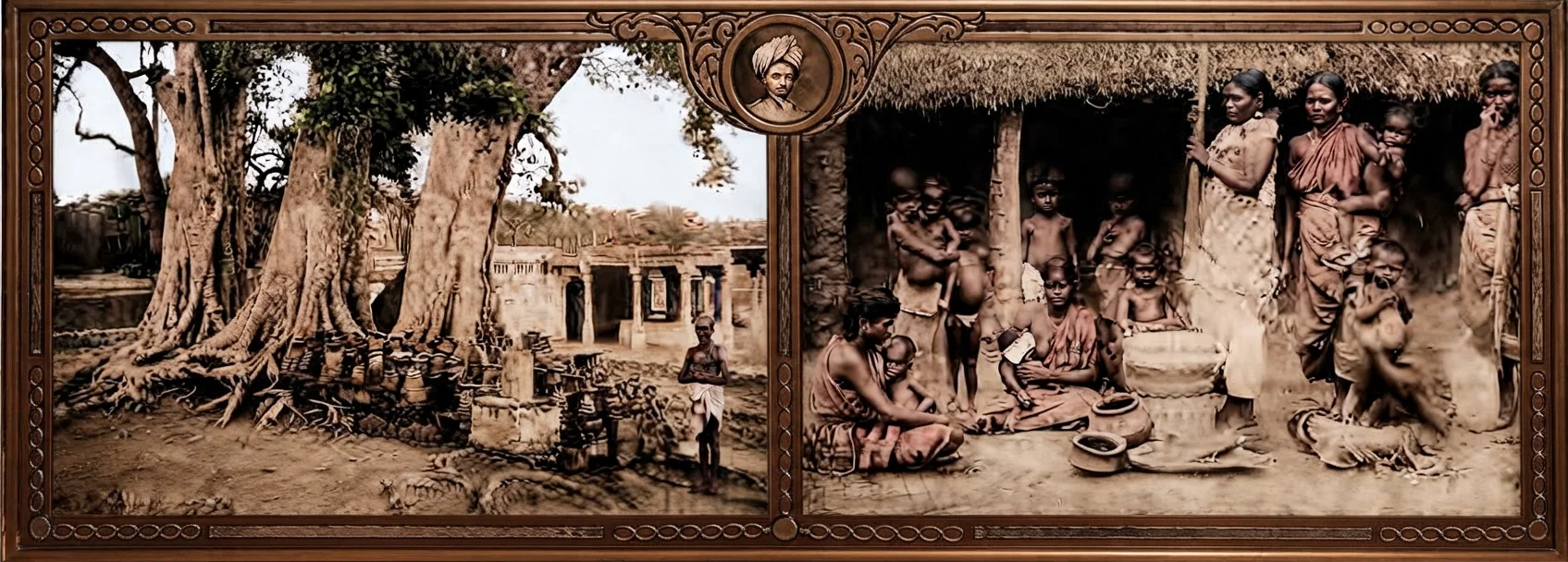
Three "spirit" trees and temple of devil worshipers of South India. Worship of this class is one of the most pitiful of superstitions. Typical group of Tamil people of the poorer class living in one house in the village of Nazareth, South India.
I was greatly pleased with the work done at this station. For two or three years, almost the entire work has been carried on by our Tamil brethren, no European being on the place. Brother E. D. Thomas is in charge, and is assisted by seven teachers, five of whom are our own baptized members. Brother Thomas and his assistants have all embraced the message since Brother James began work in Nazareth seven years ago.
As nearly as I could judge, these teachers are doing excellent work. The students are Hindus, Roman Catholics, Anglicans and other Protestants, while some have no religion. Yet with this medley, we found a strong spiritual influence pervading the school. Thirteen of these students have given their hearts to the Lord and united with the church. They are earnest, wide-awake young missionaries. Every month, they are allowed to go out to the villages to sell papers and tracts. Sometimes they walk twenty miles doing this work. They are making a good impression in all that region, and men are bringing their boys from all directions to place them in the school. When I was there, two men came from villages miles away in opposite directions, to see about getting their boys into the school.
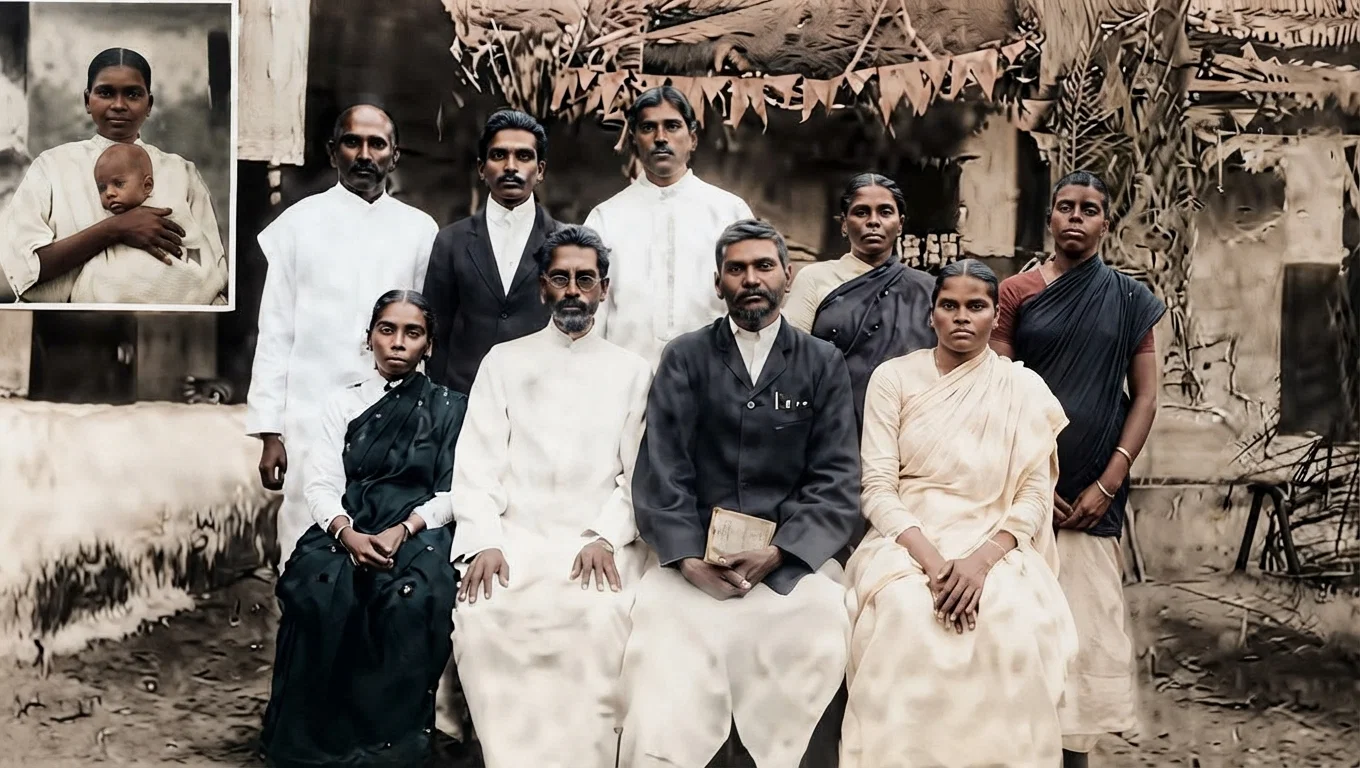
Group of our Tamil workers in charge of the Nazareth mission school, South India. Brother E. D. Thomas, superintendent of the mission, with his wife, are seated at the right. They are natives of India, and were carved out of raw heathenism by the gospel. Sister Thomas, with her first baby, is shown in the upper left-hand corner.

SACRIFICING TO HELP

During the week of prayer, some of these Christian boys gave a part of the rice allowed for their daily food, in order to make offerings to foreign missions. They denied themselves the food they really needed for their growth and work.
None of these boys use tobacco in any form, and they have abandoned everything that savors of heathenism. The girls who have become Christians have shown the same zeal. They have done what is probably the hardest thing for a girl in India to do—taken off all their jewelry,—bracelets, finger rings, neck rings, anklets, toe rings, and all. The ears of some were so disfigured by the heavy rings hanging in them from infancy, that it was necessary to perform surgical operations to restore them to something approaching their natural condition. All this they have done for their Lord and Master. They are good girls, who will make good wives for the Christian boys who are preparing for missionary service.
In an address presented to us by the faculty of the school on the occasion of our visit, they said:
"The object of this work is to lay a true foundation, in the lives of the students, for a future Christian building; to teach them the special truths for which we as a people have been called into existence; to encourage them to practice these truths, and to spread them throughout the sphere of their influence; to develop a thorough Christian experience, and beget in them a lasting desire to become earnest workers for the Lord in carrying this message to the millions of South India.
"Believing the Scriptures to be the foundation of all true education, and recognizing its importance in a school curriculum, much emphasis is placed on the teaching of the Bible. We have already seen some of the results of our efforts in this direction.

Travel Conveniences in India

(Continued from page 2) Of our students, thirteen have been baptized. One boy has connected with the office work at Trichinopoli; another boy has taken up duties in the school while continuing his education, and others are being prepared to take up responsible work in connection with this cause at an early period.
We also see a great change for the better in the lives of the Hindu children of our school."
The church membership at this station is close to 70, with a Sabbath school of 135. They are faithful in the payment of tithes and offerings for the support of the cause. The total amount paid in 1913 was $260; and in 1914, $400. This is not a large amount; but they are poor people, and it means much to them.
It was surely a great privilege to visit these dear fellow believers, who are so happy and earnest in the truth. I could but wish that we had hundreds of such stations scattered over India.

ENTERING A FRENCH SETTLEMENT

In August of last year, work was begun in Pondicherry, a French settlement on the coast about one hundred miles below Madras. Brother and Sister V. E. Peugh and a Tamil brother located here to follow up an interest that had been awakened. In November, Brother James visited this place, and baptized seven believers — four men and three women. Others are being taught and prepared for baptism.
Brother and Sister Morrow, who came to India last year, have located in Bangalore. They are studying the Tamil language, with a view to engaging in the vernacular work.
All the workers in the South India Mission, and in all India as well, were delighted to have Brother and Sister Lowry return. They will begin work in a new center. Brother Lowry has a good knowledge of the Tamil language. He loves the field, and it is believed his work will be blessed to the salvation of many souls.
At the recent biennial conference, it was decided to establish the headquarters of the South India Mission in the city of Madras. This will enable Pastor James to carry on evangelistic work among the European people.

THE STUPENDOUS TASK

The task in this mission field alone is stupendous. Besides the 17,000,000 people speaking Tamil, there are 20,000,000 who speak Telugu. Although no direct effort has yet been made by us for the Telugu people, a few have embraced the message and united with us. Great opportunities are now in sight among these people, and we must begin work for them without delay. Plans are laid to have a couple located among the Telugus before this year closes.
Then there is Ceylon with its millions. Every worker in India feels that Ceylon should be entered now. It should be made a separate mission division under permanent leadership. We hope to have a couple located in Colombo in a few months.
Knowing the value of literature in this work, Brother and Sister James are struggling hard to produce and circulate papers and tracts in the five different languages spoken in their field. But their facilities and physical powers seem so limited for this great task! How terribly we need workers and means for this stupendous undertaking! If ever the church of God should pray the Lord to send forth laborers into the field, it is now.

THE IMPARTIAL REWARD

He Who Came in Last, Received the Full Benefits — Selfishness and the Love of Supremacy — Jealousy Rebuked

By MRS. E. G. WHITE
“THE kingdom of heaven is like unto a man that is an householder, which went out early in the morning to hire laborers into his vineyard.” Matt. 20: 1. It was the custom for men seeking employment to wait in the market places, and thither the employers went to find servants. The man in the parable is represented as going out at different hours to engage workmen. Those who are hired at the earliest hours agree to work for a stated sum; those hired later leave their wages to the discretion of the householder.
“So when even was come, the lord of the vineyard saith unto his steward, Call the laborers, and give them their hire, beginning from the last unto the first. And when they came that were hired about the eleventh hour, they received every man a penny. But when the first came, they supposed that they should have received more; and they likewise received every man a penny.” Verses 8-10.

HIGHER THAN THE HUMAN STANDARD

The householder’s dealing with the workers in his vineyard represents God’s dealing with the human family. It is contrary to the customs that prevail among men. In worldly business, compensation is given according to the work accomplished. The laborer expects to be paid only that which he earns. But in the parable, Christ was illustrating the principles of His kingdom,—a kingdom not of this world. He is not controlled by any human standard. The Lord says, “My thoughts are not your thoughts, neither are your ways My ways. . . . For as the heavens are higher than the earth, so are My ways higher than your ways, and My thoughts than your thoughts.” Isa. 55: 8, 9.
In the parable the first laborers agreed to work for a stipulated sum, and they received the amount specified, nothing more. Those later hired believed the master’s promise, “Whatsoever is right, that shall ye receive.” They showed their confidence in him by asking no question in regard to wages. They trusted to his justice and equity. They were rewarded, not according to the amount of their labor, but according to the generosity of his purpose.

HIS KINDNESS FILLED THEM WITH JOY

Not the amount of labor performed, or its visible results, but the spirit in which the work is done, makes it of value with God. Those who came into the vineyard at the eleventh hour were thankful for an opportunity to work. Their hearts were full of gratitude to the one who had accepted them; and when at the close of the day the householder paid them for a full day’s work, they were greatly surprised. They knew they had not earned such wages. And the kindness expressed in the countenance of their employer filled them with joy. They never forgot the goodness of the householder, or the generous compensation they had received.
Thus it is with the sinner, who, knowing his unworthiness, has entered the Master’s vineyard at the eleventh hour. His time of service seems so short, he feels that he is undeserving of reward; but he is filled with joy that God has accepted him at all. He works with a humble, trusting spirit, thankful for the privilege of being a coworker with Christ. This spirit God delights to honor.

THE REWARD NOT UPPERMOST

The Lord desires us to rest in Him without a question as to our measure of reward. When Christ abides in the soul, the thought of reward is not uppermost. This is not the motive that actuates our service. It is true that, in a subordinate sense, we should have respect to the recompense of reward. God desires us to appreciate His promised blessings. But He would not have us eager for rewards, nor feel that for every duty we must receive compensation. We should not be so anxious to gain the reward as to do what is right, irrespective of all gain. Love to God and to our fellow men should be our motive.
This parable does not excuse those who hear the first call to labor, but who neglect to enter the Lord’s vineyard. When the householder went to the market place at the eleventh hour, and found men unemployed, he said, “Why stand ye here all the day idle?” The answer was, “Because no man hath hired us.” None of those called later in the day were there in the morning. They had not refused the call. Those who refuse and afterward repent, do well to repent; but it is not safe to trifle with the first call of mercy.
When the laborers in the vineyard received “every man a penny,” those who had begun work early in the day were offended. Had they not worked for twelve hours? they reasoned, and was it not right that they should receive more than those who had worked for only one hour in the cooler part of the day? “These last have wrought but one hour,” they said, “and thou hast made them equal unto us, which have borne the burden and heat of the day.” Matt. 20: 12.

“I DO THEE NO WRONG”

“Friend,” the householder replied to one of them, “I do thee no wrong: didst not thou agree with me for a penny? Take that thine is, and go thy way: I will give unto this last, even as unto thee. Is it not lawful for me to do what I will with mine own? Is thine eye evil, because I am good?”
“So the last shall be first, and the first last: for many be called, but few chosen.” Verses 13-16.
The first laborers of the parable represent those who, because of their services, claim preference above others. They take up their work in a self-gratulatory spirit, and do not bring into it self-denial and sacrifice. They may have professed to serve God all their lives; they may have been foremost in enduring hardship, privation, and trial, and they therefore think themselves entitled to a large reward. They think moreof the reward than of the privilege of being servants of Christ. In their view their labors and sacrifices entitle them to receive honor above others, and because this claim is not recognized, they are offended. Did they bring into their work a loving, trusting spirit, they would continue to be first; but their querulous, complaining disposition is unchristlike, and proves them to be untrustworthy. It reveals their desire for self-advancement, their distrust of God, and their jealous, grudging spirit toward their brethren. The Lord's goodness and liberality is to them only an occasion of murmuring. Thus they show that there is no connection between their souls and God. They do not know the joy of cooperation with the Master worker.

NARROWNESS AND SELF-CARING OFFENSIVE

There is nothing more offensive to God than this narrow, self-caring spirit. He cannot work with any who manifest these attributes. They are insensible to the working of His Spirit.
Christ warned the disciples who had been first called to follow Him, lest the same evil should be cherished among them. He saw that the weakness, the curse of the church, would be a spirit of self-righteousness. Men would think they could do something toward earning a place in the kingdom of heaven. They would imagine that when they had made certain advancement, the Lord would come in to help them. Thus there would be an abundance of self, and little of Jesus. Many who had made a little advancement would be puffed up, and think themselves superior to others. They would be eager for flattery, jealous if not thought most important. Against this danger Christ seeks to guard His disciples. The reward is not of works, lest any man should boast; but it is all of grace.

THE FIRST SHOULD WELCOME THE LAST

The first and the last are to be sharers in the great, eternal reward, and the first should gladly welcome the last. He who grudges the reward to another, forgets that he himself is saved by grace alone. The parable of the laborers rebukes all jealousy and suspicion. Love rejoices in the truth, and institutes no envious comparisons. He who possesses love, compares only the loveliness of Christ and his own imperfect character.
This parable is a warning to all laborers, however long their service, however abundant their labors, that without love to their brethren, without humility before God, they are nothing.
It is not the length of time we labor, but our willingness and fidelity in the work, that makes it acceptable to God. In all our service a full surrender of self is demanded. The smallest duty done in sincerity and self-forgetfulness, is more pleasing to God than the greatest work when marred with self-seeking. He looks to see how much of the spirit of Christ we cherish, and how much of the likeness of Christ our work reveals. He regards more the love and faithfulness with which we work than the amount we do.

WHEN SELFISHNESS IS DEAD

Only when selfishness is dead, when strife for supremacy is banished, when gratitude fills the heart, and love makes fragrant the life,—it is only then that Christ is abiding in the soul, and we are recognized as laborers together with God.
Not in our learning, not in our position, not in our numbers or intrusted talents, not in the will of man, is to be found the secret of success. Feeling our inefficiency, we are to contemplate Christ, and through Him who is the strength of all strength, the thought of all thought, the willing and obedient will gain victory after victory.

THE GREATEST CANNOT BUY IT — THE HUMBLEST MAY RECEIVE IT

And however short our service or humble our work, if in simple faith we follow Christ, we shall not be disappointed of the reward. That which even the greatest and wisest cannot earn, the weakest and most humble may receive. Heaven's golden gate opens not to the self-exalted. It is not lifted up to the proud in spirit. But the everlasting portals will open wide to the trembling touch of a little child. Blessed will be the recompense of grace to those who have wrought for God in the simplicity of faith and love.

The Dead Past and the Living Present

“Forgetting those things which are behind, and reaching forth unto those things which are before.” Phil. 3: 13.
WHY mourn for the mercies we’ve scorned in the past? Why weep that we journey life’s desert alone? Why lament that the roses eluded our grasp, While the thorns were our lot through some fault of our own?
Why weep for the blessings that vanished with years? That sunshine was darkened when fell the sad rain? Why add to our darkness the blur of our tears, And fill up our hearts with the anguish of pain?
All our weeping, life seasons can never restore. Past daisies no longer look up to the skies. The roses once perished shall bloom nevermore. No more life for the love that is scorned till it dies.
But the present—its pages press close to our face, Fair, white, and unsullied, for mortals to write. Shall we trace there a record of angelic grace, Or mar its fair pages with darkness of night?
Ah, the present—what conflicts, what victories to win! Then, brother, be valiant, and arm for the fray. What grand deeds for Jesus, what battles with sin, What loving acts done, may be yours for to-day! L. D. SANTEE.
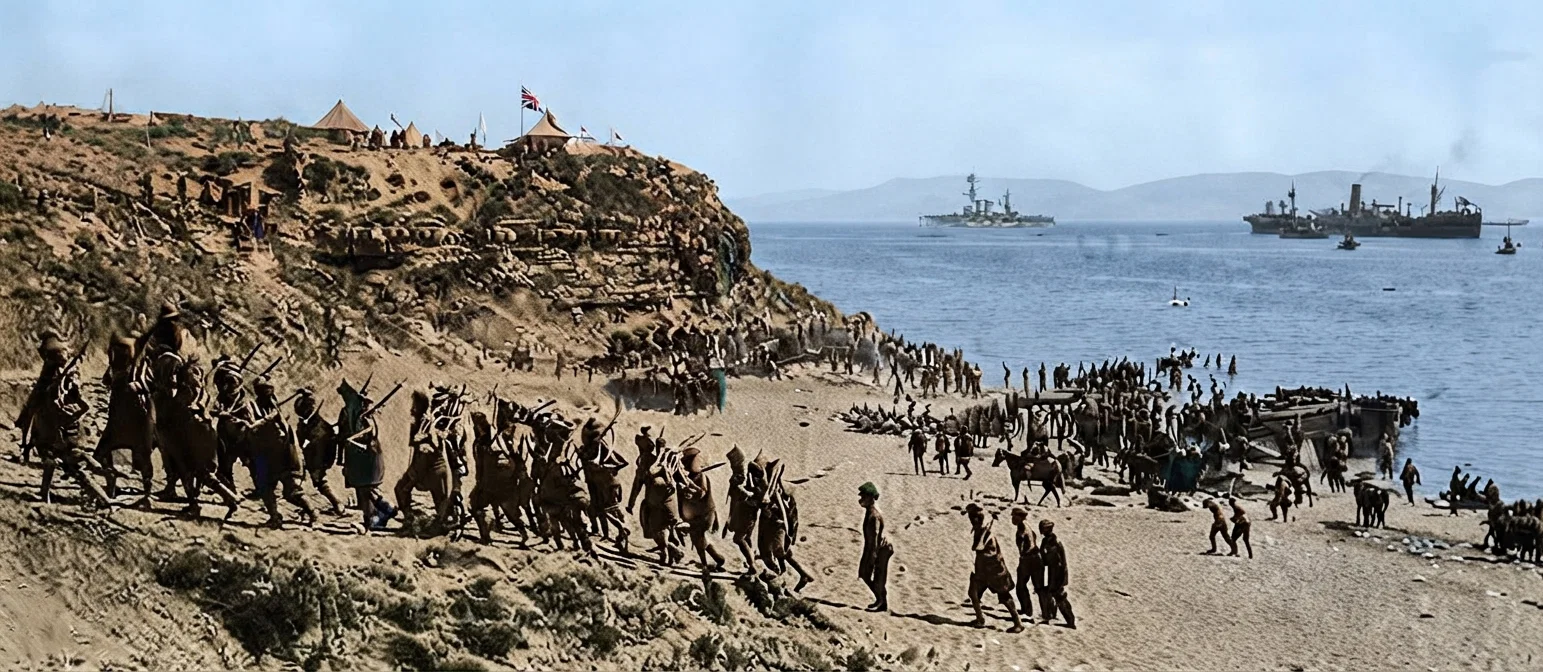
ALLIES LANDING AT THE DARDANELLES UNDER COVER OF GUNS OF THE BATTLESHIPS

THE FALL OR THE RESURRECTION OF THE TURK

Definite Points in Turkish History — How They Fulfill Prophecy
By ALBERT M. DART
IT is an evidence of God's love for the human family, that in the last days of earth's history, events attracting the attention of all the world most strikingly fulfill prophecy. The Ottoman empire is notably illustrative of this point.

THE WHOLE WORLD INVOLVED

Mr. Ed. Tallichet, editor of the French magazine Bibliothèque Universelle, published at Lausanne, in writing upon "Fall or Resurrection of the Ottoman Empire, Which?" at the time the Young Turks came to the front a few years ago, said:
"The above question applies not only to Turks, but to the entire world; for the present crisis contains the winding up of all that has occurred since the beginning of the Christian era. . . . Constantinople has become again what it was for a long time, the center and pivot of the world. . . . The recent Turkish revolution has entirely changed the political situation of the world — not only of the Mediterranean world, but of the universe."

ONE OF THE LAST MOVES ON EARTH

Dear reader, do you know that the exit of the Turk from Europe is one of the last moves among nations before the second advent of Christ and the end of the world?
Prophecy makes this fact plain. And as Mr. Tallichet says — and his statement is confirmed by many other statesmen of repute and by fact — the whole world is involved in the Turkish problem. Therefore in Turkish history to-day, viewed from the standpoint of Bible prophecy, the whole world is warned of God of the end of the world.
With what concern, then, does the student of prophecy look upon the fierce bombarding of the Dardanelles and the preparation of the Turk to leave Constantinople?
We will now further consider the points in Turkish history mentioned in our last article; namely, the Turk's establishment as an independent power; the loss of his independence; his expulsion from Europe; and his establishment at Jerusalem, where he comes to his end.

THAT "SINGULARLY ACCURATE" DATE

"A nail in a sure place" is found in the statement of the historian Gibbon where he says that Othman invaded the territory of Nicomedia July 27, 1299, and pronounces it a singularly accurate date.
For 150 years from this date, the attacks of the Mohammedans on Constantinople fulfilled the prophecy of the fifth trumpet, — the first woe trumpet of Revelation 9, which states that their power was to hurt men five months.
The prophecy also says that "they had a king over them, . . . whose name in the Hebrew tongue is Abaddon, but in the Greek tongue hath his name Apollyon ["a destroyer," margin]."
Othman had organized the roving bands of Saracens, and they went forth in their characteristic destructive manner.
Five months — 150 years — from Gibbon's singularly accurate date, July 27, 1299, brings us to July 27, 1449, at which time the Greek emperor having died, his brother Constantine ascended the throne only by consent of Amurath, the Turkish sultan. Thus was Constantinople virtually in the hands of the Turks, and the "destroyer" went forth not only to "hurt men" but to slay.
And now the prophecy points out the period of Ottoman supremacy, "an hour, and a day, and a month, and a year."
A year is 360 days. A day for a year, prophetic time, would be 360 years; a month, on the same reckoning, would be 30 years; a day, one year; and an hour, 15 days, — all amounting to 391 years and 15 days. Ottoman supremacy began July 27, 1449. 391 years and 15 days from this date would reach to August 11, 1840.

FULFILLED TO THE DAY

This date marks the end of Ottoman supremacy, in accordance with the prophecy — another of the interesting points in Turkish history.On August 11, 1840, the sultan of Turkey surrendered his independence to England, Russia, Austria, and Prussia, who had undertaken the settlement of difficulties existing between Egypt and Turkey.
An ultimatum had been drawn up by these powers, and placed in the hands of the sultan of Turkey on the very date above named. Just prior to 1840, students of prophecy had taken the position that the Turk would lose his independence on that date, and they so published it to the world. Thus the world, at this point, had an opportunity to see the hand of God in Turkish history.

HIS EXPULSION FROM EUROPE

The next point of special interest is his expulsion from Europe. Prophetic information on this point is found in the eleventh chapter of Daniel. No extended study of the prophecy is possible in this article, only allusion to prominent points.
In the first part of the chapter, Persian and Grecian history is briefly sketched by the angel. The work of Alexander the Great is thus mentioned:
"And a mighty king shall stand up, that shall rule with great dominion, and do according to his will. And when he shall stand up, his kingdom shall be broken, and shall be divided toward the four winds of heaven; and not to his posterity, nor according to his dominion which he ruled: for his kingdom shall be plucked up, even for others beside those." Dan. 11: 3, 4.
This prophecy was fulfilled in the division of Alexander's kingdom, after his death, among his four generals, who fell to quarreling, the territory eventually being divided between what prophecy mentions as the "king of the north" and the "king of the south."

KINGS OF NORTH AND SOUTH

Territorial lines indicated the kingdom. The occupant of Constantinople and adjacent countries is denominated by the angel "the king of the north"; of Egypt, "the king of the south."
Since the Turk to-day is in possession of Constantinople, he is the prophetic "king of the north," of whom the prophecy says: "But tidings out of the east and out of the north shall trouble him: therefore he shall go forth with great fury to destroy, and utterly to make away many. And he shall plant the tabernacles of his palace [seat of government] between the seas in the glorious holy mountain [Jerusalem]: yet he shall come to his end, and none shall help him." Dan. 11: 44, 45. Here the expulsion of the Turk from Europe and his establishment at Jerusalem are pointed out.

DELIVERANCE COMES THEN

All will see that this cannot occur without much trouble — world-wide trouble. This is also mentioned by the prophet: "And at that time shall Michael stand up, the great Prince [Christ] which standeth for the children of thy people: and there shall be a time of trouble, such as never was since there was a nation even to that same time." Dan. 12: 1.
O, to be delivered at such a time! What nation will unfurl her banners for our safety? What flag shall we seek? All nations are involved in the deadly conflict. The horrors of war, with modern possibilities for destroying men's lives, make the stoutest heart shudder. Whither shall we flee?
Listen, reader: "And at that time thy people shall be delivered, every one that shall be found written in the book."
The awful day is near. It would almost seem that complications and rapid developments might rush us on to the last great battle with no more than a brief cessation of war. Are the arms of the Saviour thrown around you in shelter? Can He write your name in His book? — Not if you are at variance with His law; for in that blessed land to which the delivered go at that time, there are no more tears, sorrow, pain, nor death; and all these are the result of sin — the transgression of God's law.
Never did the truths of prophecy stand out more clearly than to-day. Can we meet, at the Judgment bar, Him who died for us, and say we did not know?
The din of battle around Constantinople, viewed by the spirit of prophecy, says in tones louder than cannon's roar, "Prepare to meet thy God."
Continue reading: The Infallible Source of Truth