Your ShelfYour Projects

Review and Herald, Vol. 90, No. 7.

Nearing the Reward

Review and Herald

Feb 13, 1913

Review and Herald Publishing Association · Washington, D. C. · Feb 13, 1913

Nearing the Reward

“There shall be signs in the sun and moon and stars; and upon the earth distress of nations, in perplexity for the roaring of the sea and the billows; men fainting for fear, and for expectation of the things which are coming on the world: for the powers of the heavens shall be shaken. And then shall they see the Son of man coming in a cloud with power and great glory. But when these things begin to come to pass, look up, and lift up your heads; because your redemption draweth nigh. . . . But take heed to yourselves, lest haply your hearts be overcharged with surfeiting, and drunkenness, and cares of this life, and that day come on you suddenly as a snare: for so shall it come upon all them that dwell on the face of all the earth. But watch ye at every season, making supplication, that ye may prevail to escape all these things that shall come to pass, and to stand before the Son of man.”
“Then they that feared Jehovah spake one with another; and Jehovah harkened, and heard, and a book of remembrance was written before Him, for them that feared Jehovah, and that thought upon His name. And they shall be Mine, saith Jehovah of hosts, even Mine own possession, in the day that I make; and I will spare them, as a man spareth his own son that serveth him.”

“Tea and Coffee” and “Deep Breathing” Number

$1.00 a Year                10 Cents a Copy

MARCH FEATURES

What to Do First Consumption a Curable Disease The Hygiene of Deep Breathing How to Feed the Sick Prostituted Periodicals Education and Health Saloon Versus Safe Travel How to Make Good Soups
Chronic Rheumatism Your Children’s Teeth Archery for Health The Farm Baby: Remedies—  Contagious Diseases Are Tea and Coffee Harmful? Help the Man Lower Down Chronic Appendicitis
Try selling this “Tea and Coffee” and “Deep Breathing” number in your neighborhood. Our agents make from $2.00 to 5.00 a day.
Earn your own subscription by sending us two yearly subscriptions at $1.00 each.

ORDER THROUGH OUR NEAREST AGENCY

(If you do not know the address of our Agency, ask “Life and Health,” Washington, D. C.)
PRICES, POST-PAID Yearly subscription                $1.00 Six months                    .50 (Subscriptions for less than six months not accepted) Three years (or 3 subs. 1 year)          2.00 Five years (or 5 subs. 1 year)          3.00 Five copies, one year, to one or more addresses   3.00
NO EXTRA CHARGE ON FOREIGN SUBSCRIPTIONS
NATURAL BRIDGE, VIRGINIA

“THE END JUSTIFIES THE MEANS”

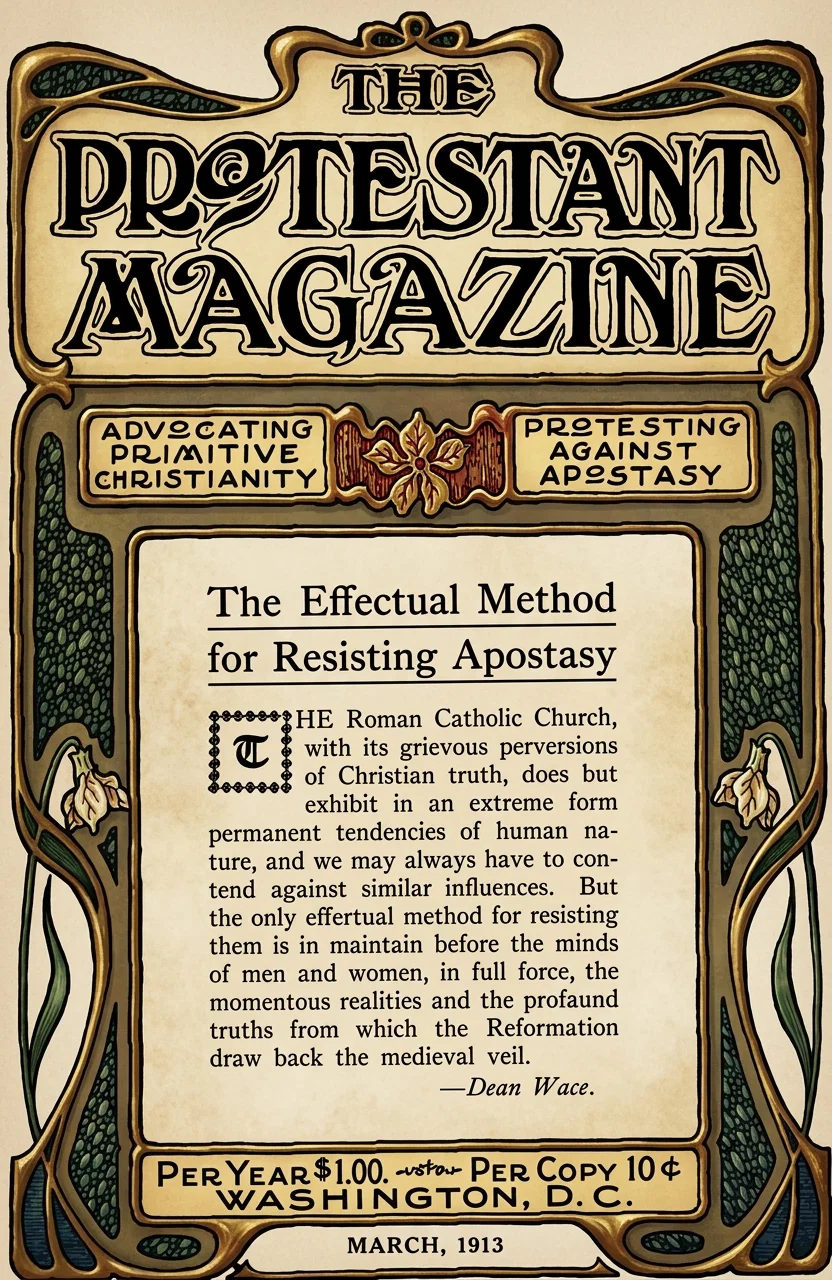
Rome's Policy Proved By Court Records!

In the March, April, May, and succeeding numbers will appear the startling court record concerning “A Convent Tragedy,” also other records of Rome's policy of KIDNAPING CHILDREN, from the times of the Waldenses (1100 A. D.), before the word “Protestant” was known, until now.

WHERE ARE THE PROTESTANTS?

Where are the Protestants in America? The very name “Protestant” itself was repudiated by the so-called “Protestant” Federal Council of Churches in Chicago, Ill., Dec. 5, 1912, on the plea that it is “a word that is NOT A UNITING BUT A DIVIDING WORD,—a word that recalls a most unhappy and trying experience.” One of the delegates argued thus: “By using this word you make it more difficult for many of your Christian brethren to work with you.” This action was taken to express the “earnest hope” for the “FELLOWSHIP OF CATHOLIC UNITY.” “Then,” says an eye-witness, “the report was promptly and unanimously adopted, and with applause.”

Show Your Protestantism By

Sending the PROTESTANT MAGAZINE to Your Friends

BE A SUBSCRIBER. You can earn your own subscription by sending us two yearly subscriptions accompanied by $2.00—three for $2.00.
TO TEN FRIENDS. You can send $3.00 for 10 six months' (or 5 yearly) subscriptions, in behalf of your friends. These will be sent to as many different names (your own included) as desired, or all to one address. Hundreds send 5, 10, and 20 subscriptions, others as many as 300, in a single letter.
BE OUR AGENT. You can become our agent for your locality, and purchase from 5 to 1,000 copies every month at the wholesale rates: 5 to 40 copies ordered at one time, cash with order, 5 cents a copy; 50 or more copies, 4 cents a copy.
Only a very few more subscriptions can be started with the January number.

ORDER THROUGH OUR NEAREST AGENCY

(If you do not know the address of our Agency, ask the “Protestant Magazine,” Washington, D. C.)

Our Children and Youth Demand Our Care

MRS. E. G. WHITE
There has been altogether too little attention paid to our children and youth, and they have failed to develop as they should in the Christian life, because the church-members have not looked upon them with tenderness and sympathy, desiring that they might be advanced in the divine life.
In our large churches very much might be done for the youth. Shall they have less special labor, or shall fewer inducements be held out to them to become full-grown Christians—men and women in Christ Jesus—than were afforded them in the denominations which they must have left for the truth’s sake? Shall they be left to drift hither and thither, to become discouraged, and to fall into temptations that are lurking everywhere to catch their unwary feet? If they err and fall from the steadfastness of their integrity, do the members of the church who have neglected to care for the lambs, censure and blame them, and may magnify their failures? Are their shortcomings talked of and exposed to others, and are they left in discouragement and despair?
The work that lies next to our church-members is to become interested in our youth; for they need kindness, patience, tenderness, line upon line, precept upon precept. O, where are the fathers and mothers in Israel? There ought to be a large number who are stewards of the grace of Christ, who feel not merely a casual but a special interest in the young. There ought to be those whose hearts are touched by the pitiable situation in which our youth are placed, and who realize that Satan is working by every conceivable device to draw them into his net.
God requires that the church arouse from her lethargy, and see what is the manner of service demanded of her at this time of peril. The lambs of the flock must be fed. The Lord of heaven is looking on to see who is doing the work he would have done for the children and youth. The eyes of our brethren and sisters should be anointed with heavenly eye-salve, that they may discern the necessities of the time. We must be aroused to see what needs to be done in Christ’s spiritual vineyard, and go to work.

A Liberal Education to Be Provided

As a people who claim to have advanced light, we are to devise ways and means by which to bring forth a corps of educated workmen for the various departments of the work of God. We need a well-disciplined, cultivated class of young men and women in our sanitariums, in the medical missionary work, in the offices of publication, in the conferences of different States, and in the field at large. We need young men and women who have high intellectual culture, in order that they may do the best work for the Lord. We have done something toward reaching this standard, but still we are far behind where we should be.
As a church, as individuals, if we would stand clear in the judgment, we must make more liberal efforts for the training of our young people, that they may be better fitted for the various branches of the great work committed to our hands. We should lay wise plans, in order that the ingenious minds of those who have talent may be strengthened and disciplined, and polished after the highest order, that the work of Christ may not be hindered for lack of skilful laborers who will do their work with earnestness and fidelity.

All to Be Trained

The church is asleep, and does not realize the magnitude of this matter of educating the children and youth. “Why,” says one, “what is the need of being so particular to educate our youth thoroughly? It seems to me that if you take a few who have decided to follow a literary calling or some other calling that requires a certain discipline, and give due attention to them, that is all that is necessary. It is not required that the whole mass of our youth be so well trained. Will not this answer every essential requirement?” I answer, No, most decidedly not.
What selection should we be able to make out of the numbers of our youth? How could we tell who would be the most promising, who would render the best service to God? In our judgment we might do as did Samuel when he was sent to find the anointed of the Lord, and look upon the outward appearance. When the noble sons of Jesse passed before him, and his eye rested upon the handsome countenance and fine stature of the eldest son, to Samuel it seemed that the anointed of the Lord was before him. But the Lord said to him, “Look not on his countenance, or on the height of his stature; because I have refused him: for the Lord seeth not as man seeth; for man looketh on the outwardappearance, but the Lord looketh on the heart.” Not one of these noble-looking sons of Jesse would the Lord accept. But when David, the youngest son, a mere youth, was called from the field, and passed before Samuel, the Lord said, “Arise, anoint him: for this is he.” 1 Sam. 16: 7, 12.
Who can determine which one of a family will prove to be efficient in the work of God? There should be general education of all its members, and all our youth should be permitted to have the blessings and privileges of an education at our schools, that they may be inspired to become laborers together with God. They all need an education, that they may be fitted for usefulness, qualified for places of responsibility in both private and public life. There is a great necessity of making plans that there may be a large number of competent workers, and many should fit themselves as teachers, that others may be trained and disciplined for the great work of the future.

A Fund for School Work

The church should take in the situation, and by their influence and means seek to bring about this much-desired end. Let a fund be created by generous contributions for the establishment of schools for the advancement of educational work. We need men well trained, well educated, to work in the interests of the churches. They should present the fact that we can not trust our youth to go to seminaries and colleges established by other denominations, that we must gather them in where their religious training will not be neglected. .

High Aims

God would not have us in any sense behind in educational work. Our colleges should be far in advance in the highest kind of education. If we do not have schools, our youth will attend other seminaries and colleges, and will be exposed to infidel sentiments, to cavilings and questionings concerning the inspiration of the Bible. There is a great deal of talk concerning higher education, and many suppose that higher education consists wholly in an education in science and literature; but this is not all. The highest education includes the knowledge of the Word of God, and is comprehended in the words, “That they might know thee the only true God, and Jesus Christ, whom thou hast sent.” John 17: 3.
The highest class of education is that which will give such knowledge and discipline as will lead to the best development of character, and will fit the soul for that life which measures with the life of God. Eternity is not to be lost out of our reckoning. The highest education is that which will teach our children and youth the science of Christianity, which will give them an experimental knowledge of God’s ways, and will impart to them the lessons that Christ gave to his disciples of the paternal character of God.
“Thus saith the Lord, Let not the wise man glory in his wisdom, neither let the mighty man glory in his might, let not the rich man glory in his riches: but let him that glorieth glory in this, that he understandeth and knoweth me.” Jer. 9: 23, 24. Let us seek to follow the counsel of God in all things; for he is infinite in wisdom. Though we have come short of doing what we might have done for our youth and children in the past, let us now repent, and redeem the time.

The Responsibility of Church-Members

There is no work more important than the education of our youth. I am glad that we have institutions where they can be separated from the corrupting influences so prevalent in the schools of the present day. Our brethren and sisters should be thankful that in the providence of God our colleges have been established, and should stand ready to sustain them by their means. Every influence should be brought to bear to educate the youth and to elevate their morals. They should be trained to have courage to resist the tide of moral pollution in this degenerate age. With a firm hold upon divine power, they may stand in society to mold and fashion, rather than to be fashioned after the world’s model.
When the youth come to our colleges, they should not be made to feel that they have come among strangers who do not care for their souls. We must guard them, fighting back Satan that he shall not take them out of our arms. There should be fathers and mothers in Israel who will watch for their souls as they that must give an account. Brethren and sisters, do not hold yourselves aloof from the youth, as if you had no particular concern or responsibility for them. You who have long professed to be Christians have a work to do, patiently and kindly to lead them in the right way. You should show them that you love them because they are younger members of the Lord’s family, the purchase of his blood.
The future of society will be determined by the youth of to-day. Satan is making earnest, persevering efforts to corrupt the mind and debase the character of every youth; and shall we who have more experience stand as mere spectators, and see him accomplish his purpose without hindrance? Let us stand at our post as minutemen, to work for these youth, and through the help of God to hold them back from the pit of destruction. In the parable, while men slept the enemy sowed tares; and while you, my brethren and sisters, are unconscious of his work, Satan is gathering an army of youth under his banner; and he exults, for through them he carries on his warfare against God.

The Teacher’s Privilege

The teachers in our schools have a heavy responsibility to bear. They must be in words and character what they wish their students to be,—men and women who fear God and work righteousness. If they are acquainted with the way themselves, they can train the youth to walk in it. They will not only educate them in the sciences, but will train them to have moral independence, to work for Jesus, and to take up burdens in his cause.
Teachers, what opportunities are yours! What a privilege is within your reach of molding the minds and characters of the youth under your charge! What a joy it will be to you to meet them around the great white throne, and to know that you have done what you could to fit them for immortality! If your work stands the test of the great day, like sweetest music will fall upon your ears the benediction of the Master, “Well done, thou good and faithful servant: . . . enter thou into the joy of thy Lord.” Matt. 25: 21.
In the great harvest-field there is abundance of work for all, and those who neglect to do what they can, will be found guilty before God. Let us work for time and for eternity. Let us work with all the powers that God has bestowed upon us, and he will bless our well-directed efforts.
The Saviour longs to save the young. He would rejoice to see them around his throne, clothed in the spotless robes of his righteousness. He is waiting to place upon their heads the crown of life, and to hear their happy voices join in ascribing honor and glory and majesty to God and the Lamb in the song of victory that shall echo and reecho through the courts of heaven.

A Song of the Rank and File

ARTHUR W. SPAULDING
Though I be not the Captain, Yet will I bare my sword, And I will be by my Captain's side, Wherever he stand, or wherever he ride, In the battles of the Lord.
For though there were captains many, What would the captains do If there were none of men beside To thrust and parry, to march and ride, And to follow the captains through?
I will not buy with money The right to idle lie; I should scorn to give, in the mask of gold, The proof of a courage I did not hold, Because I feared to die.
But I will give my body, And I will give my hand, And the joy of a heart that is true to the cause, For the King and his grace, the King and his laws, And be one of the King's own band.
And though I should count my silver Into the Captain's chest, It is but to free my good sword-arm, That, naught encumbered when sounds the alarm, I may fight, and fight my best.
And though I be not captain, Yet will I keep my stride, And the burdens bear of pack and sword, To march and to battle for the Lord, Close by my Captain's side.
New Orleans, La.

The Promise of the Spirit

The Holy Spirit—No. 5

The Promise of the Spirit

G. B. THOMPSON
The work of the Spirit of God is not confined wholly to any one age or dispensation. Conversion, or the new birth, is the work of the Holy Spirit. So long as hearts have been changed, the Spirit has been at work. The Old Testament contains many references to the manifestation of the Spirit of God during the time when types and shadows were pointing the people forward to the promised Messiah. At creation “the Spirit of God moved upon the face of the waters.” Gen. 1: 2. Speaking to Noah concerning the flood, which was to destroy man and beast from the earth, the Lord said, “My Spirit shall not always strive with man.” Gen. 6: 3. When the sanctuary was to be built according to a divine pattern, as a dwelling-place for the Most High God, we read of Bezalel, who was among those chosen to build the sanctuary, that God “filled him with the Spirit of God, in wisdom, and in understanding, and in knowledge, and in all manner of workmanship.” Ex. 31: 3. There were others also who were “filled with the spirit of wisdom.” Ex. 28: 3. We read that the “Spirit of the Lord came upon” Gideon, Jephthah, Samson, and many others, enabling them to do great things for God. During the weary wanderings of the children of Israel in the wilderness, their murmurings and rebellion “vexed his Holy Spirit.”
It remains, however, for all the fulness and glorious work of the Holy Spirit in the church to be set forth in the New Testament, where, as the successor and representative of our blessed Lord, the Spirit is seen directing the officers of the church, choosing missionaries, and turning thousands from darkness to light.
A prophet of God some eight centuries before the first advent of Christ foretold the special work of the Spirit, not only at Pentecost, but in the closing work of the gospel as well. “Be glad then, ye children of Zion, and rejoice in the Lord your God: for he hath given you the former rain moderately, and he will cause to come down for you the rain, the former rain, and the latter rain in the first month.” “And it shall come to pass afterward, that I will pour out my Spirit upon all flesh; and your sons and your daughters shall prophesy, your old men shall dream dreams, your young men shall see visions: and also upon the servants and upon the handmaids in those days will I pour out my Spirit.” Joel 2: 23, 28, 29.
It was not, however, till near the close of his earthly ministry that our Lord began to especially emphasize the work of the Holy Spirit. In the “upper room” he had made known to his disciples that he was soon to leave them and return to his Father. John 13: 33, 36. This was a sad hour to them. To comfort their sorrowing hearts, Jesus announced to them the advent of “another Comforter,” or Advocate, who would come and abide with them till the end of the church’s pilgrimage. The special instruction of Jesus at that memorable farewell meeting with his beloved disciples is given in John, chapters 14-16. The sublime prayer with which the solemn gathering was concluded is recorded in the seventeenth chapter. That we may have before us what Jesus said concerning the coming of the Comforter, we shall quote the scriptures containing this instruction:—
“And I will pray the Father, and he shall give you another Comforter, that he may abide with you forever; even the Spirit of truth; whom the world can not receive, because it seeth him not, neither knoweth him: but ye know him; for he dwelleth with you, and shall be in you.” “These things have I spoken unto you, being yet present with you. But the Comforter, which is the Holy Ghost, whom the Father will send in my name, he shall teach you all things, and bring all things to your remembrance, whatsoever I have said unto you.” John 14: 16, 17, 25, 26. “But when the Comforter is come, whom I will send unto you from the Father, even the Spirit of truth, which proceedeth from the Father, he shall testify of me.” John 15: 26. “Nevertheless I tell you the truth; It is expedient for you that I go away: for if I go not away, the Comforter will not come unto you; but if I depart, I will send him unto you. And when he is come, he will reprove the world of sin, and of righteousness, and of judgment: of sin, because they believe not on me; of righteousness, because I go to my Father, and ye see me no more; of judgment, because the prince of this world is judged. I have yet many things to say unto you, but ye can not bear them now. Howbeit when he, the Spirit of truth, is come, he will guide you into all truth: for he shall not speak of himself; but whatsoever he shall hear, that shall he speak: and he will show you things to come. He shall glorify me: for he shall receive of mine, and shall show it unto you. All things that the Father hath are mine: therefore said I, that he shall take of mine, and shall show it unto you.” John 16: 7-15.
The Holy Spirit is here spoken of for the first time under the name of paraclete, the word from which comforter is translated. The significance and beauty of this we shall notice at another time.
Let us notice some of the precious things the Saviour here says of this promised Paraclete:—
  1. He is a comforter, or advocate.
  2. He is the Spirit of truth.
  3. He will dwell with us.
  4. He will be a teacher of righteousness.
  5. He will help us remember the Word.
  6. He will testify, not of himself, but of Christ.
  7. He will convince of sin, of righteousness, and of judgment.
  8. He will guide us into the truth.
  9. He will reveal things to come.
  10. He will glorify Christ.
  11. He will reveal to us the things of God.
Nor is this all the instruction the Saviour gave to his disciples in reference to the coming of the Comforter, or Paraclete. After his resurrection he said to them: “Peace be unto you: as my Father hath sent me, even so send I you. And when he had said this, he breathed on them, and saith unto them, Receive ye the Holy Ghost.” John 20: 21, 22. “And, being assembled together with them, commanded them that they should not depart from Jerusalem, but wait for the promise of the Father, which, saith he, ye have heard of me.” Acts 1: 4.
The fulfilment of this mysterious and wonderful promise of the Father and his Son was seen at Pentecost. Here the disciples, one hundred twenty in number, were “with one accord in one place.” Not one was absent. Heart beat with heart, and prayer mingled with prayer. It was then that the Comforter came in fulfilment of the promise. Suddenly a sound from heaven as of a rushing mighty wind filled the house, “and they were all filled with the Holy Ghost, and began to speak with other tongues, as the Spirit gave them utterance.” Acts 2: 4. When the Spirit manifested himself to Ezekiel, it was with “a voice of a great rushing.” Eze. 3: 12.
What the Spirit was to the church in apostolic days, it may and will be to the church in the closing days of the world’s history. This promise of the Spirit was not for that time alone; it belongs to us as well. “Then Peter said unto them, Repent, and be baptized every one of you in the name of Jesus Christ for the remission of sins, and ye shall receive the gift of the Holy Spirit. For the promise is unto you, and to your children, and to all that are afar off, even as many as the Lord our God shall call.” Acts 2: 38, 39.
“To us to-day, as verily as to the first disciples, the promise of the Spirit belongs. God will to-day endow men and women with power from above, as he endowed those who on the day of Pentecost heard the word of salvation. At this very hour his Spirit and his grace are for all who need them and will take him at his word.”
“Christ declared that the divine influence of the Spirit was to be with his followers unto the end. But the promise is not appreciated as it should be; and therefore its fulfilment is not seen as it might be. The promise of the Spirit is a matter little thought of; and the result is only what might be expected,—spiritual drought, spiritual darkness, spiritual declension and death. Minor matters occupy the attention, and the divine power which is necessary for the growth and prosperity of the church, and which would bring all other blessings in its train, is lacking, though offered in its infinite plenitude.”
“Why do we not hunger and thirst for the gift of the Spirit, since this is the means by which we are to receive power? Why do we not talk of it, pray for it, preach concerning it? The Lord is more willing to give the Holy Spirit to us than parents are to give good gifts to their children. For the baptism of the Spirit every worker should be pleading with God. Companies should be gathered together to ask for special help, for heavenly wisdom, that they may know how to plan and execute wisely. Especially should men pray that God will baptize his missionaries with the Holy Spirit.”—“Testimonies for the Church,” Vol. VIII, pages 20, 21, 22.
The remnant church is almost through the wilderness of sin, and is soon to enter the heavenly Canaan. But dangers threaten her on every side, none perhaps more than that of ease and lukewarmness. She needs at this time the promised power and the outpouring of the Holy Spirit. Surely we should not fail to lay hold of that which will “bring all other blessings in its train.” Without the Spirit there is no life, for “the body without the spirit is dead.” But clothed with the power of the Spirit, she “cometh up from the wilderness, leaning upon her Beloved,” and goes forth “fair as the moon, clear as the sun, and terrible as an army with banners.”
The result of a vital connection between the eternal Spirit and the machinery of the church, has been graphically stated in the following language:—
“Suppose we saw an army sitting down before a granite fort, and they told us that they intended to batter it down, we might ask them, ‘How?’ They point to a cannon-ball. Well, but there is nopower in that; it is heavy, but not more than half a hundredweight, or perhaps a hundredweight. If all the men in the army hurled it against the fort, they would make no impression. They say, ‘No, but look at the cannon.’ Well, there is no power in that. A child may ride upon it, a bird may perch in its mouth: it is a machine, and nothing more. ‘But look at the powder.’ Well, there is no power in that; a child may spill it, a sparrow may peck it, yet this powerless powder and powerless ball are put into the powerless cannon. One spark of life enters it, and then in the twinkling of an eye that powder is a flash of lightning, and that ball a thunderbolt which smites as if it had been sent from heaven. So it is with our church-machinery at this day. We have all the instruments necessary for pulling down strongholds; and, O, for the baptism of fire!”—Quoted in “The Mission of the Spirit,” page 151.

Avoiding Debts

T. E. BOWEN
THERE are many practices of the world which become so familiar to the people of God that the danger is that, little by little, we shall forsake the high principles of the Bible, designed by the Lord to preserve his people in these last days, and enter upon that for which there is no Bible authority. One of these common things to be avoided is that of becoming involved in debt. In these days there are national debts of almost incomprehensible sums; there are State debts, city debts, corporation debts, and individual debts.

Recklessly Borrowing Money

So long as some men can borrow money they think apparently nothing of it. Upon this borrowed money, fine clothing, an automobile, or anything to make a fine appearance, is indulged in, with little thought, apparently, of a severe pay-day coming. Graft, embezzlement, or theft may be the next step, to meet the day of settlement, rather than break the caste this high living has made. These failing, many resort to putting an end to their troubles by committing suicide.

Christ's Example in Providing for His Work

But what about the Christian, the follower of the lowly Christ? What course should he pursue in these days of fast living? Is there anything in the life of Christ that would lead us to enter upon these things so common in the world? While he said he had no place to call his own, unlike the little birds or the foxes, yet at the end of three and one-half years of earnest, aggressive, heaven-appointed work, during which time there were associated with him quite a band of men, and an active interest was taken in assisting the poor, we learn of no debts resting upon the new cause of God just started in the earth.
Whatever trials the disciples were called upon to bear while the Master hung upon the cross, we learn from the record of no financial obligations resting upon the little band. Somehow Jesus provided for each need of the growing cause beforehand. No debt accrued. Necessary things were provided as they went along, so at the end of Jesus' life, after committing his mother to John to be tenderly cared for, the Son of God went out of this world with nothing laid up in store, and with no unpaid obligations resting upon him.

Christ's Method Continued in the Early Church

As the church increased, this principle of looking to God to provide for the things needful seems to have been the one governing the believers. Those with means were added to the church, and when a time of need came, possessions were sold, and the money was used to provide for the necessities of the believers. This was at Jerusalem. Later, contributions were taken among the Gentiles by Paul to help the Christians in Judea in time of famine. And then as a missionary Paul worked with his own hands making tents, other associate laborers no doubt joining, to provide for their own and others' temporal needs. And so inwrought became this principle in Paul's life that by inspiration he left on record these words: “Render therefore to all their dues: tribute to whom tribute is due; custom to whom custom; fear to whom fear; honor to whom honor. Owe no man anything, but to love one another: for he that loveth another hath fulfilled the law.” Rom. 13:7, 8.

Lesson From Paul's Example

Paul's example, as one of the first missionaries commissioned by the Holy Ghost to go with the gospel to the Gentiles, establishing as he did the work of God in lands outside of Palestine, indicates that he lived within his income. Whether at some period in his life he received a stated amount from the funds of the church or not, one thing is sure—that, as one would avoid the leprosy, he avoided debt. He writes: “Not that I speak in respect of want: for I have learned, in whatsoever state I am, therewith to be content. I know both how to be abased [by being in actual need, so considered by the world], and I know how to abound: everywhere and in all things I am instructed both to be full and to be hungry, both to abound and to suffer need.” Phil. 4:11, 12. Paul lived within his income. And if that income was small, he says he had learned how to cut down his expenses accordingly—even though he “be hungry.” Paul's credit possibly was such that he might have borrowed of some one to help him out. But this is not recorded. Having himself thus lived, he could point out to others this safe pathway of faith and trust in God: “But my God shall supply all your need [note it is not ambition nor wants] according to his riches in glory by Christ Jesus.” Verse 19.

Incurring Debts by Instalments

That which applies to the individual certainly applies to the Christian home. In order for the father and mother to live within their means, and not become involved in debt, many things to be desired and some things perhaps greatly needed, must be denied themselves. In these days when almost everything can be bought upon the instalment plan, and great inducements are held out to do so, it means the exercise of strict self-denial not to become greatly involved in debt. And the family that keeps from debt ought to be commended for having accomplished a good piece of financiering. And if any are so fortunate as to own little homes, be they ever so humble, and be free from debt, they are truly better off than many kings and queens.
Continue reading: CLARENCE SANTEE