Your ShelfYour Projects

Signs of the Times, Vol. 39, No. 27.

The Beatitudes

Signs of the Times

Jul 16, 1912

Pacific Press Publishing Association · Mountain View, Cal. · Jul 16, 1912

The Beatitudes

AND He [Jesus] . . . taught them, saying,
Blessed are the poor in spirit: For theirs is the kingdom of heaven.
Blessed are they that mourn: For they shall be comforted.
Blessed are the meek: For they shall inherit the earth.
Blessed are they which do hunger and thirst after righteousness: For they shall be filled.
Blessed are the merciful: For they shall obtain mercy.
Blessed are the pure in heart: For they shall see God.
Blessed are the peacemakers: For they shall be called the children of God.
Blessed are they which are persecuted for righteousness' sake: For theirs is the kingdom of heaven.

"IF YE WILL INQUIRE, INQUIRE YE."

This Inquirers' Department is conducted for the purpose of helping those who are studying the Bible. The answers are oftentimes only suggestive. They are never to be considered infallible, only as they agree with the infallible Word. The writer who may answer them does not consider that his opinion is infallible. He will simply give the best that he has, and plead with the inquirer to search the Word. Such questions only will be answered as, to the editors, seem to minister to the good of the readers and to the mission of the paper. We can not answer repeatedly in the same volume questions upon the same scripture. The name and address must accompany question, not for publication, but as an evidence of good faith, and that answer may be made by letter if deemed advisable. No letters are answered which do not contain the name of the writer. It is well always to enclose stamp for reply.

3801 — Having by Asking

Will you kindly give me a little light on the following? Matt. 7:7-9; Ps. 37: 2-7. What things can we have by asking for them? Can people who believe be healed of sickness and disease now as they were healed by Christ and His apostles? R. S. H.
There are always conditions implied, if not expressly mentioned, in connection with prayer. You will find, if you look up the kindred texts, that these conditions are required: We must ask in faith; we must ask in the name of Jesus; we must ask according to His will. These three conditions, perhaps, embrace all, and these may all be summed up in one, for asking in the name of Christ is not merely the mention of His name in our petition. It is having the same submission that our Lord Himself did, asking in the same disposition, the same humility, as did He. We will not, in such cases, have any rebellion in our heart, or any enmity against others. Asking in faith is asking according to God's Word, believing that whatsoever He has promised, He will perform; and asking according to His will is according to what He has revealed. There are some things that are very clearly revealed that we may ask for in all assurance. For instance, we read in the 4th chapter of 1 Thessalonians, "This is the will of God, even your sanctification." We read again, "If we confess our sins, He is faithful and just to forgive us our sins, and to cleanse us from all unrighteousness." It is the will of God that men should come to Him, for He invites us to come—"whosoever will." Now in all these things in which God has expressly revealed His truth to men concerning every one, having to do with character (for He is no respecter of persons), we can ask with all assurance, and know that God grants it.
When it comes to the matter of healing, that may be a different thing. We may be able to learn some lessons in sickness that we could not learn in health, and the Lord understands that. The psalmist says, "Before I was afflicted I went astray: but now have I kept Thy word." One has to be thrown down, sometimes, to know how weak he is. But if, on the bed of sickness, we can come to that place where we recognize our utter helplessness, and will cast our souls on Jesus in the same way that we did to be relieved from sin, we may seek with great assurance that the Master will heal us. He is just as ready and just as willing to heal now as He ever was. The only thing that lies between His mighty healing now as compared with what He once did is our own unbelief, or our failure to give all the glory to Him. Sometimes our own sins have brought on our sickness. If we expect to be healed we should give up the sin and the indulgence. So, in Psalm 37, we read: "Delight thyself also in the Lord; and He shall give thee the desires of thine heart. Commit thy way unto the Lord; trust also in Him; and He shall bring it to pass." He may not answer our prayers in just our way, but He will answer them in a better way. Let there be with our prayer the same submission that was in the prayer of Jesus in the Garden of Gethsemane. Note the two petitions in Christ's prayer: first, "Father, . . . let this cup pass from Me"—the human cry; and secondly, "Nevertheless not what I will, but what Thou wilt"—the divine submission. There was one prayer above the human prayer, and that was that He might be in perfect harmony with the divine will. Such prayers can never return unanswered.

3802 — Private Ownership of Land

After careful study of social conditions and their causes to-day, and study of the 5th chapter of Nehemiah, I am convinced that it is wrong for Christians to uphold private ownership of land, which makes for such great injustice. What sayest thou? E. R.
If conditions were ideal, all the land would belong to the Lord. As the Bible has stated again and again, "The earth is the Lord's, and the fulness thereof; the world, and they that dwell therein." When God brought the children of Israel out of Egypt, He divided the land among the tribes, to each tribe and to each family its inheritance, this inheritance to be ever kept with the tribe; and if at any time mortgaged or leased, it was to return to its own tribe in the Year of Jubilee. In the matter of simple justice there is very much to be said for the public ownership of land and the single tax theory; but the "Signs of the Times" is not in politics, and inasmuch as these are political questions, and ramify through the whole length and breadth of the political scheme, it is not for us to endeavor to change the order of things. We may point out principles, and teach the way of righteousness; but further than that it is not our duty. So it was with our Lord. There must have been many unjust things in His day. He pointed out the infraction of principle and of law, but He made no political attempt to change things. He stood alone, apart from the world,—in the world, but not of the world, endeavoring to lift the world to a higher estimate of manhood.

3803 — Time of Beginning the Sabbath

I am fully convinced that Saturday, the seventh day, is our Lord's Sabbath, but I am not convinced as to the time of the beginning of the Sabbath. Will you please, through the question column, advise why Matt. 28:1, "In the end of the Sabbath, as it began to dawn," does not mean that it ended at daybreak? And if this is the case, should the Sabbath begin at dawn? F.
The beginning of the day as set forth in Genesis 1, as intimated regarding the yearly sabbaths in Lev. 23:32, a comparison of Matt. 8:16, Mark 1:32, Luke 4:40, together with Neh. 13:19, clearly shows that the Sabbath began and ended with the setting of the sun. The Jews would not come to be healed during the time of the Sabbath, but as soon as the Sabbath had closed, at sunset, they came in great multitudes. Some good commentators tell us that the "began to dawn" (Matt. 28:1) simply means began to come—it was approaching. "In the end of the Sabbath, as it began to dawn toward the first day of the week," simply meant that immediately after the Sabbath closed, the next day in its light part began to draw near. What to our mind is better than this is to read Matthew 27 in connection with Matthew 28. In the original there is no division between chapters and verses. In fact, in the most ancient copies there is no division between words. The Jews were very anxious that Christ's words should be made false. They went to Pilate on the Sabbath day and said that this Man declared that He would rise after three days. Now before that time is up we ask that you command that the sepulcher be made sure. Pilate told them that they had a watch, or a guard; to go their way and do it. "So they went, and made the sepulcher sure, sealing the stone, and setting a watch, in the end of the Sabbath." It was right down in the very closing part of the Sabbath day they did these things. Then when the morning dawned, "as it began to dawn toward the first day of the week, came Mary Magdalene and the other Mary to see the sepulcher;" that is, the light part of the day, often called the day in distinction from the night. The other scriptures which we have cited show very clearly when the Sabbath day itself began.

3804 — Election

Will you kindly explain the following texts of Scripture in your "Question Corner"? Do not these scriptures plainly set forth the fact that the destiny of every soul was fixed before they were born into the world, even before the foundation of the world? Rom. 9:18-23; 8:28-30; Eph. 1:4, 5; 1 Cor. 26, 28; 1 Peter 11. J. E. J.
Two of these scriptures are uncertain. Our inquirer has given simply 1 Cor. 26, 28, and 1 Peter 11. This of course leaves it very uncertain. Presumably 1 Cor. 1:26, 28 is meant, and perhaps 1 Peter 1:11. Many other texts could have been cited along the same line. The whole question of the doctrine of election is not difficult to understand if we will remember certain principles. But first let us say: That the destiny of every soul is not fixed is shown clearly by 2 Peter 1:10, "Wherefore, brethren, give the more diligence to make your calling and election sure." If one's case was irrevocably fixed, how could he be consistently exhorted to make it sure? How could we understand such scriptures as Heb. 3:14, "For we are become partakers of Christ, if we hold fast the beginning of our confidence firm unto the end," and Matt. 24:13, "He that endureth to the end, the same shall be saved"? The important thing which God regards is character. That is more precious to Him than all else. The names written in the Lamb's Book of Life from before the foundation of the world are names of characters. To those various characters God calls the children of this earth. To one of those characters God called Cain. Character stands written in the Book of Life from the beginning. Cain failed, however, and some one else was called in to take his place. This is quite evident from Rev. 3:11, "Hold fast that which thou hast, that no one take thy crown." Certainly God would not thus warn us unless there was danger. And again, the words of Jesus (Matt. 24:13): "He that endureth to the end, the same shall be saved." In the light of these principles, all the texts may be harmonized; as, for instance, Rom. 9:18-23. In this scripture is set forth God's sovereign power, His right to do, His long-suffering and kindness. It does not mean that Pharaoh was born for the purpose of destruction, but God brought him to the throne in order that He might show His power and glory through him. Pharaoh had the privilege of having the Lord show that power and glory by being obedient, and helpful to God's people, by yielding to God just as Nebuchadnezzar did. He would not do it, and therefore he went down under the mighty hand of God. Yet equally the glory and power of God were shown.
Rom. 8:28-30 simply shows this,—that God is able to carry through to the very end all those who will yield to Him and submit to His plans and ways. You will get much help by reading the Bible Students' Library, No. 67, entitled "Bible Election." Price 3 cents. Looked upon in the right way it is a very comforting matter indeed; looked upon in the wrong way it is discouraging.

3805 — Inspiration of Nebuchadnezzar

Was Nebuchadnezzar inspired as were Daniel and the other prophets? W. T.
We do not understand that he was. The book of Daniel is an inspired book, and it simply gives the correct record concerning Nebuchadnezzar in chapters 1, 2, 3, 4; that is all. He evidently came to see that God was just and right and his own ways evil, and he submitted to God, and sent out his own great conception of God and God's goodness and God's power; but there is nothing to indicate that he himself was "inspired," or that his words were. The record that tells us this is inspired. In the meaning of the Bible it is the word that is inspired, not the man.

3806 — "Blessing" the Lord

Can we "bless" the Lord, as is used in Dan. 2:19; Ps. 103:21, 22; 134:1-3, etc.? It has been said that this could not be true, as it takes the greater to bless the lesser, as a blessing is a gift. W. T.
The Hebrew word "barak" means "to kneel" simply, to bless God as an act of adoration. When coming from God to man it is a benefit. The word is used in different senses. It is used oftentimes in the sense of praise, praising God instead of blessing God. It is adoration and praise on man's part; it is a bestowal of gifts on the part of the greater.
Our Bible Band
Our Bible Band

Schedule for the Week Ending July 27, 1912

Sunday July 21 Daniel 1
Monday " 22 " 2
Tuesday " 23 " 3
Wednesday " 24 " 4
Thursday " 25 " 5
Friday " 26 " 6
Sabbath " 27 Psalms 71, 72
Our readings are this week upon a book which we have recently studied, and therefore we will not take time to outline in detail the chapters. It includes Daniel 1 to Daniel 6. We just suggest these thoughts for the reader: See in the first chapter God the Teacher, in contrast with the great schools of the world; in the second chapter, God the Revealer; in chapter 3, the great king is forced to acknowledge that the God of the Hebrews is a Deliverer above all other gods; in chapter 4 is God the Ruler; in chapter 5 God the Judge; and God as a Deliverer is again revealed in chapter 6 to the Persian rulers as He was to the Babylonian. Our week's reading closes with Psalms 71 and 72, at the end of which it is declared the prayers of David the son of Jesse are ended. Nearly all the Psalms of David are in the first two books of the Psalms, ending with this week's reading. There are a few scattered ones which follow.

EDITORIAL

The Word Made Flesh

THE incarnation of our Lord is not a living truth for Christmas, or any other noted day of man's setting apart. It is, however, a great, living message for one day of the year, and that is this day. We have the promise of no other. Christmas is a long way off, and the usual spirit of its celebration is foreign to the message of the incarnation of our Lord. Like all the great facts of redemption, the incarnation is based in man's need, and is the fruit of God's love — God's love responding to man's need, an ever-present fact.
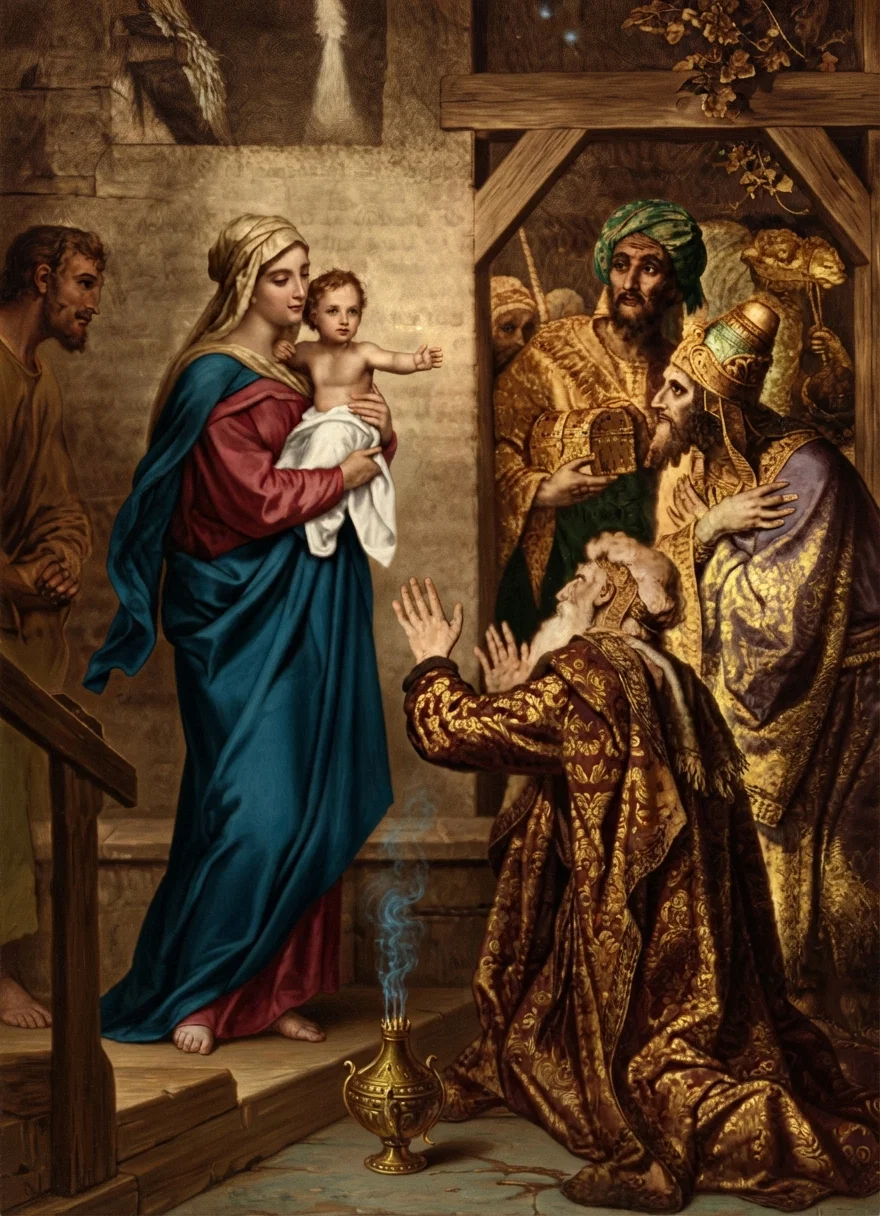
THE WORSHIP OF THE WISE MEN
THESE notes will not discuss the philosophy of the incarnation, will not seek to explain the unexplainable, but will note its great facts, and endeavor to bring home to longing hearts its great truth.
WHEN man was created, he was innocent of all sin and guilt. In harmony with God's great law, he was a constant recipient of the great floods of God's life, ever flowing in the channel of His law. God dwelt in man by His Holy Spirit; and spirit life dominated, nay, joyfully controlled soul life. The whole man was responsive to God.
BUT when, in that evil hour, man fell, sin became incarnate, infleshed. God was driven out of one of His rightful dwellings, the inflood of the spirit life was cut off, and the soul life was yielded to the flesh under the control of selfishness and sin and Satan. And the flesh of itself has been dominated by sin ever since. The mind that controls it is the carnal (fleshly) mind; and "the carnal mind," "the mind of the flesh," "is enmity against God; for it is not subject to the law of God, neither indeed can it be: and they that are in the flesh [controlled by it] can not please God." Rom. 8:7, 8.
BUT it was not God's plan that man should thus become a slave and lost. In the very beginning was the fact assured that the seed of the woman — man — should bruise the serpent's head. Gen. 3:15. A new power was to come into humanity, right into the very citadel and stronghold of sin in this world. More, it was to come into sinful humanity, into human flesh in its fallen condition. It was to demonstrate not alone that man while innocent could be kept from sin, that the pure heart might be shut against the power of the devil; but it was to demonstrate that victory might be won in a captured province, in the very citadel, or fortress, of sin's strength. Elsewise humanity is left without hope.
THEREFORE "when the fulness of the time came, God sent forth His Son, born of a woman, born under the law, that He might redeem them that were under the law, that we might receive the adoption of sons." Gal. 4:4, 5. "Under the law" means, here, condemned by the law. God made Him who knew no sin to become sin for us, "that we might be made the righteousness of God in Him." 2 Cor. 5:21. He stood for us. He represented us in His vicarious offering. He bore for us, suffered for us, became sin for us, died for us. His prayers of agony, predicted by Psalm 22, described by Heb. 5:7, were in our behalf. He was tempted in all things like as we are, and met them all, and triumphed in them all, revealing in all the goodness, the glory, of God. Thus "the Word became flesh, and dwelt among us, . . . full of grace and truth." John 1:14.
JESUS was not a different being from the Word who created or the Angel of God's presence. He did not, in becoming flesh, lose His identity, His oneness with God the Father, His Deity. He laid aside His power and glory in our behalf, that He might demonstrate in our behalf God's power over sin in the flesh of humanity. Identified with God, He forever also identified Himself with humanity. He made an eternal sacrifice for us. He will never be in form what He once was, He will ever bear the lineaments and form of humanity, not to degrade Deity, but to exalt redeemed humanity.
INTO your flesh He wishes to come to-day, dear soul. He knocks at the door for admittance. He wishes you to give up to Him the mind of the flesh, let it die, and let Him rule. He has demonstrated to you that He will rule in you just as He ruled in Jesus of Nazareth. Incarnate in you, He willconquer the habits of sloth and ease and lust, and make you eternally victorious, till you may say with the mighty apostle: "I have been crucified with Christ; and it is no longer I that live, but Christ liveth in me: and that life which I now live in the flesh I live in faith, the faith which is in the Son of God, who loved me, and gave Himself up for me." Gal. 2:20. Then will the heart no longer be at enmity with God, not subject to His law, but the righteousness (ordinance, requirement) of the law will "be fulfilled in us, who walk not after the flesh, but after the Spirit." Rom. 8:4. Then will we say with another apostle: "For this is the love of God, that we keep His commandments: and His commandments are not grievous." 1 John 5:3.

How We Are Free

RELIGIOUS liberty — what is it? Free moral agency — what do the words mean?
Free from the bondage of sin — what is this freedom, this liberty?
Fundamentally there is but one answer to the three questions. We will seek to give some fragment of the meaning of it all.
God is free. No power in the universe in any wise restrains or constrains Him. He is able both to will and to do of His own good pleasure. Phil. 2: 13. What He sees is best, that He wills and does; naught else. He works "all things after the counsel of His own will." Eph. 1: 11.
And enjoying freedom fully, God grants the same freedom to all His creatures. What God is infinitely, that His creatures are to be finitely. Thus each soul is to be like God, an imitator of God.
This is religious liberty.
It is free moral agency.
It is freedom from coercion, even the bondage of sin.
True, man yielded to voluntary slavery; but God's will that man should be free follows him still. The moment sin entered, God said, I will put enmity, or antagonism, into the controversy. The power to choose is still granted to man; and having chosen, power is vested in him to do what he has chosen. Thus even man, and in this sinful world at that, is made able to will and do of his own pleasure.
But there is a power that does not wish man to be free. He wishes to make his will man's will. By misrepresentation, by deception, or by coercion, he seeks to make all do his will. That is the power and purpose of the evil one.
He has agents who, following his methods, seek to control men. Some who claim to be followers of God, use the evil one's methods; and by so much they are imitators of Satan.
The rack, the dungeon, the stake, all witness to the fact that misguided men have tried to put their will for the will of hundreds of their fellows. And the rack, the dungeon, and the stake speak clearly that man's will is free, that God has really granted him the power to choose against every opposing influence in the universe.
In the light of these axiomatic truths, what shall we say of those who by law would control the choice of humanity? What shall we say of those who demand that all mankind worship as they worship, or suffer the penalty of broken state or national law?
Some regard one day as holy, and seek to prevent all secular labor upon it. God has given His Sabbath, and left all men free to observe or violate it. He has plainly stated in His Word both sides of the principle, and how it will all eventuate. There He leaves it. But not thus some men. They have put forward a day of their own as a sabbath, and wish laws enforcing upon all conformity to this choice.
Such is religious tyranny.
Such is exactly the opposite of the course pursued by our Maker.
It is the method of him who leads the whole concourse of evil.
God wants His creatures free, intelligently free, morally free.
Do you?
Character can be developed only by an intelligent creature acting under choice. Just to the extent that he does not choose his course, just to that extent it is not he who acts. Just to the extent that man is coerced — if he be coerced — just to that extent is he a machine, and the act is not his, but is that of the one coercing.
Then do you not see that he who seeks to coerce the individual, seeks in that to destroy the individual, and supplant the individual's will by his own will?
Therefore all attempts at coercion, all attempts to hinder a man in his religious liberty, all attempts to destroy his free moral agency, are really attempts to destroy that individual.
And hence it has not been strange that men eventually, in their efforts to coerce, to persecute, have killed or tried to kill those who did not believe or worship as they did.
Seeking to control by these unfair means a man's religion, is to seek to destroy his individuality, or character. And hence it is logical and natural that all Sunday law advocates or religious persecutors end by placing penalties upon him who disputes their right to coerce — penalties that gradually tend to the victim's destruction.
Christ paid on the cross the penalty of asserting His God-given freedom.
Likewise did Peter.
Paul was beheaded because he chose the free way of God against the tyranny of the Roman emperor.
You are free, my reader, to choose.
Choose therefore this day whom you will serve.
Stand fast in the liberty wherewith Christ has made you free.
Tell your brother God's truth, and in love with him; but do not, even by the sign of impatience at his unbelief, show a desire to coerce him.
L. A. R.

The Secret of the Enmity

ONE of the strangest developments in the professed Christian church is antinomianism, a belief that God's law is abolished, repealed, annulled. All this is in direct contradiction to our Lord's statements repeated again and again, regarding the object of His mission, the purpose of His coming, in fact the entire remedial scheme of the gospel. He came not to destroy the law, but to establish it. Matt. 5:17-20.
He declares that "it is easier for heaven and earth to pass away, than for one tittle of the law to fail." Luke 16:17.
He was called Jesus, because He would "save His people from their sins," and "sin is the transgression of the law." Matt. 1:21; 1 John 3:4; Rom. 7:7. He redeems "from all iniquity"—lawlessness—those who trust Him. Titus 2:14. Paul declares that faith in Christ establishes the law, in the heart of him, of course, who exercises the faith. Rom. 3:31.
This is not a tithe of the evidence which might be adduced to show that the mission of Christ was loyalty to the government of God, and was designed to make men obedient subjects to the law of God. Otherwise were treason.
There is but one thing that sets men against the law of God's government. That is not grace or forgiveness, or a new dispensation, or loyalty to Christ. It is the carnal mind; that is the whole secret. "Because the carnal mind is enmity against God: for it is not subject to the law of God, neither indeed can be." Rom. 8:7.
The secret, friend, lies just there—in the carnal mind. Are you opposed to God's law in any part or parcel? Yield to the law, and let the carnal mind die. Christ will give you a new heart, a new life, which loves the law of God, and makes His commandments a delight.

Faith's Answer to God's Word

"Jehovah is the true God; He is the living God, and an everlasting King. . . . He hath made the earth by His power, He hath established the world by His wisdom, and by His understanding hath He stretched out the heavens." Jer. 10: 10-12.
"Without faith it is impossible to be well-pleasing unto Him; for he that cometh to God must believe that He is, and that He is a rewarder of them that seek after Him." Heb. 11: 6.
I believe, O God, that Thou art, and that there is no God beside Thee; that Thou art a personal, living God, the Creator of the heaven and the earth, and upholdest all things by the word of Thy power. Thy greatness is incomprehensible, and Thy glory insufferable; but as Thou art God, infinite in every attribute, Thy love and wisdom are also equal to Thy majesty and glory. I believe all that Thy Word reveals to me of Thy Godhead.
"Fear God, and keep His commandments; for this is the whole duty of man. For God will bring every work into judgment, with every hidden thing, whether it be good, or whether it be evil." Eccl. 12: 13, 14.
As Thou art the Creator of all, I recognize, O God, the right to my service, the highest, holiest, and best. And as Thou hast a right to my service, Thou hast the right to direct my conduct, to command me in all things, and at last bring me to judgment, final and everlasting. All this is inherent in Thy right as Creator.
"All have sinned, and come short of the glory of God." Rom. 3: 23.
"The wages of sin is death." Rom. 6: 23.
And this, O God, is true, demonstrated by all the history of the world and in each rational soul's individual consciousness. I am one of the "all," and therefore I am a sinner. And Thy Spirit through Thy Word has revealed unto almost despair specific sins in my life. My heart has run after sin and into sin, and I have strayed far and selfishly from the path of Thy precepts. Being a sinner therefore by birth, and by choice in divers and grievous ways, I ama dying creature, a rebel against Thy government, and worthy only to die.
"God is love." 1 John 4: 8. "For God so loved the world, that He gave His only-begotten Son, that whosoever believeth on Him should not perish, but have eternal life." John 3: 16.
"Yea, I have loved thee with an everlasting love: therefore with loving-kindness have I drawn thee." Jer. 31: 3.
I believe, O Jehovah, in Thy love, Thine infinite, unfathomable love.
"Never yet, in darkest mood, Doubted I that Thou wert good, Nor mistook my will for fate, Pain of sin for heavenly hate."
My doubt, my wonder, is, Canst Thou love me—one so unworthy of Thy love?
"But God commandeth His own love toward us, in that, while we were yet sinners, Christ died for us." Rom. 5: 8.
"Faithful is the saying, and worthy of all acceptation, that Christ Jesus came into the world to save sinners; of whom I am chief." 1 Tim. 1: 15.
"For the Son of Man came to seek and to save that which was lost." Luke 19: 10.
My gracious Lord, I believe this,—that Thy wondrous, immeasurable love embraces me, not because I am worthy, but because Thou art love, and love delights in loving. But Thou dost not love sin, that which never blesses, but ever curses, and which has brought upon the world all its ills and woes, and there is sin in me. How may I be rid of that which separates from Thee, which clouds in my heart the sunshine of Thy love?
"Let the wicked forsake his way, and the unrighteous man his thoughts; and let him return unto Jehovah, and He will have mercy upon him; and to our God, for He will abundantly pardon." Isa. 55: 7.
"If we confess our sins, He is faithful and righteous to forgive us our sins, and to cleanse us from all unrighteousness." 1 John 1: 9.
My Father, I believe. I am the sinner; Thou art the Saviour. I tell Thee all my sins, in all their crooked, perverse wickedness. I hate them all in their consummation; help me to hate them more in their inception, in their seed-sowing, in the beautiful, deceptive flowering, as well as in their deadly fruitage. And I believe, I now believe, my Father, my Saviour, that my sins are all forgiven, that Thy mighty word has cleansed me from all unrighteousness, and that the good work Thou hast begun in me Thou art able to finish to the day of Christ Jesus. Even so, amen.

Working for a Sunday Law

IN the San Francisco "Call" of June 19 is a news note entitled "Petition Asks Ballot for Rest-Day Law. Work is Directed by Dr. G. L. Tufts of Berkeley." The note reads as follows:
"Initiative petitions calling for a ballot at the November election for a weekly rest-day law are being sent out from headquarters in Berkeley and Los Angeles, and a bill providing such a law will be submitted to the voters provided that 31,000 signatures are secured.
"The work is under the direction of Dr. G. L. Tufts of Berkeley, who drafted and lobbied through the legislature of Idaho the rest-day law of that state. The proposed law has been evolved from the Idaho law, and has been submitted to many lawyers and citizens. It is argued that it is in no respect a 'blue law' or 'religious legislation,' in that it does not touch upon the question of Sunday amusements, leaving that to local control.
"The proposed law provides for the closing of all unnecessary business on Sunday, and prevents generally the hiring of labor, but does not restrict any person's right to engage in personal work, and makes exceptions in the case of various manufacturing, industrial, public service, and quasi-public lines and pursuits."
It will be remembered that the Idaho law demands that officials of all sorts whose business can be interpreted to lie in that direction at all, are compelled to enforce it, under penalties of fines from $50 to $500, and their office declared vacant. It is said that it is not a "blue law," but the whole object is to introduce the small end of the wedge. That is all that is expected. If this can be done, localities and future legislation can furnish all that is necessary in stringency and tyranny. Doubtless Mr. Tufts will secure his 31,000 signatures. That is not a difficult matter. We hope that the intelligent voters of California, male and female, will see that the law is turned down. The same news is given in the San Francisco "Bulletin" of June 17, which states that the petition has been circulated among the churches of Oakland and in Los Angeles and an appeal will be made to congregations throughout the state.
Continue reading: Some Statements and Corrections Regarding Christian Science