Your ShelfYour Projects

Review and Herald, Vol. 92, No. 62.

A Canticle in War

Review and Herald

Dec 16, 1915

Review and Herald Publishing Association · Takoma Park Station, Washington, D. C. · Dec 16, 1915

A Canticle in War

ARTHUR W. SPAULDING
Glory to Thee, Father, and Author of glory! In these dread days, At altars of death-stricken homes and battle fields gory, We render Thee praise!.
Not with the offering of blood make we an oblation,— Sacrifice vain,— Though drenched is Thy footstool by nation on nation With blood profane.
We offer no sacrifice to Thee, but, bowed in sorrow, Lowly we kneel, Praying that after this darkness some happy tomorrow Thy face shall reveal.
For, though the heavens above us are crashing with thunder, And earth beneath Reels with the blows of the pitiless swords that sunder Loves in black death,
Still to Thy throne, the seat of immutable justice, We lift our eyes, Knowing that out of the turmoil we yet shall witness Some glad surprise.
For though the madness of nations, in wrath and in terror, Cast down the right, Soon shall be ended that madness, and evil, and error, Before Thy might.
Light from the darkness! Out of the midnight Thy glory! From battle to peace! For in the battle of battles is ended earth's story, And time shall cease.
Then, though war rage, and evil blast men with its wages, Glory to Thee! For, lo, we behold, enwrapped in the doom of the ages, Eternity.

“Bible Day”

THE International Sunday School Association appointed Sunday, November 28, as “Bible Day.” The Christian Observer of November 17 pointed out the purpose of the plan:—
It is desired that on that day special efforts should be made to emphasize the need of a great revival of daily Bible reading in homes and schools. There is imperative need today for a more thorough knowledge of the Word of God, for the Bible is without age or date or time in its practical value for men. It meets the needs of the human heart in all ages, and is divinely adapted to the requirements of all sorts and conditions of men. It brings to us that which is invaluable in human life, for as President Wilson says, “It classifies moral values,” indicating that men are not judged according to their wits but according to their characters. The test of any man's character is his squaring his conduct with the standards that he knows to be the standards of purity and rectitude. The wise pastor will use this opportunity, when the thoughts of men are turned in a special way toward the Bible, to impress upon his people the value of daily prayerful reading and study of the Word of God. Sunday-school teachers will emphasize to their pupils the need in every life of a thorough knowledge of God's Word.
We can heartily approve the plan of reading the Bible daily.

Increase of Crime

A WRITER in one of our exchanges draws from the report of the police department of Chicago some conclusions which are not encouraging:—
In 1910 there were sixty-one charges of murder in the city. Following this there was a steady increase year after year, until in 1914 the figures mounted to 229. There may also be added to this 67 cases of manslaughter. Crimes of various kinds in the city are said to be on the increase. . . . The crime of burglary has increased more than fifty per cent in five years; robbery, forty per cent; crimes against children, fifty per cent. It is asserted that 1,400 automobiles were stolen in the city during last year. There were arrested in Chicago in 1914, 115,286 persons. Of these more than 71,000 were Americans, and the rest may be divided between at least twenty other nationalities. This goes far to offset the claim made many times that the foreign-born population is the largest contributor to our criminal records. It would appear from the above that native-born Americans are fully performing their part in the dark recital.
One of the sorriest parts of this unpleasant picture is that of juvenile offenders. These have multiplied to an alarming extent in the city. They are from the schools, and many times are dealt with in a very lenient way. On repeated offenses they are sent to some reformatories. It is said that in the reformatories of the State more than fifty per cent are from the city of Chicago. This is one of the most serious problems before our modern city governments. One of the Chicago teachers endeavors to solve the problem by laying the blame for present conditions at the door of too great a leniency for the children:—
“There are tens of thousands of boys in Chicago, born here of foreign parents or brought to America in their infancy. In the Old Country, from which they came, obedience or respect for those in authority was sternly enforced. They learn that this is the land of the free, where it is thought that everybody may do as he pleases. Presently they begin to look down on the old folks and to flout their authority. Family discipline does not last long.
“When these boys come to school, they are shortly told that it is against the rule for the teacher to lay hands on them, no matter what the provocation. They become impudent and disobedient. A teacher stands it as long as possible. Then the boy is taken to the principal and here he gets off some more impudence. Presently the offender is reported as incorrigible. Next the courts get hold of him, and he is sent to some reformatory institution, and is started on a career of crime. I sincerely believe that the chief reason for the rapid increase in the number of juvenile delinquents—which is a polite way of saying criminals—is the fact that we teachers are not allowed to discipline them, and thus teach them the most important of all lessons, that of obedience, self-control, and respect for law during their school days.”

Note and Comment

A New Record in Wireless Telegraphy

We have already commented in these columns on the almost incredible accomplishments in long-distance wireless telegraphy; but now, according to the New York Times of November 30, a new record has been made:—
What is said to be a record in radio transmission was established today, when an operator for the Federal Wireless Telegraph Company at Honolulu picked up messages being transmitted from Nauen, Prussia, to Tuckerton, N. J., approximately 9,000 miles away. The German operator was sending war dispatches, and the dots and dashes registered so clearly in the radio station here that the eavesdropper had no difficulty in “copying the report.”

The Sixty-Fourth Congress

MANY important matters will come before the United States Congress in the session which opened Dec. 6, 1915. As the decision in many cases will be greatly influenced by party politics, a statement of the personnel of both House and Senate may be of interest. We present a table published in the Washington Post:—

The Senate

Democrats .................... 55 Republicans .................. 40 Progressives .................. 1 Democratic majority .......... 14

The House

Democrats ................... 229 Republicans ................. 197 Progressives .................. 6 Independent ................... 1 Socialist ..................... 1 Democratic majority .......... 24 Total membership ............ 435
There is one vacancy in the House, caused by the recent death of Samuel A. Witherspoon, of Mississippi.

The “New Gospel” Characterized as a Failure

The new theology has been publicly renounced by Pastor Haecker of Berlin, who had been a strong advocate of it. We reproduce one paragraph of his renunciation as quoted in the Word and Way of November 4:—
Why have I not tried “the new gospel” longer — the gospel without the incarnate God, without the death sacrifice of God's love, without the resurrection of the Lord? Because I sought life and full satisfaction, and did not find this in modern theology. As pastor, I was called not only to weddings, but to deathbeds and funerals. There I could offer no fine words on the value of the life which was vanishing, of the virtues of the dead, concerning which I was not convinced. No, at such times I needed to say that One had cried aloud over this world of graves, “Because I live, ye shall live also.” The modern man must be loved, but not with false concessions; loved as God has ever loved—with Cross love. He must be loved with the old gospel, which is the truth. Therefore, we must abandon halfway compromises. We must bring the message, not of the great men who are dead, but of the Son of God who lives.

EDITORIALS

Notes From the Field — No. 6
THE council at Loma Linda is now in the past, but the questions with which it had to deal are present, living issues. Decisions and plans were made which will have to do with the destinies of souls while time shall last. Anew must God's people dedicate themselves to the finishing of this work. The providence of God has gone out before us, opening doors of opportunity in every nation. We must enter these open doors. We shall find some reaching out their hands for help, with hearts open to receive the tidings of the soon-coming Saviour.
These Macedonian calls will demand our means, our sons and daughters. And to what nobler or more inspiring service could our sons and daughters be devoted? How much better to lay them upon the altar of China's or India's need than to see them filling positions of worldly influence or emolument! How much better to be separated from them for a season and enjoy their association throughout eternity than to keep them near us now, centering their interests at home and in the things of this life, and then lose them forever! It will take all to buy the field, to obtain the pearl of great price; but the favor of God here, and the joy of dwelling in his presence forever and of seeing among the ransomed throng those saved through our instrumentality, are well worth the price demanded — the sacrifice of self.
The closing hours of the council brought to many hearts sad reflections. Never again will the same company in its entirety come together. By the time of the next biennial meeting doubtless some will have been called to lay down life's burdens. Others will be laboring in some of earth's remote regions, and will be unable to meet with their brethren. But not one, let us pray, will become discouraged or indifferent and be led to relinquish the advent hope.
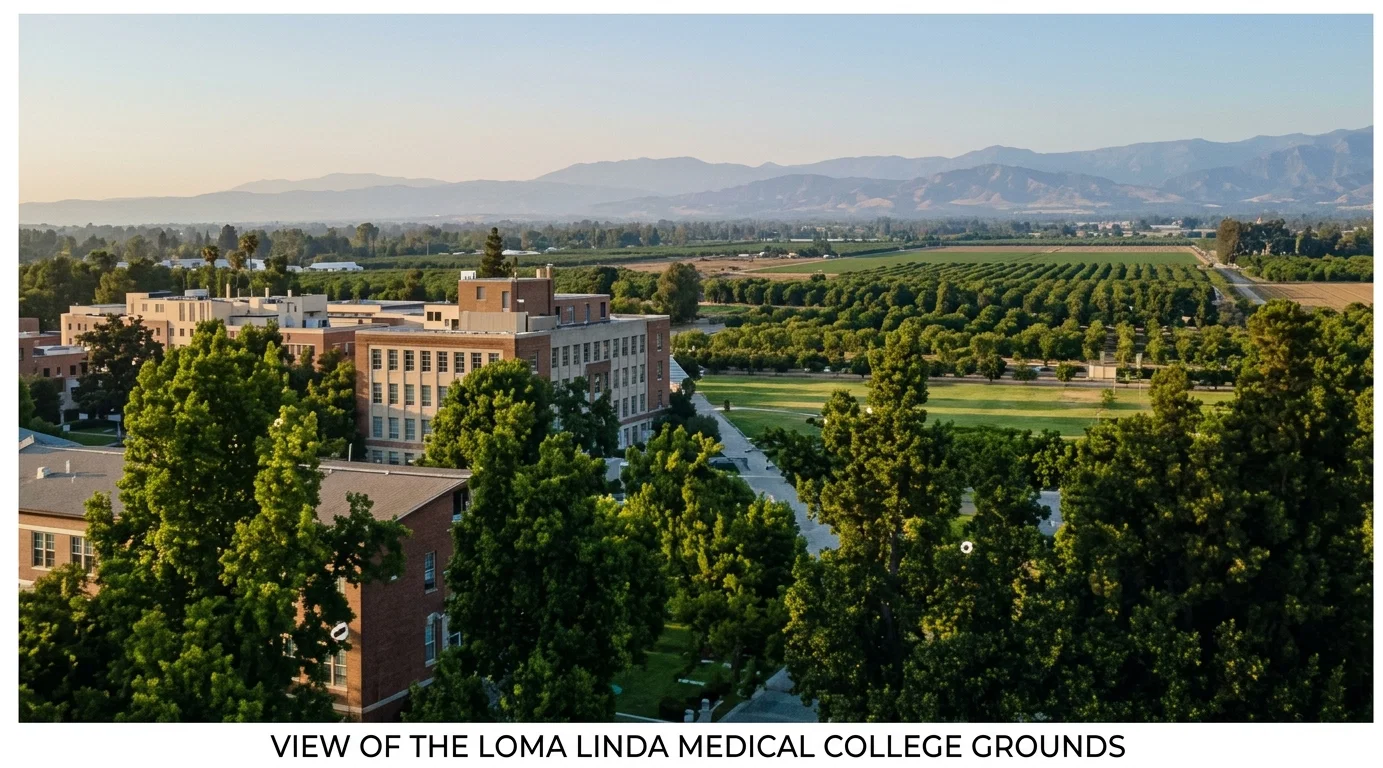
VIEW OF THE LOMA LINDA MEDICAL COLLEGE GROUNDS
Ladies’ dormitory in foreground at left, laboratory building in center, and hospital at left in the rear.
VIEW OF THE LOMA LINDA MEDICAL COLLEGE GROUNDS Ladies’ dormitory in foreground at left, laboratory building in center, and hospital at left in the rear.
As the workers gathered at Loma Linda return to their fields, how greatly they need our prayers! and how greatly they need to pray for one another! Prof. H. R. Salisbury and Elder and Mrs. R. C. Porter return to the great East, with its teeming multitudes: Elders L. R. Conradi and W. J. Fitzgerald to the great war zones of Europe; Elder J. E. Fulton to Australasia and Polynesia; Elder A. J. Haysmer to his trying island field in the West Indies; while Elder O. Montgomery goes to the great South American continent, with its papal prejudices and superstitions. In each of these fields are trying situations. Every day brings forth new complications, which only heavenly wisdom can enable these workers and their associates to meet. Let us pray for them, pray that in these days of dangerous travel they may have safe transit across the great deep, and that God will guide them in counsel in all that pertains to their work, making them indeed leaders in Israel, men who know in these perplexing days what Israel ought to do.
The men in the home field also need our prayers. Our union and State conference presidents are carrying burdens heavy to be borne. They have to do continually with many local questions which require great wisdom to settle properly. They must go to our churches and sound the rallying cry for every advance move. They must place their shoulders under the burden of raising the funds for local needs and the means required to support the work in mission lands.
And lastly, but by no means least in our interest, should we hold up in prayer before God the men whom he has called to lead out in the great world-wide work. Let us remember Elder A. G. Daniells in his great responsibilities as president of the General Conference, Elder W. A. Spicer as our missionary secretary, Elder W. T. Knox as he gathers the funds for the support of our mission work, Elders I. H. Evans and G. B. Thompson in the heavy burdens they are carrying in the North American Division Conference. Elders W. W. Prescott and N. Z. Town as they go to South America to assist in the more complete organization of the work in that field. By prayer we may enter into their labors and become God's helping hands in the work of his ministry.
How many worthy objects of prayer are placed before us in connection with this advancing movement. We need to pray much. There is great power in the united prayers of the believers throughout the world. F. M. W.
Continue reading: Report of the Biennial Council of the General Conference Committee