Your ShelfYour Projects

Review and Herald, Vol. 80, No. 24.

THE YOUTH'S INSTRUCTOR

Review and Herald

Jun 16, 1903

Seventh-day Adventist Publishing Association · Battle Creek, Mich. · Jun 16, 1903

THE YOUTH'S INSTRUCTOR

PUBLISHED BY THE

REVIEW AND HERALD PUBLISHING COMPANY

BATTLE CREEK, MICHIGAN.
An eight-page illustrated weekly paper. Especially adapted to the daily needs of the youth. Lively, interesting, instructive, entertaining, and entirely free from all cheap reading so common in most of the young people's papers. For fifty years the recipient of the hearty support of the Sabbath-schools and the general confidence of the people, is sufficient testimony of its merits.

SUBSCRIPTION RATES

YEARLY SUBSCRIPTION ............................ $ .75 SIX MONTHS ...................................... .40 THREE MONTHS .................................... .20 To Foreign Countries ............................ 1.25

CLUB RATES

5 to 9 copies to one address, each ............ $ .55 10 to 100 copies to one address, each .......... .50 100 or more copies to one address, each ......... .45

OUR SPECIAL PREMIUM OFFER

To those sending us new yearly subscriptions for the Instructor, we offer the COMBINATION TEACHERS' BIBLE, as follows:— For one new yearly subscription and $2.10. For two new yearly subscriptions and $1.75. For three new yearly subscriptions and $1.40. For four new yearly subscriptions and 70 cents. For five new yearly subscriptions alone.

DESCRIPTION OF THE BIBLE

The Old and Revised Versions of the Bible in One Volume without Increasing the Size or Weight, or Diminishing the Size of the Type.

SELF-PRONOUNCING

A teachers' Bible, enabling its readers to use and study the changes embodied in the Revised Version (heretofore only made possible by using a large parallel family Bible, or a separate revised Bible). A Bible which, without omitting a feature, or disturbing the text, points out all the words and passages wherein the two versions differ, giving the Revised Version of each at the foot of the page, as illustrated in the cut, which also represents the size of the type, and the general make-up and style of the book. The text is the old or authorized version. At the foot of the page is shown every change made by the revisers. The letters RV in the text denote that the word or passage following is changed in the Revised Version as shown in the foot-note of the same verse. The letters RO denote that the word or passage following is omitted in the Revised Version as shown in parenthesis () in foot-note. When two or more changes occur in the same verse, they are divided by a dash in the foot-note.
It is substantially and attractively bound in imperial seal, divinity circuit, leather lined to edge of circuit, round corners, carmine under gold edges.

THE COMBINATION TEACHERS' BIBLE

SELF-PRONOUNCING—
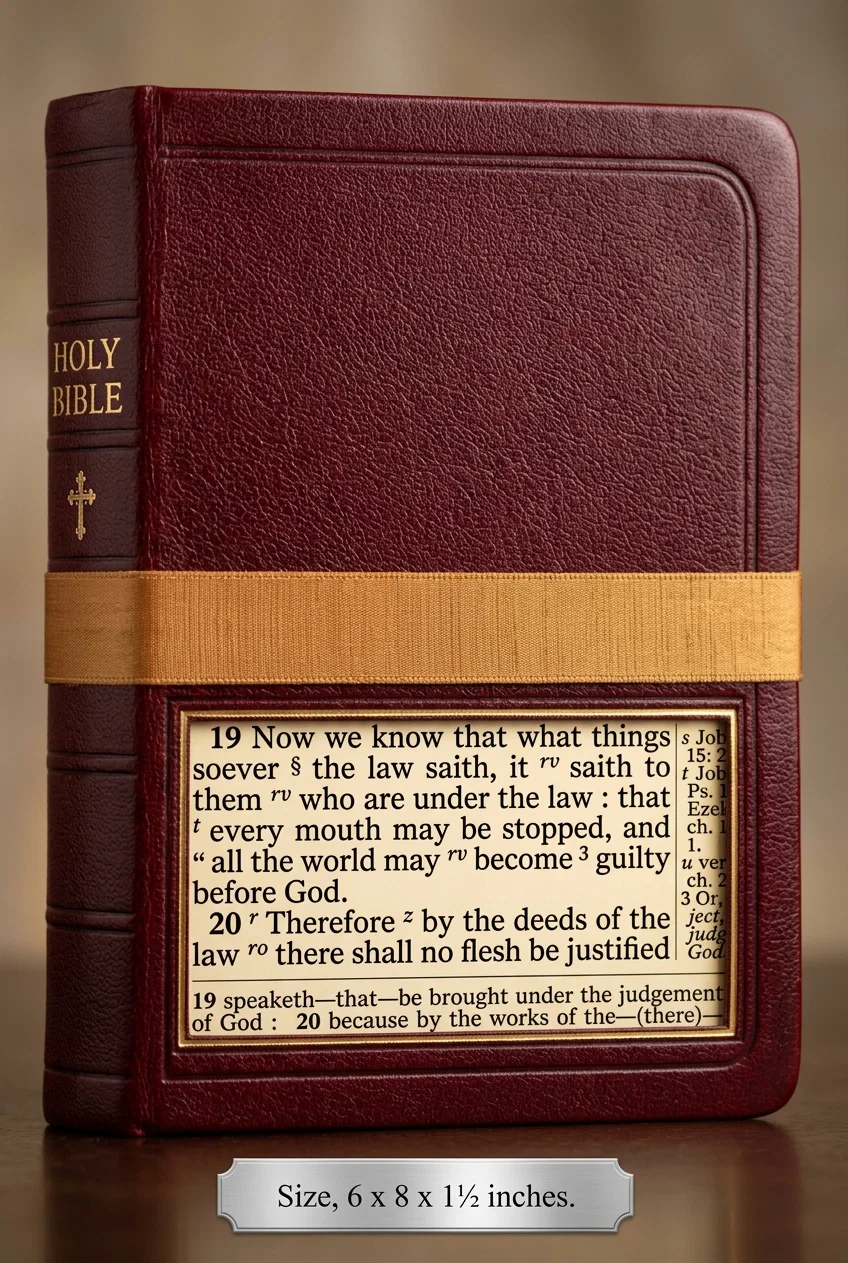
Size, 6 x 8 x 1½ inches.
It contains all the standard helps to the study of the Bible, a complete series of new maps, illustrating the geography of Palestine and the surrounding countries from the earliest times, and embodying the most recent discoveries, together with a very full concordance, containing over 40,000 references, history and summary of the books of the Bible, historical, chronological, and geographical tables, new subject index to the Bible, dictionary of the Scriptural proper names with their pronunciations and meanings, table of miracles, parables, etc., etc.
The type is large, the paper excellent, and the binding good. The newest and best teachers' Bible published in every particular. Its construction is simple, compact yet comprehensive. Any child can readily compare each, the old and the Revised versions.

TESTIMONIALS

Every student of the Bible ought to know what the revisers did. Whoever gets this Bible gets the most complete one extant.—Rev. Hiram C. Haydn, Cleveland, Ohio.
One of the most valuable editions of the Holy Scriptures ever published, and no other can claim to be its equal.—Rev. Milton S. Terry, Evanston, Ill.
The combination and self-pronouncing features make it the most practically useful Bible that has ever been published.—Bishop Spaulding, Denver, Colo.
I know of no Bible that contains within itself so much of real value to every Biblical student as your “Combination Bible.”—Rev. D. D. MacLaurin, Detroit, Mich.
Unique in plan, extraordinary in scope, and exceptional in value. The arrangement of the two editions is most helpful.—Bishop Huntington, Syracuse, N. Y.

Editorial

The Pauline Gospel

IN his salutation to the church at Rome the apostle Paul opens to us the essential truth of the gospel which he preached. He declares it to be “the gospel of God, which he promised afore through his prophets in the Holy Scriptures, concerning his Son, who was born of the seed of David according to the flesh, who was declared to be the Son of God with power, according to the spirit of holiness, by the resurrection from the dead.” We need to give careful attention to what is here set forth; for it lays open to our view the very heart of the gospel. It is “the gospel of God . . . concerning his Son.” That Son was born of the flesh, and thus became the Son of man. As the Son of man he lived and labored, suffered and died. But by his resurrection from the dead he was authoritatively declared to be the Son of God. The essential truth of the gospel is thus seen to be that the man, Jesus of Nazareth, was the Son of God,—that God has manifested himself in flesh in the person of his Son, Jesus Christ, in fulfillment of the promise made through the prophets of the coming Messiah. The gospel then, as taught by the apostle Paul, is the good news of God manifest in the flesh, even “in the likeness of sinful flesh.” This is the provision which God has made for our salvation. To believe the gospel is to believe in this provision as a present fact,—that God is manifest in the flesh. Each believer lets this be true in himself through faith’s appropriation of God’s gift of himself to the flesh. Each individual must accept this truth for himself, and yield himself to the indwelling of God through the Spirit. “If the Spirit of him that raised up Jesus from the dead dwelleth in you, he that raised up Christ Jesus from the dead shall give life also to your mortal bodies through his Spirit that dwelleth in you.” This is the gospel of God manifest in the flesh.

The Only Gospel

GOD has provided only one way of salvation for all peoples in all ages. There was not one plan devised for the Jews, and then another for the Gentiles. God manifest in the flesh is the one gospel for both Jew and Gentile. “It is too light a thing that thou shouldest be my servant to raise up the tribes of Jacob, and to restore the preserved of Israel: I will also give thee for a light to the Gentiles, that thou mayest be my salvation unto the end of the earth.” And when the devout Simeon saw the child Jesus, he recognized him as God manifest in the flesh, and said: “Mine eyes have seen thy salvation, which thou hast prepared before the face of all peoples; a light for revelation to the Gentiles, and the glory of thy people Israel.” “The Father hath sent the Son to be the Saviour of the world.” This is the gospel of “Immanuel . . . God with us.” “If any man preach any other gospel unto you, . . . let him be accursed.”

The Everlasting Gospel

THIS gospel of God manifest in the flesh is “the everlasting gospel” which is to be proclaimed in the last generation to prepare the way of the Lord. And in order that it may be proclaimed effectively, so as to meet the special need of the last generation and save a people from all the perversions of this time of great deception, the Lord has given to us in the Scripture the exact setting in which this gospel of God manifest in the flesh is to be presented. The prophecies, especially those found in the books of Daniel and the Revelation, disclose the condition both of the church and of the world in the last days. In the time just before the destruction of the world by fire we learn that it will be as it was in the time of Noah, just before the destruction of the world by water. Then “Jehovah saw that the wickedness of man was great in the earth, and that every imagination of the thoughts of his heart was only evil continually.” And we also learn that in that same time Satan will work “with all power and signs and lying wonders,” and professed Christians will have a form of godliness, but will deny the power thereof. To the world thus under the power of Satan, and to the professed church which is without the power of godliness, must be proclaimed with a loud voice “the everlasting gospel” of God manifest in the flesh, that gospel which is “the power of God unto salvation to every one that believeth.” But in order to meet the demands of this generation, it must be proclaimed in the very way in which inspiration has indicated that the final proclamation of this truth must be given. This means that the gospel of God manifest in the flesh, which was typified in the earthly sanctuary and its services, must now be taught from the standpoint of the heavenly sanctuary and its services. This will bring the world face to face with the hour of God’s judgment and with the law of God as the standard of the judgment, and will then offer to them the gospel of God manifest in the flesh as the only basis of confidence in this time of judgment. It will show that Babylon is fallen, and that any form of Babylonish worship—either of the beast or of his image—will bring upon the worshiper the unmingled wrath of God. And this is the third angel’s message.

The False Gospel

THERE is a counterfeit gospel in the world. It appropriates the names and terms of Christianity, but it denies the essential truth of Christianity. The true gospel is God manifest in sinful flesh, condemning sin in the flesh. The counterfeit gospel is sinful flesh claiming all the blessings and privileges of God manifest in the flesh, but without the experience. This false gospel finds its culmination in the papacy as the result of “the falling away” foretold by the apostle Paul, when the man of sin should be revealed. But the false gospel is also found in apostate Protestantism, that image of the papacy, which denies in experience, if not in express statements, the real gospel of God manifest in the flesh. As a result of all this departure from the truth, the people of this generation are largely left without the power for victory over sin, and are carried captive by Satan at his will. This is the gospel which was taught by the Pharisees in the time of Christ. “We haveAbraham to our father.” This is the gospel of the flesh and of self-righteousness. It often appears under the guise of great zeal for the commandments of God, but it is always the fleshly interpretation of the commandments, which is the same as tradition. It is simply man’s measure of God’s character with only man’s power with which to reveal it, and this is no defense against sin. It is certainly time that we should know that we are proclaiming the true gospel of God manifest in the flesh, and that we ourselves know this true gospel as an experience. It is so easy to pervert the true into the false by substituting a mere form for the thing itself. This is our danger. “Many talk of the truth, they preach the theory of the truth, when the melting love of Jesus has not become a living, active element in their character. This is an age of almost universal apostasy; and those who claim to hold advanced truth mislead the churches when they do not give evidence that their character and works harmonize with divine truth.” Beware of either accepting or teaching the false gospel. “Take heed lest there shall be any one that maketh spoil of you through his philosophy and vain deceit, after the tradition of men, after the rudiments of the world, and not after Christ.”

Science Affirms a Creator

THE claim so much put forward by atheists, that science is opposed to the teachings of Christianity, was recently emphatically denied by the most eminent scientist of Great Britain, Sir William Thompson, otherwise known as Lord Kelvin. In an address given at the University College, London, Lord Kelvin said that modern science, so far from being opposed to Christianity, is in thorough accord with it. A part of the report of his speech made by the London Times is as follows:— Science positively affirmed creativepower. Science made every one feel a miracle in himself. It was not in dead matter that they lived and moved and had their being, but in the creating and directive power which science compelled them to accept as an article of belief. They could not escape from that when they studied the physics and dynamics of living and dead matter all around. Modern biologists were coming once more to a firm acceptance of something, and that was a vital principle. They had an unknown object put before them in science. In thinking of that object they were all agnostics. They only knew God in his works, but they were absolutely forced by science to admit and to believe with absolute confidence in a directive power—in an influence other than physical, dynamical, electrical forces. Cicero had denied that they could have come into existence by a fortuitous concourse of atoms. There was nothing between absolute scientific belief in creative power and the acceptance of the theory of a fortuitous concourse of atoms. Was there, he asked, anything so absurd as to believe that a number of atoms, by falling together of their own accord, could make a crystal, a sprig of moss, a microbe, a living animal? People thought that, given millions of years, these might come to pass, but they could not think that a million of millions of millions of years could give them unaided a beautiful world like ours. They had a spiritual influence, and in science a knowledge that there was that influence in the world around them. . . . Let no one, he urged, be afraid of true freedom. They could be free in their thought, in their criticisms, and with freedom of thought they were bound to come to the conclusion that science was not antagonistic to religion, but a help for religion.
Lord Kelvin supplemented this report in the Times with the following statement:—
In your report of a few words which I said in proposing a vote of thanks to Professor Henslow for his lecture “On Present-day Rationalism” yesterday evening in University College, I find the following: “Was there anything so absurd as to believe that a number of atoms, by falling together of their own accord, could make a crystal, a sprig of moss, a microbe, a living animal?” I wish to delete “a crystal,” though no doubt your report of what I said is correct. Exceedingly narrow limits of time prevented me from endeavoring to explain how different is the structure of a crystal from that of any portion, large or small, of an animal or plant, or the cellular formation of which the bodies of animals and plants are made; but I desired to point out that, while “fortuitous concourse of atoms” is not an inappropriate description of the formation of a crystal, it is utterly absurd in respect to the coming into existence, or the growth, or the continuation of the molecular combinations presented in the bodies of living things. Here scientific thought is compelled to accept the idea of creative power. Forty years ago I asked Liebig, walking somewhere in the country, if he believed that the grass and flowers which we saw around us grew by mere chemical forces. He answered: “No; no more than I could believe that a book of botany describing them could grow by mere chemical forces.” Every action of human free will is a miracle to physical and chemical and mathematical science.
These words of England’s most eminent scientist have caused a great stir in scientific circles in that country. One man of note in making reference to them said: “Lord Kelvin, in effect, wiped out by a stroke of the pen the whole position won for us by Darwin.” Darwin denied the necessity of a Creator.
Real science is truth, and Christianity is truth, and neither of these can be wiped out by the stroke of a pen. Christianity is, itself, the highest science.
L. A. S.

Heaven’s Gift to Man

How shall we express what God has given to us? When he gave his Son, he gave the most precious gift of heaven, and he gave him never to take him back again. To all eternity the Son of man will bear in his body the marks that sin made; forever he will be Jesus Christ, the Saviour, and our Elder Brother. That is what God has done for us in giving his Son to us.
This union of the divine and the human has brought Jesus Christ very near to us. There is not one too low down for Jesus Christ to be with him. He identified himself completely with this human family. In the judgment when the rewards and punishments are meted out, he says, “Inasmuch as ye have done it unto one of the least of these my brethren, ye have done it unto me.” Jesus Christ looks upon every one of the human family as his, and when humanity suffers, he suffers. He is humanity, he has joined himself to this family. He is our head, and when in any part of the body there is a throb of pain felt, the head feels that throb of pain. He has united himself with us, thus uniting us with God; for we read, “Behold, a virgin shall be with child, and shall bring forth a son, and they shall call his name Emmanuel, which being interpreted is, God with us.”
Jesus Christ thus united himself with the human family that he might be with us by being in us, just as God was with him by being in him. This purpose he expressed in the words of his prayer for his disciples: “And the glory which thou gavest me I have given them; that they may be one, even as we are one. I in them, and thou in me, that they may be made perfect in one; and that the world may know that thou hast sent me, and hast loved them, as thou hast loved me. Father, I will that they also, whom thou hast given me, be with me where I am; that they may behold my glory, which thou hast given me: for thou lovedst me before the foundation of the world. O righteous Father, the world hath not known thee: but I have known thee, and these have known that thou hast sent me. And I have declared unto them thy name, and will declare it: that the love wherewith thou hast loved me may be in them, and I in them.” John 17: 21-26. And as he was ascending, his last words to his disciples were, “Lo, I am with you alway, even unto the end of the world.” By being in us he is with us alway; and that this might be possible, that he might be in us, he took our flesh.
This also is the way in which the holiness of Jesus works. He had that holiness that he could come and dwell in sinful flesh, and glorify sinful flesh by his presence in it, and that is what he did, so that when he was raised from the dead, he was glorified. His purpose was that, having purified sinful flesh by his indwelling presence, he might now come and purify sinful flesh in us, and glorify sinful flesh in us. He “shall change our vile body, that it may be fashioned like unto his glorious body, according to the working whereby he is able to subdue all things unto himself.” Phil. 3: 21. “For whom he did foreknow, he also did predestinate to be conformed to the image of his Son, that he might be the first-born among many brethren.” Rom. 8: 29.
In this idea is bound up the whole question of predestination. There is a predestination; it is a predestination of character. There is an election; it is an election of character. Every one who believes on Jesus Christ is elected, and all the power of God is behind that election that he shall bear the image of God. Bearing that image, he is predestinated to all eternity for Christ’s kingdom, but every one who does not bear the image of God is predestinated unto death. It is a predestination of God in Jesus Christ. Christ provides the character, and offers it to any one who will believe in him.
Let us enter into the experience that God has given Jesus Christ to us to dwell in our sinful flesh, to work out in our sinful flesh what he worked out when he was here. He came and lived here that we might through him reflect the image of God. This is the very heart of Christianity. Anything contrary to it is not Christianity. “Beloved, believe not every spirit, but try the spirits whether they are of God: because many false prophets are gone out into the world. Hereby know ye the Spirit of God: Every spirit that confesseth that Jesus Christ is come in the flesh is of God: and every spirit that confesseth not that Jesus Christ is come in the flesh is not of God.” 1 John 4: 1-3. That can not mean simply to acknowledge that Jesus Christ was here and lived in the flesh. The devils made that acknowledgment. They knew that Jesus Christ had come in the flesh. The faith that comes by the Spirit of God says, “Jesus Christ is come in my flesh; he dwells in my flesh; I have received him.” That is the heart and life of Christianity. The difficulty with the Christianity of to-day is that Christ does not dwell in the hearts of those professing his name. He is an outsider, one looked at from afar, as an example. But he is more than an example to us. He made known to us what God’s ideal of humanity is, and then he came and lived it out before us that we might see what it is to be in the image of God. Then he died, and ascended to his Father, sending forth his Spirit, his own representative, to live in us, that the life which he lived in the flesh we may live over again. This is Christianity.
It is not enough to talk of Christ and of the beauty of his character. Christianity without Christ dwelling in the heart is not Christianity. He only is a genuine Christian who has Christ dwelling in his heart. And we can live the life of Christ only by having him dwelling in us. He wants us to lay hold upon the life and power of Christianity. Do not be satisfied with anything else. Heed no one who will lead you in any other path. “Christ in you, the hope of glory,” his power, his indwelling presence,—that is Christianity. That is what we need to-day, and there are hearts that are longing for that experience, and who will recognize it when it comes. Recognize Jesus Christ, and let him dwell in you. By following where he leads, we shall know what Christian experience is, and what it is to dwell in the light of his presence.

Note and Comment

WHILE sections of the West have suffered almost incalculable damage from floods the past few weeks, a vast section bordering the Atlantic coast has during the same time suffered almost as severely, as regards property loss, for the want of rain. The provinces of Quebec, Ontario, New Brunswick, and Nova Scotia, Newfoundland, the northern and southwestern parts of Maine from Augusta to the New Hampshire line, the eastern part of the latter State, large tracts in eastern and western Massachusetts, several thousand acres in northern Vermont, the Adirondack region in New York, Long Island, and a large tract in eastern New Jersey, comprise the territory affected by the drought and the fires. Giving an estimate of the property loss incurred in this section, the Chicago Tribune says:—
Over this great area, embracing millions of acres of timber land, the fire has swept away not only the standing trees, involving immense losses for the lumber companies and manufacturers, but ruining many farms, and destroying hundreds of farmhouses, schoolhouses, shops, and mills, and in some cases completely wiping out small villages adjacent to the woods. The losses by fire may be roughly estimated as follows: in Canada, $5,000,000; in New England, $5,000,000, to which Maine contributes $3,000,000; in New York, $2,500,000; in New Jersey, $2,000,000. This estimate includes only the losses on timber land. Adding to it other losses, such as buildings and business property, the total probably will reach $20,000,000, which is about the average of annual losses from forest fires in the whole country. This is not the whole extent of the loss the East has suffered. It is estimated by the Massachusetts board of agriculture that the drought has occasioned losses in New England of seventy-five per cent on hay and forage, cereals, vegetables, live stock, and live stock products amounting to more than $70,000,000.
Estimating the agricultural losses in New York and New Jersey, there probably will be a total loss from fire and drought in this fire area of a round hundred million dollars.
The Chicago Tribune of June 9 closed an editorial on “The Revival of Sectionalism” by saying: “It is a serious thing to contemplate that this country is liable, unless care is taken, to be rent again into factions hating each other. And the saddest thing about it is that we seem to be going backward instead of forward. Eight, six, four, and two years ago the North and South were far more friendly than they are to-day.”
The explanation is that “intensity is taking possession of every earthly element,” and the spirit of strife and not of peace, is in the ascendency. These are the troublous times of earth’s last days:

Plague as a Weapon of War

The possibility of the spread of the plague in the earth by an organized effort of men, devoting themselves to the purpose of introducing it and facilitating its ravages in large centers of population, is one that the public have not contemplated in their forecast of future events, yet it is one which, according to reports from one of the storm-centers of Europe, they have now to face. We have become accustomed to rely with much assurance upon the protection from this source of danger afforded by modern sanitary science; but what assurance of safety can be felt when deadly disease germs become a weapon of warfare against mankind in the hands of desperate men. A London dispatch says:—
A dispatch to the Daily News from Sofia reiterates the story published a few days ago that the Macedonian revolutionary leaders threaten to use Indian plague bacilli to cause an outbreak of that disease, if their demands are not conceded. The inception of this plan is ascribed to Boris Sarafoff, the notorious Macedonian leader. The correspondent says that the threat will certainly be carried out within a few days after the rebel chiefs issue a final warning.
The Sophiska Vedomosti, a newspaper published in Sofia, which supports the Macedonian cause, prints a long, sympathetic article on the subject, in the course of which it justifies such actions of vengeance as the explosions at Salonica, and predicts the future destruction of banks, commercial houses, railways, and other property owned by European capitalists.
Dealing with what it describes as the terrific means contemplated by the Macedonian patriots to secure their aims, the paper says that a supply of bubonic bacilli sufficient to spread death and panic in Constantinople, Salonica, and many other places has been in readiness for a long time.
In the dirt of Constantinople and Salonica the plague germs once set free would multiply by millions. The sultan would take flight, and his palaces, built with the blood and tears of Bulgarian laborers, would be deserted. The plague would demoralize the Turkish army and disperse it. As for the Macedonians, they may save themselves as their fathers always did when a plague visits the land. They will take refuge in themountains, while the Turks in the towns fall victims to the disease, or seek safety in flight to Anatolia. In the mountains the Macedonians can subsist for a long time on their flocks of sheep and goats, and can even grow corn without venturing into the plague-stricken plains.
Who can say that this deadly menace, now threatened against the Turk, will not ere long be seized upon by those who war against society and civilization, as a more secret and more deadly agency than dynamite and the like weapons which they have heretofore been accustomed to use?

Public Sentiment and the Law

CONSIDERABLE press comment has been occasioned by the failure of the civil authorities in an Illinois town to prevent a recent public lynching which took place there, or to take any steps to punish those responsible for it after its occurrence. The reason given for this attitude on the part of the authorities is that the law and its agencies were powerless against the strong public sentiment justifying the lynching.
This affords an illustration of a very important truth which is often not taken into account in the calculations of those who would reform the world by law. There is something back of the laws which men enact, something of more consequence than the statutes, in maintaining peace and order in society; and that something is public sentiment. And public sentiment, by which the laws of the land are generally supported, is the result of the inborn sense of right and wrong and love of justice which all persons have to a greater or less degree, as an inheritance from the law of God, which was originally implanted in the human heart. The restraining power, which maintains the degree of peace which the world enjoys, is not the laws which men have enacted, necessary as these are, but an agency which looks back to the wisdom and power of the creator. It is a spiritual agency proceeding from and directed by God himself.
In the seventh chapter of Revelation a picture is presented of four angels standing on the four corners of the earth, holding the four winds whose blowing upon the earth would fill it with commotion and strife. Peace is preserved only because the winds of strife are held by these agencies of heaven.
The power of God is continually exercised to repress the earth's volcano of evil, through the influence of his Holy Spirit. The Spirit of God is continually working upon men's hearts, continually flooding over the troubled waters of earth's nations and peoples and tongues. But God's Spirit will not always strive with man. The time will come when his Spirit with its restraining influence will be withdrawn, and then the pent-up volcano of human carnality, inspired and directed by Satan, will burst forth in uncontrollable eruption, and all the laws upon the statute books will be powerless as straws to stay its fury. Then will the earth be filled with strife and violence, and every evil passion will assert itself unrestrained.
In the events of to-day, when law and government are swept aside by the passion of the mob, we may see already the beginning of the end. Only through God and his spiritual agencies which are at work in the earth can effective work be done in the establishment of peace and righteousness. By and by, when the four angels let loose the four winds, those who have put their dependence on human enactments will experience a sad disappointment, for which there will be no remedy.

The Topeka Flood

Brother N. B. Emerson, of Topeka, Kan., sends us the following pen picture of the situation caused by the recent flood in that city, of which he is a resident:—
TOPEKA, KAN., June 5.
At twelve o'clock, May 29, it was very apparent that great danger was threatening our city. I was standing on the bridge across the river when the warning was given that the bridge was liable to go at any time. I, with many others, got off the bridge, and watched the swelling stream. The water kept rising until the entire river valley was covered, which is five miles wide.
North Topeka, a city of ten thousand inhabitants, was covered with water before midnight, all the way from three to fifteen feet deep. I was awakened at half-past two Sabbath morning by the screaming and crying of men, women, and children. I dressed and went to a telephone and called up the police headquarters, and told them that I feared the people were needing help in North Topeka, but I soon found that they were doing all they possibly could to relieve the sufferers. As I stood on the bank of the river, and saw the men in their boats bringing that throng from trees, house-tops, anywhere they could be found, I felt that we were indeed living in strange times. That statement made by the spirit of prophecy that “whole cities shall be swept away,” surely is true. In all this confusion it seemed very sad to hear men swearing and cursing God for this terrible calamity, and as never before I have been made to understand Rev. 16: 9-11. When I see that so few people are willing to stop and talk about these things from a Bible standpoint, I can see more clearly how many will feel when the plagues fall. I can see more clearly what that statement from the pen of the servant of God means, that we should get out of the cities as soon as possible. As I meet our own people in the city of Topeka who are driven from their homes, and see the anxiety depicted upon their countenances, it makes me very sad.
Up to this writing there are some of our brethren and sisters from whom we have not even heard. My own dear boy was over in the valley, and I did not know that I should ever see his face again, but I read and meditated upon the ninety-first Psalm, and took him with all the faith I could to God. I have not seen my son yet, but I have received a note from him saying that he is all right.
While it seems that all the land on the river valley is covered with water, my own little home has escaped being flooded.
One young man, nearly frantic about his father and mother, persuaded a skilled boatman to undertake a trip through the valley in search of his parents. My son and a neighbor boy had rescued them Friday evening, and they, with all others who could do so, went to the hills. My boy had just returned to our home Sunday afternoon in time to see the boatman. We haven't heard from him since.
No pen can describe the scene, no tongue the distress. Thousands are driven to the hills, to return to nothing but mud.
In view of my many friends and acquaintances in different parts of the country who will be interested to hear from us, I have written these few lines for the Review.

Labor Unions and the Building Lockout

A PITTSBURG, Pa., dispatch stated that that city was facing a building trades lockout involving 30,000 men of all crafts, which was not on account of any dispute between workmen and their employers, but was because two labor unions, the stone-masons and the bricklayers, were having a quarrel with each other. The bricklayers demanded that the stone-masons join their union; the latter refused, claiming the right to have an independent organization. As but little if any business could be done by either party while the quarrel continued, building contractors gave notice that all building operations would be suspended until the contending labor factions could come to an agreement. Thus it appears that the industrial peace of the country is liable to be disturbed not only by disagreements between labor unions and employers of labor, but by disputes between the labor unions alone.

The Divorce Evil

SPEAKING to the graduating class of Vassar College, Hon. Whitelaw Reid touched as follows on the subject of the menace to society from the divorce evil, which he hoped the influence of educated women would be able to check:—
When higher ideals do return, the powerful influence of educated women surely will array, as never before, the best of their sex in compact, resistless phalanx against a social evil, alarming, degrading, or demoralizing, which steadily has become almost too common to provoke surprise—the transformation of marriage from a sacrament of God into a thoughtless and headlong business or social arrangement to be dissolved almost at pleasure. Six hundred and fifty-four thousand persons divorced in this country in the last twenty years! Such is the deplorable record on which Roman Catholic and Protestant clergy are already appealing for a union of all moral agencies to resist this downward rush of the multitude.

Prayer

WHEN prayer delights thee least, then learn to say, Soul, now is greatest need that thou shouldst pray.
Crooked and warped I am, and I would fain Straighten myself by Thy right line again.
O come, warm sun, and ripen my late fruits; Pierce, genial showers, down to my parched roots.
My well is bitter; cast therein the tree, That sweet henceforth its brackish waves may be.
Flowers from their stalks divided, to presently Droop, fail, and wither, in the gazer's eye.
The greenest leaf divided from its stem To speedy withering doth itself condemn.
The largest river from its fountain head Cut off, leaves soon a parched and dusty bed.
All things that live, from God their sustenance wait, And sun and moon are beggars at his gate.
All skirts extended of thy mantle hold, When angel hands from heaven are scattering gold.
— Trench.
Continue reading: God’s Purpose for His People