Your ShelfYour Projects

Review and Herald, Vol. 92, No. 37.

And Israel Mourned

Review and Herald

Jul 29, 1915

Review and Herald Publishing Association · Washington, D. C. · Jul 29, 1915

And Israel Mourned

ARTHUR W. SPAULDING
Upon the sweet Sabbatic calm The evil tidings swept; And, hushing every joyful psalm, An orphaned people wept. Alas, that human lips must tell The somber message dread: “O Israel! O Israel! Thy godly seer is dead!”
Long, long the tale of freighted years That marked the judge’s seat, From Shiloh’s mingled hopes and fears To Ramah’s counsel sweet. The chorus of their graces swell The lamentation sore: “O Israel! O Israel! Thy prophet speaks no more!”
What hand hath not that guidance felt, Or sore-pressed heart that touch, When wayward life its impulse dealt And sorrow overmuch? What tender memories compel That saddened, low refrain: “O Israel! O Israel! Thy messenger is slain!”
But hush, thou Jacob, feeble, faint, Beset by traitor foe; Take thee a pean for thy plaint, A kingdom for thy blow. With seer and prophet all is well. Loud let the heavens ring: “O Israel! O Israel! Prepare to meet thy King!”
Hendersonville, N. C.

The Book of the Law

BY MRS. E. G. WHITE
Through Huldah the Lord sent Josiah word that Jerusalem's ruin could not be averted. Even should the people now humble themselves before God, they could not escape their punishment. So long had their senses been deadened by wrongdoing, that if judgment should not come upon them, they would soon return to the same sinful course. “Tell the man that sent you to me,” the prophetess declared, “Thus saith the Lord, Behold, I will bring evil upon this place, and upon the inhabitants thereof, even all the words of the book which the king of Judah hath read: because they have forsaken me, and have burned incense unto other gods, that they might provoke me to anger with all the works of their hands; therefore my wrath shall be kindled against this place, and shall not be quenched.” 2 Kings 22: 15-17.
But because the king had humbled his heart before God, the Lord would acknowledge his promptness in seeking forgiveness and mercy. To him was sent the message: “Because thine heart was tender, and thou hast humbled thyself before the Lord, when thou heardest what I spake against this place, and against the inhabitants thereof, that they should become a desolation and a curse, and hast rent thy clothes, and wept before me; I also have heard thee, saith the Lord. Behold therefore, I will gather thee unto thy fathers, . . . and thine eyes shall not see all the evil which I will bring upon this place.” Verses 18-20.
The king must leave with God the events of the future; he could not alter the eternal decrees of Jehovah. But in announcing the retributive judgments of Heaven, the Lord had not withdrawn opportunity for repentance and reformation; and Josiah, discerning in this a willingness on the part of God to temper his judgments with mercy, determined to do all in his power to bring about decided reforms. He arranged at once for a great convocation, to which were invited the elders and magistrates in Jerusalem and Judah, together with the common people. These, with the priests and Levites, met the king in the court of the temple.
To this vast assembly the king himself read “all the words of the book of the covenant which was found in the house of the Lord.” 2 Kings 23: 2. The royal reader was deeply affected, and he delivered his message with the pathos of a broken heart. His hearers were profoundly moved. The intensity of feeling revealed in the countenance of the king, the solemnity of the message itself, the warning of judgments impending,—all these had their effect, and many determined to join with the king in seeking forgiveness.
Josiah now proposed that those highest in authority unite with the people in solemnly covenanting before God to co-operate with one another in an effort to institute decided changes. “The king stood by a pillar, and made a covenant before the Lord, to walk after the Lord, and to keep his commandments and his testimonies and his statutes with all their heart and all their soul, to perform the words of this covenant that were written in this book.” The response was more hearty than the king had dared hope for: “All the people stood to the covenant.” 2 Kings 23: 3.
In the reformation that followed, the king again turned his attention to the destruction of every vestige of idolatry that remained. So long had the inhabitants of the land followed the customs of the surrounding nations in bowing down to images of wood and stone, that it seemed almost beyond the power of man to remove every trace of these evils. But Josiah persevered in his effort to cleanse the land. Sternly he met idolatry by slaying “all the priests of the high places;” “moreover the workers with familiar spirits, and the wizards, and the images, and the idols, and all the abominations that were spied in the land of Judah and in Jerusalem, did Josiah put away, that he might perform the words of the law which were written in the book that Hilkiah the priest found in the house of the Lord.” 2 Kings 23: 20, 24.
In the days of the rending of the kingdom, centuries before, when Jeroboam the son of Nebat, in bold defiance of the God whom Israel had served, was endeavoring to turn the hearts of the people away from the services of the temple in Jerusalem to new forms of worship, he had set up an unconsecrated altar at Bethel. During the dedication of this altar, where many in years to come were to be seduced into idolatrous practices, there had suddenly appeared a man of God from Judea, with words of condemnation for the sacrilegious proceedings. He had “cried against the altar,” declaring:—
“O altar, altar, thus saith the Lord: Behold, a child shall be born unto the house of David, Josiah by name; and upon thee shall he offer the priests of the high places that burn incense upon thee, and men's bones shall be burned upon thee.” 1 Kings 13: 2.
This announcement had been accompanied by a sign that the word spoken was of the Lord.
Three centuries had passed. During the reformation wrought by Josiah, the king found himself in Bethel, where stood this ancient altar. The prophecy uttered so many years before in the presence of Jeroboam, was now to be literally fulfilled.
“The altar that was at Bethel, and the high place which Jeroboam the son of Nebat, who made Israel to sin, had made, both that altar and the high place he brake down, and burned the high place, and stamped it small to powder, and burned the grove.
“And as Josiah turned himself, he spied the sepulchers that were there in the mount, and sent, and took the bones out of the sepulchers, and burned them upon the altar, and polluted it, according to the word of the Lord which the man of God proclaimed, who proclaimed these words.
“Then he said, What title is that that I see? And the men of the city told him, It is the sepulcher of the man of God, which came from Judah, and proclaimed these things that thou hast done against the altar of Bethel. And he said, Let him alone; let no man move his bones. So they let his bones alone, with the bones of the prophet that came out of Samaria.” 2 Kings 23: 15-18.
On the southern slopes of Olivet, opposite the beautiful temple of Jehovah on Mt. Moriah, were the shrines and images that had been placed there by Solomon to please his idolatrous wives. See 1 Kings 11: 6-8. For upward of three centuries the great, misshapen images had stood on the “Mount of Offense,” mute witnesses to the apostasy of Israel's wisest king. These, too, were removed and destroyed by Josiah.
The king sought further to establish the faith of Judah in the God of their fathers by holding a great Passover feast, in harmony with the provisions made in the book of the law. Preparation was made by those having the sacred services in charge, and on the great day of the feast, offerings were freely made. “There was not holden such a Passover from the days of the judges that judged Israel, nor in all the days of the kings of Israel, nor of the kings of Judah.” 2 Kings 23: 22. But the zeal of Josiah, acceptable though it was to God, could not atone for the sins of past generations; nor could the piety displayed by the king's followers effect a change of heart in many who stubbornly refused to turn from idolatry to the worship of the true God.
For more than a decade following the celebration of the Passover, Josiah continued to reign. At the age of thirty-nine he met death in battle with the forces of Egypt, “and was buried in one of the sepulchers of his fathers.” “All Judah and Jerusalem mourned for Josiah. And Jeremiah lamented for Josiah: and all the singing men and the singing women spake of Josiah in their lamentations to this day, and made them an ordinance in Israel: and, behold, they are written in the lamentations.” 2 Chron. 35: 24-27.
Like unto Josiah “was there no king before him, that turned to the Lord with all his heart, and with all his soul, and with all his might, according to all the law of Moses; neither after him arose there any like him. Notwithstanding the Lord turned not from the fierceness of his great wrath, . . . because of all the provocations that Manasseh had provoked him withal.” 2 Kings 23: 25, 26. The time was rapidly approaching when Jerusalem was to be utterly destroyed, and the inhabitants of the land carried captive to Babylon, there to learn the lessons they had refused to learn under circumstances more favorable.

The Life and Labors of Mrs. Ellen G. White

A Chosen Messenger at Rest

BY A. G. DANIELLS President of the General Conference
The announcement of the death of our greatly beloved sister in Christ, Mrs. E. G. White, will be received with sincere regret and deep sorrow by our people throughout the world. It does not come to us as a great surprise and shock, for we have been looking for it ever since the accident that befell her last February.
Only a very brief and imperfect sketch of Mrs. White's life and labors can be given at this time. Before her marriage to James White, her name was Ellen Gould Harmon. She was born in Gorham, Maine, Nov. 26, 1827.
Her parents, Robert and Eunice Harmon, came of good New England stock in the State of Maine. They were earnest, devoted members of the Methodist Church. While active in Christian service for the conversion of sinners, Mr. and Mrs. Harmon had the joy of seeing their family of eight children yield their hearts to Him who died for them, and dedicate their lives to his service.
Miss Harmon seemed to be endowed with a deeply religious nature. In early youth she experienced a keen realization of the exceeding sinfulness of sin. The righteousness of God as revealed in the gospel charmed her, and for it her whole heart and soul seemed to yearn.
To her the Bible was the word of the living God. She accepted Christ as her only Saviour, and consecrated her whole life to him.
In 1840, when but thirteen years of age, she attended a few meetings conducted by William Miller. His thrilling sermons on the second coming of Christ made a profound impression upon her mind. Thousands were deeply moved by Mr. Miller's preaching, and many turned from their lives of selfishness and sin to live only for their Lord and Saviour. The impressions made upon Miss Harmon's mind grew stronger and deeper, until at the age of sixteen she found full salvation in Christ. Of this experience she wrote:—
“Faith now took possession of my heart. I felt an inexpressible love for God, and had the witness of his Spirit that my sins were pardoned. My views of the Father were changed. I now looked upon him as a kind and tender parent, rather than a stern tyrant compelling men to blind obedience. My heart went out toward him in a deep, fervent love. Obedience to his will seemed joy. It was a pleasure to be in his service. No shadow clouded the light that revealed to me the perfect will of God. . . . My heart was so filled with love to God and the peace that passeth understanding, that I loved to meditate and pray.”
This experience proved to be deep and abiding. It marked the beginning of a life of great devotion to God, and of the greatest activity for the salvation of a lost world. She began at once to lead her young associates to the Saviour. Although she was repulsed by some, she ceased not to pray and labor for them until every one for whom her heart was burdened experienced the new life.
Taking the Bible as the supreme guide of her life, she became fully convinced by its teaching that the second coming of Christ was near at hand. On this point she never wavered; and believing it with her whole soul, she felt that the one supreme purpose for which every person should live was the consecration of every resource of a blameless life to the salvation of the lost.
This view led her to unceasing prayer for the indwelling presence of the Holy Spirit. Her yearning for this divine Presence was answered beyond all that she had conceived. She prayed, as does every sincere Christian, for the gifts of the Spirit as set forth by the apostle Paul in his first letter to the Corinthian church,—the gift of wisdom, knowledge, faith, healing, working of miracles, prophecy, discerning of spirits, etc.
Her life of full surrender, obedience, and increasing prayer for divine help was rewarded by the bestowal of the gift of prophecy, one of the choicest of all the gifts of the Spirit.
In December, 1844, she was given a revelation of the second coming of Christ. In this vision of the future she received a view of the glorious reward that awaits the redeemed, and the terrible fate that will come to all who refuse to serve their Lord and Master. Here she received her appointment as a messenger of God. She was commanded to give the message of light and salvation to others.
This was a great trial to her. She was but seventeen years old, small, frail, and retiring, but after the severest struggle she was given courage and strength to enter upon her life work. Then followed other revelations of light and duty. These brought added burdens and responsibilities. They also brought larger blessings to others, as well as the enlargement of her own life.
Aug. 30, 1846, Miss Harmon was married to James White, a native of Palmyra, Somerset Co., Maine. Mr. White was born Aug. 4, 1821, and was a “lineal descendant on his father's side of Peregrine White, born on the ‘Mayflower,’ in the harbor of Cape Cod, before the Pilgrims had made a home in the wilderness, to whom the court gave two hundred acres of land in consideration of his birth on board the ‘Mayflower.’”
About the time of their marriage they were both convinced that the fourth commandment of the decalogue enjoins the observance of the seventh day of the week as the Sabbath of Jehovah. From childhood they had been taught a wholesome reverence for the law of God. When they came to see the plain statement that “the seventh day is the Sabbath of the Lord thy God: in it thou shalt not do any work,” they courageously took their stand for loyal obedience. Their teaching regarding the imminence of Christ's coming, and their observance of the seventh day Sabbath, led to the adoption of the denominational name—Seventh-day Adventists.
The revelations given Mrs. White by the divine Spirit filled her with profound reverence for the Bible. To the close of her life she exalted this book above all others. To her it was the voice of God. In it are set forth the duties of the human race. Its teachings are to be accepted without alteration. Nothing must be added to or taken from its vital, fundamental truths. It alone reveals God's plan for the redemption of this lost world. Its gospel is the only power unto salvation. Christ is the only Saviour. Faith in Christ is the only way of salvation from sin, and the only way to obtain the righteousness of Christ.
ELDER JAMES WHITE, WHO DIED AUG. 6, 1881
Accepting these great fundamental truths, she accepted in their fullest degree and without modification every other feature of gospel truth—the presence of the Holy Spirit as Christ's representative on earth, the Lord's Supper as the memorial of his death, and baptism (immersion) as the memorial of his burial and resurrection. She recognized and emphasized the authority vested in the church by its sovereign Head; the principles of gospel order, organization, and administration set forth in the Scriptures. She was an earnest advocate of the brotherhood of man, leveling all national, racial, and class barriers, and teaching the doctrine of St. James, “Let the brother of low degree rejoice in that he is exalted: but the rich, in that he is made low: because as the flower of the grass he shall pass away.”
From the earliest days of her thought and activity for her Lord, she never ceased to impress upon Christians the solemn obligation in behalf of home and foreign missions. In order that Christ's followers should be able to render the greatest service to mankind, she emphasized the importance of a practical Christian education,—an education that trains mind, body, and heart for the highest service. The cause of temperance reform—eating, drinking, etc.—and the use of rational remedies for restoration to health, found in Mrs. White an earnest advocate.
As we survey the whole field of gospel truth,—of man's relation to his Lord and his fellow men,—it must be seen that Mrs. White's life work has given these great fundamentals positive, constructive support. She has touched humanity at every vital point of need, and lifted it to a higher level.
For fully seventy years she gave her life in active service to the cause of God in behalf of sinful, suffering, sorrowing humanity. She traveled extensively through the United States from 1846 to 1885. Then she visited Europe, where she devoted two years to our work, which was at that time in a formative period. In 1891 she went to Australia, where she remained eight years, traveling about the colonies and devoting all her energies to the upbuilding of the work. Her labors there were of untold value to the cause of God in the Southern Pacific.
On returning to the United States in 1900, at the age of seventy-three, she seemed to feel that her duty to travel was done, and that she should devote the rest of her life to writing. Thus she toiled on until within a short time of her death, at the ripe age of almost eighty-eight years.
Now she is at rest. Her voice is silent; her pen is laid aside. But the mighty influence of that active, positive, forceful life will continue. That life was linked with the eternal; it was wrought in God. The message proclaimed and the work done have

A Chosen Messenger at Rest

(Concluded from page 4) left a monument that will never crumble nor perish. The many volumes she has left, dealing with every phase of human life, urging every reform necessary to the betterment of society as represented by the family, city, State, and nation, will continue to mold public sentiment and individual character. Their messages will be cherished more than they have been in the past. The cause to which her life was devoted, and which that life molded and advanced to such a great degree, will press forward
with greater force and rapidity than ever. We who are connected with it need entertain no fear except the fear of our own failure to do our part as faithfully and loyally as we should.

The Character of the Message

BY I. H. EVANS
President of the North American Division Conference
ANOTHER untiring worker for God and for the enlargement of his kingdom has been called to cease from her labors, and to lay down the heavy burdens borne so long and faithfully. Death is man’s enemy. Its work is to destroy, to tear down, to reduce to decay. It takes from us the physical forms of those we love; it desolates homes, and cuts short the life work of all mankind; yet in a fuller sense it cannot destroy nor end the influence of the weakest. So it seems to us in the death of Mrs. Ellen G. White. Her personal presence is taken from us; but her influence still lives, multiplied in the lives of those whom she has led to Christ, and in those to whom her life has ever been an inspiration.
The older members of our church communion know the value of the life and work of this messenger of the Lord. They know her sacrifices, her constant and indefatigable toil for the extension of the kingdom of God; but some who have more recently come to the faith, not having been associated with her in her labors, will be glad for word concerning her writings and influence.
Sister White was in the first advent movement of 1844, and tasted all the bitter disappointment of those who looked for the second coming of Christ at that time. She, with others, suffered all the reproach cast upon that movement by the scoffers of that day. While many became confused, and in their disappointment gave up their belief in the 1844 movement, she with a few faithful associates searched the Scriptures till light came to them, showing the error in their prophetic interpretation.
When the new light came to her and her husband, Elder James White, they gladly received it, and at once began preaching it to their disappointed brethren. Little by little God lifted the curtain of darkness; and as they saw rays of light, they followed on to know the Lord, and more and more they were led to acknowledge the hand of God in leading them all the way. As time passed, the message grew, both in its doctrines and in its scopeand world-wide proportions. Neither Sister White nor any of the believers in that early day comprehended the greatness of the work set before them. Still the message has grown till it has attained its present proportions, and now encircles the earth.
During those early years of development, much depended upon the unity and faith of the believers. On many occasions when the little companies were uncertain of their course, or were divided in their councils, Sister White presented what God had shown her in dream or vision, and plainly marked the way this people should go. The church has ever tried and intended to follow this instruction; because of it strong men have changed their viewpoint; policies have been modified to harmonize with it, that unity might prevail. Here and there from time to time some have broken from the denomination, under the leadership of those who refused to accept the instruction given; but all this breaking away has come to naught, and most of those who departed from the light given have made sad shipwreck of their faith. Sister White has never claimed to be the leader of the Adventist Church. Again and again she has defined her work as merely a voice,—a messenger bearing a message from God to his people to bring them to Christ. She has never assumed the rôle of a dictator to the church. She has publicly and in her writings proclaimed Christ as the head of his church on earth, and always urged the people of every communion to make him their counselor and guide.
The influence of Sister White on our denomination has been marked and strong. She continually so called the church to a deeper consecration, so urged the ministry to a more holy life and active service, and so exalted Christ as the mediator between God and man, that she was a great spiritual factor in holding the church to a spirit of sacrifice and missionary endeavor. Her voice ever called for advance moves.
Her writings have been before the public for many years. She was the author of more than thirty volumes, some of which have had a large sale. She has been a constant contributor to our periodicals, and nearly every Seventh-day Adventist has felt something of her influence through her writings.
Her Christian life was marked by deep personal piety; she had great faith in prayer, and was zealous in her spiritual devotions. Her charities were liberal beyond her means; she was ever impoverishing herself by her gifts to the cause she loved and by her care for the poor and needy.
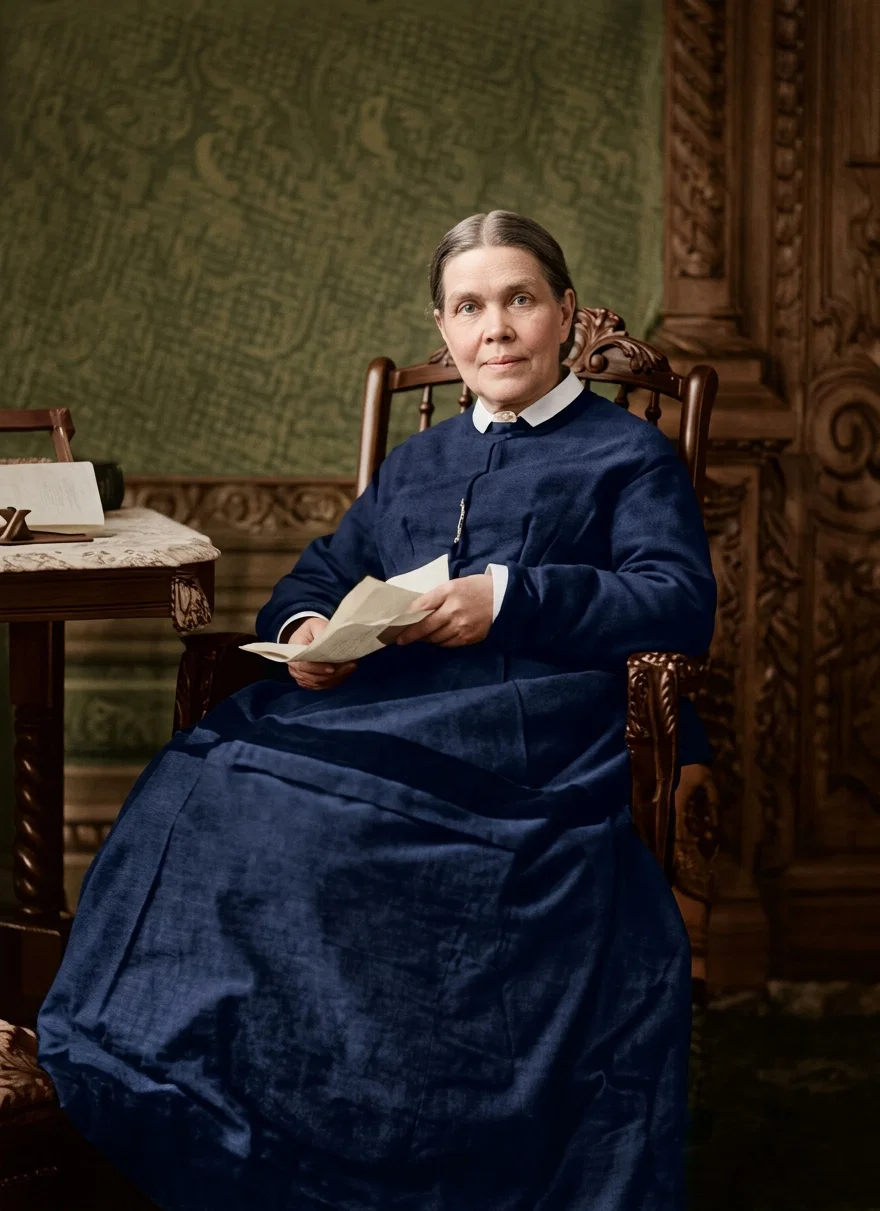
MRS. ELLEN G. WHITE, WHO DIED JULY 16, 1915
She believed in the divine inspiration of the Bible. Of this Word she was a constant student all her life; to her it was the voice of God. Modern criticism and piecemeal dissection had no place in her heart or faith. Her voice was ever uplifted to exalt her Saviour, and she proclaimed Christ as the divine Son of God, the Saviour of sinners. No one ever more firmly preached righteousness by faith than she. She exalted Christ as the sinner’s only hope. She loved this Saviour, and did what she could to bring others to a knowledge of him.
Her active work continued until near the close of her long life. The last few years were occupied largely in preparing manuscripts for publication. She felt that the people needed what God had given to her; and she diligently toiled till she was too feeble for further service. In her last weeks, when unable to write, she found great satisfaction in the realization that the people had her writings to read.
To us who remain to finish the work, much valuable instruction is left, which we need to heed carefully, and to search for light as for hidden treasure. This great advent movement cannot fail. It is founded on the Word of God. We may fail, for we are human; but our leader is Christ. He now is at the right hand of God, making intercession for all who repent and believe. As he has been with us during the early rise and progress of this work, so will he remain with us to its finish, if we seek him with all our hearts.
While we mourn the loss of one so strong and true as Sister White, still Christ lives, and in him we must unite in a renewed consecration of life and means to complete his work on earth.

Blessed Are the Dead Which Die in the Lord

“And I heard a voice from heaven saying unto me, Write, Blessed are the dead which die in the Lord from henceforth: Yea, saith the Spirit, that they may rest from their labors; and their works do follow them. And I looked, and behold a white cloud, and upon the cloud one sat like unto the Son of man, having on his head a golden crown, and in his hand a sharp sickle.” Rev. 14:13, 14.

Precious in the Sight of the Lord

“PRECIOUS in the sight of the Lord is the death of his saints.” Ps. 116: 15.

Our Refuge in Sorrow

WE are sure that the heart of every reader of the REVIEW was filled with sorrow as there was borne to him last week intelligence of the death of our dear Sister White. It will seem strange indeed no longer to receive from week to week her words of admonition and counsel through the church paper; we face the sad but cold and hard fact that death has claimed her as his own. Hers is the common lot of all mankind. None are exempt. The rich and the poor, the foolish and the wise, the righteous and the ungodly, the innocent babe, the man of mature years, the aged and infirm,—all fall a prey to death’s ruthless power. There is hardly a household in the land that his steps have not entered; but very few hearts among earth’s millions that have not felt the poignant wound which he inflicts.
Others speak in this paper of Sister White’s life work, of all that she has accomplished by God’s grace, of the nobility of her life and character; to these testimonials we can add but little. She died as she had lived,—with her faith steadfast in God, with her pathway growing brighter and brighter to the end of life’s journey, with unwavering trust in her Heavenly Father. And this indeed is the estimate of her long life.
Set as a teacher in Israel, she was true to the trust imposed upon her. With unswerving fidelity she bore her testimony as the Spirit of God directed her utterance—in reproof, in exhortation, in encouragement. As a special watchman upon Zion’s walls, as the messenger of God, she never faltered in bearing the burden which this ministry imposed. How often during her long ministry has she stood in the breach to call Israel back to their allegiance to God! How often has she rebuked sin in high places in the church! She has not betrayed her trust, but has proved loyal to the position appointed her.
With no spirit of self-assumption or egotistical arrogance has she carried forward the work God gave her to do. In her own personal life of practical godliness she has exemplified the principles which she taught to others. With reproof she ministered comfort. Affectionate as a wife, devoted as a mother, loyal as a friend, helpful and sympathetic as a sister in the church, she has stood to diffuse light and hope and gladness to the members of her own family, to the church of God, and to the world. Her own humble, God-fearing life, her simplicity of character, her dignity of womanhood, were models of Christian character.
But in saying this we would not unduly exalt the human; for our beloved sister was only human after all—a fallible mortal woman striving by God’s grace to overcome the evil tendencies which existed in her heart, and which exist in the heart of every human being. Her temptations, her fears, her personal strivings, her agonizing prayers for personal strength and overcoming grace, were known to God only. Handicapped by the frailties of human nature, hampered in her life work by the weakness of the body, by God’s grace she persevered even unto the end, developing a Christian character which under Christ is an example to the followers of the Master.
Of the great influence exerted by her words, spoken and written, we need not speak. The judgment will reveal, we believe, a wonderful fruitage of the labors of this devout servant. Though dead, she still speaks. Her works follow her. They still live to bless the church. Her stirring appeals, her exhortations, her instructions in the divine life, are still left us. To these we can still seek for the help which personally she is powerless to give. She does not need these words of commendation. She needs no praise to endear her to this people, no monument of stone to keep alive in their memory her long and useful life.
But while she was prominently connected with this movement, and while the church is so greatly indebted to the work which God did through her for its preservation and guidance, she did not form its groundwork. This movement is not dependent upon any of its human founders for continuance. God buries his workmen, but his work moves on; in it is his own enduring life.
In the wilderness wanderings of Israel, Miriam, the prophetess, was laid to rest; Aaron, the high priest, was gathered to his people; Moses, that great leader with whom God spoke face to face, was buried by angel hands. But God did not forsake his people. The pillar of cloud and the pillar of fire still led them on. In God’s providence others were raised up to take their places. Thus has God demonstrated in every age that the work of his church was not dependent upon human agencies.
One by one we have buried strong leaders in this movement. Elder James White, the apostle of God in this closing work, Elders Joseph Bates and J. N. Andrews, and other pioneers have been laid to rest. Their loss has seemed utterly irreparable. We still grieve for their memory, and honor them for the work which God wrought through their ministry. But this movement has passed from strength to strength, and thus it will continue to do until the grand consummation.
We shall miss our beloved sister, but we trust that we shall treasure even more carefully the instruction that she has given us. If we shall do this, if we shall turn to the Lord with all our hearts, realizing that our dependence is upon him, if we shall search his Word with renewed diligence, if we shall place all upon the altar of his service, God will constitute our strong rock of refuge and defense.     F. M. W.
Continue reading: The End of Satan's Work